
How much rent can I afford?
The rent that fits your budget.
What you get → rent that fits
Someone shared this page with you.
Questions and answers
Every question our 29 guides about renting answer, grouped by guide. Each answer is the guide's own and leads to it, with its sources.
Open a question to read its answer. Each group ends with the full guide, its sources and, when it has one, its calculator.
We found no questions with those words. Try another word or open a topic.
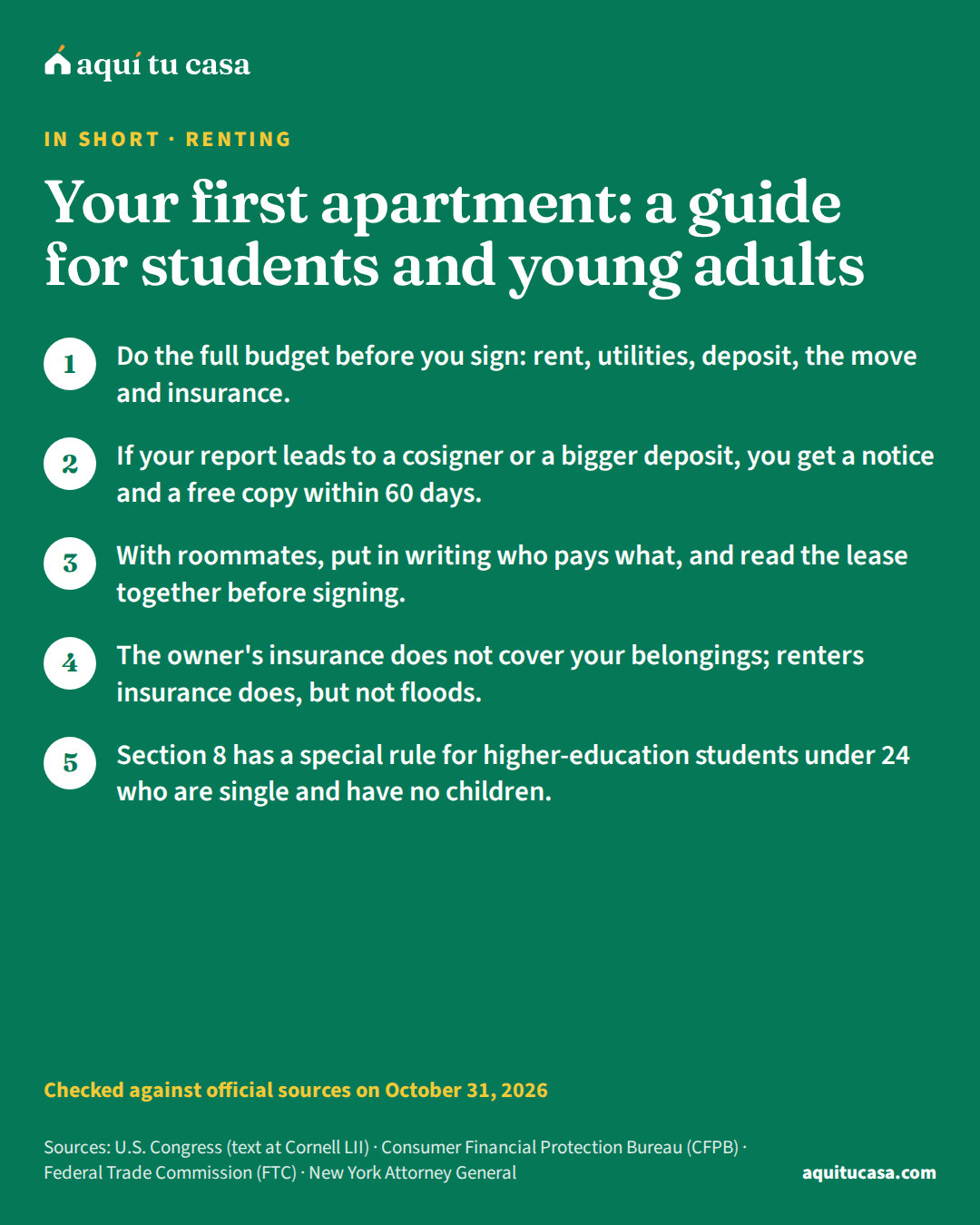
From the guide
Renting for the first time as a student or young adult: the budget, a cosigner, roommates, renters insurance and the student rules for low-cost housing.
Verified on October 31, 2026 9 official sources
Read the full guide Do the math: How much rent can I afford?
Because the landlord checks your credit, rental history and job, and at your age there is very little history. If you are asked for a cosigner because of something in your report, the FTC says it is an adverse action: you must get a notice with the report company's details, and you can ask for a free copy within 60 days.
Read the full guideYes. A cosigner pays if you do not. Before they sign, read our guide on the risks of cosigning together, which explains what they are risking, and read the full lease.
Read the full guideIt is not always required, but some landlords require it. According to the Texas Department of Insurance, the landlord's insurance does not cover your belongings; renters insurance covers your belongings, your liability if someone is hurt and extra costs if you have to move out for a while. It does not cover floods.
Read the full guideThe cost of attendance used for federal aid includes a housing allowance. For students living off campus, it is a standard allowance for rent. Ask your school's financial aid office how much it is and when the money arrives.
Read the full guideIt depends. HUD's rule gives no Section 8 assistance to a higher-education student under 24 who is not a veteran, is unmarried and has no children, unless they are individually eligible and their parents are income-eligible, among other conditions. Ask the housing authority.
Read the full guideIt depends on your lease and your state's law. In New York, for example, in buildings with four or more apartments you have the right to sublet with the landlord's advance consent, asked for in writing; in smaller buildings there is no such right. Check your lease and ask first.
Read the full guideUnder Regulation Z, before age 21 you need to show you can pay with your own income, or have a cosigner who is at least 21. A secured card or a credit-builder loan are other ways to start.
Read the full guideThe data behind these guides
The guides on Renting cite these figures. They update when their sources publish new ones; what you see here is current.
See all the dataSources: HUD (Fiscal year 2027) · U.S. Census Bureau (Average 2020–2024)
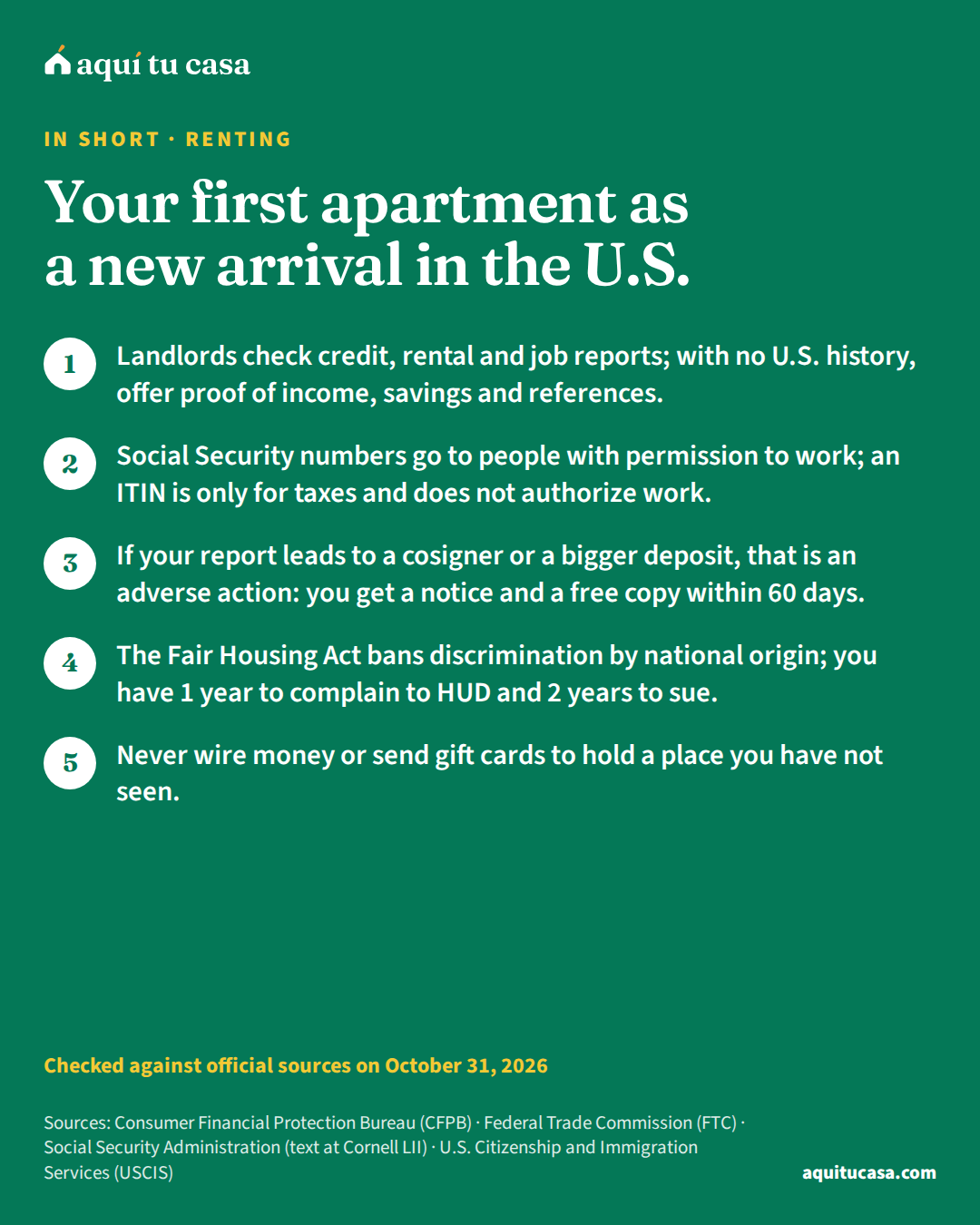
From the guide
Renting your first apartment after arriving with parole, a pending asylum case or TPS: what landlords ask for, what to offer, your rights and free help.
Verified on October 31, 2026 17 official sources
Read the full guide Do the math: How much rent can I afford?
Yes, many people do. The landlord checks your credit, rental history and job to decide. If you have no credit, offer proof of income, savings statements, job letters and references. Each landlord decides what it accepts, so ask before you pay an application fee.
Read the full guideThe law bans discrimination based on national origin. HUD says language, by itself, is not a protected trait, but it investigates when language is used as a pretext to discriminate on purpose because of where you are from. If you think it happened to you, write everything down and report it to HUD within one year.
Read the full guideMany landlords ask people with no history for one. If it is required because of something in your background report, the FTC says it is an adverse action: you must get a notice with the report company's details, and you can ask for a free copy within 60 days.
Read the full guideFederal law protects your national origin, and some states and cities also protect immigration status. Our guide on your immigration status and your landlord explains what may be asked and where to report. Do not share immigration papers you were not asked for.
Read the full guideDo not send it. The FTC says a request for a wire transfer through Western Union or MoneyGram is a scam sign, and that wiring money, gift cards or cryptocurrency are the same as sending cash. Ask to see the place and get a copy of the contract before paying, and report the scam at ReportFraud.ftc.gov.
Read the full guideFor housing problems, find free legal aid with the LSC finder or a HUD-approved housing counseling agency. For your immigration case, go only to a lawyer or an accredited representative on EOIR's official roster.
Read the full guide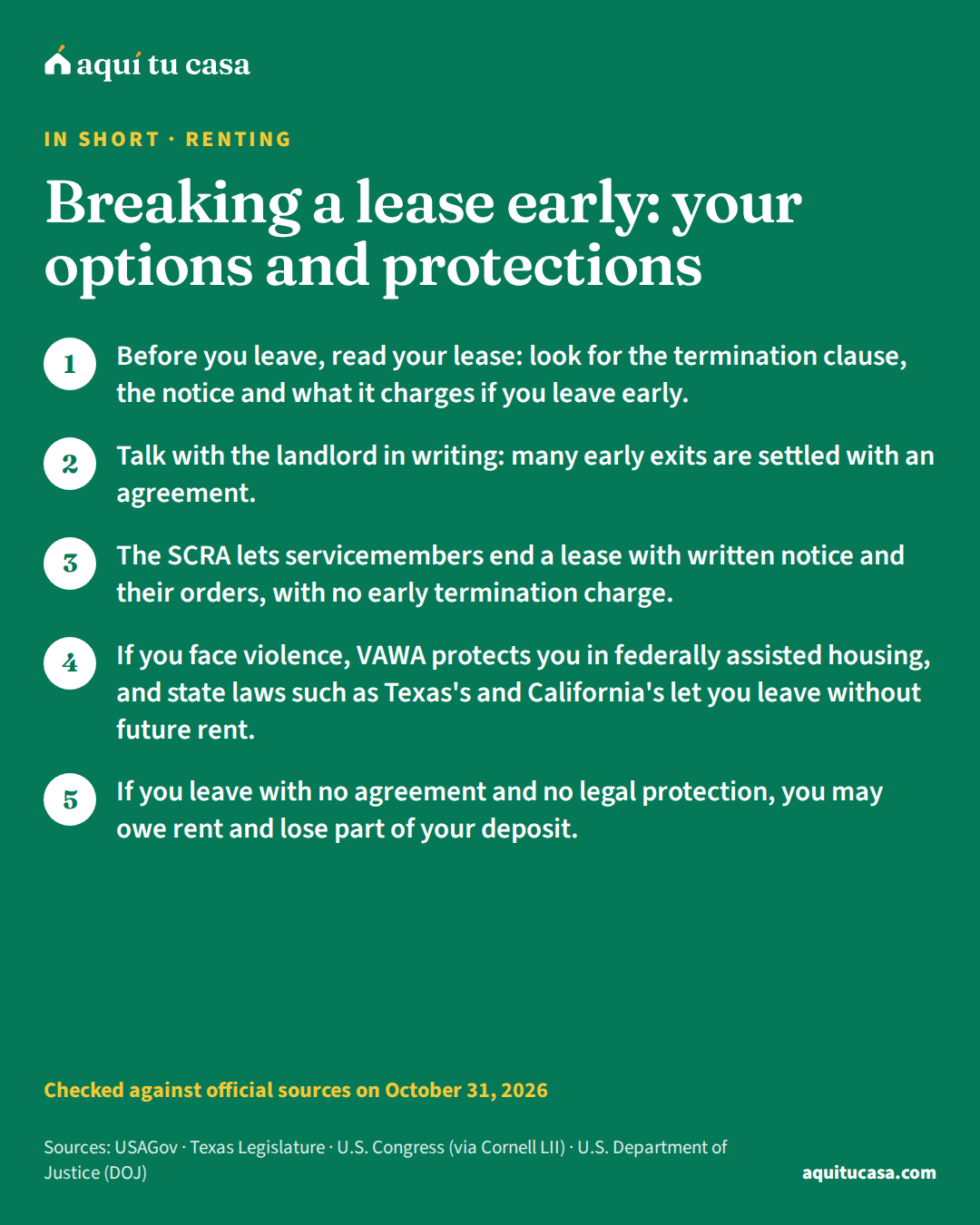
From the guide
What happens if you leave before your lease ends, how to negotiate your way out and the protections for servicemembers (SCRA) and survivors of violence.
Verified on October 31, 2026 11 official sources
It depends on your lease and your state's law. You may owe rent until the lease ends or until the home is rented again, plus charges the lease sets. In Texas, for example, the landlord has a duty to try to reduce those damages if you abandon the home.
Read the full guideUnder the SCRA, you give the landlord written notice with a copy of your orders, by hand, by courier, by mail with return receipt or electronically. If you pay monthly, termination takes effect 30 days after the next rent payment comes due.
Read the full guideNo. The SCRA says the landlord may not impose an early termination charge. You do owe prorated rent up to the effective date and what the lease provides, such as reasonable charges for excess wear.
Read the full guideOften yes, depending on your state. In Texas, with a protective order or documentation from a health care provider or victim advocate, and 30 days' written notice. In California, with written notice and documentation, you pay rent for no more than 14 days. In federally assisted housing, VAWA protects you too.
Read the full guideIn housing covered by VAWA, you can ask to be moved to another unit if you reasonably believe you face further violence if you stay. If you have a Section 8 voucher, you must be allowed to move with your assistance. The site's VAWA guide explains it step by step.
Read the full guideIt depends on your lease and your state. In Texas, for example, you may not sublet without the landlord's prior consent. Ask in writing whether they accept a new tenant or a sublet before you leave.
Read the full guideThe LSC helps you find free legal aid near you. If you are a servicemember, contact your military legal assistance office. If you face violence, the National Domestic Violence Hotline, 1-800-799-7233, connects you with local services.
Read the full guide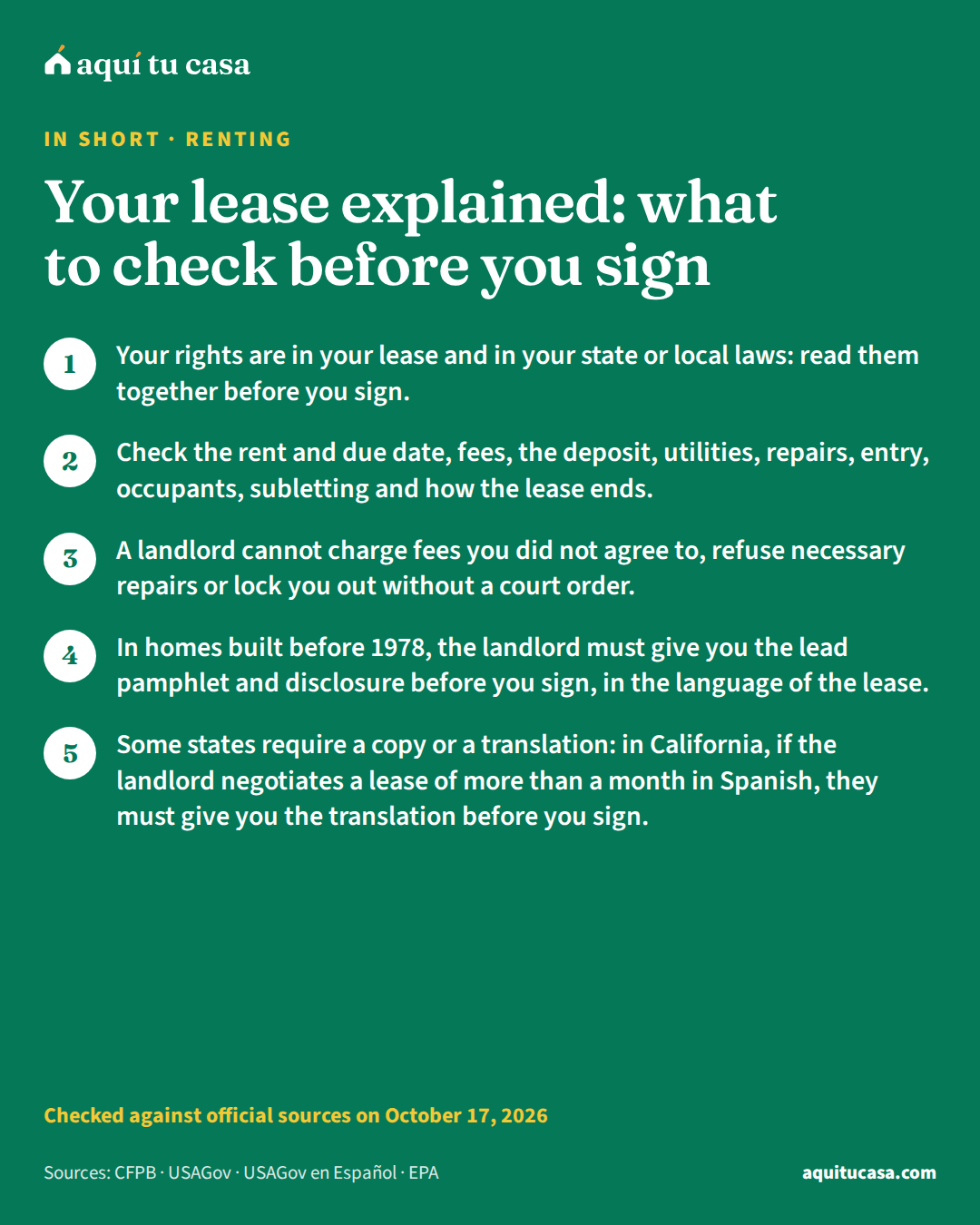
From the guide
What a lease is, which clauses to read before you sign, the lead paint disclosure, your fair housing rights and where to get free help.
Verified on October 17, 2026 14 official sources
Read the full guide Do the math: How much rent can I afford?
It depends on your state. In California, if the landlord negotiates primarily in Spanish, Chinese, Tagalog, Vietnamese or Korean, they must give you a full translation before you sign a residential lease of more than one month. Other states have different rules; where there is no rule, ask for time to read it with someone you trust. The lead attachment, when it applies, is in the language of the lease.
Read the full guideThe CFPB warns that you may face financial penalties if you move out before the end of the term. Read the early termination clause and the notice it requires; the exact rules depend on your state's law. If you received an eviction notice, that is a different situation: go to our eviction guide.
Read the full guideEntry rules depend on your lease and your state's law. In public housing, federal regulation treats a written notice stating the purpose, delivered at least two days ahead, as reasonable notice, and the agency may enter without notice when there is reasonable cause to believe there is an emergency.
Read the full guideGenerally, no. The Fair Housing Act protects familial status, which includes pregnancy and families with children. What can apply are reasonable local, state or federal limits on the maximum number of occupants of a home.
Read the full guideDo not sign with doubts. Ask the landlord in writing and take the lease to a free legal aid office or a HUD-approved housing counselor. In public housing, federal regulation bars certain clauses, such as waiving a jury trial or paying the landlord's legal costs even if you win.
Read the full guideYour lease says, within what your state's law allows. In New York, for example, a payment only counts as late if it arrives more than five days after the due date, and the maximum fee is $50 or 5% of the monthly rent, whichever is less. Look up your state's rule on its page under Places.
Read the full guideIt depends on what it says and on your state. In New York, if the lease has an automatic renewal clause, the landlord must remind you of it 15 to 30 days before the date you have to say you will not renew. And if the landlord will not renew or wants to raise the rent more than 5%, they must tell you in writing 30, 60 or 90 days ahead, depending on how long you have lived there.
Read the full guide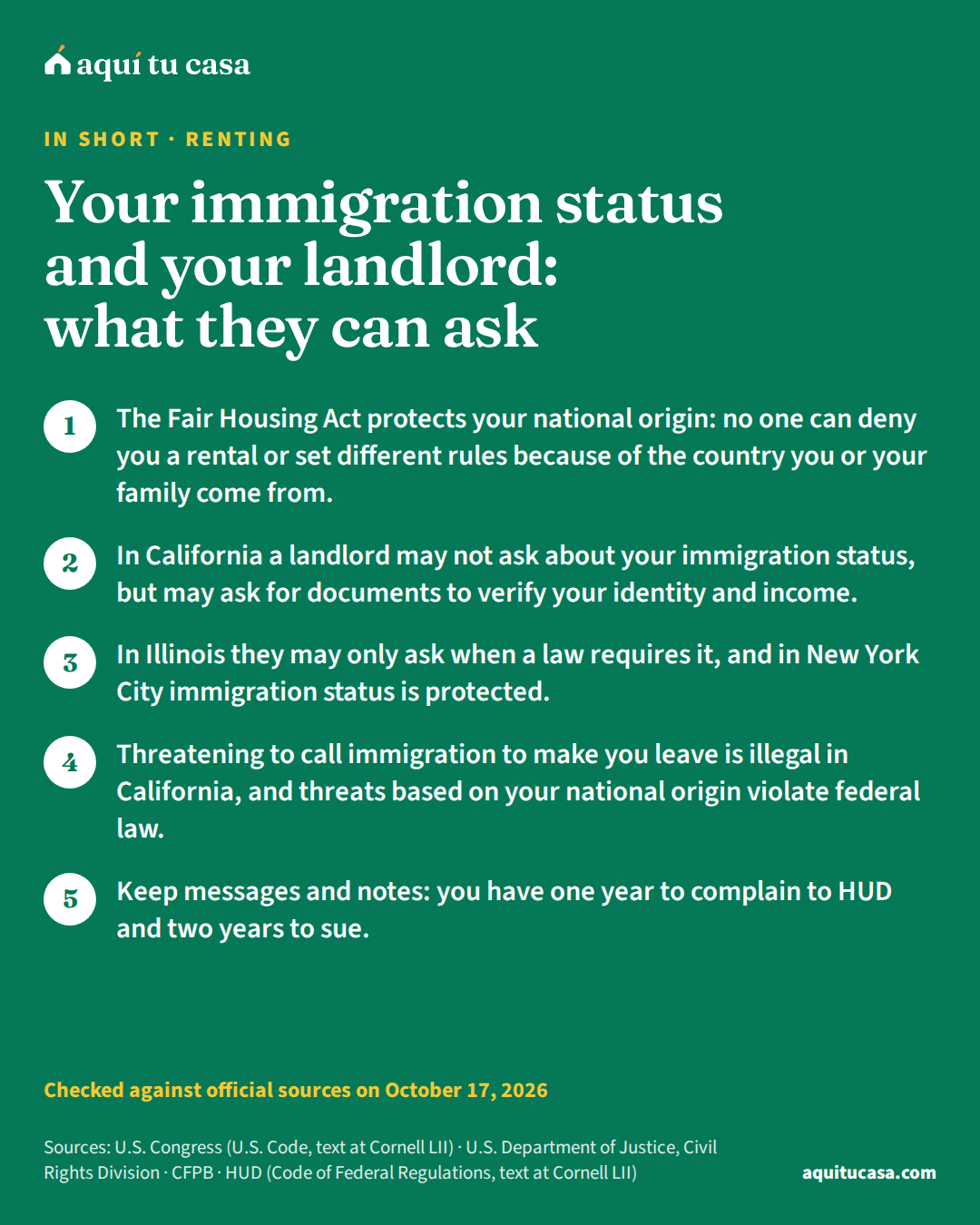
From the guide
What a landlord may ask about your immigration status, what protects you, which states ban those questions and what to do if you are threatened.
Verified on October 17, 2026 19 official sources
Read the full guide Do the math: How much rent can I afford?
It depends on the state. In California, the law prohibits asking about your immigration status or requiring you to disclose it, except to comply with federal law, as in federal rental assistance programs. In Illinois a landlord may only ask when state or federal law requires it and must ask everyone the same questions. Rules vary in other states, but everywhere a landlord may not discriminate against you because of your national origin.
Read the full guideSave the message or write down the date, time and exact words. In California, threatening to disclose your status to make you leave, or reporting you to immigration in retaliation, is illegal. Federal law prohibits threatening or intimidating you because of your national origin. You can get free legal help and, if you wish, file a complaint.
Read the full guideNo one can force you out by changing the locks without a court order. In California, the law prohibits evicting someone because of their immigration or citizenship status, except to comply with a federal rental assistance program, and the tenant can raise it as a defense in court.
Read the full guideIn Illinois, the Department of Human Rights says you do not need to be a permanent resident or citizen to report, that it provides an interpreter and that it charges nothing. Federal law gives you one year to complain to HUD. If you are worried about sharing your information, you can talk to legal aid or an accredited representative first.
Read the full guideThose federal programs do verify the status of the people who receive assistance, and California and Illinois law allow questions needed to comply with federal law. The Section 8 and mixed-status families guide explains how it works.
Read the full guideFor a complaint to HUD, one year from when the discrimination happened or ended. For a lawsuit in federal or state court, two years. Your state agency's deadlines may differ.
Read the full guide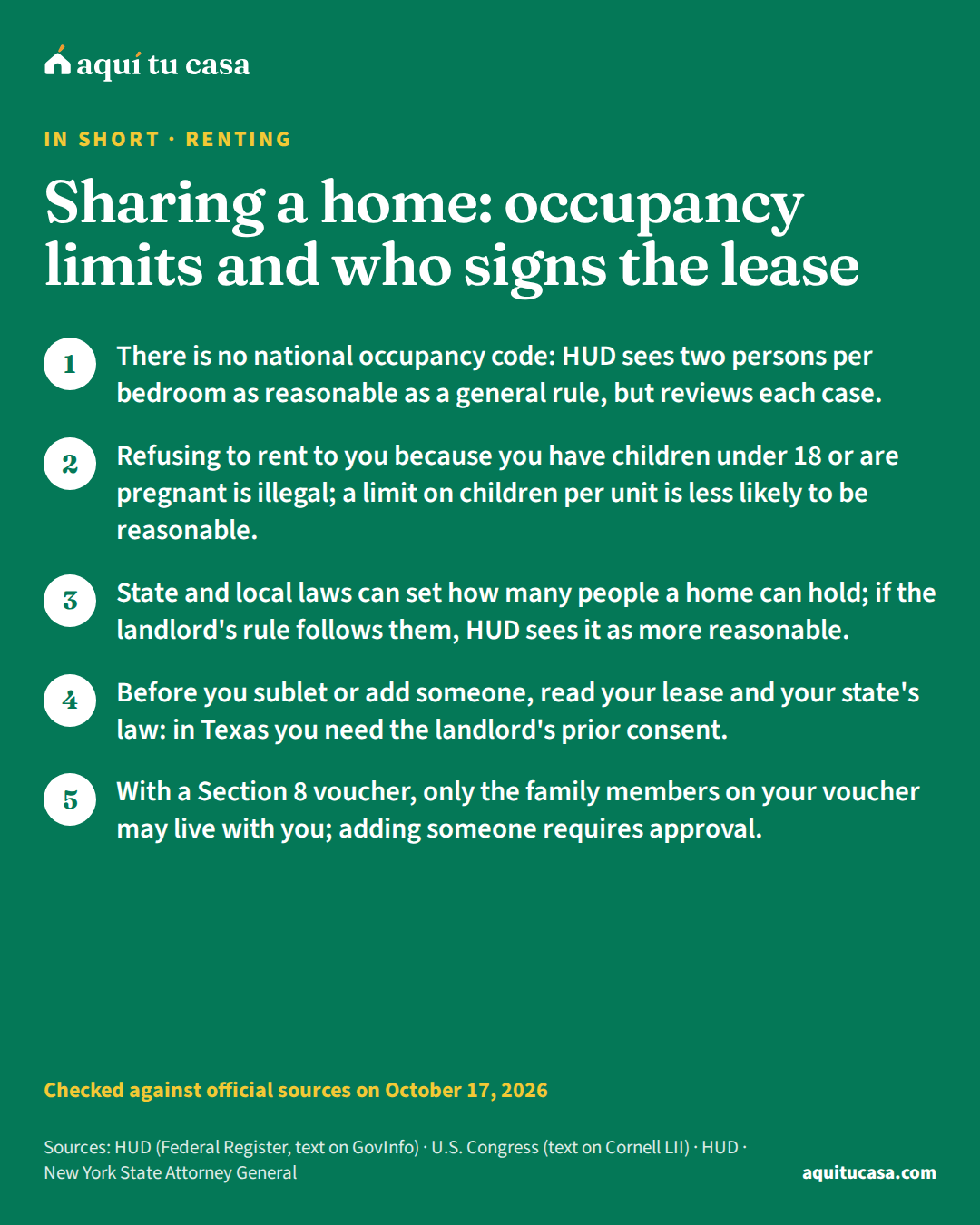
From the guide
How many people can live in a home, when an occupancy limit discriminates against families with children, and what to know before subletting.
Verified on October 17, 2026 10 official sources
Read the full guide Do the math: How much rent can I afford?
There is no fixed national number. HUD says a policy of two persons per bedroom is reasonable as a general rule, but it depends on the size of the bedrooms and the unit, the children's ages, the layout and your state's or city's occupancy laws.
Read the full guideThe Fair Housing Act bars refusing to rent to you because of familial status: having children under 18, being pregnant or being in the process of getting custody of a child. There are exceptions, such as certain housing for older persons and rooms in small buildings where the owner lives, although discriminatory ads are not allowed there either.
Read the full guideUnder HUD's policy, a rule limiting the number of children per unit is less likely to be reasonable than one limiting the total number of people. If it happened to you, keep evidence and consider reporting it to HUD.
Read the full guideIt depends on your lease and your state's law. In Texas, during the lease you may not rent the home to someone else without the landlord's prior consent. In New York, tenants in buildings with four or more apartments have the right to sublet with the landlord's advance consent, following written steps.
Read the full guideRead your lease first. In New York, a sole tenant may share with immediate family, one additional occupant and that occupant's dependent children, and must tell the landlord the occupant's name. With a housing voucher, you need the housing agency's approval to add someone, except for a birth, adoption or custody.
Read the full guideIn New York, if the named tenant moves out, the remaining occupant has no right to stay without the landlord's express consent. That is why every adult moving in should know who is on the lease.
Read the full guideYou can report it to HUD online or at 1-800-669-9777. The law gives you one year from when it happened to file, and HUD asks you to do it as soon as possible. Free legal aid can advise you about your case.
Read the full guide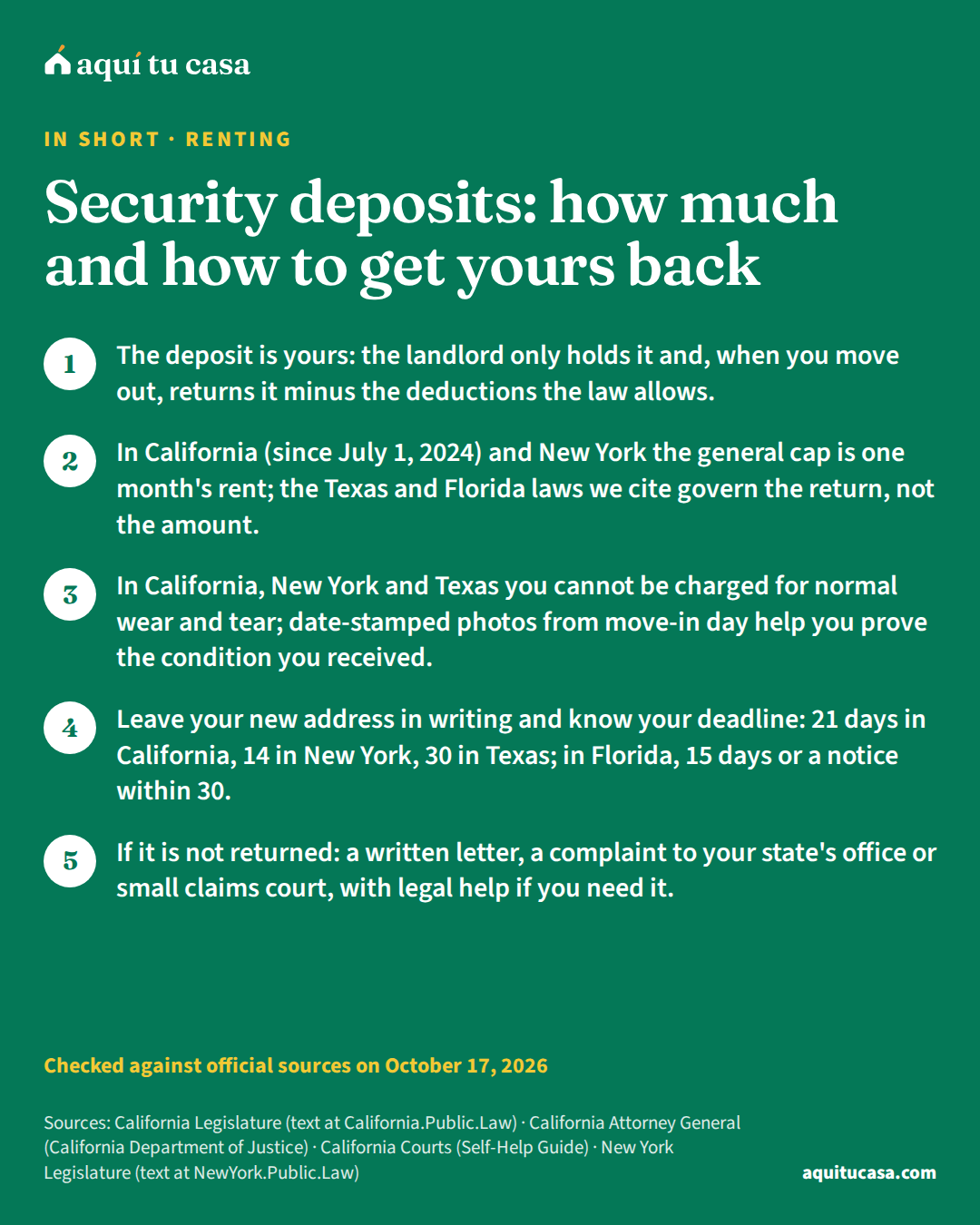
From the guide
What a security deposit is, how much a landlord may charge in your state, what can be deducted, when it must be returned and where to complain if it isn't.
Verified on October 17, 2026 16 official sources
Read the full guide Do the math: How much rent can I afford?
In New York, no: the state Attorney General explains that the one-month limit means a landlord cannot ask for last month's rent and a security deposit. Elsewhere it depends on state law; check your state's page under Places.
Read the full guideIn Texas the law prohibits it: if you withhold the last month's rent on the grounds that the deposit covers it, you are presumed to have acted in bad faith and could owe the landlord three times that rent plus the landlord's attorney's fees. In other states, check your lease and your state's law first.
Read the full guideIn Texas, the landlord does not have to refund the deposit or send the list of deductions until you give your forwarding address in writing, although you do not lose your right to the deposit. In Florida, the disclosure you get at signing says you must give your new address when you move out. Always put it in writing and keep a copy.
Read the full guideYou can start on your own: a letter asking for the deposit, a complaint to your state's office and, if needed, small claims court. If you want guidance, a legal aid organization or a HUD-approved housing counselor (often free or low cost) can look at your situation.
Read the full guideIt depends on the state: 21 days in California, 14 in New York and 30 in Texas, with the itemized list of deductions. In Florida it is 15 days if nothing is deducted, or written notice within 30 days to deduct. The table in this guide and your state's page under Places have the deadline for more states.
Read the full guideNot for the normal wear and tear of living there. The Texas Attorney General explains it with a carpet: if it wore down because people walked on it for a year, you cannot be charged for a new one; if it got mildewed because your water bed leaked, you can. In California, New York and Texas the landlord cannot deduct normal wear and tear.
Read the full guideIt depends on where you live. In New York, in buildings with six or more apartments, the deposit goes into an account that earns interest, and almost all of the interest is yours. In Florida, a landlord who rents five or more units must tell you in writing where the deposit is held and whether you are entitled to interest. In California, some cities require interest.
Read the full guideThere may be. The CFPB explains that some local rental assistance programs help with moving costs, the deposit and application fees for a new home; many have closed, but some money may still be available. Look for your area's programs among your state's assistance programs or ask a HUD-approved housing counselor.
Read the full guide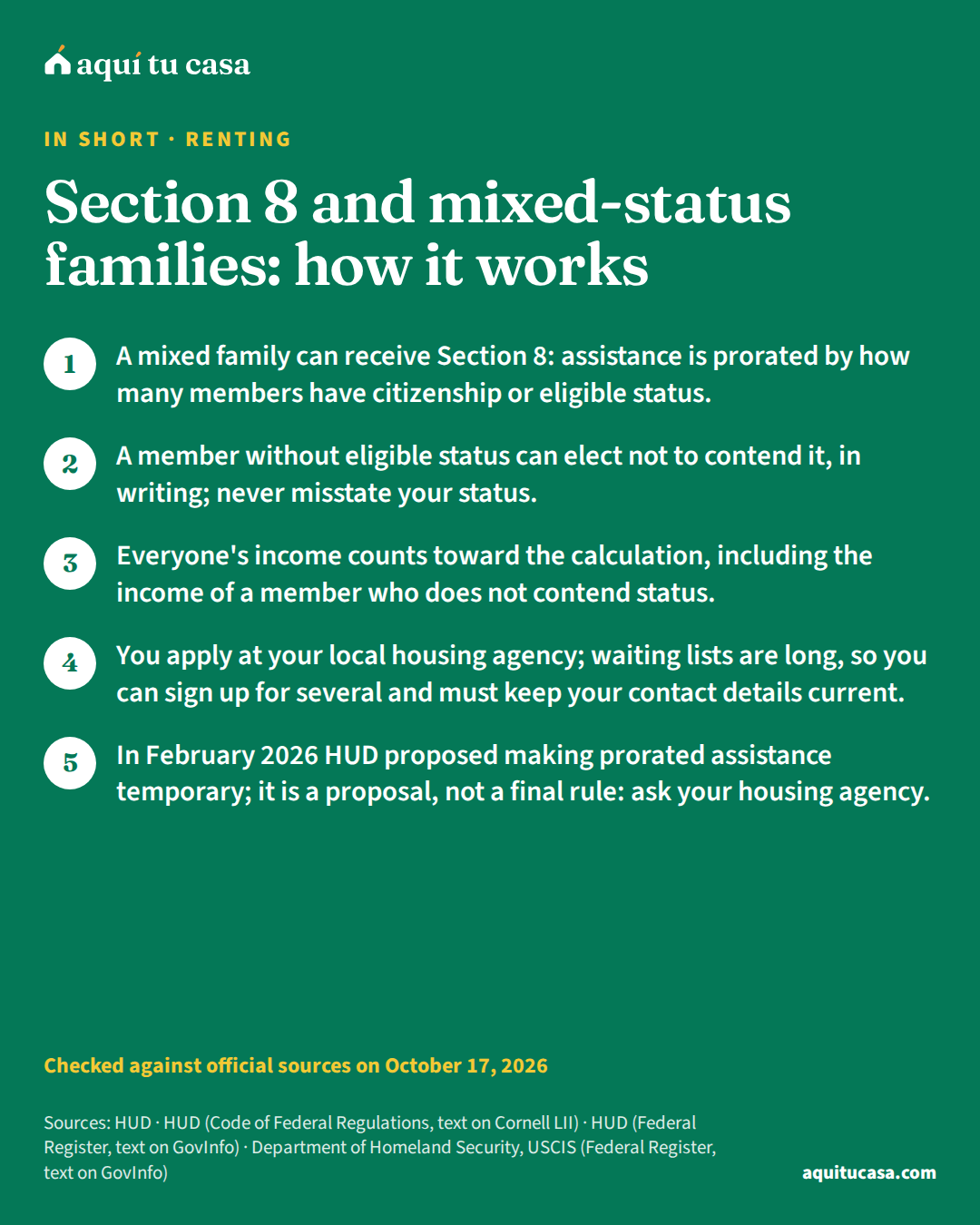
From the guide
How the Section 8 voucher works, how aid is prorated in a mixed-status family, how to apply through your housing agency and what HUD proposed.
Verified on October 17, 2026 17 official sources
Read the full guide Do the math: How much rent can I afford?
Yes, if at least one member has citizenship or eligible immigration status. HUD's regulations call this a 'mixed family' and say it can receive prorated assistance; the housing agency must offer it to eligible families.
Read the full guideThe agency first calculates the full assistance using the income of all members, including anyone without eligible status. It then multiplies it by the number of members with eligible status and divides by the total number of members. The family pays the part of the rent that assistance does not cover.
Read the full guideUnder the current regulations, a member can elect not to contend eligible status and then submits no immigration documents; the family must state in writing who elects not to contend. Misstating your status can require you to repay the assistance and lead to criminal prosecution.
Read the full guideAt your local public housing agency. If you are eligible, you usually go on a waiting list, which can be long; HUD suggests applying to several. Once you are selected and get the voucher, you have 60 to 120 days to find a home, depending on the agency.
Read the full guideIt depends on who is applying for a visa or green card and on their case. DHS says it may consider means-tested housing assistance received by a person subject to public charge, but that it generally does not consider benefits received by family members. Read the public charge guide and talk to an accredited representative.
Read the full guideIn February 2026 HUD published a proposal that would make prorated assistance temporary and require proof of status from everyone regardless of age. A proposal is not a final rule. Ask your housing agency whether anything has changed and get legal advice if you receive a notice.
Read the full guideTools
The calculators these guides use. Each one leaves you with a result you can use today.
The rent that fits your budget.
What you get → rent that fits
The steps and periods of an eviction in your state.
What you get → steps and days
What your state's law says about the deposit, notices and repairs.
What you get → your state's rule, with its citation
Everything you pay before you get the keys.
What you get → move-in cash
From the guide
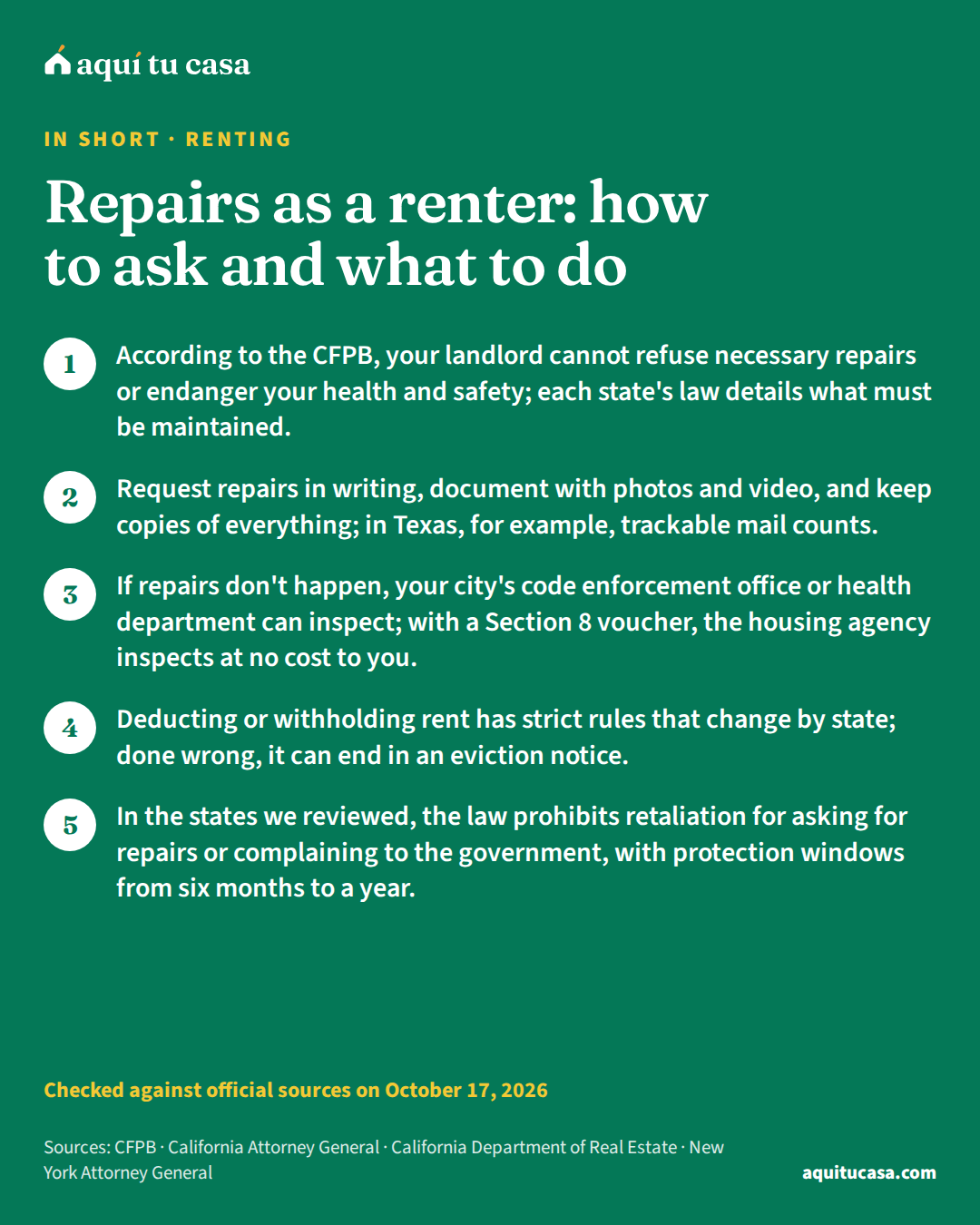
Which repairs fall on the landlord, how to request them in writing, when to call your city's code inspectors and the risks of withholding rent.
Verified on October 17, 2026 16 official sources
Read the full guide Do the math: Eviction timelines by state
It depends on your state, but the laws we reviewed all ask, in different words, for a home that is safe and fit to live in. In California that includes working plumbing, heat, electricity, safe floors and stairs, a roof and walls that keep water out, working locks and no roaches or rats. Damage you cause may be your responsibility.
Read the full guideIt is the safest way. The California Attorney General recommends making requests in writing and keeping a copy. North Carolina's law requires written notice except in emergencies, and in Texas a second written notice or a trackable mailing is what makes the landlord liable. A text message or email also leaves a record.
Read the full guideEach state sets it. In Texas the law presumes seven days is a reasonable time; in Florida and Arizona there are 7- and 10-day periods after written notice for certain remedies. With a Section 8 voucher, if the housing agency confirms a life-threatening deficiency, the owner has 24 hours; otherwise, 30 days.
Read the full guideIn some states, with limits and strict steps. In California the repair can't cost more than one month's rent or be used more than twice in 12 months; in Texas the deduction can't exceed one month's rent or $500, whichever is greater; in Arizona you must use a licensed contractor. Done wrong, the landlord can sue you or serve a notice to pay or quit.
Read the full guideIt's risky. In New York the Attorney General explains you can withhold rent, but the landlord can sue you for nonpayment. In Florida, if you raise any defense other than payment in an eviction, you must deposit the rent with the court. Talk to legal aid first.
Read the full guideSeveral states prohibit it as retaliation. In Texas the landlord cannot evict you in retaliation within six months after you request a repair; in New York, if you are sued within a year of your complaint, the landlord must show it isn't retaliation. But in Texas, as in Arizona and North Carolina, an eviction for unpaid rent does not count as retaliation.
Read the full guideThe California Attorney General says to contact your local code enforcement office or health department. If you have a voucher or live in public housing, HUD says to contact your housing agency; in HUD-assisted buildings, its Multifamily Housing Complaint Line at (800) 685-8470.
Read the full guide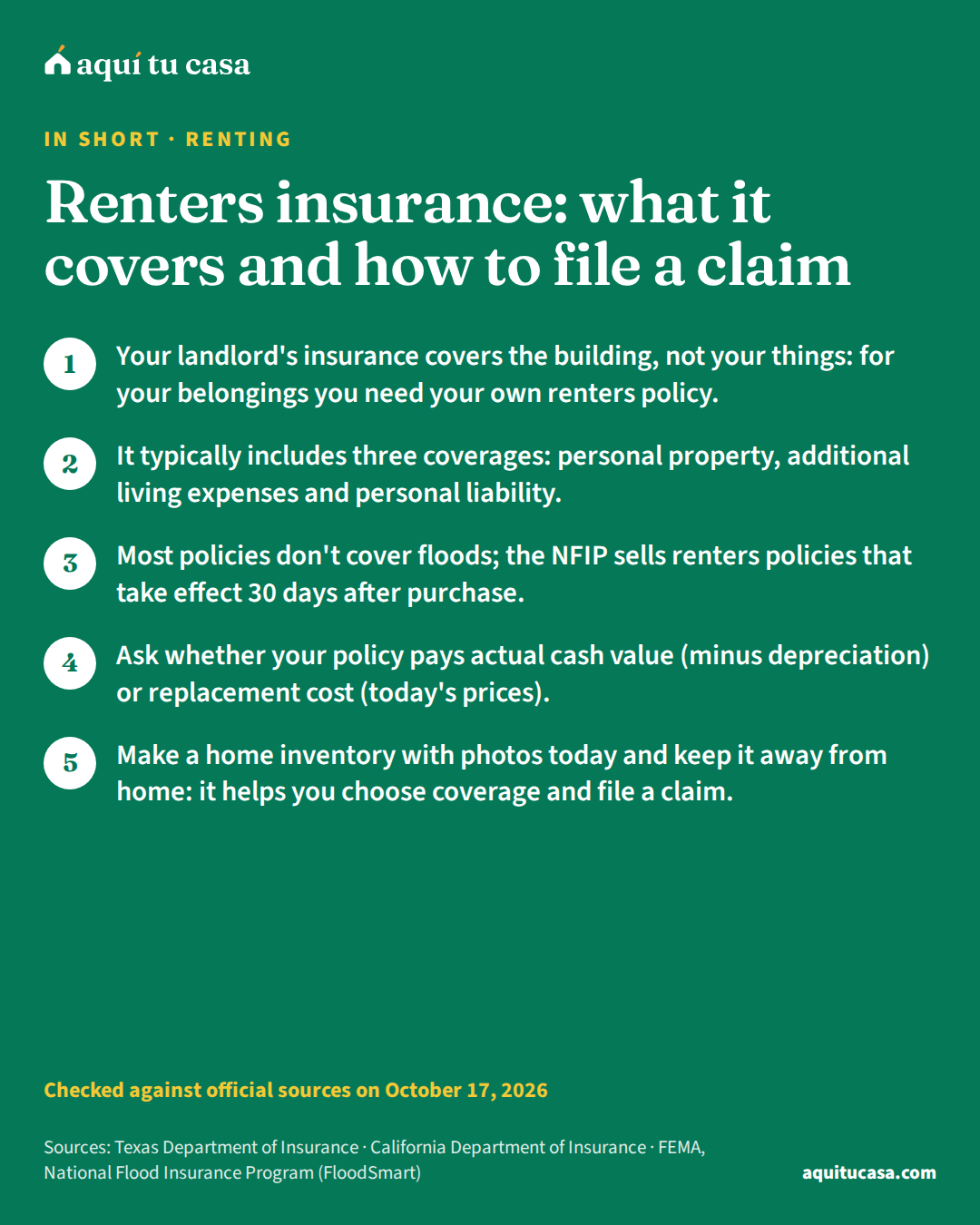
From the guide
What renters insurance covers, why it leaves out floods, actual cash value vs. replacement cost, liability coverage and how to file a claim.
Verified on October 17, 2026 7 official sources
Read the full guide Do the math: How much rent can I afford?
According to the Texas Department of Insurance, it typically covers your personal property (even items stolen from your car or while traveling), extra living costs if a covered loss forces you out for a while, and liability if someone is hurt in your home. It covers losses from fire, smoke, theft or vandalism and certain water damage.
Read the full guideNo. The Texas and California insurance departments both say your landlord's insurance does not cover your personal property. The landlord's policy pays to fix the building; your renters policy pays for your things.
Read the full guideNot by law, according to the Texas Department of Insurance, but some landlords require it. If your lease requires it, read that part before you sign so you know what is being asked of you.
Read the full guideUsually not. For that there is the National Flood Insurance Program (NFIP) renters policy, which covers your belongings up to $100,000. It takes effect 30 days after purchase, with some exceptions, and you can buy it if your community participates in the NFIP.
Read the full guideReplacement cost pays to replace your belongings at today's prices. Actual cash value pays that cost minus depreciation, the value an item loses with wear and age. A policy that pays replacement value costs more, according to the Texas Department of Insurance.
Read the full guideIn California, personal property coverage protects your belongings and those of family members who live with you. If you share with people who are not family, ask the agent whether their things are covered or whether each person needs a policy.
Read the full guideThe liability part of your policy protects you if you are legally responsible and pays legal costs if you are sued. Medical payments coverage pays reasonable medical bills for guests hurt by accident, but not your own injuries or those of people who live with you.
Read the full guideFirst tell the company why you disagree. In Texas you can ask for an appraisal if the dispute is about the amount, file a written complaint with the Department of Insurance (800-252-3439) or go to court. In other states, call your state insurance department.
Read the full guide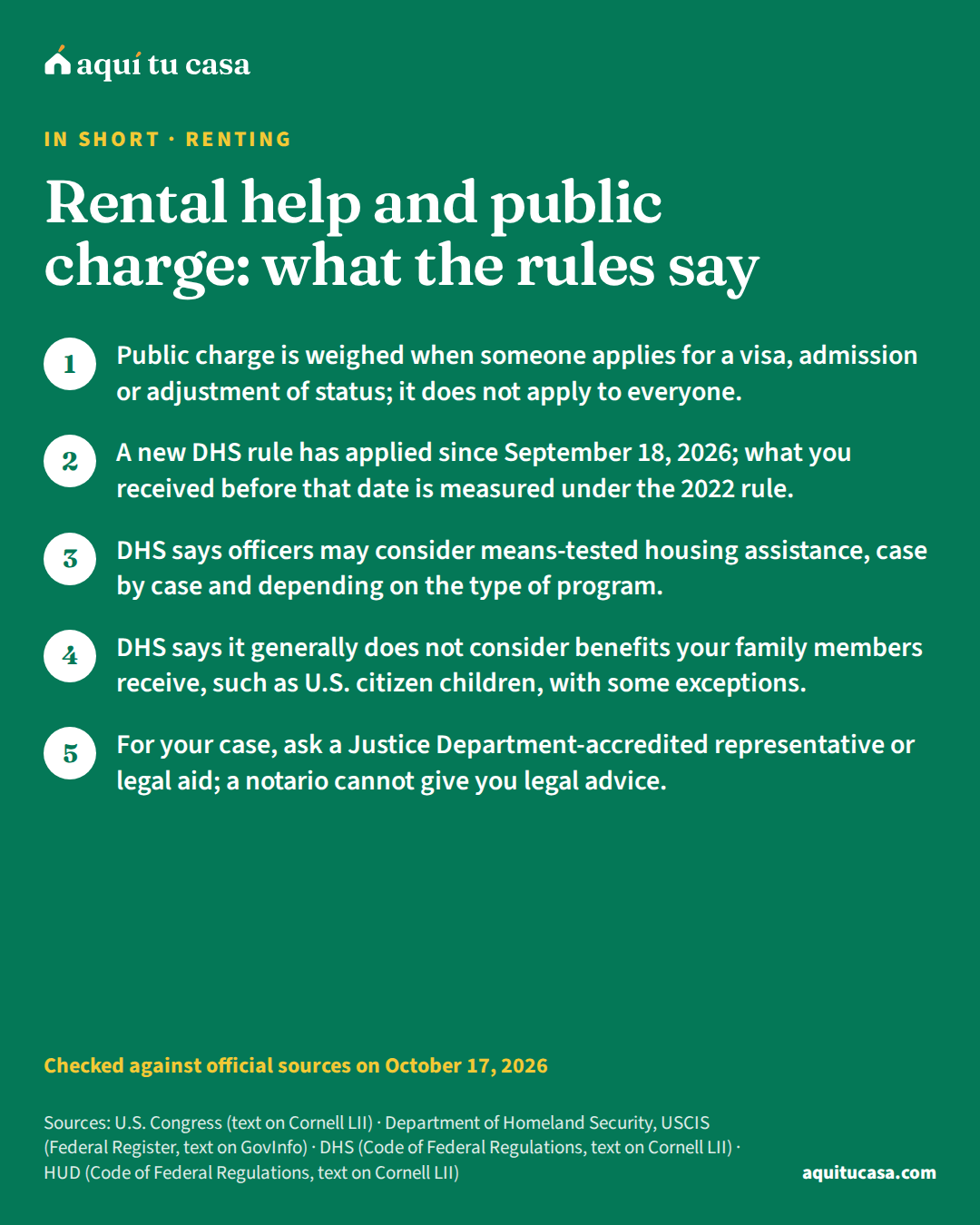
From the guide
What public charge is, what changed in September 2026, whether housing help counts, and where to find rent help and free advice.
Verified on October 17, 2026 14 official sources
Read the full guide Do the math: How much rent can I afford?
It is a rule in immigration law. When someone applies for a visa, admission or adjustment of status, the government weighs whether they are likely to become dependent on the government, considering at a minimum their age, health, family status, assets and resources, and education and skills.
Read the full guideWe cannot say for your case. According to DHS, since September 18, 2026 its officers may consider means-tested housing assistance received by the person applying for a visa or green card, deciding case by case. Help received before that date is measured under the 2022 rule. An accredited representative can review your situation.
Read the full guideDHS says it generally does not consider benefits received by your family members, such as U.S. citizen children. There are exceptions: if you are legally obligated to support them and they receive help because your income is below a threshold, or if you live off that help.
Read the full guideNo. The law says it does not apply, for example, to people adjusting status as refugees or asylees, people seeking T or U visas, or VAWA self-petitioners. If you don't know whether it applies to you, ask an accredited representative.
Read the full guideDHS rescinded it with a final rule published on July 20, 2026, which took effect on September 18, 2026. The 2022 rule only counted cash assistance and long-term institutional care. Benefits you received before September 18, 2026 are still measured under the 2022 rule.
Read the full guideNo. DHS says the rule does not regulate who can receive benefits or prohibit immigrants from receiving benefits they qualify for. But if you are subject to public charge, officers may consider certain benefits in your case.
Read the full guideFrom a Justice Department-accredited representative, who works at a recognized non-profit organization; the list is on EOIR's website. Free legal aid is another option. A notario or consultant cannot give you legal advice.
Read the full guide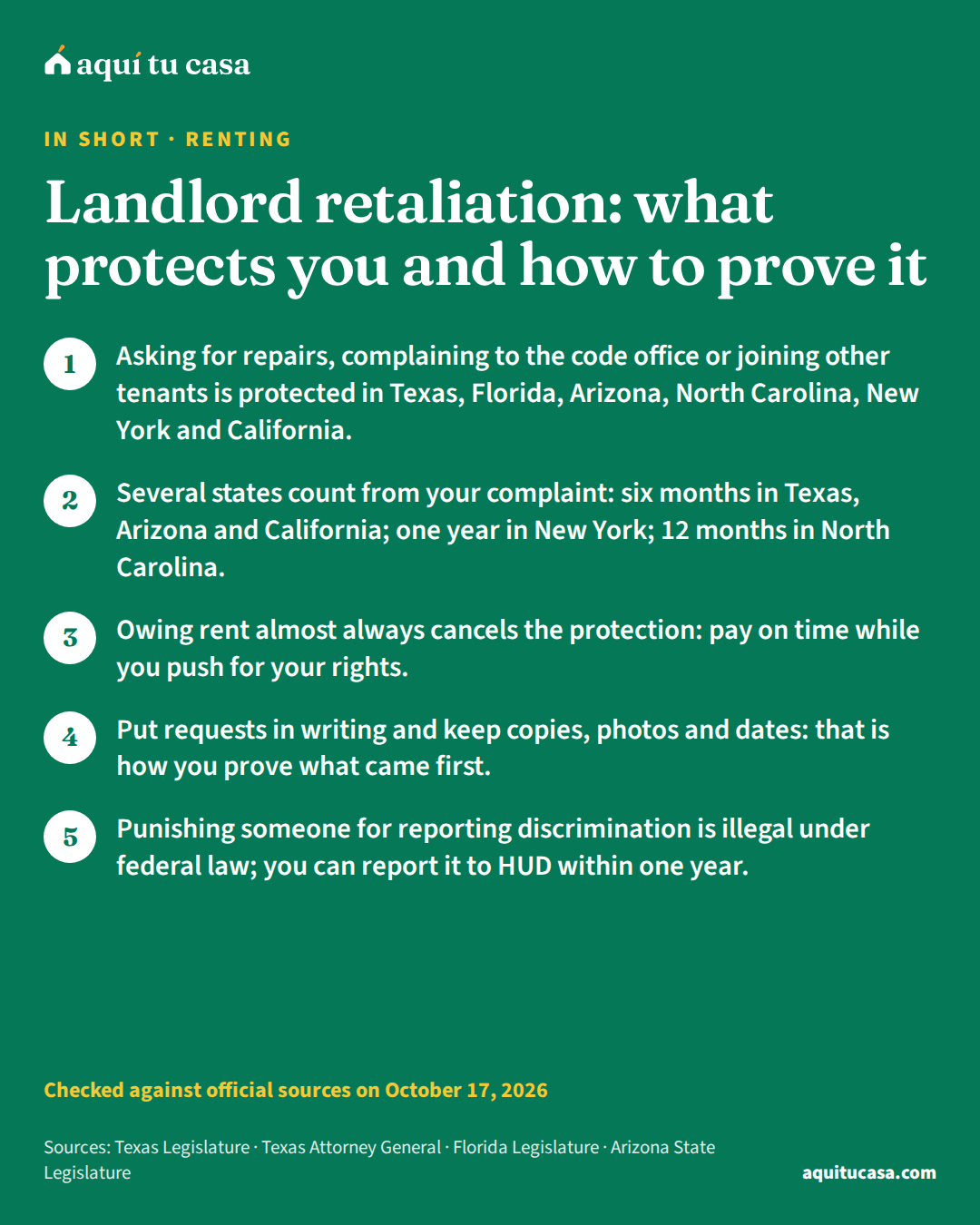
From the guide
If your rent went up, a service was cut or your landlord wants you out because you complained: what state laws say and how to keep proof.
Verified on October 17, 2026 17 official sources
Read the full guide Do the math: Eviction timelines by state
In several states, not as punishment. In Texas, a landlord may not raise your rent in retaliation for six months after your repair request; in Florida and Arizona the law prohibits raising rent to get back at you for a complaint. In Texas, an increase under a written lease clause, or one applied to the whole complex, may not count as retaliation.
Read the full guideIt depends on the state. Texas protects you for six months; in Arizona and California, a complaint in the previous six months creates a presumption of retaliation; in New York the window is one year; in North Carolina the defense covers what you did in the 12 months before the lawsuit. In another state, ask legal aid.
Read the full guideAlmost never. Texas, Arizona, North Carolina and Florida say an eviction for unpaid rent is not retaliation, and in California the defense requires that your rent be current. That is why it makes sense to keep paying while you push for your rights, unless legal aid tells you otherwise.
Read the full guideIn Texas, terminating your lease is one of the retaliatory acts barred for six months. In New York, refusing to renew within a year of your complaint creates a presumption of retaliation. In North Carolina, though, if your lease was for a fixed term with no option to renew and you stay after it ends, the landlord can win the eviction.
Read the full guideCalifornia's official tenant guide mentions photos or video of the defects, witnesses, copies of your letters to the landlord and a report from a health or building inspector. The Texas Attorney General says to send dated letters by certified mail, return receipt requested, and keep a copy. Also write down the date of every notice or rent increase.
Read the full guideIn California, the Attorney General says a landlord may never threaten to disclose your immigration status to pressure you to leave, or disclose it to law enforcement as retaliation. In other states the rules differ: talk to a free legal aid office or a DOJ-accredited representative before you decide.
Read the full guideYes, when the retaliation is for reporting discrimination or helping someone report it: HUD says that is illegal and you can report it as housing discrimination. The law gives you one year from when it happened to file. You can file online, by mail or at 1-800-669-9777.
Read the full guideIt depends on the state. In North Carolina, the judge must deny the eviction. In Texas you can recover one month's rent plus $500, your damages and attorney's fees, minus what you owe; in Arizona, up to two months' rent or twice your damages; in California, up to $2,000 for each act, on top of damages.
Read the full guide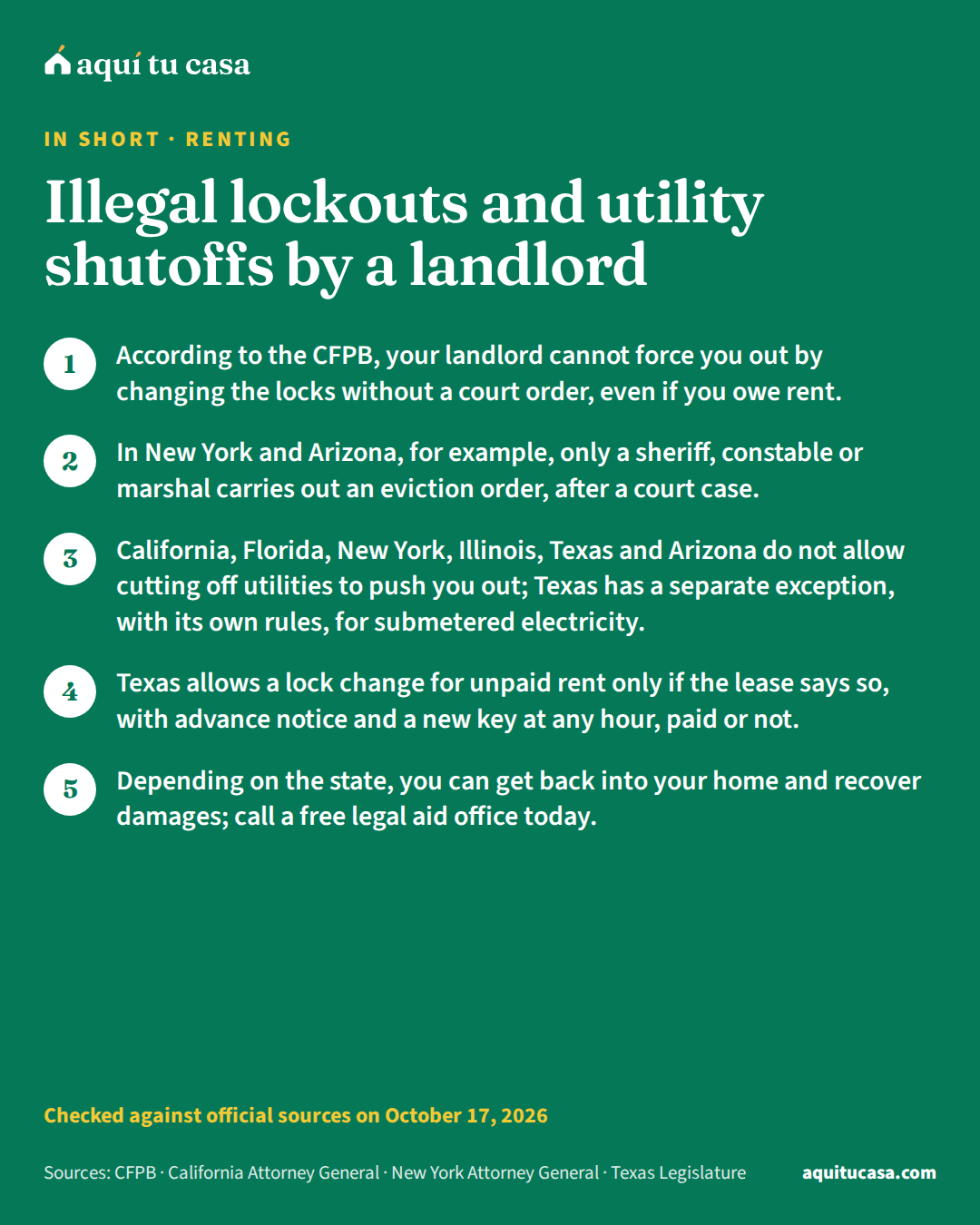
From the guide
If your landlord changed the locks, removed your things or cut off water or power to make you leave: what several states' laws say and what to do today.
Verified on October 17, 2026 15 official sources
Read the full guide Do the math: Eviction timelines by state
According to the CFPB, your landlord cannot force you out by changing the locks without a court order. California, Florida, New York, Arizona, North Carolina and Illinois require the court process. Texas allows a lock change for unpaid rent only if the lease says so and with advance notice, and even then the landlord must give you the new key at any hour, whether you pay or not.
Read the full guideNot in the states in this guide. California treats it as an illegal eviction; Florida prohibits causing the shutoff of any utility, whether or not it is in the landlord's name; New York prohibits willfully cutting essential services such as water or heat; Texas and Arizona allow it only for repairs or emergencies, with their own exceptions.
Read the full guideIt depends on the state. The Arizona courts say a tenant can call the police if the landlord changes the locks or enters before the court's writ is served. In other states, ask legal aid; in Texas, for example, the path is asking the justice court for a writ of reentry.
Read the full guideIt is an order available in Texas. The tenant files a sworn complaint about the illegal lockout with the justice court in their precinct, and if the judge believes it likely happened, the judge can issue the writ, which gives the tenant immediate and temporary possession until the hearing.
Read the full guideIt depends on the state. In Florida, your damages or 3 months' rent, whichever is greater, plus costs and fees; in Texas, a penalty of one month's rent plus $1,000, on top of your damages; in Arizona, up to two months' rent or twice your damages; in New York, up to triple damages. A legal aid office can tell you what applies.
Read the full guideIn the states we reviewed, eviction goes through a court order. In New York, the order is carried out by a sheriff, marshal or constable; in Arizona, by a constable or the sheriff. Your landlord cannot do it alone.
Read the full guideIf the account is in your name and the utility cut service for nonpayment, that is not a landlord lockout. The CFPB says LIHEAP helps with utility bills year-round; the national referral line is (866) 674-6327.
Read the full guide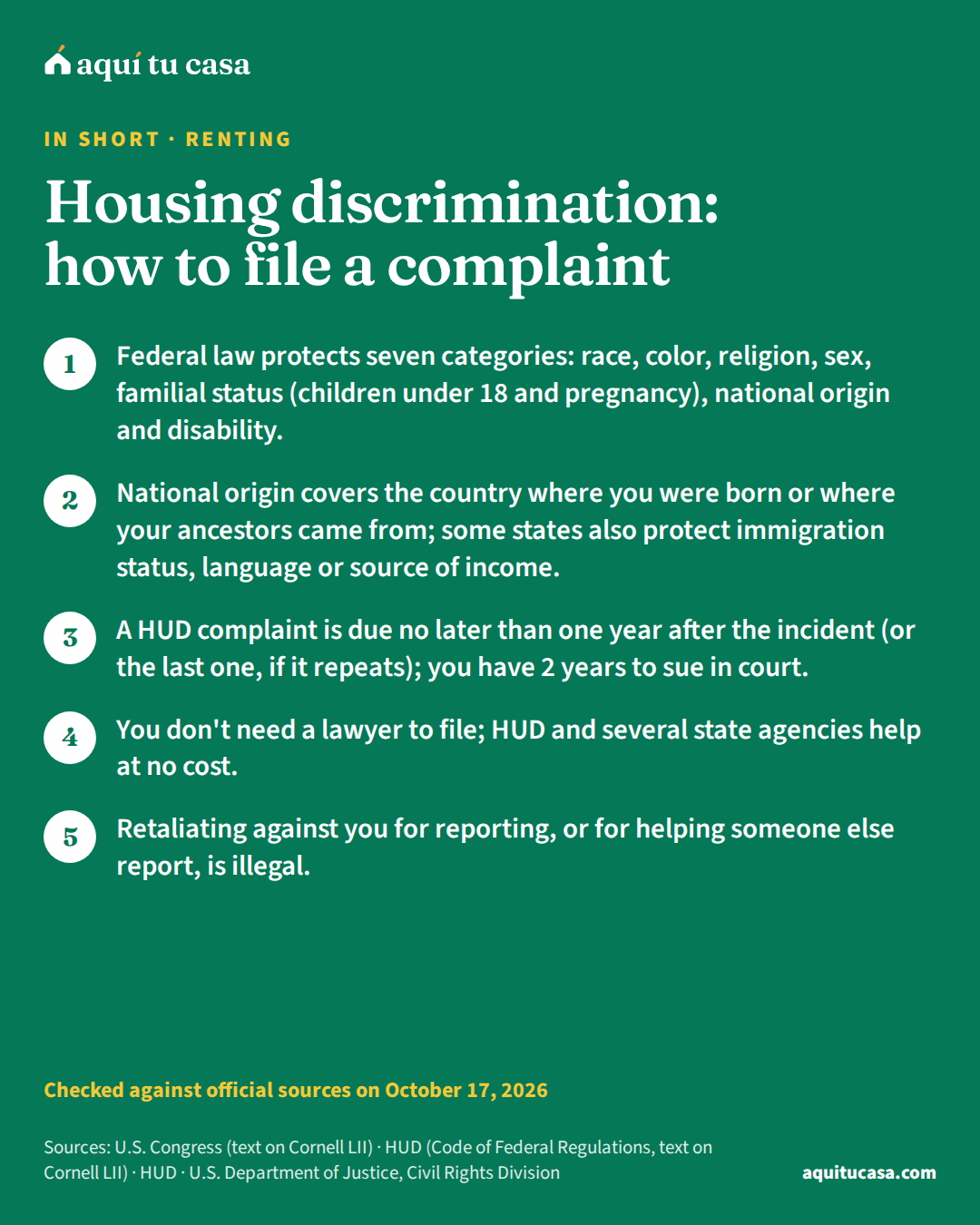
From the guide
What the Fair Housing Act prohibits when you rent, how national origin and children are covered, and how to file with HUD or your state on time.
Verified on October 17, 2026 23 official sources
Read the full guide Do the math: Eviction timelines by state
Generally, no. The Fair Housing Act protects familial status: households with children under 18 and people who are pregnant. The Justice Department explains that landlords also cannot impose special conditions on families with children, such as an unreasonable limit on the number of occupants. There is an exception for certain housing for people 55 and older.
Read the full guideThe federal list protects national origin, which can be based on the country where you were born or where your ancestors came from. Some states go further: California also protects primary language. If you believe you were treated differently because of your origin, describe everything in your complaint; the agency decides.
Read the full guideThe Fair Housing Act does not include immigration status in its list, but some states do limit it. In California, in most cases landlords may not ask; in Illinois, only when state or federal law requires it; in New York City, immigration status is protected against discrimination. If your immigration case worries you, talk with an accredited representative or legal aid.
Read the full guideWith HUD, no later than one year after the discrimination happened or ended; if it repeated or continues, one year from the last incident. To sue in court, 2 years, not counting the time your complaint was being processed. State agencies set their own deadlines: in Texas, one year.
Read the full guideNo. HUD's fair housing office can help you file, and you can ask an organization, an individual or a lawyer for help. In New York and Illinois, the state agencies say reporting is free and no lawyer is needed.
Read the full guideThe Illinois Department of Human Rights says anyone can report discrimination in that state regardless of immigration status, including undocumented people, and that it provides interpreters. HUD asks for your name, address and phone numbers to reach you. If sharing your information worries you, talk first with an accredited representative or legal aid.
Read the full guideThat is illegal. The Fair Housing Act prohibits intimidating, threatening or interfering with anyone exercising their rights, and HUD's rule prohibits retaliation for filing a complaint or reporting discrimination to the landlord or another authority. You can include the retaliation in your complaint.
Read the full guideChange topic without leaving the questions.

These answers explain the rules but do not know your situation. These organizations go over it with you, free.