Help and programs Essential guide
HUD housing counselors: what they do and what they cost
What a HUD-approved housing counselor does, what they help with (buying, renting, missed payments, credit), what they may charge and how to find one.
Verified against official sources on October 17, 2026 11 official sources

Show contents
In short
What you need to know
Quick answer
A HUD-approved housing counselor is a person certified by the government who gives you independent advice on buying, renting, missed payments and credit, without selling you anything. By regulation, the first intake interview is not charged, fees (where there are any) must be reasonable and the agency must serve for free anyone who cannot pay; foreclosure prevention counseling is free. You search by ZIP code in the CFPB's tool, which uses HUD's official list, or on your state's page on this site.
What matters most
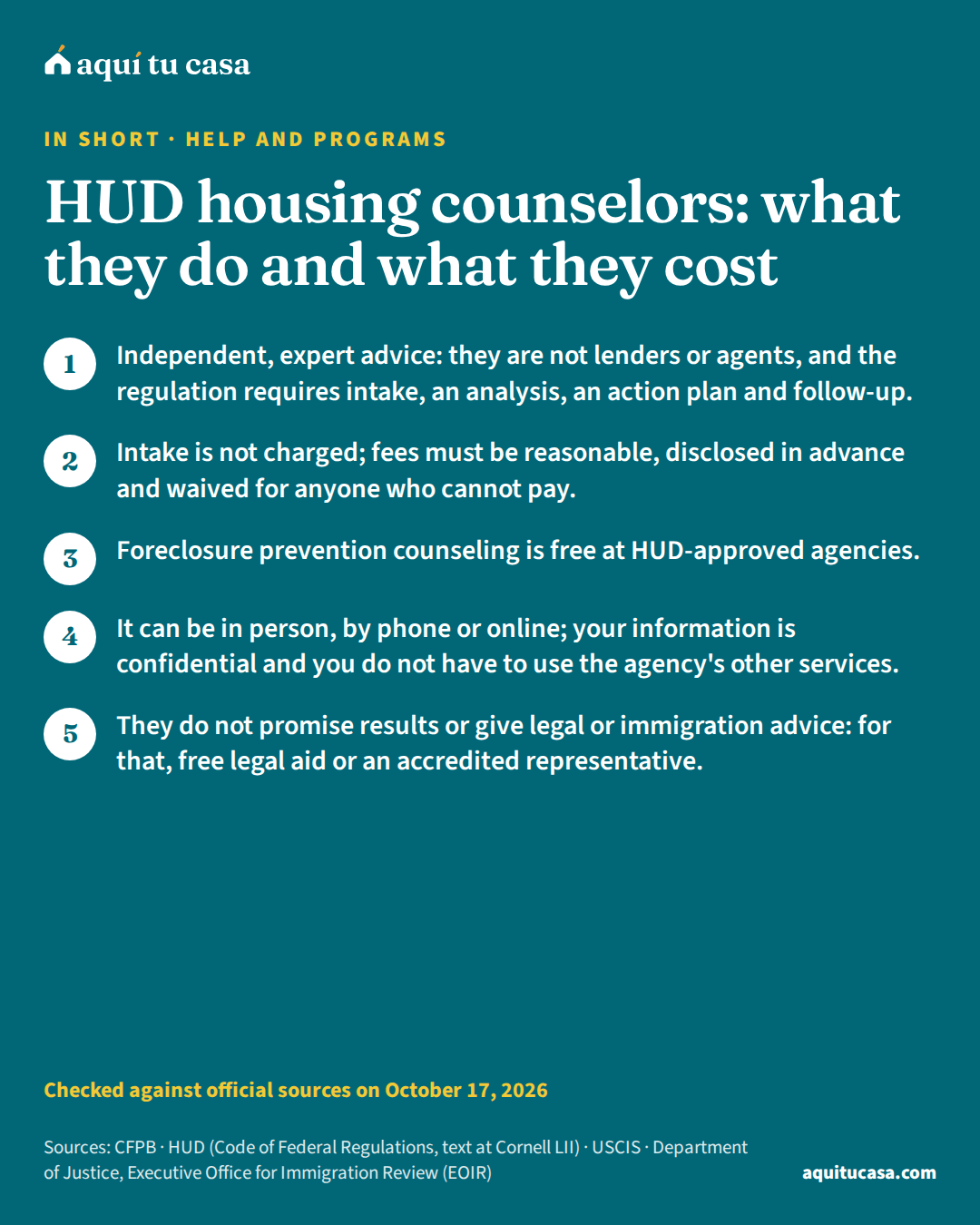
- Independent, expert advice: they are not lenders or agents, and the regulation requires intake, an analysis, an action plan and follow-up.
- Intake is not charged; fees must be reasonable, disclosed in advance and waived for anyone who cannot pay.
- Foreclosure prevention counseling is free at HUD-approved agencies.
- It can be in person, by phone or online; your information is confidential and you do not have to use the agency's other services.
Is this for you?
This guide is for you if…
- You want to buy a home and do not know where to start or whom to trust.
- You rent and have a problem with the lease, the deposit or an eviction notice.
- You have fallen behind on your mortgage and get letters you do not understand.
- Someone offers you 'help' with your home in exchange for an upfront payment.
Get direct help first if…
- You already have a hearing date or were served court papers: besides the counselor, look for free legal help today.
- Your question is about immigration: a housing counselor does not give immigration advice; only an attorney or a representative accredited by the Department of Justice can.
When a family does not know where to start, they almost always end up asking someone who has something to sell: the agent, the lender, the “advisor” who charges up front. There is another door, and it is free or nearly free: HUD-approved housing counselors. This guide explains what they are, what they help with, what a counseling session looks like, what they may charge under federal regulation and how to find one near you.
What a housing counselor is
A housing counselorHUD-approved housing counselorA HUD-approved housing counselor works at an agency HUD has approved to provide housing counseling: independent, expert advice customized to your situation about buying a home, renting, a missed mortgage payment, a foreclosure or credit problems. The agencies usually charge little or nothing; many serve in Spanish and offer the homebuyer education course several assistance programs require. They are not lenders or real estate agents and sell you nothing. Your county page lists the official agencies with phone numbers.See the full definition is not an agent or a lender. Under federal regulation, housing counseling is independent, expert advice tailored to your needs to overcome the obstacles between you and your housing goal. And it has a defined shape: an intake interview, an analysis of your finances and of how much housing you can afford, an action plan (except in reverse mortgage counseling) and a reasonable effort at follow-up. Homeownership counseling and rental counseling are both types of housing counseling.2
The person who helps you is certified: a HUD-certified counselor passed HUD’s certification exam, works for a participating agency and is recognized by HUD as competent to provide these services. Participating agencies are HUD-approved agencies, affiliates and branches of approved intermediaries, and state housing finance agencies.3
The regulation also protects the independence of the advice. No one at the agency may have a conflict of interest with you, such as a direct interest in you as a landlord, broker or creditor. Nor may they take a fee for sending you to a lender, broker, builder or real estate agent. And at least half of each agency’s counselors must have six months or more of experience in the job.5
What they help with
According to the CFPB, housing counselors give advice on buying a home, renting, defaults, forbearance, foreclosure and credit issues, and the agencies on its list offer that advice independently.1
| Your situation | What the counselor does |
|---|---|
| You want to buy | Reviews your income, debts and credit with you; explains the buying process; tells you which down payment assistancedown payment assistance (DPA)Down payment assistance (DPA) is money a public or nonprofit program contributes toward your down payment and sometimes your closing costs. Many states, local governments and nonprofits offer programs to make homeownership more affordable; most focus on low- and moderate-income families buying their first home, and some target teachers, firefighters and other public service employees. The help can be a grant you never repay, a second loan with no payments that is forgiven over the years or repaid when you sell, and many can be used with a regular FHA or conventional loan.See the full definition programs exist in your area and what they require |
| You rent | Helps with your lease, your rent budget and what you can do if you fall behind or get a notice |
| You are behind on your mortgage | Evaluates options with you, helps you talk to your loan servicer and understand its offers; this counseling is free8 |
| Your credit falls short | Reviews your reports, builds a credit plan and guides you on debts and collections |
HUD’s regulation gives examples of approved topics: getting ready to buy, FHA financing, budgeting and credit, comparing loans, closing costs, default and foreclosure, escrow, landlord-tenant law, leases and rent delinquency. Homeownership counseling must cover the whole road, from the decision to buy and the home inspection to the sale; rental counseling includes eviction prevention. And if an agency holds group classes, it must also offer individual counseling on the same topics.4

What a counseling session looks like, step by step
HUD’s regulation sets what has to happen in counseling, from the first call to the follow-up:4
What happens in housing counseling
1. You find an agency
Today
Use the CFPB's tool, the HOPE Hotline, or ask the CFPB to connect you with a counselor by phone.8
2. You choose how you are served
When you book
At the office, another location, by phone or online. If you ask for in-person service and your agency does not offer it, it must refer you to one that does.4
4. Intake interview
First appointment
You explain your situation and your goal. This part is not charged.6
5. A look at your budget
First appointment
The counselor reviews income, debts and expenses to see how much housing you can afford; that is why they ask for pay stubs and statements.8
7. Referrals and follow-up
Afterward
You are referred to local, state and federal resources, and the agency makes a reasonable effort to check on your progress.4
What should you bring? If you are going because of a mortgage problem, the CFPB says the counselor will ask how much you owe and the date of your last payment, which are usually on your last statement. They may also ask for pay stubs, tax returns, bank statements and your other monthly bills, such as a car loan or credit cards. They ask in order to understand your situation and how much you can pay each month, and to help you look at your options and decide what is right for you.8 If you are going to buy or rent, bring the same: your income, your expenses and your debts.
What you share stays protected. The agency keeps a confidential file with your action plan, and must protect your personal and financial information, including your credit reportscredit reportA credit report is a statement that has information about your credit activity and current credit situation: your loans and cards, the balances, whether you have paid on time, accounts in collection and who has checked your credit. Credit reporting companies, also called credit bureaus, compile it from what banks and creditors report; your credit score is computed from it. When you apply for a mortgage, the lender pulls your report from the three bureaus. You have the right to see it for free and to dispute anything that is wrong.See the full definition.7

What it costs
Here the regulation is clear. Participating agencies may charge reasonable and customary fees for housing education and counseling, but only if the cost does not create a financial hardship for you; fees must match the level of service; agencies that charge must serve for free anyone who cannot pay; they must tell you their fee structure before providing the service and post the fee schedule in a visible place; they cannot charge you for the intake interview; and if a lender pays the agency for your counseling, they have to tell you.6
In practice, the CFPB describes the service as independent advice “often at little or no cost,”1 and HUD-approved agencies provide foreclosureforeclosureForeclosure is the process by which the lender or servicer takes back the property after the homeowner fails to make mortgage payments. The rules and timelines depend on each state; all of them include advance notices and, in general, time to catch up or ask for an alternative, such as a repayment plan or a loan modification. If you fall behind, call your servicer and a HUD-approved housing counseling agency early: foreclosure counseling is free and exists for exactly this.See the full definition prevention counseling free of charge.8
How to find one near you
HUD-approved counseling agencies by state
| State | HUD-approved counselors |
|---|---|
| Alabama | 25 |
| Alaska | 1 |
| Arizona | 21 |
| Arkansas | 14 |
| California | 81 |
| Colorado | 26 |
| Connecticut | 13 |
| Delaware | 12 |
| District of Columbia | 17 |
| Florida | 98 |
| Georgia | 42 |
| Hawaii | 17 |
| Idaho | 10 |
| Illinois | 81 |
| Indiana | 21 |
| Iowa | 11 |
| Kansas | 3 |
| Kentucky | 19 |
| Louisiana | 26 |
| Maine | 7 |
| Maryland | 41 |
| Massachusetts | 37 |
| Michigan | 59 |
| Minnesota | 33 |
| Mississippi | 16 |
| Missouri | 18 |
| Montana | 11 |
| Nebraska | 8 |
| Nevada | 8 |
| New Hampshire | 5 |
| New Jersey | 34 |
| New Mexico | 7 |
| New York | 93 |
| North Carolina | 52 |
| North Dakota | 3 |
| Ohio | 54 |
| Oklahoma | 6 |
| Oregon | 25 |
| Pennsylvania | 75 |
| Puerto Rico | 9 |
| Rhode Island | 5 |
| South Carolina | 13 |
| South Dakota | 13 |
| Tennessee | 32 |
| Texas | 51 |
| Utah | 7 |
| Vermont | 7 |
| Virginia | 49 |
| Washington | 15 |
| West Virginia | 8 |
| Wisconsin | 26 |
| Wyoming | 1 |
Only states with their own page on this site appear; for the rest, use the CFPB's tool. Source: HUD
- On this site. Your state’s page under Places lists HUD-approved agencies with their contact details and the languages they declare; many serve people in Spanish.
- The CFPB’s tool. It searches by ZIP code and uses HUD’s official list. If you would rather talk, the CFPB connects you with a counselor at 1-855-411-2372.1
- If the problem is your mortgage. The HOPE Hotline, (888) 995-4673, answers 24 hours a day, seven days a week.8 The If you can’t pay your mortgage guide explains what to do in the first days.
Not every counselor offers every service: the CFPB recommends checking each agency’s list of services.1 If the agency does not offer what you need or has no room, the regulation asks it to refer you to another participating agency.5
When you call, ask three things: whether they serve people in your language, how soon they can give you a first appointment and which documents to bring. The document list in this guide covers most cases.

If this is you
You want to buy your first home
Homeownership counseling covers the whole road, from deciding whether to buy to the inspection and closing.4 Ask about down payment assistance programs in your area.
You rent and have a problem
Rental counseling covers the lease, rent delinquency and eviction prevention.4 If you have already received court papers, look for free legal aid too.
You are behind on your mortgage
Foreclosure prevention counseling is free at HUD-approved agencies.8 Bring your last statement.8
You have immigration questions
The counselor works on your housing and your money. For your immigration case, only an attorney or an accredited representative; notarios cannot give legal advice.11
What a counselor does not do
A counselor cannot promise you will keep your home or guarantee you a loan: they help you see your options and choose. If foreclosure is imminent or you have been served legal papers, the CFPB says you may also need to consult an attorney.8 That is what free legal aidlegal aidLegal aid is the free civil legal help that nonprofit organizations and their lawyers provide to low-income people in civil, not criminal, matters. In housing, that includes representing families facing eviction or foreclosure, alongside matters such as custody, child support, protection from domestic violence and access to benefits. In the United States, the Legal Services Corporation, created by Congress, funds a nationwide network of these organizations; its finder points you to the one in your area. Each sets its own income limits.See the full definition offices are for, linked at the end of this guide.
Nor do they give immigration advice. USCIS warns that a “notario público” is not authorized to provide immigration legal services in the United States.10 According to the Department of Justice’s immigration court office (EOIR), only certain people can represent you, such as licensed attorneys and accredited representativesDOJ-accredited representativeAn accredited representative is a non-attorney whom the U.S. Department of Justice, through its Recognition and Accreditation Program, authorizes to represent people in immigration matters before DHS and, with full accreditation, before the immigration courts. They may only do so through a recognized organization, which must be a non-profit, federally tax-exempt entity. It is the safe way to get low-cost immigration help: the Department of Justice publishes the official roster by state. Anyone who is not on that roster and is not a lawyer is not authorized to represent you.See the full definition; notarios, document preparers and immigration consultants cannot give you legal advice.11
Costly mistakes
Mistake: Going to an “advisor” who is not on HUD's list.
Instead: Search the CFPB's tool, which uses HUD's official list.1
Mistake: Paying for the first appointment.
Instead: The intake interview is not charged, and anyone who cannot pay gets counseling for free.6
Mistake: Showing up without papers.
Instead: Bring your last mortgage statement, pay stubs, tax returns, bank statements and your monthly bills.8
Mistake: Feeling you have to use the agency's other services.
Instead: The agency must tell you in writing that you are not obligated to receive its other services or its partners'.5
Mistake: Signing papers for someone who promises to save your home.
Instead: No one needs to charge you to avoid foreclosure; show those papers to a counselor or to legal aid.9
The housing scams guide has more warning signs. And if a counselor does not feel right, you can look for another on the official list: the agency must give you information on alternative services, programs and products.5

What to do this week
- Find a HUD-approved agency on your state’s page or with the CFPB’s tool, and confirm the language.1
- Ask whether they can see you in person, by phone or online, whichever suits you.4
- Book the first appointment; remember that the intake interview is not charged.6
- Gather the papers on the list: income, expenses, mortgage statement or lease, credit reports.8
- Write down your three main questions before you go.
- If you are behind on your mortgage, do not wait for the appointment to call your loan servicer: the counselor can help you prepare for that call.8
Your numbers
The minimum for this loan is 3.5%. More down lowers the monthly payment.
Adjust advanced details
First number: share of income for housing. Second: housing plus debts. Lender references, not fixed rules.
Let's do the math
Estimated top price
National figure$227,000
Limited by the housing payment: at that price it would be about $1,883 a month, 28% of your income.
- By the housing payment (28% of income)Limits you$227,000
- By your total debts (36% of income)$292,000
- By your cash (down payment + closing)$330,500
- Typical home in the United States
- $332,700
- Your cap is 68% of the typical home.
What changes if…?
- …you save $10,000 more$227,000
- …you cut $200 a month in debts$227,000
Your maximum price with four loans
Same income, debts and savings; only the down payment and the loan type change. ITIN uses an example down payment and rate.
| FHA 3.5% | Conventional 5% | Conventional 20% | ITIN 15% (example) | |
|---|---|---|---|---|
| Maximum price | $227,000 | $232,000 | $93,000 | $119,000 |
| Payment per month | $1,883 | $1,882 | $616 | $898 |
Educational estimate, not a pre-approval. Uses example insurance (0.5% of value per year) and example closing costs (3% of price); the tax is the place’s typical rate.
Ready to see the numbers? Find your county here
See how this applies in your county: its loan limits, prices and rents, from the official data.
Printable checklist
Frequently asked questions
Is a housing counselor the same as an agent or a lender?
No. The counselor does not sell you a home or a loan: they give independent, HUD-certified advice so that you decide. The regulation bars them from having an interest in you as a lender, broker or landlord, and from taking a fee for sending you to a lender or agent. If a lender pays the agency for the counseling, the agency has to tell you.
How much does it cost?
The intake interview is not charged. If the agency charges fees for other services, they must be reasonable, disclosed in advance and waived for anyone who cannot pay them. Foreclosure prevention counseling is free.
Do they serve people in Spanish?
Many agencies do. On your state's page on this site you will see the HUD-approved agencies with the languages they declare; the CFPB's tool also lets you search by ZIP code. Since not all of them offer every service, check each one's list of services.
Will they ask about my immigration status?
A housing counselor does not give immigration advice; their job is your housing and your money. If you have immigration questions, only an attorney or an accredited representative can advise you; according to the Department of Justice, notarios and immigration consultants cannot give legal advice.
Can I get counseling by phone or online?
Yes. Under HUD's regulation, counseling can take place at the agency's office, at another location, by phone or online. If you prefer in person and your agency does not offer it, it must refer you to one that does.
What documents should I bring to the first appointment?
If you are going because of a mortgage problem, the CFPB says you will be asked how much you owe and the date of your last payment (both on your last statement), and possibly for pay stubs, tax returns, bank statements and your other monthly bills. To buy or rent, bring your income, your expenses and your debts.
Is what I tell the counselor confidential?
Yes. Under HUD's regulation, the agency keeps a confidential file with your action plan and must protect your personal and financial information, including your credit reports.
Can they make me use the agency's other services?
No. The agency must tell you in writing what services it offers and what financial relationships it has, and state clearly that you are not obligated to receive any other services from it or its partners. It must also tell you about other options.
Sources
Every figure in this guide comes from one of these official sources. The number next to a sentence leads to the source behind it.
Each source on one line: who publishes it, its title, its address and the date we read it.
- 1. CFPB · Find a Housing Counselor · consumerfinance.gov · Accessed October 17, 2026
- 2. HUD (Code of Federal Regulations, text at Cornell LII) · 24 CFR §5.100, Definitions ('Housing counseling') · law.cornell.edu · Accessed October 17, 2026
- 3. HUD (Code of Federal Regulations, text at Cornell LII) · 24 CFR §214.3, Definitions (Housing Counseling Program) · law.cornell.edu · Accessed October 17, 2026
- 4. HUD (Code of Federal Regulations, text at Cornell LII) · 24 CFR §214.300, Counseling services · law.cornell.edu · Accessed October 17, 2026
- 5. HUD (Code of Federal Regulations, text at Cornell LII) · 24 CFR §214.303, Performance and compliance (agencies participating in the Housing Counseling Program) · law.cornell.edu · Accessed October 17, 2026
- 6. HUD (Code of Federal Regulations, text at Cornell LII) · 24 CFR §214.313, Housing counseling fees · law.cornell.edu · Accessed October 17, 2026
- 7. HUD (Code of Federal Regulations, text at Cornell LII) · 24 CFR §214.315, Recordkeeping · law.cornell.edu · Accessed October 17, 2026
- 8. CFPB · What is a HUD-approved housing counseling agency, and how can they help me? · consumerfinance.gov · Accessed October 17, 2026
See the other 3 sources
- 9. CFPB · If I can't pay my mortgage loan, what are my options? · consumerfinance.gov · Accessed October 17, 2026
- 10. USCIS · Common Scams (notario público) · uscis.gov · Accessed October 16, 2026
- 11. Department of Justice, Executive Office for Immigration Review (EOIR) · Can Someone Represent You Before EOIR? · justice.gov · Accessed October 17, 2026
Keep reading
Related guides
If this guide helped, these follow the same path.

Help and programs 12 minute read
Down payment assistance: how it works
What down payment assistance is, the types that exist (grant, forgivable or deferred second loan, tax credit), who qualifies and where to find it.
- It is almost never 'free money': often it is a second loan with no monthly payments that is forgiven over time or repaid when you sell or when it comes due.
- Programs come from states, counties, cities and nonprofits; you apply through a participating lender.
- Almost all ask for income under a cap tied to the area median income and a home price under a limit.
- Money problems Can't pay your mortgage? What to do in the first week Can't pay your mortgage? Call your servicer, learn the options that exist, the federal rules that protect you and the rescue scams to avoid. 14 minute read
- Buying a home How to buy a home in the United States, step by step The nine steps to buying a home: paperwork, credit, budget, assistance, preapproval, offer, inspection, closing and the first year, with official sources. 15 minute read
- Credit Credit from zero: how to start your history in the U.S. What credit reports and scores are, how to get them for free, and how to start a history from nothing with a secured card or a credit-builder loan. 16 minute read

Tools for this topic
Was this guide useful?
Thank you. Your answer stays in your browser; nothing is sent.