Help and programs Essential guide
Down payment assistance: how it works
What down payment assistance is, the types that exist (grant, forgivable or deferred second loan, tax credit), who qualifies and where to find it.
Verified against official sources on October 17, 2026 12 official sources

Show contents
In short
What you need to know
Quick answer
Down payment assistance is money a public or nonprofit program puts in so you can buy: sometimes a grant you never repay, often a second loan that is forgiven over the years or repaid at the end, and sometimes a credit on your taxes. States, counties, cities and nonprofits offer it, almost always through lenders that take part in the program, with income and price limits. aquitucasa holds 134 verified programs in 52 states and territories; yours are on your state's page.
What matters most
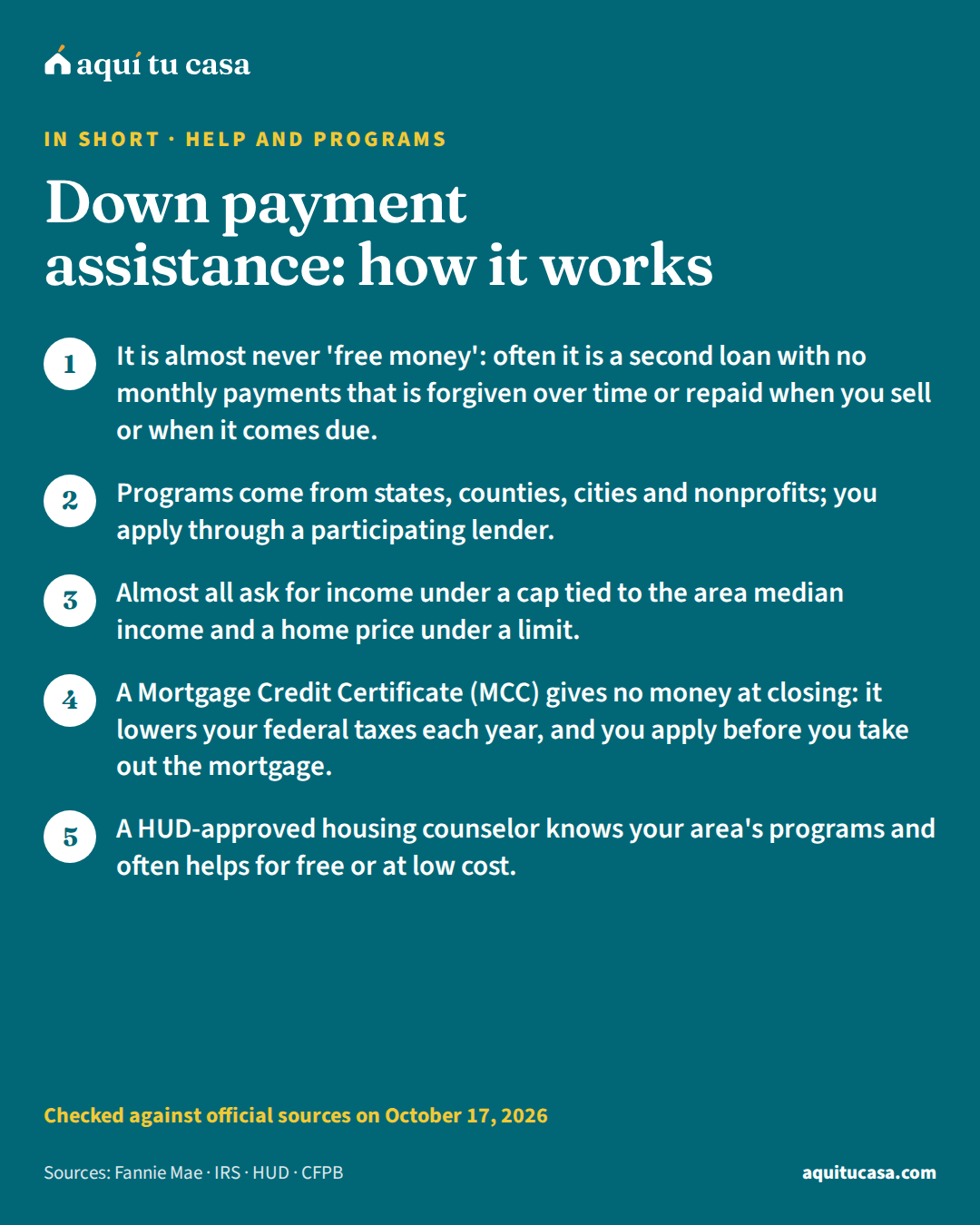
- It is almost never 'free money': often it is a second loan with no monthly payments that is forgiven over time or repaid when you sell or when it comes due.
- Programs come from states, counties, cities and nonprofits; you apply through a participating lender.
- Almost all ask for income under a cap tied to the area median income and a home price under a limit.
- A Mortgage Credit Certificate (MCC) gives no money at closing: it lowers your federal taxes each year, and you apply before you take out the mortgage.
Is this for you?
This guide is for you if…
- You have a steady income but not the savings for the down payment and closing costs.
- You heard that 'the government gives away money for a house' and want to know how much of that is true.
- A lender mentioned a 'second loan' or a 'credit certificate' and you did not understand what it was.
Get direct help first if…
- You already have a program reservation and a closing date: talk to the participating lender and your housing counselor about the remaining steps.
- You are looking for help with rent, not with buying: that is covered by housing vouchers and your local housing authority.
“The government gives away money to buy a house” is half true. Down payment assistancedown payment assistance (DPA)Down payment assistance (DPA) is money a public or nonprofit program contributes toward your down payment and sometimes your closing costs. Many states, local governments and nonprofits offer programs to make homeownership more affordable; most focus on low- and moderate-income families buying their first home, and some target teachers, firefighters and other public service employees. The help can be a grant you never repay, a second loan with no payments that is forgiven over the years or repaid when you sell, and many can be used with a regular FHA or conventional loan.See the full definition (DPA) exists, states, counties, cities and nonprofits really do offer it, and it can cover part of the money you need to close. But it is almost never a gift without conditions. This guide explains the types of assistance, who qualifies, how to apply and which fine print to read before you sign.
- Assistance programs verified in our dataset, with the text of their official page
- 134
- States and territories with at least one program in our dataset
- 52
- Programs that include a grant you do not repay
- 17
- Programs that ask for a homebuyer course, according to their page
- 65
What it is and who offers it
It is money a program puts in to cover the down paymentdown paymentThe down payment is the part of the home's price you pay out of your own pocket when you buy; the loan covers the rest. In U.S. Spanish it is also called enganche, cuota inicial or entrada. Each loan type has its own minimum: FHA requires at least 3.5% of the value, VA and USDA loans may require none, and conventional loans ask for more if you want to avoid private mortgage insurance. A larger down payment lowers the loan, the monthly payment and the total interest; many state programs help families put it together.See the full definition, the closing costsclosing costsClosing costs are all of the costs you pay on closing day on top of the down payment: lender fees, the appraisal, the credit report, title insurance, the closing agent's fees, any transfer taxes your state or county charges and the first deposits into the escrow account. The lender must itemize them on the Loan Estimate within days of your application and confirm them on the Closing Disclosure before you sign. Some can be paid by the seller, and several state programs help cover them.See the full definition or both. According to Fannie Mae, borrowers buying a principal residence may use funds donated from acceptable entities (federal, state and local governments, housing finance agencies, nonprofits, Federal Home Loan Banks, employers, tribes and lenders) for all or part of the down payment, closing costs or reserves.1
The CFPB puts it simply: many states and local organizations run programs to help first-time buyers with a down payment or closing costs.7 Many of those programs come from each state’s housing finance agencystate housing finance agency (HFA)A state housing finance agency (HFA) is a public body created by an act of a state legislature, or by a local government, with the power to finance housing. In that federal definition, "state" includes Puerto Rico and the District of Columbia. Its mission is to increase affordable housing for renters and homebuyers with low to moderate incomes, especially first-time homebuyers. HFAs usually do not lend directly: they work with participating lenders that offer their loans and down payment assistance. Programs vary by state.See the full definition (the “HFA”); others come from counties, cities and nonprofits. You usually do not apply to the program directly, but through a lender that takes part in it.
Our dataset holds 134 verified programs in 52 states and territories. Each record quotes the program’s exact text on how much it gives, to whom and on what conditions, and links its official page.
The types of assistance, side by side
When a program says “assistance,” it can mean five very different things. The difference is whether it is repaid, when and how. The second loans of public programs often take the form Fannie Mae calls Community Seconds: a second loansecond mortgageA second mortgage (or junior lien) is a loan you take out using your home as collateral while you still have another loan secured by it. Home equity loans and HELOCs are common examples. It is called "second" because, if you stop paying and the home is sold to pay the debts, this loan is paid after the first one; if there is not enough money, the second lender may not get everything it is owed. That is why it often has a higher interest rate. It adds to your total debt and, if you cannot repay it, you could lose your home.See the full definition that may only be funded by an eligible entity, for the down payment, closing costs, renovations or a rate buydown.2 Fannie Mae accepts several ways to repay it: monthly payments, deferred payments, or debt forgiven over time.2
Three kinds of assistance with no monthly payment
17 programs in our dataset
Grant
35 programs
Forgivable second loan
- A loan against the home whose debt is forgiven over time.2
- Each program publishes the forgiveness conditions, such as how many years to live in the home and what happens if you sell early.
One program can combine more than one type: read on its record which one you would get and on what conditions.
Two more kinds
24 programs
Repayable second loan
On your taxes
Mortgage Credit Certificate (MCC)
One program can offer more than one type of assistance, so the counts for each type do not add up to the total. What matters is your program’s record: it says which type it gives, whether it is forgiven and over how long, and when it is repaid.
The Mortgage Credit Certificate (MCC)mortgage credit certificate (MCC)A mortgage credit certificate (MCC) is a document issued by a state or local housing agency that entitles you to a credit on your federal income tax return for part of the interest you pay on your mortgage each year. Unlike a deduction, the credit directly reduces the tax you owe. You claim it with IRS Form 8396, and any credit you cannot use in one year can be carried forward to the next. Each agency sets who qualifies, normally first-time buyers within income and price limits; you apply through a participating lender.See the full definition deserves its own note, because you request it at a different time. According to the IRS, it is meant to help lower-income people afford a home, and you must contact the agency that issues it before you take out the mortgage. If the certificate credit rate is higher than 20%, the credit can’t be more than $2,000. And if you itemize, you reduce your mortgage interest deduction by the credit.5
Who qualifies
The rules change with each program, but almost all turn on the same pieces:
- Income. A cap that many programs set as a share of the area median incomearea median income (AMI)The area median income (AMI) is the median family income of an area, which HUD computes every year for each metropolitan area and county. Housing programs use it as the yardstick: under the federal rule, a family is low-income when it earns no more than 80% of its area's median income and very low-income when it earns no more than 50%, adjusted for family size. State down payment assistance programs and Section 8 vouchers publish their limits as a percentage of AMI, so the same salary can qualify in one county and not in the next.See the full definition. HUD publishes income limits by area every year, based on the median family income of each metropolitan area and of each county outside them; the current edition is fiscal year 2026.6 Other programs use their own tables, which we link on each record.
- Home price. A cap by county or area, published by the program.
- First-time buyerfirst-time homebuyerUnder the definition HUD uses, a first-time homebuyer is a person, and his or her spouse, who has not owned a home during the three years before the purchase. There are exceptions: a single parent or a displaced homemaker is not excluded just because he or she owned a home with a spouse while married. Nor does it count if you only owned a home that was not on a permanent foundation, or one that did not meet building codes and could not be brought up to code for less than the cost of building a new one. Each program may use its own definition.See the full definition. Many programs require it, and each publishes its definition. It does not always mean “never owned a home.” Read it before ruling yourself out.
- Homebuyer coursehomebuyer education courseA homebuyer education course is a class with a set curriculum that covers the homebuying process, how to maintain a home, budgeting and why good credit matters. It can be in a group, in person, online or by phone. It is not the same as housing counseling, which is one-on-one help with an action plan for your situation. Some loans and some down payment assistance programs require you to finish a course before closing, especially first-time homebuyers. When you finish, you get a certificate.See the full definition. Of our 134 programs, 65 require one according to their page. In HUD’s housing counseling program, education means group classes on topics such as the homebuying process, budgeting and credit.9
- First-mortgage type. The assistance goes with an FHAFHA loanAn FHA loan is a mortgage made by a private lender and insured by the Federal Housing Administration (FHA), an agency of the U.S. government. That insurance protects the lender if you stop paying, which is why the lender can accept a lower down payment and a less-than-perfect credit history than on a conventional loan. Federal law sets the minimum cash investment at 3.5% of the property's value and caps the loan amount at the FHA limit, which changes by county. In exchange for the insurance you pay a mortgage insurance premium.See the full definition, conventionalconventional loanA conventional loan is any mortgage that is not insured or guaranteed by the federal government: it is not FHA, VA or USDA. The lender, or the companies that buy the loans (Fannie Mae and Freddie Mac), carry the risk. When the amount is within the conforming loan limit the loan is called "conforming"; above it, it is a "jumbo" loan. It usually asks for a higher credit score than an FHA loan and, if your down payment is less than 20% of the price, you are normally required to buy private mortgage insurance (PMI) until you build enough equity in the home.See the full definition, VA or USDA loan, and each program says which ones it accepts. The lender checks that both sets of rules fit.
- Residency and ITIN. Most programs say nothing about the ITIN on their page (110 of 134). Ask directly.

How much it can cover and how it fits your loan
Assistance does not change what the home costs: it changes where the money comes from. A grant can pay all or part of the down payment, closing costs or reserves.1 A second loan adds debt against the home. With a Community Seconds loan, Fannie Mae lets the combined debt reach 105% of the home’s value.2 The combined loan-to-value ratioloan-to-value ratio (LTV)The loan-to-value ratio (LTV) compares the amount of your mortgage with the appraised value of the property. It is expressed as a percentage: a loan that covers almost the whole value has a high LTV; one with a large down payment, a low LTV. Lenders use it to measure risk: the higher the LTV, the stricter the requirements and the more likely you will be asked for mortgage insurance. Over time, as you pay down principal or the home gains value, your LTV falls, which can let you cancel PMI on a conventional loan.See the full definition is the sum of your loans divided by the value.
Do you need to put in your own money? It depends on the loan. On a conventional loan Fannie Mae buys, with a Community Seconds loan on a one-unit principal residence, no contribution of your own is required: all the money can come from the second loan. On a two- to four-unit home financed above 80%, you must put in at least 5%.2 Other loans and programs have their own rules.

Your lender also looks at your debt-to-income ratiodebt-to-income ratio (DTI)Your debt-to-income ratio (DTI) is all your monthly debt payments divided by your gross monthly income, that is, income before taxes. If you pay a certain amount each month across a car, cards, student loans and the mortgage you are asking for, and you earn three times that, your DTI is one third. Lenders use it to measure whether you can manage the payment; each loan type and lender sets its own limit, and assistance programs usually publish theirs. Paying down debt before applying improves your DTI.See the full definition. If the second loan’s payments are deferred five years or more, Fannie Mae does not require counting them as a monthly payment; if they are deferred for less, the lender must count the payment that will come due.2 Use the How much house can I afford? tool to see what you can pay each month, with and without assistance.
One paperwork detail: for the second loan of certain assistance programs you do not get a Loan EstimateLoan EstimateThe Loan Estimate is a three-page form you receive from the lender within days of applying for a mortgage. In the same format at every bank, it sums up the terms of the loan being offered: amount, interest rate, whether the payment can change, the estimated monthly payment with taxes and insurance, the itemized closing costs and how much cash you need at closing. Because every lender uses the same form, it lets you compare offers side by side. It commits you to nothing: requesting one is not accepting the loan.See the full definition, but “Truth-in-Lending” disclosures instead.8 Ask for them and read them just as carefully. The closing costs guide helps you read the rest.
Find your state’s programs
The full list, with each program’s record, is under assistance programs. The Which programs do I qualify for? tool looks for programs that might fit you with a few questions, without asking for personal data. This table shows the states that already have their own page on this site and how many verified programs we hold for each; tap the name to see their records.
Verified assistance programs by state
Only states with their own page on this site appear; the rest are under assistance programs. Source: each state's housing agency
A state with few programs in our dataset may still have more. Counties, cities and local organizations run their own programs, which change every year. To find them, the CFPB suggests looking up a HUD-approved housing counseling agency in your area or calling the HOPE Hotline, (888) 995-4673, 24 hours a day, seven days a week.7

How to apply, step by step
From your search to closing with assistance
1. Find your state's programs
Before you house-hunt
Many states and local organizations help with the down payment or closing costs; start with your state's list.7
Try it with your numbersWhich programs might I qualify for?2. Talk to a housing counselor
At the start
Locating cash for a down payment is part of housing counseling, and all counseling involves an action plan.9
3. Take the course, if the program requires it
Before closing
In HUD's program, education means group classes on the homebuying process, budgeting and credit. Keep the certificate.9
4. Choose a participating lender
With your preapproval
The program publishes its list. The lender reviews your first mortgage and the assistance together and tells you which documents are missing.
5. Reserve the assistance with your contract
When you sign the purchase contract
Ask the lender when and how the assistance is reserved: each program has its own process and calendar.
6. Check the assistance paperwork
Before you sign
For the second loan of certain programs you get Truth-in-Lending disclosures instead of a Loan Estimate.8
Try it with your numbersClosing costs
Do not skip the counselor. Housing counseling includes locating cash for a down payment,9 and HUD-approved counselors give independent advice, often at little or no cost.10 They know local programs that appear on no list and can tell you which course your program accepts. The HUD-approved housing counselors guide explains how to find one.
With the lender, ask to see your payment with the assistance and without it. Also ask whether the assistance comes with a first-mortgage rate different from the one you would get without it. With those numbers in hand, you decide.
Your family’s help counts too
If a relative can gift you part of the money, it does not compete with public assistance. On a conventional loan for a one-unit principal residence, all funds needed can come from a gift from an acceptable donor, documented with a gift lettergift letterA gift letter is a document signed by the person who gives you money to buy a home, stating that the money is a gift and not a loan. For some loans, a gift can pay the down payment, closing costs or reserves, as long as you can prove where the money came from. Under Fannie Mae's rules, the letter states the amount of the gift, says no repayment is expected, and gives the donor's name, address, phone number and relationship to you. The lender also verifies that the money moved from the donor's account to yours or to the closing agent.See the full definition.3 The how much down payment you need guide explains how it is documented.

If this is you
You are buying for the first time
Many states and local organizations help first-time buyers.7 Check how your program defines 'first-time': it does not always mean 'never'.
Your income is low or moderate
Many programs set their cap as a share of the area median income, which HUD publishes every year.6 A counselor can help you see which ones fit.10
You are buying with an ITIN
Ask the program and the lender; FHA no longer accepts non-permanent residents for case numbers assigned on or after May 25, 2025.11 See the ITIN mortgage guide.
Your family wants to help
On a conventional loan for a one-unit principal residence, all the money can be a gift documented with a letter.3
Costly mistakes
Mistake: Thinking all assistance is a grant.
Instead: Check whether it is a grant or a forgivable, deferred or repayable second loan: loans are repaid or forgiven on conditions.2
Mistake: House-hunting without knowing the program's caps.
Instead: Check the income and price caps on the record before you make an offer; HUD publishes income limits by area.6
Mistake: Applying for the MCC after closing.
Instead: Apply to the agency before you take out the mortgage and buy the home.5
Mistake: Looking only at the assistance and not at the first mortgage.
Instead: Compare your payment with and without assistance, and read the second loan's disclosures.8
Mistake: Paying someone who promises to “get” or “guarantee” you assistance.
Instead: Promises of “grants” or “free money” from the government are often scams: report them to the FTC.12
Scams change shape, but the warning sign repeats: someone asks you for money up front or promises a result. USA.gov warns that promises of “grants” or “free money” from the government are often scams and arrive by text, email, ads and websites.12 Each program’s official information is linked on its record, and the housing scams guide has more warning signs.

What to do this week
- Open assistance programs, find your state and read the records.
- Compare your household income with each program’s cap, and the price of the homes you are looking at with its cap.6
- Book an appointment with a HUD-approved housing counselorHUD-approved housing counselorA HUD-approved housing counselor works at an agency HUD has approved to provide housing counseling: independent, expert advice customized to your situation about buying a home, renting, a missed mortgage payment, a foreclosure or credit problems. The agencies usually charge little or nothing; many serve in Spanish and offer the homebuyer education course several assistance programs require. They are not lenders or real estate agents and sell you nothing. Your county page lists the official agencies with phone numbers.See the full definition: they often help for free or at low cost.10
- If you are interested in an MCC, ask the agency today how to apply, before you take out the mortgage.5
- Ask two participating lenders which first mortgage they offer you with the assistance and without it.
- If the program requires the homebuyer course, enroll now so you have the certificate in time.
Your numbers
The minimum for this loan is 3.5%. More down lowers the monthly payment.
Adjust advanced details
First number: share of income for housing. Second: housing plus debts. Lender references, not fixed rules.
Let's do the math
Estimated top price
National figure$227,000
Limited by the housing payment: at that price it would be about $1,883 a month, 28% of your income.
- By the housing payment (28% of income)Limits you$227,000
- By your total debts (36% of income)$292,000
- By your cash (down payment + closing)$330,500
- Typical home in the United States
- $332,700
- Your cap is 68% of the typical home.
What changes if…?
- …you save $10,000 more$227,000
- …you cut $200 a month in debts$227,000
Your maximum price with four loans
Same income, debts and savings; only the down payment and the loan type change. ITIN uses an example down payment and rate.
| FHA 3.5% | Conventional 5% | Conventional 20% | ITIN 15% (example) | |
|---|---|---|---|---|
| Maximum price | $227,000 | $232,000 | $93,000 | $119,000 |
| Payment per month | $1,883 | $1,882 | $616 | $898 |
Educational estimate, not a pre-approval. Uses example insurance (0.5% of value per year) and example closing costs (3% of price); the tax is the place’s typical rate.
Ready to see the numbers? Find your county here
See how this applies in your county: its loan limits, prices and rents, from the official data.
Printable checklist
Frequently asked questions
Do I have to pay the assistance back?
It depends on the type. A grant is not repaid. A forgivable second loan is forgiven over time if you meet the program's conditions, such as living in the home for a set time. A deferred one has no monthly payments but is repaid when it comes due, or earlier if you sell the home or pay off the loan. A repayable one has monthly payments. Each program publishes its conditions, and our records quote its text.
Can I use it with an ITIN?
Most programs say nothing about the ITIN on their page (110 of the 134 we have read). Ask the program or a participating lender directly. Remember that the first-mortgage type matters too: FHA stopped accepting non-permanent residents for case numbers assigned on or after May 25, 2025.
Does the assistance make my loan more expensive?
A second loan adds debt against the home. For loans Fannie Mae buys, a program's second loan (Community Seconds) must be fixed-rate, no more than 2 points above your first mortgage's initial rate, and if its payments are deferred five years or more the lender does not have to count them in your debt-to-income ratio. Compare the total cost with and without assistance before you decide.
Do I have to put in my own money?
It depends on the loan and the program. On a conventional loan Fannie Mae buys, with a Community Seconds loan on a one-unit principal residence, no minimum contribution of your own funds is required; on a two- to four-unit home financed above 80%, you must put in at least 5%. Other loans and programs have their own rules, listed on their record.
Where do I find my state's programs?
On this site's assistance programs page, organized by state, and with the Which programs do I qualify for? tool. The CFPB also suggests looking up a HUD-approved housing counseling agency in your area or calling the HOPE Hotline, (888) 995-4673, 24 hours a day.
What is an MCC and how much is it worth?
A Mortgage Credit Certificate turns part of the interest you pay into a credit on your federal taxes, figured each year on Form 8396. If the certificate credit rate is higher than 20%, the credit can't be more than $2,000. You apply before taking out the mortgage, and if you sell the home within 9 years you may have to repay part of the benefit.
Do I have to be a first-time buyer?
Many programs require it, but each publishes its own definition, and it does not always mean 'never owned a home'. Some programs do not require it. Read the definition on the program's record before ruling yourself out.
Can someone charge me to get the assistance for me?
Be wary of anyone who asks for money up front to 'get' or 'guarantee' you assistance. USA.gov warns that promises of 'grants' or 'free money' from the government are often scams and asks people to report them to the FTC. Each program's record and HUD-approved counselors can guide you, often for free or at low cost.
Sources
Every figure in this guide comes from one of these official sources. The number next to a sentence leads to the source behind it.
Each source on one line: who publishes it, its title, its address and the date we read it.
- 1. Fannie Mae · Fannie Mae Selling Guide B3-4.3-06, Grants and Lender Contributions · selling-guide.fanniemae.com · Accessed October 17, 2026
- 2. Fannie Mae · Fannie Mae Selling Guide B5-5.1-02, Community Seconds Loan Eligibility · selling-guide.fanniemae.com · Accessed October 17, 2026
- 3. Fannie Mae · Fannie Mae Selling Guide B3-4.3-04, Personal Gifts · selling-guide.fanniemae.com · Accessed October 17, 2026
- 4. IRS · About Form 8396, Mortgage Interest Credit · irs.gov · Accessed October 17, 2026
- 5. IRS · Publication 530 (2025), Tax Information for Homeowners · irs.gov · Accessed October 17, 2026
- 6. HUD · Income Limits (HUD User datasets) · huduser.gov · Accessed October 17, 2026
- 7. CFPB · Where can I find information on programs for first-time home buyers? · consumerfinance.gov · Accessed October 17, 2026
- 8. CFPB · What is a Loan Estimate? · consumerfinance.gov · Accessed October 17, 2026
See the other 4 sources
- 9. HUD (Code of Federal Regulations, text at Cornell LII) · 24 CFR §214.3, Definitions (Housing Counseling Program) · law.cornell.edu · Accessed October 17, 2026
- 10. CFPB · Find a Housing Counselor · consumerfinance.gov · Accessed October 17, 2026
- 11. HUD · HUD Mortgagee Letter 2025-09, Revisions to Residency Requirements · hud.gov · Accessed October 17, 2026
- 12. USAGov (U.S. General Services Administration) · Avoid "free money" from the government scams · usa.gov · Accessed October 17, 2026
Keep reading
Related guides
If this guide helped, these follow the same path.

Buying a home 11 minute read
How much do you need for a down payment?
20% is not required: what each loan asks for (FHA, conventional, VA, USDA), what changes with less than 20% down, and where the money can come from.
- 20% is not a rule: FHA asks for 3.5% and a conventional HomeReady loan for 3%.
- VA (veterans and service members) and USDA (rural areas, with an income limit) may require no down payment.
- With less than 20% down there is mortgage insurance: PMI on conventional loans, which can be removed; MIP on FHA, with an upfront premium.
- Buying a home Closing costs explained: what you pay and what can change What closing costs are, how to read them on your Loan Estimate, which charges cannot go up before closing and how to compare offers to pay less. 14 minute read
- Help and programs HUD housing counselors: what they do and what they cost What a HUD-approved housing counselor does, what they help with (buying, renting, missed payments, credit), what they may charge and how to find one. 11 minute read
- Mortgage loans ITIN mortgages: what exists and what lenders ask for Which home loans accept an ITIN and which do not: Fannie Mae's rule, what FHA and USDA say, who lends and how to compare offers. 12 minute read
Tools for this topic
Was this guide useful?
Thank you. Your answer stays in your browser; nothing is sent.