Payday loans: what they cost and the alternatives
How a payday loan works, what the CFPB says it costs, what a federal credit union payday alternative loan (PAL) is and what to do if you already have one.
Verified against official sources on October 31, 2026 13 official sources

Show contents
In short
What you need to know
Quick answer
A payday loan is usually $500 or less and due on your next payday. The CFPB says a typical $15 per $100 fee for two weeks equals an APR of almost 400%, and that four out of five are rolled over or renewed within 14 days. One alternative is a PAL loan from a federal credit union: $200 to $2,000, one to 12 months, an application fee of $20 at most and a rate of up to 28%. If you already have one, you can ask for an extended repayment plan and revoke the automatic payment authorization.
What matters most
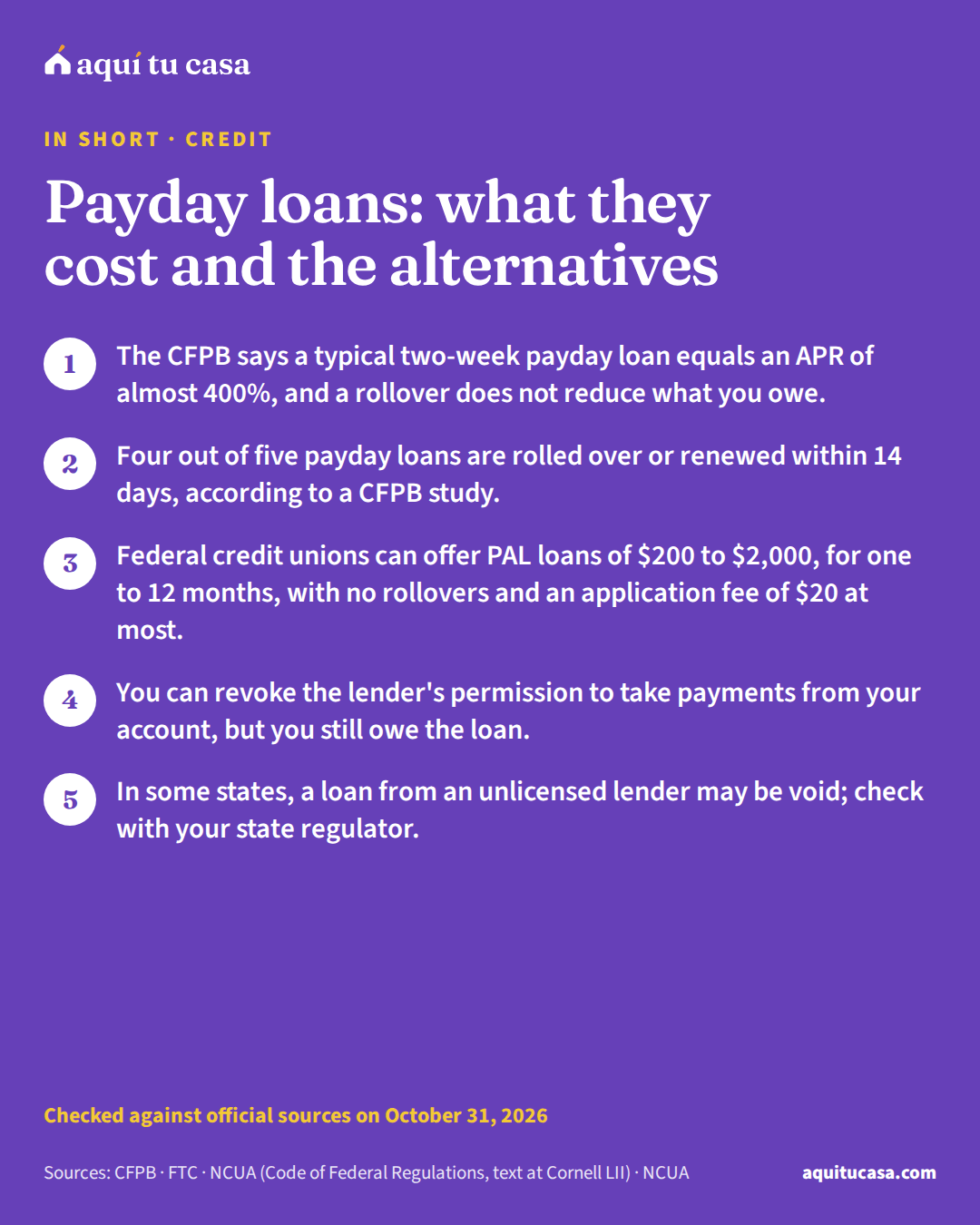
- The CFPB says a typical two-week payday loan equals an APR of almost 400%, and a rollover does not reduce what you owe.
- Four out of five payday loans are rolled over or renewed within 14 days, according to a CFPB study.
- Federal credit unions can offer PAL loans of $200 to $2,000, for one to 12 months, with no rollovers and an application fee of $20 at most.
- You can revoke the lender's permission to take payments from your account, but you still owe the loan.
Is this for you?
This guide is for you if…
- You are short on money for rent, utilities or a repair before your next paycheck, and you are thinking about a payday loan.
- You already have a payday loan and cannot pay it in full on the due date.
- You want to know what a credit union PAL loan is.
Get direct help first if…
- A collector or a court has already sued you over the debt: read the debt collection guide today and look for free legal aid; court dates do not wait.
- You are on active military duty: the Military Lending Act gives you its own protections; your legal assistance (JAG) office can help.
When money runs short before the next paycheck, an ad for “cash today, no credit check” can look like the way out. This guide is for you if you are thinking about a payday loanpayday loanA payday loan is, according to the CFPB, a small, short-term, high-cost loan that is usually due on your next payday. To collect, the lender usually asks for a post-dated check or permission to take the money from your account. It generally does not check whether you can repay it and still cover your other bills. Its fees, expressed as an annual percentage rate (APR), can be much higher than a credit card's. Some states do not allow payday loans or cap them, and in others you may be offered a rollover in which you pay only the fees.See the full definition or already have one: it explains how it works, what the CFPB says it costs, what a federal credit union PAL loan is and the rules the NCUA sets, other alternatives and what to do if you can no longer afford to pay it.
How a payday loan works
The CFPB explains that there is no set definition, but that a payday loan is usually a short-term, high-cost loan, generally for $500 or less, typically due on your next payday. Depending on your state’s law, it is offered by storefront or online lenders, and many states limit the loan amount.1
This is how it works, according to the CFPB:1
- One payment. You repay it all at once, typically two to four weeks after you get it.
- Automatic repayment. You give a post-dated check or permission to take the money from your bank, credit union or prepaid card account. If you do not pay on time, the lender cashes the check or withdraws the money.
- No check of whether you can repay. Generally, the lender does not verify whether you can repay it on top of your other bills.
For a payday loan you do not put up collateral as at a pawn shop. But federal law says the lender cannot condition the loan on your authorizing automatic, recurring electronic transfers. If your account lacks the money when the lender collects, your bank will likely charge you for the bounced check or the overdraftoverdraftAn overdraft happens when you do not have enough money in your account to cover a payment, but the bank or credit union pays it anyway. According to the CFPB, it can happen with checks, ATM withdrawals, debit card purchases, automatic payments and other withdrawals. Many banks charge a fee, on top of what you have to pay back. Under Regulation E, they cannot charge that fee for a one-time debit card purchase or an ATM withdrawal unless you first agreed to (opted in to) their overdraft service. You can change your mind later.See the full definition, and depending on your state the lender may charge another fee. And if you do not repay, the lender can sue you.5
What the CFPB says it costs
Many state laws cap fees at $10 to $30 for every $100 borrowed. A typical two-week loan with a $15 per $100 fee equals an APRannual percentage rate (APR)The annual percentage rate (APR) is a broader measure of the cost of borrowing money than the interest rate. Besides the interest, it includes certain loan charges, such as discount points and some lender fees, spread over the life of the loan and expressed as a yearly percentage. That is why the APR is almost always a little higher than the interest rate. It is useful for comparing offers: if two loans have the same interest rate but a different APR, the one with the higher APR charges more in fees.See the full definition (annual percentage rate) of almost 400%. For comparison, the CFPB says credit card APRs range from about 12% to 30%.1
The biggest problem is the rollover. Rolling over a payday loan means paying a fee to delay repayment, and that fee does not reduce what you owe: you still owe the principal plus the new fees. Many states limit or ban rollovers, but where they are allowed, if you roll over several times you may pay several hundred dollars in fees and still owe what you borrowed.3
Example with real numbers
The CFPB's example
A $300 loan with the typical fee of $15 per $100.
- What you borrow today
- $300
- What you repay in a couple of weeks
- $345
- If you pay only the fee and roll it over
- You pay $45 and still owe $345
- What it costs to borrow $300 for one month
- $90
That is the CFPB's math.2 To see what fits in your month, try the family budget.
Run it with your numbersFamily budgetA CFPB study of more than 12 million storefront loans found that four out of five payday loans are rolled over or renewed within 14 days, and that most are made to borrowers who renew so many times that they end up paying more in fees than they borrowed.8
Besides the main fee, the CFPB mentions others: rollover fees, repayment plan fees depending on your state, late or returned check fees, your bank’s non-sufficient funds fee and, if the money is loaded onto a prepaid card, the card’s fees. Read the whole agreement before you sign.4

The credit union alternative: PAL loans
Federal credit unionscredit unionA credit union is a not-for-profit financial institution that, like a bank, accepts deposits, makes loans and offers other services, but is owned by its members. Members elect a volunteer board of directors, and profits go back to them as lower fees, higher savings rates and lower loan rates. To join you need a common bond, such as your employer, your family, where you live or a group you belong to. It is chartered by the NCUA, a federal agency, or by a state. If the credit union is federally insured, your deposits are protected by the NCUA's insurance fund.See the full definition can offer a payday alternative loanpayday alternative loan (PAL)A payday alternative loan (PAL) is a small loan that federal credit unions can offer their members instead of a payday loan, which costs much more. According to the NCUA, the federal rule limits the amount and the term, which is short; the application fee may only cover the real cost of processing it, and there is a cap on how many you can have in a period. It is paid off in full in installments and cannot be rolled over. For one type of PAL, you must be a member for some time before applying. Some lenders that are not credit unions use the name, so read the fine print.See the full definition, known as a PAL. The rules are set by the NCUA, the federal credit union agency, in its regulation. There are two kinds.
PAL I. Under the regulation, the federal credit union must meet these conditions, among others:10
- the loan is $200 to $1,000;
- the term is one to six months;
- it gives you no more than three PALs in six months, and no more than one at a time;
- it does not roll the loan over, though it may extend the term within the maximum with no fees or extra money;
- the loan is repaid in full in installments;
- you must be a member of the credit union for at least one month first;
- the application fee reflects actual costs and never exceeds $20.
PAL II. The regulation allows it up to $2,000 and for one to 12 months, with the same limit of three PALs in six months and one at a time, no rollovers, repayment in installments and an application fee of $20 at most. Also, the credit union cannot charge your account overdraft-service fees, including non-sufficient funds fees, in connection with that loan. And unlike PAL I, the PAL II rule does not require a month of membership.10
How much interest? Federal credit union law generally caps their loans at 15%, but the NCUA Board can set a higher cap for a time. The Board extended the temporary 18% cap through September 10, 2027, and with that decision federal credit unions may still charge up to 28% on PALs, under the terms of the regulation.11 According to MyCreditUnion.gov, the NCUA’s public website, federal credit union loans that are not PALs can have a maximum APR of 18%, and may suit you better if you qualify.12
Payday loan, PAL I and PAL II
Storefront or online lender
Payday
Federal credit union
PAL I
Before you sign, compare each option's APR: payday lenders must give it to you before you sign.12
How to start? Ask a federal credit union in your area whether it offers PALs and how to join. The guide credit unions vs. banks explains how they work and what they ask for to open an account, and the one on opening an account without a Social Security number covers what they usually ask for if you have an ITIN. Some credit unions also offer free financial counseling to members.12
Other alternatives before you borrow
The CFPB suggests checking options that may not require a loan: some employers, nonprofit organizations and community groups offer advances or emergency credit; help from family or friends; cheaper options at your bank or credit union, especially if you have a stable credit history; or negotiating a smaller payment with whoever is collecting.2
The FTC adds others:9
- Ask your creditors for more time. Ask whether they will charge you for the extension, through a late fee, a finance charge or a higher rate.
- Local or large banks. Some offer small loans or lines of credit to customers with low or no credit scores.
- Your tax refund. If you expect one, file as soon as you can.
- Credit counseling. Nonprofit groups in every state offer it free or at low cost.
- Charities and places of worship, which often help people going through a rough spot at no cost.
MyCreditUnion.gov also suggests asking your state or local government whether it has emergency assistance programs.12 If what you are short on is the power or gas bill, the guide on LIHEAP explains that help; if it is rent, see if you can’t pay your rent.
And for next time: the CFPB suggests that if you expect a refund or more income, you use that money to start saving for the next emergency.2 The emergency fund guide explains how to start small.

If you already have a payday loan
You are not alone, and there are steps the CFPB explains.
1. Ask for an extended repayment plan. If you are having trouble paying, call the lender and ask for one.3 Some state laws require lenders to offer it, sometimes at no cost, and even if your state does not require it, some lenders offer one anyway. It is different from a rollover: it lets you pay the debt off instead of borrowing again.4
2. You can stop the automatic withdrawals. You have the right to stop the lender from taking payments from your account, even if you authorized them before. Tell the company and your bank or credit union, by phone and in writing, that you are revoking authorization. You can also give the bank a stop payment order at least three business days before the withdrawal; if the bank asks for it in writing, send it within 14 days of your call. Banks commonly charge for that order. Note: canceling the automatic payment does not cancel the contract, and you still owe the loan.6
3. Watch your account. If you see a payment you did not authorize, or one taken after you revoked permission, tell your bank right away: federal law lets you dispute it and get your money back if you tell the bank in time.6
4. Check the lender’s license. Your state regulator or attorney general can tell you whether the lender is licensed. In some states, a payday loan made by an unlicensed business may be void, and the lender may not have the right to collect it.7
5. File a complaint if there is a problem. You can contact your state regulator or attorney general, or complain to the CFPB online or at (855) 411-2372.5 If the debt has gone to a collection agency, the guide on debt collection explains your rights. And if you are sued, look for free legal aid right away.
Getting out of a payday loan
1. Call the lender and ask for a repayment plan
Before the due date
It is different from a rollover; in some states lenders must offer it.4
2. Revoke the automatic payment authorization
At the same time
By phone and in writing, to the company and your bank.6
3. Give a stop payment order if needed
Three business days before the withdrawal
Your bank may charge for the order.6
5. Find a cheaper alternative
So you do not roll over again
A federal credit union PAL or nonprofit credit counseling.9
If this is your situation
You have no credit history
Some large banks offer small loans to customers with low or no credit scores,9 and for a PAL I the rule requires one month of membership first.10
You are paid in cash
A PAL is repaid in installments over one to 12 months, not in one payment;10 the credit union may ask for pay stubs to verify your employment.10
You are on active military duty
The Military Lending Act caps payday loans at a 36% MAPR; your JAG office can help.13
Mistakes that make the debt grow
Mistake: Rolling over by paying only the fee.
Instead: That fee does not reduce what you owe; ask for an extended repayment plan.3
Mistake: Signing without seeing the APR.
Instead: The lender must give you the APR before you sign; use it to compare.12
Mistake: Thinking that revoking the payment authorization erases the debt.
Instead: You still owe the loan; revoke the authorization and ask for a plan.6
Mistake: Borrowing from a site that says 'payday alternative loan' without checking who it is.
Instead: Some are not credit unions; a real PAL comes from a federal credit union.12
Mistake: Ignoring a lawsuit from the lender.
Instead: If you do not pay, you can be sued; look for legal aid before the court date.5
Mistake: Taking a new loan to pay off the old one.
Instead: Four out of five loans are rolled over within 14 days; look for a cheaper alternative.8

What to do this week
- Write down how much you need, what for and by when; check whether an option without a loan covers it.2
- Ask a federal credit union in your area whether it offers PALs and how to join.12
- If you already have a loan, call the lender and ask for an extended repayment plan.3
- Check with your state regulator whether the lender is licensed.7
- Build your family budget and set something aside each payday for the next emergency; the credit plan helps you organize your debts.
Your household this month
Let's do the math
Left each month
Enter what at least one person takes home to see the result.
What helps
- Pay savings first: set the goal aside the day the money arrives, before flexible spending.
- Add up the bills that come every few months (car insurance, school) and divide by twelve.
- If income changes, plan on a low month and save the extra from good months.
- A HUD-approved housing counselor can go over the budget with you, often for free.
This is a planning tool with your numbers, not a credit evaluation or an approval. The split reference is only a guide.
Ready to see the numbers? Find your county here
See how this applies in your county: its loan limits, prices and rents, from the official data.
Printable checklist
Frequently asked questions
What does a payday loan really cost?
The CFPB says many states allow fees of $10 to $30 per $100. With a typical fee of $15 per $100, borrowing $300 costs you $345 in a couple of weeks, and if you roll it over once you pay $90 for a month. That equals an APR of almost 400% on a two-week loan.
What is a PAL loan?
It is a payday alternative loan that a federal credit union can offer. PAL I is $200 to $1,000, for one to six months, and requires one month of membership. PAL II goes up to $2,000 and 12 months. In both, the application fee never exceeds $20 and they cannot be rolled over.
How much interest does a PAL charge?
The NCUA says federal credit unions may charge up to 28% on a PAL, under the terms of the regulation, while the temporary ceiling the Board extended through September 10, 2027 remains. Their loans that are not PALs can have a maximum APR of 18%.
Can I get a PAL if I am not a credit union member?
You have to join. For PAL I, the rule requires at least one month of membership first. The PAL II rule has no such wait. Ask a federal credit union near you whether it offers PALs.
How do I stop the lender's automatic withdrawals?
The CFPB says to tell the company and your bank, by phone and in writing, that you are revoking authorization. You can also give the bank a stop payment order at least three business days before the withdrawal. You still owe the loan, so ask for a repayment plan too.
Can I be sued if I do not pay a payday loan?
Yes. The CFPB says that if you do not repay, the lender can sue you. If you receive court papers, look for free legal aid right away and do not ignore the date.
Does my state allow these loans?
It depends on the state. The CFPB says some states do not allow them, others allow them with a license, and in some a loan made without a license may be void. Your state regulator or attorney general can tell you whether a lender is licensed.
Sources
Every figure in this guide comes from one of these official sources. The number next to a sentence leads to the source behind it.
Each source on one line: who publishes it, its title, its address and the date we read it.
- 1. CFPB · What is a payday loan? · consumerfinance.gov · Accessed October 31, 2026
- 2. CFPB · Should I get a payday loan if I need money now? · consumerfinance.gov · Accessed October 31, 2026
- 3. CFPB · What does it mean to renew or roll over a payday loan? · consumerfinance.gov · Accessed October 31, 2026
- 4. CFPB · What are the costs and fees for a payday loan? · consumerfinance.gov · Accessed October 31, 2026
- 5. CFPB · Do I have to put up collateral for a payday loan? · consumerfinance.gov · Accessed October 31, 2026
- 6. CFPB · How can I stop a payday lender from electronically taking money out of my bank or credit union account? · consumerfinance.gov · Accessed October 31, 2026
- 7. CFPB · How can I tell if a payday lender is licensed to do business in my state? · consumerfinance.gov · Accessed October 31, 2026
- 8. CFPB · CFPB Finds Four Out Of Five Payday Loans Are Rolled Over Or Renewed · consumerfinance.gov · Accessed October 31, 2026
See the other 5 sources
- 9. FTC · What To Know About Payday and Car Title Loans · consumer.ftc.gov · Accessed October 31, 2026
- 10. NCUA (Code of Federal Regulations, text at Cornell LII) · 12 CFR §701.21, Loans to members and lines of credit to members · law.cornell.edu · Accessed October 31, 2026
- 11. NCUA · Letter to Federal Credit Unions 26-FCU-02, Permissible Loan Interest Rate Ceiling Extended · ncua.gov · Accessed October 31, 2026
- 12. NCUA (MyCreditUnion.gov) · Payday Alternative Loans · mycreditunion.gov · Accessed October 31, 2026
- 13. CFPB · What is covered under the Military Lending Act? · consumerfinance.gov · Accessed October 31, 2026
Keep reading
Related guides
If this guide helped, these follow the same path.

Credit 12 minute read
Car title loans and pawn loans: what you can lose
How car title loans and pawn loans work, what the CFPB found, what you can lose and which cheaper alternatives exist before you hand over your car title.
- The FTC says title loans often charge up to 25% a month, an APR of about 300%, plus fees and add-ons.
- The CFPB found that one in five single-payment borrowers has the car seized, and more than four in five loans are renewed the day they are due.
- Your car can be taken even after partial payments, and in some states the lender can keep everything from the sale.
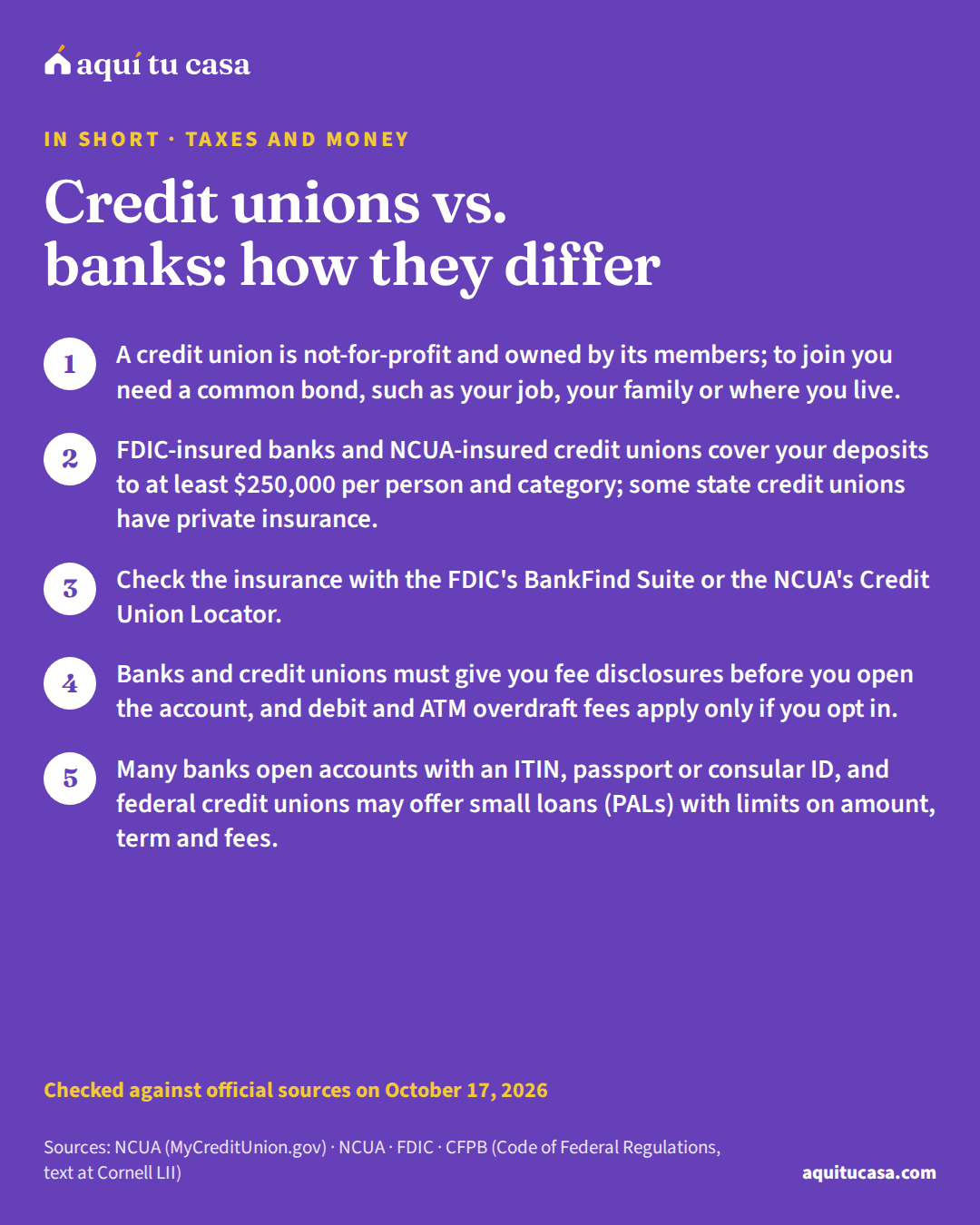
- Taxes and money Credit unions vs. banks: how they differ Credit unions and banks: who can join, NCUA and FDIC insurance, fees and overdrafts, accounts with an ITIN, small-dollar loans and CDFIs. 11 minute read
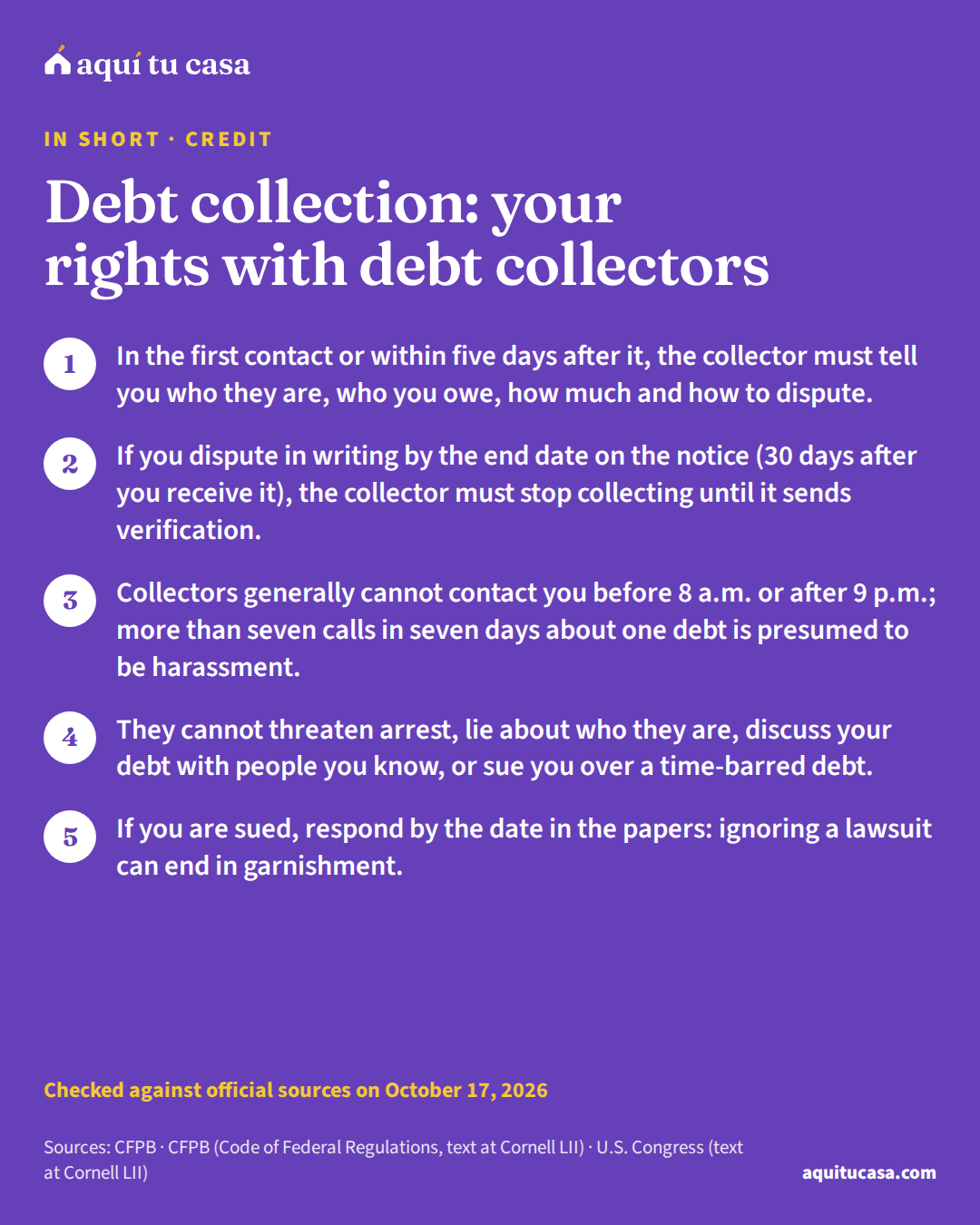
- Credit Debt collection: your rights with debt collectors What a debt collector must tell you, how to dispute in writing, when and how often they can call, old debts, and what to do if you are sued. 16 minute read
Tools for this topic
Was this guide useful?
Thank you. Your answer stays in your browser; nothing is sent.