LIHEAP: help paying for power, gas and heat
What LIHEAP is, who qualifies, how to apply in your state, crisis help when a shutoff is coming and free weatherization (WAP) to lower your bills.
Verified against official sources on October 17, 2026 11 official sources

Show contents
In short
What you need to know
Quick answer
LIHEAP is a federally funded program that helps low-income households pay for heating, cooling and, depending on the state, electricity; it also gives crisis help if a shutoff is coming, and can pay for improvements so your home uses less energy. You apply at your state or county LIHEAP office, and each state sets its own requirements within the law's limits. If you do not know where your office is, call the national hotline at (866) 674-6327 or 211. Because funds run out, apply as soon as you need help.
What matters most
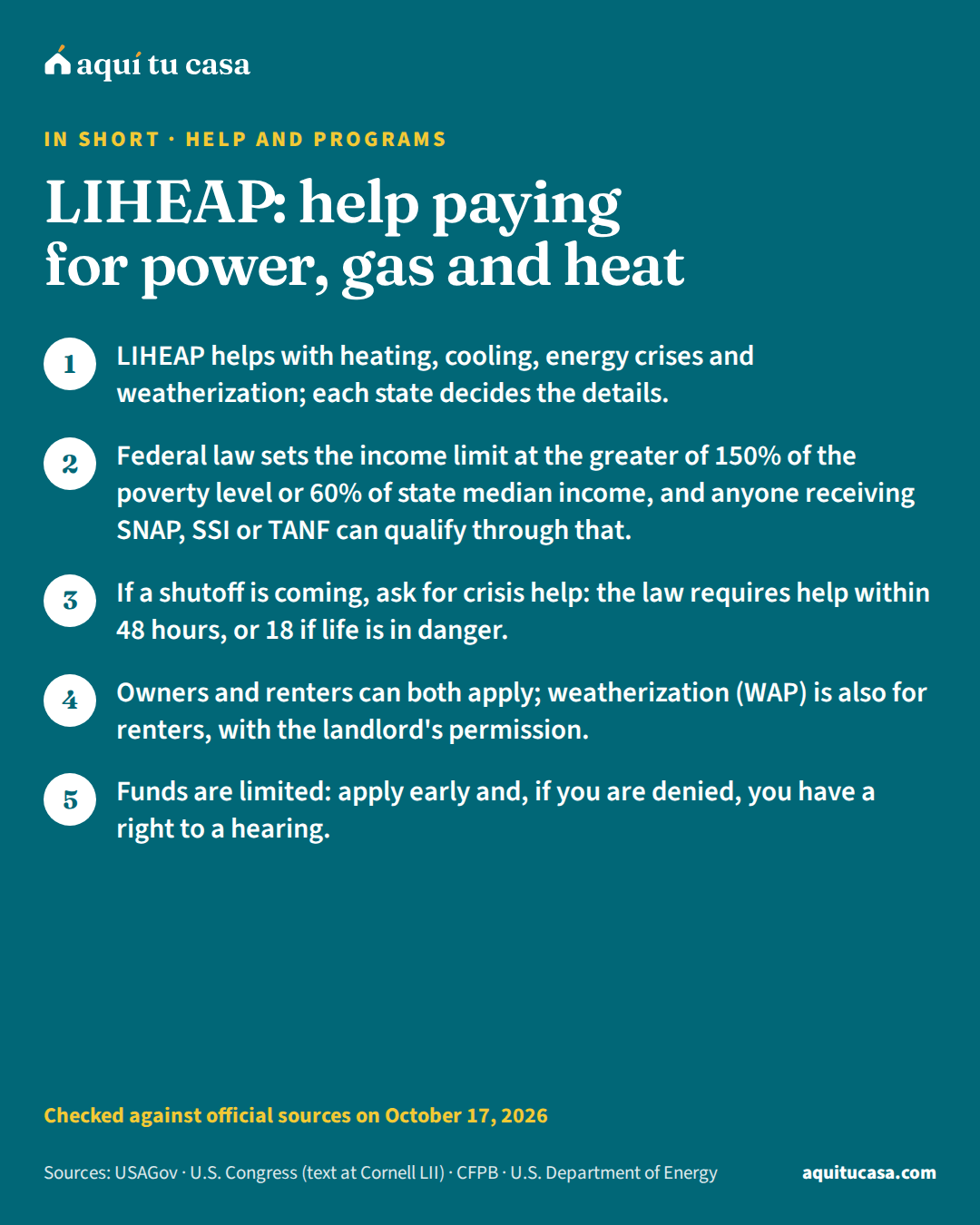
- LIHEAP helps with heating, cooling, energy crises and weatherization; each state decides the details.
- Federal law sets the income limit at the greater of 150% of the poverty level or 60% of state median income, and anyone receiving SNAP, SSI or TANF can qualify through that.
- If a shutoff is coming, ask for crisis help: the law requires help within 48 hours, or 18 if life is in danger.
- Owners and renters can both apply; weatherization (WAP) is also for renters, with the landlord's permission.
Is this for you?
This guide is for you if…
- You are struggling to pay for electricity, gas or heat and want to know whether government help exists.
- You got a shutoff notice and need help fast.
- Your home uses a lot of energy and you want to know whether you can improve it for free.
Get direct help first if…
- Your landlord cut off your water or power to make you leave: that is illegal in many states; start with the guide on illegal lockouts and utility shutoffs.
- Your main problem is rent: start with the guide on what to do if you can't pay your rent.
- There is danger from gas, fire or no heat with someone sick at home: call 911.
When the electric or gas bill goes up, many families have to choose between paying for the service or for food. This guide is for anyone who needs help with those bills: it explains what LIHEAPLIHEAP (Low Income Home Energy Assistance Program)LIHEAP (the Low Income Home Energy Assistance Program) is a federally funded program that helps with home energy costs, such as heating and cooling. According to the Administration for Children and Families (ACF), it can help with bills, energy crises, preventing shutoffs or reconnecting service, weatherization and minor energy-related repairs. It targets low-income households with a high energy burden or with members who are elderly, disabled or young children. You apply through your local LIHEAP office, and the program does not charge a fee for help.See the full definition is, who qualifies, how to apply in your state, what to do if you already got a shutoff notice and how free weatherization can lower your bills every month.
What LIHEAP is and what it pays for
LIHEAP is the Low Income Home Energy Assistance Program. USAGov explains that it can help you pay heating or cooling bills or get emergency services during an energy crisis, and that depending on where you live you may also get help with your electric bill.1
The money is federal, but each state runs its own program. The law says states use those funds for three things: helping with home energy costs, especially for the lowest-income households that spend a high share of income on energy; intervening in energy crises; and paying for low-cost weatherization and energy-related home repairs.2
Often the state pays the utility directly. In that case, the law requires that you be told how much was paid for you, that the utility bill you only for the difference and that no one treat you worse because you receive the help.2
Three kinds of help
LIHEAP
Help with the bill
Urgent
Crisis help
You may need all three: help with the bill today and weatherization to spend less tomorrow.2
Who qualifies
Every state and territory has its own requirements, but all are based on income.1 Federal law sets the frame: a state may only help households in which someone receives TANF, SSI (Supplemental Security Income), SNAP (food stamps) or certain veterans’ payments, or households whose income is no higher than the greater of two limits: 150% of the state’s poverty level or 60% of state median income. And it may not exclude a household solely on income if it earns less than 110% of the poverty level.2
Within that frame, the state decides. Illinois, for example, sets its limit each year based on funding, never above 60% of state median income.10 The law asks states to give the most help to households with the lowest incomes and highest energy costs, taking family size into account, and to reach out especially to households with older or disabled members.2
Do you rent? The law requires states to treat owners and renters equitably.2 If you live in federally assisted housing and pay some or all of your heating out of pocket, you cannot be automatically denied LIHEAP because you receive a utility allowance, although the state may consider it when setting the amount.2
How to apply in your state
From the first call to getting help
1. Find your local office
Today
Call the national energy referral hotline or 211 if you do not know where it is.4
2. Check your state's requirements
Before you go
Eligibility is based on income, but each state has its own rules.1
3. Gather your papers
Before the appointment
ID, proof of income, your lease and whatever your state asks for.11
4. Apply
As soon as the program opens
Some places let you apply online; others require you to go in person.1
5. If a shutoff is coming, ask for crisis help
With the notice in hand
The law requires a response within 48 hours, or 18 if life is in danger.3
6. If you are denied, ask for a hearing
After the decision
The law gives you the right to a fair hearing if you are denied or get no timely answer.2
If you do not know where your office is, the CFPB points to two routes: the National Energy Assistance Referral Hotline, (866) 674-6327, and 211, from a cell phone or landline.4 Some examples of how it works in different states:
- Texas: the program is called CEAP and is run by local providers that cover all 254 counties.9 The Texas Department of Housing and Community Affairs (TDHCA) does not take applications from individuals: on its “Help for Texans” page you choose the type of help and your city or county, and it lists organizations; some may be out of funds.8
- California: CSD offers one-time help with the bill (HEAP), crisis help (ECIP) and free weatherization through local providers.7
- Illinois: there is a list of agencies by county, and the Help Illinois Families call center answers at 1-833-711-0374.10
- North Carolina: households with someone 60 or older, or with disabled people receiving services through the Division of Aging, sign up December 1-31; everyone else from January 1 through March 31 or until funds run out.11

If you already got a shutoff notice: crisis help
Do not wait for the shutoff date. Federal law requires each state’s crisis program to provide some form of help that resolves the crisis no later than 48 hours after an eligible household applies, and no later than 18 hours if the household is in a life-threatening situation.3 In California, the crisis program (ECIP) gives the example of a household that receives a 24-48 hour disconnect notice.7
Each state has different rules on when utilities can disconnect electricity or gas for non-payment; they may depend on the current weather and on which utility you have.1 The guide on utility shutoffs explains those notices and protections. If your landlord cut the service to force you out, that is a different problem: read the guide on illegal lockouts and utility shutoffs.

Weatherization: spending less every month
The Department of Energy’s Weatherization Assistance Program (WAP) reduces energy costs for low-income households by making their homes more energy efficient, while ensuring their health and safety.6 Under DOE guidelines, households with incomes up to 200% of the poverty guidelines or receiving SSI qualify, and each state may use the LIHEAP limit of 60% of state median income. Priority goes to older adults, families with a member with a disability, families with children and high energy users. Both owners and renters can apply.5
How it works: you find your state administrator and local provider, who will ask for proof of income for the prior year, such as pay stubs or Social Security payments. If you qualify, you go on a waitlist. If you rent, the provider works with you and your landlord to get permission. Before the work, an auditor inspects your home and runs an air-leak test.5 USAGov also points you to your state’s WAP office.1

Other help: utility discounts and 211
LIHEAP is not the only help. In California, CSD lists programs run by the utilities: CARE, a 30-35% discount on the bill; FERA, for families earning a bit more than the CARE limit; and a no-cost weatherization program (ESA) for those who meet CARE guidelines. To sign up, call your electric utility.7
In any state, 211 helps you find resources for rent or utility bills, and some HUD-approved housing counseling agencies offer free or low-cost rental counseling (800-569-4287).4 A housing counselorHUD-approved housing counselorA HUD-approved housing counselor works at an agency HUD has approved to provide housing counseling: independent, expert advice customized to your situation about buying a home, renting, a missed mortgage payment, a foreclosure or credit problems. The agencies usually charge little or nothing; many serve in Spanish and offer the homebuyer education course several assistance programs require. They are not lenders or real estate agents and sell you nothing. Your county page lists the official agencies with phone numbers.See the full definition can help you build a plan. The guide on what to do if you can’t pay your rent gathers housing help, and the family budget guide helps you sort out the month’s expenses.
If you are denied
Funds are limited. In California, CSD warns that some eligible households may not get a benefit so that those with the greatest need come first,7 and in Texas providers may be out of funds.8 That is why it pays to apply as soon as the program opens.
If you are denied or do not get an answer with reasonable promptness, federal law requires the state to give you the opportunity for a fair administrative hearing.2 Illinois, for example, publishes an appeal rights poster.10 Ask for the decision in writing and how to appeal.
If this is you
You are an older adult
The law asks states to reach households with older members first, and in North Carolina they sign up earlier, in December.211
You rent and the power bill is in your name
Owners and renters must be treated equitably.2 For weatherization, the provider asks your landlord for permission.5
Your family has mixed immigration status
Some states require at least one household member to meet citizenship or status rules.11 Talk to a DOJ-accredited representative before you decide.
Your service will be cut in days
Ask for crisis help with the notice in hand: the law requires a response within 48 hours, or 18 if there is danger.3

Costly mistakes
Mistake: Waiting until the shutoff date to ask for help.
Instead: Ask for crisis help as soon as the notice arrives.3
Mistake: Thinking you cannot get LIHEAP because you rent.
Instead: Owners and renters must be treated equitably.2
Mistake: Applying late in the season.
Instead: Funds run out: apply as soon as your state's program opens.11
Mistake: Taking a no without asking questions.
Instead: Ask for the decision in writing and a hearing if you are denied.2
Mistake: Stopping at this month's help.
Instead: Also ask for weatherization so you spend less every month.6
What to do this week
- Call the National Energy Assistance Referral Hotline, (866) 674-6327, or 211 to find your LIHEAP office.4
- Ask which requirements and documents your state needs and when applications open.1
- Gather your latest bill, proof of your household’s income and the shutoff notice if you have one.11
- If a shutoff is coming, ask for crisis help and say whether anyone at home is sick or in danger.3
- Ask about weatherization (WAP) and, if you rent, let your landlord know you will need their permission.5
- If you are denied, ask for the decision in writing and a hearing; a HUD-approved housing counselor can help you with a plan.24
Your household this month
Let's do the math
Left each month
Enter what at least one person takes home to see the result.
What helps
- Pay savings first: set the goal aside the day the money arrives, before flexible spending.
- Add up the bills that come every few months (car insurance, school) and divide by twelve.
- If income changes, plan on a low month and save the extra from good months.
- A HUD-approved housing counselor can go over the budget with you, often for free.
This is a planning tool with your numbers, not a credit evaluation or an approval. The split reference is only a guide.
Ready to see the numbers? Find your county here
See how this applies in your county: its loan limits, prices and rents, from the official data.
Printable checklist
Frequently asked questions
What is LIHEAP?
It is the Low Income Home Energy Assistance Program. With federal funds, each state helps pay heating or cooling bills, provides emergency services in an energy crisis and, depending on where you live, helps with electric bills. It can also pay for improvements so your home uses less energy.
Who qualifies for LIHEAP?
It depends on the state, but within federal law: households in which someone receives TANF, SSI, SNAP or certain veterans' payments, or households with incomes no higher than the greater of 150% of the poverty level or 60% of state median income. A state cannot exclude you solely on income if you earn less than 110% of the poverty level.
Where and how do I apply for LIHEAP?
At your state or county LIHEAP office. Some places let you apply online and others require you to apply in person. If you do not know your office, call the National Energy Assistance Referral Hotline at (866) 674-6327 or 211.
I got a shutoff notice. Is there quick help?
Yes: ask for LIHEAP crisis help. Federal law requires the crisis program to provide some form of assistance that resolves the problem within 48 hours after an eligible household applies, or 18 hours if life is in danger. Bring the shutoff notice when you apply.
Can I get LIHEAP if I rent?
Yes. The law requires states to treat owners and renters equitably. If you live in federally assisted housing and pay part of your heating, you cannot be automatically denied LIHEAP because you receive a utility allowance. For weatherization, the provider asks your landlord for permission.
What is weatherization (WAP)?
It is a Department of Energy program that makes your home more efficient so you spend less, while protecting your health and safety. Under its guidelines, households with incomes up to 200% of the poverty guidelines or receiving SSI qualify, with priority for older adults, people with disabilities and families with children. There may be a waitlist.
Do I need a Social Security number or immigration papers?
It depends on the state. North Carolina, for example, asks for the Social Security number and verification of citizenship or alien status, and the household must have at least one citizen or non-citizen who meets the criteria. Ask your local office; if your family has mixed status, talk first with a DOJ-accredited representative or free legal aid.
Can I be denied even if I qualify?
Yes, because funds are limited. California says some eligible households may not get a benefit so that those with the greatest need come first, and in Texas providers may be out of funds. If you are denied or get no timely answer, the law gives you the right to a fair hearing.
Sources
Every figure in this guide comes from one of these official sources. The number next to a sentence leads to the source behind it.
Each source on one line: who publishes it, its title, its address and the date we read it.
- 1. USAGov · Get help with energy bills · usa.gov · Accessed October 17, 2026
- 2. U.S. Congress (text at Cornell LII) · Low-Income Home Energy Assistance Act, 42 U.S.C. §8624, Applications and requirements · law.cornell.edu · Accessed October 17, 2026
- 3. U.S. Congress (text at Cornell LII) · Low-Income Home Energy Assistance Act, 42 U.S.C. §8623, Allotment of funds (energy crisis intervention) · law.cornell.edu · Accessed October 17, 2026
- 4. CFPB · Get help paying rent and bills · consumerfinance.gov · Accessed October 17, 2026
- 5. U.S. Department of Energy · How to Apply for Weatherization Assistance · energy.gov · Accessed October 17, 2026
- 6. U.S. Department of Energy · Weatherization Assistance Program · energy.gov · Accessed October 17, 2026
- 7. California Department of Community Services and Development · Low Income Home Energy Assistance Program (LIHEAP) · csd.ca.gov · Accessed October 17, 2026
- 8. Texas Department of Housing and Community Affairs · Help for Texans · tdhca.texas.gov · Accessed October 17, 2026
See the other 3 sources
- 9. Texas Department of Housing and Community Affairs · Comprehensive Energy Assistance Program (CEAP) · tdhca.texas.gov · Accessed October 17, 2026
- 10. Illinois Department of Commerce and Economic Opportunity · Utility Bill Assistance (LIHEAP) · dceo.illinois.gov · Accessed October 17, 2026
- 11. North Carolina Department of Health and Human Services · Low Income Energy Assistance (LIEAP) · ncdhhs.gov · Accessed October 17, 2026
Keep reading
Related guides
If this guide helped, these follow the same path.

Money problems 13 minute read
Can't pay your rent: what to do and where to get help
If you can't cover the rent: how to talk to your landlord, where to find rental assistance (211, local programs, HUD) and what an eviction requires.
- Talk to your landlord before you fall further behind: landlords very rarely prefer an eviction to getting paid, and many assistance programs need their help.
- Start local: programs in your city, county or state, and 211; assistance can take several weeks to arrive.
- LIHEAP helps with power and gas bills year-round; HUD-approved counselors (800-569-4287) who offer rental counseling can help you make a plan.
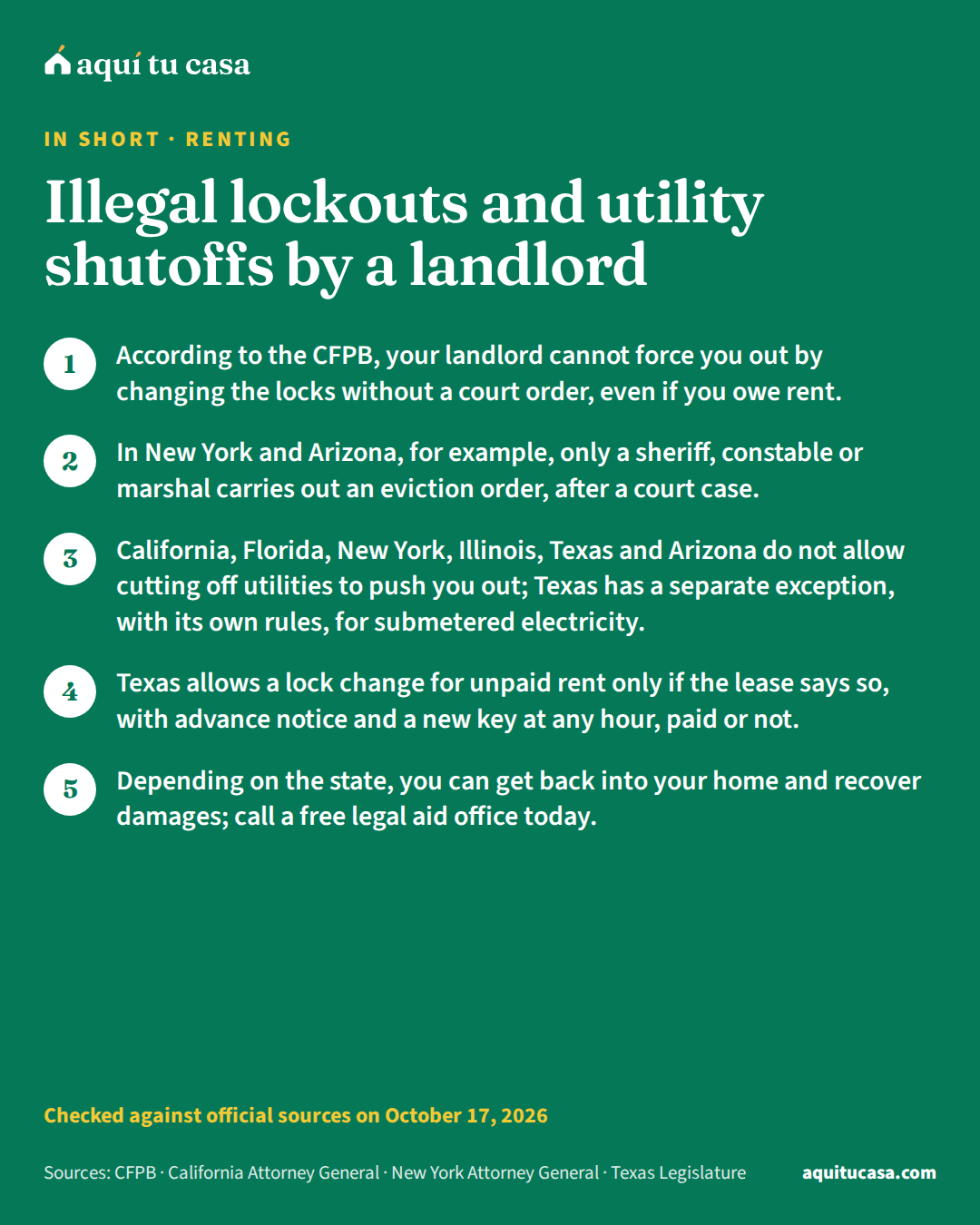
- Renting Illegal lockouts and utility shutoffs by a landlord If your landlord changed the locks, removed your things or cut off water or power to make you leave: what several states' laws say and what to do today. 12 minute read
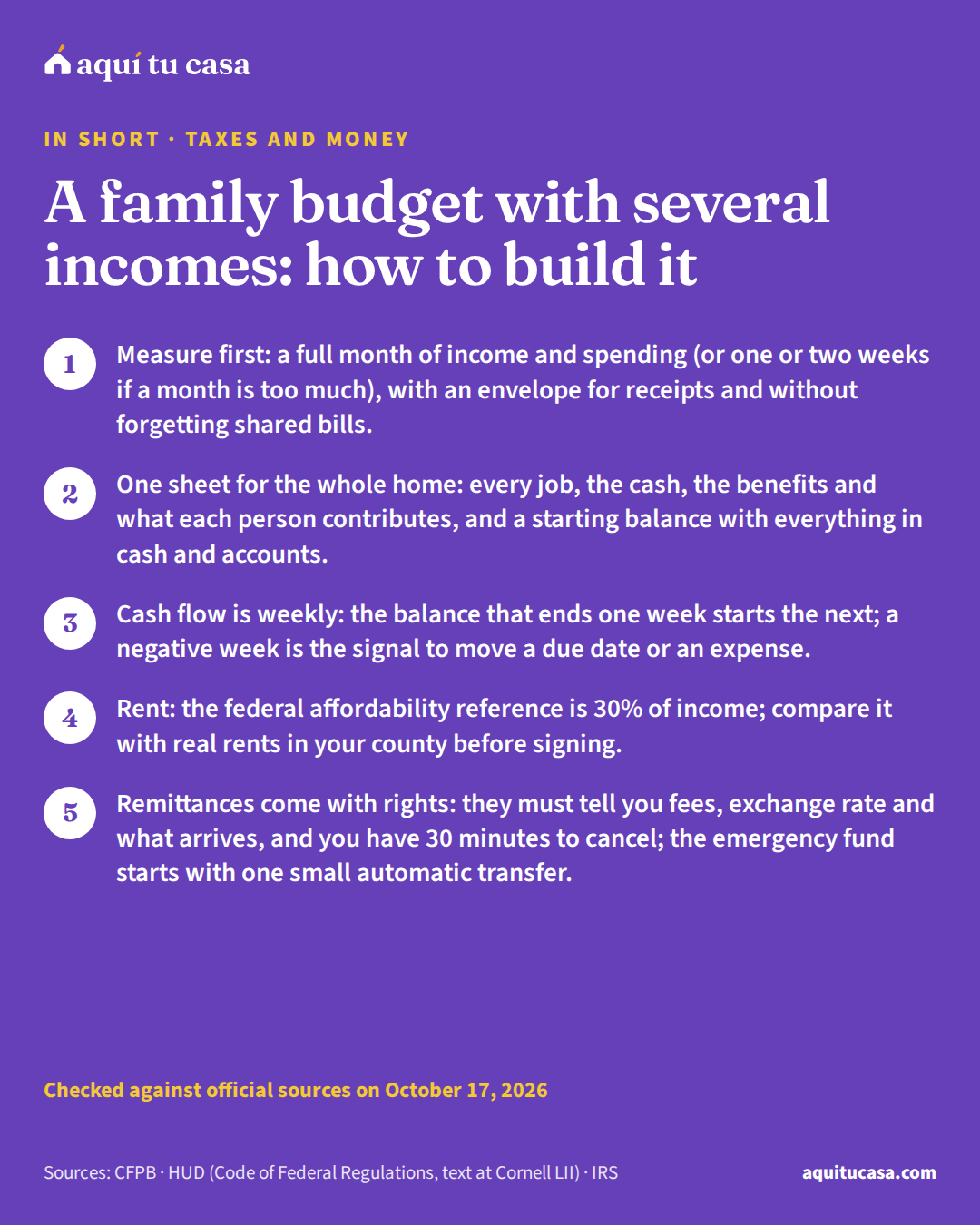
- Taxes and money A family budget with several incomes: how to build it How to budget when several incomes, cash and remittances come into the home: tracking, weekly cash flow, rent and the emergency fund. 11 minute read
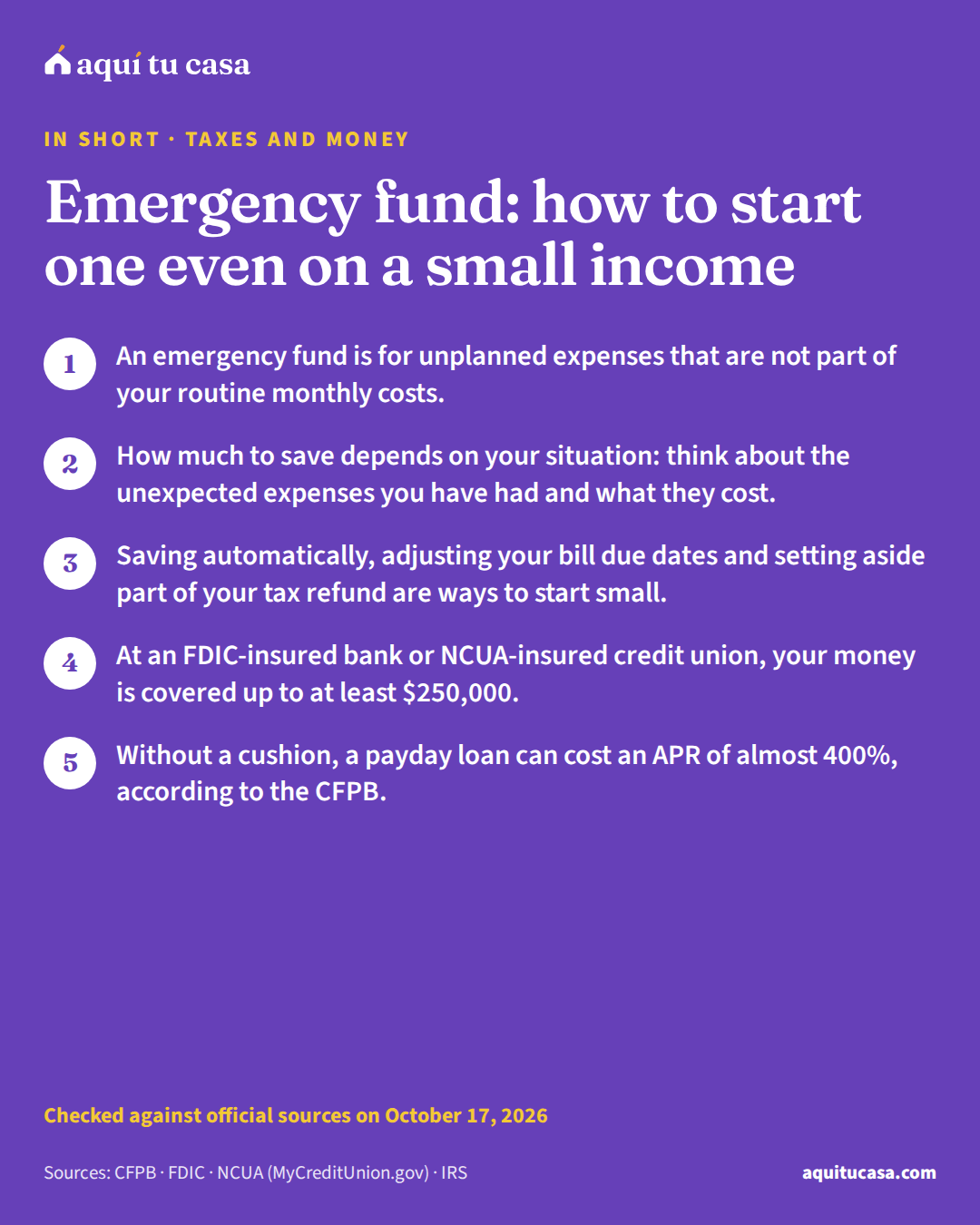
- Taxes and money Emergency fund: how to start one even on a small income What an emergency fund is, how much to save for your situation, how to start with little money, where to keep it safe and what it costs not to have one. 10 minute read
Tools for this topic
Was this guide useful?
Thank you. Your answer stays in your browser; nothing is sent.