Buying a home Essential guide
Closing Disclosure explained: what to check before signing
What the Closing Disclosure is, when it must reach you, what to check on each of its five pages and which closing costs are not allowed to go up.
Verified against official sources on October 17, 2026 18 official sources

Show contents
In short
What you need to know
Quick answer
The Closing Disclosure is the five-page form with the final numbers of your mortgage. The lender must make sure you receive it at least three business days before you sign, precisely so you can compare it with your Loan Estimate. Check page 1 (rate, payment, penalties), page 2 (closing costs: the lender's own charges cannot go up) and page 3 (the cash you bring). If something changed and you do not know why, ask before closing; signing the disclosure only confirms you received it, not that you accept the loan.
What matters most
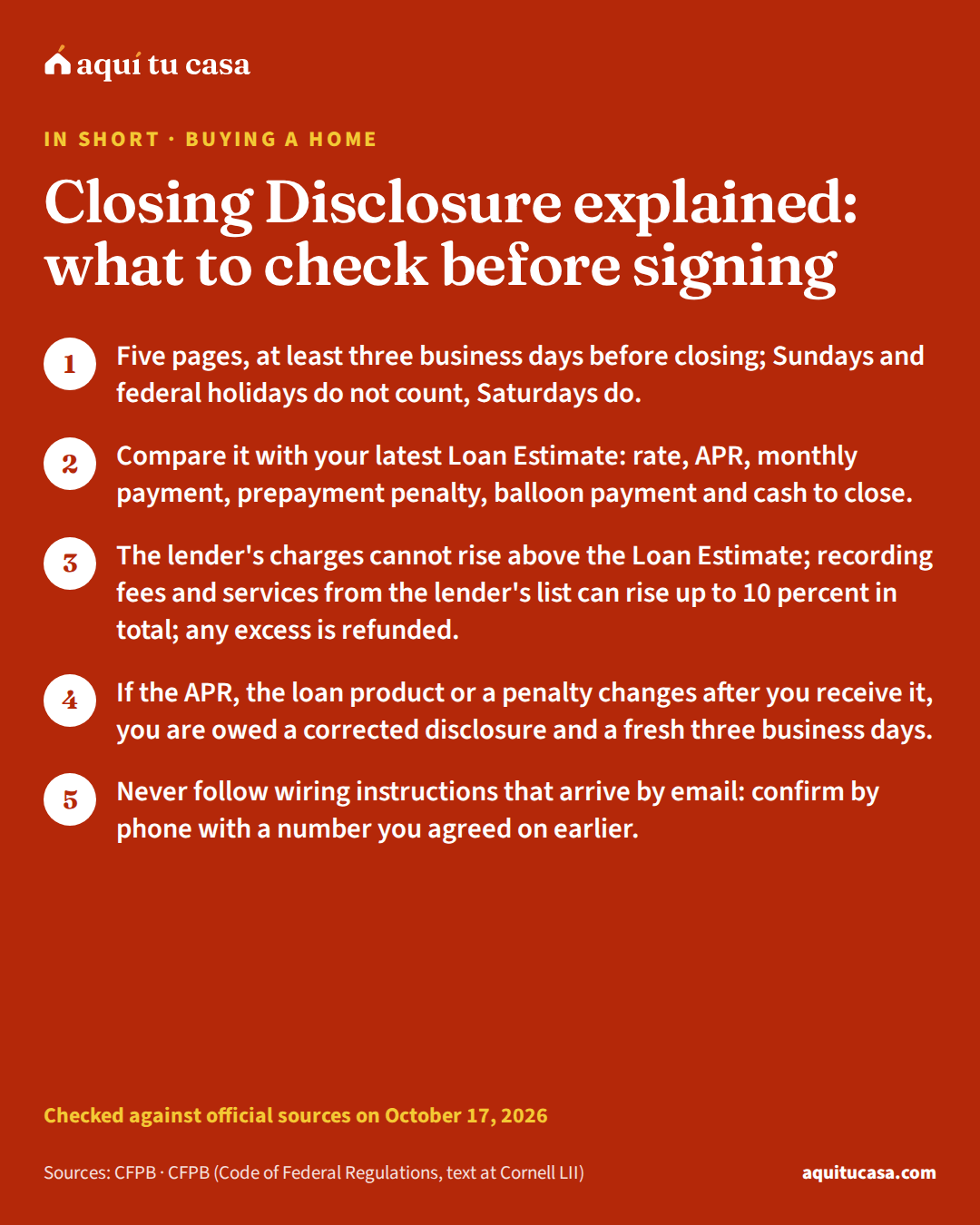
- Five pages, at least three business days before closing; Sundays and federal holidays do not count, Saturdays do.
- Compare it with your latest Loan Estimate: rate, APR, monthly payment, prepayment penalty, balloon payment and cash to close.
- The lender's charges cannot rise above the Loan Estimate; recording fees and services from the lender's list can rise up to 10 percent in total; any excess is refunded.
- If the APR, the loan product or a penalty changes after you receive it, you are owed a corrected disclosure and a fresh three business days.
Is this for you?
This guide is for you if…
- Your Closing Disclosure just arrived, closing is days away and you want to know what to look at and what to ask.
- A number changed from your Loan Estimate and you do not know whether that is allowed.
- You are closing soon and want to protect yourself from the email scam with changed wiring instructions.
Get direct help first if…
- Your loan is a refinance or a home equity line: the pages are similar, but you also have a right to cancel that this guide only mentions.
- You are still comparing lenders: read the closing costs guide first and ask for several Loan Estimates.
The Closing DisclosureClosing DisclosureThe Closing Disclosure is a required five-page form with the final details of the mortgage you selected: the loan terms, your monthly payment, every closing cost and how much cash you must bring on signing day. The lender must give it to you at least three business days before closing, so you can compare it with your Loan Estimate and ask about any change. If an important number changes, the three-day period starts again. Keep it: you will need it for your taxes.See the full definition is the document that sums up your mortgage as it will actually be: rate, monthly payment, closing costs and the money you bring to the signing. It arrives days ahead so you can read it calmly. This guide is for anyone about to close: it walks you through it page by page and tells you what to compare with your Loan Estimate, which costs are not allowed to rise and what to do if something does not add up.
What it is and when it must reach you
According to the CFPB, the Closing Disclosure is a five-page form with the final details of the loan you selected: the terms, the projected monthly payments and the closing costsclosing costsClosing costs are all of the costs you pay on closing day on top of the down payment: lender fees, the appraisal, the credit report, title insurance, the closing agent's fees, any transfer taxes your state or county charges and the first deposits into the escrow account. The lender must itemize them on the Loan Estimate within days of your application and confirm them on the Closing Disclosure before you sign. Some can be paid by the seller, and several state programs help cover them.See the full definition. The lender must provide it at least three business days before closingclosingClosing, also called settlement, is the last step in buying and financing a home: the moment when you and the other parties sign the necessary documents. Once you sign, you are responsible for repaying the mortgage. The lender sends the loan money to the settlement agent, who pays the seller and distributes the closing costs; the seller signs the deed that makes you the owner, and the documents are recorded with the county. Depending on the state, everyone signs together at a table or signatures are collected separately, sometimes online. Before you sign, read everything and ask about anything you do not understand.See the full definition; those days are for comparing its terms and costs with the Loan EstimateLoan EstimateThe Loan Estimate is a three-page form you receive from the lender within days of applying for a mortgage. In the same format at every bank, it sums up the terms of the loan being offered: amount, interest rate, whether the payment can change, the estimated monthly payment with taxes and insurance, the itemized closing costs and how much cash you need at closing. Because every lender uses the same form, it lets you compare offers side by side. It commits you to nothing: requesting one is not accepting the loan.See the full definition you received at the start and asking your questions before you get to the table.1 The Loan Estimate is the three-page form the lender must give you within three business days of receiving your application; because every lender uses the same form, it is built for comparing offers.2
The three-day rule is in Regulation Z: the lender must make sure you receive the Closing Disclosure no later than three business days before the loan is signed. If after delivering it the APR becomes inaccurate, the loan product changes or a prepayment penalty is added, it has to give you a corrected disclosure and count three business days again.3 For this deadline, “business day” means every calendar day except Sundays and federal holidays; Saturday counts.4
Who sends it? It can come from the lender or the closing agentsettlement agentThe settlement agent (also called a closing agent) is the person or company that coordinates the closing so that everything the contract requires is accounted for. Depending on the location, it may be a title company, an escrow company (in most western states) or a closing attorney (in some eastern states). It collects the money from the lender and from you, pays the seller, distributes the closing costs and records the documents with the county. It works for all the parties; it is not your personal representative. Ask it how to pay the money you need to bring to closing.See the full definition, by email, by postal mail or through a website. The CFPB suggests asking how it will reach you at least a week before closing and keeping your most recent Loan Estimate at hand.7
Your three days, step by step
From the week before closing to the signing
1. You ask how it will reach you
A week before closing
It can come from the lender or the closing agent. Ask for the promissory note, the mortgage and the deed in advance too.7
2. You receive the Closing Disclosure
No later than 3 business days before signing
Saturdays count toward this deadline; Sundays and federal holidays do not.4
3. You check pages 1 and 3
Day one
Compare the loan amount, rate, payment and cash to close with your latest Loan Estimate. If they do not match, call the lender.6
Try it with your numbersMortgage calculator4. You check page 2
Day two
See which costs changed and which group they belong to: some cannot rise at all and others can rise up to 10% as a group.3
Try it with your numbersClosing costs5. You ask questions and request corrections
Before signing day
If the APR becomes inaccurate, the loan product changes or a prepayment penalty is added, you are owed a corrected disclosure and a new three business days.3
6. You do a final walk-through of the home
Before you sign
Check that agreed repairs are done and that anything the seller agreed to leave is there.8
8. If you were overcharged, you get the difference back
Up to 60 days after
The regulation gives the lender up to 60 days after closing to refund the excess.3
If something else changes, other than the APR, the loan product or a penalty, the lender must give you the corrected disclosure by the time you sign, with no new three-day wait. You also have the right to see the disclosure, filled in with what is known so far, on the business day before the signing. And the regulation lets the closing agent deliver it instead of the lender.3
The CFPB puts it simply: use your three days wisely.7 Read it as soon as it arrives, not the night before.

Page 1: the loan terms
The first page has three blocks. “Loan Terms” gives the amount, the interest rateinterest rateThe interest rate on a mortgage is what you pay each year to borrow the money, expressed as a percentage of the loan balance. It does not include fees or other charges; that is what the annual percentage rate (APR) is for. On a fixed-rate loan the rate never changes over the life of the loan; on an adjustable-rate loan it can go up or down after an initial period. The rate you are offered depends on your credit score, your down payment, the loan type and the market, and you see it on the first page of the Loan Estimate.See the full definition, the monthly principal-and-interest payment, and whether any of those can rise after closing; also whether the loan has a prepayment penalty or a balloon payment. “Projected Payments” adds the loan payment, mortgage insurance and the estimated escrow for taxes and insurance, and shows how it changes over the years. “Costs at Closing” has two numbers: total closing costs and cash to close. The CFPB says that if the terms do not match your Loan Estimate, call the lender immediately and ask why they changed.6
First, check your name: the CFPB warns that even a minor misspelling can cause big problems later. If the loan amount went up, ask why: one possible reason is that closing costs were rolled into the loan, which lowers what you pay at signing but raises your overall cost through interest. And if you locked your rate with a rate lockrate lockA rate lock (or lock-in) means your interest rate will not change between the offer and closing, as long as you close within the agreed time frame and your application does not change. Rates can change daily; if yours is not locked, it can change at any time. Even when locked, it can change if your loan amount, credit score, verified income or appraisal changes. Extending a lock can cost money, and if rates fall you may be stuck with the higher rate. The first page of the Loan Estimate says whether your rate is locked and until when.See the full definition, the lender may only change it under limited circumstances.6
Two boxes on this page worth understanding:
- Prepayment penaltyprepayment penaltyA prepayment penalty is a fee some lenders charge if you pay off all or part of your mortgage early. Not every mortgage has one; if yours does, you agreed to it at closing. According to the CFPB, it usually applies if you pay off the whole balance within a certain number of years, for example when you sell or refinance, and sometimes if you pay a large amount at once; it does not normally apply to small extra principal payments. Many states limit these penalties. The Loan Estimate says whether the loan has one, and the details may be in the note or an addendum.See the full definition. A fee some lenders charge if you pay off all or part of the loan early; it typically applies only if you pay off the entire balance (through a sale or a refinancing) within a set number of years, usually three or five, and it does not apply to small extra principal payments.12
- Balloon paymentballoon paymentA balloon payment is a large, one-time payment at the end of the loan term, higher than the payments before it and sometimes much higher. On the Loan Estimate, "Balloon Payment" means any payment that is more than two times a regular payment. Loans with a balloon payment usually have shorter terms and lower monthly payments that do not pay off the whole debt. If you cannot make the final payment, you may have to refinance or sell the home, or face foreclosure. With limited exceptions, a Qualified Mortgage (QM) cannot have a balloon payment.See the full definition. A large, one-time payment at the end of the loan term; the CFPB calls it risky because, if you cannot make it, you could lose the home.13 Its explainer adds that it is often tens of thousands of dollars.6
If either box says “YES” and you were not expecting it, do not sign until you understand why.
The total monthly payment is almost always higher than principal and interest, because it adds taxes and insurance. Mortgage insurance is typically required when the down payment is less than 20% of the price. The CFPB recommends making sure you can comfortably afford that total every month.6
Example with real numbers
How the monthly payment on a typical home adds up
With the typical US home value ($332,700), an FHA loan with the minimum down payment and the average 30-year rate as of November 5, 2026 (7.18%).
- Principal and interest
- $2,213
- Mortgage insurance (MIP)
- $147
- Property taxes, in escrow
- $261
- Homeowners insurance, in escrow (example estimate)
- $139
- Estimated total monthly payment
- $2,759
This is an example with national numbers. On your disclosure, the “Projected Payments” block adds up these same parts;6 compare its total with your latest Loan Estimate.6 Put in your own numbers with the calculator.
Run it with your numbersMortgage calculator
Page 2: closing costs, line by line
The second page breaks the closing costs into two tables. “Loan Costs” holds the lender’s origination charges (including discount pointsdiscount pointsDiscount points are a payment you make to the lender at closing in exchange for a lower interest rate over the life of the loan. Each point costs a percentage of the loan amount. The opposite is lender credits: the bank lowers your closing costs today in exchange for a higher rate. Buying points only pays off if you keep the loan long enough for the monthly savings to exceed what you paid. Points appear on the Loan Estimate, in section A of the closing costs.See the full definition), the services you could not shop for (such as the appraisalhome appraisalAn appraisal is a written document that gives a professional appraiser's opinion of how much a property is worth. The lender orders it before approving the mortgage, because the home is the loan's collateral and the lender does not want to lend more than it is worth. If the appraisal comes in below the price you agreed, the bank bases the loan on the lower value and you will have to cover the difference, renegotiate the price or walk away if your contract allows it. An appraisal is not an inspection: it measures value, not the home's condition.See the full definition) and the services you could shop for (such as title insurance or the inspection). “Other Costs” holds taxes and government fees, prepaid items (the first days of interest, the homeowner’s insurance premium), the initial escrow deposit and other charges. At the bottom come total closing costs and lender credits. The CFPB recommends checking that the prices of the services you shopped for match what you agreed and asking about any service you do not recognize.6
Compare the services you did not shop for with blocks B and C of your Loan Estimate. No new services should appear; costs should be similar, though they may change a little. If you see a company you did not choose, ask the lender what the charge is for and how that company was chosen.6 The closing costs guide explains each block of the Loan Estimate, letter by letter.
What many people do not know: not every cost may rise above the Loan Estimate. Under Regulation Z, an estimated charge counts as made in good faith only if what you pay does not exceed what you were told, with exceptions; for third-party services where the lender let you choose the provider and for recording fees, the total may rise up to 10 percent in aggregate; and if you were charged more than those tolerances allow, the lender must refund the excess no later than 60 days after closing.3 The CFPB explains it in three groups:
What can change between the Loan Estimate and the Closing Disclosure
Without a change in circumstances
Cannot go up
Without a change in circumstances
Up to 10% as a group
With a change in circumstances (a different kind of loan or down payment, a different appraisal, a change in your credit or income that could not be documented), these limits do not apply.5
Page 3: cash to close
The third page explains where the final number comes from. “Calculating Cash to Close” compares each line with the Loan Estimate and flags whether it changed. “Summaries of Transactions” sums up what you owe at closing (price, costs) and what you already put in or are credited: the earnest moneyearnest moneyEarnest money is a deposit the buyer pays when signing the purchase contract to show good faith that the offer is serious. The seller does not keep it: a neutral third party (the title company or a closing agent) normally holds it, and at closing it is applied to your down payment or closing costs. If you back out for a reason the contract allows, such as an inspection or financing contingency, you get it back; if you back out without a valid reason, you can lose it.See the full definition, the loan, seller credits and adjustments for taxes or dues the seller already paid. The CFPB recommends checking that the seller credit reflects what you agreed with the seller.6
Do not mix up two numbers. “Total Closing Costs” is the total cost of your loan and the purchase, not counting your down payment. “Cash to Close” is the money you actually bring to closing. That payment is typically made by cashier’s check or wire transfer; ask the closing agent how to make it. Depending on where you live, that person may be called a “settlement agent,” an “escrow agent” or a “closing attorney.”6
Sometimes something changes in the last few days. For example, if the seller did not make an agreed repair, they might give you money toward your closing costs (a seller credit) instead.8 If that happens, check that the credit appears on this page. The closing cost calculator helps you see whether your cash to close makes sense with your numbers.
Pages 4 and 5: the fine print that matters
The fourth page, “Loan Disclosures”, says what happens if you pay late, whether the lender accepts partial payments, whether you will have an escrowescrow accountAn escrow account is an account set up by your mortgage lender to pay certain property-related expenses on your behalf, mainly property taxes and homeowners insurance. The money comes from a portion of your monthly mortgage payment: each month you contribute a share and the loan servicer pays the bills when they come due. That is why your payment is higher than principal and interest alone, and why it can change when taxes or the insurance premium go up. In some states the word also names the period between the offer and the closing.See the full definition account and how much goes into it, and whether the loan has assumption, demand or negative-amortization features. The CFPB suggests asking questions until you understand exactly what happens if you cannot make a payment in full.6
Three details on that page: if one month you cannot pay in full, the lender may not accept a partial payment, or may hold it aside without applying it to your loan. Homeowners association (HOA) dues are often not in escrow, so you pay them separately. And some lenders charge a fee if you choose not to have escrow. Most loans do not allow assumptions or have negative amortization.6
The fifth page has the calculations for the whole loan, several warnings and the contacts. The “Total of Payments” is what you will pay over the life of the loan if you make every payment on time; the “Finance Charge” is the total of interest and fees; and the “Total Interest Percentage” (TIP) helps you compare loans.6 The quickest way to see whether your costs rose is to compare the APRannual percentage rate (APR)The annual percentage rate (APR) is a broader measure of the cost of borrowing money than the interest rate. Besides the interest, it includes certain loan charges, such as discount points and some lender fees, spread over the life of the loan and expressed as a yearly percentage. That is why the APR is almost always a little higher than the interest rate. It is useful for comparing offers: if two loans have the same interest rate but a different APR, the one with the higher APR charges more in fees.See the full definition on this page with the one on your Loan Estimate.7
Under Regulation Z, the disclosure also includes:14
- The closing date and the disbursement date.
- A notice: if there was an appraisal, you are entitled to a copy at no additional cost.
- “Liability after Foreclosure”: whether, under your state’s law, you could still owe money after a foreclosure. The form suggests consulting an attorney about it; your state’s free legal aid can point you in the right direction.
- A table with the name, address and NMLS or license number of the lender, the mortgage broker, the real estate brokers and the settlement agent. With those numbers you can look up every license before you sign.
If you find an error or something does not add up
The CFPB says that if you find an error in your closing documents, you should call the lender or the settlement agent right away to have it corrected. Common errors range from a misspelled name or a wrong number in the address to an incorrect loan amount or missing pages, and they can delay closing by a few hours or a few days. Its advice: ask to see every document in advance and never assume they were prepared correctly.9
No one should rush you. The CFPB says you should never feel pressured to sign and that you can ask the lender whether help is available in your preferred language.10 For family members who read Spanish, the CFPB’s Spanish-language toolkit, “Su conjunto de herramientas para préstamos hipotecarios,” has a section on understanding and using the Closing Disclosure.11 If the problem is not fixed, raise it with the lender and, if needed, submit a complaint to the CFPB online or at (855) 411-2372; the CFPB forwards it to the company and works to get you a response, generally in 15 days.9
If this is you
You would rather have it explained in Spanish
Ask the lender whether help is available in your language; no one should pressure you to sign.10 Bring this guide and your questions in writing.
You are buying with someone else
Ask for the deed and the other key documents in advance, and check that every name is right.7 A misspelled name can delay closing.9
You are using a loan from an assistance program
For the loan from certain homebuyer assistance programs you do not get a Closing Disclosure, but a “Truth-in-Lending” disclosure.1 Ask which form comes with each loan.
You are on active military duty
The CFPB says your installation's legal office can review your contracts for free.7
The other papers you sign that day
According to the CFPB, besides the Closing Disclosure you will receive these papers:16
- The promissory notepromissory noteThe promissory note (or simply the note) is the document you sign at closing to promise you will repay the loan to the lender. It describes what you are agreeing to: how much you owe, the interest rate, the payment dates, the total you will pay, the length of the loan, whether the payments can change and where to send them. It is separate from the mortgage or deed of trust, the document that gives the lender the right to take the home if you do not pay. Some terms, such as a prepayment penalty, may be in an addendum to the note. You can ask for copies of the documents before closing to review them.See the full definition. It describes what you are agreeing to: the amount, the rate, the payment dates, the term and where to send payments.
- The mortgage or security instrument (also called a deed of trustdeed of trustThe deed of trust is, along with the "mortgage," one of the most common names for the security instrument you sign at closing. With it, the home becomes collateral for the loan: if you do not make the payments or break the agreement, the lender can take the home and sell it to pay off the loan. Your signature on this document must be notarized. It is separate from the promissory note, which is your promise to pay. In some states, the lender can foreclose without going to court by following the notices in a "power of sale" clause in this document.See the full definition). It explains your rights and responsibilities and lets the lender foreclose if you do not pay as agreed.
- The initial escrow statement. It lists the taxes, premiums and other charges the lender expects to pay from the account in the first year.
- Documents from your state, your city and the lender, such as an affidavit that you will live in the home.
If the loan is not for buying (for example, a refinancing), you also receive the notice of your right to cancel within three business days.16
The CFPB reminds you that you have the right to take your time and review every document, and that if the answers do not add up you should not be afraid to stop the closing. You are not committed until you sign. You can walk away, although you might lose the deposit you gave the seller and the application or appraisal fees you paid, and breaking the contract can bring other consequences. Never sign blank documents.8
The closing scam: the email that changes the account
For many families the closing money is years of savings. Ask the closing agent how they prefer to receive it and confirm the destination account in person or by phone on the same day you send it. The housing scams guide has more warning signs of wire fraudwire fraud at closingThis is a scam aimed at people about to close on a home. Days before closing, the scammer sends an email that looks like it comes from your real estate agent or settlement agent with "new" instructions to wire or electronically transfer your down payment or closing costs to a different account. If it works, getting the money back can be very hard. The CFPB recommends writing down two trusted contacts ahead of time, confirming any instructions with them using only those numbers, and not using phone numbers or links in the email. If it happens to you, call your bank right away to stop or reverse the transfer.See the full definition.

Costly mistakes
Mistake: Leaving the reading for the night before or for the closing table.
Instead: Read it as soon as it arrives and use the three business days to ask questions.7
Mistake: Signing without comparing it with your latest Loan Estimate.
Instead: Compare the APR, loan amount, rate and cash to close, and ask about every difference.7
Mistake: Assuming the documents are right because a professional prepared them.
Instead: The CFPB says never to assume it: check names, addresses and amounts.9
Mistake: Leaving homeowners association dues out of your budget.
Instead: Check on page 4 what goes into escrow: those dues often do not.6
Mistake: Signing blank documents or documents that say something different from what you agreed.
Instead: Do not sign until they match what you accepted.8
Mistake: Wiring closing money with instructions that came by email.
Instead: Confirm the account in person or at the phone number you already knew.17
What to do this week
- Ask the lender or the closing agent how the disclosure will reach you, and ask for the promissory note, the mortgage and the deed in advance.7
- Save the Closing Disclosure the moment it arrives and write down the date you received it.1
- Compare page 1 (rate, payment, penalties), page 3 (cash to close) and the APR with your latest Loan Estimate; mark every difference.6
- On page 2, check that the lender’s charges did not rise and that the services you shopped for cost what you agreed.3
- Call the lender with your questions within the three days; if a big change arrives late, ask whether a corrected disclosure and a new waiting period apply.3
- Confirm the payment instructions by phone with your trusted contact, never from an email.17
- If you want a second reading, a HUD-approved housing counselor can go through it with you.18
Your numbers
Starts at the typical home value in the United States. Change it to the price you have in mind.
That is $11,645 (3.5% of the price). The usual minimum for this loan is 3.5%.
This week's average ± a quarter or half point.
National average as of November 5, 2026 (Freddie Mac); your rate may be different.
Adjust advanced details
Let's do the math
Estimated monthly payment
National figure$2,759
at 7.18% · 30 years
- Loan amount
- $326,673
- Total interest
- $470,006
- Paid off in
- November 2056
Includes $5,618 FHA upfront mortgage insurance premium.
Does it fit the income?
Comfortable
up to $1,884 a month
Tight
$1,884 to $2,422 a month
Hard
more than $2,422 a month
Your payment · 41%
Compared with the typical household income in the United States ($80,734 a year). Reference: HUD calls paying more than 30% of income for housing a cost burden.
| Principal & interest | $2,213 |
|---|---|
| Property tax | $261 |
| Home insurance | $139 |
| FHA mortgage insurance (MIP) | $147 |
How does it compare with incomes?
For this payment to be 28% of your income, you'd need to earn about $118,260 a year. With your other debts, to stay under 36%: about $91,980 a year.
You need at least $11,645 for the down payment, plus closing costs.
This is an estimate to give you an idea, not a loan offer. Your real payment depends on your rate, your credit, and the insurance and taxes on the home you buy.
Total monthly payment $2,759; principal and interest $2,213.
Ready to see the numbers? Find your county here
See how this applies in your county: its loan limits, prices and rents, from the official data.
Printable checklist
Frequently asked questions
What if I get the Closing Disclosure less than three days before closing?
The deadline is the lender's, not yours: it must make sure you receive it at least three business days before you sign. If it arrives late, the closing has to move to respect the three days. Say so in writing to the lender and the closing agent, and do not sign in a hurry.
Can I negotiate charges that appear on the Closing Disclosure?
What you can demand is that the lender's charges not exceed what the Loan Estimate said and that the services you shopped for cost what you agreed. If a figure rose beyond the tolerances the regulation allows, ask for the correction before signing; if you signed and find it later, the excess must be refunded within 60 days.
Does signing the Closing Disclosure commit me to the loan?
No. If the form has the 'Confirm Receipt' line, the regulation's wording says that by signing you are only confirming you received the document and that you do not have to accept the loan because you signed or received it. The CFPB explains that you are not committed until you sign the closing documents, such as the promissory note and the mortgage.
Is the Closing Disclosure available in Spanish?
The Spanish version of this guide explains each block in Spanish, and the CFPB publishes its home loan toolkit in Spanish, 'Su conjunto de herramientas para préstamos hipotecarios', with a section on the Closing Disclosure. The CFPB also says you can ask the lender whether help is available in your preferred language and that you should never feel pressured to sign. You can go over it with someone you trust or a HUD-approved housing counselor, often for free or at low cost.
What do I do if I find an error on my Closing Disclosure?
The CFPB says to contact your lender or settlement agent right away to have it corrected. A misspelled name or a wrong amount can delay closing by a few hours or a few days, so review it as soon as it arrives. If the problem continues, you can submit a complaint to the CFPB online or at (855) 411-2372.
Can I back out on closing day?
According to the CFPB, you are not committed until you sign the closing documents, and you can always walk away if you are not comfortable. But you might lose the deposit you gave the seller, face other consequences for breaking the purchase contract and lose application or appraisal fees you paid. Read your contract before you go to closing.
How can I quickly tell whether my costs went up?
The CFPB suggests comparing the APR on the Closing Disclosure with the APR on your latest Loan Estimate: it is an easy way to see whether your costs increased. Then check page 2 to see which charges changed and which group they belong to.
Why is my monthly payment higher than principal and interest?
Because the total payment adds mortgage insurance, if you need it, and escrow for property taxes and homeowners insurance. On a typical home with an FHA loan, principal and interest come to $2,213 a month and the estimated total payment reaches $2,759. Your own figure is in the 'Projected Payments' block on page 1.
Sources
Every figure in this guide comes from one of these official sources. The number next to a sentence leads to the source behind it.
Each source on one line: who publishes it, its title, its address and the date we read it.
- 1. CFPB · What is a Closing Disclosure? · consumerfinance.gov · Accessed October 17, 2026
- 2. CFPB · What is a Loan Estimate? · consumerfinance.gov · Accessed October 17, 2026
- 3. CFPB (Code of Federal Regulations, text at Cornell LII) · Regulation Z, 12 CFR §1026.19, Certain mortgage and variable-rate transactions · law.cornell.edu · Accessed October 17, 2026
- 4. CFPB (Code of Federal Regulations, text at Cornell LII) · Regulation Z, 12 CFR §1026.2, Definitions and rules of construction · law.cornell.edu · Accessed October 17, 2026
- 5. CFPB · Can my final mortgage costs increase from what was on my Loan Estimate? · consumerfinance.gov · Accessed October 17, 2026
- 6. CFPB · Closing Disclosure Explainer · consumerfinance.gov · Accessed October 17, 2026
- 7. CFPB · Owning a Home: Review documents before closing · consumerfinance.gov · Accessed October 17, 2026
- 8. CFPB · Owning a Home: Close the deal · consumerfinance.gov · Accessed October 17, 2026
See the other 10 sources
- 9. CFPB · What should I do if I find an error in one of my mortgage closing documents? · consumerfinance.gov · Accessed October 17, 2026
- 10. CFPB · Credit discrimination is illegal · consumerfinance.gov · Accessed October 17, 2026
- 11. CFPB · Su conjunto de herramientas para préstamos hipotecarios: guía paso a paso (Your home loan toolkit, Spanish edition) · files.consumerfinance.gov · Accessed October 17, 2026
- 12. CFPB · What is a prepayment penalty? · consumerfinance.gov · Accessed October 17, 2026
- 13. CFPB · What is a balloon payment? When is one allowed? · consumerfinance.gov · Accessed October 17, 2026
- 14. CFPB (Code of Federal Regulations, text at Cornell LII) · Regulation Z, 12 CFR §1026.38, Content of disclosures for certain mortgage transactions (Closing Disclosure) · law.cornell.edu · Accessed October 17, 2026
- 15. CFPB (Code of Federal Regulations, text at Cornell LII) · Regulation Z, 12 CFR §1026.37, Content of disclosures for certain mortgage transactions (Loan Estimate) · law.cornell.edu · Accessed October 17, 2026
- 16. CFPB · What documents should I receive before closing on a mortgage loan? · consumerfinance.gov · Accessed October 17, 2026
- 17. CFPB · Mortgage closing scams: How to protect yourself and your closing funds · consumerfinance.gov · Accessed October 17, 2026
- 18. CFPB · Find a Housing Counselor · consumerfinance.gov · Accessed October 17, 2026
Keep reading
Related guides
If this guide helped, these follow the same path.

Buying a home 14 minute read
Closing costs explained: what you pay and what can change
What closing costs are, how to read them on your Loan Estimate, which charges cannot go up before closing and how to compare offers to pay less.
- Closing costs are what you pay to get the loan and transfer the home to you; together with the down payment they make up your cash to close.
- The Loan Estimate sorts them by letter: A, B and C are loan costs; E, F, G and H are taxes, prepaids, escrow and other; J is the total.
- Lender charges and transfer taxes cannot go up; recording fees and services picked from the lender's list can rise up to 10% as a group, unless there is a change in circumstances.
- Buying a home How to buy a home in the United States, step by step The nine steps to buying a home: paperwork, credit, budget, assistance, preapproval, offer, inspection, closing and the first year, with official sources. 15 minute read
- Buying a home Home inspection: what it covers and when to get it What a home inspection is, how it differs from the appraisal, when to get it under a contingency, radon and lead tests, and what to do with the report. 12 minute read
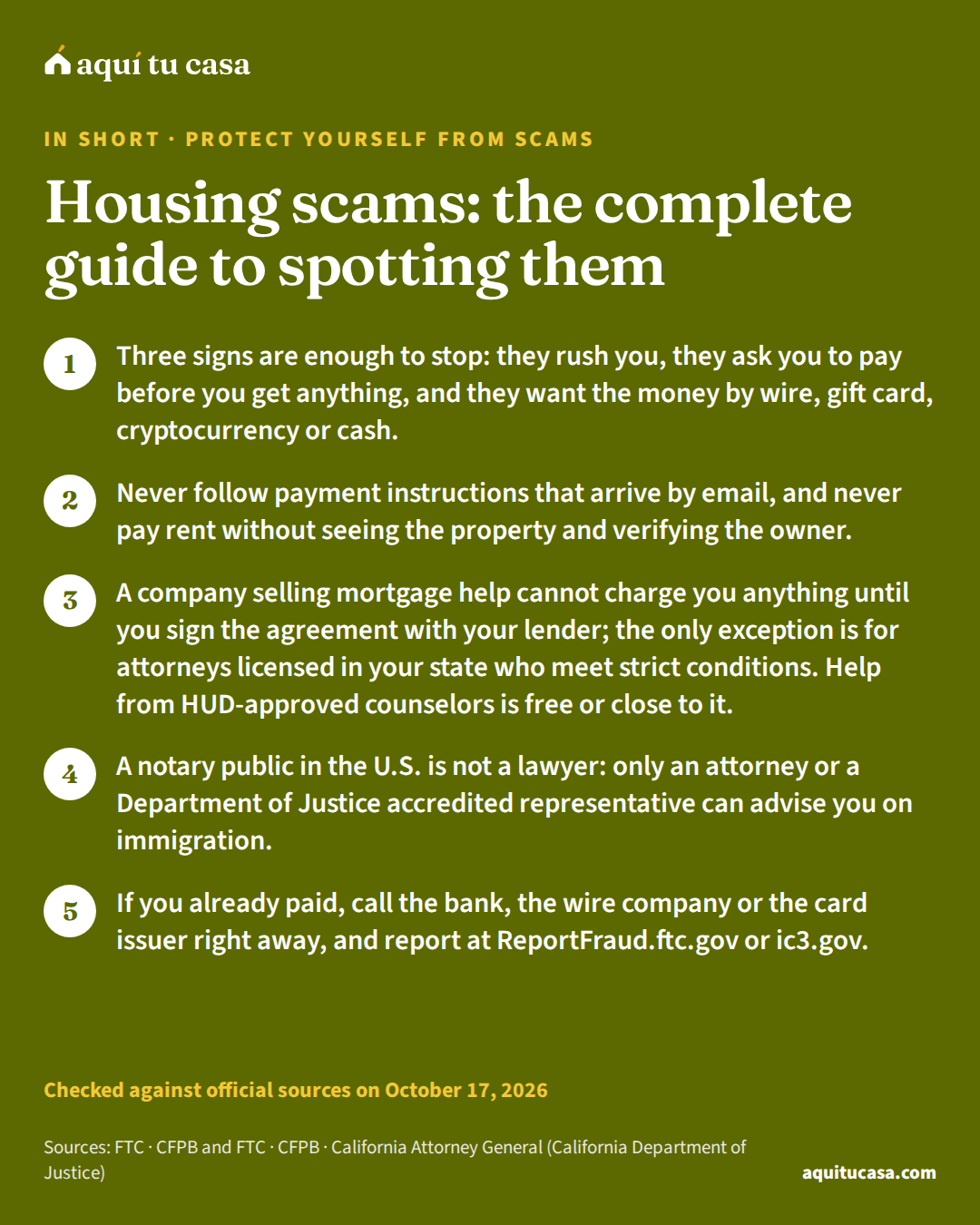
- Protect yourself from scams Housing scams: the complete guide to spotting them The rental, mortgage, title, contractor, credit and moving scams families run into most: how to spot them, what to do and where to report them. 17 minute read
Tools for this topic
Was this guide useful?
Thank you. Your answer stays in your browser; nothing is sent.