Mortgage Credit Certificates (MCC): how they work
What an MCC is, how much it can cut your federal tax, who issues it, how to claim it on Form 8396 and when you might repay part of it if you sell.
Verified against official sources on October 17, 2026 12 official sources

Show contents
In short
What you need to know
Quick answer
A Mortgage Credit Certificate (MCC) is issued by a state or city housing agency when you buy your main home with a new mortgage. Each year it lets you subtract from your federal tax a percentage of the interest you paid: the certificate rate runs from 10% to 50%, and if it exceeds 20% the credit is capped at $2,000 a year. You claim it on Form 8396. You must request it before you get the mortgage, and if you sell within 9 years you may repay part of the benefit.
What matters most
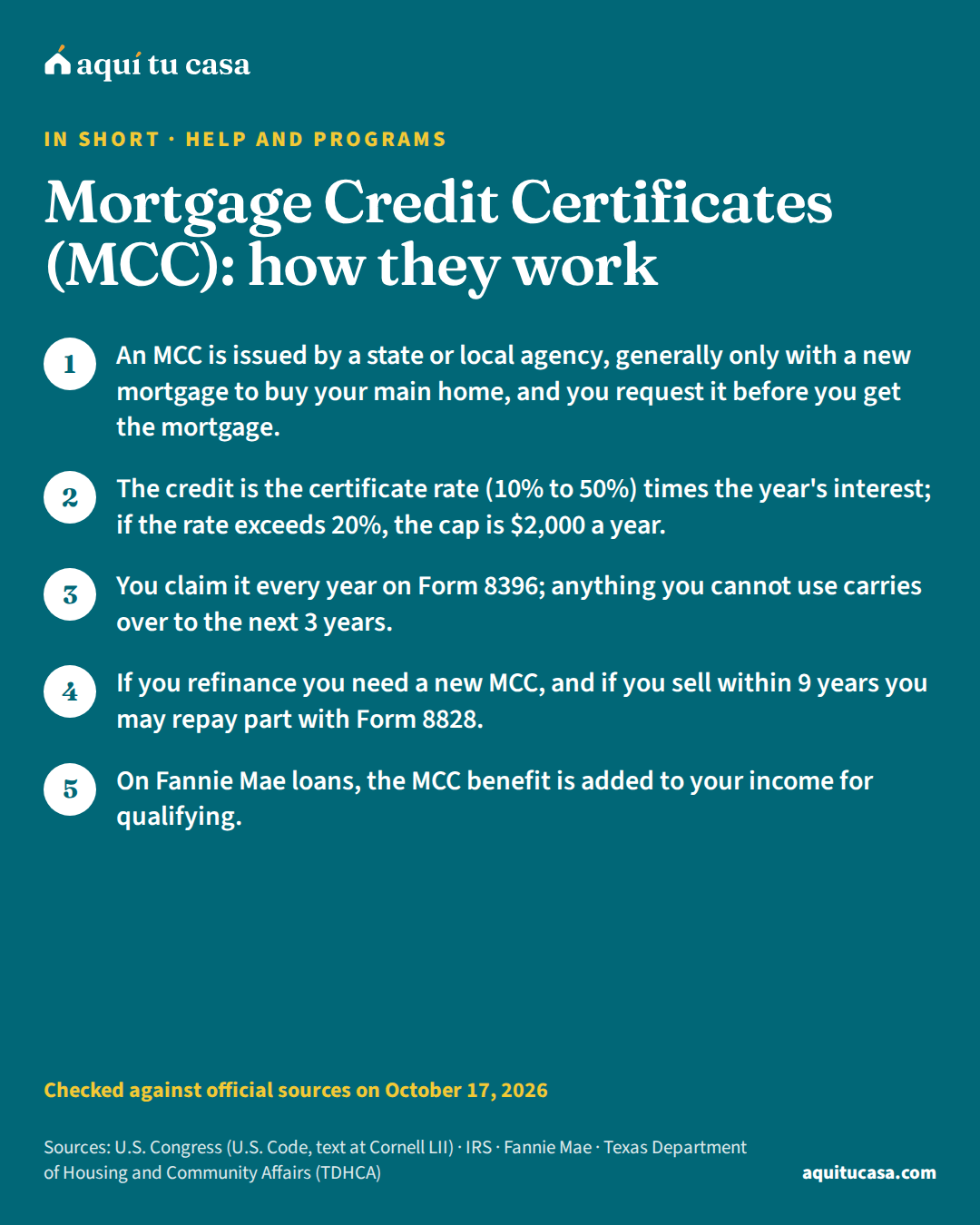
- An MCC is issued by a state or local agency, generally only with a new mortgage to buy your main home, and you request it before you get the mortgage.
- The credit is the certificate rate (10% to 50%) times the year's interest; if the rate exceeds 20%, the cap is $2,000 a year.
- You claim it every year on Form 8396; anything you cannot use carries over to the next 3 years.
- If you refinance you need a new MCC, and if you sell within 9 years you may repay part with Form 8828.
Is this for you?
This guide is for you if…
- You are about to buy your first home and heard that a program in your state or city offers a «tax credit» or MCC.
- You already have an MCC and want to know how to claim it on your return each year.
- You have an MCC and are thinking about refinancing or selling your home.
Get direct help first if…
- You already signed your loan without an MCC: it is generally requested before you get the mortgage; ask your state agency whether any option remains.
- You are looking for down payment money: that is a different kind of help; start with the down payment assistance guide.
Buying a home comes with a bill that lasts for years: mortgage interest. Some states and cities offer a Mortgage Credit Certificate (MCC)mortgage credit certificate (MCC)A mortgage credit certificate (MCC) is a document issued by a state or local housing agency that entitles you to a credit on your federal income tax return for part of the interest you pay on your mortgage each year. Unlike a deduction, the credit directly reduces the tax you owe. You claim it with IRS Form 8396, and any credit you cannot use in one year can be carried forward to the next. Each agency sets who qualifies, normally first-time buyers within income and price limits; you apply through a participating lender.See the full definition that turns part of that interest into a credit against your federal tax, year after year. This guide is for anyone about to buy their first home or who already has an MCC: it explains what it is, how much it can be worth, who issues it, how to claim it and what happens if you refinance or sell, based on the law and IRS pages.
What an MCC is
An MCC is a certificate issued by a state or a political subdivision (a city or a county, for example) under a qualified program. It is issued when you buy, rehabilitate or improve your main home, and it states two numbers: the credit rate and the certified debt amount.1 The IRS explains that the credit is meant to help lower-income people afford home ownership, and that an MCC is generally issued only with a new mortgage to buy your main home.3
With the certificate, each year you subtract from your federal tax a credit equal to the certificate rate times the interest you paid that year on the certified debt.1 A credit comes straight off your tax; the Texas program, for example, describes it as a dollar-for-dollar reduction of your federal tax liability.9

What it is worth: the rate, the cap and your tax
Three rules decide how much it helps. First, the rate: the law says the certificate rate may not be less than 10% or more than 50%.1 Second, the cap: if the rate exceeds 20%, the year’s credit cannot exceed $2,000, and if the home has several owners, that cap is split by each one’s share.1 Third, your tax: after the cap, the credit generally cannot exceed the tax you owe; what you could not use carries over to the next 3 years or until used.3
Only interest on the certified debt counts. If your loan is equal to or smaller than that debt, you count all of the year’s interest; if it is larger, you count only part, based on the ratio of the certified debt to the original loan amount, and that ratio does not change.3
Example with real numbers
How the credit is built on a typical loan
With the FHA loan on a typical US home and this week's average 30-year rate. Your program sets your certificate rate.
- Loan (typical home, FHA, without the upfront premium)
- $321,056
- Average 30-year interest rate (November 5, 2026)
- 7.18%
- The year's credit
- Interest paid in the year × your certificate rate
- If your certificate rate exceeds 20%
- The credit does not exceed $2,000 a year
- What you subtract from your federal tax
- The credit, up to what you owe; the rest carries to the next 3 years
This is an example with national numbers, not a promise.13 With your own loan and rate, the calculator shows how much interest you pay.
Run it with your numbersMortgage calculatorWho can get one
Each program publishes its own rules, but the law sets a base. The certified debt has to meet residence, 3-year, purchase price and income requirements.1 The 3-year rule is the first-time buyerfirst-time homebuyerUnder the definition HUD uses, a first-time homebuyer is a person, and his or her spouse, who has not owned a home during the three years before the purchase. There are exceptions: a single parent or a displaced homemaker is not excluded just because he or she owned a home with a spouse while married. Nor does it count if you only owned a home that was not on a permanent foundation, or one that did not meet building codes and could not be brought up to code for less than the cost of building a new one. Each program may use its own definition.See the full definition rule: no ownership interest in your main home in the 3 years before you sign the mortgage, with exceptions such as targeted-area homes and financing for veterans who have not used it before. The price may not exceed 90% of the average area purchase price, and family income generally may not exceed 115% of the applicable median family income (140% in targeted areas).2
The law also says the program cannot be limited to loans from particular lenders, except as regulations provide; that the certificate cannot be transferred; and that no MCC is issued for a home financed with a qualified mortgage bond.1 The agency must publish the requirements at least 90 days before issuing certificates.1
A real example: the Texas program says it is available to veterans and first-time homebuyers with a first mortgage through the program, and also as a stand-alone option.9 Each state, city or county may have its own, or none: ask in your area.3
If this is you
You are a first-time buyer
The 3-year rule without a home of your own is the base; check your program's income and price limits.2
You are a veteran
The law has an exception to the 3-year rule for veterans who have not used it before.2 Texas, for example, opens its MCC to veterans.9
Several people are buying
If the rate exceeds 20%, the $2,000 cap is split by each owner's share.1
You are buying with an ITIN
Of the 134 programs in our database, in 110 the official source does not say whether they accept an ITIN. Ask your state agency directly.3

How to get one: before the mortgage
Order matters. The IRS says you must contact the government agency that issues the MCC before you get the mortgage and buy your home, for example your state or local housing finance agencystate housing finance agency (HFA)A state housing finance agency (HFA) is a public body created by an act of a state legislature, or by a local government, with the power to finance housing. In that federal definition, "state" includes Puerto Rico and the District of Columbia. Its mission is to increase affordable housing for renters and homebuyers with low to moderate incomes, especially first-time homebuyers. HFAs usually do not lend directly: they work with participating lenders that offer their loans and down payment assistance. Programs vary by state.See the full definition.3
From the program to your tax return
1. Find your state or city program
Before you choose a loan
Contact the housing finance agency before you get the mortgage.3
Try it with your numbersWhich programs might I qualify for?2. Check the requirements
Before you make an offer
Main home, 3 years without owning (with exceptions), price and income.2
3. Close with a new mortgage
Closing day
An MCC is generally issued only with a new mortgage to buy your main home.3
4. Claim the credit every year
With your federal return
Complete Form 8396 and attach it to your 1040, 1040-SR or 1040-NR.3
5. If you refinance, request a new MCC
Before you refinance
Without a new MCC you cannot claim the credit on the new loan.3
6. If you sell, check recapture
Within 9 years
You may repay part of the benefit; it is figured on Form 8828.6
The CFPB says many states and local organizations offer programs for first-time buyers, and suggests looking up a HUD-approved counseling agency or calling the HOPE Hotline, (888) 995-4673, 24 hours a day.10 The which programs do I qualify for tool searches programs in our database, and the down payment assistance guide explains the other kinds of help.
The MCC and your loan
An MCC can also matter when the lender calculates whether you qualify. On loans Fannie Mae buys, MCCs let you claim a credit for a percentage of interest, usually 20% to 25%. To calculate your debt-to-income ratiodebt-to-income ratio (DTI)Your debt-to-income ratio (DTI) is all your monthly debt payments divided by your gross monthly income, that is, income before taxes. If you pay a certain amount each month across a car, cards, student loans and the mortgage you are asking for, and you earn three times that, your DTI is one third. Lenders use it to measure whether you can manage the payment; each loan type and lender sets its own limit, and assistance programs usually publish theirs. Paying down debt before applying improves your DTI.See the full definition, the maximum MCC benefit is added to your income rather than subtracted from the payment, with this formula: loan amount × note rate × MCC percentage ÷ 12. On a purchase, the lender obtains a copy of the MCC.8 Other lenders may have different rules; ask how they count it.
How to claim it every year
Each year you complete Form 8396 and attach it to your return (1040, 1040-SR or 1040-NR).3 The IRS says the form is used to figure the year’s credit and any carryforward to the next year.4 On line 2 you enter your certificate’s credit rate, not your mortgage interest rate, and the form asks for the issuer’s name, the certificate number and its date.5
If you itemize on Schedule A, you must reduce your mortgage interest deduction by the amount of the credit.3 If someone prepares your tax returntax returnA tax return is the yearly form you use to report your income to the IRS and figure the tax you owe, so you can pay what is due or get a refund. The federal return for individuals is Form 1040. In general you must file if your gross income is above the minimum the IRS sets for your filing status, or if you had a certain amount of net earnings from self-employment; even when you do not have to, filing can pay off. You need your SSN or ITIN, and those of everyone else on the return, plus documents such as your W-2s and 1099s.See the full definition, bring your certificate. VITAVITA (free tax preparation)VITA (Volunteer Income Tax Assistance) and TCE (Tax Counseling for the Elderly) are IRS programs that offer free basic tax return preparation by IRS-certified volunteers. They are meant for people with moderate income, people with disabilities and limited-English speakers; TCE focuses on people sixty and older. The IRS sets no program-wide income limit, but individual sites may set their own. Many sites serve in Spanish and help with ITIN applications and renewals. Filing taxes every year builds the record lenders ask for.See the full definition sites prepare basic returns for free for those who qualify, although services vary by site; ask whether they can help with Form 8396.12

The certificate is in effect from its issue date until the agency revokes it or the home stops being your main home.1
If you refinance or sell
If you refinance the loan that had the MCC, you need a new MCC to claim the credit on the new loan, and the credit may change.3 Ask the agency before you sign the refinancerefinanceTo refinance is to take out a new mortgage loan to pay off and replace the one you have. According to the CFPB, common reasons are to lower the interest rate, lower the monthly payment or borrow additional money. When you refinance you usually pay closing costs again. If your payment goes down, the CFPB says to understand how much of the drop comes from a lower rate and how much from a longer loan term. In many refinances you have a right to cancel (right of rescission) until midnight of the third business day, but not if you refinance with the same lender without borrowing more.See the full definition.
If you bought with an MCC and sell within 9 years, you may have to recapture (repay) all or part of the benefit.3 You repay it by increasing your federal income tax for the year of sale, even if you can exclude your gain, and you must file Form 8828 with your return whether you sold at a loss or a gain. If you had a loss, you repay nothing.6 On the form, the gain is multiplied by 50%, and if your income does not exceed your adjusted qualifying income, you do not owe recapture tax either.7
What it gives, what it asks and what it can cost
Every year
What it gives you
Before and after
What it asks of you
Before you sign, ask the agency for its reissuance and recapture rules in writing.36
Questions to ask the agency
The law requires the agency to publish the requirements for the certificate before issuing it, so ask for them in full.1 These questions help you compare and avoid surprises:
- What credit rate does your certificate give, and what is the maximum certified debt?
- What are the income and price limits for my county and my family size?
- Do I have to be a first-time buyer, or is there an exception for veterans or for my area?
- How do I request the certificate, and at what point in the purchase?
- Is there any fee for the certificate, and who charges it?
- Can it be combined with your program’s down payment assistance?
- What happens if I refinance? How do I request reissuance?
- What will you give me in writing about recapture if I sell within 9 years?
- If I buy with an ITIN, do you accept it?
Write down the answers and keep them with your purchase papers. If anything is unclear, a HUD-approved housing counselor can go over the answers with you.11

Costly mistakes
Mistake: Getting the mortgage first and asking about the MCC later.
Instead: Contact the agency before you get the mortgage and buy.3
Mistake: Entering your mortgage rate on Form 8396.
Instead: Line 2 takes your certificate's credit rate.5
Mistake: Claiming the credit and also the full interest deduction.
Instead: If you itemize, reduce your interest deduction by the amount of the credit.3
Mistake: Refinancing without requesting a new MCC.
Instead: Without a reissued MCC you cannot claim the credit on the new loan.3
Mistake: Selling within 9 years without filing Form 8828.
Instead: It is filed with your return, even if you sold at a loss.6
Mistake: Losing credit you could not use.
Instead: The excess carries over to the next 3 years; track it on Form 8396.34
What to do this week
- Look up your state and city housing finance agency and ask whether it offers an MCC.3
- Check its requirements for main home, first-time buyers, price and income.2
- If you have a loan in mind, ask the lender how it counts the MCC for qualifying.8
- Estimate how much interest you would pay with the mortgage calculator.1
- Get help from a HUD-approved housing counselor, often for free or at low cost.11
- If you already have an MCC, keep your certificate with your tax papers for Form 8396.5
Your numbers
Starts at the typical home value in the United States. Change it to the price you have in mind.
That is $11,645 (3.5% of the price). The usual minimum for this loan is 3.5%.
This week's average ± a quarter or half point.
National average as of November 5, 2026 (Freddie Mac); your rate may be different.
Adjust advanced details
Let's do the math
Estimated monthly payment
National figure$2,759
at 7.18% · 30 years
- Loan amount
- $326,673
- Total interest
- $470,006
- Paid off in
- November 2056
Includes $5,618 FHA upfront mortgage insurance premium.
Does it fit the income?
Comfortable
up to $1,884 a month
Tight
$1,884 to $2,422 a month
Hard
more than $2,422 a month
Your payment · 41%
Compared with the typical household income in the United States ($80,734 a year). Reference: HUD calls paying more than 30% of income for housing a cost burden.
| Principal & interest | $2,213 |
|---|---|
| Property tax | $261 |
| Home insurance | $139 |
| FHA mortgage insurance (MIP) | $147 |
How does it compare with incomes?
For this payment to be 28% of your income, you'd need to earn about $118,260 a year. With your other debts, to stay under 36%: about $91,980 a year.
You need at least $11,645 for the down payment, plus closing costs.
This is an estimate to give you an idea, not a loan offer. Your real payment depends on your rate, your credit, and the insurance and taxes on the home you buy.
Total monthly payment $2,759; principal and interest $2,213.
Ready to see the numbers? Find your county here
See how this applies in your county: its loan limits, prices and rents, from the official data.
Printable checklist
Frequently asked questions
What is an MCC?
It is a certificate issued by a state or a political subdivision, such as a city or county, under a qualified program. Each year it lets you claim on your federal return a credit equal to the certificate rate times the mortgage interest you paid on the certified debt.
How much can it save me?
It depends on your certificate rate, how much interest you pay and your tax. The law sets the rate between 10% and 50%; if it exceeds 20%, the credit cannot exceed $2,000 a year. The credit also generally cannot exceed your tax for the year; the rest carries over to the next 3 years.
Where do I apply for an MCC?
At your state or local housing finance agency. The IRS says you must contact the agency before you get the mortgage and buy the home. A HUD-approved housing counselor can also help you find programs.
Do I have to be a first-time buyer?
The law generally requires that buyers have not owned their home in the 3 years before signing the mortgage, with exceptions such as targeted-area homes and certain veterans. Each program publishes its own income and price requirements.
What happens if I refinance?
You need a new (reissued) MCC to keep claiming the credit on the new loan, and the credit may change. Ask the agency that issued your certificate before you refinance.
Do I have to repay the credit if I sell?
If you bought with an MCC and sell within 9 years, you may have to repay part of the benefit on Form 8828. If you sold at a loss you repay nothing, and if your income does not exceed a limit on the form, you do not either. Even so, you must file Form 8828 with your return.
Does an MCC help me qualify for a loan?
On loans Fannie Mae buys, it can: the maximum MCC benefit is added to your monthly income with the formula loan × note rate × MCC percentage ÷ 12. Other lenders may have different rules.
Can I get an MCC if I buy with an ITIN?
It depends on the program: ask your state agency directly. In 110 of the 134 programs in our database, the official source does not say whether they accept an ITIN.
Sources
Every figure in this guide comes from one of these official sources. The number next to a sentence leads to the source behind it.
Each source on one line: who publishes it, its title, its address and the date we read it.
- 1. U.S. Congress (U.S. Code, text at Cornell LII) · 26 U.S.C. §25, Interest on certain home mortgages · law.cornell.edu · Accessed October 17, 2026
- 2. U.S. Congress (U.S. Code, text at Cornell LII) · 26 U.S.C. §143, Mortgage revenue bonds: qualified mortgage bond and qualified veterans' mortgage bond · law.cornell.edu · Accessed October 17, 2026
- 3. IRS · Publication 530 (2025), Tax Information for Homeowners · irs.gov · Accessed October 17, 2026
- 4. IRS · About Form 8396, Mortgage Interest Credit · irs.gov · Accessed October 17, 2026
- 5. IRS · Form 8396, Mortgage Interest Credit (2025) · irs.gov · Accessed October 17, 2026
- 6. IRS · Publication 523 (2025), Selling Your Home · irs.gov · Accessed October 17, 2026
- 7. IRS · Form 8828, Recapture of Federal Mortgage Subsidy (Rev. November 2024) · irs.gov · Accessed October 17, 2026
- 8. Fannie Mae · Selling Guide B3-3.4-10, Mortgage Credit Certificates · selling-guide.fanniemae.com · Accessed October 17, 2026
See the other 4 sources
- 9. Texas Department of Housing and Community Affairs (TDHCA) · Texas Mortgage Credit Certificate Program · welcomehome.tdhca.texas.gov · Accessed October 17, 2026
- 10. CFPB · Where can I find information on programs for first-time home buyers? · consumerfinance.gov · Accessed October 17, 2026
- 11. CFPB · Find a Housing Counselor · consumerfinance.gov · Accessed October 17, 2026
- 12. IRS · Free tax return preparation for qualifying taxpayers (VITA and TCE) · irs.gov · Accessed October 17, 2026
Keep reading
Related guides
If this guide helped, these follow the same path.

Help and programs 12 minute read
Down payment assistance: how it works
What down payment assistance is, the types that exist (grant, forgivable or deferred second loan, tax credit), who qualifies and where to find it.
- It is almost never 'free money': often it is a second loan with no monthly payments that is forgiven over time or repaid when you sell or when it comes due.
- Programs come from states, counties, cities and nonprofits; you apply through a participating lender.
- Almost all ask for income under a cap tied to the area median income and a home price under a limit.
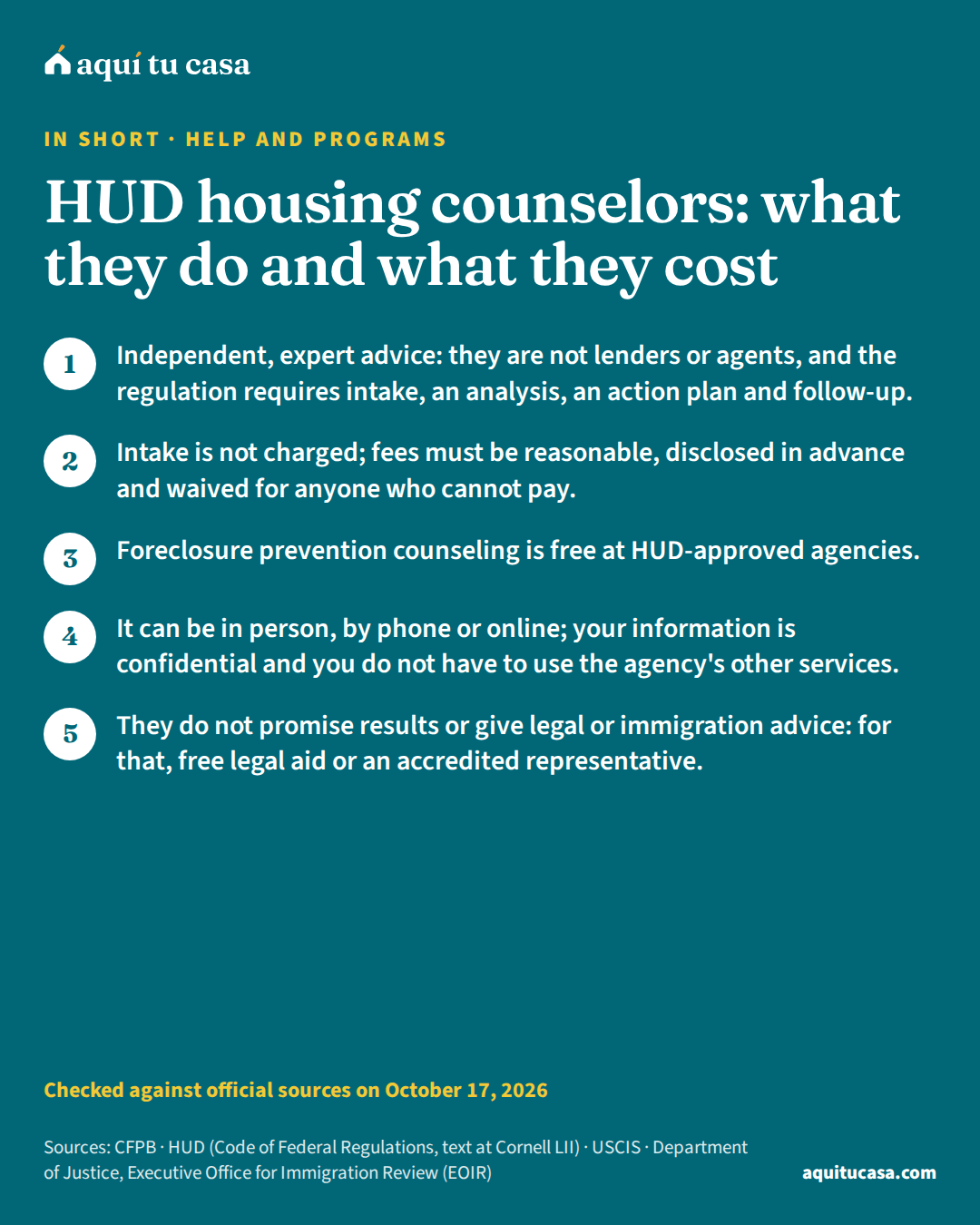
- Help and programs HUD housing counselors: what they do and what they cost What a HUD-approved housing counselor does, what they help with (buying, renting, missed payments, credit), what they may charge and how to find one. 11 minute read
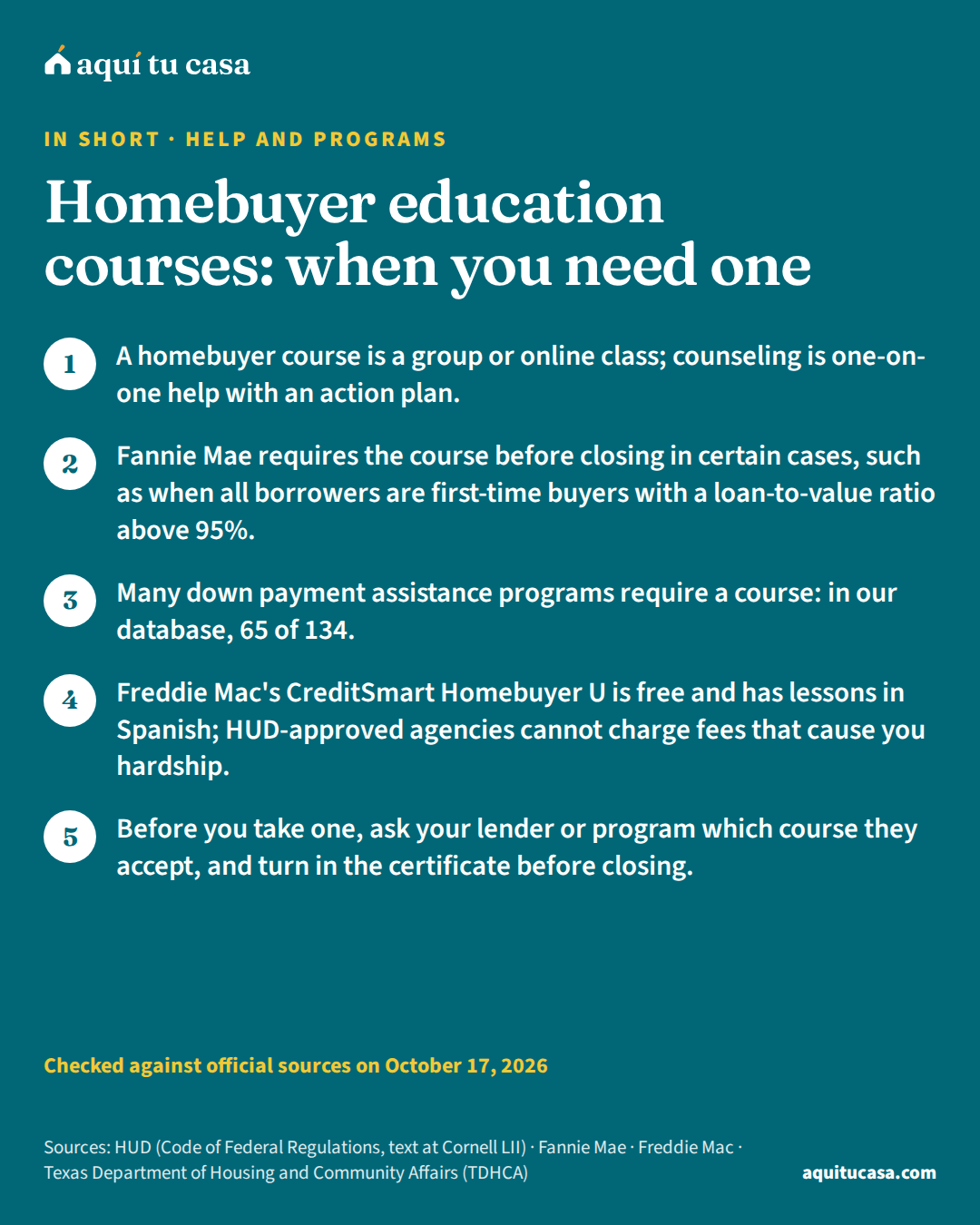
- Help and programs Homebuyer education courses: when you need one What a homebuyer education course is, when Fannie Mae, Freddie Mac and assistance programs require one, and where to take it for free or in Spanish. 10 minute read
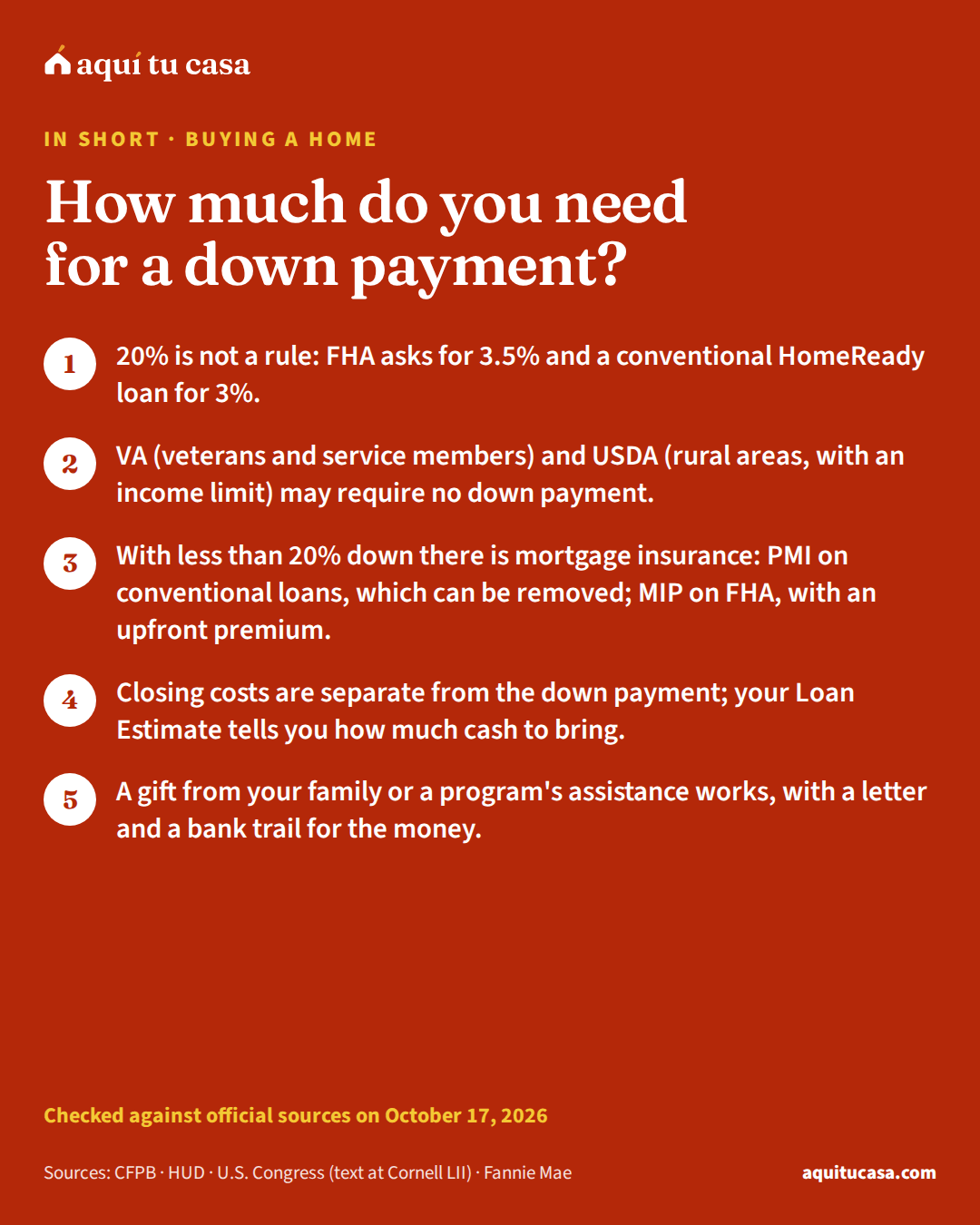
- Buying a home How much do you need for a down payment? 20% is not required: what each loan asks for (FHA, conventional, VA, USDA), what changes with less than 20% down, and where the money can come from. 11 minute read
Tools for this topic
Was this guide useful?
Thank you. Your answer stays in your browser; nothing is sent.