Foreclosure: the process step by step
How foreclosure works, the federal deadlines that protect you before the sale, and what you can still do: apply for help, short sale or deed in lieu.
Verified against official sources on October 31, 2026 7 official sources

Show contents
In short
What you need to know
Quick answer
Foreclosure is the process of selling your home to pay off the mortgage when you stop paying. Each state has its own process: in some it goes through a court (judicial) and in others it does not (non-judicial). Under the federal rule, the servicer cannot start until you are more than 120 days behind. If you submit a complete application for help more than 37 days before the sale, the servicer must evaluate you within 30 days and cannot hold the sale while it decides. If you cannot stay, a short sale or a deed in lieu of foreclosure usually does less damage to your credit.
What matters most
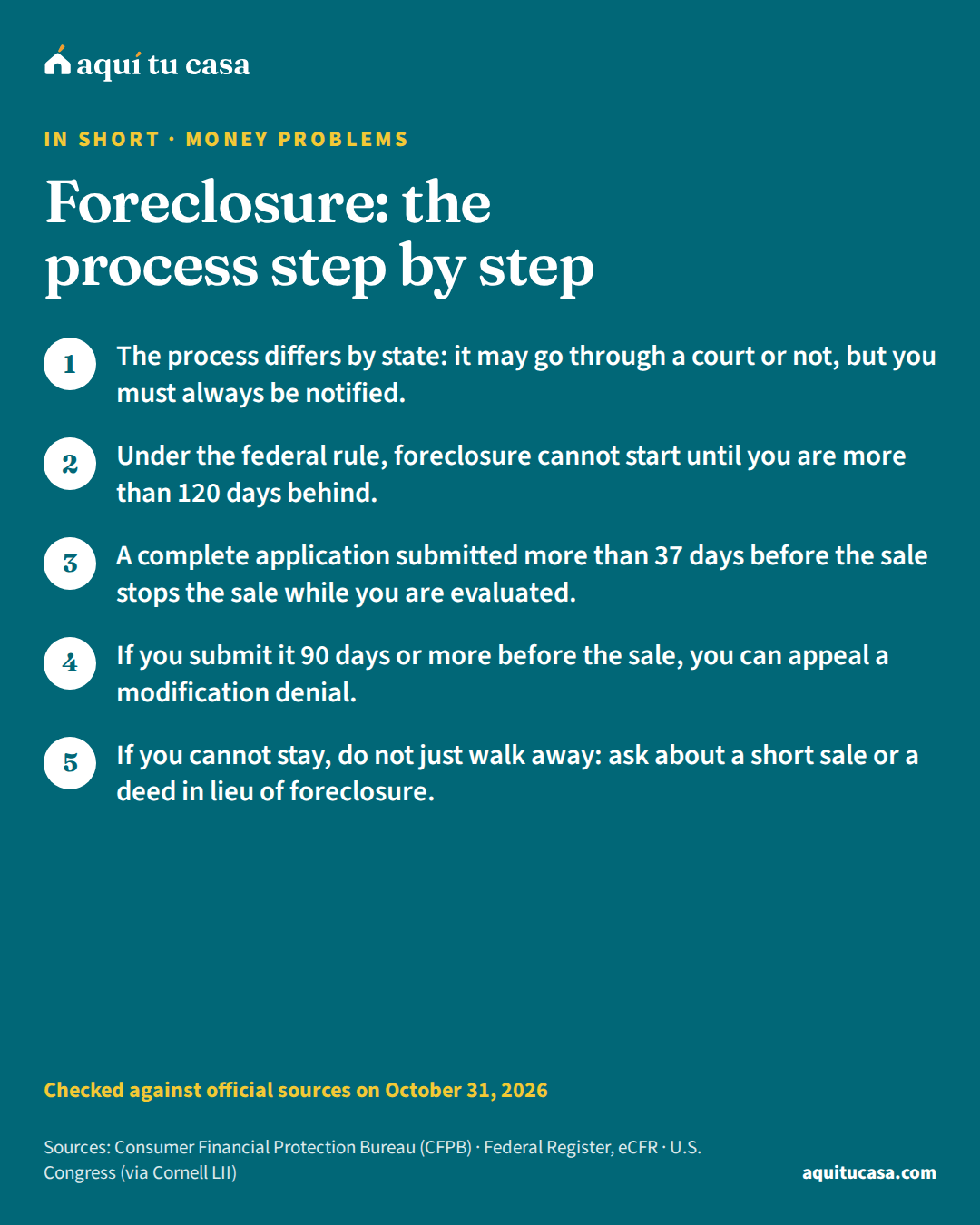
- The process differs by state: it may go through a court or not, but you must always be notified.
- Under the federal rule, foreclosure cannot start until you are more than 120 days behind.
- A complete application submitted more than 37 days before the sale stops the sale while you are evaluated.
- If you submit it 90 days or more before the sale, you can appeal a modification denial.
Is this for you?
This guide is for you if…
- You are several months behind on your mortgage and got a foreclosure notice, a sale notice or court papers.
- You want to understand the dates in the process so you do not lose your protections.
- You rent a home and found out the owner is in foreclosure.
Get direct help first if…
- You just fell behind or think you will: start with «If you can't pay your mortgage», which covers the first steps.
- Someone offers to save your home for an upfront fee or for signing over the deed: read the rescue scams guide today.
If you received a foreclosure notice, a sale notice or court papers, you are not alone and you can still act. ForeclosureforeclosureForeclosure is the process by which the lender or servicer takes back the property after the homeowner fails to make mortgage payments. The rules and timelines depend on each state; all of them include advance notices and, in general, time to catch up or ask for an alternative, such as a repayment plan or a loan modification. If you fall behind, call your servicer and a HUD-approved housing counseling agency early: foreclosure counseling is free and exists for exactly this.See the full definition is the process of selling your home to pay off the mortgage when you stop paying.1 It has dates, and some of them protect you if you know them. This guide explains how the process moves, which federal dates count before the sale and what options you still have.
How foreclosure works in your state
There is no single process for the whole country. The CFPB explains that it differs by state and is done in two ways:1
- Judicial. The lender files a lawsuit in court. There you can raise defenses. If you receive a summonssummonsA summons is a court document that tells you that you are being sued or must appear before the judge. The person suing you prepares it, the court issues it, and a sheriff or another authorized person delivers it to you. It says how many days you have to respond in writing or appear. If you do not respond in time, the court may enter a judgment against you without hearing your side (a default judgment). Responding does not mean you agree that you owe. If it is an eviction case, you can call the court clerk to ask about your deadline.See the full definition, it has a deadline to respond: do not ignore it.
- Non-judicial. It happens without a lawsuit, through a series of steps and written notices that follow a “power of sale” clause in your mortgage or deed of trustdeed of trustThe deed of trust is, along with the "mortgage," one of the most common names for the security instrument you sign at closing. With it, the home becomes collateral for the loan: if you do not make the payments or break the agreement, the lender can take the home and sell it to pay off the loan. Your signature on this document must be notarized. It is separate from the promissory note, which is your promise to pay. In some states, the lender can foreclose without going to court by following the notices in a "power of sale" clause in this document.See the full definition.
Either way, your state’s law requires that you be notified. After the notices, there is generally a public auction, and the home is sold to the highest bidder, which may be the lender itself. Some states also give you a right to mediation before foreclosure.1 The time between the start and the sale depends on your state’s laws. To learn how it works where you live, you can ask your county clerk’s office or a legal services provider.4
Most important: read all your mail and every legal notice, and act quickly. Each notice may carry a date that counts.1
The timeline: from the first missed payment to the sale
On top of your state’s law, there are federal rules your loan servicerloan servicerThe loan servicer is the company that sends you your mortgage statements and handles the day-to-day tasks of the loan: it processes your payments, answers your questions, keeps track of principal and interest paid and manages your escrow account, if you have one. It can also offer options if you fall behind and, in certain cases, start a foreclosure. It may be the same company that lent you the money or a different one, and it is common for another company to take over the loan after closing.See the full definition must follow. They are in Regulation X. This is the path, in order:
The federal dates, in order
1. Live contact
By day 36 of delinquency
The servicer must try to reach you and tell you about options to avoid foreclosure.2
2. Written notice
By day 45 of delinquency
It must send you a letter with information about the options and how to ask for them.2
3. No foreclosure yet
Until you are past 120 days behind
It cannot make the first foreclosure notice or filing, except in rare cases.3
4. Your complete application
As soon as possible
If you submit it before foreclosure starts, the servicer cannot start while it decides.3
5. Acknowledgment
5 business days after receiving it
If received 45 days or more before the sale, it tells you whether it is complete and what is missing.3
6. The decision
Within 30 days
If the complete application arrives more than 37 days before the sale, it evaluates you for every option.3
7. The appeal
14 days after a denial
If your complete application arrived 90 days or more before the sale, you can appeal a modification denial.3
8. The sale
Under your state's law
It is generally a public auction; the highest bidder may be the lender.1
The dates that matter most before the sale
If you already have a sale date, count backward from it. Three numbers decide your protections:
45 days before the sale. If the servicer receives your application 45 days or more before the sale, it must review it and tell you in writing, within 5 business days, that it received it and whether it is complete or incomplete. If something is missing, it must tell you which documents and by what date.3
More than 37 days before the sale. This is the most important date. If your complete application arrives more than 37 days before the sale, the servicer must evaluate you for every available option and give you its decision in writing within 30 days.3 And if foreclosure has already started, it cannot move for a judgment or order of sale, or hold the sale, until that process ends: until it tells you that you are not eligible and the appeal is over, you reject the options or you fail to keep an agreement.3 The CFPB warns that if your complete application does not arrive more than 37 days before the sale, the servicer does not necessarily have to review it, though depending on your loan type it may have to under other rules.4
90 days or more before the sale. If your complete application arrives with that much time, you have the right to appeal if you are denied a loan modificationloan modificationA loan modification is a change in the terms of your mortgage that you agree on with your loan servicer when you have trouble paying. It is a type of loss mitigation, meaning one of the options to avoid foreclosure. It can extend the time you have to repay, lower the interest rate, or defer or reduce part of the principal balance, which can lower your monthly payment. Often you start with a trial modification for a few months; if you make those payments on time, the change becomes permanent.See the full definition. You have 14 days to appeal, and the servicer must answer within 30 days.3 Also, you cannot be required to accept or reject an offer sooner than 14 days; if it arrived between 90 and 37 days before, not sooner than 7 days.3
Example with real numbers
A family with a sale date two months away
An example in words, not a real case, of how to count the days backward.
- About 60 days before the sale
- Still past the 45-day mark: the servicer must tell them within 5 business days what is missing
- They send everything that was missing
- The application is complete more than 37 days before the sale
- What the servicer must do
- Evaluate them for every option and answer in writing within 30 days
- While it decides
- It cannot move for a judgment or hold the sale
- What they do not have
- A right to appeal a denial, because the complete application arrived less than 90 days out
The dates come from Regulation X.333 A housing counselor can help them put the application together.
Run it with your numbersFamily budget
If staying is not possible: short sale or giving the home back
Sometimes there is no way to stay. The CFPB says: do not just walk away. There are options that are better for your money and credit than letting the home go to sale. If your home is worth more than you owe, selling it is usually best, and you do not need the servicer’s approval to do it.5 If it is worth less, there are two paths:
Short sale or deed in lieu of foreclosure
You find the buyer
Short sale
- You sell for less than you owe, with the servicer's approval
- If there is a second mortgage, you also need that servicer's approval
- You request a loss mitigation application and submit it complete
- Ask about the tax implications
You hand over the home
Deed in lieu of foreclosure
- You turn the home over to the servicer and move out
- You do not have to find a buyer
- Qualifying could mean you do not owe the deficiency
- You also apply and need approval
Both are typically cheaper, faster and less damaging to your credit than foreclosure.
In a short saleshort saleA short sale is selling your home for less than what you still owe on the mortgage, with your lender's or servicer's permission. It is an alternative to foreclosure, but because it is a sale, you have to leave the home. If the lender approves, the sale proceeds pay off the mortgage even if they do not cover the whole balance. In some states the lender can later sue you for the difference, called the deficiency. That is why the CFPB says to ask the lender to waive the deficiency and to keep the waiver in writing.See the full definition, you find the buyer. You need the servicer’s approval to forgive the difference between the price and what you owe, and if you have a second mortgagesecond mortgageA second mortgage (or junior lien) is a loan you take out using your home as collateral while you still have another loan secured by it. Home equity loans and HELOCs are common examples. It is called "second" because, if you stop paying and the home is sold to pay the debts, this loan is paid after the first one; if there is not enough money, the second lender may not get everything it is owed. That is why it often has a higher interest rate. It adds to your total debt and, if you cannot repay it, you could lose your home.See the full definition, that servicer’s approval too. To qualify, you request an application for help (loss mitigation), submit it complete and wait for approval from the servicer and the loan’s owner. The CFPB recommends understanding the terms well, including the tax implications.5
With a deed in lieu of foreclosuredeed in lieu of foreclosureA deed in lieu of foreclosure is an arrangement in which you voluntarily turn over ownership of your home to the lender to avoid the foreclosure process. The lender agrees to take the house instead of the debt. It may help you avoid owing what is left on the mortgage, but in some states you could still owe the difference between the home's value and what you owe. That is why the CFPB says to make sure the deal covers the entire debt and to get any waiver of the difference in writing.See the full definition, you turn the home over to the servicer and move out. You do not have to sell it. Qualifying could mean you do not have to pay what is left on the debt, called the deficiency.5 Before you sign either one, ask in writing what happens to the remaining balance.
These options are typically cheaper and faster than foreclosure, and they can do less damage to your credit.5 Afterward, check your credit reportcredit reportA credit report is a statement that has information about your credit activity and current credit situation: your loans and cards, the balances, whether you have paid on time, accounts in collection and who has checked your credit. Credit reporting companies, also called credit bureaus, compile it from what banks and creditors report; your credit score is computed from it. When you apply for a mortgage, the lender pulls your report from the three bureaus. You have the right to see it for free and to dispute anything that is wrong.See the full definition to see how it was reported: our guide How to read your credit report helps.

If you rent a home that is in foreclosure
If you are a tenant and your landlord’s home is in foreclosure, federal law protects you. Whoever takes the home in the foreclosure must give you a notice to vacate at least 90 days in advance. If you have a lease signed before the notice of foreclosure, you can stay until it ends, unless the home is sold to someone who will live in it; even then you get the 90-day notice. If you have no lease or a month-to-month one, you also get the 90-day notice.6
To have these protections you must be a “bona fide” tenant: not the owner or the owner’s child, spouse or parent, with a lease made at arm’s length and rent that is not much lower than market rent, or that is subsidized. Your state may give you more time, and the rules for subsidized housing still apply.6 If you get an eviction noticeeviction noticeAn eviction notice, also called a notice to quit or notice to vacate, is the written letter in which the landlord demands that you leave the home within a certain time. In general the landlord must give you this notice before starting an eviction case in court. At a minimum it should say why the landlord wants you out and what you can do to avoid it, such as paying the back rent. Your state's law decides when it can be given, how it must be delivered and how much time you get. The notice is not a court order: with the notice alone, the landlord cannot remove you.See the full definition, read our guide What to do if you get an eviction notice.
If you are in the military
If your mortgage predates your military service, federal law gives you strong protection: a sale or foreclosure for nonpayment is not valid if made during your service or within one year after, except under a court order or a written waiver agreement the law allows. The court can also pause the case if your service affects your ability to pay.7 Talk with your military legal assistance office (JAG) and with VA.1
If this is you
You received court papers
Check the deadline to respond and look for legal aid today; in court you can raise defenses.1
Your sale date is more than 37 days away
Submit your complete application now: it stops the sale while you are evaluated.3
You can no longer afford the home
Ask about a short sale or a deed in lieu of foreclosure before you leave.5
You rent and the owner is in foreclosure
If you are a bona fide tenant, you must get notice at least 90 days in advance.6
You are on active duty or just left service
A sale without a court order within one year after your service is not valid.7
You prefer to talk in Spanish
Call the HOPE Hotline at (888) 995-4673 or find a HUD-approved counselor, and ask whether they can help you in Spanish.1
Free help and how to avoid scams
You do not have to do this alone. A HUD-approved housing counselorHUD-approved housing counselorA HUD-approved housing counselor works at an agency HUD has approved to provide housing counseling: independent, expert advice customized to your situation about buying a home, renting, a missed mortgage payment, a foreclosure or credit problems. The agencies usually charge little or nothing; many serve in Spanish and offer the homebuyer education course several assistance programs require. They are not lenders or real estate agents and sell you nothing. Your county page lists the official agencies with phone numbers.See the full definition can help you, at no cost, talk with your servicer and build a plan.5 You can also call the HOPE Hotline, open 24 hours a day, seven days a week, at (888) 995-4673.1 Our guide HUD-approved housing counselors explains how to find one.
If you were served with legal papers, you may need a lawyer, and you may qualify for free legal aidlegal aidLegal aid is the free civil legal help that nonprofit organizations and their lawyers provide to low-income people in civil, not criminal, matters. In housing, that includes representing families facing eviction or foreclosure, alongside matters such as custody, child support, protection from domestic violence and access to benefits. In the United States, the Legal Services Corporation, created by Congress, funds a nationwide network of these organizations; its finder points you to the one in your area. Each sets its own income limits.See the full definition.5 Our guide Free legal aid explains how to ask for it. If you have a problem with your servicer, you can file a complaint with the CFPB, which forwards it to the company and works to get you a response, generally within 15 days.5

Mistakes that cost you
Mistake: Not opening your mail or court notices.
Instead: Read every notice and act quickly; each one may carry a date that counts.1
Mistake: Waiting until the last week to ask for help.
Instead: Submit your complete application more than 37 days before the sale, and 90 or more if you can.3
Mistake: Sending a half-finished application and thinking you are protected.
Instead: The protections depend on a complete application; send what is missing by the date you are given.3
Mistake: Leaving the home and handing over the keys without an agreement.
Instead: Ask for a short sale or a deed in lieu of foreclosure in writing.5
Mistake: Signing an agreement without knowing what happens to the remaining debt.
Instead: Ask about the deficiency and the tax implications before you sign.5
Mistake: Paying someone who promises to stop the sale.
Instead: Use a HUD-approved counselor, who helps you at no cost.5
What to do this week
- Gather every notice and check whether a sale date has been set; count the days left.4
- Call your servicer and ask for the loss mitigation application and the list of documents.3
- Call a HUD-approved housing counselor or the HOPE Hotline at (888) 995-4673.1
- Submit the complete application as early as you can and keep proof of the date.3
- If you received court papers, look for legal aid before the deadline to respond.5
- Build your family budget to know what payment you can truly keep up with.
Your household this month
Let's do the math
Left each month
Enter what at least one person takes home to see the result.
What helps
- Pay savings first: set the goal aside the day the money arrives, before flexible spending.
- Add up the bills that come every few months (car insurance, school) and divide by twelve.
- If income changes, plan on a low month and save the extra from good months.
- A HUD-approved housing counselor can go over the budget with you, often for free.
This is a planning tool with your numbers, not a credit evaluation or an approval. The split reference is only a guide.
Ready to see the numbers? Find your county here
See how this applies in your county: its loan limits, prices and rents, from the official data.
Printable checklist
Frequently asked questions
How long does a foreclosure take?
It depends on your state. The CFPB explains that the time between the start of foreclosure and the sale depends on your state's laws. What is federal: in general it cannot start before 120 days of delinquency.
What is the difference between judicial and non-judicial foreclosure?
Judicial foreclosure goes through a court, where you can raise defenses. Non-judicial foreclosure happens without a lawsuit, through written notices and steps that follow a 'power of sale' clause in your mortgage or deed of trust. Either way, you must be notified.
A sale date has been set. Can I still ask for help?
Yes. If your complete application arrives more than 37 days before the sale, the servicer must evaluate you within 30 days and cannot hold the sale while it decides. If it arrives later, the servicer does not always have to review it, but depending on your loan it may have to under other rules. Call today.
What is a short sale?
It is selling the home for less than you owe, with your servicer's permission, so the difference is forgiven. You find the buyer, and you need a complete application and approval from the servicer and the loan's owner. Also ask about the tax implications.
What happens to the debt that is left?
What is left is called a deficiency. The CFPB explains that qualifying for a deed in lieu of foreclosure could mean you do not have to pay that deficiency. Ask in writing what happens to the remaining balance before you sign any agreement.
I rent a home that is in foreclosure. Do I have to leave right away?
Not immediately. Under federal law, if you are a bona fide tenant, the new owner must give you notice at least 90 days in advance, and if you have a lease you can stay until it ends, unless the home is sold to someone who will live in it. Your state may give you more time.
I am in the military. Do I have special protections?
Yes. If your mortgage predates your service, federal law says a foreclosure sale made during your service or within one year after is not valid without a court order or a written waiver agreement. Talk with your military legal assistance office.
Sources
Every figure in this guide comes from one of these official sources. The number next to a sentence leads to the source behind it.
Each source on one line: who publishes it, its title, its address and the date we read it.
- 1. Consumer Financial Protection Bureau (CFPB) · How does foreclosure work? · consumerfinance.gov · Accessed October 31, 2026
- 2. Federal Register, eCFR · 12 CFR §1024.39, Early intervention requirements for certain borrowers (Regulation X) · ecfr.gov · Accessed October 31, 2026
- 3. Federal Register, eCFR · 12 CFR §1024.41, Loss mitigation procedures (Regulation X) · ecfr.gov · Accessed October 31, 2026
- 4. Consumer Financial Protection Bureau (CFPB) · What happens after I complete an application to determine my options to avoid foreclosure? · consumerfinance.gov · Accessed October 31, 2026
- 5. Consumer Financial Protection Bureau (CFPB) · Avoid foreclosure · consumerfinance.gov · Accessed October 31, 2026
- 6. U.S. Congress (via Cornell LII) · Protecting Tenants at Foreclosure Act (Pub. L. 111-22, §702), 12 U.S.C. §5220 note · law.cornell.edu · Accessed October 31, 2026
- 7. U.S. Congress (via Cornell LII) · 50 U.S.C. §3953, Mortgages and trust deeds (Servicemembers Civil Relief Act) · law.cornell.edu · Accessed October 31, 2026
Keep reading
Related guides
If this guide helped, these follow the same path.

Money problems 14 minute read
Can't pay your mortgage? What to do in the first week
Can't pay your mortgage? Call your servicer, learn the options that exist, the federal rules that protect you and the rescue scams to avoid.
- Call your loan servicer as soon as you know you cannot pay; answer its calls and ask about your options.
- Under federal regulation, foreclosure generally cannot start until you are more than 120 days behind, with some exceptions.
- A complete application sent in time triggers protections: a written evaluation, a pause in the process and, if a modification is denied, the reason and sometimes an appeal.
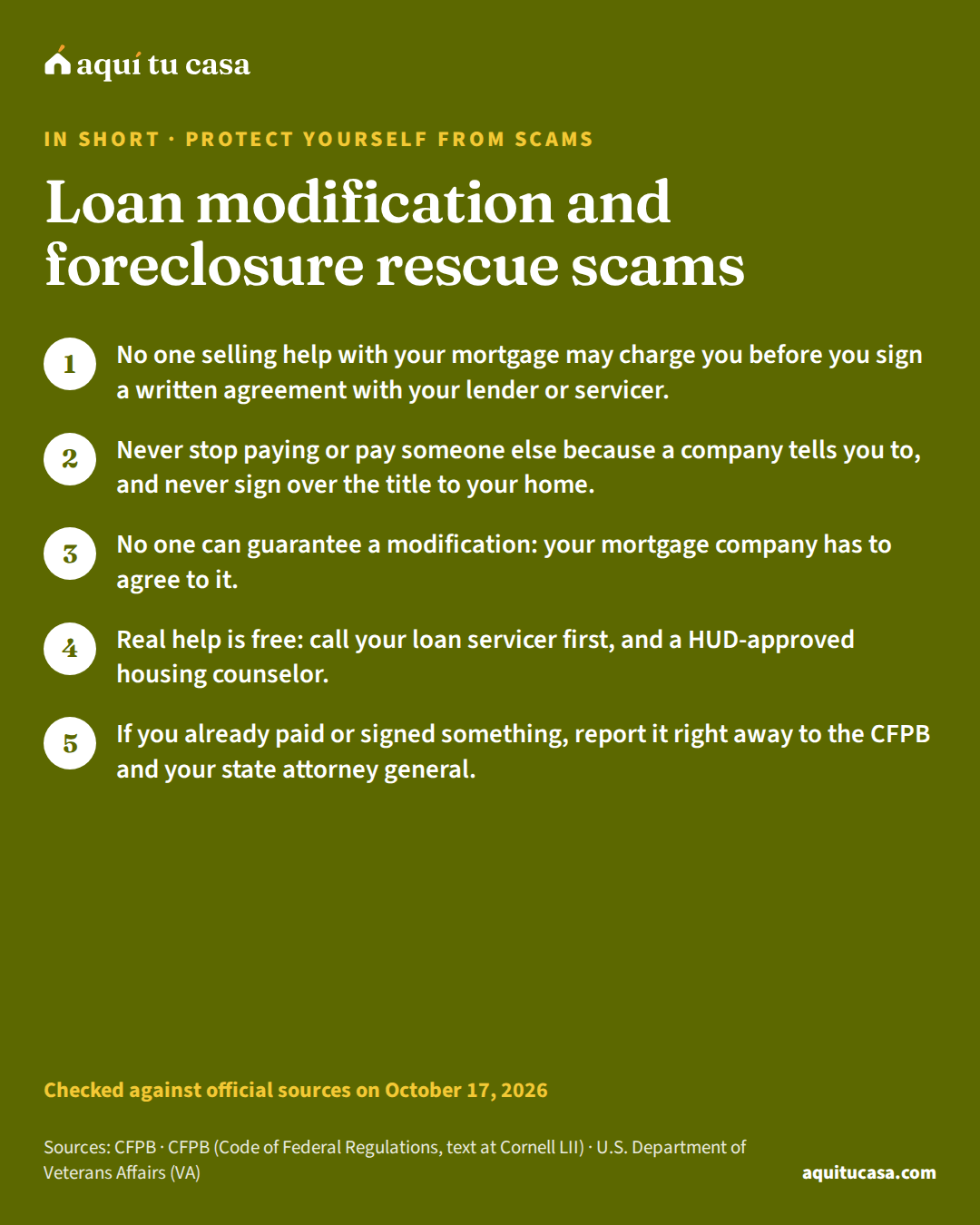
- Protect yourself from scams Loan modification and foreclosure rescue scams How to spot scams that promise to save your home from foreclosure, what federal law prohibits and where to get real, free help. 11 minute read
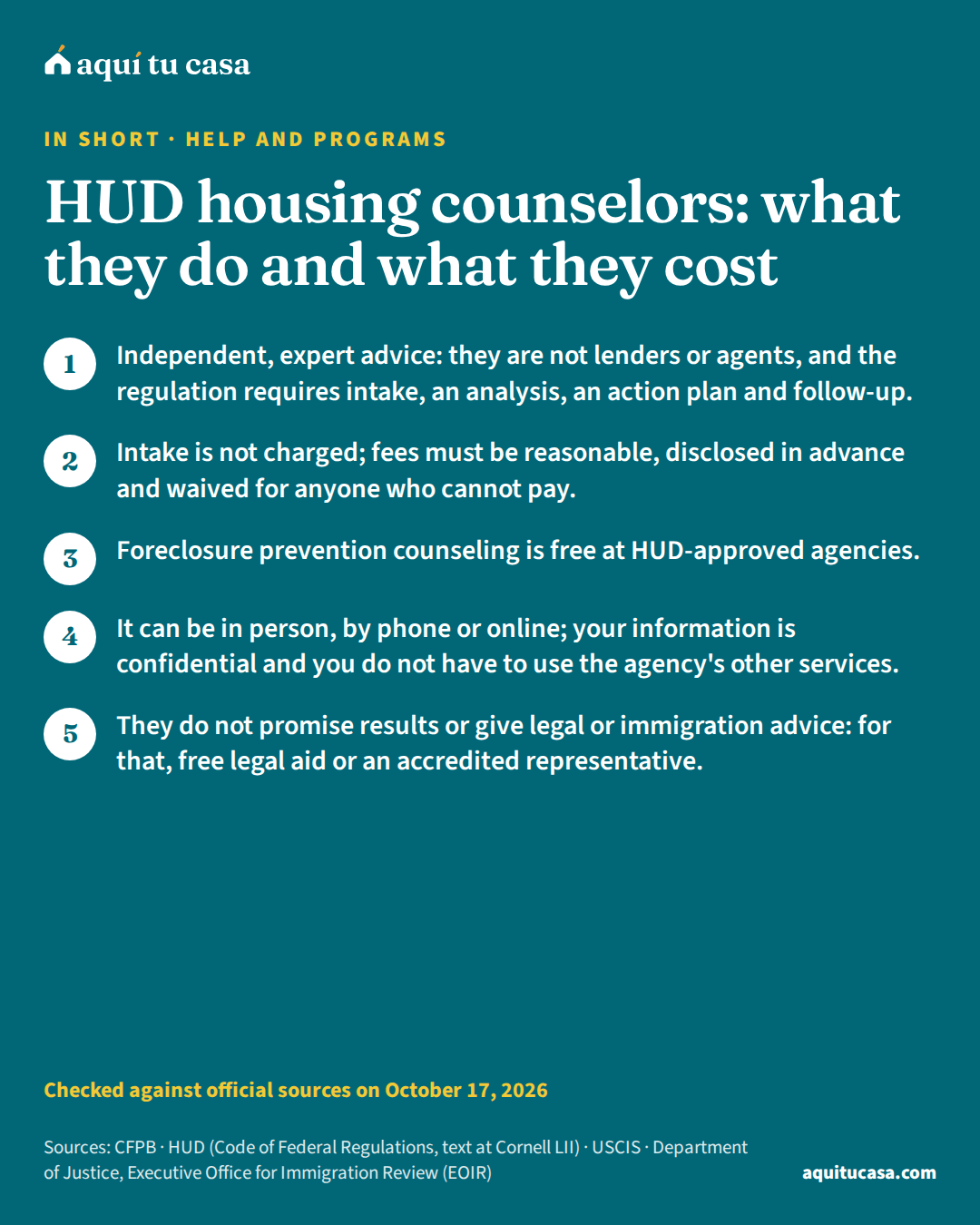
- Help and programs HUD housing counselors: what they do and what they cost What a HUD-approved housing counselor does, what they help with (buying, renting, missed payments, credit), what they may charge and how to find one. 11 minute read
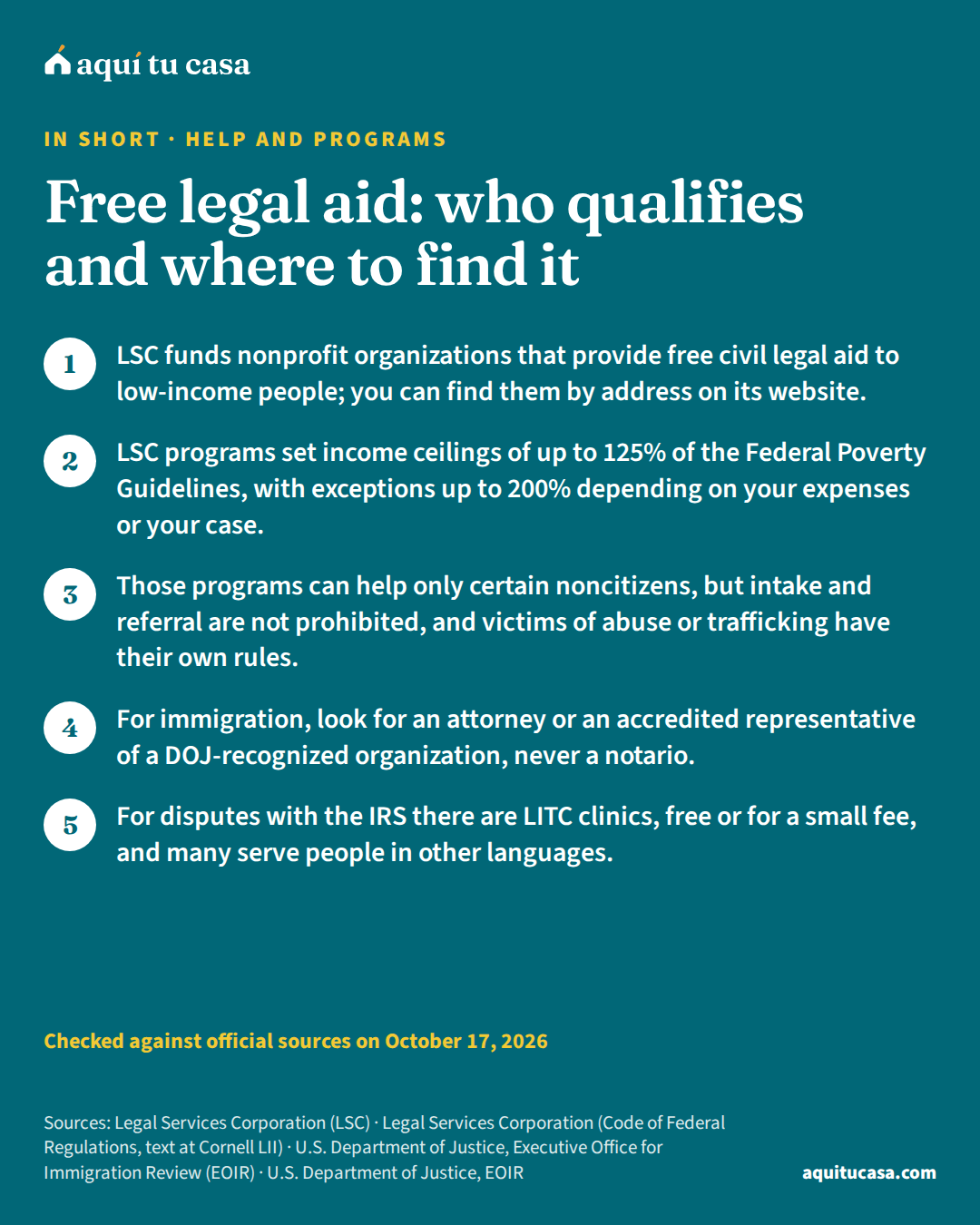
- Help and programs Free legal aid: who qualifies and where to find it What free legal aid is, who qualifies, which rules apply if you are not a citizen, and where to get help with immigration and tax problems. 11 minute read
Tools for this topic
Was this guide useful?
Thank you. Your answer stays in your browser; nothing is sent.