Loan modification and foreclosure rescue scams
How to spot scams that promise to save your home from foreclosure, what federal law prohibits and where to get real, free help.
Verified against official sources on October 17, 2026 12 official sources

Show contents
In short
What you need to know
Quick answer
Loan modification and foreclosure rescue scams promise to save your home from foreclosure in exchange for money, and often just keep it. Under Regulation O, no one selling these services may charge you before you sign a written agreement with your lender or servicer. Warning signs: they ask for payment up front, guarantee results, tell you to stop paying or to pay someone else, or ask you to sign over the title to your home. Real help is free: your loan servicer and HUD-approved housing counselors.
What matters most
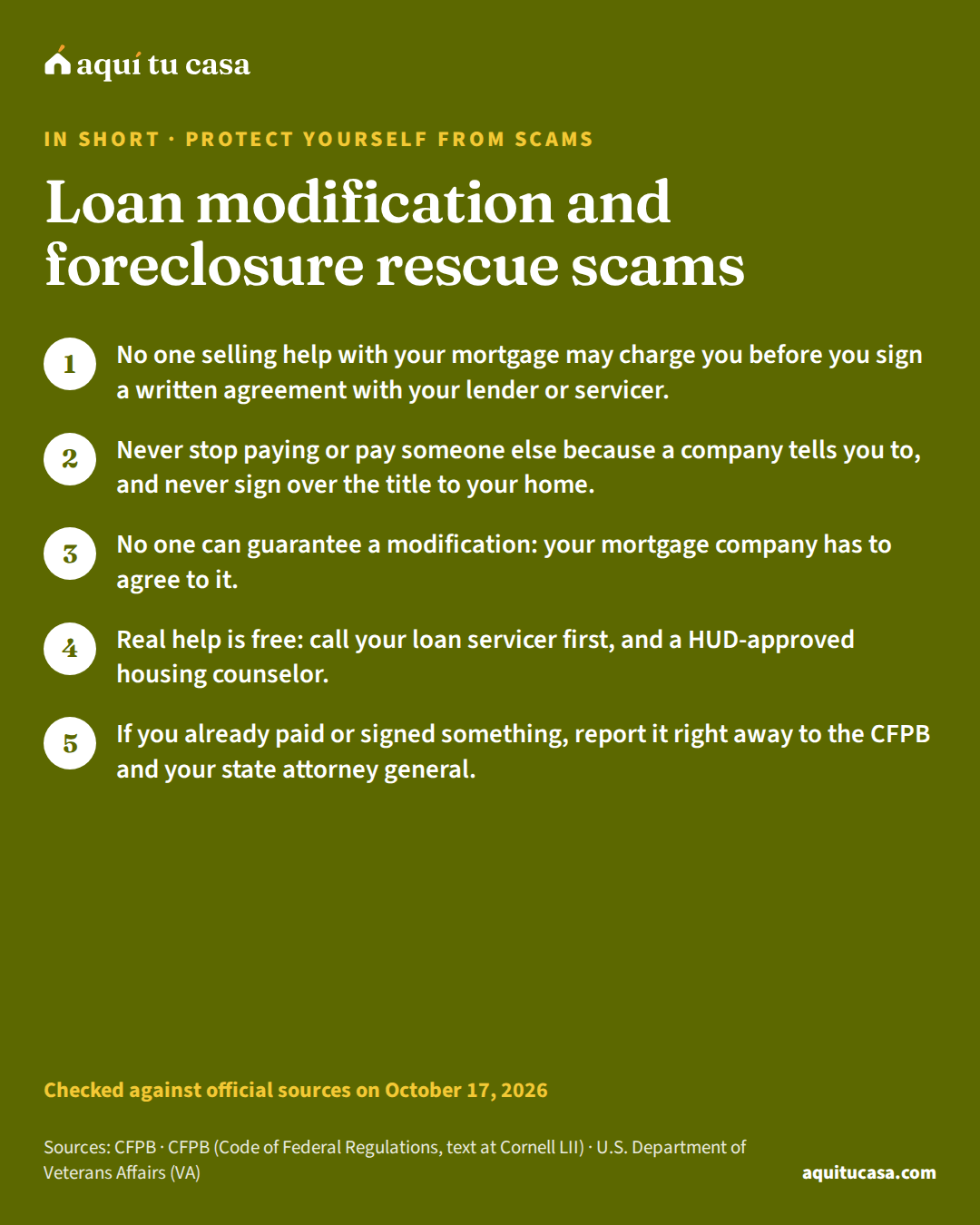
- No one selling help with your mortgage may charge you before you sign a written agreement with your lender or servicer.
- Never stop paying or pay someone else because a company tells you to, and never sign over the title to your home.
- No one can guarantee a modification: your mortgage company has to agree to it.
- Real help is free: call your loan servicer first, and a HUD-approved housing counselor.
Is this for you?
This guide is for you if…
- You are behind on your mortgage, or worried you will be, and you are getting letters, calls or messages promising to save your home.
- A company or person is asking for money up front to get you a loan modification.
- You already paid or signed something and are not sure whether it was a scam.
Get direct help first if…
- You want to know your real options if you can't pay your mortgage: start with that guide and come back here to protect yourself.
- Someone recorded a fake deed on your home: the deed theft guide explains what to do.
- You have an open foreclosure case or have been served court papers: get legal aid right away.
This guide is for homeowners who are behind on their mortgage, or worried they will be, and are getting offers to “save” their home. It explains how these scams work, what federal law prohibits, how to tell real help from a trap and what to do if you already paid or signed something. If this happened to you, it is not your fault: these scams are designed to look official.
How the scam works
According to the CFPB, loan modificationloan modificationA loan modification is a change in the terms of your mortgage that you agree on with your loan servicer when you have trouble paying. It is a type of loss mitigation, meaning one of the options to avoid foreclosure. It can extend the time you have to repay, lower the interest rate, or defer or reduce part of the principal balance, which can lower your monthly payment. Often you start with a trial modification for a few months; if you make those payments on time, the change becomes permanent.See the full definition scams are schemes to take your money, often with a false promise of saving you from foreclosureforeclosureForeclosure is the process by which the lender or servicer takes back the property after the homeowner fails to make mortgage payments. The rules and timelines depend on each state; all of them include advance notices and, in general, time to catch up or ask for an alternative, such as a repayment plan or a loan modification. If you fall behind, call your servicer and a HUD-approved housing counseling agency early: foreclosure counseling is free and exists for exactly this.See the full definition.1 They target homeowners in financial trouble, and often arrive by mail or email with designs, emblems, logos or names that look like government agencies.2
Scammers may promise you a modification, charge you up front or tell you to stop paying. Some ask you to send your monthly payment to them, or to sign over the title to your propertytitleTitle is your legal right to own and possess a property. The deed is the document showing that the seller transferred that right to you, and legal title is the title that can be documented in public records. As part of the purchase, a title search is done to see whether anyone else has a claim against the home; common claims come from a previous owner's unpaid taxes or from contractors who say they were not paid for work on the home. Title insurance protects you if such a claim shows up later.See the full definition with a promise that you can “rent to buy” your home back.12 The CFPB warns that one of these scams could cost you your home.2
The warning signs
The CFPB lists these signs. If you see even one, stop and check:23
- They ask you to pay up front.
- They guarantee they will change your mortgage or that you won’t lose your home.
- They tell you to stop paying your mortgage. That can hurt your credit scorecredit scoreA credit score is a number that predicts how likely you are to pay back a loan on time. It is computed from the information in your credit report: whether you pay on time, how much you owe relative to your limits, how long you have used credit and how many new accounts you opened. FICO is one brand of score; VantageScore is another, and each lender decides which one it uses. A higher score usually brings a lower interest rate and more loan options; each program publishes the minimum it accepts. You can check your report for free and dispute errors.See the full definition and limit your options.
- They ask you to make your payments to someone else, not your lender or servicer.
- They ask you to sign over the title to your home, or to sign papers you don’t understand.
- They pressure you to act now.
- They say they will do a “forensic audit” of your loan.
- They claim to be affiliated with the government, or use a logo that looks like an official seal but is slightly different.
Real government officials never ask for payment to help you.2 And no one can guarantee you a modification: your mortgage company has to agree to it.11
Real help or a scam
Free
Real help
If they charge you before you sign an agreement with your lender, the law has already been broken.8
What the law prohibits: Regulation O
Regulation O, a federal rule, covers “mortgage assistance relief services”: any service offered in exchange for payment to stop or postpone a foreclosure, get a modification (such as a lower interest rate, balance or payment), forbearanceforbearanceForbearance is an agreement with your loan servicer to pause your mortgage payments, or make smaller payments, for a while when you face a hardship such as losing your job, a natural disaster or unexpected medical costs. It does not erase or reduce what you owe: you have to repay the missed or reduced amounts later. Depending on the agreement, you may repay it all at once at the end, add it to the end of the loan, repay it with a new loan or spread it out through higher payments for a time. You have to request it from your servicer.See the full definition, more time to catch up, or negotiate a short saleshort saleA short sale is selling your home for less than what you still owe on the mortgage, with your lender's or servicer's permission. It is an alternative to foreclosure, but because it is a sale, you have to leave the home. If the lender approves, the sale proceeds pay off the mortgage even if they do not cover the whole balance. In some states the lender can later sue you for the difference, called the deficiency. That is why the CFPB says to ask the lender to waive the deficiency and to keep the waiver in writing.See the full definition or a deed-in-lieu of foreclosuredeed in lieu of foreclosureA deed in lieu of foreclosure is an arrangement in which you voluntarily turn over ownership of your home to the lender to avoid the foreclosure process. The lender agrees to take the house instead of the debt. It may help you avoid owing what is left on the mortgage, but in some states you could still owe the difference between the home's value and what you owe. That is why the CFPB says to make sure the deal covers the entire debt and to get any waiver of the difference in writing.See the full definition. Your lender and your loan servicer do not count as providers of that service.5
They can’t charge you up front. Anyone selling mortgage relief may not request or receive any payment until you have signed a written agreement with your lender or servicer that includes the offer they obtained. When they hand you that agreement, they must give you, on a separate page, a notice that you may accept or reject the offer and that, if you reject it, you owe them nothing. They must also give you a notice from your lender showing the differences between your current loan and the new one: balance, rate, payments, arrears, fees and term. If the offer is a trial modification, they must tell you that you may not qualify for a permanent one.8
The CFPB sums it up: these companies cannot collect anything until they give you a written offer from your lender that you decide to accept, a document describing the key changes to your mortgage and a reminder that you can reject the offer without paying.1
They can’t tell you not to talk to your lender. Nor can they misrepresent the likelihood of getting the result, how long it will take, any link to the government, a nonprofit counseling agency or your lender, your obligation to keep paying, whether you will have legal representation, the free alternatives, how much you will save or what it will cost.6
They must tell you the truth in writing. Their ads must say the company is not associated with the government and its service is not approved by the government or your lender. Anything they send you directly must also say you may stop doing business with them at any time, that you may accept or reject the offer and that if you reject it you don’t pay them. Those written notices go under the heading “IMPORTANT NOTICE.” And if they tell you to stop paying, they must warn you that you could lose your home and damage your credit.7
Anyone who knowingly helps one of these companies break the rule also violates it.9
Example with real numbers
When they can charge you, under Regulation O
An example in words of how the process should go with a legitimate company.
- The company offers help and gives you its notices
- Cannot charge you
- The company negotiates with your lender
- Cannot charge you
- You receive the lender's written offer and the notices
- You decide whether to accept; if you reject it, you don't pay
- You sign the agreement with your lender
- Only then can it charge what it told you
That is what Regulation O says.8 The CFPB reminds you that you don't have to pay anyone: your servicer and HUD-approved counselors help at no cost.3
What if they say they are a lawyer?
Regulation O has a limited exception for attorneys. An attorney is outside the rule, except for the advance-fee ban, if they provide these services as part of practicing law, are licensed in the state where you live or where your home is, and follow state law. And they can charge you first only if they also deposit that money in a client trust account and follow the state rules for those accounts.10
The CFPB warns that if a lawyer, or someone claiming to offer legal help, wants to be paid first, before you receive a modification, they may be breaking the law. Most licensed lawyers don’t call or email you and push you to pay right away. And if your mortgage company asks you to authorize a third party to speak for you, authorize only someone trustworthy and be careful about what you authorize.11
Where the real (and free) help is
According to the CFPB, you don’t have to pay anyone to avoid foreclosure: help is available at no cost from your loan servicerloan servicerThe loan servicer is the company that sends you your mortgage statements and handles the day-to-day tasks of the loan: it processes your payments, answers your questions, keeps track of principal and interest paid and manages your escrow account, if you have one. It can also offer options if you fall behind and, in certain cases, start a foreclosure. It may be the same company that lent you the money or a different one, and it is common for another company to take over the loan after closing.See the full definition or a HUD-approved housing counseling agency.3 The first step is to call your servicer. A HUD-approved counselor can go over your options with you, such as forbearance or a modified payment program.1
HUD-approved agencies provide foreclosure prevention counseling free of charge and can help you talk to your servicer and understand what it offers. To find one, call the HOPE Hotline, open 24 hours a day, seven days a week, at (888) 995-4673, or the CFPB at (855) 411-2372 to be connected to a counselor by phone. The counselor will ask what you owe and the date of your last payment, and may ask for pay stubs, tax returns and bank statements. A counselor can’t promise you will keep your home, but helps you see your options.4
HUD-approved housing counselors, by state
| State | HUD-approved counselors |
|---|---|
| Alabama | 25 |
| Alaska | 1 |
| Arizona | 21 |
| Arkansas | 14 |
| California | 81 |
| Colorado | 26 |
| Connecticut | 13 |
| Delaware | 12 |
| District of Columbia | 17 |
| Florida | 98 |
| Georgia | 42 |
| Hawaii | 17 |
| Idaho | 10 |
| Illinois | 81 |
| Indiana | 21 |
| Iowa | 11 |
| Kansas | 3 |
| Kentucky | 19 |
| Louisiana | 26 |
| Maine | 7 |
| Maryland | 41 |
| Massachusetts | 37 |
| Michigan | 59 |
| Minnesota | 33 |
| Mississippi | 16 |
| Missouri | 18 |
| Montana | 11 |
| Nebraska | 8 |
| Nevada | 8 |
| New Hampshire | 5 |
| New Jersey | 34 |
| New Mexico | 7 |
| New York | 93 |
| North Carolina | 52 |
| North Dakota | 3 |
| Ohio | 54 |
| Oklahoma | 6 |
| Oregon | 25 |
| Pennsylvania | 75 |
| Puerto Rico | 9 |
| Rhode Island | 5 |
| South Carolina | 13 |
| South Dakota | 13 |
| Tennessee | 32 |
| Texas | 51 |
| Utah | 7 |
| Vermont | 7 |
| Virginia | 49 |
| Washington | 15 |
| West Virginia | 8 |
| Wisconsin | 26 |
| Wyoming | 1 |
Foreclosure prevention counseling at these agencies is free.4 Source: HUD
If you are behind on your mortgage
1. Call your loan servicer
Today
It is the first step the CFPB recommends; the number is on your statement.1
2. Call a HUD-approved counselor
This week
Foreclosure prevention counseling is free; the HOPE Hotline answers 24 hours a day.4
3. Gather your papers
Before the appointment
Your latest statement, pay stubs, tax returns and bank statements.4
4. Get the options in writing
When your servicer offers something
A modification, a repayment plan or forbearance, among others.3
5. Don't pay anyone up front
At any point
If someone charges you before you sign with your lender, it is illegal.8
The can’t pay my mortgage guide explains each option and its timelines, and the HUD-approved housing counselors guide explains how to find one near you.

If you already paid or signed something
Act fast. The CFPB recommends reporting it immediately.2 You can file a complaint with the CFPB online or at (855) 411-23721, which takes calls in more than 180 languages.2 You can also contact your state attorney general’s office to learn about state protections and file a complaint.1
Call your loan servicer to learn the real status of your mortgage and confirm where your payments should go. If you signed something about the title to your home, read the deed theft guide. The CFPB notes that if you think you were a victim, you may want to consult an attorney, and that there may be resources through your local bar association or free legal aidlegal aidLegal aid is the free civil legal help that nonprofit organizations and their lawyers provide to low-income people in civil, not criminal, matters. In housing, that includes representing families facing eviction or foreclosure, alongside matters such as custody, child support, protection from domestic violence and access to benefits. In the United States, the Legal Services Corporation, created by Congress, funds a nationwide network of these organizations; its finder points you to the one in your area. Each sets its own income limits.See the full definition.1 If you have a VA loan, VA provides counseling even if your loan is not a VA loan, and assigns a loan technician when you are 61 days behind.12
If this is you
You got an offer to save your home
Don't pay anything up front: it is illegal to charge before you sign with your lender.8 Call your servicer first.1
Someone asks you to sign over your title
It is a scam sign, sometimes called “rent to buy.”2 Don't sign, and ask for help.
You have a VA loan
VA provides foreclosure prevention counseling and says to work only with trusted organizations.12
You prefer to speak Spanish
The CFPB complaint line serves callers in more than 180 languages.2 To find a counselor, see the HUD-approved counselors guide.
Costly mistakes
Mistake: Paying an “enrollment” or “review” fee for the modification.
Instead: No one can charge you before you sign the agreement with your lender.8
Mistake: Stopping your mortgage payments because the company told you to.
Instead: That can hurt your credit and limit your options.2
Mistake: Sending your payments to the company “while it negotiates.”
Instead: Pay only your lender or servicer.1
Mistake: Signing over the title to your home to “rent to buy.”
Instead: It is a classic scam sign: don't sign anything you don't understand.2
Mistake: Believing a modification “guarantee.”
Instead: Your mortgage company has to agree; no one can guarantee it.11
Mistake: Staying silent out of embarrassment.
Instead: Report it right away to the CFPB and your state attorney general.21

What to do this week
- If you were offered help with your mortgage, don’t pay anything and don’t sign anything yet.8
- Call your loan servicer using the number on your statement.1
- Call the HOPE Hotline, (888) 995-4673, to find a HUD-approved housing counselor; foreclosure prevention counseling is free.4
- Keep the letters, emails, contracts and receipts from the company that contacted you.1
- If you already paid or signed, file a complaint with the CFPB and your state attorney general’s office.1
- Share this guide with older relatives or anyone who is behind: the housing scams guide covers other common traps.
Your household this month
Let's do the math
Left each month
Enter what at least one person takes home to see the result.
What helps
- Pay savings first: set the goal aside the day the money arrives, before flexible spending.
- Add up the bills that come every few months (car insurance, school) and divide by twelve.
- If income changes, plan on a low month and save the extra from good months.
- A HUD-approved housing counselor can go over the budget with you, often for free.
This is a planning tool with your numbers, not a credit evaluation or an approval. The split reference is only a guide.
Ready to see the numbers? Find your county here
See how this applies in your county: its loan limits, prices and rents, from the official data.
Printable checklist
Frequently asked questions
Is it legal to charge me up front for a loan modification?
No. Under Regulation O, anyone selling mortgage assistance relief may not request or receive any payment until you have signed a written agreement with your lender or servicer that includes the offer they obtained. There is a limited exception for attorneys licensed in your state who deposit the money in a client trust account and follow state law.
How can I tell if a foreclosure rescue company is a scam?
The CFPB lists these signs: they charge up front, guarantee they will change your mortgage or that you won't lose your home, tell you to stop paying or pay someone else, ask you to sign over title or sign papers you don't understand, pressure you to act now, talk about a 'forensic audit' or use logos that look like the government's.
Where can I get free help if I can't pay my mortgage?
According to the CFPB, you don't have to pay anyone: help is available at no cost from your loan servicer or a HUD-approved housing counseling agency. You can call the HOPE Hotline, 24 hours a day, at (888) 995-4673.
They told me to stop paying my mortgage while they negotiate. Should I?
The CFPB flags this as a scam sign: stopping payments can hurt your credit and limit your options. And if a company tells you this, Regulation O requires it to warn you that if you stop paying your mortgage, you could lose your home and damage your credit.
Can a lawyer charge me first for help with foreclosure?
Only in very limited circumstances. According to the CFPB, a lawyer can ask you to pay first only if licensed in the state where you live or where your home is and meeting other requirements, such as depositing the money in a client trust account. If someone claiming to offer legal help wants to be paid before you receive a modification, they may be breaking the law.
I already paid one of these companies. What do I do?
Report it right away. You can file a complaint with the CFPB online or at (855) 411-2372, which serves callers in more than 180 languages, and contact your state attorney general's office. Free legal aid in your area can review your case, if you wish. And call your loan servicer to confirm the real status of your mortgage.
Does the government charge to help me save my home?
No. According to the CFPB, real government officials never ask for payment to help you. And by law, anyone selling mortgage relief must say in its ads that it is not associated with the government and that its service is not approved by the government or your lender.
Sources
Every figure in this guide comes from one of these official sources. The number next to a sentence leads to the source behind it.
Each source on one line: who publishes it, its title, its address and the date we read it.
- 1. CFPB · What are mortgage loan modification scams? · consumerfinance.gov · Accessed October 17, 2026
- 2. CFPB · How to spot and avoid foreclosure relief scams · consumerfinance.gov · Accessed October 17, 2026
- 3. CFPB · If I can't pay my mortgage loan, what are my options? · consumerfinance.gov · Accessed October 17, 2026
- 4. CFPB · What is a HUD-approved housing counseling agency, and how can they help me? · consumerfinance.gov · Accessed October 17, 2026
- 5. CFPB (Code of Federal Regulations, text at Cornell LII) · Regulation O, 12 CFR §1015.2, Definitions · law.cornell.edu · Accessed October 17, 2026
- 6. CFPB (Code of Federal Regulations, text at Cornell LII) · Regulation O, 12 CFR §1015.3, Prohibited representations · law.cornell.edu · Accessed October 17, 2026
- 7. CFPB (Code of Federal Regulations, text at Cornell LII) · Regulation O, 12 CFR §1015.4, Disclosures required in commercial communications · law.cornell.edu · Accessed October 17, 2026
- 8. CFPB (Code of Federal Regulations, text at Cornell LII) · Regulation O, 12 CFR §1015.5, Prohibition on collection of advance payments and related disclosures · law.cornell.edu · Accessed October 17, 2026
See the other 4 sources
- 9. CFPB (Code of Federal Regulations, text at Cornell LII) · Regulation O, 12 CFR §1015.6, Assisting and facilitating · law.cornell.edu · Accessed October 17, 2026
- 10. CFPB (Code of Federal Regulations, text at Cornell LII) · Regulation O, 12 CFR §1015.7, Exemptions · law.cornell.edu · Accessed October 17, 2026
- 11. CFPB · Consumer advisory: Don't fall for a foreclosure relief scam or bogus legal help · consumerfinance.gov · Accessed October 17, 2026
- 12. U.S. Department of Veterans Affairs (VA) · VA help to avoid foreclosure · va.gov · Accessed October 17, 2026
Keep reading
Related guides
If this guide helped, these follow the same path.

Money problems 14 minute read
Can't pay your mortgage? What to do in the first week
Can't pay your mortgage? Call your servicer, learn the options that exist, the federal rules that protect you and the rescue scams to avoid.
- Call your loan servicer as soon as you know you cannot pay; answer its calls and ask about your options.
- Under federal regulation, foreclosure generally cannot start until you are more than 120 days behind, with some exceptions.
- A complete application sent in time triggers protections: a written evaluation, a pause in the process and, if a modification is denied, the reason and sometimes an appeal.
- Protect yourself from scams Housing scams: the complete guide to spotting them The rental, mortgage, title, contractor, credit and moving scams families run into most: how to spot them, what to do and where to report them. 17 minute read
- Help and programs HUD housing counselors: what they do and what they cost What a HUD-approved housing counselor does, what they help with (buying, renting, missed payments, credit), what they may charge and how to find one. 11 minute read
- Protect yourself from scams A notario is not a lawyer: who can give you legal advice Outside Puerto Rico, a notary public is not a lawyer. What a notary can do, who can advise you for free or at low cost, warning signs and how to report it. 12 minute read
Tools for this topic
Was this guide useful?
Thank you. Your answer stays in your browser; nothing is sent.