Deed theft and title fraud: how to protect your home
What deed theft is, who is most at risk, the warning signs, your county's property alerts and what to do if someone records a fake deed.
Verified against official sources on October 17, 2026 8 official sources

Show contents
In short
What you need to know
Quick answer
Deed theft happens when someone puts your home in their name without your knowledge: they forge your signature on a deed and record it with the county, or trick you into signing it. Thieves mainly target empty homes, owners who live far away and homes whose owner died, and they also target seniors and immigrants. Several counties offer free alerts that notify you when a document is recorded under your name. If it happens, report it to the police right away and get legal help to recover your title.
What matters most
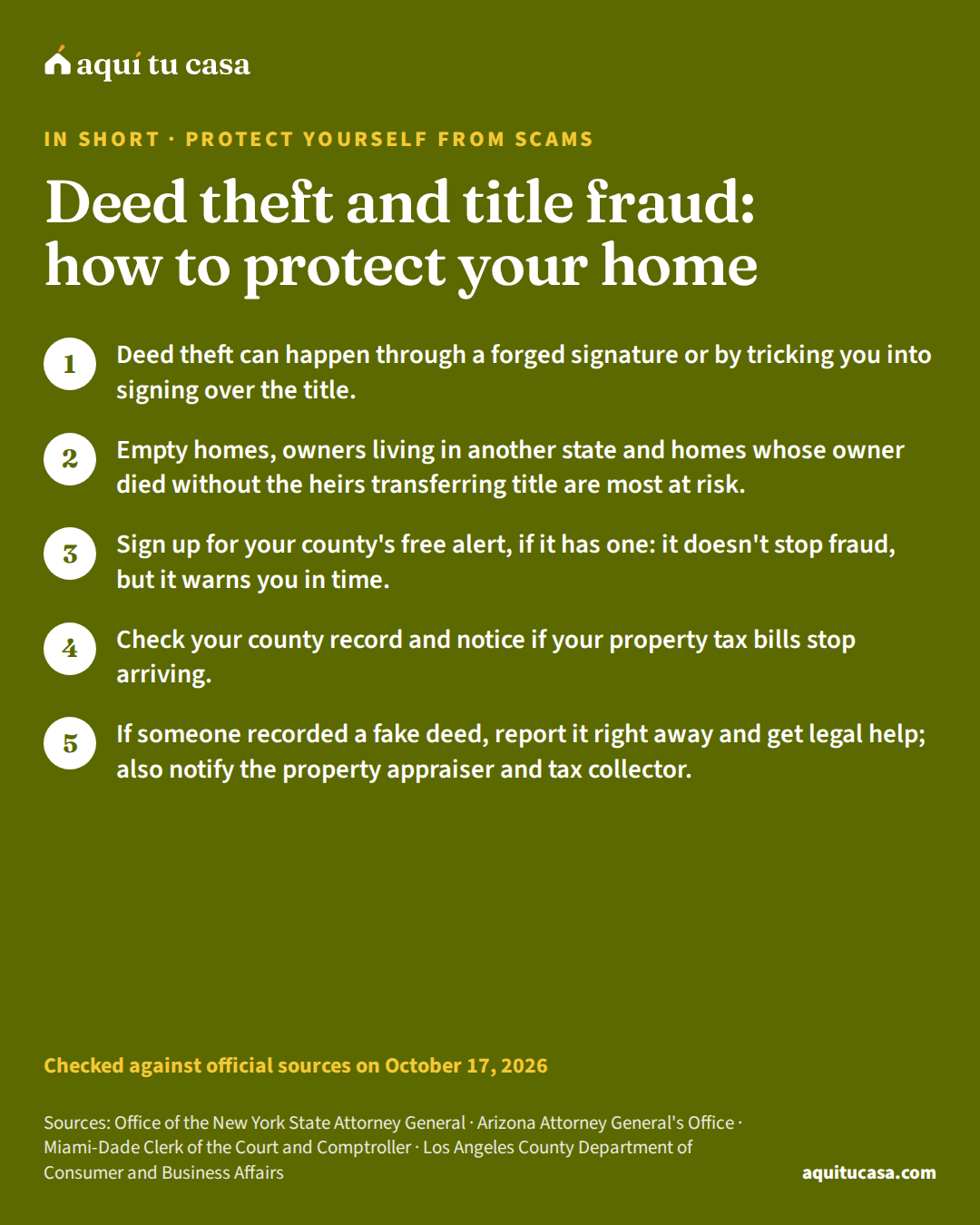
- Deed theft can happen through a forged signature or by tricking you into signing over the title.
- Empty homes, owners living in another state and homes whose owner died without the heirs transferring title are most at risk.
- Sign up for your county's free alert, if it has one: it doesn't stop fraud, but it warns you in time.
- Check your county record and notice if your property tax bills stop arriving.
Is this for you?
This guide is for you if…
- You own a home or land and want to protect it against a fake deed.
- You inherited a home, own a vacant property or live in another state and worry someone could put it in their name.
- You received a county notice, a loan letter or a document about your home that you don't recognize.
Get direct help first if…
- A company is offering to save your home from foreclosure if you sign over the title: also read the loan modification and rescue scams guide.
- You want to understand title insurance when buying: that guide explains what it protects.
- There is already a lawsuit over your home or you are being evicted: get legal aid right away.
This guide is for owners of a home or land who want to protect their title against a fake deed, and for anyone who already suspects something happened. It explains what deed theft is, who is most at risk, the warning signs, the free alerts several counties offer and what to do if someone recorded a fake document. There are simple ways to keep an eye on your home.
What deed theft is
When you buy a home, you receive a document usually called a deeddeedA deed is the legal document the seller uses to transfer ownership of the home to you. The seller signs it at closing, it lists the names of all the buyers and you receive a copy. Afterward, the settlement agent records it with the county records office; that recording puts the public on notice that you are now the owner. There are several types: a warranty deed gives the most promises about the title, and a quitclaim deed promises nothing. Do not confuse it with a deed of trust, which is the mortgage document.See the full definition, which shows the seller transferred ownership, or title, to you.8 According to the New York Attorney General’s office, deed theft occurs when a thief takes the titletitleTitle is your legal right to own and possess a property. The deed is the document showing that the seller transferred that right to you, and legal title is the title that can be documented in public records. As part of the purchase, a title search is done to see whether anyone else has a claim against the home; common claims come from a previous owner's unpaid taxes or from contractors who say they were not paid for work on the home. Title insurance protects you if such a claim shows up later.See the full definition to a home without the owner’s knowledge or approval. It happens in two common ways:1
- Forgery. The thief fakes your signature on a deed and records it with the county.
- Fraud. You sign the deed over to the thief without realizing what you are signing, often after false promises of help.
The Miami-Dade Clerk explains that a forged document can make it look as if the home changed owners, and that removing that change from your title can be complicated.3 In Arizona, the Attorney General’s office reported cases where someone forged the owner’s signature on a deed, recorded it with the county, sold the home quickly and left with the money.2 Bexar County, Texas, calls it a fast-growing crime as damaging as identity theftidentity theftIdentity theft happens when someone uses your personal information without your permission to commit fraud: for example, your name, your Social Security or Medicare number, or your credit card or bank account number. With that information, a thief can rent a home, get credit cards, receive government benefits or tax refunds, or open other accounts in your name. You often find out when your credit report or a statement shows accounts or charges you do not recognize, or when a debt collector calls. The federal site IdentityTheft.gov takes reports and gives you a recovery plan.See the full definition.7
Who is most at risk
Any homeowner can be a victim. But according to the New York Attorney General’s office, thieves mainly target:1
- Abandoned or empty properties.
- Properties in foreclosureforeclosureForeclosure is the process by which the lender or servicer takes back the property after the homeowner fails to make mortgage payments. The rules and timelines depend on each state; all of them include advance notices and, in general, time to catch up or ask for an alternative, such as a repayment plan or a loan modification. If you fall behind, call your servicer and a HUD-approved housing counseling agency early: foreclosure counseling is free and exists for exactly this.See the full definition.
- Properties with unpaid tax or utility lienslienA lien is a legal right a creditor holds in your property to make sure you repay a debt. It usually prevents the property from being sold until the debt is paid, and if you do not pay, the creditor may be able to take the property. Your mortgage is a lien on your home: when you pay it off, the lien is released and that shows up in your county's property records. There are other kinds, such as a federal tax lien, which is the government's legal claim against all your property when you do not pay a tax debt.See the full definition.
- Properties whose owner died without the heirs transferring title.
The same office says scammers also target seniors, immigrants and people of color.1 In Arizona, the Attorney General added rentals owned by corporations or out-of-state owners, and noted that owners who live in their homes and carry a mortgage are less likely to experience it.2

The warning signs
The Miami-Dade Clerk lists these signs that someone may have recorded a fake document on your property:3
- You receive a fraud notice from the county.
- There is a recorded document on your home that you never signed.
- Your home, or part of it, was transferred or sold to someone else without your knowledge.
- The person who signed the document had already died.
- A loan was taken out on your home without your knowledge, or you get papers for a loan or a transaction you didn’t make.
- You stop receiving your property taxproperty taxProperty tax is the tax the county, city, school district and other local bodies charge real property owners every year to pay for schools, police, fire and other public services. It is computed on the value the assessor's office assigns to your home, at each body's rate, minus the exemptions you qualify for, such as the primary-residence exemption in many states. If you have a mortgage you normally pay it month by month inside your payment, through the escrow account. It is generally deductible on your federal return if you itemize.See the full definition bill or notices.
- You get a notice of default or sale even though you own the home outright or are current.
- You get suspicious calls, emails or texts about your property that direct you to another website.
In New York, the Attorney General’s office also mentions no longer receiving your property tax and water bills, or a sudden jump in your utility bills.1
Your county’s free alerts
Several counties offer a free service that notifies you when a document is recorded under your name. These alerts can’t stop someone from recording a fake deed, but they let you respond quickly.36 Some examples, according to their official pages:
| County | How it notifies you |
|---|---|
| Los Angeles (California) | Mailed notice within 30 days after a deed is recorded, or 5 days for a notice of default or sale; plus an email within 48 hours if you sign up on the Assessor’s portal |
| Miami-Dade (Florida) | Free email alert within 24 hours of any document affecting your property |
| Tarrant (Texas) | Free alert by email or phone call when your exact name appears on more than 90 document types |
| Bexar (Texas) | Free email alert whenever a document is recorded under your name; the flyer is in Spanish |
In Los Angeles, if you have questions or think a document is suspicious, you can call the Department of Consumer and Business Affairs at (800) 593-8222.4 In Miami-Dade, mailed courtesy notices have been sent since 2005.3 In Bexar, you sign up on the county’s public portal by selecting “Property Alert,” and the email includes a link to view the document.7 In Tarrant, you are notified only when the exact name you gave appears, so register the name exactly as it is on your deed.6
In California, the Department of Real Estate (DRE) lists the counties it knows of with electronic notices (Calaveras, Los Angeles and San Diego) or letter notices (Contra Costa, Placer and Riverside), and suggests checking your county’s website if yours is not listed.5 In New York City, the Recorded Document Notification Program sends alerts by email or text.1
If your county is not listed here, look on the website of the county recorder or county clerk for a service with a name like “Property Fraud Alert.”
How to keep an eye on your home's title
1. Find your county's alert
This week
On the county recorder's or clerk's website; if your county has none, check its site from time to time.5
2. Sign up with your exact name
When you register
Some alerts only notify you when the exact name you gave appears.6
3. Check your record online
From time to time
Look at the county recorder's and assessor's sites to confirm the information is accurate.2
5. Act if something is off
The same day
If you see a document you didn't sign, report it to the police right away.3
How to protect yourself
The New York Attorney General’s office gives these tips to all homeowners:1
- Never sign anything you don’t understand, and read everything before signing.
- Be wary of anyone who asks for your title. Legitimate organizations will not ask you to transfer your property rights or promise you can buy the property back.
- Beware of upfront fees for a loan modification.
- Have a will. Thieves target homes whose owner died years ago without the heirs transferring title.
- Don’t abandon the property, and keep up with your mortgage, taxes and utilities.
- Check your records with the county clerk.
- Get your own help. Use your own lawyer or free services, and don’t hire a lawyer referred by someone with an interest in your property.
If you are behind on your mortgage and someone offers to “save” your home in exchange for signing over your title, read the loan modification and rescue scams guide. And if a “notario” offers to fix papers for your home, read notario is not a lawyer first.
About title insurancetitle insuranceTitle is the legal right of ownership of the home, and title insurance protects you if, after closing, someone claims a right to it: an old debt, an heir, an error in the records. There are two policies. Most lenders require a lender's policy, which protects the amount they lent. The owner's policy is optional, paid once at closing, and protects you for as long as you own the home, including the legal costs of defending your right. You can shop for a title company; the price varies by state.See the full definition: the CFPB explains that an owner’s policy protects you if someone claims a right to the home from before you bought it, and that most lenders require a lender’s policy.8 Check your own policy to see what it covers; the title insurance guide explains how it works.

If someone already recorded a fake deed
Act fast. The Miami-Dade Clerk suggests these steps, written for Florida but useful as a guide in other states:3
- Report it to the police right away. Deed forgery is a crime.
- Ask the court to clear your title. In Florida, you file a complaint to quiet title based on a fraudulent conveyance, asking the court to declare the forged deed void. There are filing fees, or you can file for indigency. The Clerk provides a simplified form.
- Record a lis pendens (notice of pending lawsuit) after filing the case, to put the public on notice and help prevent further sales.
- Notify the property appraiser and tax collector. A recorded deed can change your address in their systems, and bills can go elsewhere. Unpaid taxes can end in a tax deed auction.
These cases can be complicated, and Miami-Dade notes that you may want to consider an attorney.3 Free legal aidlegal aidLegal aid is the free civil legal help that nonprofit organizations and their lawyers provide to low-income people in civil, not criminal, matters. In housing, that includes representing families facing eviction or foreclosure, alongside matters such as custody, child support, protection from domestic violence and access to benefits. In the United States, the Legal Services Corporation, created by Congress, funds a nationwide network of these organizations; its finder points you to the one in your area. Each sets its own income limits.See the full definition in your area is an option. In New York, the Attorney General’s office takes complaints at 1-800-771-7755, and the Homeowner Protection Program (HOPP) has lawyers who provide free counseling and legal assistance at 855-466-3456. There, if a scammer sues to evict you, you can ask the judge to stay the case for 90 days.1 If you live in another state, you can contact your state attorney general’s office and legal aid in your area.
Example with real numbers
What happens when a county alert arrives
An example in words of how the service works and what you do.
- Someone records a document under your name
- The county records it; the alert doesn't stop it
- The alert arrives
- In Miami-Dade, by email within 24 hours
- You review the document
- In the county's public records
- If you didn't sign it
- Report it to the police right away and get legal help
That is how Miami-Dade and Bexar describe it.37 The steps for victims are the ones Miami-Dade suggests.3
If this is you
You inherited a home
Thieves look for homes whose owner died without the heirs transferring title.1 Get the title in order and check the county record.
You live alone or are older
Scammers target seniors.1 Never sign anything about your home that you don't understand.1
You own an empty home or live in another state
These are among the most common cases, according to Arizona.2 Sign up for the alert in the county where the home is.
You prefer to read in Spanish
Bexar County's alert flyer is in English and Spanish.7 Ask your county whether it has materials in Spanish.
Costly mistakes
Mistake: Thinking a county alert prevents fraud.
Instead: It doesn't prevent it, but it warns you in time to act fast.3
Mistake: Signing up with a name different from the one on your deed.
Instead: Some alerts only notify you when the exact name you gave appears.6
Mistake: Leaving the title of an inherited home unresolved.
Instead: It is a favorite target; have a will and get the title in order.1
Mistake: Signing over your title so someone can “help” with the mortgage.
Instead: Legitimate organizations don't ask you to transfer your rights.1
Mistake: Ignoring that your tax bills stopped arriving.
Instead: It can be a sign of fraud; check your county record.3
Mistake: Waiting to report it.
Instead: Deed forgery is a crime: report it right away.3
What to do this week
- Check your county’s website for a free property fraud alert and sign up with your exact name.56
- Check the county recorder’s and assessor’s sites to confirm your home is still in your name.2
- Make sure your property tax and utility bills are still arriving.3
- If you inherited a home, find out whether the title is already in the heirs’ names.1
- Save the numbers for local police and your state attorney general; if you see something odd, report it the same day.3
- Read the housing scams guide and the property tax guide for other warning signs.
Your household this month
Let's do the math
Left each month
Enter what at least one person takes home to see the result.
What helps
- Pay savings first: set the goal aside the day the money arrives, before flexible spending.
- Add up the bills that come every few months (car insurance, school) and divide by twelve.
- If income changes, plan on a low month and save the extra from good months.
- A HUD-approved housing counselor can go over the budget with you, often for free.
This is a planning tool with your numbers, not a credit evaluation or an approval. The split reference is only a guide.
Ready to see the numbers? Find your county here
See how this applies in your county: its loan limits, prices and rents, from the official data.
Printable checklist
Frequently asked questions
Can someone take my house with a fake deed?
Someone can record a deed with your forged signature and make it look as if the home changed owners. The Arizona Attorney General's office reported cases where the criminal quickly sold the home. Removing that change from your title can be complicated, which is why it helps to catch it early.
How do I know if someone recorded something on my home?
Several counties offer a free alert service that notifies you when a document is recorded under your name; in Miami-Dade, for example, the alert arrives within 24 hours. You can also check your county recorder's and assessor's websites from time to time.
Does my county have property fraud alerts?
It depends on the county. Miami-Dade, Tarrant and Bexar, among others, offer free alerts, and Los Angeles sends notices by mail and by email. Look on your county recorder's or clerk's website for a service called 'Property Fraud Alert' or something similar.
What do I do if someone recorded a fake deed on my home?
The Miami-Dade Clerk suggests reporting it right away to the police, because it is a crime, and filing a court case to quiet title. It also helps to notify the property appraiser and tax collector, so your bills don't go to another address. Free legal aid in your area can help.
Does title insurance protect me against deed theft?
The CFPB describes owner's title insurance as protection if someone claims a right to the home from before you bought it. Check your own policy to see what it covers; the title insurance guide explains how it works.
Who is most at risk?
According to the New York and Arizona attorneys general, empty or abandoned homes, owners who live in another state, properties in foreclosure or with liens, and homes whose owner died without the heirs transferring title. New York adds that scammers also target seniors, immigrants and people of color.
A company is asking me to sign over my title to help me. Is that normal?
No. The New York Attorney General's office says legitimate organizations will not ask you to transfer your property rights or promise you can buy the property back. Never sign anything you don't understand.
Sources
Every figure in this guide comes from one of these official sources. The number next to a sentence leads to the source behind it.
Each source on one line: who publishes it, its title, its address and the date we read it.
- 1. Office of the New York State Attorney General · Deed theft · ag.ny.gov · Accessed October 17, 2026
- 2. Arizona Attorney General's Office · Attorney General's Office Warns AZ Homeowners About Deed Fraud · azag.gov · Accessed October 17, 2026
- 3. Miami-Dade Clerk of the Court and Comptroller · Property Fraud · miamidadeclerk.gov · Accessed October 17, 2026
- 4. Los Angeles County Department of Consumer and Business Affairs · DCBA, LA County Assessor, Registrar-Recorder/County Clerk Launch Property Owner E-Notification Alert · dcba.lacounty.gov · Accessed October 17, 2026
- 5. California Department of Real Estate (DRE) · County Recorder Property Owner Alert Program · dre.ca.gov · Accessed October 17, 2026
- 6. Tarrant County Clerk, Texas · Property Fraud Alert · tarrantcountytx.gov · Accessed October 17, 2026
- 7. Bexar County Clerk, Texas · Bexar County Clerk's Free Vanguard Property Alert Service · bexar.org · Accessed October 17, 2026
- 8. CFPB · What is owner's title insurance? · consumerfinance.gov · Accessed October 17, 2026
Keep reading
Related guides
If this guide helped, these follow the same path.

Protect yourself from scams 11 minute read
Loan modification and foreclosure rescue scams
How to spot scams that promise to save your home from foreclosure, what federal law prohibits and where to get real, free help.
- No one selling help with your mortgage may charge you before you sign a written agreement with your lender or servicer.
- Never stop paying or pay someone else because a company tells you to, and never sign over the title to your home.
- No one can guarantee a modification: your mortgage company has to agree to it.
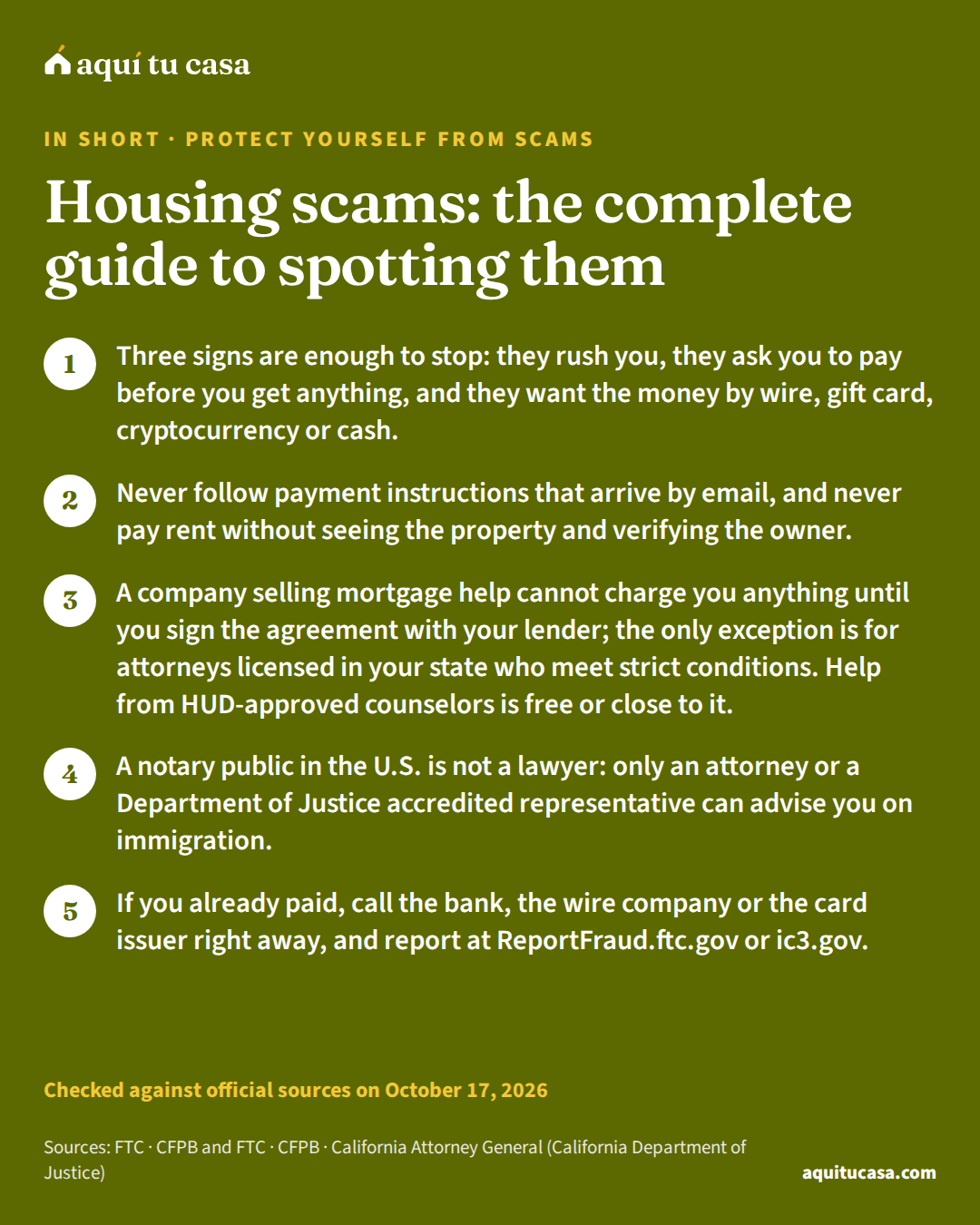
- Protect yourself from scams Housing scams: the complete guide to spotting them The rental, mortgage, title, contractor, credit and moving scams families run into most: how to spot them, what to do and where to report them. 17 minute read
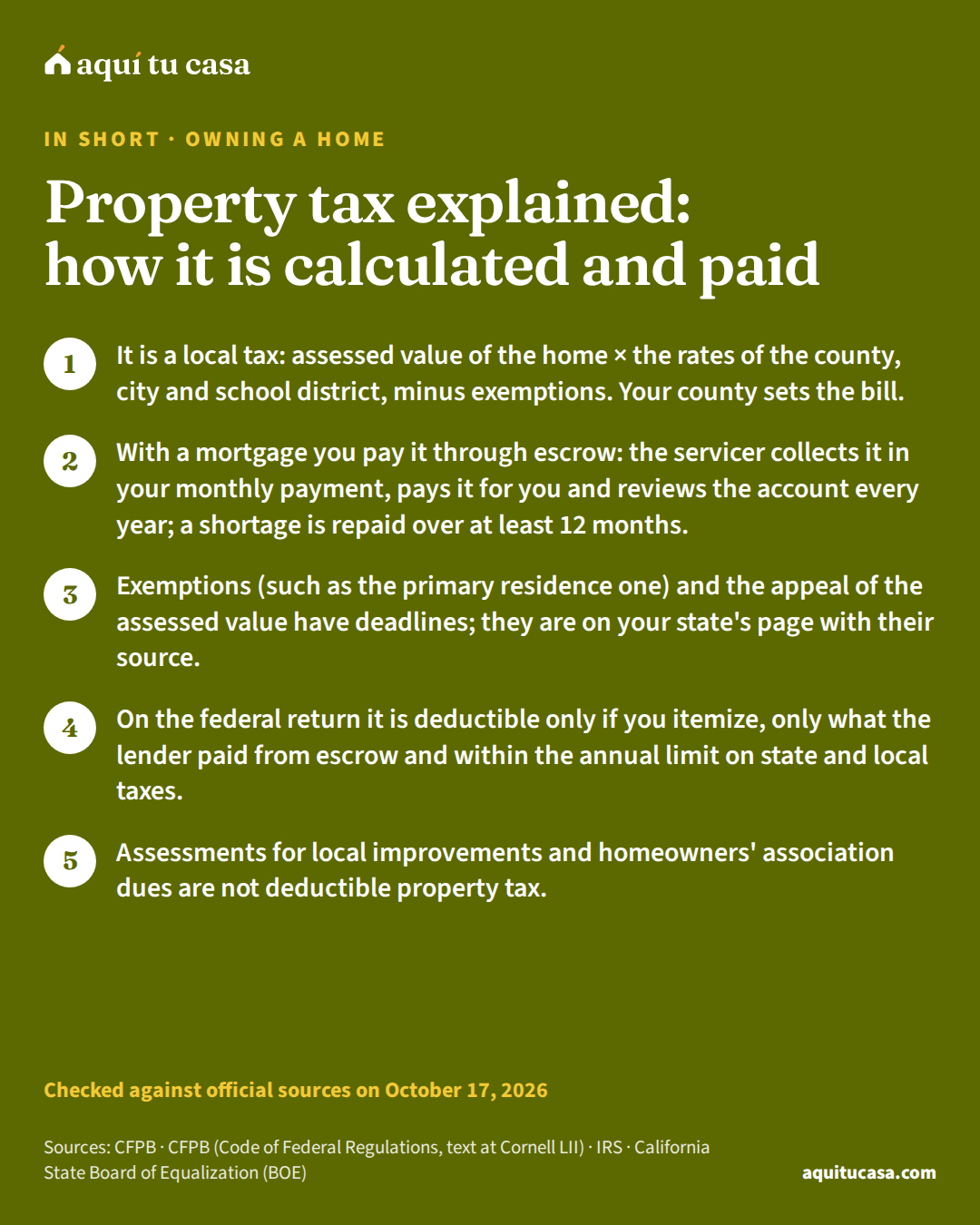
- Owning a home Property tax explained: how it is calculated and paid Who charges property tax, how it is calculated, how it is paid through escrow, which exemptions and appeals exist and what part is deductible. 13 minute read
- Money problems Can't pay your mortgage? What to do in the first week Can't pay your mortgage? Call your servicer, learn the options that exist, the federal rules that protect you and the rescue scams to avoid. 14 minute read
Tools for this topic
Was this guide useful?
Thank you. Your answer stays in your browser; nothing is sent.