What a repair quote must include
What a repair estimate and contract should say according to the FTC and ENERGY STAR, and where to look up a contractor's license in your state.
Verified against official sources on November 6, 2026 14 official sources

Show contents
In short
What you need to know
Quick answer
According to the FTC, a written estimate should state the work to be done, the materials, the completion date and the price. The contract adds the contractor's name, address, phone and license number, the start and end dates, any spoken promises and, if you sign at home, your right to cancel within three business days, with no blank spaces. Don't pay everything up front or make the last payment before the job is done. Look up the license on your state's or city's official page: here are the pages for several states.
What matters most
- A written estimate states the work, materials, completion date and price, according to the FTC.
- The contract adds the contractor's details and license, the dates, spoken promises and your right to cancel.
- Don't sign anything with blank spaces, and put every change in writing, with its price.
- Don't pay everything up front; some states limit the deposit, as California does.
Is this for you?
This guide is for you if…
- You're repairing your home and want to compare estimates from several contractors.
- A contractor gave you an estimate or a contract and you want to know if something is missing.
- You want to check whether a contractor is licensed in your state.
Get direct help first if…
- You already signed and the work was poor or abandoned: the contractor scams guide explains where to complain.
- You're looking for money to pay for the repair: the repair-help programs and the USDA 504 guide cover it.
A good estimate protects you before the work starts. If it says everything that will be done, with what materials, in how long and for how much, you can compare offers and push back if something goes wrong. This guide is for you if you’re repairing your home and have one or more estimates in hand. It explains what an estimate and a contract should say according to official sources, how to pay safely and where to look up a contractor’s license in your state.
What an estimate should say
The Federal Trade Commission (FTC) recommends getting multiple estimates. A written one should include four things: a description of the work, the materials, the completion date and the price. Don’t automatically choose the lowest, and ask for an explanation if there’s a big difference among them.1
To really compare, ask that all the estimates be for the same work. If one proposes repairing part and another replacing everything, you can’t compare them on price. For heating and cooling equipment, ENERGY STAR recommends written, itemized estimates, comparing cost, efficiency and warranties.2
California’s Contractors State License Board (CSLB) gives a good example of how specific to be about materials: quality, quantity, color, size or brand. “Install cabinets” isn’t enough; say which cabinets, from which manufacturer and which model.3
Check each estimate
5. License and insurance
Before signing
Look up the license on your state's page and ask for proof of insurance.1
What the contract should say
The FTC says contract requirements vary by state, but that even if your state doesn’t require a written agreement, you should ask for one. Before signing, make sure it includes:1
- The contractor’s name, address, phone number and license number.
- An estimated start date and completion date.
- Any promises made in conversations or calls, about the scope of work and the cost of labor and materials.
- A written statement of your right to cancel within three business days, if you signed at home or somewhere other than the seller’s permanent place of business.
And make sure all blank spaces are filled in.1 The CSLB adds that the contract should say who gets the building permitsbuilding permitA building permit is the approval a local government gives to start a construction project. Not every area of the country requires one. If you renovate with an FHA 203(k) loan, the program requires all building permits to be obtained before work starts and posted on site. Freddie Mac also recommends working with your contractor to get any permits you need before a renovation begins.See the full definition and when each payment is made, and that you should never sign a blank or partially blank contract.3 For heating and cooling equipment, ENERGY STAR recommends that the signed proposal also state the model numbers and the warranty.2

A complete estimate or one that falls short
You can compare
Complete
If you were promised something out loud, ask for it in writing.1
How to pay without losing your money
The FTC says not to pay the full amount up front. Some states limit how much a contractor can ask as a down payment: your state or local consumer agency can tell you the law in your area. And never make the final payment until the work is done and you’re satisfied.1
In California, the CSLB says the down payment should never exceed 10 percent of the price or $1,000, whichever is less, and that the contract should include the total price, when payments are made and whether there’s a cancellation penalty.3 After a disaster, FEMA recommends not paying more than half the cost of repairs in advance.4
Example with real numbers
A payment schedule in words
An example of how payments line up; the allowed deposit changes by state.
- At signing
- A deposit within your state's limit (in California, 10% or $1,000, whichever is less)
- During the job
- Payments for work already done, with receipts
- If there are changes
- A signed change order, with the new price
- Final payment
- When the work is done and you're satisfied
California's limit is from the CSLB;3 the final payment, from the FTC.1 Plan the cost in your family budget.
Run it with your numbersFamily budgetIf the estimate is in English only
Many contractors speak Spanish but write the estimate and the contract in English. The FTC says not to sign a document you haven’t read, that’s in a language you don’t understand or that has blank spaces. If you talk with the salesperson or contractor in a language other than English, depending on where you live and what you’re buying, you may be entitled to a copy of the contract in that language, so you can read and understand it before signing the English version. And don’t let anyone pressure you into signing.1
If there’s no copy in your language, ask for time. Take the estimate to someone you trust who reads English, or compare it point by point with this guide’s list: the work, materials, date, price, the contractor’s details and license, spoken promises and your right to cancel. Ask about anything you don’t understand before you sign, not after.

What to keep when the job is done
Keep the estimate, the signed contract, every change order, the receipts for all payments, the warranties and the permits together. If something fails, those papers show what was promised and what you paid. If there’s a problem, the FTC recommends following each phone call with a letter sent by certified mail and keeping notes and copies.1 The contractor scams guide explains where to complain if it isn’t resolved.
Changes halfway through the job
Almost every job changes a little: hidden damage turns up, a material changes or a date moves. The CSLB says that if you add or remove work, swap materials or change the completion date, write it on a change order with the price change; once signed, it becomes part of the contract.3 If the contractor says “we’ll take care of that later” without writing it down, ask them to write it.
Your right to cancel
The FTC’s Cooling-Off RuleFTC Cooling-Off RuleThe Cooling-Off Rule is a federal FTC rule that gives you the right to cancel certain sales a seller makes to you in person away from its place of business, for example in your home, even if you invited the seller. You can cancel before midnight of the third business day after the purchase. The seller must give you a contract in the same language used in the sales pitch, such as Spanish, with two copies of a cancellation notice, and tell you out loud that you can cancel. It does not cover, among others, sales of real estate or insurance, or purchases below a certain price.See the full definition gives you three days to cancel certain sales made at your home. Your right to cancel for a full refund lasts until midnight of the third business day after the sale. The seller must give you two copies of a cancellation form and a dated copy of the contract or receipt with the seller’s name and address and an explanation of your right to cancel.5
The Rule has exceptions: it doesn’t cover sales under $25 at your home, sales needed to meet an emergency, or repairs you asked the seller to come do; things you buy beyond that repair are covered.5 Some states give their own rights. In California, for example, the CSLB says you may cancel within three days of signing a contract, in writing, mailed before midnight of the third day.3
Where to look up a license in your state
The FTC recommends confirming a contractor’s license with your state or county government.1 These are official pages we read for this guide, with what each one says:
| Place | Who issues the license | What its page says |
|---|---|---|
| California | Contractors State License Board (CSLB) | Search by license number, business name or salesperson name, with public complaints.6 |
| Florida | Department of Business and Professional Regulation (DBPR) | A search to verify a licensee and an unlicensed activity search.7 |
| Texas | Department of Licensing and Regulation (TDLR) and State Board of Plumbing Examiners (TSBPE) | TDLR covers air conditioning contractors and electricians; TSBPE regulates plumbing.89 |
| Nevada | State Contractors Board (NSCB) | Search by license number, company or person.10 |
| New Mexico | Construction Industries Division (RLD) | Requires a license for anyone offering construction work.11 |
| New York City | Department of Consumer and Worker Protection (DCWP) | Requires a Home Improvement Contractor license.12 |
| New Jersey | Division of Consumer Affairs | Home improvement contractors are looked up as businesses.13 |
| Denver, Colorado | Community Planning and Development | Issues licenses in the city and doesn’t accept other counties’ or states’.14 |
If your state isn’t on the list, find the board or agency that licenses contractors on your state government’s official site, and ask your county or city: in some places the city issues the license, as in New York and Denver.1214 Rules also change by trade: in Texas, for example, air conditioning and electrical work are under TDLR and plumbing under TSBPE.89
If this is you
You have three estimates with very different prices
Ask for an explanation of the difference and check that all are for the same work.1
The contractor explained everything in Spanish
Ask that spoken promises be written down, and for a copy in Spanish if you're entitled to one.11
You need the repair after a disaster
Don't pay more than half up front, and get the guarantees in writing.4
Costly mistakes
Mistake: Choosing the cheapest estimate without asking why.
Instead: Ask for an explanation of big differences between estimates.1
Mistake: Signing with blank spaces.
Instead: Check that everything is filled in before you sign.1
Mistake: Accepting spoken changes halfway through the job.
Instead: Ask for a signed change order with the new price.3
Mistake: Paying everything before the job is done.
Instead: Don't pay in full up front or make the last payment before you're satisfied.1
Mistake: Believing a license number on the estimate is enough.
Instead: Look it up on your state's or city's official page.1
What to do this week
- Get two or three written estimates for the same work.1
- Check that each one states the work, materials, completion date and price.1
- Look up each contractor’s license on your state’s or city’s official page.1
- Before signing, check the contract against this guide’s list and fill every blank space.1
- Agree on a payment schedule that follows the work, without paying everything up front.1
- Add the cost to your family budget, and read the guides on contractor scams, the roof and heating and cooling.
Your household this month
Let's do the math
Left each month
Enter what at least one person takes home to see the result.
What helps
- Pay savings first: set the goal aside the day the money arrives, before flexible spending.
- Add up the bills that come every few months (car insurance, school) and divide by twelve.
- If income changes, plan on a low month and save the extra from good months.
- A HUD-approved housing counselor can go over the budget with you, often for free.
This is a planning tool with your numbers, not a credit evaluation or an approval. The split reference is only a guide.
Ready to see the numbers? Find your county here
See how this applies in your county: its loan limits, prices and rents, from the official data.
Printable checklist

Frequently asked questions
What's the difference between an estimate and a contract?
The estimate is the offer: according to the FTC, it should state the work, materials, completion date and price. The contract is the agreement you sign: it adds the contractor's details and license, the start and end dates, spoken promises and your right to cancel if you sign at home.
How many estimates should I get?
The FTC recommends getting several, not automatically choosing the lowest and asking for an explanation if there's a big difference among them. To compare them, ask that all be for the same work.
How much can I give as a deposit?
It depends on the state. The FTC says some states limit it and your state's consumer protection agency can tell you the law. In California, for example, the CSLB says the deposit should never exceed 10 percent of the price or $1,000, whichever is less. After a disaster, FEMA recommends not paying more than half up front.
What if the contractor wants to change the job halfway through?
Ask that the change be in writing, with its price. The CSLB calls it a change order: once signed, it becomes part of the contract.
How do I check whether a contractor is licensed?
Look up their license number on your state's or city's official page. This guide lists the pages for California, Florida, Texas, Nevada, New Mexico, New York City, New Jersey and Denver. If your state isn't on the list, find the contractor board on your state government's official site.
Do I have to get the estimate in Spanish?
The FTC says that if you talk with the salesperson or contractor in another language, depending on where you live and what you're buying, you may be entitled to a copy of the contract in that language. And don't sign a document in a language you don't understand.
Can I cancel a contract I signed at home?
Often, yes. The FTC's Cooling-Off Rule gives you until midnight of the third business day to cancel certain sales made at your home, and the seller must give you two copies of the cancellation form. It doesn't cover emergencies or repairs you asked for.
Sources
Every figure in this guide comes from one of these official sources. The number next to a sentence leads to the source behind it.
Each source on one line: who publishes it, its title, its address and the date we read it.
- 1. Federal Trade Commission (FTC) · How To Avoid a Home Improvement Scam · consumer.ftc.gov · Accessed November 6, 2026
- 2. ENERGY STAR (EPA) · 10 Tips for Hiring a Heating and Cooling Contractor · energystar.gov · Accessed November 6, 2026
- 3. Contractors State License Board (CSLB), California · What Should I Look for in a Contract and Binding Agreements? · cslb.ca.gov · Accessed November 6, 2026
- 4. FEMA · Disaster Fraud · fema.gov · Accessed November 6, 2026
- 5. Federal Trade Commission (FTC) · Buyer’s Remorse: The FTC’s Cooling-Off Rule May Help · consumer.ftc.gov · Accessed November 6, 2026
- 6. Contractors State License Board (CSLB), California · Check a Contractor License or Home Improvement Salesperson (HIS) Registration · cslb.ca.gov · Accessed November 6, 2026
- 7. Florida Department of Business and Professional Regulation (DBPR) · Licensing Portal - License Search · myfloridalicense.com · Accessed November 6, 2026
- 8. Texas Department of Licensing and Regulation (TDLR) · TDLR License Data Search · tdlr.texas.gov · Accessed November 6, 2026
See the other 6 sources
- 9. Texas State Board of Plumbing Examiners (TSBPE) · Texas State Board of Plumbing Examiners · tsbpe.texas.gov · Accessed November 6, 2026
- 10. Nevada State Contractors Board (NSCB) · Contractor License Search · app.nvcontractorsboard.com · Accessed November 6, 2026
- 11. New Mexico Regulation and Licensing Department (RLD) · Construction Industries · rld.nm.gov · Accessed November 6, 2026
- 12. NYC Department of Consumer and Worker Protection (DCWP) · Home Improvement Contractor License Application Checklist · nyc.gov · Accessed November 6, 2026
- 13. New Jersey Division of Consumer Affairs · License Verification System · newjersey.mylicense.com · Accessed November 6, 2026
- 14. City and County of Denver, Community Planning and Development · Contractor Licensing · denvergov.org · Accessed November 6, 2026
Keep reading
Related guides
If this guide helped, these follow the same path.

Protect yourself from scams 11 minute read
Contractor and home repair scams: how to protect yourself
How to spot a dishonest contractor, check a license, sign a solid contract, pay safely and cancel a sale made at your home.
- Be wary of anyone who knocks on your door, pressures you to decide today or scares you with a 'free inspection'.
- Ask for the license number and look it up on your state contracting board or agency's website; if it isn't listed, it's not a good option.
- Sign a complete contract, never a blank one: work, materials, permits, dates, total price and payment schedule.
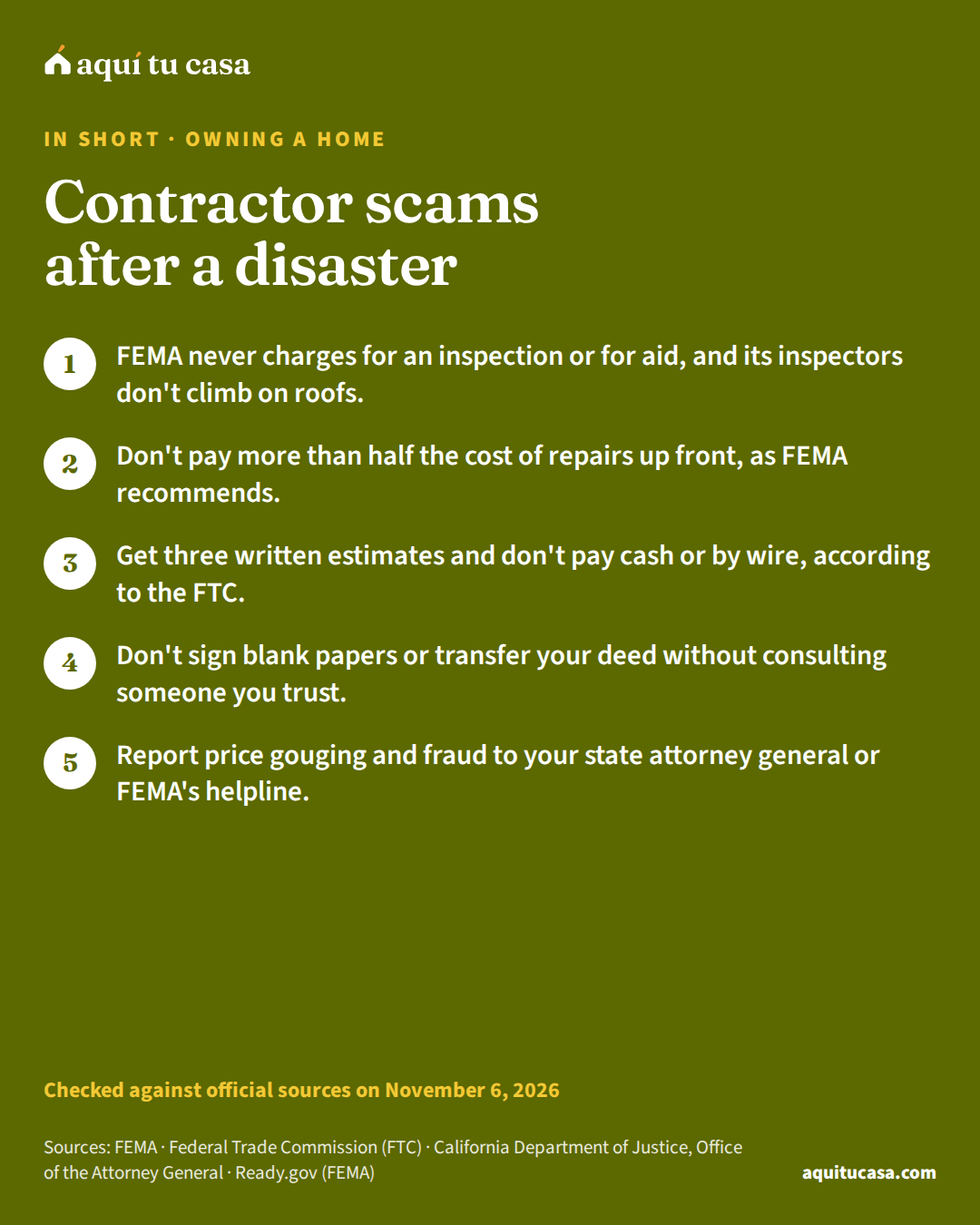
- Owning a home Contractor scams after a disaster How to spot a fake FEMA inspector or a contractor taking advantage of a storm, what the law says about price gouging and where to report it. 9 minute read
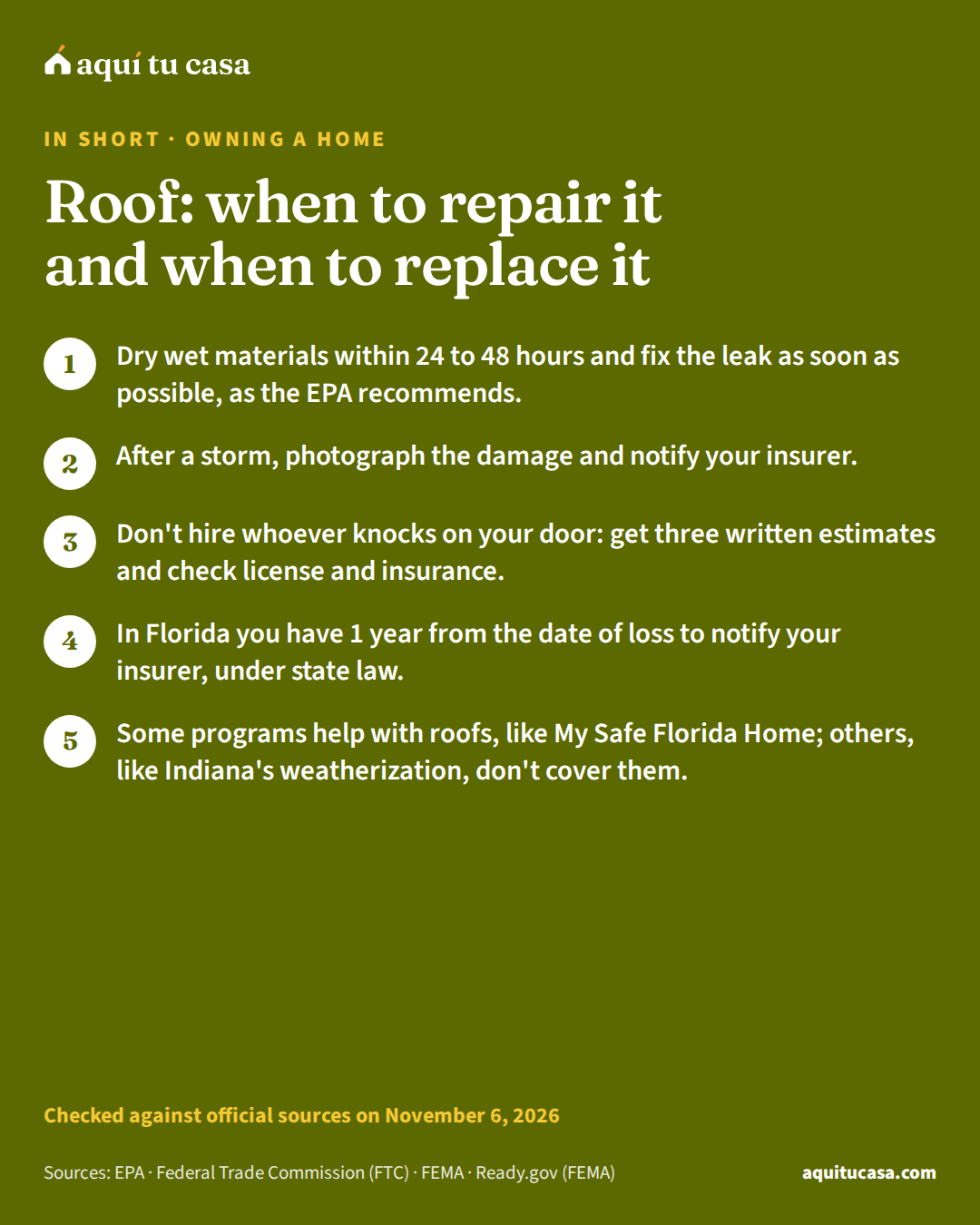
- Owning a home Roof: when to repair it and when to replace it What to do if your roof leaks, how to avoid scams after a storm, what Florida's law and insurance rules say and which programs help pay for a roof. 9 minute read
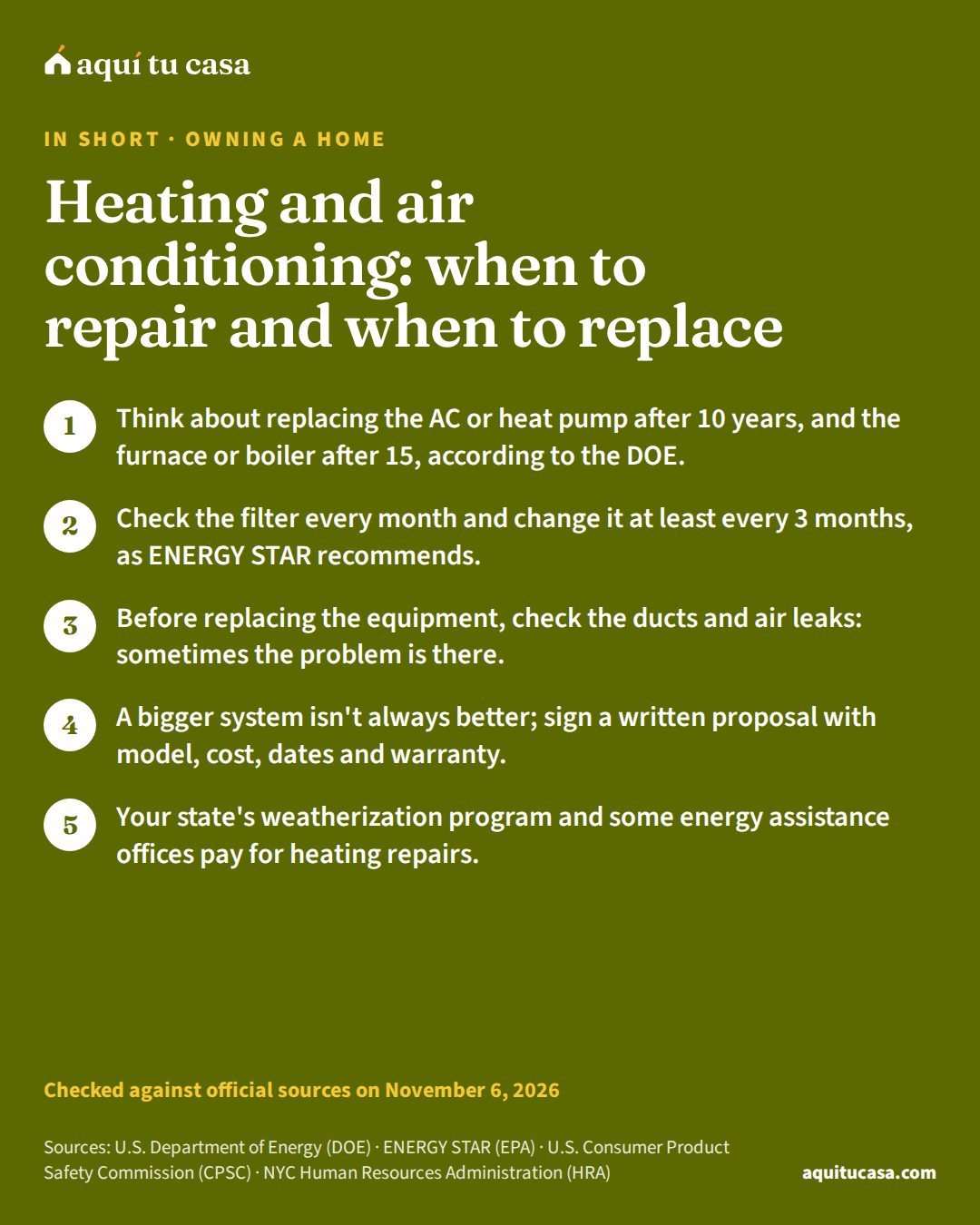
- Owning a home Heating and air conditioning: when to repair and when to replace When to think about replacing your AC or furnace, the upkeep ENERGY STAR recommends, how to hire a technician and which public help pays for the repair. 9 minute read
Tools for this topic
Was this guide useful?
Thank you. Your answer stays in your browser; nothing is sent.