FEMA disaster assistance for renters and homeowners
What FEMA assistance for individuals and households covers, how to apply, deadlines to register and appeal, and what mixed-status families can ask for.
Verified against official sources on October 31, 2026 10 official sources

Show contents
In short
What you need to know
Quick answer
If you live in a presidentially declared disaster area, FEMA can help with rent for other housing or a hotel while you cannot live in your home, with repairs if you own the home and it is your primary residence, and with other needs such as personal property, transportation or child care. It does not replace insurance. You generally have 60 days from the declaration to register and 60 days to appeal a decision. If the person applying does not meet the status requirements, the parent of a minor child who is a citizen or qualified alien can apply on the child's behalf.
What matters most
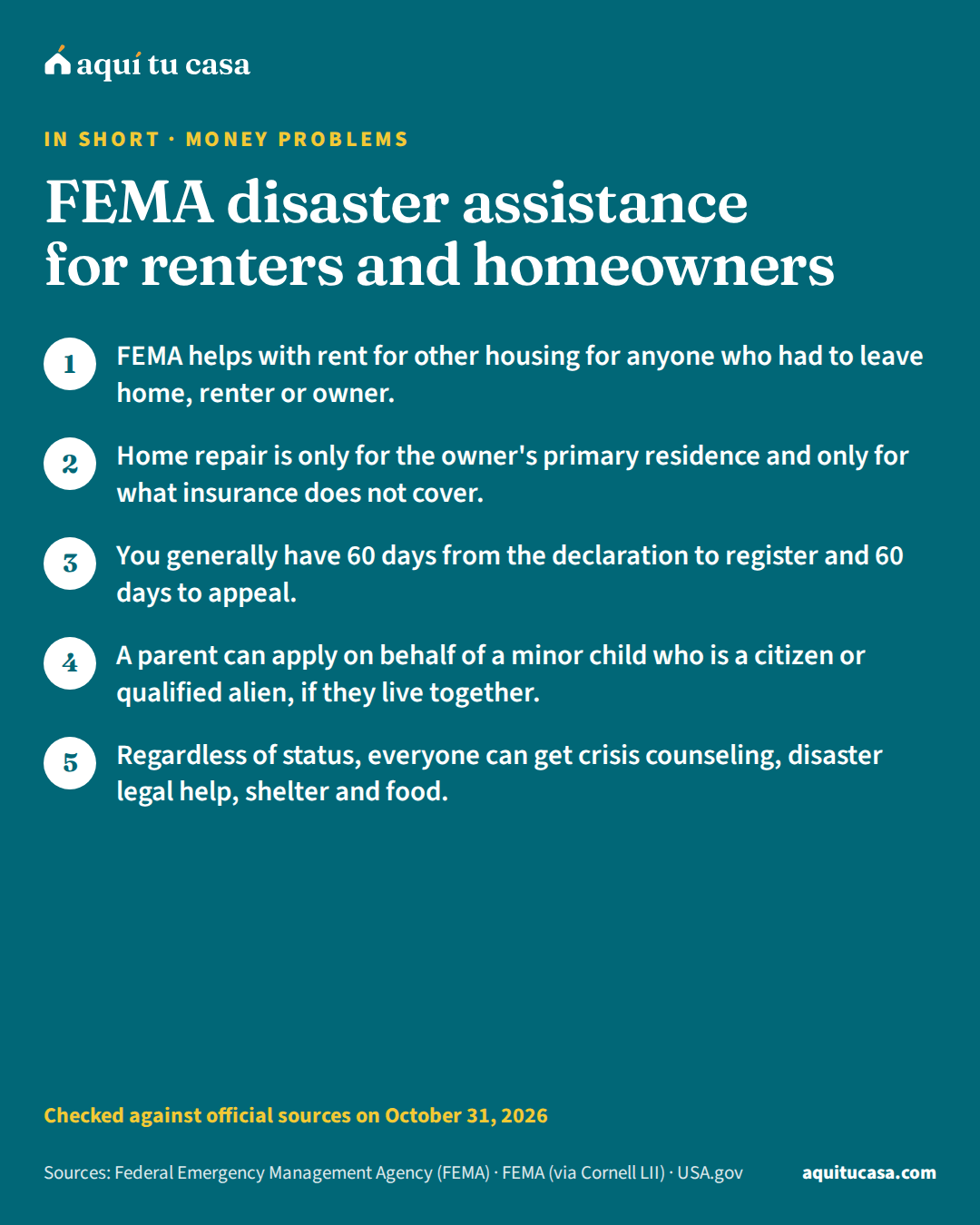
- FEMA helps with rent for other housing for anyone who had to leave home, renter or owner.
- Home repair is only for the owner's primary residence and only for what insurance does not cover.
- You generally have 60 days from the declaration to register and 60 days to appeal.
- A parent can apply on behalf of a minor child who is a citizen or qualified alien, if they live together.
Is this for you?
This guide is for you if…
- Your house or apartment was damaged in a presidentially declared disaster.
- You rent and had to leave your home because of a hurricane, flood, fire or other disaster.
- Your family includes people with different immigration statuses and you want to know who can apply.
Get direct help first if…
- You are in danger right now: call 911 and follow evacuation orders.
- You need to file your insurance claim: start with «After a hurricane, flood or fire».
After a hurricane, flood, fire or tornado, many families do not know whether they can ask the federal government for help, especially if they rent or if people in the home have different immigration statuses. The Federal Emergency Management Agency (FEMAFederal Emergency Management Agency (FEMA)FEMA (the Federal Emergency Management Agency) is the federal agency that supports people and emergency personnel to prepare for, protect against, respond to, recover from and mitigate all hazards. When the President declares a disaster in an area, people there can apply for help from FEMA; if your area is not eligible, state agencies and other organizations may offer assistance. FEMA also runs the National Flood Insurance Program (NFIP) and publishes the flood maps that show high-risk flood zones.See the full definition) has a program for individuals and households with clear rules. This guide explains what it covers, how to apply, the deadlines and what mixed-status families can do. For the insurance claim and the first days, read After a hurricane, flood or fire.
What FEMA assistance for individuals and households covers
FEMA’s Individuals and Households Program (IHP) is for people who live in an area with a presidential disaster declaration.9 It provides funds for three things:1
- Temporary housing while you cannot live in your home: rental assistance for other housing or hotel reimbursement.
- Repair or replacement of the owner’s home, if it is their primary residence.
- Other disaster-caused expenses and serious needs that insurance does not cover or covers poorly.
FEMA is clear on two points: this assistance is not a substitute for insurance and cannot compensate for all losses.1 It is help to start recovering, not a full payment.
Under “other needs”, FEMA’s regulation includes medical and dental expenses, child care, funeral, personal property, transportation, moving and storage, among others.8 Keep receipts for everything you pay because of the disaster.
If you rent or if you own: what changes
FEMA assistance by situation
Renter
If you rent
- Help renting other housing if you had to leave
- Reimbursement for a short hotel stay
- Other needs: personal property, transportation, moving
- Repairing the building is the owner's job
Primary residence
If you own
- Help renting other housing while you repair
- Repair or replacement of your primary residence
- Only what your insurance does not cover
- Other household needs
Renters and owners can both apply; what changes is whether FEMA can pay to repair the home.
Under FEMA’s regulation, eligible people who had to leave their home can receive rental assistance for other housing, and those not yet receiving that assistance can be reimbursed for reasonable short-term lodging. Repair or replacement is only for an owner-occupied primary residence, when the disaster damaged or destroyed it and the damage is not covered by insurance.7
If you rent, remember that repairing the building is the owner’s responsibility, and your belongings may be covered by your renters insurancerenters insuranceRenters insurance, also called tenants insurance, protects your belongings and protects you when you rent. The landlord's insurance covers the building, but not your furniture, clothes or electronics. It usually includes three coverages: your personal property, even if it is stolen away from home; additional living expenses if a covered loss forces you to move out for a while; and personal liability if someone is hurt in your home. A standard policy does not cover floods, which are insured separately. Some landlords require it.See the full definition if you have it; read the guide Renters insurance.
Insurance comes first
FEMA does not pay for what your insurance already covers. Under its regulation, it does not give assistance to people with adequate insurance coverage, unless the insurance payment is likely to be significantly delayed. It also does not give temporary housing assistance to someone who owns a second or vacation home nearby, or available rental property.5
So file your insurance claim and apply to FEMA at the same time. If your insurer pays little or denies the claim, keep the letter: it proves what was not covered. The guide Flood insurance and the NFIP explains a flood claim.

How to apply and the deadlines
According to USA.gov, there are four ways to apply: online at DisasterAssistance.gov, with the FEMA app, by phone at 1-800-621-3362 or in person at a Disaster Recovery Center. To apply you will need a Social Security number, your insurance information, a description of the damage, your annual household income, your contact information and a bank account for direct deposit.9
Do not wait. The standard registration period is 60 days after the presidential declaration. FEMA may extend it if the state asks, and afterward it accepts late registrations for 60 more days, but you must explain why you were late.4
Your FEMA application, step by step
1. Photograph the damage
Before cleaning up
Photos and videos of every room and your damaged belongings.1
2. File your insurance claim
As soon as possible
FEMA does not pay for what your insurance already covers.5
3. Register with FEMA
Within 60 days
At DisasterAssistance.gov, with the app, at 1-800-621-3362 or at a Recovery Center.9
6. Appeal if you disagree
Within 60 days
In writing and signed, with documents; FEMA answers within 90 days.6

If your family has mixed immigration statuses
To receive FEMA financial assistance, you must be a U.S. citizen, non-citizen national or qualified alien. That last category includes, among others, permanent residents, asylees, refugees, certain people paroled for at least one year and certain victims of battery and trafficking.2 The glossary explains what a qualified alienqualified alien"Qualified alien" is a term in a federal law, 8 U.S.C. 1641, used to decide who may apply for or receive certain federal public benefits. The law defines it with a list of categories. They include lawful permanent residents, people granted asylum, refugees, certain people paroled into the country for at least one year, people whose deportation is being withheld, Cuban and Haitian entrants and, in certain cases, people subjected to battery or extreme cruelty. The same law has exceptions and other conditions, so the definition alone does not say whether a person can receive a benefit.See the full definition is.
If the person applying does not meet those requirements, FEMA has a rule for mixed-status families: the parent or legal guardian of a minor child who is a citizen or qualified alien can apply on the child’s behalf, as long as they live in the same household. The parent or guardian must apply as the co-applicant, and the child must have been under 18 when the disaster occurred.2
There is also help for everyone, regardless of citizenship or status: crisis counseling, disaster legal services, disaster case management, disaster food assistance and other in-kind emergency aid such as medical care, shelter, food and water. Voluntary agencies also help regardless of status.2
Example with real numbers
A mixed-status family after a flood
An example in words, not a real case, of how FEMA's rules apply.
- They rent an apartment and had to leave
- They can ask for help renting other housing
- The parents are not qualified aliens
- They do not qualify for financial assistance on their own
- Their 9-year-old daughter was born in the U.S.
- The mother can apply on the girl's behalf, as co-applicant
- They all live together
- They meet the same-household rule
- What they do
- Apply within 60 days and consult an accredited representative
The rules come from FEMA and its regulation.274 Use the document checklist to gather your papers.
Run it with your numbersDocument checklistIf FEMA denies you or gives you little
A denial is not always the last word. Many letters ask for a missing document. You can appeal any decision about your eligibility within 60 days of the date FEMA notifies you. The appeal must include a written explanation or verifiable documents. If you send a written explanation, you sign it, or the person you designate does, with a signed statement granting that authority. FEMA or the state must answer you in writing, with its reasons, within 90 days.6
If you need help with the appeal, Disaster Legal Services provides free legal help to low-income people in federally declared areas.9 The guide Free legal aid explains how to find it.
SBA loans and other help
The Small Business Administration (SBA) lends money to homeowners and renters whose homes were damaged in a disaster, even if they do not own a business. The loan must be for your primary home, cannot duplicate what insurance or other programs pay, and before applying you must register with FEMA.10 A loan must be repaid, so review your budget before accepting one.
If the disaster has no federal declaration, the Red Cross may provide free shelter and food.9 And if you were left without housing, the guide Emergency shelter and rapid rehousing explains other options.
If this is your situation
Your home is your primary residence
FEMA can help repair it for what your insurance does not cover.75
Your household has mixed status
A parent can apply on behalf of a minor child who is a citizen or qualified alien, if they live together.2
You need shelter, food or medical care now
That emergency aid is for everyone, regardless of status.2
Watch out for scams after the disaster
According to FEMA, it never charges a fee for an inspection. Its inspectors always wear an official government badge, and you can ask to see it. They do not ask for your bank information. If you receive a FEMA letter you did not request, call its Helpline at 800-621-3362.3 If someone offers to “speed up” your assistance for money, do not pay. And if a contractor knocks on your door offering repairs, first read Contractor and home repair scams.

Costly mistakes
Mistake: Waiting for insurance to pay before registering with FEMA.
Instead: Do both at once; FEMA's deadline is 60 days from the declaration.4
Mistake: Cleaning up before taking photos.
Instead: Document all the damage first.1
Mistake: Not appealing a denial.
Instead: You have 60 days to appeal in writing, with documents.6
Mistake: Believing nobody in your home can apply because of your status.
Instead: A parent can apply on behalf of a minor child who is a citizen or qualified alien, and there is help for everyone.22
Mistake: Paying someone who says they are from FEMA.
Instead: FEMA never charges to inspect; ask for ID.3
Mistake: Throwing away hotel or moving receipts.
Instead: Keep them to ask for reimbursement and other needs.78
What to do this week
- Confirm your county has a presidential declaration and register with FEMA.9
- Photograph the damage and file your insurance claim.5
- Gather your papers with the document checklist and keep every receipt.8
- If your household has mixed status, consult an accredited representative before applying.2
- Write down the date of each FEMA letter: you have 60 days to appeal.6
- Organize your expenses with the family budget before accepting an SBA loan.10
Your household this month
Let's do the math
Left each month
Enter what at least one person takes home to see the result.
What helps
- Pay savings first: set the goal aside the day the money arrives, before flexible spending.
- Add up the bills that come every few months (car insurance, school) and divide by twelve.
- If income changes, plan on a low month and save the extra from good months.
- A HUD-approved housing counselor can go over the budget with you, often for free.
This is a planning tool with your numbers, not a credit evaluation or an approval. The split reference is only a guide.
Ready to see the numbers? Find your county here
See how this applies in your county: its loan limits, prices and rents, from the official data.
Printable checklist
Frequently asked questions
I rent my apartment. Can FEMA help me?
It can. FEMA can give you help renting other housing if you had to leave, reimbursement for a short hotel stay and help with other needs, such as personal property or transportation. Repair of the home is for the owner.
How long do I have to apply?
The standard period is 60 days from the presidential declaration. FEMA may extend it, and afterward accepts late registrations for 60 more days if you explain why you were late.
I am undocumented, but my child was born here. Can we get help?
According to FEMA, the parent or legal guardian of a minor child who is a citizen or qualified alien can apply on the child's behalf, as co-applicant, if they live in the same household and the child was under 18 when the disaster occurred. FEMA recommends consulting an immigration expert.
What help is there for anyone, whatever their status?
According to FEMA, crisis counseling, disaster legal services, case management, disaster food assistance and in-kind emergency aid such as medical care, shelter, food and water. Voluntary agencies also help regardless of status.
I have insurance. Can I also apply to FEMA?
Yes, but FEMA does not pay for what your insurance already covers. If you have adequate coverage it will not give you that assistance, unless the insurance payment will be significantly delayed. Apply to FEMA anyway and keep the insurer's answer.
FEMA denied me. What do I do?
You can appeal within 60 days of the letter's date, with a signed written explanation or documents that prove your case. FEMA must answer you in writing within 90 days.
Someone who says they are from FEMA is asking me for money. Is that normal?
No. FEMA never charges for an inspection and its inspectors do not ask for your bank details. Ask for their official ID. If something seems off, call FEMA's Helpline at 800-621-3362.
Sources
Every figure in this guide comes from one of these official sources. The number next to a sentence leads to the source behind it.
Each source on one line: who publishes it, its title, its address and the date we read it.
- 1. Federal Emergency Management Agency (FEMA) · Individuals and Households Program · fema.gov · Accessed October 31, 2026
- 2. Federal Emergency Management Agency (FEMA) · Qualifying for FEMA Disaster Assistance: Citizenship and Immigration Status Requirements · fema.gov · Accessed October 31, 2026
- 3. Federal Emergency Management Agency (FEMA) · Disaster Fraud · fema.gov · Accessed October 31, 2026
- 4. FEMA (via Cornell LII) · 44 CFR §206.112, Registration period · law.cornell.edu · Accessed October 31, 2026
- 5. FEMA (via Cornell LII) · 44 CFR §206.113, Eligibility factors · law.cornell.edu · Accessed October 31, 2026
- 6. FEMA (via Cornell LII) · 44 CFR §206.115, Appeals · law.cornell.edu · Accessed October 31, 2026
- 7. FEMA (via Cornell LII) · 44 CFR §206.117, Housing assistance · law.cornell.edu · Accessed October 31, 2026
- 8. FEMA (via Cornell LII) · 44 CFR §206.119, Financial assistance to address other needs · law.cornell.edu · Accessed October 31, 2026
See the other 2 sources
- 9. USA.gov · How to apply for disaster assistance · usa.gov · Accessed October 31, 2026
- 10. USA.gov · Mortgage help and home repair loans after a disaster · usa.gov · Accessed October 31, 2026
Keep reading
Related guides
If this guide helped, these follow the same path.

Money problems 16 minute read
After a hurricane, flood or fire: what to do
What to do after a disaster: your home, flood or renters insurance claim, federal disaster aid, your mortgage and how to avoid scams.
- Notify your insurer right away: many policies set a deadline to file, and flood insurance requires your proof of loss within 60 days.
- Photograph and video everything before you clean up or throw anything out, keep samples and receipts, and make only temporary repairs.
- Homeowners insurance usually does not cover floods: a separate policy, such as the NFIP's, does.
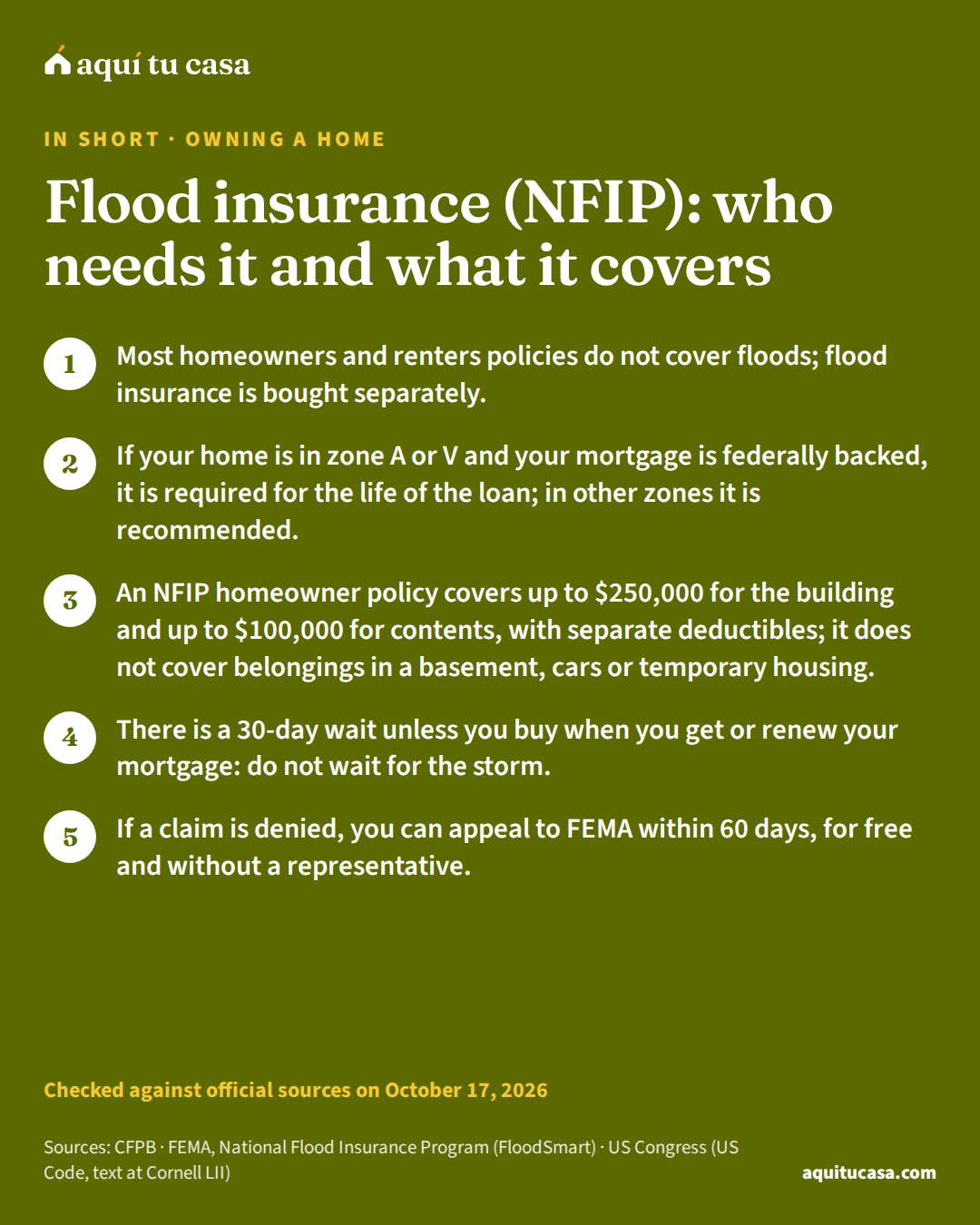
- Owning a home Flood insurance (NFIP): who needs it and what it covers Why home insurance does not cover floods, when you must buy NFIP coverage, what it covers, the 30-day wait, flood zones and how to file a claim. 13 minute read
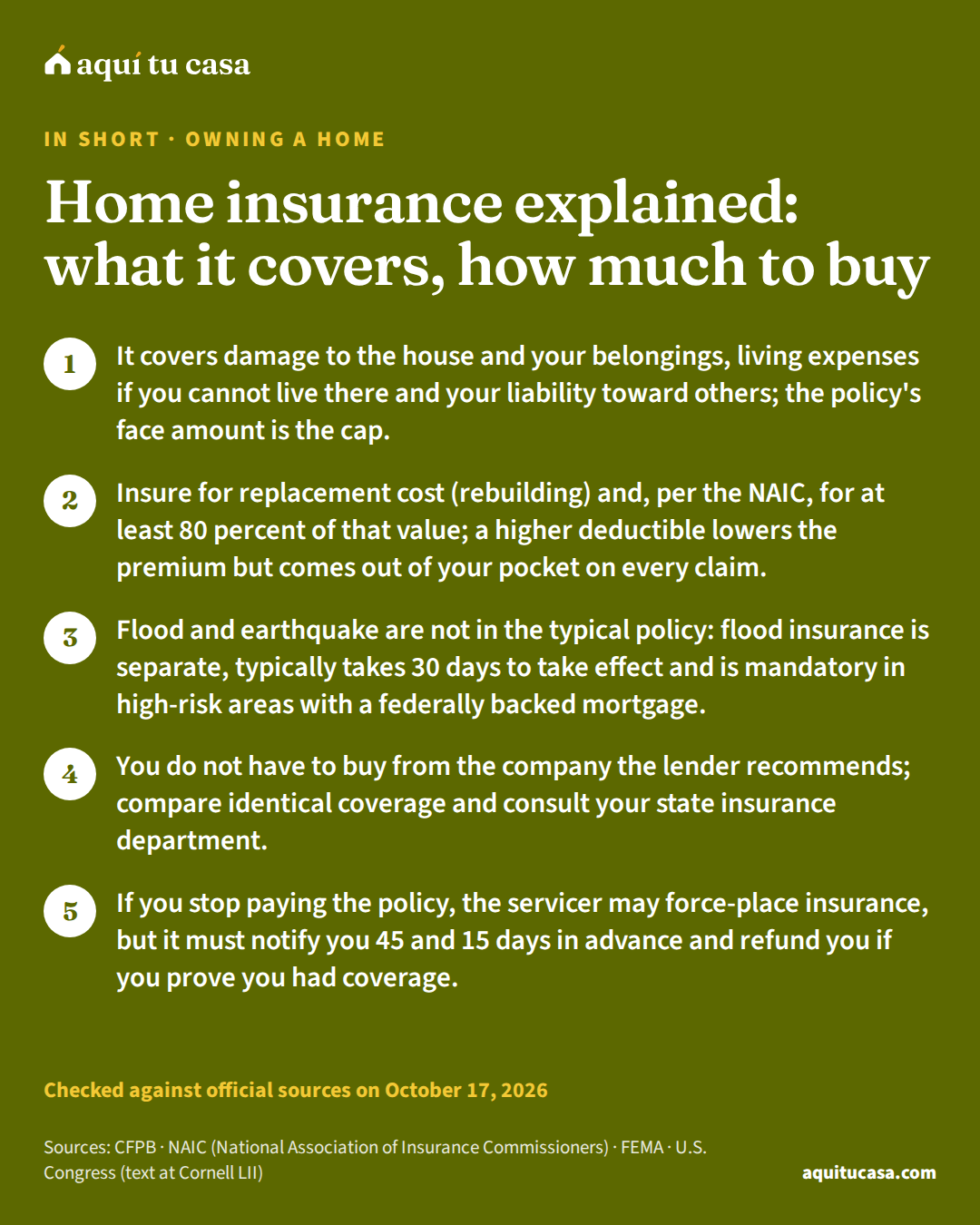
- Owning a home Home insurance explained: what it covers, how much to buy What home insurance covers, why the lender requires it, how to choose the amount and the deductible, why flood is separate and what happens if it lapses. 13 minute read
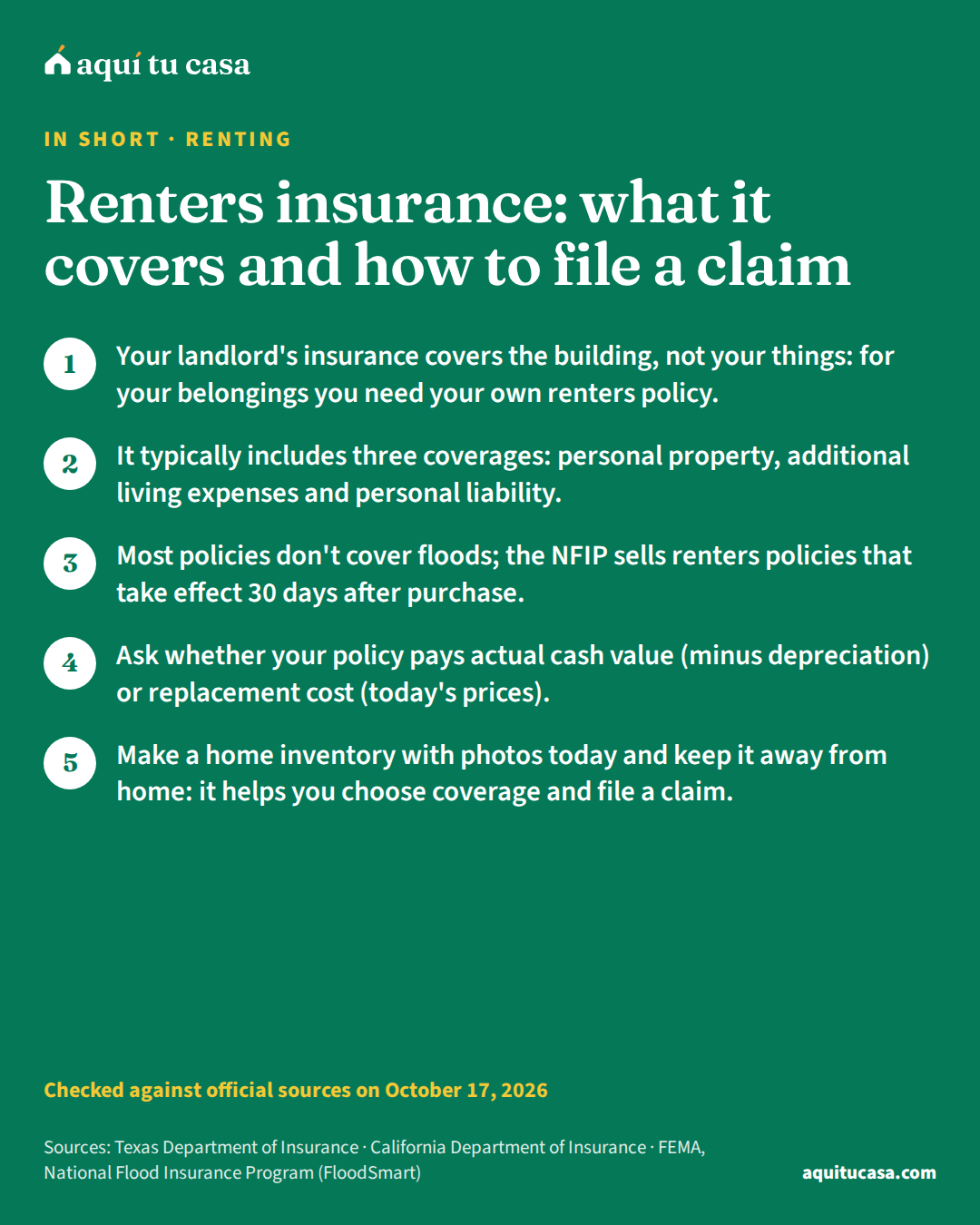
- Renting Renters insurance: what it covers and how to file a claim What renters insurance covers, why it leaves out floods, actual cash value vs. replacement cost, liability coverage and how to file a claim. 13 minute read
Tools for this topic
Was this guide useful?
Thank you. Your answer stays in your browser; nothing is sent.