
Family budget
How much is left for housing each month.
What you get → what is left
Someone shared this page with you.
Questions and answers
Every question our 15 guides about money problems answer, grouped by guide. Each answer is the guide's own and leads to it, with its sources.
Open a question to read its answer. Each group ends with the full guide, its sources and, when it has one, its calculator.
We found no questions with those words. Try another word or open a topic.
From the guide
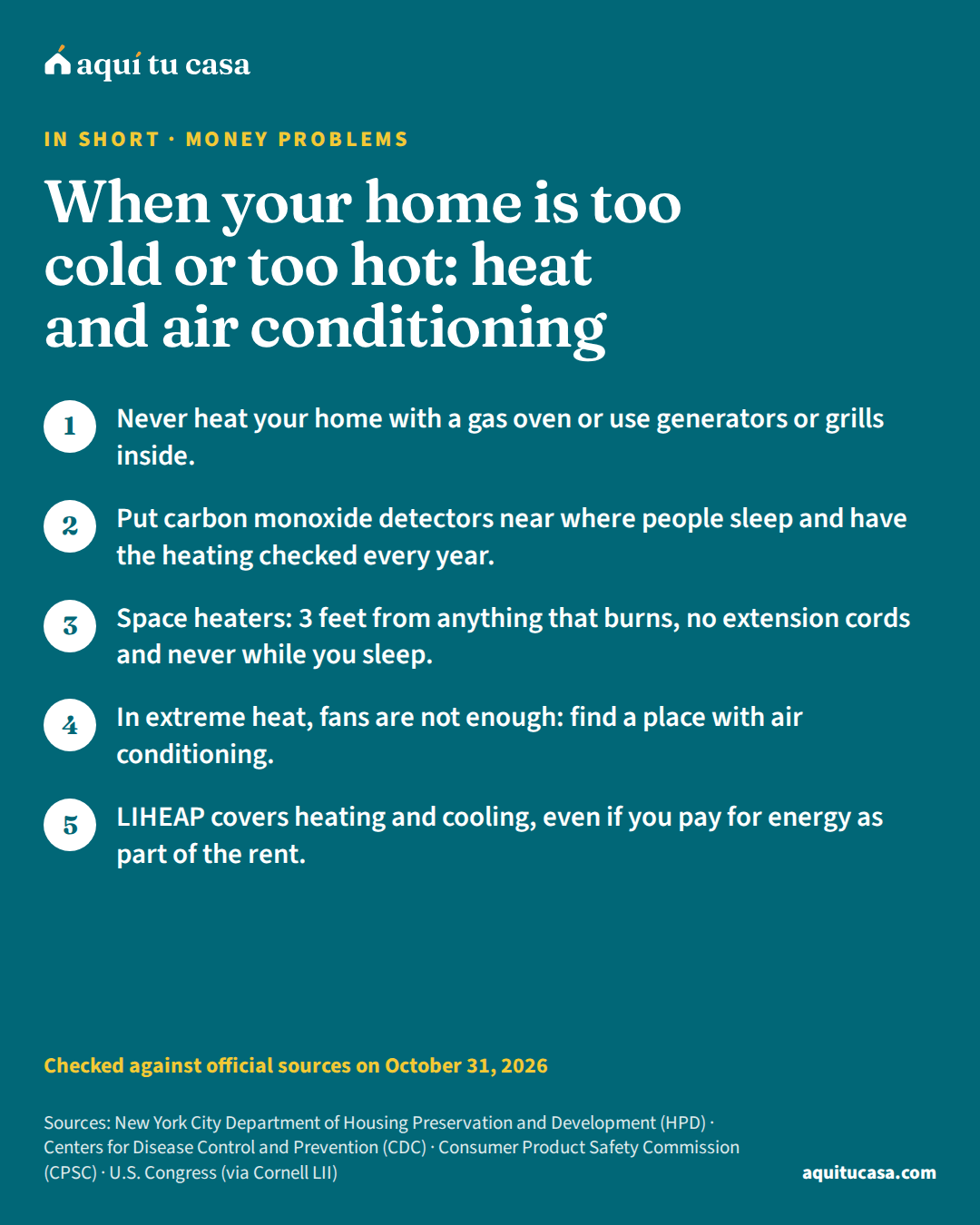
What to do if the heat goes out or your home gets dangerously hot: temperature rules, safe space heaters, carbon monoxide and help paying.
Verified on October 31, 2026 7 official sources
No. The CDC says never heat your house with a gas oven, because of the carbon monoxide risk. Dress warmly, gather the family in one room and, if you use a space heater, follow the safety rules.
Read the full guideIt depends on your state and city. In New York City, from October 1 to May 31, it must be at least 68 °F during the day when it is below 55 °F outside, and at least 62 °F at night. Ask your city what its rule is.
Read the full guideThe CPSC recommends keeping 3 feet clear around it, plugging it straight into the wall rather than an extension cord, placing it on a stable surface and never leaving it on unattended or while you sleep.
Read the full guideOutside, at least 20 feet from doors, windows and vents, according to the CDC. Never inside the home, the garage or next to the house.
Read the full guideHeadache, dizziness, weakness, upset stomach, vomiting, chest pain and confusion, similar to the flu. If you suspect it, get to fresh air and call 911.
Read the full guideNot always. The CDC says that when it is very hot, fans will not prevent heat-related illness. Find an air-conditioned shelter or spend a few hours at a library or mall.
Read the full guidePossibly. The LIHEAP law counts as a household people who pay for energy as part of the rent. Ask your state's LIHEAP office.
Read the full guideThe data behind these guides
The guides on Money problems cite these figures. They update when their sources publish new ones; what you see here is current.
See all the dataSources: U.S. Census Bureau (Average 2020–2024)
From the guide
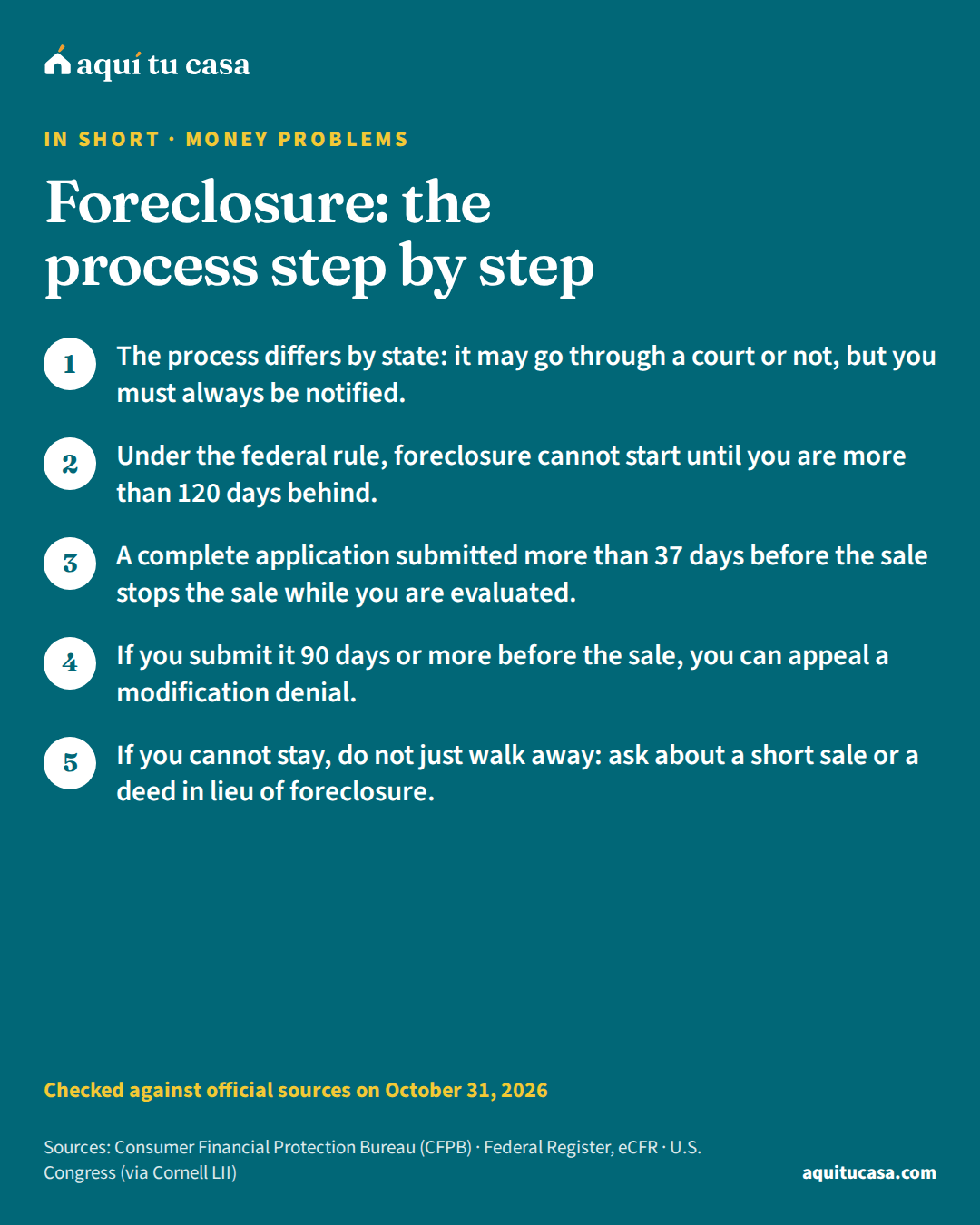
How foreclosure works, the federal deadlines that protect you before the sale, and what you can still do: apply for help, short sale or deed in lieu.
Verified on October 31, 2026 7 official sources
It depends on your state. The CFPB explains that the time between the start of foreclosure and the sale depends on your state's laws. What is federal: in general it cannot start before 120 days of delinquency.
Read the full guideJudicial foreclosure goes through a court, where you can raise defenses. Non-judicial foreclosure happens without a lawsuit, through written notices and steps that follow a 'power of sale' clause in your mortgage or deed of trust. Either way, you must be notified.
Read the full guideYes. If your complete application arrives more than 37 days before the sale, the servicer must evaluate you within 30 days and cannot hold the sale while it decides. If it arrives later, the servicer does not always have to review it, but depending on your loan it may have to under other rules. Call today.
Read the full guideIt is selling the home for less than you owe, with your servicer's permission, so the difference is forgiven. You find the buyer, and you need a complete application and approval from the servicer and the loan's owner. Also ask about the tax implications.
Read the full guideWhat is left is called a deficiency. The CFPB explains that qualifying for a deed in lieu of foreclosure could mean you do not have to pay that deficiency. Ask in writing what happens to the remaining balance before you sign any agreement.
Read the full guideNot immediately. Under federal law, if you are a bona fide tenant, the new owner must give you notice at least 90 days in advance, and if you have a lease you can stay until it ends, unless the home is sold to someone who will live in it. Your state may give you more time.
Read the full guideYes. If your mortgage predates your service, federal law says a foreclosure sale made during your service or within one year after is not valid without a court order or a written waiver agreement. Talk with your military legal assistance office.
Read the full guide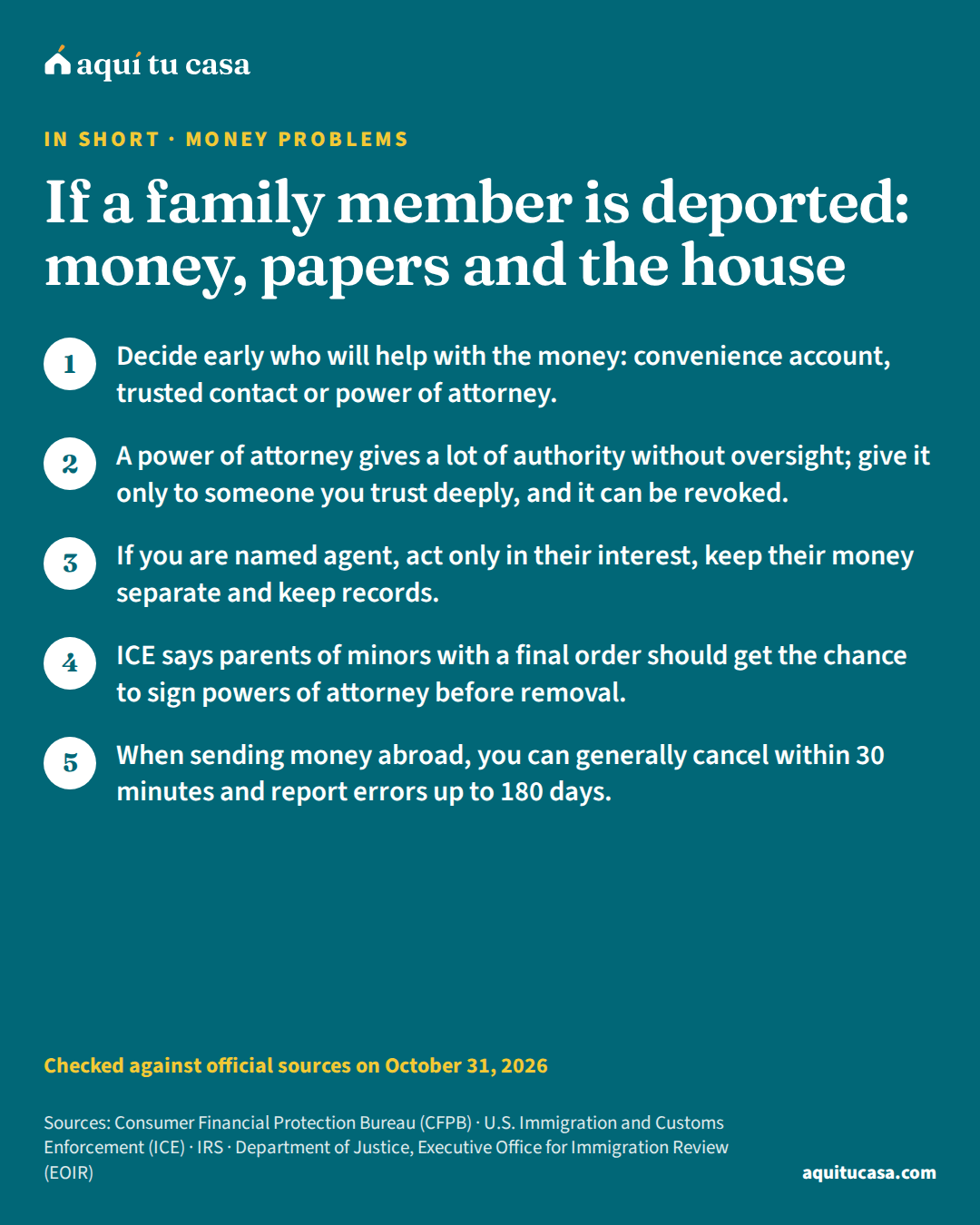
From the guide
What to do with bank accounts, a power of attorney, the mortgage or lease and sending money when a family member is deported or leaves the country.
Verified on October 31, 2026 9 official sources
It depends on how the account is set up and what authorization you have. The CFPB explains options such as a convenience account or a power of attorney, and says that with a power of attorney the bank should honor the document and let the agent handle the account. Ask the bank what it needs and get free legal aid.
Read the full guideAccording to the CFPB, it is a legal document that lets someone else, the agent, act on your behalf. It can be durable or temporary, for example to pay bills while you are away. It gives a lot of authority over your money without oversight, and you can change or revoke it. Each state has its own rules for signing it.
Read the full guideIf they are the parent or guardian of minors and have a final order, ICE Directive 11064.4 says ICE should, to the extent practicable, give them the chance to talk to their lawyer and contact consulates, notaries or family to sign papers such as powers of attorney. Ask their lawyer or accredited representative how to arrange it.
Read the full guideIt depends on what you want. The CFPB says that if you do not want your money to become the other person's when you die, avoid a joint account with right of survivorship. For someone to just help with bills, the CFPB mentions a convenience account, and notes that the helper could also withdraw your money.
Read the full guideThe house and the mortgage stay in their name. Someone has to keep paying or talk to the loan servicer soon. If you decide to sell and the seller is a foreign person for the IRS, the buyer generally must withhold 15% of the amount realized under FIRPTA, with some exceptions.
Read the full guideThrough a money transfer company or your bank. According to the CFPB, before you pay you see the total cost and the exchange rate, you get a receipt, you can generally cancel within 30 minutes and you can report an error up to 180 days later.
Read the full guideFor the money and house papers, find free legal aid with the LSC finder. For the immigration case, go only to a lawyer or an accredited representative; notarios and consultants cannot give legal advice.
Read the full guide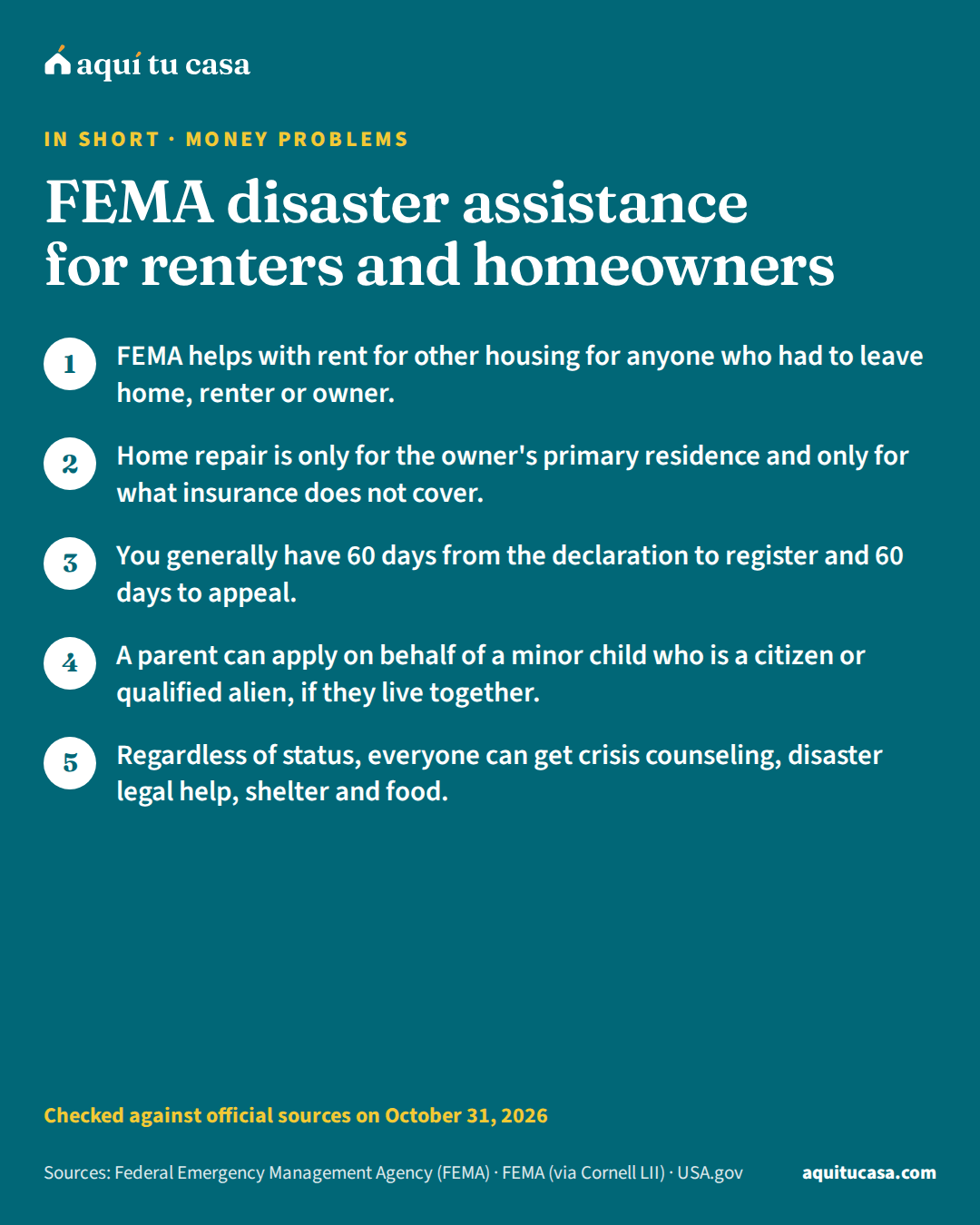
From the guide
What FEMA assistance for individuals and households covers, how to apply, deadlines to register and appeal, and what mixed-status families can ask for.
Verified on October 31, 2026 10 official sources
It can. FEMA can give you help renting other housing if you had to leave, reimbursement for a short hotel stay and help with other needs, such as personal property or transportation. Repair of the home is for the owner.
Read the full guideThe standard period is 60 days from the presidential declaration. FEMA may extend it, and afterward accepts late registrations for 60 more days if you explain why you were late.
Read the full guideAccording to FEMA, the parent or legal guardian of a minor child who is a citizen or qualified alien can apply on the child's behalf, as co-applicant, if they live in the same household and the child was under 18 when the disaster occurred. FEMA recommends consulting an immigration expert.
Read the full guideAccording to FEMA, crisis counseling, disaster legal services, case management, disaster food assistance and in-kind emergency aid such as medical care, shelter, food and water. Voluntary agencies also help regardless of status.
Read the full guideYes, but FEMA does not pay for what your insurance already covers. If you have adequate coverage it will not give you that assistance, unless the insurance payment will be significantly delayed. Apply to FEMA anyway and keep the insurer's answer.
Read the full guideYou can appeal within 60 days of the letter's date, with a signed written explanation or documents that prove your case. FEMA must answer you in writing within 90 days.
Read the full guideNo. FEMA never charges for an inspection and its inspectors do not ask for your bank details. Ask for their official ID. If something seems off, call FEMA's Helpline at 800-621-3362.
Read the full guide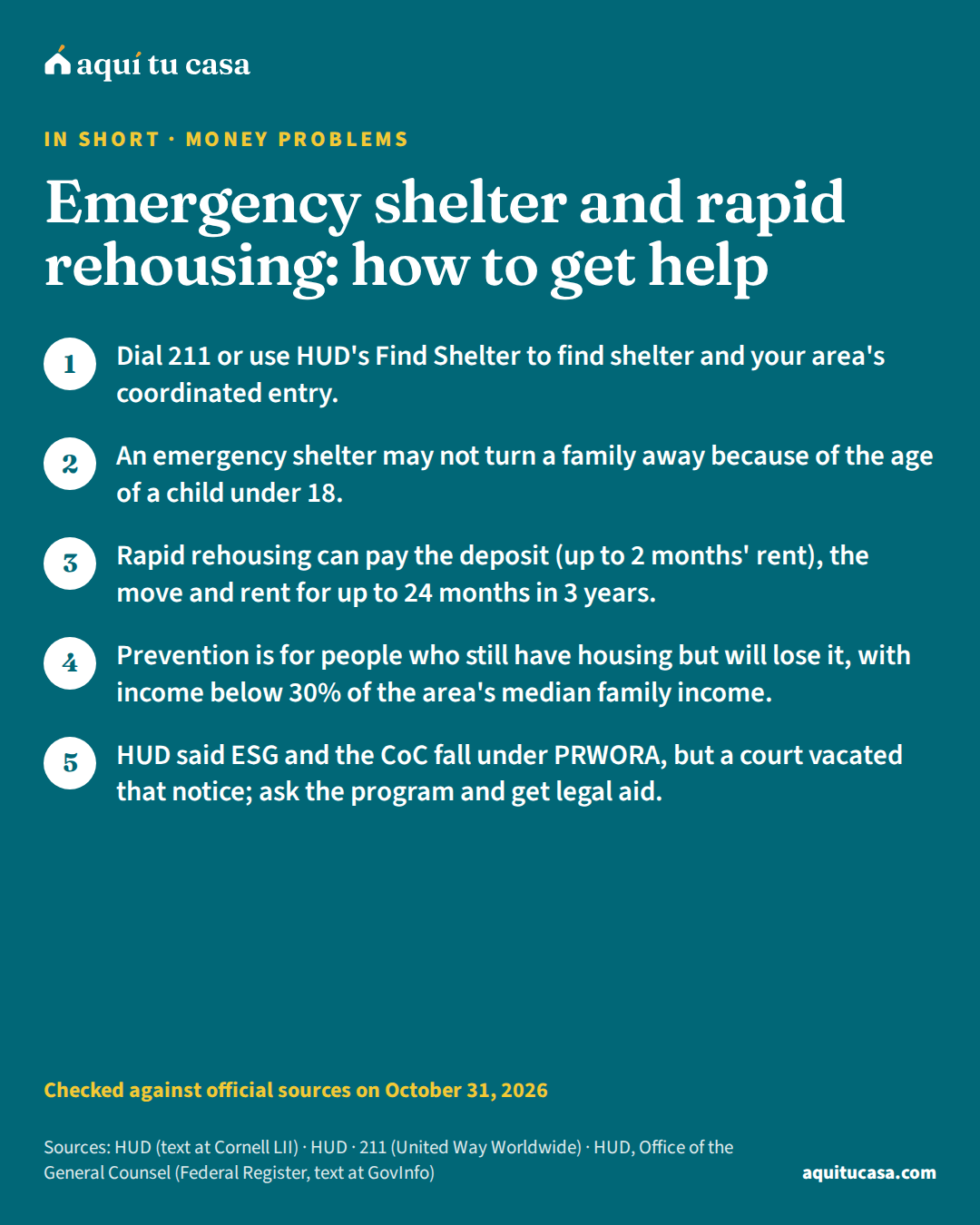
From the guide
What HUD's homeless programs (ESG and the Continuum of Care) pay for, how to reach coordinated entry, what 211 does and what the rules say today.
Verified on October 31, 2026 16 official sources
Read the full guide Do the math: How much rent can I afford?
Dial 211, which gives referrals for housing and homelessness and is confidential. You can also use HUD's Find Shelter tool: pick shelter, enter your location and search. If you are in danger, call 911.
Read the full guideIt is the front door to the local homeless services network. By rule, each Continuum of Care must have a system that assesses the housing and service needs of each person and family, and ESG-funded programs in the area must use it. 211 or a shelter can tell you how to reach it.
Read the full guideUnder the ESG rule, it can pay the application fee, a deposit of no more than 2 months' rent, last month's rent, utility deposits and payments, moving costs and rental assistance for up to 24 months in a 3-year period. It also provides services such as housing search, mediation and legal services.
Read the full guideThe ESG rule says the age of a child under 18 may not be used to deny a family admission to an ESG-funded shelter that takes families with children. If a shelter sets that condition, ask for another shelter in the network and get legal aid.
Read the full guideHUD published a notice saying ESG and the Continuum of Care fall under PRWORA's rules, and that nonprofit charitable organizations are not required to verify eligibility. Later, a federal court vacated that notice. The rules may change: ask the program what it requires and get legal aid or an accredited representative.
Read the full guideThe definition of homeless includes people fleeing domestic violence, dating violence, sexual assault or stalking. Victim service providers may choose not to use coordinated entry. Our VAWA guide explains your housing protections.
Read the full guideYes, there is prevention. Under the ESG rule, it can provide rental assistance and services so you do not have to go to a shelter, if your annual income is below 30% of the area's median family income and the help is needed for you to regain stability. Call 211 as soon as you can.
Read the full guide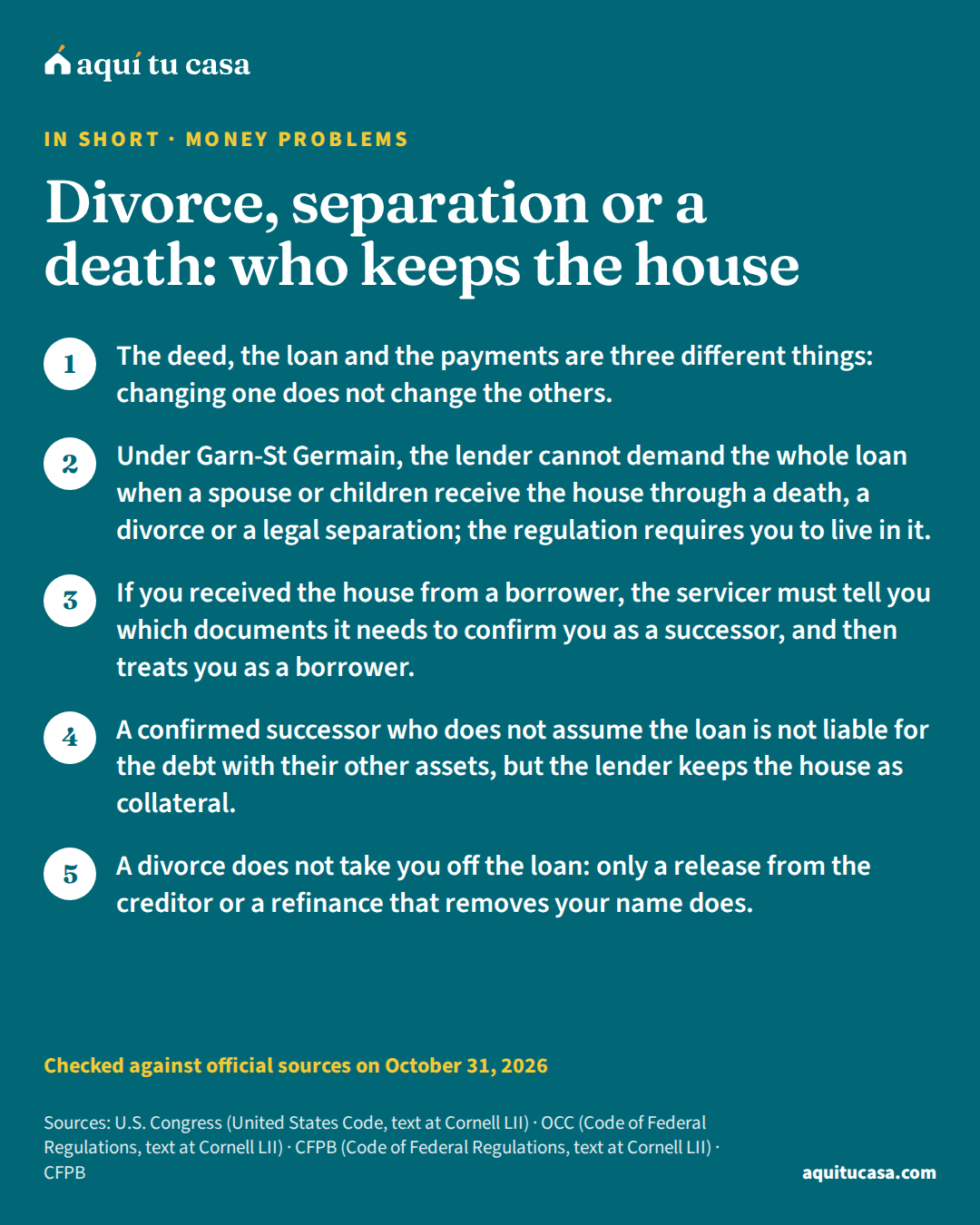
From the guide
What happens to the deed, the mortgage and the payments in a divorce, a separation or a death in the family, and what federal law protects for you.
Verified on October 31, 2026 13 official sources
The federal Garn-St Germain law says the lender cannot use the due-on-sale clause for a transfer to a relative resulting from the borrower's death, or when the spouse becomes an owner. The regulation requires that you live or will live in the house. What you do need to keep doing is pay, and tell the servicer.
Read the full guideSend a written request saying you may be a successor in interest, with the borrower's name and the account number or address. Under Regulation X, it must answer in writing with the list of documents it needs to confirm you and a phone number for help.
Read the full guideThe servicer decides, and must tell you. For an inheritance, the CFPB mentions a copy of the executed will and the death certificate, or a letter from the executor. The proof you can get varies by state.
Read the full guideUnder Regulation X, unless you assume the loan under your state's law, you are not liable for the debt and cannot be required to pay it with your assets. But the lender keeps the house as collateral and can foreclose if it is not paid, when the law allows.
Read the full guideNot necessarily. The CFPB explains that the divorce decree does not change what you owe the creditor: you remain responsible unless the creditor releases you or your former spouse refinances and removes your name. Taking your name off the title does not take you off the loan.
Read the full guideAccording to the CFPB, if you already have title to the house through inheritance, divorce, legal separation or another family transfer, its rules do not require the lender to evaluate your ability to repay before letting you take over the loan.
Read the full guideUnder Regulation X, the servicer generally cannot start a foreclosure until the loan is more than 120 days delinquent. If you are confirmed as a successor, it treats you as a borrower and you can ask for alternatives. Talk to a HUD-approved housing counselor today.
Read the full guide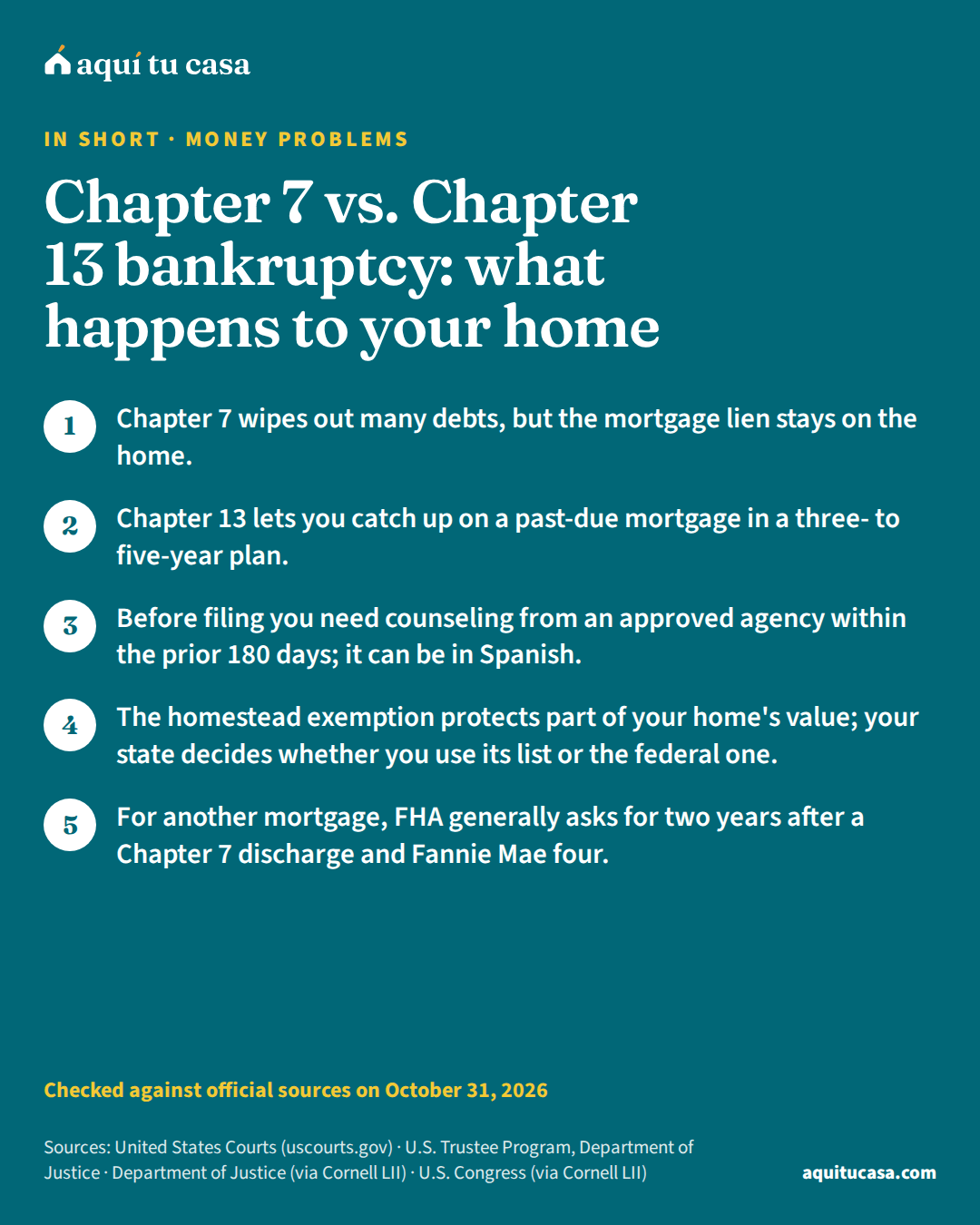
From the guide
How Chapters 7 and 13 differ, the homestead exemption, the required credit counseling course and how long to wait before another mortgage.
Verified on October 31, 2026 12 official sources
Not always. In Chapter 7 the trustee sells the property that is not exempt, and the homestead exemption protects part of your home's value. But the mortgage stays: if you do not pay, the lender can foreclose. Chapter 13 is designed for people who want to keep the home and catch up.
Read the full guideFiling automatically stops most collection actions. In Chapter 13 you can catch up on past-due payments during the plan, as long as you make each new payment on time. In Chapter 7 the pause does not remove the mortgage lien.
Read the full guideWith an agency on the U.S. Trustee Program list at justice.gov/ust. The list can be filtered for Spanish. In Alabama and North Carolina, ask your district's Bankruptcy Administrator.
Read the full guideThe approved agency must waive its fee in whole or in part if you show you cannot pay it. You are presumed unable to pay if your household income is less than 150% of the poverty guidelines. Ask before you start.
Read the full guideNo. According to the federal courts, child support and alimony debts are not discharged in Chapter 7, and neither are certain taxes.
Read the full guideFederal law allows it to appear for up to 10 years from the order for relief. That limit does not apply to credit of $150,000 or more.
Read the full guideIt depends on the program. For FHA, generally two years after a Chapter 7 discharge. Fannie Mae asks for four years after Chapter 7 and two from a Chapter 13 discharge. There are exceptions if you document circumstances beyond your control.
Read the full guide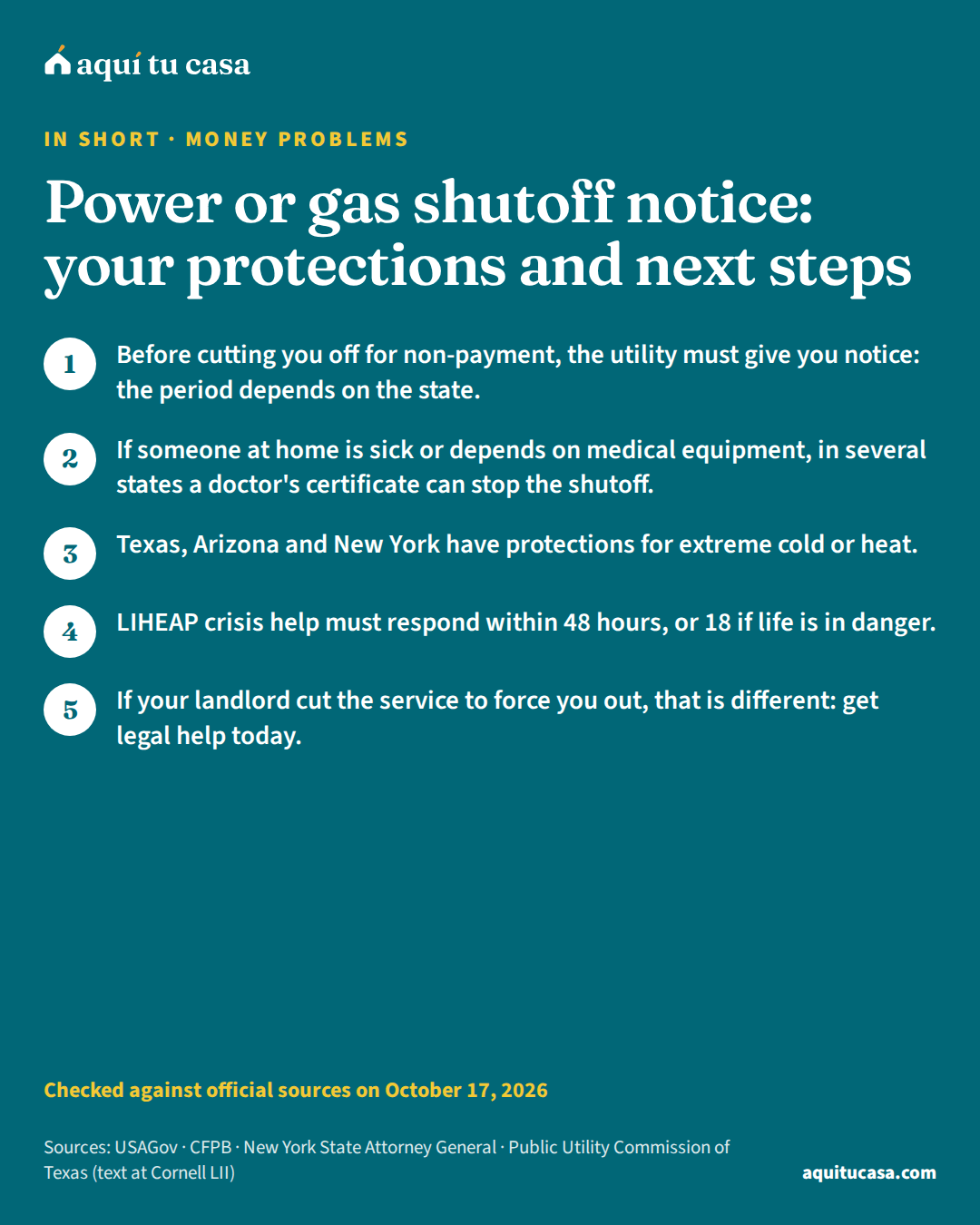
From the guide
If your power or gas is about to be shut off for non-payment: notice periods, health and extreme-weather protections, crisis help and how to complain.
Verified on October 17, 2026 12 official sources
It depends on the state and the utility. In Texas, the shutoff date must be at least ten days after the notice; in Florida, the electric utility must give at least 5 working days' written notice; and in New York, the final notice must arrive at least 15 days ahead. Read the date on your notice and call the utility right away.
Read the full guideSeveral states offer protection. In New York, a doctor's medical emergency certificate stops the shutoff for 30 days and can be renewed; in Texas, the doctor must contact the provider and send a statement, and you set up a payment plan; in Arizona, medical documentation is required each year. Ask your utility about its process.
Read the full guideIn Texas they cannot cut service in a county with an extreme weather emergency, such as a freeze or a heat advisory. In Arizona, each electric utility chooses between no shutoffs with forecasts of 32 °F or lower or above 95 °F, or no shutoffs from June 1 through October 15. In New York there are extra steps from November 1 to April 15.
Read the full guideAsk for LIHEAP crisis help: the law requires a response within 48 hours, or 18 if life is in danger. To find your office, call (866) 674-6327 or 211. In Texas, if an assistance agency pledges payment before the notice's due date, the provider cannot cut you off that period.
Read the full guideIn Florida and Arizona, the rules say a previous occupant's debt is not a reason to cut you off, with exceptions such as that person still living in the home. If it happens, complain to the utility and to your state's utility commission.
Read the full guideIn New York, the utility must notify tenants in writing, and it cannot cut service if tenants pay the landlord's current bill directly and deduct it from rent. In Texas, in a master-metered complex, the provider must post notices in English and Spanish at least four days before the shutoff. Get legal help.
Read the full guideFirst with the utility. Then with your state's utility commission: in Florida, at 1(800) 342-3552; in Arizona, the Corporation Commission takes complaints by phone, letter, email or in person, although not about municipal utilities or against landlords.
Read the full guideThat is not a shutoff by the utility for non-payment. The CFPB says landlords cannot fail to pay for utilities under their control, and many states prohibit cutting services to force a tenant out. Read the guide on illegal lockouts and utility shutoffs and call legal aid today.
Read the full guideTools
The calculators these guides use. Each one leaves you with a result you can use today.
How much is left for housing each month.
What you get → what is left
The steps to build or improve your credit.
What you get → steps in order
The documents you'll be asked for.
What you get → your document list
The rent that fits your budget.
What you get → rent that fits
From the guide
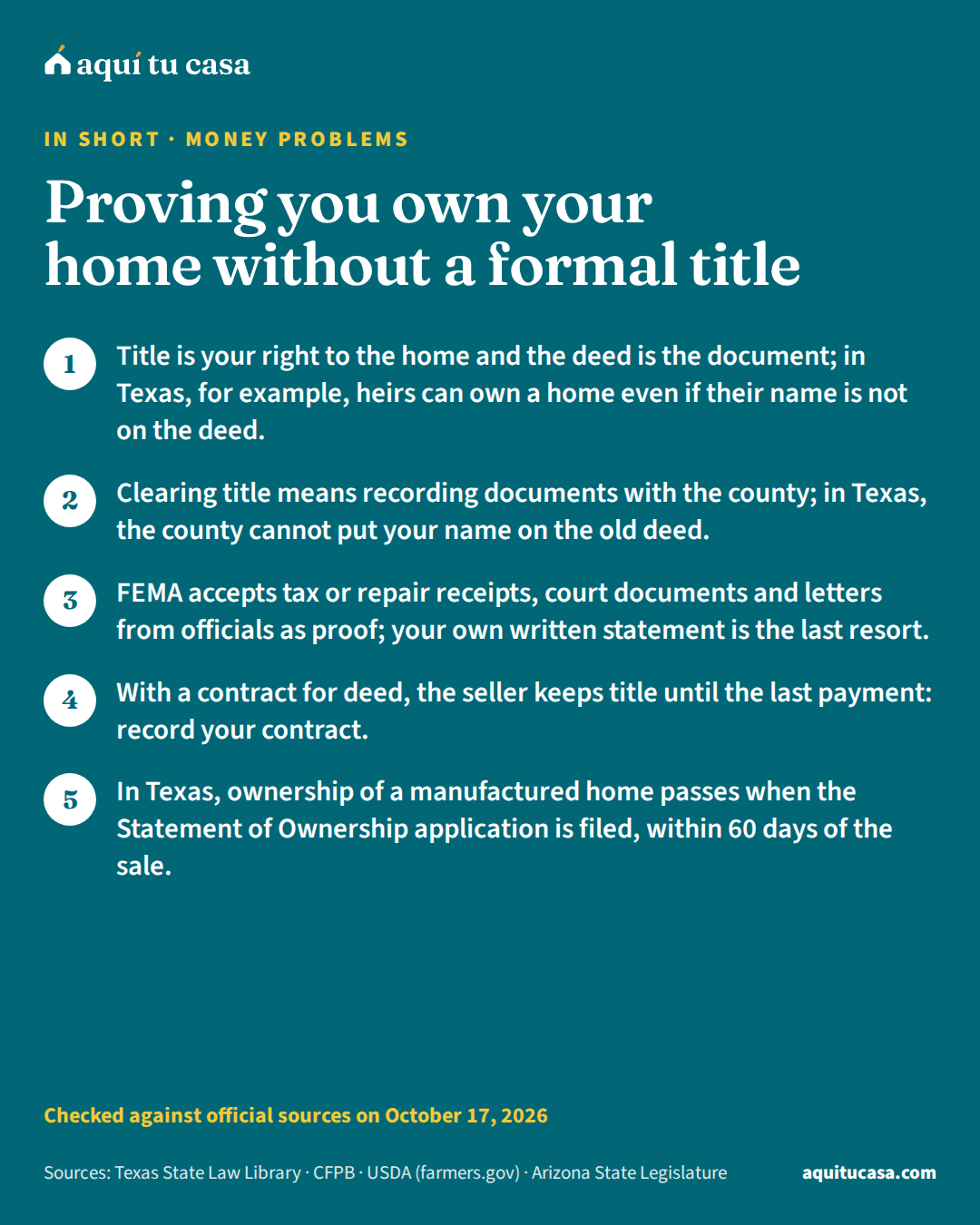
Inherited home never transferred, contract for deed or mobile home: which papers prove it is yours and why they matter to FEMA, insurers and lenders.
Verified on October 17, 2026 16 official sources
It may be. The Texas State Law Library explains that if the estate did not go through probate, the heirs may not be listed on the deed but still own all the rights to the property. To prove it, certain documents are recorded with the county. Rules vary by state; a legal aid office can review your case.
Read the full guideFEMA's regulation lists verifiable documents such as tax payment receipts, receipts for major repairs or improvements, court documents and letters from public officials, and for mobile homes in a park, a letter from the park manager. As a last resort, FEMA explained it may accept a written statement if the home was passed down through heirship.
Read the full guideNo. FEMA explained that its inspectors do not accept those statements, because they are a last resort. You mail them, upload them to your online account or hand them in at a Disaster Recovery Center.
Read the full guideIn Texas, it is a sworn statement listing the heirs, signed by someone who knows the family history. It is filed with the county clerk's office. Buyers and title companies commonly accept it, but no law requires anyone to accept it and banks usually do not.
Read the full guideAccording to the CFPB, in a contract for deed the seller keeps legal title until you make all the payments. You can file the contract with the land records office, which entitles you to receive notices about the home, and some states require it.
Read the full guideIn Texas, the document that confirms ownership is the TDHCA's Statement of Ownership. If you never received a title and the seller is gone, the TDHCA asks for evidence such as the bill of sale, purchase agreement, contract, receipts or deed records.
Read the full guideMost lenders require a lender's title insurance policy, and the Texas State Law Library says banks usually do not accept an affidavit of heirship. Without clear title it can also be hard to sell. Clearing the title with the county helps.
Read the full guide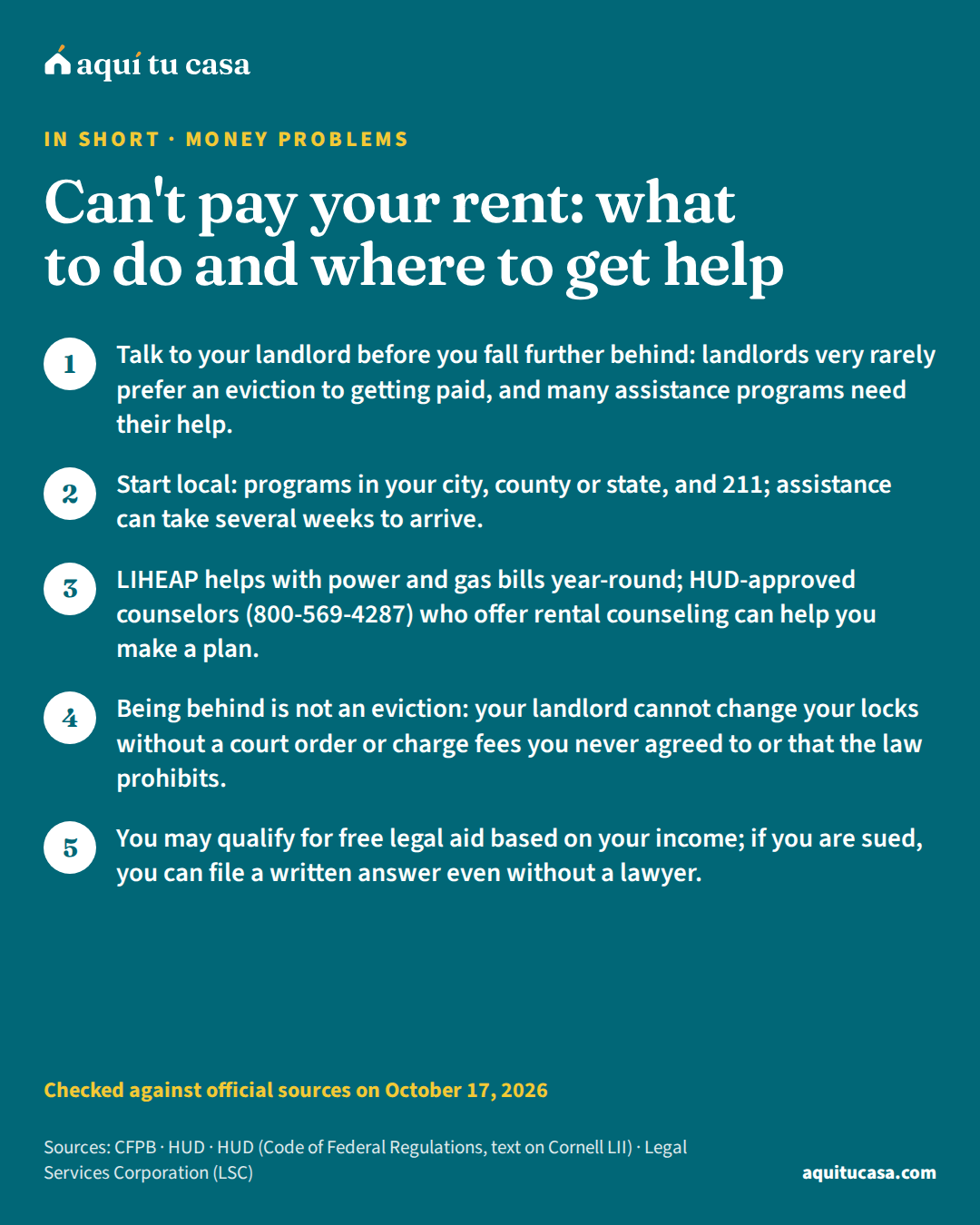
From the guide
If you can't cover the rent: how to talk to your landlord, where to find rental assistance (211, local programs, HUD) and what an eviction requires.
Verified on October 17, 2026 10 official sources
Read the full guide Do the math: How much rent can I afford?
Not overnight. According to the CFPB, your landlord cannot force you out by changing the locks without a court order. In the states we have verified, the law first requires a notice with its own deadline; the table in this guide shows it. Use that time to talk to your landlord and ask for help.
Read the full guideThe CFPB says state, tribal and local organizations are the best place to start: look for rental assistance in your city, county and state, ask at local government offices and the library, and call 211 from any phone. A HUD-approved housing counselor can also help you find resources and make a plan.
Read the full guideThe CFPB warns that after you apply, the money may take several weeks to arrive. That is why it helps to apply early, keep your confirmation and tell your landlord. If a lawsuit has already been filed, say in your answer that you applied and are waiting for a decision.
Read the full guideYou can offer it. The CFPB notes that some landlords accept a smaller payment for a few months as long as the agreed amount is paid each month, or a plan to repay back rent over six months to a year. Put the agreement in writing. If a notice or lawsuit already exists, the rules change by state and city: ask a legal aid office.
Read the full guideAccording to the CFPB, your landlord cannot demand fees, interest or other charges you did not agree to or that your state or city prohibits. Check what your lease says. In New York, for example, you cannot be evicted for not paying fees such as late fees in a non-payment case.
Read the full guideYes. The CFPB explains that you can get year-round help with utility bills through your local LIHEAP office or by calling the National Energy Assistance Referral Hotline at (866) 674-6327. 211 also knows the programs in your area.
Read the full guideYou don't need one to ask for help or to answer a lawsuit: the CFPB says that if you don't have a lawyer yet, you can file your answer on your own. But many landlords come to court with a lawyer, and you may qualify for free legal aid based on your income. The Legal Services Corporation helps you find the nearest office.
Read the full guide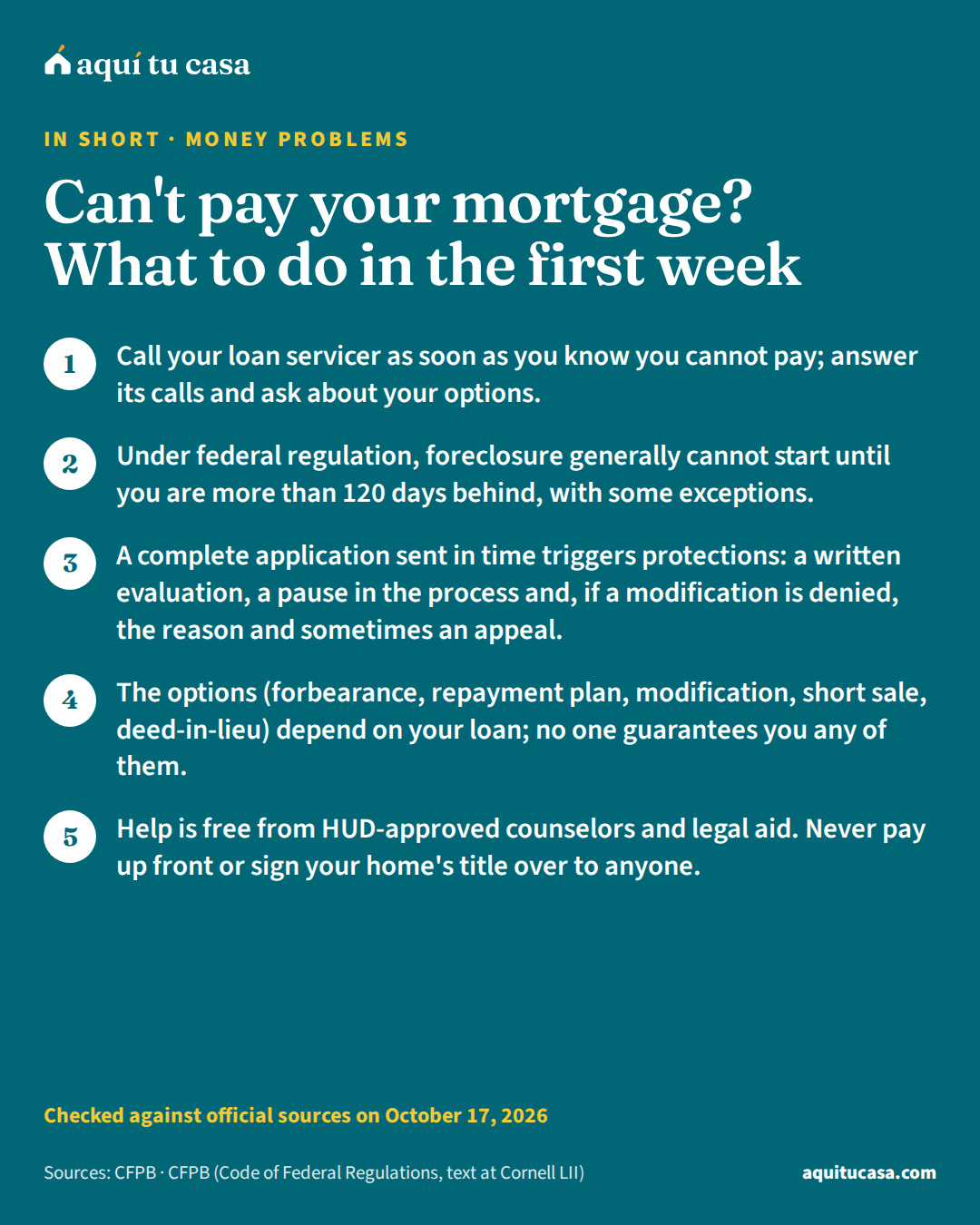
From the guide
Can't pay your mortgage? Call your servicer, learn the options that exist, the federal rules that protect you and the rescue scams to avoid.
Verified on October 17, 2026 17 official sources
Foreclosure does not start right away. Under Regulation X, a servicer generally cannot make the first foreclosure notice or filing until your loan is more than 120 days delinquent, with some exceptions; after that, timing depends on your state. But stopping payments without an agreement is reported to the credit reporting companies, so call early.
Read the full guideNo. The CFPB says help is available at no cost from your servicer or a HUD-approved housing counseling agency. A mortgage relief company cannot charge you until you have a written offer from your lender or servicer that you decide to accept.
Read the full guideNo. The regulation does not require the servicer to give you any specific option. But if it receives your complete application more than 37 days before a foreclosure sale, it must evaluate you for all available options and answer in writing within 30 days; and if it denies a modification, it must tell you why.
Read the full guideNo. The early-contact and application rules cover loans on your principal residence, and they do not apply the same way to small servicers or reverse mortgages. Even so, a small servicer cannot start foreclosure before you are 120 days behind either. Ask your servicer and a counselor which rules apply to your loan.
Read the full guideIf the application arrives 45 days or more before a foreclosure sale, the servicer must tell you in writing within 5 days (excluding holidays and weekends) whether it is complete or what is missing. If the complete application arrives more than 37 days before the sale, it has 30 days to evaluate you for all available options and answer in writing.
Read the full guideYou still owe them: forbearance does not erase or reduce your debt. According to the CFPB, they are repaid all at once, at the end of the loan, with a new loan or with higher payments for some months. For most government-backed loans, the servicer cannot require you to repay everything in a lump sum; if that is all you are offered, ask about other options.
Read the full guideThe letter must give you the reason. If your complete application arrived 90 days or more before the sale, or within your first 120 days behind, you may appeal within 14 days of the decision; different staff review it and you get an answer within 30 days.
Read the full guideYou can file a complaint with the CFPB, which forwards it to the company and works to get you a response, generally within 15 days. A HUD-approved housing counselor can also help you deal with your servicer, at no cost.
Read the full guide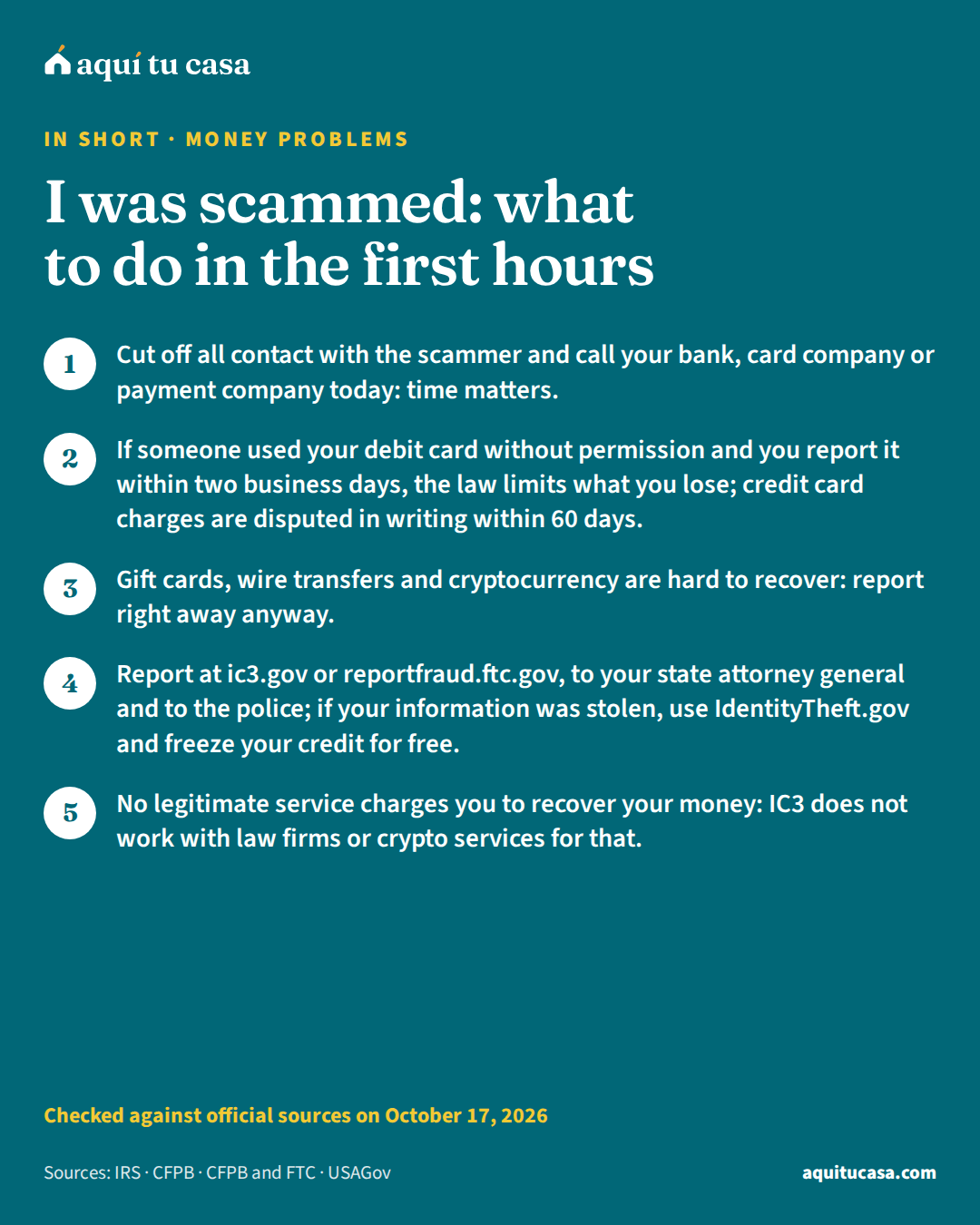
From the guide
If you sent money or personal information to a scammer: who to call first, how to dispute a charge, where to report it and how to stop identity theft.
Verified on October 17, 2026 14 official sources
It depends on how you paid and how fast you act. Debit and credit cards come with protections if you report in time; wire transfers, gift cards and cryptocurrency are much harder, because the CFPB and FTC explain that you usually cannot get that money back. Call your bank or the company you used right away and ask them to reverse the payment.
Read the full guideAccording to the CFPB, if you used a remittance transfer provider, you can cancel at no cost if you paid less than 30 minutes ago and the money has not been picked up or deposited; for a scheduled transfer, up to three business days before it is made. Check your receipt, which should generally state your cancellation period, and call the company immediately.
Read the full guideAccording to the CFPB, if you tell your bank within two business days of discovering your card was lost or stolen, you cannot be held responsible for more than $50 or the amount taken, whichever is less; if you report later, you could be responsible for up to $500. Check your statements and report within 60 days.
Read the full guideThe CFPB points to the FTC at reportfraud.ftc.gov, the FBI at ic3.gov, your state attorney general and your local police through their non-emergency number. If you are not sure which applies, USAGov's where-to-report-a-scam tool guides you with a few questions.
Read the full guideBe wary. The IRS warns that some victims get scammed again by people offering to recover their money, and the FBI's IC3 says it does not work with law firms or crypto services to recover funds and never contacts you for information or money.
Read the full guideFor a complaint, the CFPB asks for the key facts in your own words and supporting documents. The CFPB keeps complaint information, including your personal information, for 25 years and shares it with certain agencies as the law allows. If that worries you because of your situation, a legal aid office can guide you before you report.
Read the full guide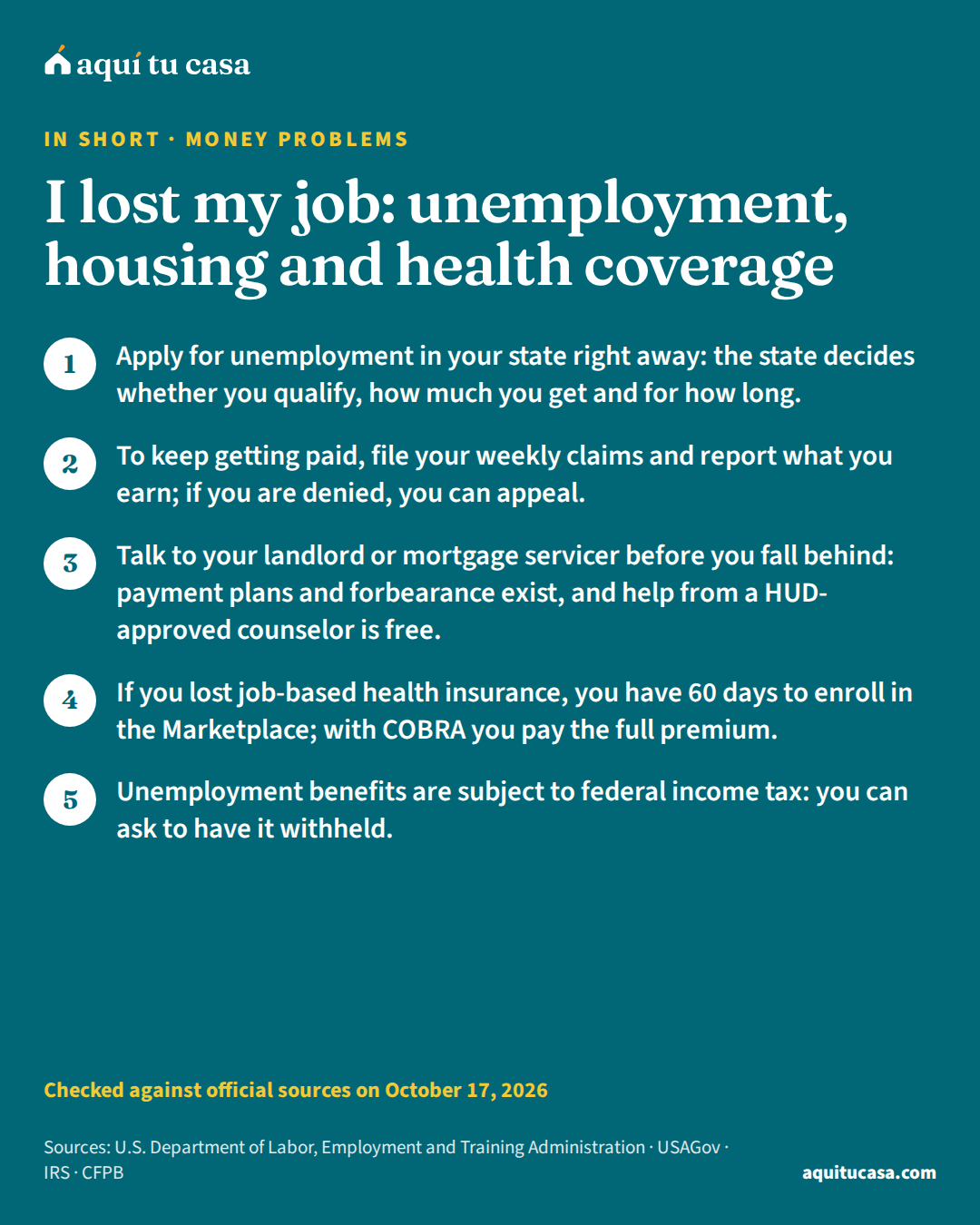
From the guide
If you lost your job: how to apply for unemployment, talk to your landlord or lender, keep your health coverage and rebuild your budget.
Verified on October 17, 2026 13 official sources
Contact your state's unemployment insurance agency as soon as possible; in many states you can apply online or by phone. You generally apply in the state where you worked, and you will be asked for the addresses and dates of your past jobs. USAGov has a map to find your state's agency.
Read the full guideYour state decides. According to the Department of Labor, benefits are generally a percentage of what you earned over a recent 52-week period, up to a state maximum, and most states pay for a maximum of 26 weeks. The first payment usually arrives two to three weeks after you apply.
Read the full guideUnemployment insurance is for people who are unemployed through no fault of their own, as defined by each state's law. If you left for a reason other than lack of work, the state decides whether you qualify. If you are denied, you have the right to appeal within the time the state gives you.
Read the full guideYes, generally. The IRS says you must include unemployment compensation in your income; you can ask to have federal tax withheld using Form W-4V. At the end of the year you will receive a Form 1099-G showing what you were paid.
Read the full guideTalk to your landlord before the due date. The CFPB suggests options such as splitting rent into two payments, paying less for a few months or paying back what you owe over time. Also call 211 to look for help with rent and utilities in your area; assistance can take several weeks.
Read the full guideIt is an agreement with your servicer to pause or reduce your payments for a while. It does not erase the debt: you pay back later what you did not pay. Call your servicer right away and ask how much you will pay, how interest accrues and how you will repay what you missed.
Read the full guideYou can apply in the Health Insurance Marketplace: you have 60 days from losing job-based coverage, and savings depend on your income and household size, not on whether you have a job. If your former employer offers COBRA, you can keep the same plan, but you pay 100% of the premium plus an administrative fee.
Read the full guide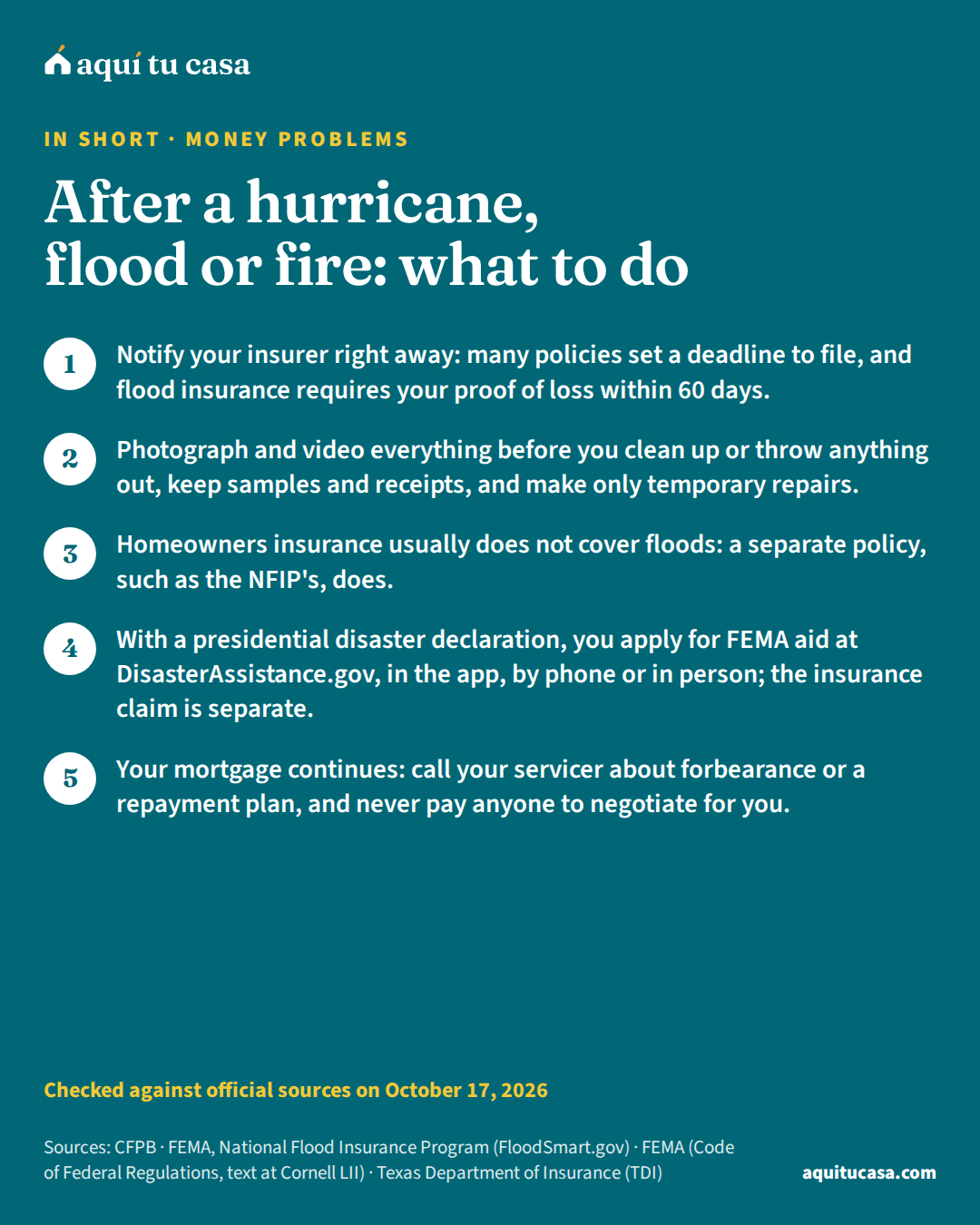
From the guide
What to do after a disaster: your home, flood or renters insurance claim, federal disaster aid, your mortgage and how to avoid scams.
Verified on October 17, 2026 20 official sources
Yes. According to the CFPB, you still have to pay your mortgage after a disaster, including while your insurance claim is paid out. Call your servicer, explain what happened and ask about forbearance or a repayment plan; the options depend on who owns or guarantees your loan.
Read the full guideUsually not. The CFPB says flood damage is usually not covered by homeowners insurance. A flood policy, such as the NFIP's, covers it, and it pays only for physical damage directly caused by water rising from the ground up.
Read the full guideIt depends on your policy, and many set a deadline. For NFIP flood insurance, the standard policy requires your proof of loss within 60 days after the loss. Notify your insurer right away and ask in writing which deadlines apply to you.
Read the full guideIf your policy includes additional living expenses (ALE) coverage, it can pay for rent, food and other extra costs while your home is repaired, up to its limit. If the disaster has a presidential declaration, FEMA may help qualified applicants with a hotel or rent.
Read the full guideBecause many mortgage agreements require it. Typically, your servicer releases part of the money before work begins, more as the work progresses and the rest once the job is finished and the home passes inspection.
Read the full guideAccording to the CFPB, all FEMA representatives, including inspectors, have a laminated photo ID, and no FEMA, federal or state worker will ask for or accept money. If in doubt, call FEMA at (800) 621-3362.
Read the full guideYes, some help is for renters too. Renters insurance covers your belongings and sometimes the cost of living elsewhere, and the SBA lends to homeowners and renters whose homes were damaged in a declared disaster. Notify your landlord about the damage in writing.
Read the full guideYou can talk to your adjuster or insurer, appeal to FEMA within 60 days of the date on the denial letter, at no cost and without a representative, or sue within one year of the denial. If you choose an appraisal, you can no longer appeal to FEMA.
Read the full guide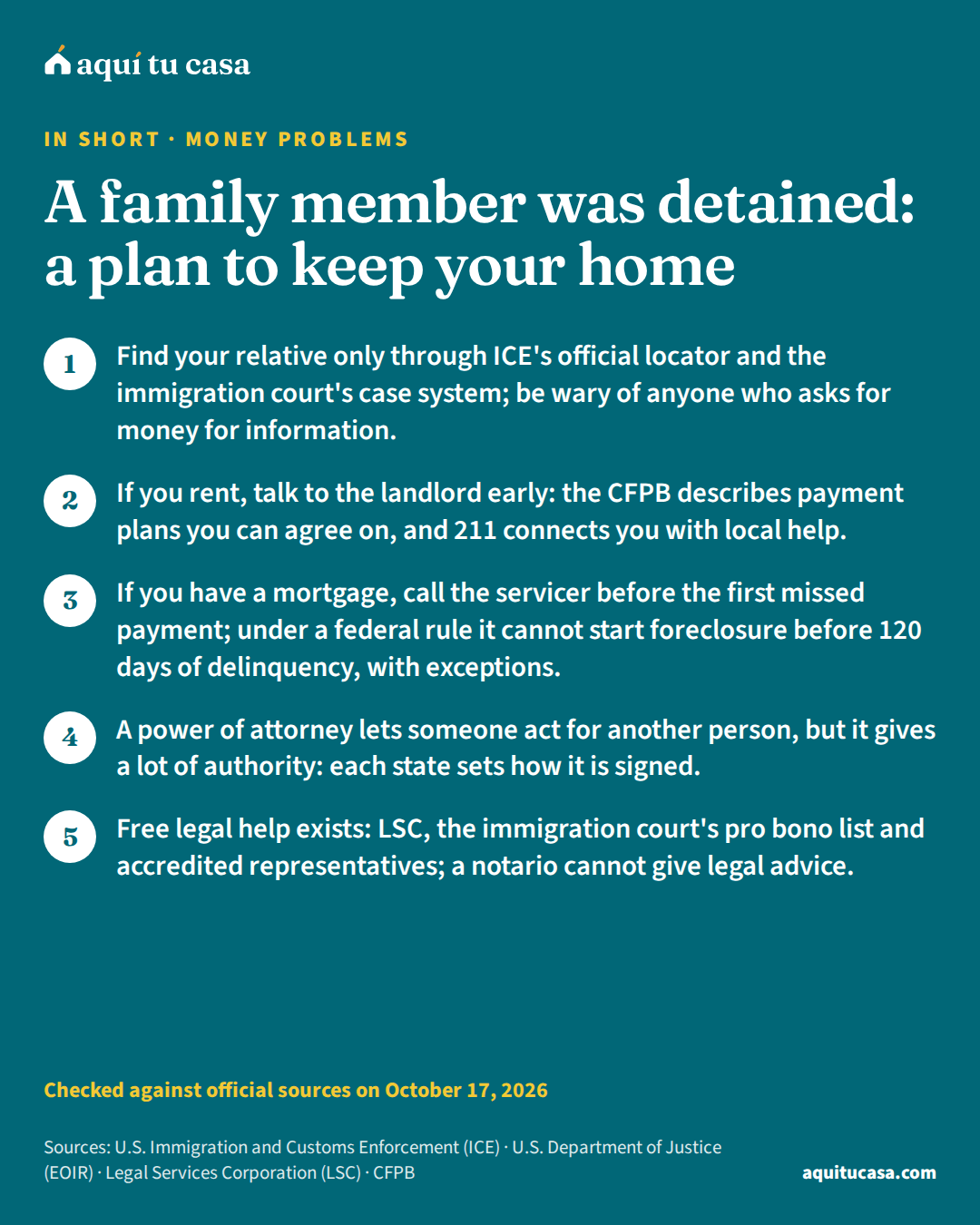
From the guide
If a relative was detained: how to find them through official channels, protect the rent or mortgage, talk to the servicer and get free help.
Verified on October 17, 2026 22 official sources
ICE has an official online tool, the Online Detainee Locator System, at locator.ice.gov. If your relative has an immigration court case, EOIR's ACIS system gives basic information with their A-Number and nationality. Use only those official pages and be wary of anyone who asks for money for information.
Read the full guideYour obligations are in your lease and your state's laws. If you are short, the CFPB recommends talking to the landlord: it is very rare for a landlord to prefer evicting you over receiving rent, and you can agree to change the due date, make smaller payments for a few months or spread out what is overdue. 211 also helps you look for local rental assistance.
Read the full guideAccording to the CFPB, a landlord cannot force you out by changing the locks without a court order. An eviction is a legal process that goes before a judge. If you get a notice, do not ignore it and look for free legal help.
Read the full guideCall the loan servicer as soon as possible, explain the situation and ask what options there are to stay in the home and what authorization it needs to talk to you. Under a federal rule, the servicer must try to reach a delinquent borrower no later than the 36th day of delinquency and cannot start foreclosure before 120 days, with exceptions. A HUD-approved housing counselor can help you for free.
Read the full guideAccording to the CFPB, it is a legal document that lets another person act on behalf of the person who signs it, including for a short time, for example to pay bills. It gives a lot of authority over money, so you only name someone you really trust, and it can be revoked. Each state sets how it is signed; free legal aid can guide you on your case.
Read the full guideLSC funds civil legal aid offices in every state. For the immigration case, the immigration court publishes a list of free legal service providers and the Justice Department publishes lists of accredited representatives by state.
Read the full guideEOIR warns that its employees never call to ask for personal information or money, and says not to trust anyone who guarantees results or claims a special relationship with the courts. You can report it to EOIR.Fraud.Program@usdoj.gov.
Read the full guideChange topic without leaving the questions.

These answers explain the rules but do not know your situation. These organizations go over it with you, free.