
Credit plan
The steps to build or improve your credit.
What you get → steps in order
Someone shared this page with you.
Questions and answers
Every question our 16 guides about credit answer, grouped by guide. Each answer is the guide's own and leads to it, with its sources.
Open a question to read its answer. Each group ends with the full guide, its sources and, when it has one, its calculator.
We found no questions with those words. Try another word or open a topic.
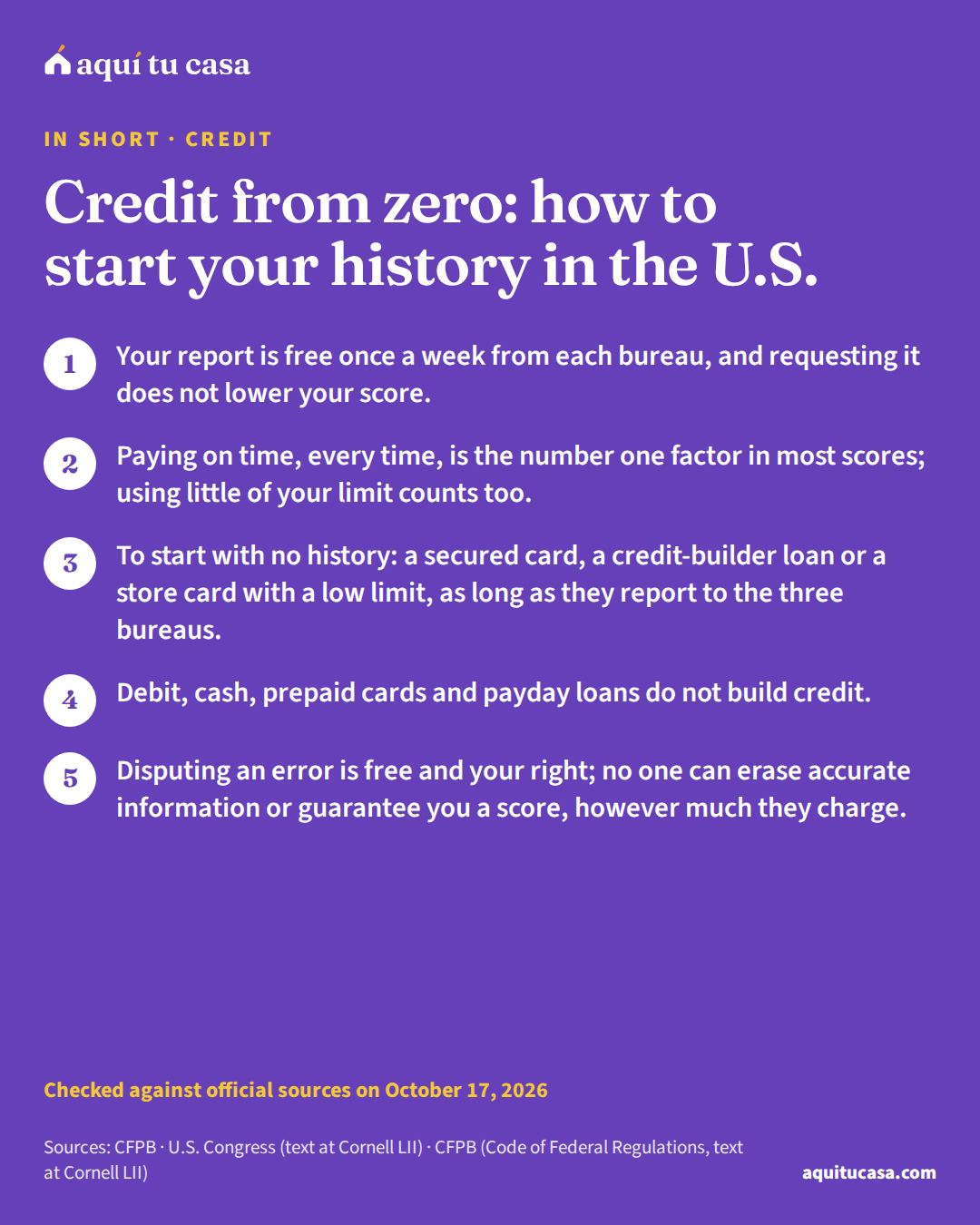
From the guide
What credit reports and scores are, how to get them for free, and how to start a history from nothing with a secured card or a credit-builder loan.
Verified on October 17, 2026 18 official sources
The federal sources we reviewed do not give a fixed timeline. The CFPB says building good credit takes time and there are no shortcuts: the longer you have credit and pay on time, the more information there is to show you are a good risk. What you control from day one is paying on time and using little of your limit.
Read the full guideNo. Requesting your own report is not an inquiry about new credit and has no effect on your score. The inquiries that do count are hard inquiries: a lender's check when you apply for credit.
Read the full guideThe CFPB does not rank one above the other: it describes both as ways to start. A secured card asks for a deposit up front, and its fees and interest can be high; a credit-builder loan holds your money as savings while you make small payments, usually over six to 24 months. In both, what builds history is that they report to the three bureaus and that you pay on time.
Read the full guideLittle. The experts the CFPB cites advise using no more than 30% of your total credit limit. And you do not need to carry a balance to have a good score: paying the balance in full each month helps get you the best scores and saves you interest.
Read the full guideFirst, read the notice: the lender must give you the reasons or tell you that you can ask for them within 60 days. If the decision was based on your report, the notice names the bureau that made it and says you have the right to a free copy. Then start with a product made to build history, and apply only for the credit you need.
Read the full guideBe wary of anyone who charges before doing anything, promises a higher score or says they can erase accurate information: no one can. Disputing errors is free and you can do it yourself; a HUD-approved housing counselor advises on credit, often at little or no cost.
Read the full guideThe data behind these guides
The guides on Credit cite these figures. They update when their sources publish new ones; what you see here is current.
See all the dataSources: Freddie Mac (As of November 5, 2026) · U.S. Census Bureau (Average 2020–2024)
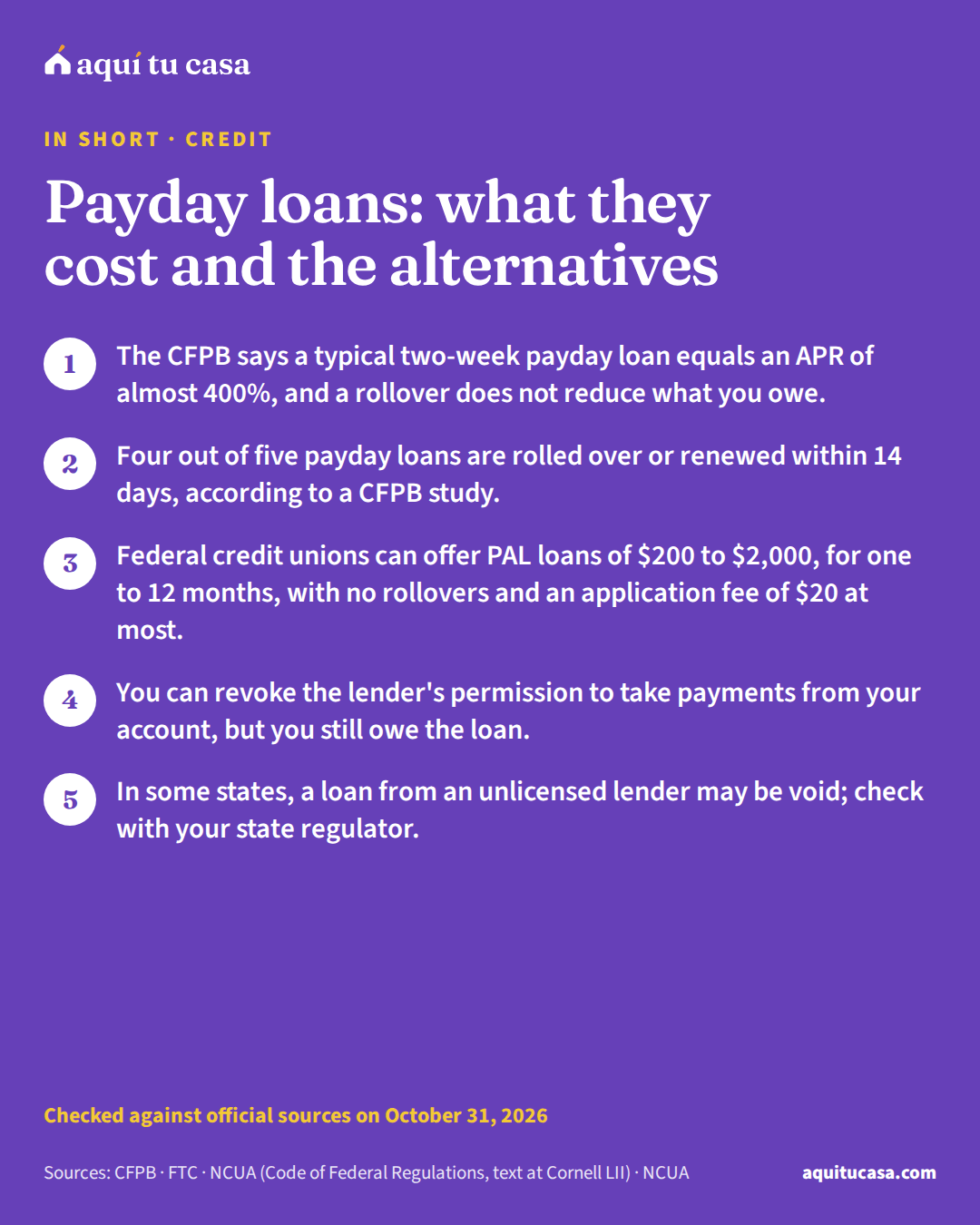
From the guide
How a payday loan works, what the CFPB says it costs, what a federal credit union payday alternative loan (PAL) is and what to do if you already have one.
Verified on October 31, 2026 13 official sources
The CFPB says many states allow fees of $10 to $30 per $100. With a typical fee of $15 per $100, borrowing $300 costs you $345 in a couple of weeks, and if you roll it over once you pay $90 for a month. That equals an APR of almost 400% on a two-week loan.
Read the full guideIt is a payday alternative loan that a federal credit union can offer. PAL I is $200 to $1,000, for one to six months, and requires one month of membership. PAL II goes up to $2,000 and 12 months. In both, the application fee never exceeds $20 and they cannot be rolled over.
Read the full guideThe NCUA says federal credit unions may charge up to 28% on a PAL, under the terms of the regulation, while the temporary ceiling the Board extended through September 10, 2027 remains. Their loans that are not PALs can have a maximum APR of 18%.
Read the full guideYou have to join. For PAL I, the rule requires at least one month of membership first. The PAL II rule has no such wait. Ask a federal credit union near you whether it offers PALs.
Read the full guideThe CFPB says to tell the company and your bank, by phone and in writing, that you are revoking authorization. You can also give the bank a stop payment order at least three business days before the withdrawal. You still owe the loan, so ask for a repayment plan too.
Read the full guideYes. The CFPB says that if you do not repay, the lender can sue you. If you receive court papers, look for free legal aid right away and do not ignore the date.
Read the full guideIt depends on the state. The CFPB says some states do not allow them, others allow them with a license, and in some a loan made without a license may be void. Your state regulator or attorney general can tell you whether a lender is licensed.
Read the full guide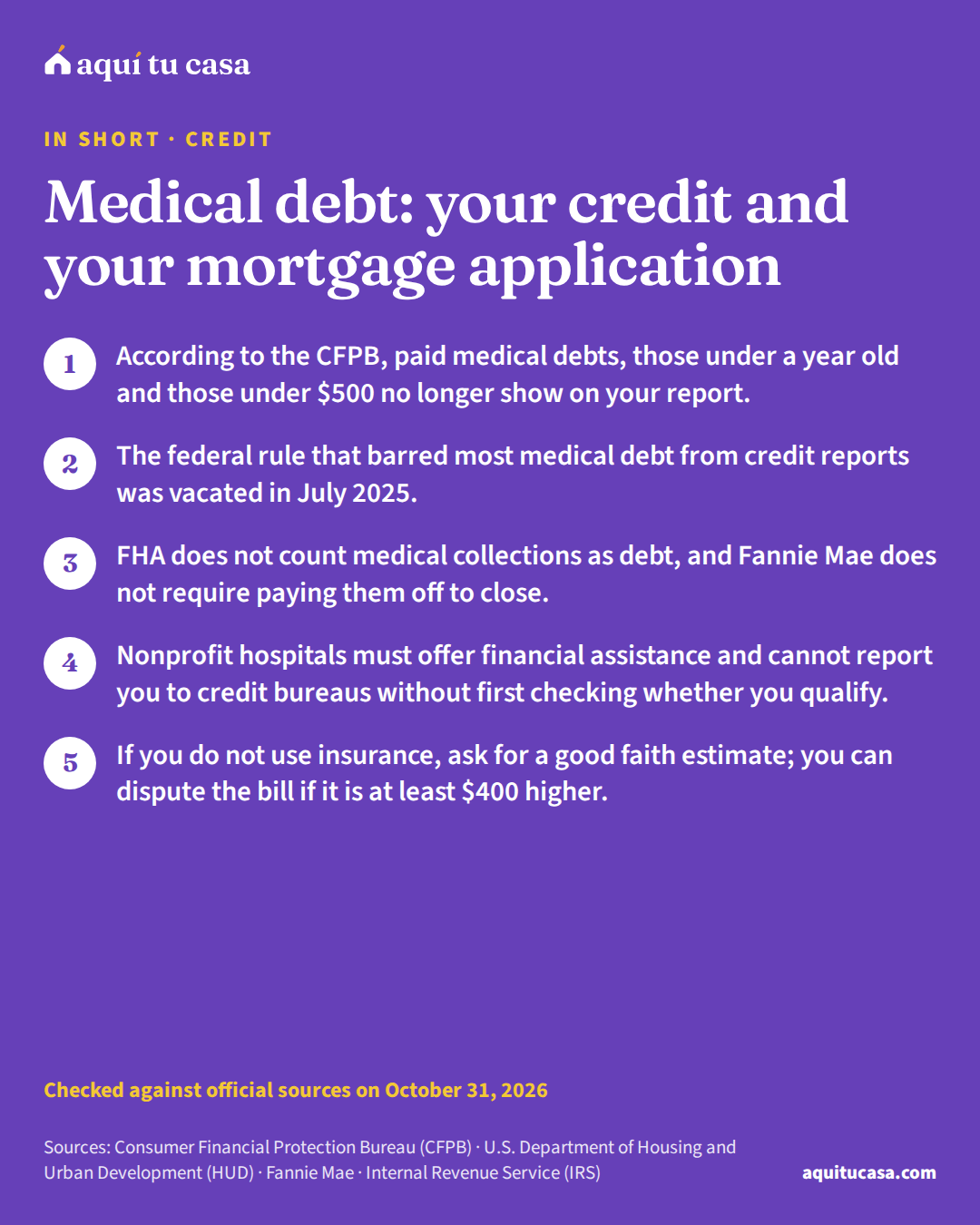
From the guide
When medical debt shows up on your credit report, how FHA and Fannie Mae treat it, hospital financial assistance and your rights against surprise bills.
Verified on October 31, 2026 7 official sources
Some still is. According to the CFPB, the three credit bureaus removed paid medical debts, those under a year old and medical collections under $500. But these are bureau policies, not a law. The federal rule that went further was vacated by a court in July 2025.
Read the full guideThen the debt belongs to the card, not to medical care. The CFPB notes that the bureau changes do not include credit card collections, even if you used the card to pay a medical expense.
Read the full guideUnder HUD's Handbook, medical collections are not considered debt on an FHA loan underwritten with the TOTAL system. Ask your lender how it sees them in your case, because it may have its own rules.
Read the full guideFannie Mae excludes medical collections from its limits and does not require paying them before closing. And on a one-unit principal residence, it does not require paying off collections, regardless of the amount.
Read the full guideIf it is a nonprofit hospital, it must have a financial assistance policy, which may include free or discounted care, and publicize it. If you qualify, you cannot be charged more than what the hospital generally bills for that care. Ask in writing.
Read the full guideA nonprofit hospital must make reasonable efforts to see whether you qualify before reporting you to credit bureaus, and cannot start those actions for at least 120 days from the first bill. You have 240 days to apply for help.
Read the full guideIf you do not use insurance, the provider generally must give you a good faith estimate. If the bill is at least $400 more than the estimate, you can dispute it. Call 1-800-985-3059 for help, including in Spanish.
Read the full guide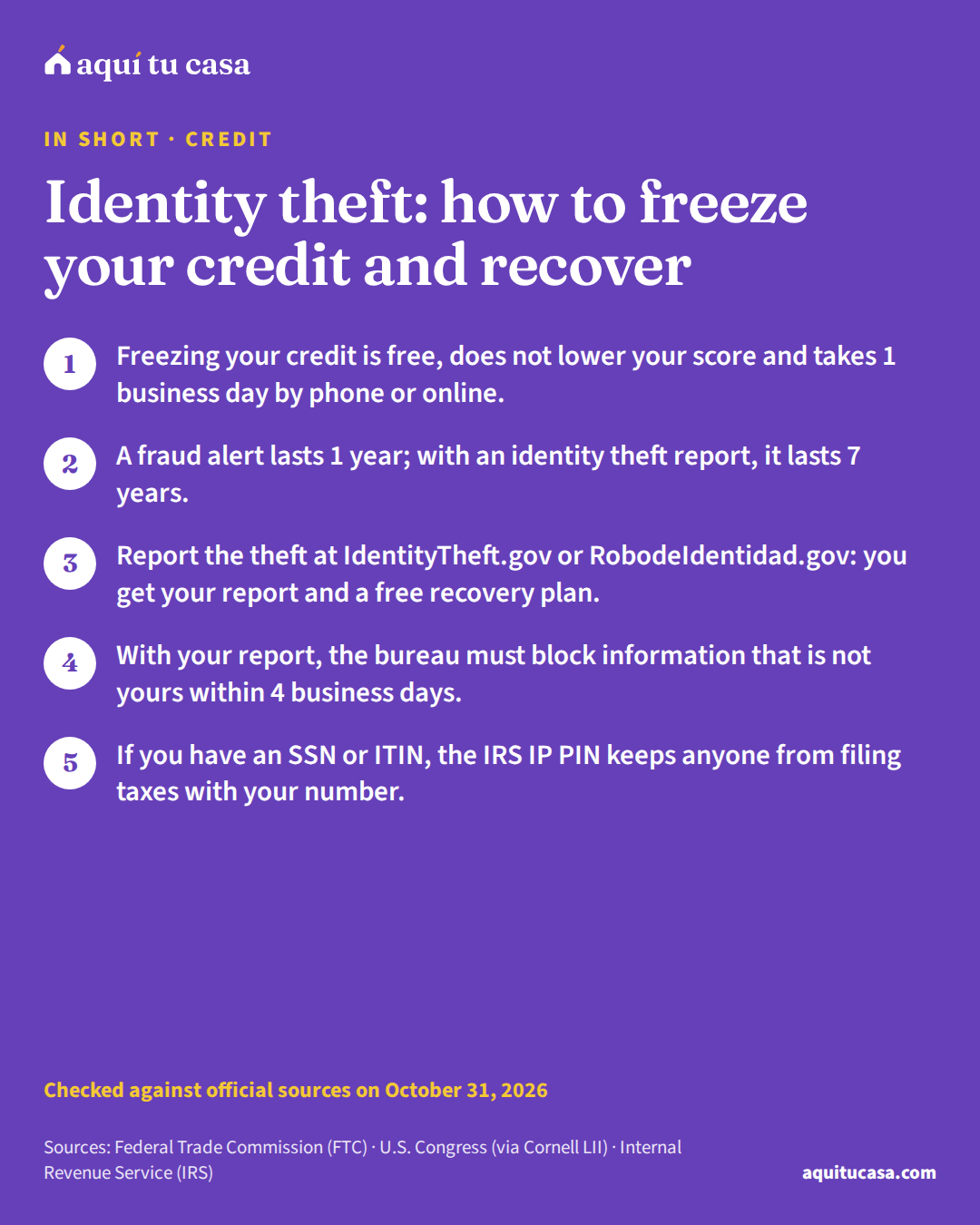
From the guide
What to do if your identity is stolen: close accounts, place a fraud alert, freeze your credit for free and report it at IdentityTheft.gov.
Verified on October 31, 2026 6 official sources
No. The FTC says freezing your credit does not affect your score. It only keeps new credit accounts from being opened in your name, even by you, until you lift it.
Read the full guideNothing. By law, placing and lifting it is free. You have to request it from each of the three bureaus: Equifax, Experian and TransUnion.
Read the full guideWith an alert, a business must verify your identity before opening a new account; it lasts 1 year, or 7 with an identity theft report, and you place it with just one bureau. With a freeze, nobody can open a new account in your name; you request it from all three bureaus.
Read the full guideLift it temporarily before the lender checks your credit. If you ask by phone or online, the bureau must lift it within 1 hour; by mail, within 3 business days. You can freeze it again afterward.
Read the full guideYes. The FTC has RobodeIdentidad.gov in Spanish. For another language, call 877-438-4338 and press 3; interpreters are available from 9:00 a.m. to 5:00 p.m. Eastern Time.
Read the full guideYes. If your child is under 16, you can request a free freeze, which lasts until you ask to remove it. Each bureau has its own instructions for minors.
Read the full guideYes. The IRS says anyone with an SSN or ITIN who can verify their identity can request an IP PIN, which keeps someone else from filing taxes with your number. You get a new one every year.
Read the full guide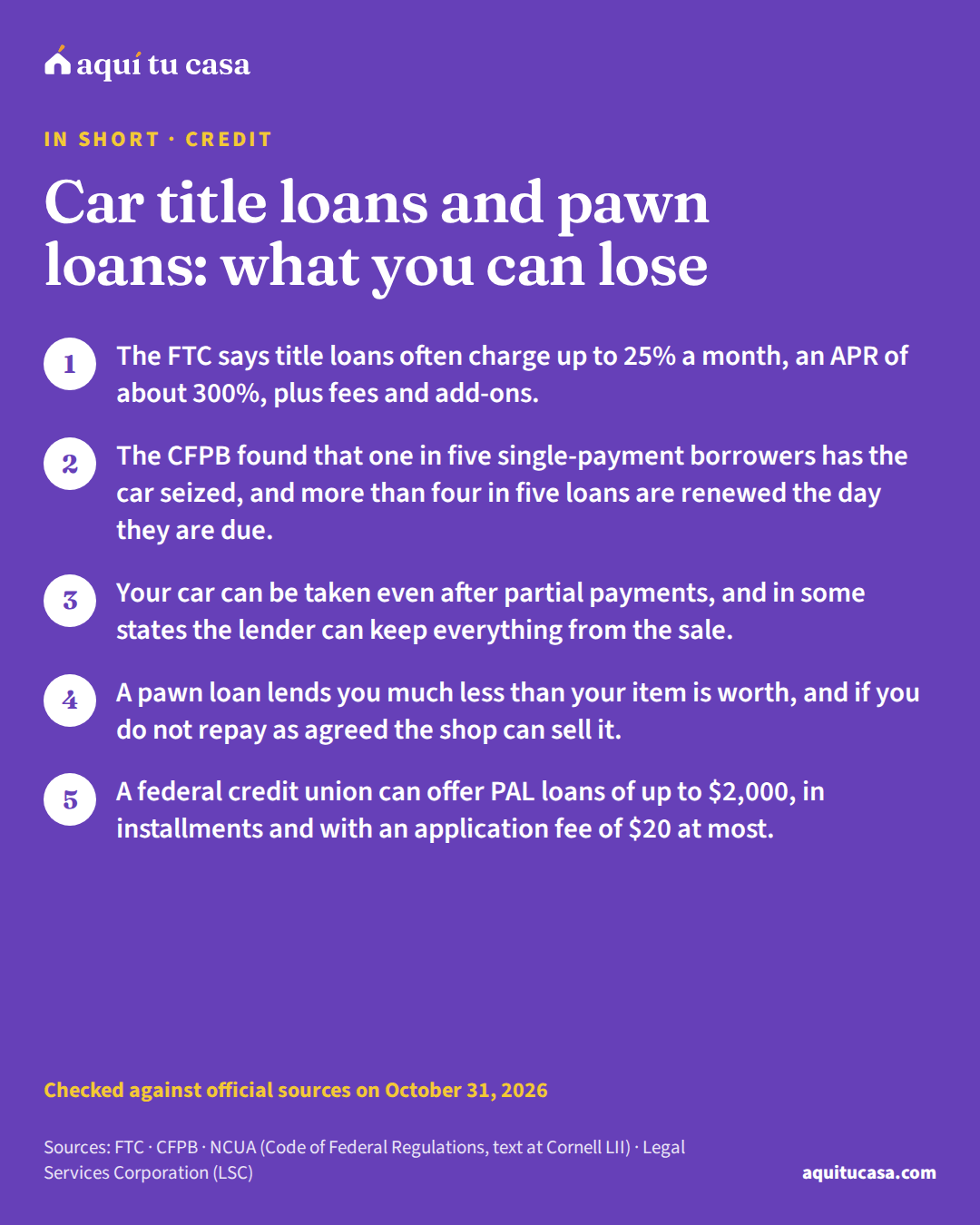
From the guide
How car title loans and pawn loans work, what the CFPB found, what you can lose and which cheaper alternatives exist before you hand over your car title.
Verified on October 31, 2026 9 official sources
The FTC says they often have monthly fees of up to 25%, an APR of about 300%, plus processing, document or origination fees and add-ons such as a roadside service plan. In its example, borrowing $1,000 for 30 days leaves you owing $1,250, and rolling it over another 30 days raises the cost to at least $500.
Read the full guideYes. The FTC warns that the lender may repossess the vehicle even if you have been making partial payments, and that some install GPS and starter interrupt devices to locate and disable it remotely.
Read the full guideIt depends on your state. The CFPB explains that, when a car is repossessed, if it sells for more than you owe you may be entitled to the surplus. But the FTC warns that, with a title loan, in some states the lender can keep everything from the sale. Ask your local legal services office or your state attorney general.
Read the full guideThe CFPB explains that the pawn shop keeps your item during the loan and, if you do not repay as agreed, can sell it to cover the debt. It also says the loan is often much less than the item's actual value.
Read the full guideAsk for the annual percentage rate (APR). In a lawsuit, the CFPB explained that every fee on the loan, whether called storage, appraisal or processing, is part of the finance charge and must be included in the APR. Add up all the fees before you sign.
Read the full guideThe FTC suggests asking your creditors for more time, a PAL loan from a federal credit union, small loans from local banks, nonprofit credit counseling, help from family or friends, and charities and places of worship.
Read the full guideYes. The CFPB explains that the Military Lending Act covers vehicle title loans: active-duty members and their dependents cannot be charged more than a 36% MAPR or be required to accept mandatory arbitration. Your JAG office can help.
Read the full guide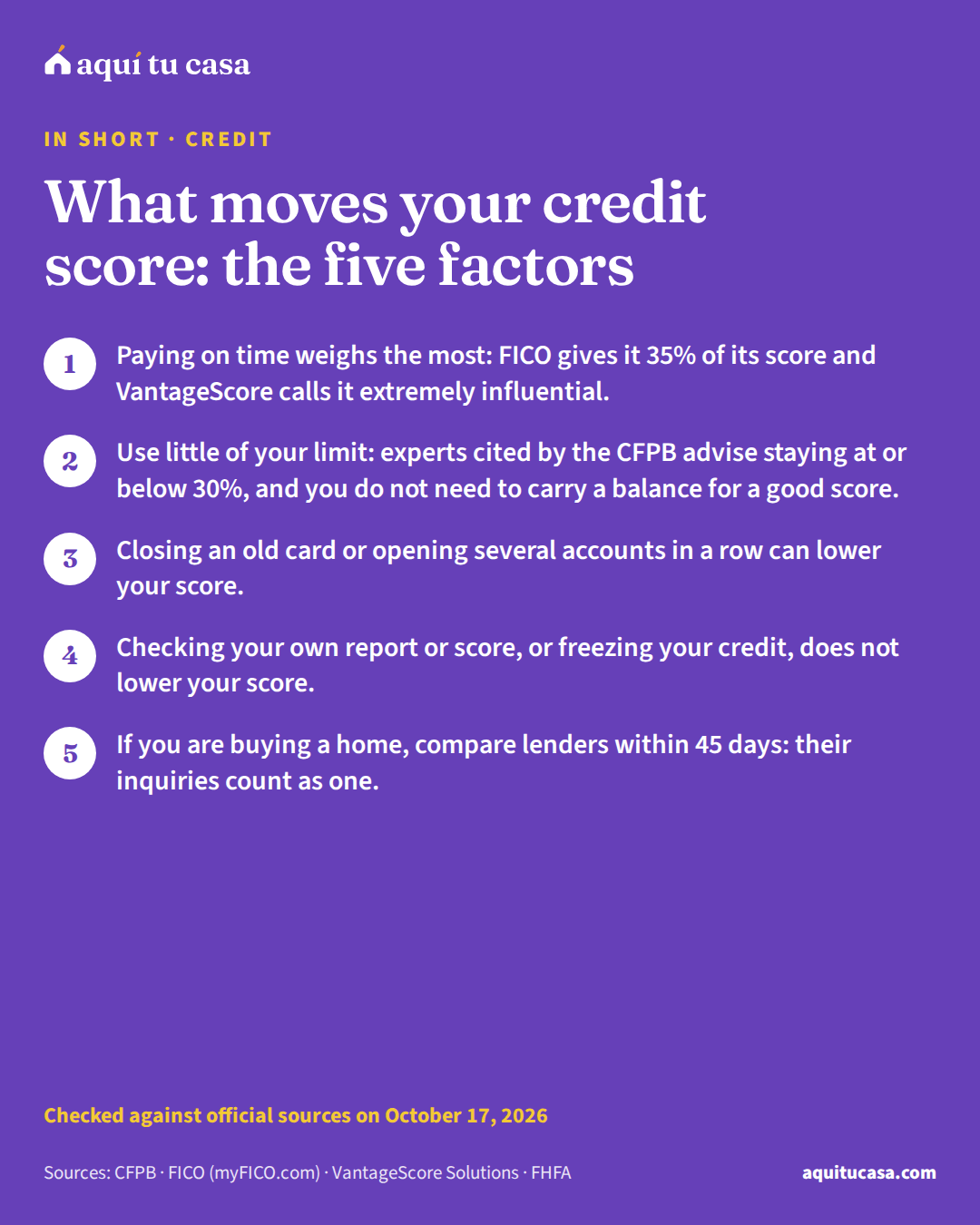
From the guide
What raises and lowers your credit score according to the CFPB, FICO and VantageScore: on-time payments, credit use, age, new credit and account mix.
Verified on October 17, 2026 21 official sources
The sources we checked do not give a fixed number: it depends on your whole report. FICO says an overall good history can outweigh one or two late credit card payments, and the CFPB says recent negative information weighs more than older information. Negative payment information can be reported for up to seven years.
Read the full guideNo. Checking your own credit does not affect your scores: it is a soft inquiry. The ones that count are hard inquiries, made by a lender when you apply for credit.
Read the full guideDo not assume so. The CFPB explains that closing a card can raise your utilization, because your total limit goes down, and that can lower your score. Closing it can make sense if it charges an annual fee or helps you avoid debt, especially if you do not plan to apply for credit soon.
Read the full guideLittle. Experts cited by the CFPB advise using no more than 30% of your total limit, and others say less than 10%. You do not need to carry a balance: paying in full every month helps you get the best scores and saves you interest.
Read the full guideBecause you do not have just one score. Each depends on the model, the credit reporting agency the data comes from and the day it is calculated, and lenders use different scores for different loans. Some apps also show an educational score: for most people it is close to what lenders use, but not always.
Read the full guideNot in the score. FICO says it does not use your national origin, salary or employer, and VantageScore says the same about its model, adding your age and where you live. A lender can still look at your income and job when deciding whether to lend to you.
Read the full guideAccording to the CFPB, multiple mortgage lender inquiries within 45 days count as a single inquiry. You can compare several preapprovals and Loan Estimates; what you should avoid is applying for other cards or loans right before or during the process.
Read the full guideOnly if it gets reported. FHFA says the newer models approved for Fannie Mae and Freddie Mac take rent payment history into account. Our guide to reporting rent explains the options and the fees to watch.
Read the full guide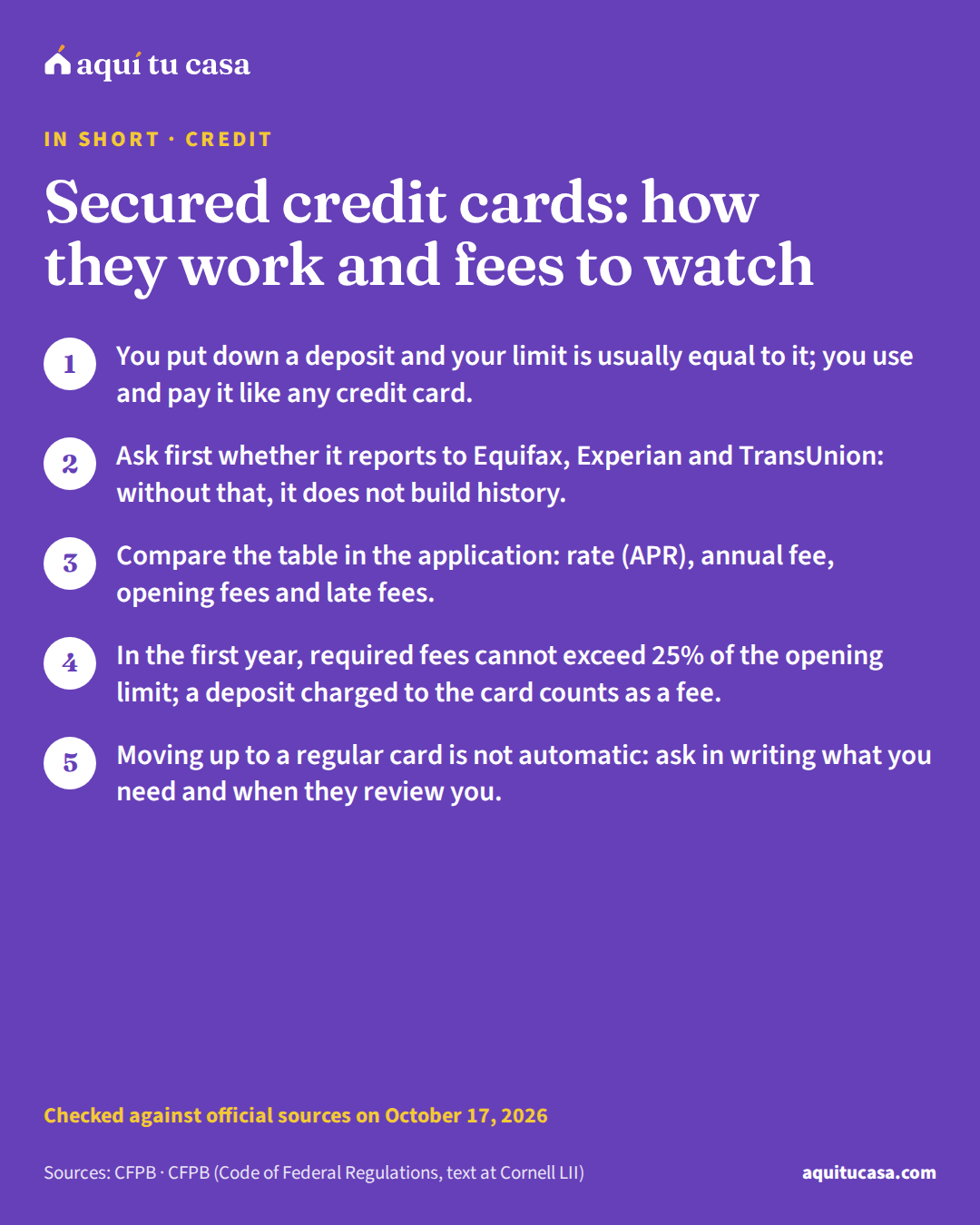
From the guide
How a secured credit card works: the deposit, the fees and rate to compare, how it reports your payments and how to move up to a regular card.
Verified on October 17, 2026 17 official sources
According to the CFPB, as you show you can pay on time, your limit may be raised and your deposit may be refunded. Terms vary by issuer: ask in writing when and how they return it, and read what your agreement says if you close the account.
Read the full guideIt depends on the issuer. The CFPB explains that you put an amount equal to your credit limit in an account, and gives $500 as an example; with most of these cards, the credit line starts out small.
Read the full guideIt can, if the issuer reports your payments to the three nationwide agencies and you pay on time. The CFPB suggests asking the issuer about reporting before you apply.
Read the full guideThe law sets no fixed timeline. The CFPB found issuers that promised orally to convert accounts to unsecured in six or twelve months and did not, because it depended on other factors. Ask in writing for the requirements and how often they review your account.
Read the full guideUnder Regulation Z, required fees in the first year cannot exceed 25% of the limit when the account was opened; late, over-the-limit and returned-payment fees do not count. If the deposit is charged to the card, it counts as a fee; if you pay it separately, it does not.
Read the full guideNo. With a secured card you borrow and pay later, and that can be reported to the agencies. With a prepaid card you only spend money you loaded beforehand, and the CFPB says it does not build history.
Read the full guideIt depends on the issuer. The CFPB says the issuer may ask for your Social Security number to get your credit report. Before applying, ask whether they accept an ITIN and whether they report your payments to the three agencies.
Read the full guideOn most cards, not on purchases, if you pay the full balance by the due date. Companies are not required to give a grace period, and cash advances generally charge interest from day one.
Read the full guide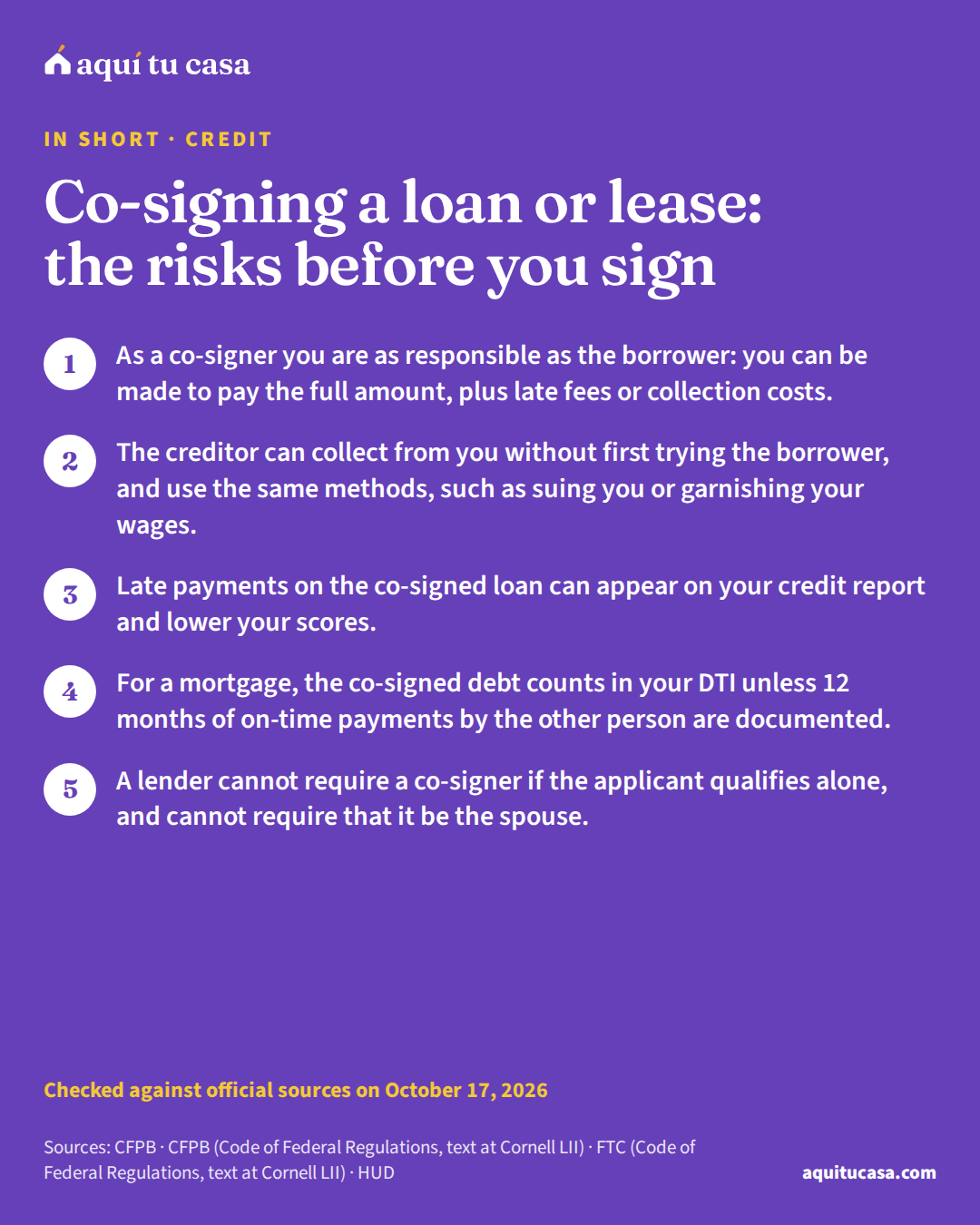
From the guide
What co-signing a loan or a lease means, what you can be made to pay, how it affects your credit and a future mortgage, and how to protect yourself.
Verified on October 17, 2026 15 official sources
Read the full guide Do the math: How much house can I afford?
You will be asked to pay. You may have to pay up to the full amount of the debt, plus late fees or collection costs, and the creditor can collect from you without first trying the borrower. Late payments can show up on your credit report, and after a default you can be sued.
Read the full guideIt can. According to the CFPB, late or missed payments on a co-signed loan affect both people's credit history, and a default goes on your report. That is why it is worth getting the statements and checking your credit report.
Read the full guideGenerally yes: for an FHA loan, the lender must count that debt in your monthly obligations unless it documents that the other person made 12 months of on-time payments. Fannie Mae also allows leaving it out of your DTI with 12 months of canceled checks or bank statements from the person paying, with no late payments.
Read the full guideIt depends on the loan. Some private student loans allow the co-signer to be released if the borrower makes payments for a certain length of time; the requirements are in the loan terms and on the lender's website. Ask the lender or servicer what options your loan has.
Read the full guideNot if your spouse qualifies alone. Under Regulation B, a creditor cannot require the signature of a spouse or anyone else if the applicant qualifies, and if it asks for a co-signer, it cannot require that it be the spouse. There are exceptions when state law requires it to secure a property.
Read the full guideThe FTC rule calls for the lender or retail installment seller to give you, before you are obligated, a separate document called the “Notice to Cosigner” explaining that you may have to pay the whole debt and that the creditor can collect from you without going after the borrower first. That notice is not the contract: the contract is what binds you, so read it too.
Read the full guide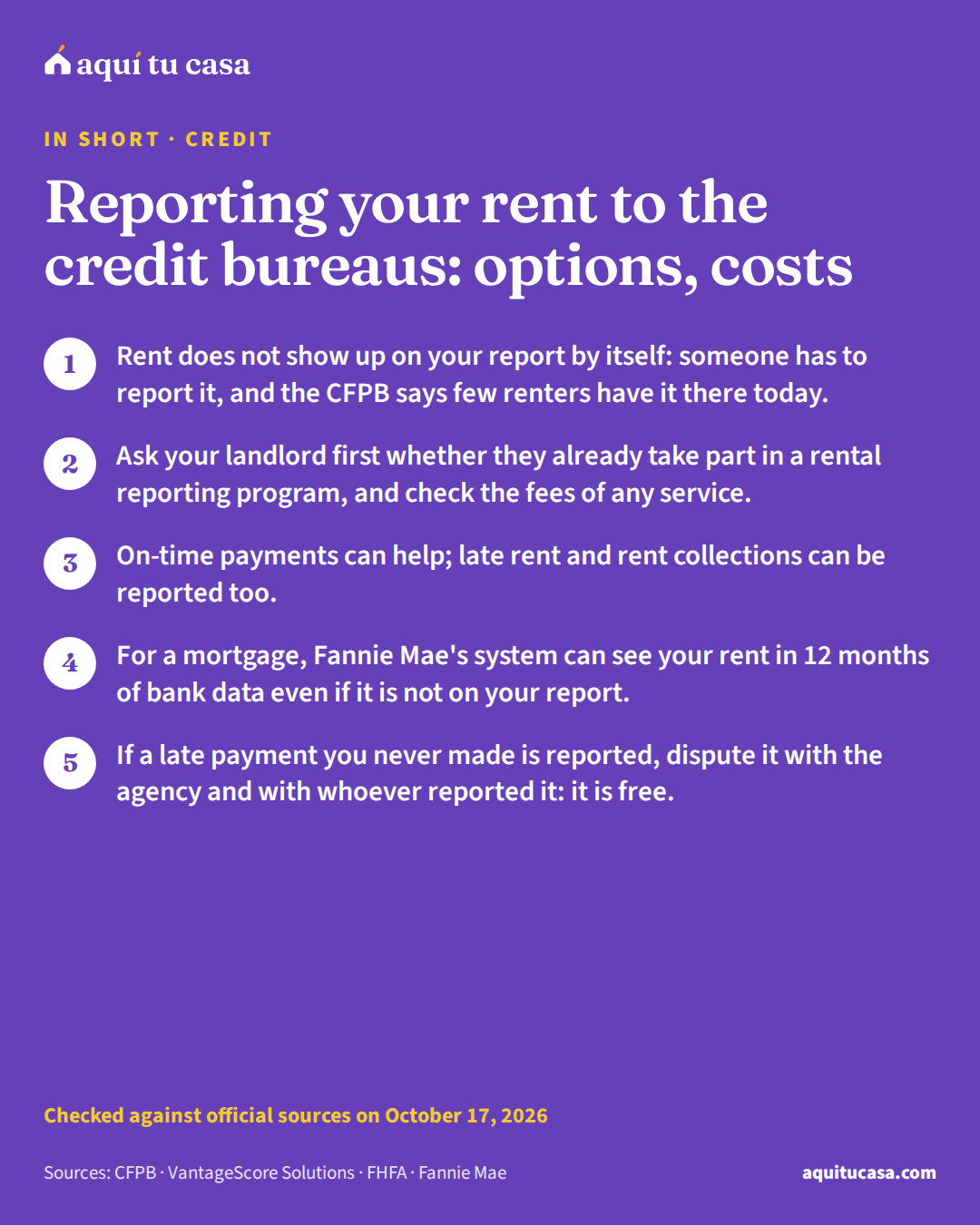
From the guide
How to make your rent payments count on your credit: what your landlord does, what services exist, which fees to check and what happens if you pay late.
Verified on October 17, 2026 16 official sources
It can help, but only if it is reported to the agencies and the scoring model uses it. The CFPB says positive rental payments can help build your credit, and FHFA says the newer models approved for Fannie Mae and Freddie Mac take rent history into account.
Read the full guideAsk whether they take part in a rental reporting program, often through a rent payment app. Then check your three credit reports: if your rent is reported, it should appear as an account.
Read the full guideIt depends on the program: some are paid by the landlord and others charge the renter. The CFPB suggests considering the fees of these services before you sign up. Ask how much it is per month, whether there is a signup fee and how to cancel.
Read the full guideYes, if you fall behind and the late payment is reported. The big three agencies use rental payment and related collection information, and negative payment information can be reported for up to seven years. Ask whether the program reports only on-time payments or late ones too.
Read the full guideIt can. Fannie Mae's DU system can identify your rent payments in 12 months of bank data if you have rented for at least 12 months at $300 or more and have no mortgage on your report, a limited history or no score. Without a score, rent can also be a nontraditional credit reference.
Read the full guideDispute it in writing with the credit reporting agency and with whoever reported it. Your landlord may be the one furnishing the information, and it generally must investigate and respond within 30 days. The law bars them from reporting information they know is inaccurate.
Read the full guideNot necessarily: it depends on the model. VantageScore says its model uses alternative data such as rent, and FHFA says the newer models approved for Fannie Mae and Freddie Mac mortgages take it into account. Other models may not use it.
Read the full guideTools
The calculators these guides use. Each one leaves you with a result you can use today.
The steps to build or improve your credit.
What you get → steps in order
How much is left for housing each month.
What you get → what is left
The price your income can carry.
What you get → maximum price
How many months until your down payment.
What you get → months of saving
From the guide
How Fannie Mae and FHA accept rent, utilities, insurance and remittances as credit history when you have no score: requirements, documents and limits.
Verified on October 17, 2026 8 official sources
Read the full guide Do the math: How much house can I afford?
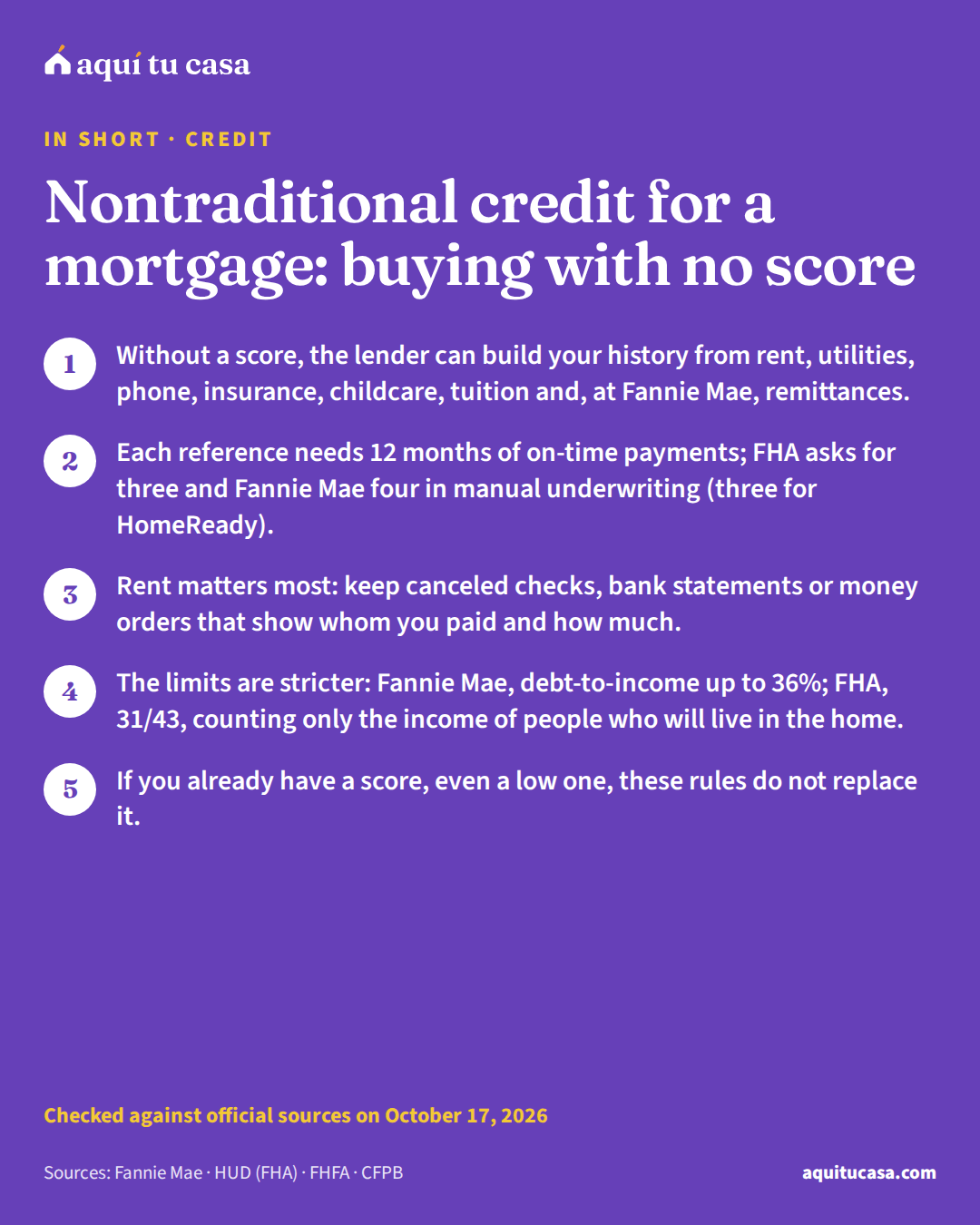
Yes, under some programs. Fannie Mae says that if you have no score or a limited history, the lender must establish an acceptable nontraditional history, and HUD Handbook 4000.1 allows the same for manually underwritten FHA loans. Each program has its own rules on references, debts and income.
Read the full guideRent and utilities (power, gas, water, phone, internet) are the most common. Insurance not paid through payroll, childcare, tuition, store payments, medical bills and a personal loan with written terms can also count. Fannie Mae also accepts savings with regular deposits and consistent remittances over 12 months.
Read the full guideFor Fannie Mae loans, they can: the Selling Guide accepts wire remittance statements showing a consistent amount sent over the most recent 12 months. Keep the receipt for every transfer.
Read the full guideFHA asks for three, with at least one from rent, phone or utilities. Fannie Mae asks for four in manual underwriting (three for HomeReady) and, when its DU system requires them, at least two, one of them housing. Each must cover the most recent consecutive 12 months.
Read the full guideFannie Mae accepts canceled checks and, instead, bank statements, copies of money orders or other reasonable methods that show whom you paid and how much, or direct verification from the landlord. FHA asks for 12 months of canceled checks or other proof of payment, or a reference from the management company instead; if you rent from a family member, that reference does not replace the proof of payment.
Read the full guideFor Fannie Mae loans, in many cases yes: if no borrower on the purchase has a score (or, in DU, none has a credit account on their report), at least one must complete a homebuyer education course before closing. It can be in person, online or by phone, or be replaced by counseling from a HUD-approved agency.
Read the full guideFor FHA, if a borrower has no score, ratios are computed only with the income of the people who will live in the home and sign the loan. Fannie Mae permits non-occupant co-borrowers in manual underwriting if they meet its section B2-2-04.
Read the full guideNot to replace it. Fannie Mae does not accept a nontraditional history if the lender can obtain your score, or if your score is below the minimum, except for some HomeReady loans. The guide on what moves your score explains how to raise it.
Read the full guide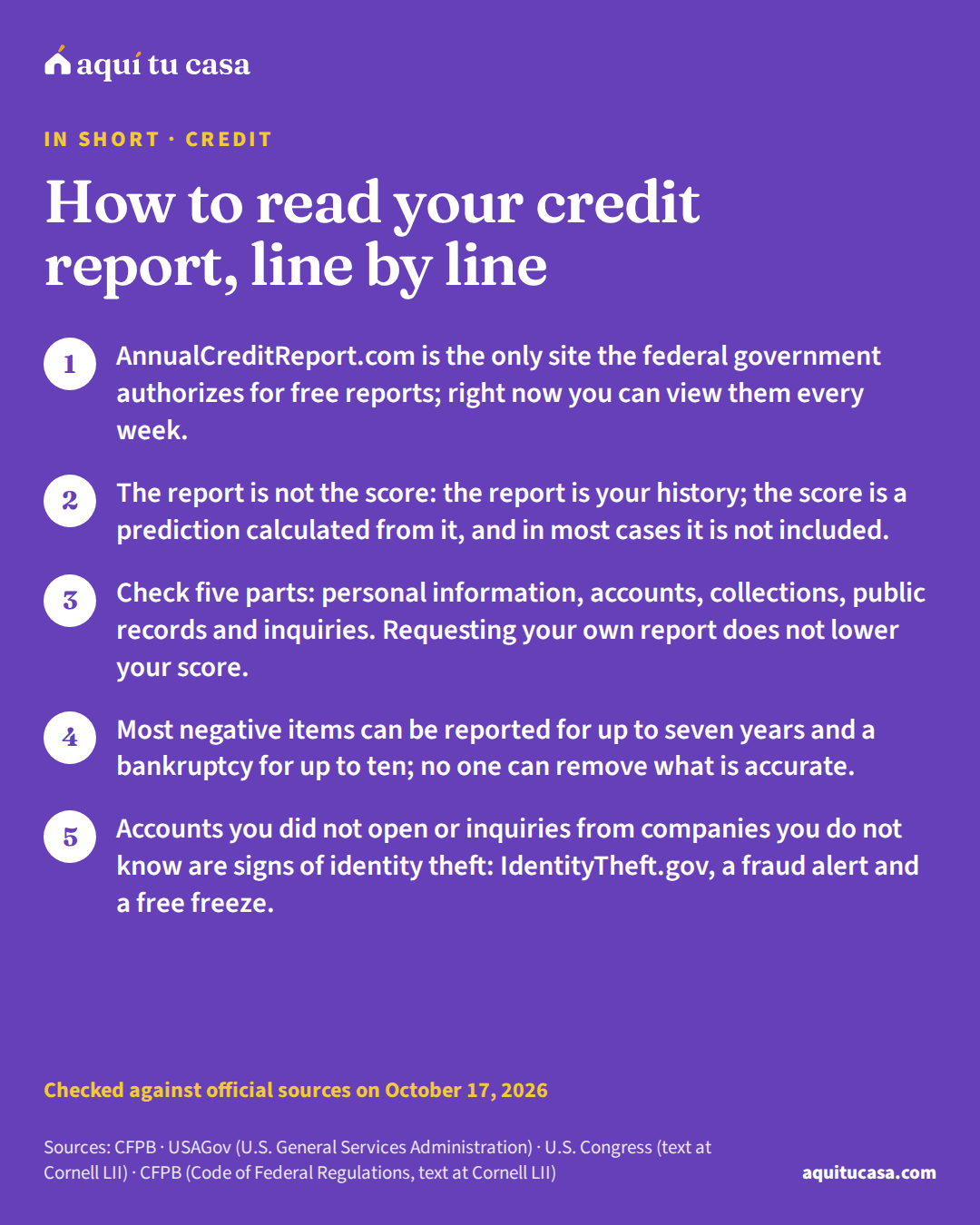
From the guide
Where to get your free credit reports, what each part says, how long negative items can stay and how to spot errors or identity theft.
Verified on October 17, 2026 16 official sources
No. Requesting your own report is a soft inquiry: only you see it and it does not affect your scores. The ones that count are hard inquiries, made by a lender when you apply for credit.
Read the full guideBecause creditors are not required to report to all three bureaus. An account can appear on one report and not on another, which is why it is worth checking all three.
Read the full guideIn most cases, no. The score is calculated from the data in the report and varies by model. If you apply for a mortgage and the lender uses your score, the law requires the lender to give you that information.
Read the full guideAccording to the CFPB, most negative information can be reported for seven years; a bankruptcy, for up to ten. If the item is accurate, no one has the right to remove it early, however much they charge.
Read the full guideThe federal sources we reviewed do not explain how each bureau handles a file with an ITIN. If the official source cannot verify your identity, it must tell you what additional information or documents are needed and how to send them. If your request is denied, contact the bureau and, if that does not resolve it, the CFPB; a HUD-approved housing counselor can help you.
Read the full guideAccording to the CFPB, you can view it for free every week at AnnualCreditReport.com, from each of the three bureaus. The law also gives you the right to one free report from each bureau every 12 months, and to more in certain cases, such as when you are denied credit because of your report.
Read the full guideIt may be identity theft or a file mixed with someone else's. If you think your identity was stolen, report it at IdentityTheft.gov, place a fraud alert and consider freezing your credit, which is free. If it is an error, dispute it with the bureau and with the company that reported the account.
Read the full guideIt is a report from a specialty agency that collects information for landlords, such as your previous addresses and your payment history with landlords. Many of those agencies give you a free copy every 12 months. If a landlord turns you down because of that report, it must give you a notice with the agency's details.
Read the full guide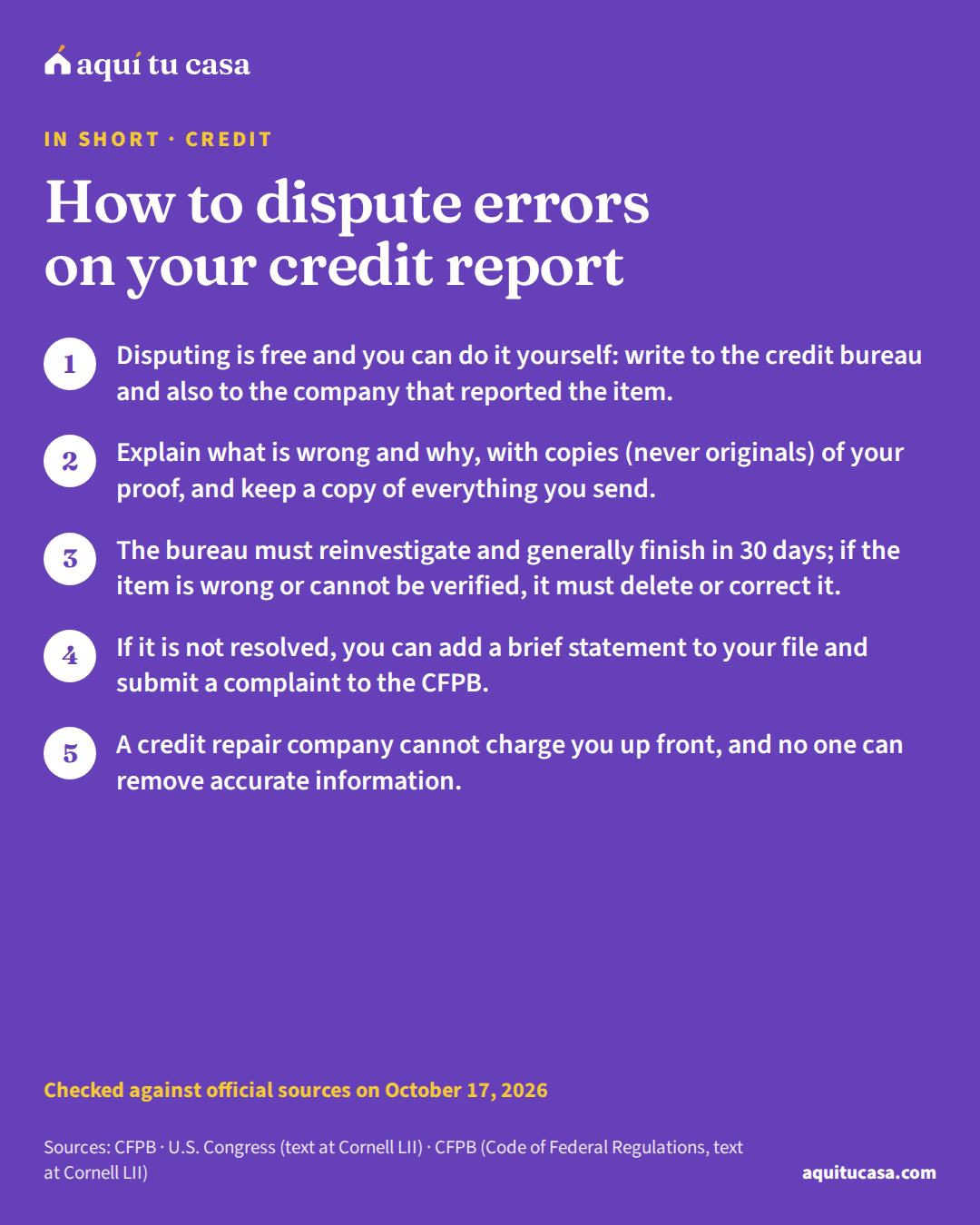
From the guide
How to fix credit report errors for free: what to send each bureau and the company that reported it, legal deadlines, and credit repair scams.
Verified on October 17, 2026 16 official sources
Nothing. By law, the bureau reinvestigates free of charge, and the CFPB notes that disputing errors is a free legal right: you do not need to pay a credit repair company to do it.
Read the full guideGenerally 30 days from receiving your dispute, plus up to 15 more days if you send relevant information during that period. It then has 5 business days to send you the results in writing.
Read the full guideIt can end the reinvestigation if it reasonably determines your dispute is frivolous or irrelevant, for example if you did not give enough information. But it must tell you no later than 5 business days afterward, with its reasons and the information needed to investigate.
Read the full guideThe CFPB calls this a mixed file and lists it among common errors. You dispute it the same way: with the bureau and with the company that reported the account. If you think someone used your information, also go to IdentityTheft.gov.
Read the full guideThe federal sources we reviewed do not explain how each bureau handles a dispute from someone with an ITIN, and we will not guess. If a bureau asks for a document you do not have, a HUD-approved housing counselor can go over it with you, often at little or no cost.
Read the full guideAccording to the CFPB, the bureaus take disputes online, by mail or by phone. If you mail it, you can use certified mail with a return receipt to have proof of the date. Either way, explain what is wrong and why, and keep a copy of everything.
Read the full guideYou can ask the bureau to add a brief statement explaining the dispute to your file, and submit a complaint to the CFPB online or at (855) 411-2372. The CFPB also notes that you may qualify for free legal services and that you can complain to your state attorney general.
Read the full guideYes. By law, you can cancel it without penalty or obligation before midnight of the third business day after you sign, and the contract must come with a cancellation form. Those companies also cannot charge you before they finish the service.
Read the full guide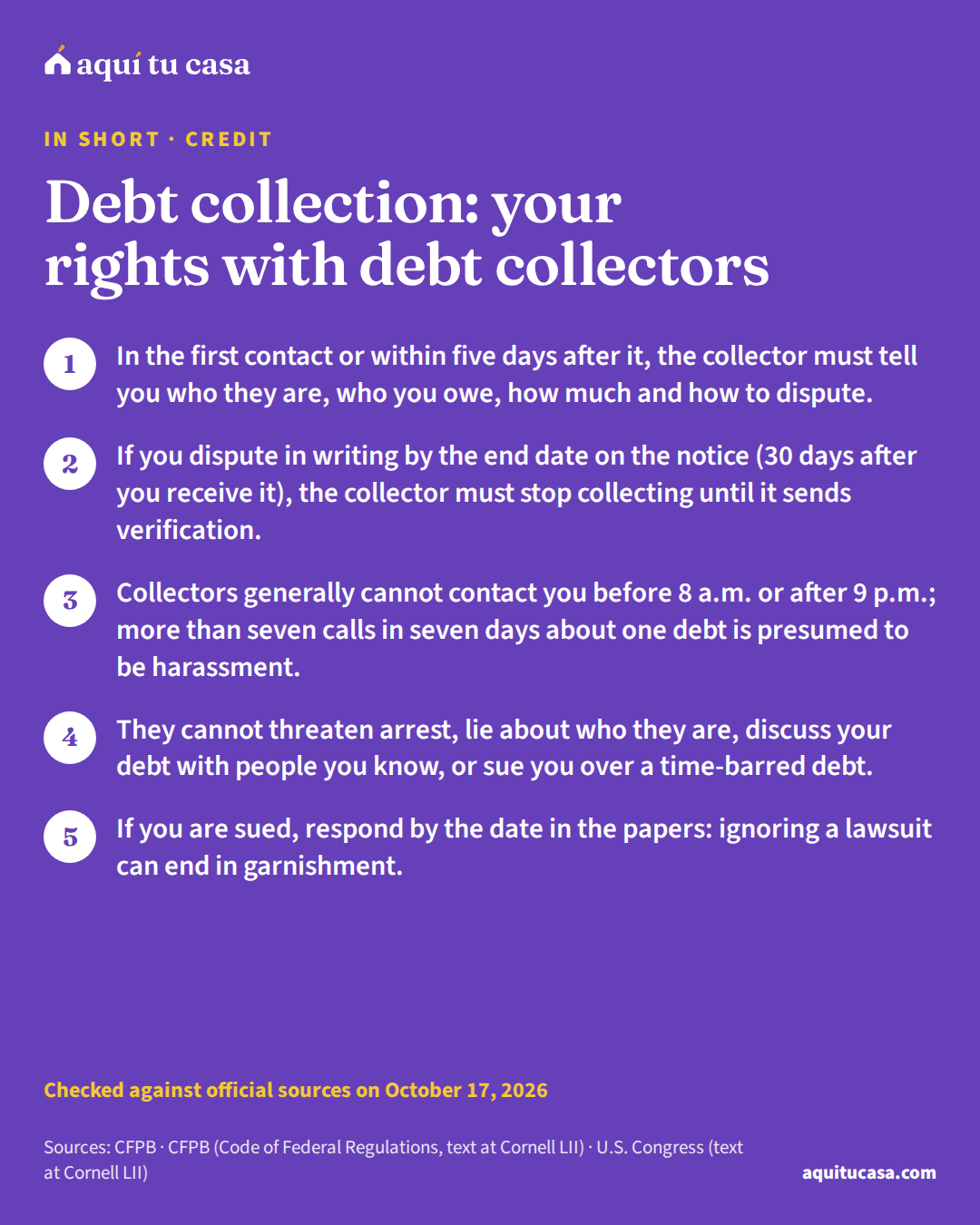
From the guide
What a debt collector must tell you, how to dispute in writing, when and how often they can call, old debts, and what to do if you are sued.
Verified on October 17, 2026 28 official sources
You have 30 days from receiving the validation information to dispute in writing. The notice gives the exact end date of that period. If you dispute in writing by that date, the collector must pause collecting the disputed amount until it sends you verification. You can still dispute after that, but the collector no longer has to pause.
Read the full guideGenerally not before 8 a.m. or after 9 p.m. where you are, or at any time they know is inconvenient for you. If they call at a bad time, you can tell them and they must end the call. They also have to follow your instructions about when and where you do not want to be contacted.
Read the full guideRegulation F presumes a violation if a collector calls about the same debt more than seven times in seven consecutive days, or calls again within seven days after talking with you about that debt. Calls that go to voicemail count. Even fewer calls can break the law, for example seven calls in a single day.
Read the full guideA debt collector cannot threaten to have you arrested, or have you arrested, for an unpaid debt; the CFPB calls that harassment. But if you are sued and do not follow a court order, such as appearing or providing information, a judge may issue a warrant for your arrest. That is why you should never ignore a court order.
Read the full guideGenerally no. They may contact other people only to find out where you live, your phone number or where you work, and they cannot say it is about a debt. They can ask your employer for your address or phone number, but they cannot tell your employer you owe a debt.
Read the full guideThe debt does not disappear until it is paid, but once your state's statute of limitations has passed, the collector cannot sue you or threaten to sue. According to the CFPB, most states have limits between three and six years. Careful: a partial payment or acknowledging the debt may restart the clock.
Read the full guideSend a letter telling them to stop contacting you; the CFPB has sample letters. After that they can only write to say there will be no further contact or that they may take other action, such as a lawsuit. The debt does not go away: if you plan to dispute it, do that before asking them to stop.
Read the full guideA collector may include on the notice an option to request it in Spanish. If it does and you ask, it must send you a notice completely and accurately translated into Spanish. If it does not include that option, Regulation F allows, but does not require, a translation.
Read the full guideMost creditors can garnish your wages or benefits only after a court issues a judgment. Federal and state laws protect part of it so you have something left to live on, and if you receive federal benefits such as Social Security by direct deposit, the bank must protect two months of those deposits. Some government agencies, such as the IRS, can garnish without a court order.
Read the full guide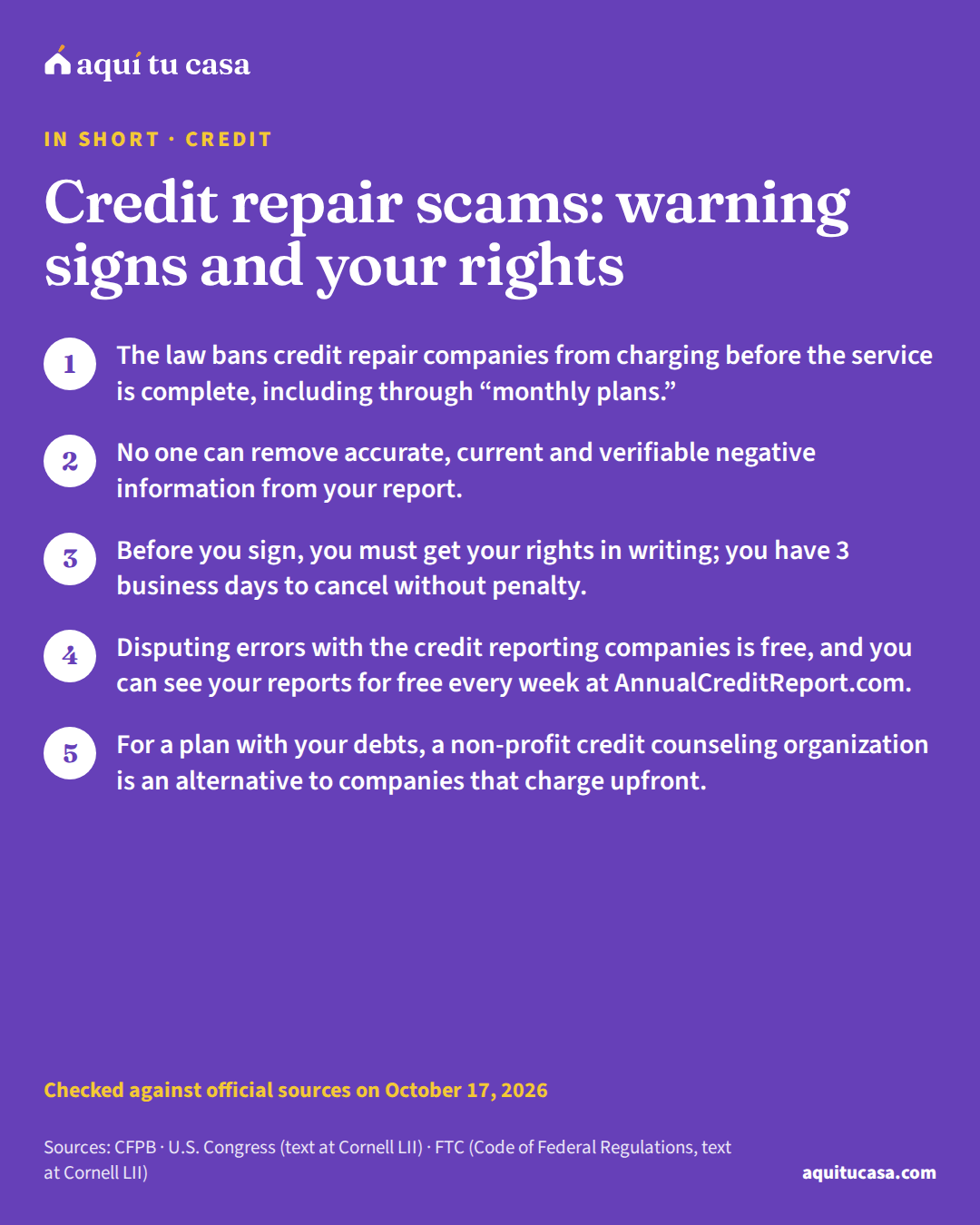
From the guide
What credit repair companies cannot do, what the law requires (no upfront fees, a written contract, 3 days to cancel) and what you can do for free.
Verified on October 17, 2026 15 official sources
Hiring one is legal, but the law bans it from charging you before it finishes the service. Before you sign, it must give you your rights in writing and a dated contract, and you have 3 business days to cancel without penalty. What it does with errors on your report, you can do yourself for free.
Read the full guideNo. Neither you nor any company has the right to have accurate, current and verifiable information removed. According to the CFPB, accurate negative information, such as a collection account, stays for seven years from the last activity or first delinquency.
Read the full guideNothing. Disputing errors is a free right, and the credit bureau cannot charge you to reinvestigate. You do not need to pay anyone to do it.
Read the full guideBefore midnight of the third business day after signing, mail or deliver the “Notice of Cancellation” form that comes with the contract, signed and dated, or any other written notice. You do not have to give a reason or pay a penalty. Keep a copy of what you send.
Read the full guideAccording to the CFPB, every form of upfront payment before the service is completed is illegal, and some companies set up monthly payments to get around that rule. If you were signed up by phone, they also cannot charge you until the promised time frame has passed and they give you a report showing the results, issued more than six months after they were achieved.
Read the full guideA contract that does not comply with the law is void. You can sue the company for what you paid it or for your damages, whichever is greater, within 5 years of the violation. You can also submit a complaint to the CFPB.
Read the full guideAccording to the CFPB, credit counseling organizations are usually nonprofits that offer free materials and can set up a debt management plan; they do not erase debts and never advise you to stop paying. Credit repair companies are usually for-profit and charge for things you can do yourself for free.
Read the full guideThe CFPB warns it can be risky: these companies often charge expensive fees, ask you to stop paying your cards and cannot always settle everything, so you may end up deeper in debt. They could be breaking the law if they charge you before settling at least one debt, before you agree to the settlement and before you make a payment under it. A non-profit credit counseling service is an alternative.
Read the full guide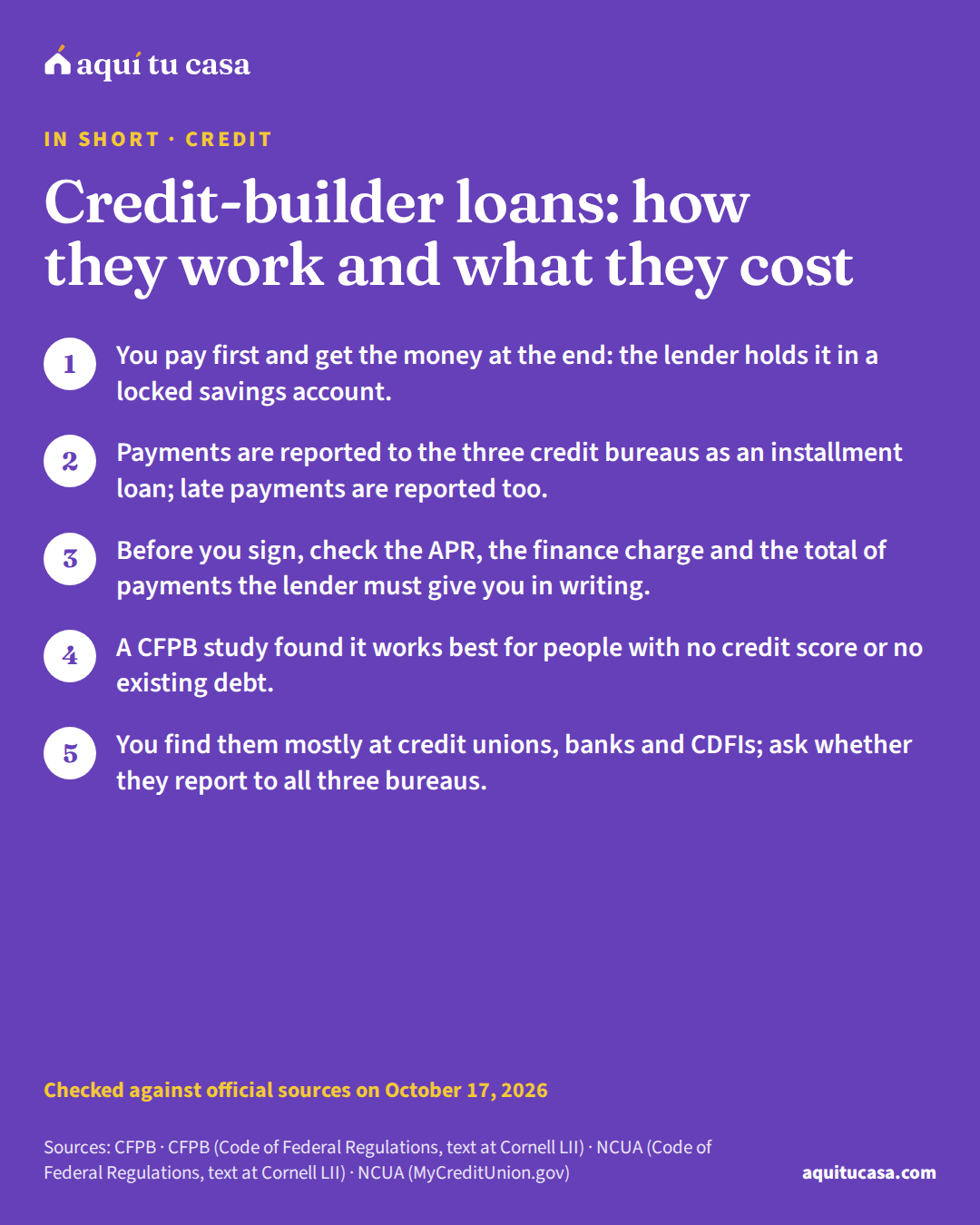
From the guide
What a credit-builder loan is, how it works month by month, which costs to check, who it helps most and where to find one.
Verified on October 17, 2026 12 official sources
It is a small loan you do not receive up front. The lender holds the money in a locked savings account, you pay it off in installments, usually over 6 to 24 months, and at the end you get what you saved. Each payment is reported to the credit bureaus, which is how you build history.
Read the full guideYou pay interest and fees that vary from lender to lender; the CFPB says risk is a key factor in setting them. Before you sign, the lender must give you the APR, the finance charge in dollars and the total of payments in writing. Compare those numbers across several offers.
Read the full guideIt depends on you. With a secured card you put down a deposit and can use credit up to that amount; with the loan you spend nothing, make fixed payments and get the money at the end. The CFPB lists both as products for getting started; what weighs most in your score is paying on time.
Read the full guideIt depends on the lender. In 2003 NCUA said it saw no legal impediment to a federal credit union lending to members with an ITIN or a matrícula consular, if it manages the risks, and that it knows of no law that bars reporting payments under a number other than a Social Security number. Ask your credit union whether it offers one and reports your payments.
Read the full guideThe late payment is reported like any other loan and can hurt your score. If you stop paying, the lender closes the loan: you are not left owing a balance, but you do get a negative mark on your history.
Read the full guideThe hard inquiry a lender makes when you apply for credit can affect your score, because models look at how often you apply. That is why the CFPB recommends applying only for credit you need. Checking your own reports does not lower your score.
Read the full guideCheck your contract: the lender must tell you in writing whether you can be charged for paying early. At credit unions, according to NCUA, regulations let you pay off your loan early without a penalty.
Read the full guideIn the CFPB study, the loan slightly lowered scores, on average, for people who already had debt, and it was associated with more late payments on other loans. The CFPB suggests that people with debt consider paying it down first or looking at other services, such as credit counseling.
Read the full guide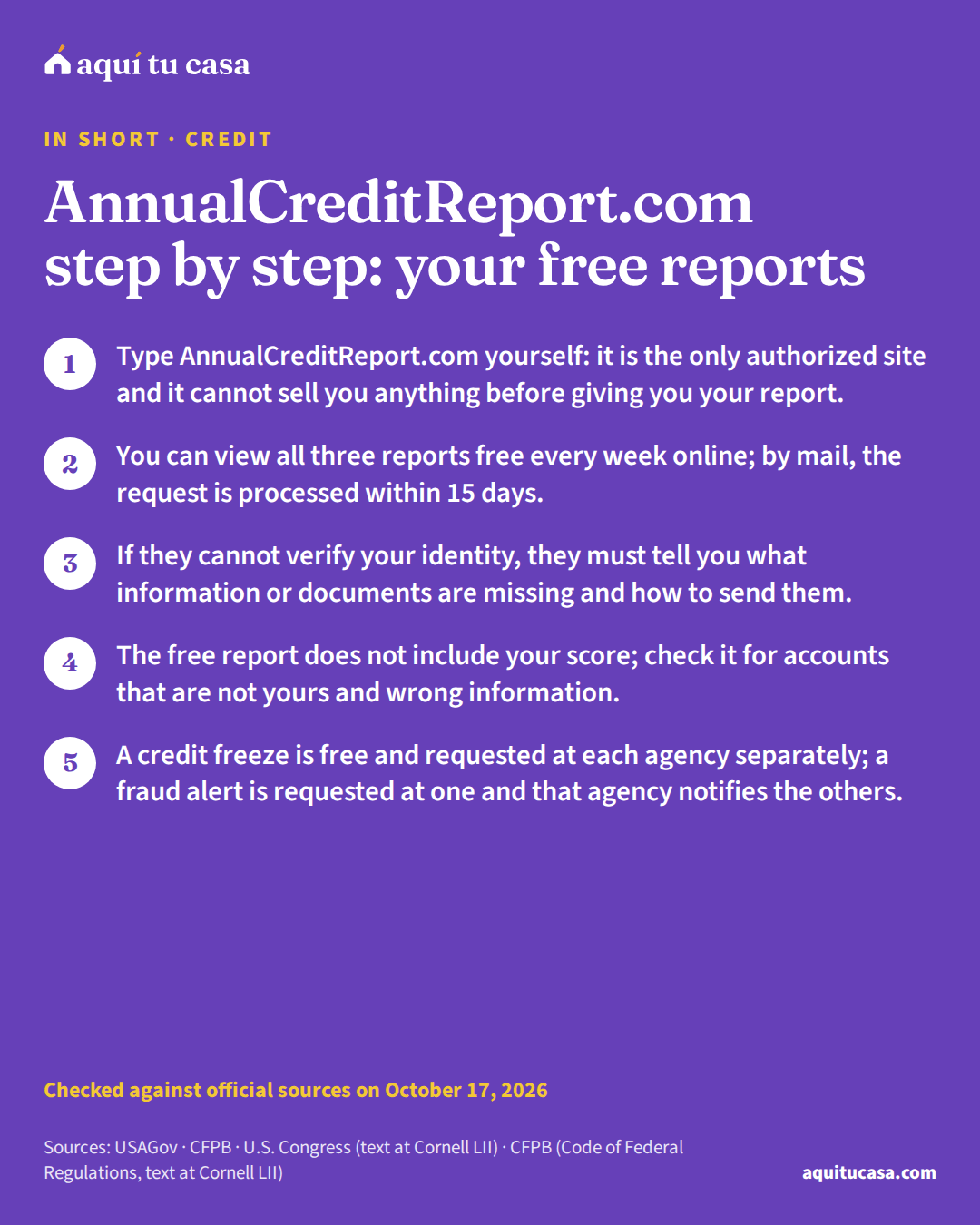
From the guide
How to get your free credit reports online, by phone or by mail, what information they ask for, what to check and how to freeze your credit.
Verified on October 17, 2026 17 official sources
According to the CFPB, you can see it free once a week at AnnualCreditReport.com, from each of the three agencies. The law also gives you the right to one free report from each agency every 12 months.
Read the full guideNo. Requesting your own report is a soft inquiry: it does not affect your scores and only you can see it.
Read the full guideNo. The free reports from the nationwide agencies do not include a score. Our guide on what moves your score tells you where to see one without paying.
Read the full guideThe regulation requires the official source to tell you it could not verify you and explain what information or documents are missing and how to send them. You can also request by phone or mail. If an agency denies your request, contact it first and, if that does not resolve it, take it to the CFPB.
Read the full guideThe official form says your request is processed within 15 days of receipt and the report is then mailed to you. If information is missing, the agency contacts you by mail, which can delay it.
Read the full guideNo. Under federal law, freezing and unfreezing are free at all three agencies, but you have to request it at each one. The credit locks the agencies sell are no more effective than a freeze.
Read the full guideA freeze keeps prospective creditors from seeing your file, and you request it at each agency. A fraud alert does not block access, but it requires creditors to confirm it is you; you request it at one agency and that one notifies the others. An initial alert lasts one year.
Read the full guideChange topic without leaving the questions.

These answers explain the rules but do not know your situation. These organizations go over it with you, free.