Reporting your rent to the credit bureaus: options, costs
How to make your rent payments count on your credit: what your landlord does, what services exist, which fees to check and what happens if you pay late.
Verified against official sources on October 17, 2026 16 official sources

Show contents
In short
What you need to know
Quick answer
Your rent only counts toward your credit if someone reports it, and according to estimates cited by the CFPB, very few renters have it on their reports. To get it reported, ask your landlord whether they take part in a rental reporting program, often through a rent payment app, and check what fees it charges. On-time payments can help, and the newer score models approved by FHFA take rent into account; but late payments and collections can be reported too. Even if your rent is not reported, a lender using Fannie Mae's system can see it in your bank data.
What matters most
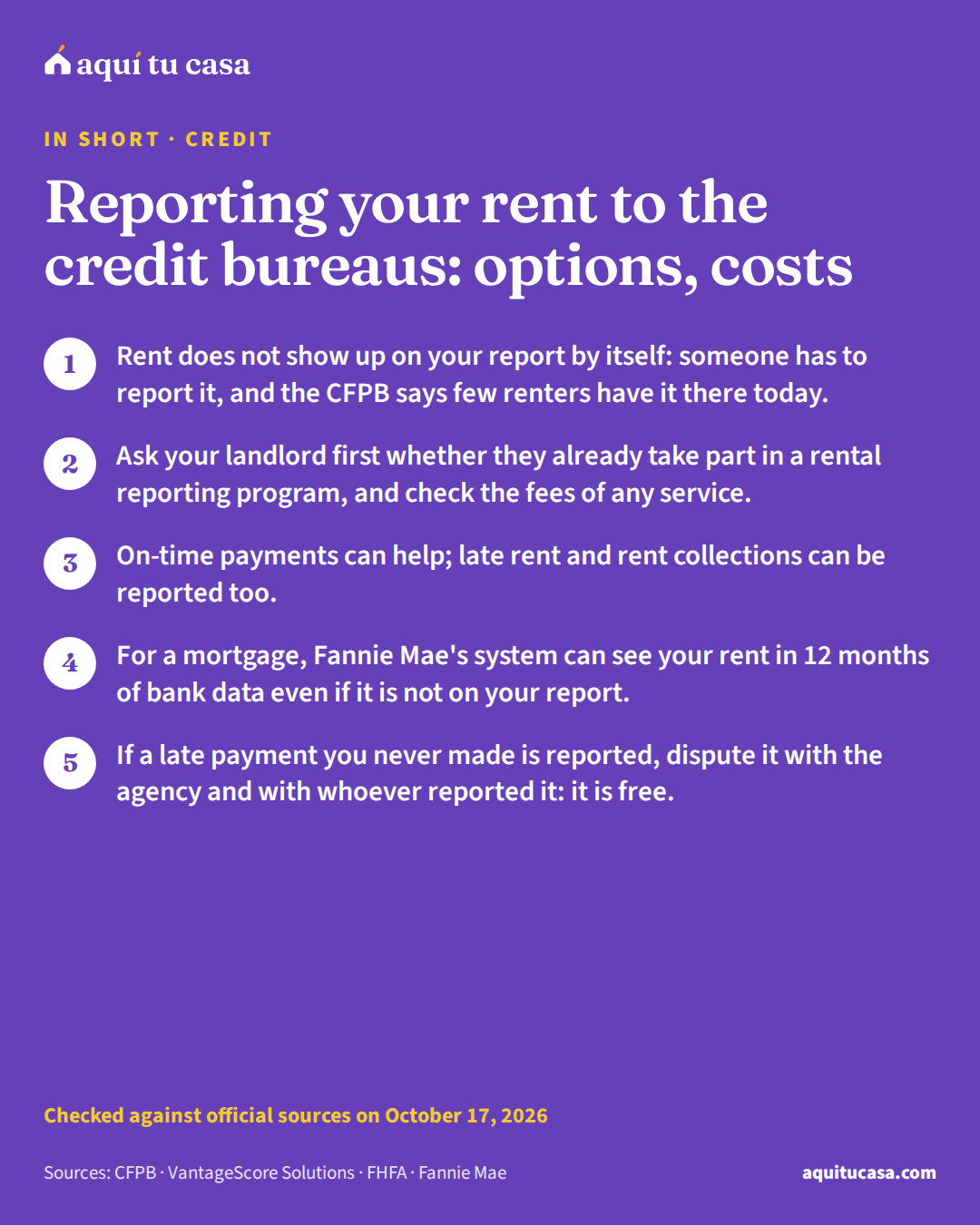
- Rent does not show up on your report by itself: someone has to report it, and the CFPB says few renters have it there today.
- Ask your landlord first whether they already take part in a rental reporting program, and check the fees of any service.
- On-time payments can help; late rent and rent collections can be reported too.
- For a mortgage, Fannie Mae's system can see your rent in 12 months of bank data even if it is not on your report.
Is this for you?
This guide is for you if…
- You have paid rent on time for years and it does not show on your credit report.
- Your landlord or an app offers to report your rent and you want to know whether it is worth it and what it costs.
- You want to buy a home and wonder whether your rent history helps with a mortgage.
Get direct help first if…
- You are behind on rent or got an eviction notice: start with the guide on eviction notices and look for free legal aid.
- You were turned down for an apartment because of a tenant screening report: the guide to reading your report explains those reports and your rights.
- You have no accounts at all and want to start from scratch: the Credit from zero guide compares all the options.
Paying rent on time, month after month, is a good track record. But it almost never shows on your credit report, because nobody reports it. This guide is for renters who want those payments to count: it explains how rent gets reported, what to ask before you sign up for a program, what can go wrong and how mortgage lenders see it, based on what the CFPB (the federal consumer financial protection agency), FHFA and Fannie Mae publish.
- Of adults who rent have rent on their report, according to estimates cited by the CFPB
- 1.7% to 2.3%2
- Of rent that Fannie Mae's system can read in your bank data
- 12 months7
- Of monthly rent for that system to take it into account
- $300 or more7
- That a furnisher generally has to respond to your dispute
- 30 days15
Does your rent already count toward your credit?
Probably not. The big three credit reporting agencies (Experian, Equifax and TransUnion) do use rental payment and related collection information, although each handles it differently.1 The problem is that few people report it: according to industry estimates cited by the CFPB, only 1.7% to 2.3% of adults who rent have rent in their credit file.2
The reason is simple: reporting is voluntary. Anyone who gives you credit can report your payments, and specialty agencies can also report rent payments, but creditors report voluntarily.3 If nobody reports your rent, it does not appear in your credit historycredit historyYour credit history is the record of your credit accounts and of whether you paid them on time, as shown in your credit report. Credit reporting companies collect and update this information and provide it to other businesses, which use it to make decisions about you. A good history helps you get housing, bank accounts, cards and loans, and lowers the interest you pay. If you have no history, or very little (a thin file), there may not be enough information to produce a score. Paying with a debit card, cash or a prepaid card usually does not build it.See the full definition, even if you have paid on time for years.
Do not confuse your credit report with a tenant screening report. Many landlords use tenant screening reports to decide whether to rent to you and how much deposit to ask for; they can include credit reports, evictions and lawsuits, and a risk score. They are different from credit reports.11 Tenant screeningtenant screening reportA tenant screening report is a report many landlords use to decide whether to rent to you and how much to charge for the security deposit. Specialty companies prepare it, and it can include your credit report, your rental history including eviction cases and lawsuits, employment verification, criminal history and a score or recommendation. It is not the same as a credit report. If a landlord denies you, or asks for a larger deposit or higher rent, because of the report, federal law requires the landlord to tell you, name the company and explain your right to a free copy and to dispute errors.See the full definition has its own specialty agencies, which compile your payment history with past landlords.1
How rent gets reported: three routes
Three ways to make your rent count
Ask first
Your landlord already reports
Check who pays
A reporting service
Start by asking your landlord: it is the route the CFPB suggests.1
The first step is to ask. The CFPB says that if you want your rent payments reported, ask your landlord whether they participate in a rental reporting program, which often works through a rent payment app.1 VantageScore, one of the companies that build scores, also says that in some cases your landlord may already be able to report your payments to the agencies.4
If your landlord does not offer it, there are services that report rent. The CFPB describes commercial efforts to increase rent reporting, such as companies that encourage renters to contribute this information voluntarily to build credit.2 We do not recommend any particular service: compare what they offer using the questions further down.

What you can gain
Positive rental payments can help build your credit.1 In its 2022 report on tenant screening, the CFPB mentions studies showing that including rental history boosts credit scores.2
Whether it counts also depends on the credit scorecredit scoreA credit score is a number that predicts how likely you are to pay back a loan on time. It is computed from the information in your credit report: whether you pay on time, how much you owe relative to your limits, how long you have used credit and how many new accounts you opened. FICO is one brand of score; VantageScore is another, and each lender decides which one it uses. A higher score usually brings a lower interest rate and more loan options; each program publishes the minimum it accepts. You can check your report for free and dispute errors.See the full definition model. VantageScoreVantageScoreVantageScore is a credit scoring model separate from FICO. Like any score, it uses a mathematical formula (a scoring model) to estimate, from the data in your credit report, how likely you are to pay on time. The FHFA, the federal agency in charge of Fannie Mae and Freddie Mac, approved the VantageScore 4.0 version, which takes into account additional sources of data, such as rent payment history. Today, for mortgages sold to those two companies, lenders may use VantageScore 4.0 or Classic FICO, but they must use the same model for every borrower on the same loan.See the full definition says its model uses alternative data, such as rent and utility payments, even if you have a limited history.5 And for mortgages, FHFA says the newer models approved for Fannie Mae and Freddie Mac take rent payment history into account; for now, lenders can choose between Classic FICO and VantageScore 4.0.6 The guide What moves your credit score explains the other factors.
For your mortgage, even if it is not reported. Fannie Mae’s automated system (DU) can take into account your rent history found on your credit report or on a 12-month report of your bank data, and it uses it to improve your assessment.7
Example with real numbers
When Fannie Mae's system can use your rent
The Selling Guide's conditions, next to the typical rent in the United States.
- Time renting
- 12 months or more
- Minimum monthly rent
- $300
- Typical monthly rent in the U.S.
- $1,413
- Your history
- No mortgage on your report, a limited history or no score
- If rent is not on your report
- 12 months of data from the bank account you pay from
- Result
- DU uses your rent history to improve your risk assessment
Conditions from section B3-2-03 of the Fannie Mae Selling Guide.7 The typical rent comes from the Census; yours may differ. Work out how much rent you can afford with your own numbers.
Run it with your numbersHow much rent can I afford?For that, the lender enters your rent in the application and gets 12 months of data from your bank; the account must be yours and must be the one you pay rent from.7 If you have no score, rent can also serve as a nontraditional credit reference, documented with canceled checks, bank statements, money orders or verification from your landlord.8 The guide Nontraditional credit for a mortgage explains all of those rules.
What it costs and what to ask
The CFPB asks you to consider the fees of these services before you sign up.1 Before you sign, get the answers in writing:
Questions before you join a rent reporting program
1. Which agencies do you report to?
First
The big three use rent information differently; ask whether they report to Equifax, Experian and TransUnion.1
3. How much does it cost and who pays?
Before you sign
Ask the monthly cost, whether there is a signup fee and whether the landlord covers it.1
4. How do I cancel?
Before you sign
Ask how to unenroll and whether they keep charging you afterward.1
5. What bank data do you need?
Before you connect your account
If they ask for access to your bank account, ask what data they see, what they use it for and whom they report it to.3
6. Check your reports afterward
A few months later
Confirm the rent appears and the payments show as on time; if something is wrong, dispute it for free.15
If you pay late: the other side of reporting
Rent reporting works both ways. The big three agencies use rental payment information and also related collectioncollection accountA collection account is a past-due debt that the original creditor (the company that gave you the loan or credit) handed to a debt collector or sold to another company. A debt collector is a person or company that regularly collects debts owed to others, such as a collection agency, a lawyer or a debt buyer. The account can show up on your credit report; once you pay it, it should generally show a zero balance as a paid collection. Most negative information can be reported for up to seven years. If you think you do not owe the debt or the amount is wrong, you can dispute it with the collector and with the credit reporting company.See the full definition information.1 Credit reporting companies can generally report negative payment information for up to seven years,9 and recent negative information weighs more on your score than older information. “On time” means the payment arrives by the due date.10
A late payment can also show up in the tenant screening reports other landlords use, because those agencies compile your payment history with past landlords.1 If a landlord requires a co-signer, a larger deposit or higher rent than other applicants because of a tenant screening report, that is also an adverse action.12
If you know you will have trouble paying, talk to your landlord before the due date and look for help. If you already got a notice, the guide What to do if you get an eviction notice covers the first steps. A HUD-approved housing counselorHUD-approved housing counselorA HUD-approved housing counselor works at an agency HUD has approved to provide housing counseling: independent, expert advice customized to your situation about buying a home, renting, a missed mortgage payment, a foreclosure or credit problems. The agencies usually charge little or nothing; many serve in Spanish and offer the homebuyer education course several assistance programs require. They are not lenders or real estate agents and sell you nothing. Your county page lists the official agencies with phone numbers.See the full definition gives independent advice on renting and credit, often at little or no cost.16

If something untrue is reported
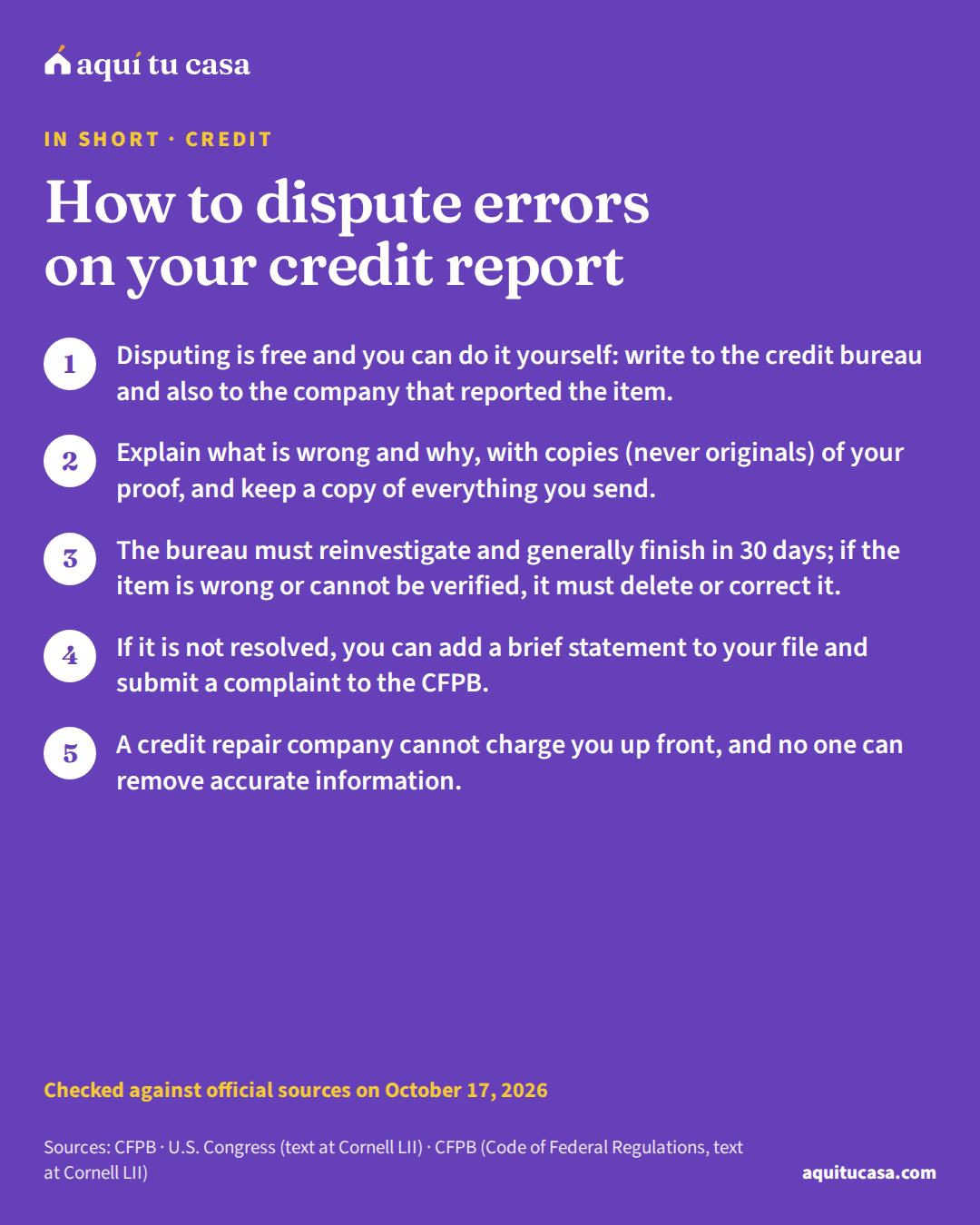
Whoever reports your rent (your landlord or the service) has obligations. The law bars them from giving an agency information they know or have reasonable cause to believe is inaccurate. And if you dispute an item with them directly, they may not report it again without noting that it is disputed.13
To fix it, the CFPB says to contact both the credit reporting agency and the company that provided the information; your landlord can be that company. You write to the furnisher by certified mail, and it generally must investigate and respond within 30 days.15 By regulation, when you send a direct disputecredit report disputeA credit report dispute is the complaint you make when your credit report has wrong or incomplete information. You have the right to dispute it, and the investigation is free. It is usually done in two places: with the credit reporting company and with the company that supplied the information, called a furnisher, such as your bank, your landlord or your credit card company. You explain in writing what is wrong and why, with copies of your documents. The credit reporting company must investigate, generally within thirty days, and delete or correct anything found to be inaccurate, incomplete or unverifiable.See the full definition, the furnisher must investigate reasonably, review what you sent and, if the item was inaccurate, promptly notify every agency it reported to.14
If the error is on a tenant screening report, you also have the right to dispute it; the company generally has 30 days to investigate, sometimes 45, and some states set shorter deadlines.12 If a landlord denies you because of a specialty report, it must give you a notice with the agency’s information, and if you ask, the agency gives you a free copy of the report used.1 The full steps are in How to dispute credit report errors.
If this is you
You rent from a large management company
Ask at the office whether they take part in a rental reporting program and who pays for it.1
You want to buy a home soon
Even if your rent is not reported, Fannie Mae's system can see it in 12 months of bank data.7
You have no credit score
Reported rent can help you build credit,1 and without a score it also works as a reference for a mortgage.8
You pay rent in cash
Keep receipts or use money orders: Fannie Mae accepts that proof.8 See how to rent without a Social Security number or credit.

Common mistakes
Mistake: Paying for a service without asking your landlord first.
Instead: Ask first whether they already take part in a rental reporting program.1
Mistake: Signing up without reading the fees.
Instead: The CFPB asks you to consider the fees; ask the monthly cost and how to cancel.1
Mistake: Assuming only good payments get reported.
Instead: Late rent and rent collections can be reported too.1
Mistake: Paying rent from different accounts or in cash with no receipt.
Instead: One account in your name or saved receipts leave the proof lenders ask for.8
Mistake: Ignoring a late payment you never made on your report.
Instead: Dispute it with the agency and with whoever reported it; they must investigate.14
What to do this week
- Get your three reports and look for whether your rent already shows up as an account.1
- Ask your landlord whether they take part in a rental reporting program and who pays for it.1
- If you compare services, get in writing which agencies they report to, whether they report late payments and what they charge.1
- Start paying rent from a bank account in your name, or keep your receipts.8
- If you see a late payment you never made, dispute it in writing with the agency and with whoever reported it.15
- Plan your next steps with the credit plan, and if you want help, look for a HUD-approved housing counselor.16
Your situation
If you have never had a card or a loan in the U.S., choose "None".
Your credit plan
12 steps
You have done 0 of 12.
This week
Get your three credit reports for free
At AnnualCreditReport.com you can get the Equifax, Experian and TransUnion reports for free once a week. Checking your own report does not lower your score. If it comes up empty, that is not an error: you simply have no history yet.
Source: CFPB: How do I get a free copy of my credit reports? ↗ · CFPB: Does requesting my credit report hurt my credit score? ↗
Dispute any error in writing
Write to the credit bureau and to the company that reported the item, with copies of your proof, by certified mail. By law, the bureau must investigate again for free and resolve it within 30 days of receiving your notice.
Source: CFPB: How do I dispute an error on my credit report? ↗ · Congreso de EE. UU. (texto en Cornell LII): Fair Credit Reporting Act, 15 U.S.C. §1681i, Procedure in case of disputed accuracy ↗
Talk to a HUD-approved housing counselor
They give independent advice on buying, renting, defaults and credit, often free or at low cost. You can go over your report and your plan with them.
Source: CFPB: Find a Housing Counselor ↗
This month
Open a secured card
You deposit an amount (for example, $500) and can spend up to that amount. With on-time payments, the limit can go up, and the deposit comes back. Before signing, ask whether they report to all three bureaus and compare the annual fee and the rate: they can be high.
Source: CFPB: What are some ways to start or rebuild a good credit history? ↗ · CFPB: How to rebuild your credit ↗
Or a credit builder loan
The bank or credit union holds the money as savings while you make small payments, usually for six to 24 months; when you finish, you get it. You build history and savings at the same time.
Source: CFPB: What are some ways to start or rebuild a good credit history? ↗
Ask for your rent to be reported
On-time rent payments can help build your credit. Ask your landlord whether they take part in a rent reporting program (often through a payment app) and check its fees.
Set up automatic payments
An automatic payment or a reminder before the statement date prevents the costliest kind of slip: payment history is the main factor in most models.
What does not build credit
Paying with a debit card or cash, prepaid cards and payday loans do not build history, according to the CFPB. They are ways to pay, not accounts that get reported.
From here on
Do not close your first account
A long history of on-time payments helps your score. When a better card comes along, keep the first one open and current.
Only apply for the credit you need
Opening several accounts in a short time is a risk signal for lenders, and each application leaves a hard inquiry that does affect your score.
Source: CFPB: How do I get and keep a good credit score? ↗ · CFPB: What is a credit inquiry? ↗
Watch your debt-to-income ratio
Lenders divide your monthly debt payments by your gross monthly income to see whether you can handle a new loan. While you prepare, avoid new payments, such as a car.
Watch out for "credit repair"
It is a scam if they charge before doing anything, promise to remove accurate negative information, tell you not to contact the bureaus or to dispute everything. Disputing errors is free by law, and if you already signed up for something like this, you can cancel within three business days.
Source: CFPB: How can I tell a credit repair scam from a reputable credit counselor? ↗
An educational plan built on what the CFPB, the NCUA and the federal credit reporting law publish; not individual advice. We recommend no brands and are paid for no product.
Ready to see the numbers? Find your county here
See how this applies in your county: its loan limits, prices and rents, from the official data.
Printable checklist
Frequently asked questions
Does paying rent on time raise my credit score?
It can help, but only if it is reported to the agencies and the scoring model uses it. The CFPB says positive rental payments can help build your credit, and FHFA says the newer models approved for Fannie Mae and Freddie Mac take rent history into account.
How do I know whether my landlord already reports my rent?
Ask whether they take part in a rental reporting program, often through a rent payment app. Then check your three credit reports: if your rent is reported, it should appear as an account.
How much does rent reporting cost?
It depends on the program: some are paid by the landlord and others charge the renter. The CFPB suggests considering the fees of these services before you sign up. Ask how much it is per month, whether there is a signup fee and how to cancel.
Can reporting my rent hurt me?
Yes, if you fall behind and the late payment is reported. The big three agencies use rental payment and related collection information, and negative payment information can be reported for up to seven years. Ask whether the program reports only on-time payments or late ones too.
Can my rent help me get a mortgage even if it is not on my report?
It can. Fannie Mae's DU system can identify your rent payments in 12 months of bank data if you have rented for at least 12 months at $300 or more and have no mortgage on your report, a limited history or no score. Without a score, rent can also be a nontraditional credit reference.
What do I do if a late rent payment I never made was reported?
Dispute it in writing with the credit reporting agency and with whoever reported it. Your landlord may be the one furnishing the information, and it generally must investigate and respond within 30 days. The law bars them from reporting information they know is inaccurate.
Does rent count in every credit score?
Not necessarily: it depends on the model. VantageScore says its model uses alternative data such as rent, and FHFA says the newer models approved for Fannie Mae and Freddie Mac mortgages take it into account. Other models may not use it.
Sources
Every figure in this guide comes from one of these official sources. The number next to a sentence leads to the source behind it.
Each source on one line: who publishes it, its title, its address and the date we read it.
- 1. CFPB · Does late rent affect my credit score? · consumerfinance.gov · Accessed October 17, 2026
- 2. CFPB · Tenant Background Checks Market · files.consumerfinance.gov · Accessed October 17, 2026
- 3. CFPB · Can I opt out of having creditors report my accounts to credit reporting companies? · consumerfinance.gov · Accessed October 17, 2026
- 4. VantageScore Solutions · Consumer FAQs · vantagescore.com · Accessed October 17, 2026
- 5. VantageScore Solutions · Consumer Education · vantagescore.com · Accessed October 17, 2026
- 6. FHFA · Credit Scores · fhfa.gov · Accessed October 17, 2026
- 7. Fannie Mae · Selling Guide B3-2-03, Risk Factors Evaluated by DU · selling-guide.fanniemae.com · Accessed October 17, 2026
- 8. Fannie Mae · Selling Guide B3-5.4-03, Documentation and Assessment of a Nontraditional Credit History · selling-guide.fanniemae.com · Accessed October 17, 2026
See the other 8 sources
- 9. CFPB · How long does information stay on my credit report? · consumerfinance.gov · Accessed October 17, 2026
- 10. CFPB · How to rebuild your credit · consumerfinance.gov · Accessed October 17, 2026
- 11. CFPB · What is a tenant screening report? · consumerfinance.gov · Accessed October 17, 2026
- 12. CFPB · What should I do if my rental application is denied because of a tenant screening report? · consumerfinance.gov · Accessed October 17, 2026
- 13. U.S. Congress (text at Cornell LII) · Fair Credit Reporting Act, 15 U.S.C. §1681s-2, Responsibilities of furnishers of information to consumer reporting agencies · law.cornell.edu · Accessed October 17, 2026
- 14. CFPB (Code of Federal Regulations, text at Cornell LII) · Regulation V, 12 CFR §1022.43, Direct disputes · law.cornell.edu · Accessed October 17, 2026
- 15. CFPB · How do I dispute an error on my credit report? · consumerfinance.gov · Accessed October 17, 2026
- 16. CFPB · Find a Housing Counselor · consumerfinance.gov · Accessed October 17, 2026
Keep reading
Related guides
If this guide helped, these follow the same path.

Credit 15 minute read
What moves your credit score: the five factors
What raises and lowers your credit score according to the CFPB, FICO and VantageScore: on-time payments, credit use, age, new credit and account mix.
- Paying on time weighs the most: FICO gives it 35% of its score and VantageScore calls it extremely influential.
- Use little of your limit: experts cited by the CFPB advise staying at or below 30%, and you do not need to carry a balance for a good score.
- Closing an old card or opening several accounts in a row can lower your score.
- Credit Nontraditional credit for a mortgage: buying with no score How Fannie Mae and FHA accept rent, utilities, insurance and remittances as credit history when you have no score: requirements, documents and limits. 13 minute read
- Credit How to dispute errors on your credit report How to fix credit report errors for free: what to send each bureau and the company that reported it, legal deadlines, and credit repair scams. 14 minute read

Tools for this topic
Was this guide useful?
Thank you. Your answer stays in your browser; nothing is sent.