The VA funding fee and the IRRRL refinance
How much the VA funding fee is on each loan type, who does not pay it, how to ask for a refund and the IRRRL rules for lowering your interest rate.
Verified against official sources on October 31, 2026 6 official sources

Show contents
In short
What you need to know
Quick answer
The VA funding fee is a one-time charge figured as a percentage of the loan. It depends on the loan type: on an IRRRL, the refinance to lower your rate, it is 0.5%; on a purchase or a cash-out refinance it is higher, especially if you have used the benefit before. You do not pay it if you receive VA compensation for a service-connected disability and in a few other cases, and you can ask for a refund if that compensation is awarded with an effective date before closing. An IRRRL only refinances your VA loan on the same home, must lower your payment or improve your loan and must recoup its costs within 36 months.
What matters most
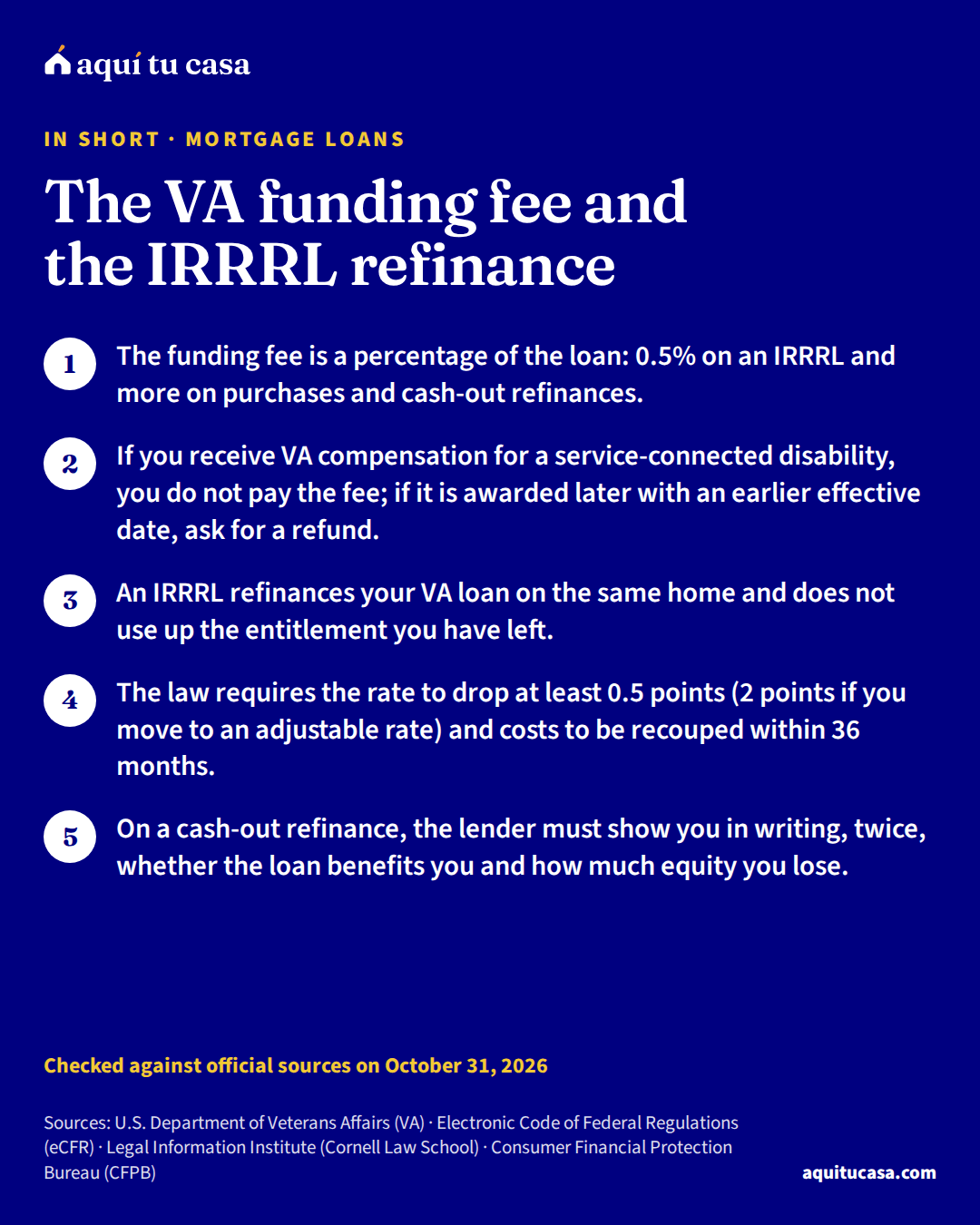
- The funding fee is a percentage of the loan: 0.5% on an IRRRL and more on purchases and cash-out refinances.
- If you receive VA compensation for a service-connected disability, you do not pay the fee; if it is awarded later with an earlier effective date, ask for a refund.
- An IRRRL refinances your VA loan on the same home and does not use up the entitlement you have left.
- The law requires the rate to drop at least 0.5 points (2 points if you move to an adjustable rate) and costs to be recouped within 36 months.
Is this for you?
This guide is for you if…
- You have a VA loan and were offered an IRRRL refinance to lower your rate.
- You are going to use your VA benefit again and want to know how much the funding fee will be.
- You receive VA disability compensation, or got it after closing, and want to know whether you are owed a refund.
Get direct help first if…
- You do not have a VA loan yet and want to know how it works: read «VA home loan».
- You want to compare every kind of refinance: read «Refinancing your mortgage».
If you have a VA loanVA loanA VA loan is a mortgage program offered by the U.S. Department of Veterans Affairs (VA) to help servicemembers, veterans and some surviving spouses buy a home. The VA does not lend the money: it guarantees part of a loan made by a private lender, and with that guarantee the lender can offer terms other loans do not have, such as buying with no down payment. Only people who meet the VA's service requirements can use it; the lender will ask for your certificate of eligibility.See the full definition, two topics come up again and again: the funding fee and the IRRRL, VA’s refinance for lowering your interest rate. This guide explains how much the fee is on each loan type, who does not pay it, how to ask for a refund and which rules an IRRRL must meet. For the basics of a VA loan, read the VA home loan guide first.1
How much the fee is on each loan type
VA figures the fee on the loan amount, not on the price of the home. The percentage depends on the loan type and, for some loans, on whether it is your first use and on your down payment.1 These are VA’s charts effective April 7, 2023:1
The funding fee by loan type
Depends on the down payment
Purchase or construction
- First use, less than 5% down: 2.15%
- After first use, less than 5% down: 3.3%
- With 5% or more down: 1.5%
- With 10% or more down: 1.25%
Does not depend on the down payment
Cash-out refinance
- First use: 2.15%
- After first use: 3.3%
- Cannot exceed 100% of the value
A single rate
IRRRL and others
- IRRRL: 0.5%
- Assuming a VA loan: 0.5%
- Manufactured home not affixed to land: 1%
Ask your lender to show you the fee on the Loan Estimate.
The same chart has other cases: the Native American Direct Loan (NADL) charges 1.25% to buy and 0.5% to refinance, and the vendee loan for buying a VA-owned home charges 2.25%. And if you used the benefit before only for a manufactured home, you still pay the first-use fee.1
Adding it to the loan costs more. If you add the fee to the loan, you also pay interest on it for years. On a cash-out refinance, any part of the fee that would push the loan above 100% of the value set by VA is paid in cash at closing.3
Who does not pay the fee and how to ask for a refund
VA says you do not pay the funding fee if:1
- You receive VA compensation for a service-connected disability.
- You are eligible for that compensation but receive retirement or active-duty pay instead.
- You receive Dependency and Indemnity Compensation (DIC) as the surviving spouse of a Veteran.
- You are a service member who, before closing, received a proposed or memorandum rating saying you are eligible for compensation based on a pre-discharge claim.
- You are on active duty and, on or before closing, provide evidence that you received a Purple Heart.
The refund. If you paid the fee and VA later awards you compensation with an effective date before closing, you may get it back. But if the proposed or memorandum rating arrives after closing, the fee stands. To ask for the refund, call your VA regional loan center, Monday through Friday, 8:00 a.m. to 6:00 p.m. Eastern Time.1
The IRRRL: who can ask for one
The IRRRL is VA’s refinance for lowering your rate or moving from an adjustable rate to a fixed one. According to VA, you may qualify if all three are true:2
- You already have a VA-backed home loan.
- You are using the IRRRL to refinance that same VA loan.
- You can certify that you live or used to live in the home.
The regulation adds important details. The new loan must be secured by the same home. If you could not live there because of active duty, it is enough that your spouse lives or lived in the home and certifies it.4 And there is good news: the IRRRL does not reduce the entitlement you have left for another VA loan.4
You get it from a lender, not from VA. A bank, mortgage company or credit union makes the loan. Bring your original Certificate of EligibilityVA Certificate of Eligibility (COE)The Certificate of Eligibility (COE) is the VA document that confirms to your lender that you can use the VA home loan benefit. According to the VA, requesting it is the first step toward a VA-backed loan. You can request it online, through your lender, which can process it in a VA system, or by mail with VA Form 26-1880. The documents you need depend on your situation: a Veteran uses discharge papers (DD214); an active-duty service member, a statement of service; and a surviving spouse, other forms. The COE does not approve the loan: the lender also reviews your credit, income and the appraisal.See the full definition, or ask the lender to get it electronically. If you have a second mortgagesecond mortgageA second mortgage (or junior lien) is a loan you take out using your home as collateral while you still have another loan secured by it. Home equity loans and HELOCs are common examples. It is called "second" because, if you stop paying and the home is sold to pay the debts, this loan is paid after the first one; if there is not enough money, the second lender may not get everything it is owed. That is why it often has a higher interest rate. It adds to your total debt and, if you cannot repay it, you could lose your home.See the full definition, its holder must agree to let the new VA loan take first place.2

What an IRRRL must improve and how much you can borrow
An IRRRL cannot be just any new loan. The regulation requires at least one of these:4
- Your monthly principal and interest payment goes down.
- The loan term is shorter.
- You move from a VA adjustable rateadjustable-rate mortgage (ARM)An adjustable-rate mortgage (ARM) is a loan whose interest rate can change, usually in step with a market index. It often starts with a fixed rate for an initial period (for example, the first few years) and then adjusts at set intervals, so your payment can go up or down. The contract sets caps on how much the rate can rise at each adjustment and in total. Before accepting one, check on the Loan Estimate how high your payment could reach and whether you could afford it.See the full definition to a fixed ratefixed-rate mortgageA fixed-rate mortgage is a home loan whose interest rate is set when you take out the loan and does not change over its whole life. The part of your payment that covers principal and interest is therefore the same every month, from the first payment to the last; what can change is what you pay for taxes and insurance if they ride in the same payment. It is the most common choice in the United States and the one almost every state assistance program uses. The most common terms are thirty and fifteen years.See the full definition.
- The payment goes up only because you add energy efficiency improvements.
- VA approves it in advance because it is needed to prevent an imminent foreclosure.
The amount. The IRRRL cannot exceed your current loan balance, plus allowed closing costs and a discount of no more than 2% of the loan, plus energy improvements if any. It does not give you cash. If you are more than 30 days behind, VA must approve the loan in advance. And the new term cannot exceed the original term plus ten years.4
The rules in the law. For refinances that are not cash-out, the law requires:5
- Recouping the costs within 36 months through lower monthly payments. Taxes, escrow and VA fees do not count.
- Lowering the rate at least 0.5 percentage points if both loans are fixed-rate, or at least 2 points if you move from fixed to adjustable.
- A lower rate that does not come only from points. If discount pointsdiscount pointsDiscount points are a payment you make to the lender at closing in exchange for a lower interest rate over the life of the loan. Each point costs a percentage of the loan amount. The opposite is lender credits: the bank lowers your closing costs today in exchange for a higher rate. Buying points only pays off if you keep the loan long enough for the monthly savings to exceed what you paid. Points appear on the Loan Estimate, in section A of the closing costs.See the full definition are added to the loan, with one point or less the loan cannot exceed 100% of value, and with more than one point, 90%.
- Waiting. You must have made six monthly payments in a row and 210 days must have passed since the old loan’s first payment due date.
Example with real numbers
A Veteran with a fixed-rate VA loan
An example in words, not a real case, of how to review an IRRRL offer.
- The offer
- A new fixed rate, 0.5 points or more below the current one
- The funding fee
- 0.5% of the loan, unless she receives disability compensation
- Closing costs
- She can add them to the new loan, within the regulation's limit
- The 36-month test
- The costs are recouped by the monthly savings within 36 months
- What she decides
- Get Loan Estimates from two more lenders and compare
The rules come from VA and the law.15 Use the refinance calculator with your balance and your rate.
Run it with your numbersShould I refinance?If you want cash out: different rules
VA’s cash-out refinance is not an IRRRL. It charges a higher fee (2.15% on first use and 3.3% after) and the loan cannot exceed 100% of the reasonable value set by VA.13
The lender must also give you a net tangible benefit test. The new loan must, for example, lower your rate or payment, shorten the term, remove mortgage insurance, raise your residual incomeresidual incomeResidual income is the money you have left each month for your family's living expenses after paying your housing costs and your other monthly debts. On VA loans, the lender uses two main standards to judge whether your income is enough: the debt-to-income ratio and residual income. The VA publishes guideline tables with minimum amounts by region and family size, and everyone living in the household is counted. Ordinarily you must meet both standards, but failing one does not automatically disqualify you.See the full definition, move from an adjustable to a fixed rate or end up at 90% or less of the value. The lender must also compare the two loans for you (payoff, type, rate, term, total paid and loan-to-value), tell you how much of your home’s equity is being removed and explain that this can affect a future sale. You get this no later than 3 business days after you apply and again at closing, and you sign that you received it.3
The guide HELOC vs. cash-out refinance compares that option with a line of credit.
Before you sign an IRRRL
1. Review your current loan
Today
Write down the rate, whether it is fixed or adjustable, the balance and the first payment date.5
2. Confirm whether you pay the fee
Before you ask for offers
If you receive compensation for a service-connected disability, you do not pay it.1
3. Get offers from several lenders
This week
A bank, mortgage company or credit union makes the IRRRL, not VA.2
5. Check the amount and the term
Before you sign
No cash to you, and a term no longer than the original plus ten years.4
6. If you have a second mortgage, get its consent
Before closing
Its holder must agree to take second place.2
If this is you
You receive compensation for a service-connected disability
You do not pay the funding fee on your IRRRL or your purchase.1
You moved for a new assignment
You can do an IRRRL if you lived in the home and certify it; on active duty, your spouse can certify it.4
You have a VA adjustable rate
Moving to a fixed rate is one of the reasons an IRRRL allows.4
You are behind on your payments
More than 30 days behind, VA must approve the IRRRL in advance; talk to a counselor too.4
Someone offers you cash out
That is a different loan, with a higher fee and a written benefit test given to you twice.3

Costly mistakes
Mistake: Thinking the funding fee is the same on every VA loan.
Instead: It depends on the type: 0.5% on an IRRRL and more on purchases and cash-out refinances.1
Mistake: Paying the fee when you qualify for the exemption.
Instead: Check your compensation before closing; if it is awarded later with an earlier date, ask for a refund.1
Mistake: Taking an IRRRL whose costs take more than 36 months to recoup.
Instead: The law requires recouping them within 36 months through lower payments.5
Mistake: Lowering the rate only with points added to the loan.
Instead: The law limits that case; ask how much comes from points and how much from market rates.5
Mistake: Thinking an IRRRL leaves you without entitlement for another home.
Instead: An IRRRL does not reduce the entitlement you have left.4
Free help
A HUD-approved housing counselorHUD-approved housing counselorA HUD-approved housing counselor works at an agency HUD has approved to provide housing counseling: independent, expert advice customized to your situation about buying a home, renting, a missed mortgage payment, a foreclosure or credit problems. The agencies usually charge little or nothing; many serve in Spanish and offer the homebuyer education course several assistance programs require. They are not lenders or real estate agents and sell you nothing. Your county page lists the official agencies with phone numbers.See the full definition can go over whether a refinance makes sense and compare offers with you, often for free or at low cost.6 The guide to HUD-approved housing counselors explains how to find one. If you get offers that look official and promise cash or skipped payments, read Refinancing your mortgage and Predatory refinancing before you answer. To see how much your payment would drop, use the refinance calculator.

What to do this week
- Find your latest statement and write down your rate, your balance and your first payment date.5
- Check whether you receive VA compensation that exempts you from the fee.1
- Get IRRRL Loan Estimates from two or three lenders.2
- Work out how many months it takes to recoup the costs with the monthly savings.5
- If you paid the fee and were awarded compensation with an effective date before closing, call your VA regional loan center.1
Your two loans
Today's loan
The new loan
Adjust advanced details
Your plans
Let's do the math
Your payment would drop by
Enter what you owe, your rate and the time left on today's loan to see the comparison.
This is an educational estimate, not a loan offer. Taxes, insurance and mortgage insurance are not included. Your Loan Estimate has the real figures.
Ready to see the numbers? Find your county here
See how this applies in your county: its loan limits, prices and rents, from the official data.
Printable checklist
Frequently asked questions
How much is the funding fee on an IRRRL?
According to VA's chart effective April 7, 2023, it is 0.5% of the loan amount, whether or not you have used the benefit before. You can add it to the new loan or pay it at closing.
Do I pay the funding fee if I have a VA disability rating?
If you receive VA compensation for a service-connected disability, you do not pay it. Nor if you are eligible for that compensation but receive retirement or active-duty pay instead, or in other cases VA lists, such as DIC for surviving spouses.
I already paid the fee and was awarded compensation later. Do I get it back?
You may. VA says you may be eligible for a refund if the effective date of your compensation is before your closing date. Call your VA regional loan center to ask.
Does an IRRRL use more of my VA entitlement?
No. Under VA's regulation, an IRRRL is guaranteed regardless of how much entitlement you have left and is not charged against your available entitlement.
Can I do an IRRRL if I no longer live in the home?
Yes, if you lived there before and certify it. If you could not live there because of active duty, it is enough that your spouse lives or lived in the home and certifies it.
Can the IRRRL give me cash out?
No. The IRRRL may not exceed the old loan balance plus allowed closing costs and a discount of up to 2% of the loan, plus energy improvements if any. For cash there is the cash-out refinance, with a different fee and different rules.
How much does my rate have to drop for an IRRRL to be allowed?
The law requires at least 0.5 percentage points if both loans are fixed-rate, and at least 2 points if you move from fixed to adjustable. Costs must also be recouped through lower payments within 36 months.
Sources
Every figure in this guide comes from one of these official sources. The number next to a sentence leads to the source behind it.
Each source on one line: who publishes it, its title, its address and the date we read it.
- 1. U.S. Department of Veterans Affairs (VA) · VA funding fee and loan closing costs · va.gov · Accessed October 31, 2026
- 2. U.S. Department of Veterans Affairs (VA) · Interest rate reduction refinance loan · va.gov · Accessed October 31, 2026
- 3. Electronic Code of Federal Regulations (eCFR) · 38 CFR §36.4306, Refinancing of mortgage or other lien indebtedness · ecfr.gov · Accessed October 31, 2026
- 4. Electronic Code of Federal Regulations (eCFR) · 38 CFR §36.4307, Interest rate reduction refinancing loan · ecfr.gov · Accessed October 31, 2026
- 5. Legal Information Institute (Cornell Law School) · 38 U.S.C. §3709, Refinancing of housing loans · law.cornell.edu · Accessed October 31, 2026
- 6. Consumer Financial Protection Bureau (CFPB) · Find a housing counselor · consumerfinance.gov · Accessed October 31, 2026
Keep reading
Related guides
If this guide helped, these follow the same path.

Mortgage loans 14 minute read
VA home loans: who qualifies, the COE and what it costs
How a VA home loan works: who qualifies, getting your Certificate of Eligibility (COE), the funding fee and the rule that you must live in the home.
- VA does not lend the money: a bank or mortgage company does, and VA guarantees part of the loan.
- The first step is the Certificate of Eligibility (COE): request it online, through your lender or by mail.
- No down payment if the price is not above the appraisal and no monthly mortgage insurance; in exchange, there is a one-time funding fee with exemptions.
- Mortgage loans Refinancing your mortgage: types, costs and break-even Refinancing explained: rate-and-term vs cash-out, closing costs, the break-even point and FHA and VA streamline refinances. 12 minute read
- Protect yourself from scams Predatory refinancing: warning signs and your rights How to spot a predatory refinance that eats your home equity, what the law bans in high-cost mortgages and how to cancel in time if you already signed. 14 minute read
- Mortgage loans HELOC vs cash-out refinance: how they compare A home equity line of credit (HELOC) or a cash-out refinance: how each works, what it costs, your rights and the risks to your home. 11 minute read
Tools for this topic
Was this guide useful?
Thank you. Your answer stays in your browser; nothing is sent.