Debt-to-income ratio (DTI): what it is and how to lower it
What the debt-to-income ratio (DTI) is, how to calculate it, which payments count, the caps FHA, Fannie Mae, VA and USDA publish and how to lower it.
Verified against official sources on October 17, 2026 13 official sources

Show contents
In short
What you need to know
Quick answer
Your debt-to-income ratio (DTI) is all your monthly debt payments, including the payment on the home you want to buy, divided by your gross monthly income (before taxes). For loans covered by the federal ability-to-repay rule, the lender has to consider your DTI or your residual income before lending to you. Each program publishes its own cap and each lender can be stricter, so no single number applies to everyone. You can lower it by paying down debt, adding income you can document, adding a co-borrower or borrowing less, though none of that guarantees approval.
What matters most
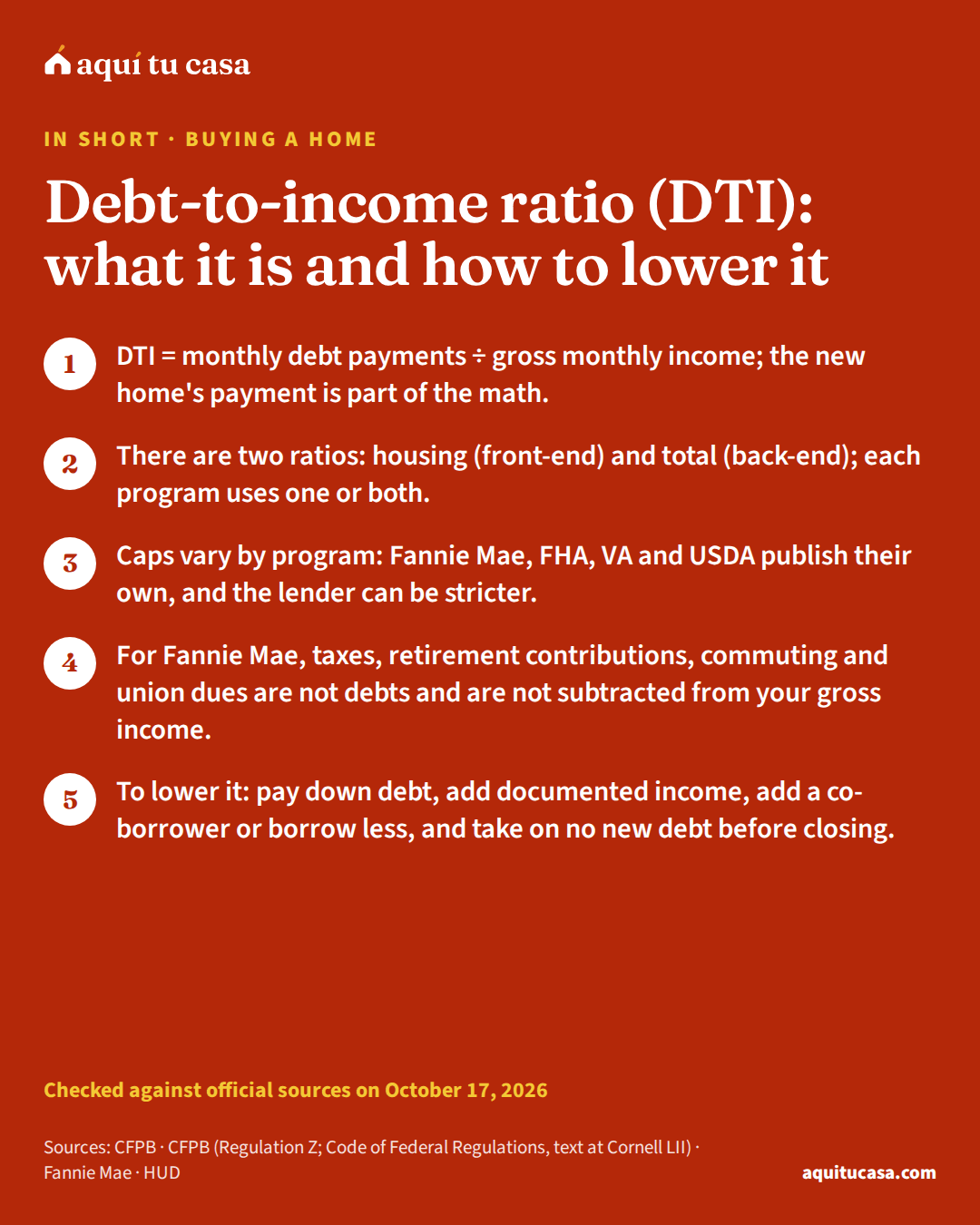
- DTI = monthly debt payments ÷ gross monthly income; the new home's payment is part of the math.
- There are two ratios: housing (front-end) and total (back-end); each program uses one or both.
- Caps vary by program: Fannie Mae, FHA, VA and USDA publish their own, and the lender can be stricter.
- For Fannie Mae, taxes, retirement contributions, commuting and union dues are not debts and are not subtracted from your gross income.
Is this for you?
This guide is for you if…
- You are about to apply for a mortgage and want to know how the lender measures your debts.
- You were told your DTI is too high and do not know what that means or what you can do.
- You pay a relative's debt, or a relative wants to help you qualify, and you want to know what counts.
Get direct help first if…
- You are already behind on your debts or your mortgage: talk first with a HUD-approved housing counselor, often at little or no cost.
- You want to know whether you will be approved: the lender decides that with your whole file; this guide explains the rules programs publish.
When you apply for a mortgagemortgageA mortgage is an agreement between you and a lender (a bank, a credit union or a mortgage company) that gives the lender the right to take your property if you do not repay the money it lent you, plus interest. Mortgage loans are used to buy a home or to borrow money against the value of a home you already own. You repay it in monthly payments that cover the principal (the money borrowed) and the interest, and often the property taxes and insurance as well. In Spanish, "hipoteca" and "préstamo hipotecario" mean the same thing.See the full definition, the lender does not only look at your credit. It also looks at how much of what you earn already goes to debts. That measure is called the debt-to-income ratio, or DTI. This guide is for anyone getting ready to buy: what the number is, how it is calculated, which payments go in, the caps programs publish and how to lower it honestly.
- Of a typical household's income would go to the payment alone on a typical home with FHA
- 41%10
- An example with national data; the math is below.
- FHA housing and total caps in manual underwriting, with no compensating factors
- 31/4310
- Fannie Mae's maximum DTI through its automated system (DU)
- 50%3
- VA's DTI standard, alongside residual income
- 41%11
What the debt-to-income ratio (DTI) is
According to the CFPB (the Consumer Financial Protection Bureau), your debt-to-income ratio (DTI)debt-to-income ratio (DTI)Your debt-to-income ratio (DTI) is all your monthly debt payments divided by your gross monthly income, that is, income before taxes. If you pay a certain amount each month across a car, cards, student loans and the mortgage you are asking for, and you earn three times that, your DTI is one third. Lenders use it to measure whether you can manage the payment; each loan type and lender sets its own limit, and assistance programs usually publish theirs. Paying down debt before applying improves your DTI.See the full definition is all your monthly debt payments divided by your gross monthly income. Gross incomegross incomeGross income is the total you earn before taxes and other deductions are taken out. On your pay stub it shows up as gross pay, not as what lands in your account. Lenders use it to figure your debt-to-income ratio (DTI): they add up your monthly debt payments and divide them by your gross monthly income. When you apply for a mortgage, your annual pre-tax income can include full-time or part-time work, self-employment, tips, commissions, overtime and bonuses; the lender looks at whether you can reasonably expect that income to continue.See the full definition is generally what you earn before taxes and other deductions come out. It is one way lenders measure whether you can manage the payments on the money you borrow.1
It is not a bank whim. For loans covered by the federal ability-to-repay rule, the lender has to determine in good faith whether you can repay. To do that it considers, among other things, your income, your debts, your credit history and your DTI or your residual income, which is what you have left each month after paying your debts.2
How to calculate it, step by step
The math takes four steps. You can do it with pen and paper and your statements in front of you.
Your DTI in four steps
1. List your monthly debt payments
Car, credit cards, student or personal loans, leases, alimony and child support: the monthly payment on each one.3
2. Add the payment on the home you want to buy
If it will be your principal residence, that is the housing payment that counts, not your rent today.3
3. Take your gross monthly income
It is what you earn before taxes and other deductions, not what lands in your account.1
4. Divide and multiply by 100
Debt payments divided by gross income, times 100: that is your DTI as a percentage.1
Try it with your numbersHow much house can I afford?
Example with real numbers
The housing DTI of a typical household
With the typical US household income and the payment on a typical $332,700 home with an FHA loan, at the average 30-year rate of 7.18% (November 5, 2026).
- Monthly income of a typical household ($80,734 a year, divided by 12)
- $6,728
- Monthly home payment: principal, interest, taxes, insurance and MIP10
- $2,759
- Housing (front-end) DTI, before other debts
- 41%
This is an example with national numbers: the payment divided by the income, times 100.1 If you have other debts, they are added to the home payment to get the total DTI.
Run it with your numbersHow much house can I afford?In that example, the home payment alone already takes 41% of income, before adding a car or credit cards. Compare that result with each program’s caps below. If your income or the home prices where you live are different, your result will be too: the how much house can I afford calculator runs the math with your own numbers.
The two ratios: front-end and back-end
Some programs look at two ratios, often called front-end and back-end:
| Ratio | What is divided by your income | Name in program rules |
|---|---|---|
| Housing (front-end) | Only the total home payment | FHA: PTI. USDA: PITI ratio |
| Total (back-end) | The home payment plus your other monthly debts | FHA: DTI. USDA: total debt (TD) ratio |
For FHA, the total home payment includes principal, interest, real estate taxes, insurance, the mortgage insurance premium (MIP) and homeowners association (HOA) fees, among other charges. The total ratio adds the payments on all your debts.10 USDA uses both as well.12 Fannie Mae, by contrast, puts its cap on a single number: the total ratio.3

That is why the home price, the rate and your county’s property tax also move your DTI: all of them sit inside the home payment.10
Which payments count and which do not
Each program has its own list. Fannie Mae’s, for the conventionalconventional loanA conventional loan is any mortgage that is not insured or guaranteed by the federal government: it is not FHA, VA or USDA. The lender, or the companies that buy the loans (Fannie Mae and Freddie Mac), carry the risk. When the amount is within the conforming loan limit the loan is called "conforming"; above it, it is a "jumbo" loan. It usually asks for a higher credit score than an FHA loan and, if your down payment is less than 20% of the price, you are normally required to buy private mortgage insurance (PMI) until you build enough equity in the home.See the full definition loans delivered to it, is one of the most detailed:
| Payment | Does it go into your DTI? |
|---|---|
| The new home’s payment | Yes3 |
| Car, personal or student loan | Yes, if more than ten payments remain; with fewer, also if it significantly affects your ability to pay3 |
| Credit cards, store cards, personal lines of credit | Yes; if your credit report shows no minimum payment and there is no other documentation, 5% of the balance is used4 |
| A lease, such as a car lease | Yes, no matter how many months are left4 |
| Alimony and child support | Yes, if more than ten months remain; voluntary payments do not need to be counted4 |
| Student loan on pause (deferred or in forbearance) | Yes; the lender may use 1% of the balance or the payment that pays off the loan4 |
| A 30-day charge account you pay in full every month | Fannie Mae does not require it4 |
| Taxes, FICA, retirement contributions such as a 401(k), commuting, union dues, voluntary deductions | No, and they are not subtracted from your gross income either5 |
Food, electricity and gas are not on the list, but they still come out of your pocket. A DTI the lender accepts is not the same as a comfortable budget.
Debts someone else pays. If a debt in your name is actually paid by someone else (say, the car you co-signed for a relative), the lender may leave that payment out. It needs that person’s canceled checks or bank statements for the last 12 months, with no late payments. This does not apply if the person paying has an interest in the sale, such as the seller or the agent.4
The caps each program publishes
These are the DTI caps in the official rules. They are the program’s ceiling, not what you will be approved for. In a pair like 31/43, the first number is the housing ratio and the second is the total.
| Loan | What the rule publishes |
|---|---|
| Conventional (Fannie Mae) | Manual underwriting: up to 36% of stable monthly income, or up to 45% if you meet the credit score and reserve requirements in its Eligibility Matrix. Through its Desktop Underwriter (DU) system: up to 50%.3 |
| FHAFHA loanAn FHA loan is a mortgage made by a private lender and insured by the Federal Housing Administration (FHA), an agency of the U.S. government. That insurance protects the lender if you stop paying, which is why the lender can accept a lower down payment and a less-than-perfect credit history than on a conventional loan. Federal law sets the minimum cash investment at 3.5% of the property's value and caps the loan amount at the FHA limit, which changes by county. In exchange for the insurance you pay a mortgage insurance premium.See the full definition (manual underwriting) | 31/43 with no compensating factors; 37/47 with one; 40/40 with no discretionary debt; 40/50 with two. With a score of 500 to 579, or no score, no more than 31/43.10 |
| VAVA loanA VA loan is a mortgage program offered by the U.S. Department of Veterans Affairs (VA) to help servicemembers, veterans and some surviving spouses buy a home. The VA does not lend the money: it guarantees part of a loan made by a private lender, and with that guarantee the lender can offer terms other loans do not have, such as buying with no down payment. Only people who meet the VA's service requirements can use it; the lender will ask for your certificate of eligibility.See the full definition | The standard is 41% or less; above that, the loan may be approved with a justification signed by the underwriter’s supervisor. VA also analyzes your residual income.11 |
| USDAUSDA loanA USDA loan is a mortgage from the Rural Housing Service, part of the U.S. Department of Agriculture (USDA). It is meant for low- and moderate-income families buying a home in an area the USDA considers rural, and it can be offered with no down payment. There are two paths: the USDA guarantees a loan made by a private lender, or it lends directly to very-low-income families. To qualify, your income must be within the limit for your area and the home must be in an eligible area, which you can check on the USDA's map.See the full definition guaranteed | 29% housing and 41% total debt; these can be exceeded when compensating factors exist.12 |
Compensating factors are strengths that justify a higher DTI. FHA names, for example, verified cash reserves, a minimal increase in your housing payment, or residual income.10 ReservesreservesReserves are the cash and other easy-to-cash assets you still have available after the mortgage closes. They are measured in months: how many full monthly house payments (principal, interest, taxes, insurance and association dues) you could cover with them. Under Fannie Mae's rules, they include money in checking or savings accounts, investments, the vested part of a retirement account and the cash value of a life insurance policy; personal loans and the money you use to close do not count. An eligible gift can also be used. How many months are required depends on the loan and the property.See the full definition are the money, and assets easily turned into money, that you still have after closing.9 The FHA row applies when the underwriter reviews the loan by hand, for example when the TOTAL scoring system returns a “Refer”.10
Automated underwriting and manual review
First
Automated
- Fannie Mae: through its Desktop Underwriter (DU) system, DTI can go up to 50%.3
- FHA: applications go through its TOTAL Mortgage Scorecard first, with exceptions such as certain refinances.10
- If a new debt shows up before closing, the lender recalculates; with Fannie Mae, over 50% makes the loan ineligible.3
If the system does not approve it on its own
By hand
- Fannie Mae: up to 36%, or up to 45% with the credit score and reserves its matrix requires.3
- FHA: if TOTAL returns a “Refer,” the underwriter reviews it by hand using the 31/43 to 40/50 table.10
- With a co-borrower who will not live in the home, Fannie Mae caps it at 43% using only the income of those who will live there.8
Ask your lender which path your application takes: the cap that applies to you changes.3
The lender can also be stricter than the program: Fannie Mae accepts a more conservative approach as long as its minimums are met and the lender applies it the same way to similar loans.3

Residual income: what you have left to live on
DTI measures how much of your income goes to debts. Residual income looks at the other side: how much you have left each month after paying them. The federal ability-to-repay rule lets the lender consider one measure or the other.2
VA uses both, and ordinarily you have to meet both. Even so, meeting them does not mean the loan is approved automatically.11 For VA, residual income is what you have left for living expenses after paying for housing and your other obligations. Everyone in your household counts, even if your spouse does not sign the loan. The minimums come from tables by region of the country and family size, and VA says they are a guide.11
Residual income can also help with DTI. If your DTI is above 41% but your residual income beats the guideline by at least 20%, VA does not require the second-level review or the supervisor’s justification. The compensating factors VA accepts include excellent long-term credit, minimal consumer debt, long-term employment, significant savings or other liquid assets, little or no increase in your housing expense and high residual income.11 For FHA, residual income is one of the factors that allow higher caps in manual underwriting.10
How to lower your DTI, no tricks
There are two paths: pay less toward debts each month, or have more income you can document.

1. Pay down or pay off debts. According to Fannie Mae, if you pay off a card’s balance at or before closing, its payment drops out of your DTI and you do not have to close the account. An installment loan paid down to ten or fewer payments generally does not count either. But paying off debt just to qualify is evaluated carefully, along with your credit history.6
2. Add income you can document. The lender has to document that your income is stable, that you have a documented history of receiving it and that it is reasonably expected to continue.7 For FHA, it also has to be likely to continue for at least the first three years of the loan.10
3. Add a co-borrower. Fannie Mae counts the income of every borrower that is used to qualify,3 even someone who will not live in the home, as long as their income meets the same standards.7 But that person signs the note and shares liability for the debt with you, and the DU system also looks at their income, assets, debts and credit. In manual underwriting, if that person will not live in the home, the DTI calculated using only the income of those who will live there may not exceed 43%.8 And if they will not live with you, their own rent or mortgage goes into the math.3
4. Borrow less. The mortgage payment is part of your DTI.3 A less expensive home or a larger down paymentdown paymentThe down payment is the part of the home's price you pay out of your own pocket when you buy; the loan covers the rest. In U.S. Spanish it is also called enganche, cuota inicial or entrada. Each loan type has its own minimum: FHA requires at least 3.5% of the value, VA and USDA loans may require none, and conventional loans ask for more if you want to avoid private mortgage insurance. A larger down payment lowers the loan, the monthly payment and the total interest; many state programs help families put it together.See the full definition lowers that payment. The mortgage calculator shows you by how much, and the savings plan helps you build the down payment.
5. Take on no new debt before closing. If, after your application is underwritten and up to closing, a new debt shows up or your income drops, the lender has to recalculate your DTI. With Fannie Mae, if it goes above 45% (manual) or 50% (DU), the loan is no longer eligible.3
Lowering your DTI does not guarantee approval: the lender also looks at your credit history and your income.2 If you want someone to go over your numbers with you, a HUD-approved housing counselorHUD-approved housing counselorA HUD-approved housing counselor works at an agency HUD has approved to provide housing counseling: independent, expert advice customized to your situation about buying a home, renting, a missed mortgage payment, a foreclosure or credit problems. The agencies usually charge little or nothing; many serve in Spanish and offer the homebuyer education course several assistance programs require. They are not lenders or real estate agents and sell you nothing. Your county page lists the official agencies with phone numbers.See the full definition gives independent advice on buying a home and on credit, often at little or no cost.13
If this is you
You are buying with an ITIN
Each product and each lender has its own DTI limits,1 so the caps in this guide may not be yours. Ask which one they use and which income they accept, and get the answer in writing. The ITIN mortgage guide covers the rest.
You are a veteran or servicemember
VA looks at your DTI and your residual income.11 If you are on active duty or retired and will clearly keep using a nearby military base, the residual income figures drop by at least 5%.11
You work for yourself
The lender has to document that your income is stable, that you have a documented history of receiving it and that it is reasonably expected to continue.7 Start gathering proof of what you earn now.
Several relatives are buying together
Fannie Mae counts the income of every borrower that is used to qualify.3 Someone who will not live in the home also signs the note and shares liability for the debt.8 The budget with several incomes guide helps you sort out the numbers.

Common mistakes
These mistakes can give you the wrong number or stall your loan in the weeks before closing:
Mistake: Doing the math with what lands in your account (net income).
Instead: DTI uses your gross income, before taxes and other deductions.1
Mistake: Subtracting taxes, your 401(k) or union dues from your income.
Instead: For Fannie Mae they are not debts and are not subtracted from your gross income.5
Mistake: Leaving out the payment on the home you want to buy.
Instead: If it will be your principal residence, that payment goes into the math.3
Mistake: Taking out a new car loan or credit card before closing.
Instead: If a new debt shows up, the lender has to recalculate your DTI.3
Mistake: Leaving a debt off your application.
Instead: If it shows up on your credit report, you will be asked for an explanation and possibly documents.5
Mistake: Assuming the program's cap is your lender's cap.
Instead: The lender can be stricter: ask which cap it uses.3
What to do this week
- Gather your credit reportcredit reportA credit report is a statement that has information about your credit activity and current credit situation: your loans and cards, the balances, whether you have paid on time, accounts in collection and who has checked your credit. Credit reporting companies, also called credit bureaus, compile it from what banks and creditors report; your credit score is computed from it. When you apply for a mortgage, the lender pulls your report from the three bureaus. You have the right to see it for free and to dispute anything that is wrong.See the full definition and the latest statement for each debt, and write down each monthly payment.
- Calculate your DTI: monthly debt payments divided by gross monthly income.1
- Mark the debts you could pay off and the ones someone else pays, and collect proof of those payments.4
- Try different prices in the how much house can I afford calculator.
- When you talk with lenders about preapprovalpreapproval letterA preapproval or prequalification letter is a document from a lender saying it is generally willing to lend you up to a certain amount. It is not a guaranteed loan offer. Lenders use the two words differently: some issue a prequalification based on information you report, without verifying it, and only issue a preapproval after reviewing your documents; others use the words the other way around or interchangeably. That is why it pays to ask what the letter is based on. Sellers often ask for one before accepting an offer.See the full definition, ask which DTI cap they use.3
- If you want a second opinion, search by ZIP code for a HUD-approved housing counselor.13
Your numbers
The minimum for this loan is 3.5%. More down lowers the monthly payment.
Adjust advanced details
First number: share of income for housing. Second: housing plus debts. Lender references, not fixed rules.
Let's do the math
Estimated top price
National figure$227,000
Limited by the housing payment: at that price it would be about $1,883 a month, 28% of your income.
- By the housing payment (28% of income)Limits you$227,000
- By your total debts (36% of income)$292,000
- By your cash (down payment + closing)$330,500
- Typical home in the United States
- $332,700
- Your cap is 68% of the typical home.
What changes if…?
- …you save $10,000 more$227,000
- …you cut $200 a month in debts$227,000
Your maximum price with four loans
Same income, debts and savings; only the down payment and the loan type change. ITIN uses an example down payment and rate.
| FHA 3.5% | Conventional 5% | Conventional 20% | ITIN 15% (example) | |
|---|---|---|---|---|
| Maximum price | $227,000 | $232,000 | $93,000 | $119,000 |
| Payment per month | $1,883 | $1,882 | $616 | $898 |
Educational estimate, not a pre-approval. Uses example insurance (0.5% of value per year) and example closing costs (3% of price); the tax is the place’s typical rate.
Ready to see the numbers? Find your county here
See how this applies in your county: its loan limits, prices and rents, from the official data.
Printable checklist
Frequently asked questions
What is the maximum DTI to buy a home?
It depends on the loan. Fannie Mae publishes 36% for manually underwritten loans (up to 45% with the required credit score and reserves) and 50% for loans run through its DU system; FHA starts at 31/43 for manual underwriting; VA uses 41% as its standard and USDA 29/41. Each lender can also be stricter.
Does my current rent count in my DTI?
If the home you are buying will be your principal residence, Fannie Mae uses the new home's payment as your housing payment. If a co-borrower will not live in the home, that person's rent or mortgage does count.
If I pay off my credit card, do I have to close it?
According to Fannie Mae, no. If you pay off the balance at or before closing, its payment is left out of your DTI and the account does not need to be closed. Paying off debt just to qualify is evaluated carefully, along with your credit history.
Can a relative help me qualify?
Yes, as a co-borrower: their income can count even if they will not live in the home, as long as it meets the same standards. But they sign the note, share liability for the debt with you, and Fannie Mae's DU system also looks at their income, debts and credit.
What counts as gross income for DTI?
According to the CFPB, gross income is generally what you earn before taxes and other deductions. For Fannie Mae, your taxes, 401(k) contributions, commuting costs and union dues are not subtracted from it. The lender has to document that your income is stable and reasonably expected to continue.
What is the DTI of a typical family buying with FHA?
As an example with national numbers: the payment on a typical $332,700 home with FHA would be $2,759 a month, and a typical household's monthly income is $6,728. The home payment alone would be 41% of income, before adding other debts. For your own numbers, use the how much house can I afford calculator.
What is residual income?
It is what you have left each month after paying your debts. The federal ability-to-repay rule lets the lender look at your DTI or your residual income. VA uses both: it compares what you have left with tables by region and family size, and it counts everyone in your household.
Do student loans on pause count in my DTI?
Yes. With Fannie Mae, if your student loan is deferred or in forbearance, the lender may use 1% of the balance as the monthly payment, or a payment that pays off the loan under its terms.
Sources
Every figure in this guide comes from one of these official sources. The number next to a sentence leads to the source behind it.
Each source on one line: who publishes it, its title, its address and the date we read it.
- 1. CFPB · What is a debt-to-income ratio? · consumerfinance.gov · Accessed October 17, 2026
- 2. CFPB (Regulation Z; Code of Federal Regulations, text at Cornell LII) · 12 CFR §1026.43, Minimum standards for transactions secured by a dwelling · law.cornell.edu · Accessed October 17, 2026
- 3. Fannie Mae · Fannie Mae Selling Guide B3-6-02, Debt-to-Income Ratios · selling-guide.fanniemae.com · Accessed October 17, 2026
- 4. Fannie Mae · Fannie Mae Selling Guide B3-6-05, Monthly Debt Obligations · selling-guide.fanniemae.com · Accessed October 17, 2026
- 5. Fannie Mae · Fannie Mae Selling Guide B3-6-01, General Information on Liabilities · selling-guide.fanniemae.com · Accessed October 17, 2026
- 6. Fannie Mae · Fannie Mae Selling Guide B3-6-07, Debts Paid Off At or Prior to Closing · selling-guide.fanniemae.com · Accessed October 17, 2026
- 7. Fannie Mae · Fannie Mae Selling Guide B3-3.1-01, General Income Information · selling-guide.fanniemae.com · Accessed October 17, 2026
- 8. Fannie Mae · Fannie Mae Selling Guide B2-2-04, Guarantors, Co-Signers, or Non-Occupant Borrowers on the Subject Transaction · selling-guide.fanniemae.com · Accessed October 17, 2026
See the other 5 sources
- 9. Fannie Mae · Fannie Mae Selling Guide B3-4.1-01, Minimum Reserve Requirements · selling-guide.fanniemae.com · Accessed October 17, 2026
- 10. HUD · HUD Handbook 4000.1, FHA Single Family Housing Policy Handbook (Update 18) · hud.gov · Accessed October 17, 2026
- 11. Department of Veterans Affairs (Code of Federal Regulations, text at Cornell LII) · 38 CFR §36.4340, Underwriting standards, processing procedures, lender responsibility, and lender certification · law.cornell.edu · Accessed October 17, 2026
- 12. USDA (Code of Federal Regulations, text at Cornell LII) · 7 CFR §3555.151, Eligibility requirements (Guaranteed Rural Housing Program) · law.cornell.edu · Accessed October 17, 2026
- 13. CFPB · Find a Housing Counselor · consumerfinance.gov · Accessed October 17, 2026
Keep reading
Related guides
If this guide helped, these follow the same path.

Buying a home 11 minute read
How much do you need for a down payment?
20% is not required: what each loan asks for (FHA, conventional, VA, USDA), what changes with less than 20% down, and where the money can come from.
- 20% is not a rule: FHA asks for 3.5% and a conventional HomeReady loan for 3%.
- VA (veterans and service members) and USDA (rural areas, with an income limit) may require no down payment.
- With less than 20% down there is mortgage insurance: PMI on conventional loans, which can be removed; MIP on FHA, with an upfront premium.
- Buying a home Preapproval vs. prequalification: what each letter means What prequalification and preapproval letters are, what lenders check, why neither one is a loan, and how to compare lenders without hurting your credit. 14 minute read
- Credit How to read your credit report, line by line Where to get your free credit reports, what each part says, how long negative items can stay and how to spot errors or identity theft. 13 minute read
Tools for this topic
Was this guide useful?
Thank you. Your answer stays in your browser; nothing is sent.