A family budget with several incomes: how to build it
How to budget when several incomes, cash and remittances come into the home: tracking, weekly cash flow, rent and the emergency fund.
Verified against official sources on October 17, 2026 10 official sources

Show contents
In short
What you need to know
Quick answer
A family budget that works with several incomes is built in three steps: a month of tracking everything that comes in and goes out (with an envelope for receipts, if needed), one sheet with every income in the home (jobs, cash, benefits, contributions) and a week-by-week cash flow, because the problem is almost never the month's total but the week when rent is due before the paycheck lands. Then you split with a simple rule, decide how much rent fits (the federal reference is 30% of income), enter remittances as a fixed line and open the emergency fund with automatic transfers, however small.
What matters most
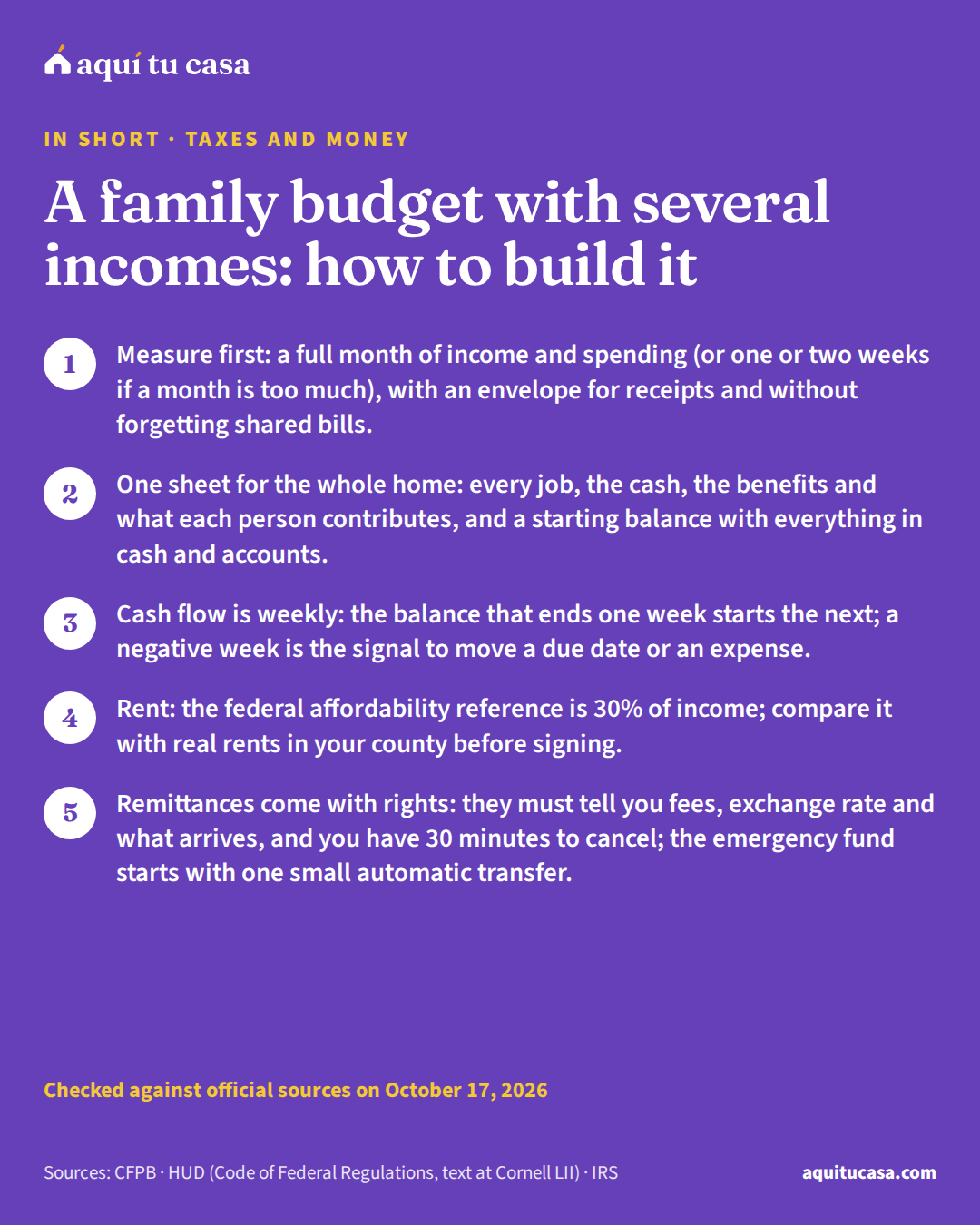
- Measure first: a full month of income and spending (or one or two weeks if a month is too much), with an envelope for receipts and without forgetting shared bills.
- One sheet for the whole home: every job, the cash, the benefits and what each person contributes, and a starting balance with everything in cash and accounts.
- Cash flow is weekly: the balance that ends one week starts the next; a negative week is the signal to move a due date or an expense.
- Rent: the federal affordability reference is 30% of income; compare it with real rents in your county before signing.
Is this for you?
This guide is for you if…
- Several incomes come into your home (two jobs, a business, a relative who chips in) and you never quite know how much there is or what it covers.
- You are paid in cash or your income changes from week to week and monthly budgets do not work for you.
- You send remittances and want them to fit the plan without giving up saving for rent, a deposit or a down payment.
Get direct help first if…
- You can no longer cover this month's rent or mortgage: go to the emergency guides first and talk to a HUD-approved housing counselor today.
- You want tax advice on how to report cash income: an IRS VITA site helps you for free if you qualify; this guide does not replace that visit.
In many families there is no single paycheck: there are two jobs, a weekend business, a son who chips in, an aunt who pays the internet and remittances that go out every two weeks. “One income, twelve months” budgets do not work for that. This guide uses the free tools of the CFPB (the federal consumer financial protection agency) to build a budget for the whole home, week by week, and adds what families ask about most: how much rent fits, where remittances go and how to start an emergency fund when little is left over.
Look at a full month first
Before deciding anything, measure. The CFPB recommends keeping track of what you earn and everything you spend for a month, not one or two weeks, so you see income and expenses in one place. Many people who do it discover small expenses that add up and sometimes do not match their priorities; others manage to balance their budget.1
The method is simple. Every time you spend, the receipt goes into an envelope; if there is no receipt, you write the amount and what you bought on a slip of paper. At the end of each week you total by category, and at the end of the month you total everything. Do not forget bills you share with other people. If a whole month seems too much, start with one or two weeks. Circle what repeats the same every month (rent, car, cell phone): those are usually your needs and obligations. What you can eliminate or cut back is usually wants.1
In a home with several people, the envelope belongs to the home: ask everyone to drop their receipts there or send you a photo. No need to argue yet; just count.
Add up every income in the home
The second step is one sheet with everything that comes in. The CFPB’s cash flow tool starts with the starting balance, which is the total of your cash on hand, prepaid cards and checking and savings accounts. Then each week it adds all the income and benefits you receive, with a line per source: the sheet has “Job 1” and “Job 2”, and you can add as many as you need.2
Benefits you use to pay for things you would otherwise pay in cash count too, such as SNAP and TANF. Careful: some can only be used for specific expenses; SNAP covers food, but not household items like paper towels. If you receive a housing subsidy, you enter its full value as income and the full market rent as an expense.2
Here are the lines families tend to forget: cash you earn from odd jobs (write it down the day it comes in), what each person in the home contributes and when, and what the business brings in. Use gross incomegross incomeGross income is the total you earn before taxes and other deductions are taken out. On your pay stub it shows up as gross pay, not as what lands in your account. Lenders use it to figure your debt-to-income ratio (DTI): they add up your monthly debt payments and divide them by your gross monthly income. When you apply for a mortgage, your annual pre-tax income can include full-time or part-time work, self-employment, tips, commissions, overtime and bonuses; the lender looks at whether you can reasonably expect that income to continue.See the full definition when you compare against a rent or debt rule: it is what you earn before taxes and other deductions come out.5 If part of the money never goes through a bank, the budget counts it anyway. How to open an account without a Social Security number is in this guide, and low-fee accounts are in this one.
Build the cash flow week by week
The problem for families with several incomes is almost never the month’s total: it is the week when rent is due on the 1st and the big paycheck arrives on the 5th. That is why the CFPB proposes a cash flow budget, which tracks when money comes in and goes out so it lasts from one week to the next. Before you build it, you need to track income and expenses for at least one month.2
One week of your cash flow
1. Write down the starting balance
At the start of the week
Everything there is in cash, prepaid cards and checking and savings accounts.2
2. Add everything that comes in
During the week
One line per source: job 1, job 2, what each person contributes, cash and benefits such as SNAP or TANF.2
3. Subtract everything that goes out
During the week
Everyday expenses, bills (remittances too) and savings, which also count as a weekly expense.2
4. Look at the ending balance
At the end of the week
If it is positive, it was enough; if it is negative, you are falling short and something has to move.2
5. Carry it to the next week
When the next week starts
One week's ending balance is the next week's starting balance. Repeat until the month is done.2
If a week comes out negative, that is where to act: move a due date, bring income forward or cut an expense that week. The CFPB has another tool, “Improving cash flow”, to brainstorm strategies when expenses exceed income.2

A simple rule for splitting
Once you know how much comes in and when, it is time to split. The CFPB records the 50/20/30 rule as common advice: 50 percent of take-home pay (net incomenet incomeNet income is the money you actually receive in your paycheck or deposit after taxes and other deductions are taken out; it is also called take-home pay. It is your gross income minus those deductions, such as federal income tax, Social Security and Medicare taxes, and state and local taxes where they apply. Your pay stub lists each deduction, which is why what you receive can be quite a bit less than what you earned. The CFPB suggests basing your monthly budget on net income, not gross income, to cover your necessary expenses realistically.See the full definition, what reaches you after deductions) to needs, 20 percent to savings and debt payments and no more than 30 percent to wants. It also notes that general advice is hard to apply to your own situation, that you can decide on your own rule and that writing down your goal makes you much more likely to stick to it.3
In a home where rent takes more than half, the rule does not fit, and that is not a failure: it is information. Write down the rule you can actually keep this month and revisit it when incomes change.
How much rent fits
The federal affordability reference is clear: HUD’s housing-program rule sets the tenant’s payment at 30% of the family’s monthly adjusted income (or 10% of gross income, if higher). That is the reference we use to talk about affordable rent and rent burdenrent burdenRent burden measures how much of a household's income goes to gross rent. The Census Bureau computes it household by household: monthly gross rent divided by monthly household income. A household is rent-burdened when it spends 30% or more of its income on housing, and severely burdened when it spends half or more; that 30% is the same share of adjusted income HUD sets as the tenant's payment in its rental assistance programs. On your county pages we show what share of renter households is in each situation.See the full definition.4
Example with real numbers
How much rent fits on the typical income
With the typical US household income and the federal reference of 30%.
- Gross monthly income of a typical household (all households)
- $6,728
- Rent that fits in 30% of that income
- $2,018
- Typical gross rent in the US (rent plus utilities)
- $1,413
This is an example with national numbers. HUD uses the family's monthly adjusted income in its programs;4 here we use gross income, what you earn before taxes and deductions.5 Run it with your real income and your county's rent in the calculator.
Run it with your numbersHow much rent can I afford?Gross rentgross rentGross rent is the contract rent plus the estimated average monthly cost of utilities (electricity, gas, water and sewer) and fuels, when the renter pays them. It is the measure the Census Bureau uses in the American Community Survey to compare the cost of renting across places, because it removes the difference between leases that include utilities and leases that do not. The "typical rent" on our pages is the median gross rent: half of renter households pay less and the other half pay more.See the full definition adds rent and utilities, such as electricity and water. According to the Census Bureau, 51% of renter households in the country put 30% or more of their income toward rent. The chart shows it:

That is why it pays to compare your budget with the typical rent and the fair market rent in your area before signing. The rent calculator does it with your county’s data, and the rent burden page shows how much of income goes to rent where you live.
Remittances belong in the budget, with their rights
If you send money to your family, it is one more fixed expense: give it an amount and a date, and agree on it with whoever contributes. And know your rights when you send it. According to the CFPB, a remittanceremittance transferA remittance transfer is an electronic money transfer you send from the United States to a person or company in another country through a remittance transfer provider, such as a bank or another financial services company. Federal law protects transfers above a minimum amount made by a provider in the normal course of its business. The provider must tell you, before and after you pay, the fees, taxes, exchange rate and how much the other person will receive, in your language if it advertises in it or served you in it. You have up to thirty minutes to cancel at no charge, if the money has not been picked up, and one hundred eighty days to report an error.See the full definition is an electronic transfer of more than $15 from the U.S. to another country through a provider. The provider must tell you the fees and taxes it charges, the exchange rate and the amount expected to be delivered. You have up to 30 minutes to cancel at no charge, unless the money has already been picked up or deposited. And you have 180 days, from the date they said the money would be available, to report a mistake, which the provider generally must investigate within 90 days.6 With that in writing, you can compare two or three providers before choosing.
The emergency fund
An emergency fundemergency fundAn emergency fund is cash you set aside only for unplanned expenses or emergencies, such as car or home repairs, medical bills or a loss of income. It is not for routine monthly spending. The CFPB explains that without savings, even a small financial shock can push you into debt that is hard to pay off. How much you need depends on your situation; the CFPB suggests thinking about the unexpected expenses you have had before. You can keep it in a bank or credit union account, on a prepaid card or in cash, and it grows more easily with automatic saving or part of a tax refund.See the full definition is, according to the CFPB, a cash reserve set aside specifically for unplanned expenses. To set the goal, think about the most common unexpected expenses you have had and how much they cost; even a small amount provides some security. What works: a specific goal; a system of steady contributions, such as automatic transfers from checking to savings or splitting your direct deposit if the employer allows it; tracking progress; and saving all or part of tax refunds or cash gifts. Keep it in a bank or credit unioncredit unionA credit union is a not-for-profit financial institution that, like a bank, accepts deposits, makes loans and offers other services, but is owned by its members. Members elect a volunteer board of directors, and profits go back to them as lower fees, higher savings rates and lower loan rates. To join you need a common bond, such as your employer, your family, where you live or a group you belong to. It is chartered by the NCUA, a federal agency, or by a state. If the credit union is federally insured, your deposits are protected by the NCUA's insurance fund.See the full definition account, which is considered one of the safest places; cash can be stolen, lost or destroyed.7

Taxes: the refund is part of the plan
For many families the tax refund is the largest income of the year, and the budget should know ahead of time what part goes to the emergency fund, what part to debts and what part to the housing goal.7 The IRS’s VITA and TCE programs prepare your basic tax returntax returnA tax return is the yearly form you use to report your income to the IRS and figure the tax you owe, so you can pay what is due or get a refund. The federal return for individuals is Form 1040. In general you must file if your gross income is above the minimum the IRS sets for your filing status, or if you had a certain amount of net earnings from self-employment; even when you do not have to, filing can pay off. You need your SSN or ITIN, and those of everyone else on the return, plus documents such as your W-2s and 1099s.See the full definition for free if you generally make about $70,244 or less, have a disability or speak limited English; each site may set its own limit, and you find one with the IRS locator or by calling 800-906-9887.9 If you need an ITIN to file, the step by step is in How to get an ITIN.
If this is you
You get paid in cash
Write it down the day it comes in, just like a check.1 For your savings, a bank or credit union account is considered one of the safest places; cash can be lost or stolen.7
You run a business or do odd jobs
Your income changes week to week: the weekly cash flow shows you ahead of time when you will come up short.2 For your taxes, check whether you qualify for a free VITA site.9
Several people contribute at home
Enter each person's contribution as an income line with its date,2 and do not forget the bills you share.1
You receive SNAP, TANF or housing assistance
Count them: benefits you use instead of cash go in as income; with a housing subsidy, enter its full value as income and the full rent as an expense.2

Common mistakes
Mistake: Budgeting only with the month's total.
Instead: Build the cash flow week by week: the problem is usually the week when rent is due before payday.2
Mistake: Forgetting the bills you share with other people.
Instead: Write them down too; the CFPB says not to forget shared bills.1
Mistake: Signing a lease without comparing it with your income.
Instead: Compare it with 30% of your income and with the typical rent in your county before you sign.4
Mistake: Sending a remittance without checking how much arrives.
Instead: The provider must tell you the fees, the exchange rate and how much is delivered: compare before you send.6
Mistake: Keeping the emergency fund in cash at home.
Instead: A bank or credit union account is considered one of the safest places; cash can be lost or stolen.7
Mistake: Using the emergency fund and never refilling it.
Instead: Using it is a success, not a failure; make a plan to replenish it.8
What to do this week
- Put an envelope in the kitchen and ask everyone for this week’s receipts; if you can, keep it up for the whole month.1
- Write down on one sheet every income in the home with the day it arrives, and the starting balance with everything there is in cash and accounts.2
- Build the cash flow for the next four weeks and mark the first week that comes out negative.2
- Compare your rent with 30% of your income and with the typical rent in your county in the rent calculator.4
- Set up a small automatic transfer to a separate savings account: that is your emergency fund, day one. The savings plan helps if your goal is a down payment on a home.7
- If you want to build the plan with someone, a HUD-approved housing counselorHUD-approved housing counselorA HUD-approved housing counselor works at an agency HUD has approved to provide housing counseling: independent, expert advice customized to your situation about buying a home, renting, a missed mortgage payment, a foreclosure or credit problems. The agencies usually charge little or nothing; many serve in Spanish and offer the homebuyer education course several assistance programs require. They are not lenders or real estate agents and sell you nothing. Your county page lists the official agencies with phone numbers.See the full definition will do it with you, often for free.10
Your household this month
Let's do the math
Left each month
Enter what at least one person takes home to see the result.
What helps
- Pay savings first: set the goal aside the day the money arrives, before flexible spending.
- Add up the bills that come every few months (car insurance, school) and divide by twelve.
- If income changes, plan on a low month and save the extra from good months.
- A HUD-approved housing counselor can go over the budget with you, often for free.
This is a planning tool with your numbers, not a credit evaluation or an approval. The split reference is only a guide.
Ready to see the numbers? Find your county here
See how this applies in your county: its loan limits, prices and rents, from the official data.
Printable checklist
Frequently asked questions
How do I budget if my income changes every week?
With a weekly cash flow instead of a monthly total: write down what actually came in that week, subtract what went out and carry the balance to the next. The weeks that come out negative tell you where to move a payment or what to cut. In good weeks, set something aside for the slow ones: that is your cushion.
Do cash income and a relative's contribution count?
Yes. The budget belongs to the home, not the bank: write down cash the day it comes in and what each person contributes, even if it never touches an account. To keep your savings, the CFPB considers a bank or credit union account one of the safest places; our guide explains how to open one without a Social Security number.
How much should go to rent?
The federal reference is 30% of monthly income: it is the rule HUD uses to set the tenant's payment in its programs, and the one we use to talk about affordable rent. With the typical US household income, $6,728 a month, that comes to $2,018. This site's rent calculator runs the numbers with your income and your county's rent.
Where do remittances go in the budget?
As a fixed line, like rent or electricity, with the amount and date the family agrees on. When you send them, the provider must tell you in writing the fees, the exchange rate and how much will arrive; compare two or three providers on that basis, and remember you have 30 minutes to cancel at no charge if something went wrong.
What do I do if a week does not cover everything?
If a week's balance comes out negative, you are falling short, and it is better to know ahead of time. The CFPB has a tool, «Improving cash flow», to brainstorm strategies. Look at which payment or expense that week can be moved or cut; if what does not fit is the rent or mortgage, a HUD-approved housing counselor can guide you, often for free.
How much should I have in my emergency fund?
The CFPB does not give a single number: it suggests thinking about the most common unexpected expenses you have had and how much they cost, and says even a small amount provides some security. Start with an automatic transfer, however small, to a separate account.
Where can I get free help with my taxes?
The IRS's VITA and TCE programs prepare basic returns for free for people who generally make about $70,244 or less, persons with disabilities and limited English-speaking taxpayers. Each site may set its own limit; find one with the IRS locator or at 800-906-9887.
Sources
Every figure in this guide comes from one of these official sources. The number next to a sentence leads to the source behind it.
Each source on one line: who publishes it, its title, its address and the date we read it.
- 1. CFPB · Spending tracker (Your Money, Your Goals) · files.consumerfinance.gov · Accessed October 17, 2026
- 2. CFPB · Creating a cash flow budget (Your Money, Your Goals) · files.consumerfinance.gov · Accessed October 17, 2026
- 3. CFPB · My spending rule to live by · files.consumerfinance.gov · Accessed October 17, 2026
- 4. HUD (Code of Federal Regulations, text at Cornell LII) · 24 CFR §5.628, Total tenant payment · law.cornell.edu · Accessed October 17, 2026
- 5. CFPB · What is a debt-to-income ratio? · consumerfinance.gov · Accessed October 17, 2026
- 6. CFPB · What is a remittance transfer and what are my rights? · consumerfinance.gov · Accessed October 17, 2026
- 7. CFPB · An essential guide to building an emergency fund · consumerfinance.gov · Accessed October 17, 2026
- 8. CFPB · Building your savings? Start with small goals (Your Money, Your Goals) · files.consumerfinance.gov · Accessed October 17, 2026
See the other 2 sources
- 9. IRS · Free tax return preparation for qualifying taxpayers (VITA and TCE) · irs.gov · Accessed October 17, 2026
- 10. CFPB · Find a Housing Counselor · consumerfinance.gov · Accessed October 17, 2026
Keep reading
Related guides
If this guide helped, these follow the same path.

ITIN 11 minute read
How to open a bank account without a Social Security number
What banks and credit unions ask for to open an account without a Social Security number (ITIN, passport or consular ID) and which account to pick.
- Federal law allows opening an account with an ITIN, a passport, an alien identification card or another government document; the bank chooses which it accepts.
- Bring a photo ID, a second proof (a bill or birth certificate), your ITIN if you have one and the opening deposit, usually between $25 and $100.
- Without a Social Security number or an ITIN you may only be able to open a no-interest account; with an ITIN, you sign the W-9 with that number.
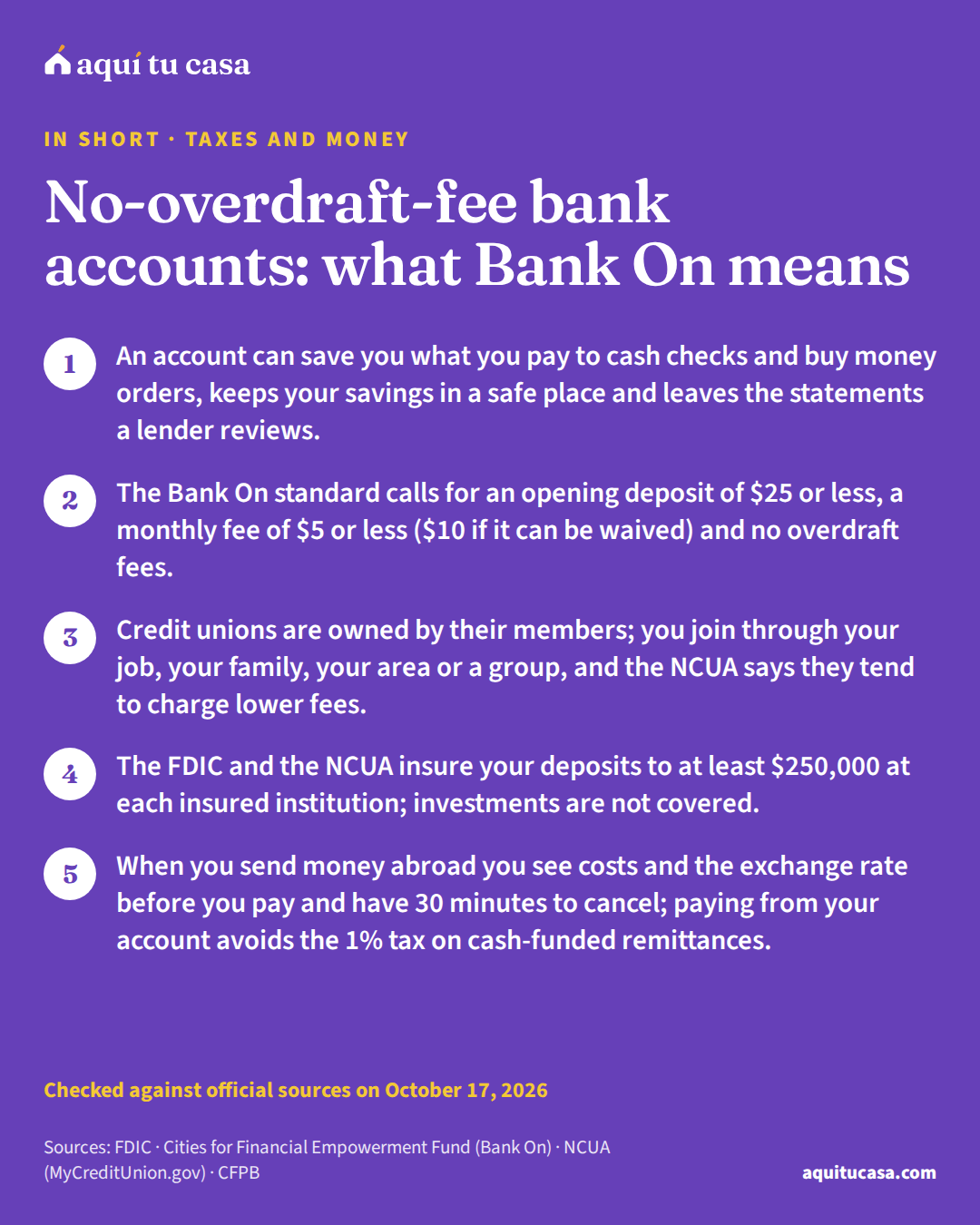
- Taxes and money No-overdraft-fee bank accounts: what Bank On means What a Bank On certified account is, why an account helps you save and buy a home, credit unions, FDIC/NCUA insurance, check cashing and remittances. 13 minute read
- Credit Credit from zero: how to start your history in the U.S. What credit reports and scores are, how to get them for free, and how to start a history from nothing with a secured card or a credit-builder loan. 16 minute read
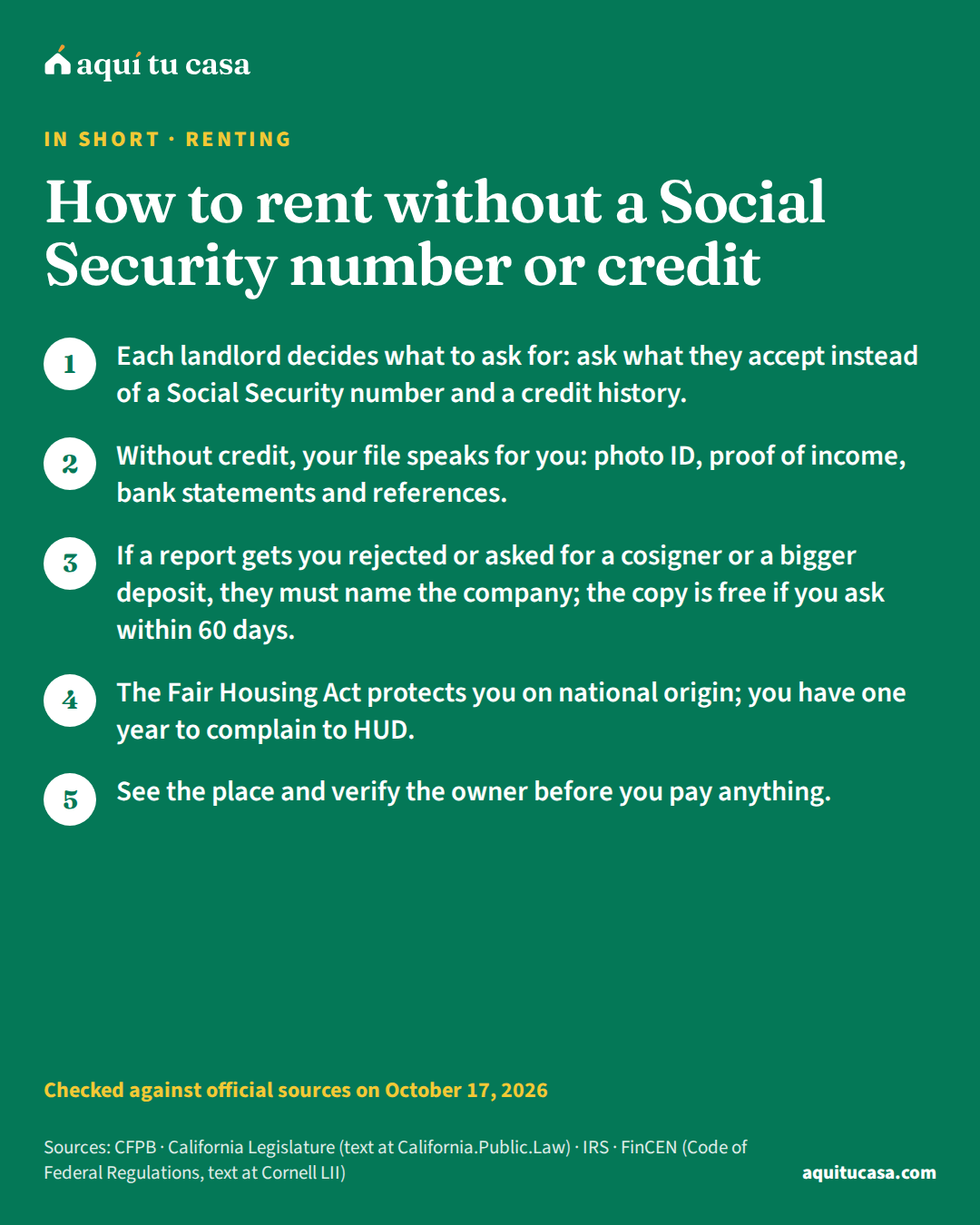
- Renting How to rent without a Social Security number or credit What a landlord can ask for, what to offer instead of an SSN and credit, how much rent fits your income and your rights if you are turned down. 11 minute read

Tools for this topic
Was this guide useful?
Thank you. Your answer stays in your browser; nothing is sent.