
Family budget
How much is left for housing each month.
What you get → what is left
Someone shared this page with you.
Questions and answers
Every question our 7 guides about taxes and money answer, grouped by guide. Each answer is the guide's own and leads to it, with its sources.
Open a question to read its answer. Each group ends with the full guide, its sources and, when it has one, its calculator.
We found no questions with those words. Try another word or open a topic.
From the guide
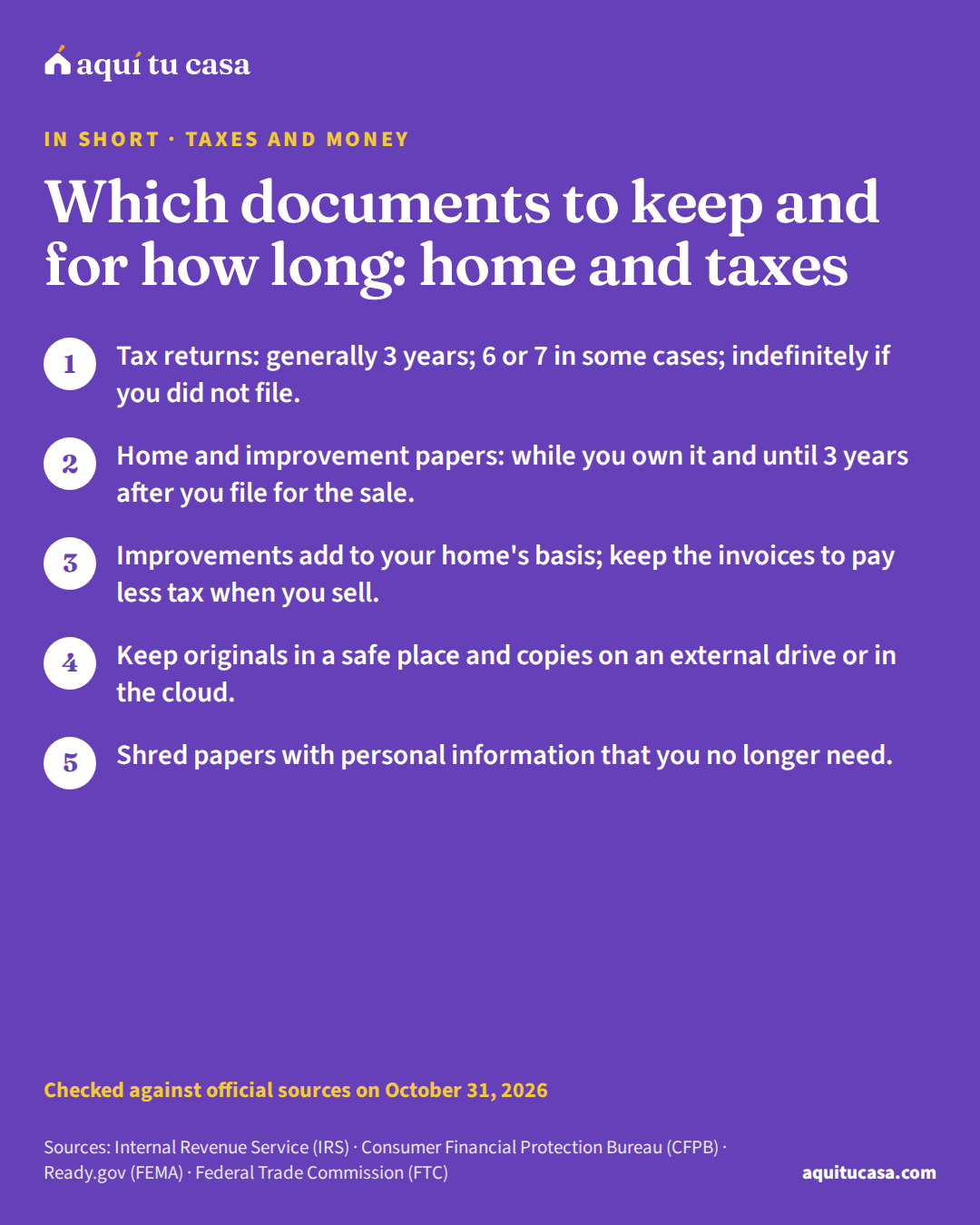
How long to keep your tax returns, home papers and improvement records, how to protect them from a disaster or theft and how to replace what you lose.
Verified on October 31, 2026 7 official sources
According to the IRS, generally 3 years. But 6 years if you did not report income that was more than 25% of the income on your return, 7 years if you claimed certain losses, and indefinitely if you did not file a return.
Read the full guideThose for the purchase and the improvements, while you own the home and until 3 years after the due date of the return for the year you sell it. And keep the closing documents complete: the Closing Disclosure, the promissory note, the mortgage and the deed.
Read the full guideBecause improvements are added to your home's basis, and a higher basis can lower the gain figured when you sell. Repairs, such as painting or fixing a leak, do not count as improvements.
Read the full guideReady.gov recommends a safety deposit box, an external drive or the cloud. Keep the originals in a safe place and copies somewhere else.
Read the full guideShred the ones with personal information, such as charge receipts and copies of credit applications, as the FTC recommends. Do not throw them away whole.
Read the full guideYou can request transcripts from the IRS in your online account or by mail, at 800-908-9946. By mail they arrive in 5 to 10 days.
Read the full guideThe data behind these guides
The guides on Taxes and money cite these figures. They update when their sources publish new ones; what you see here is current.
See all the dataSources: U.S. Census Bureau (Average 2020–2024)
From the guide
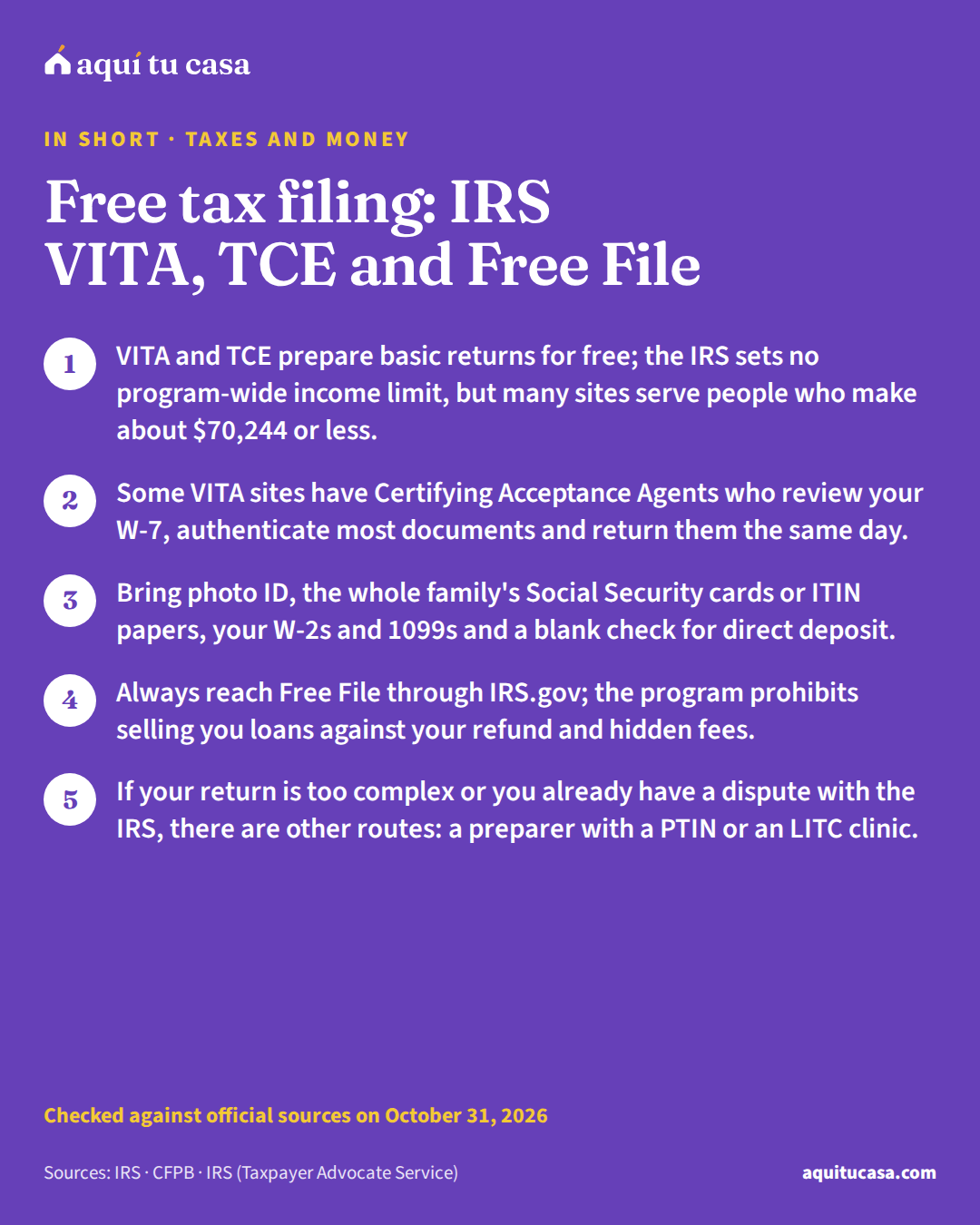
Who can file for free with VITA, TCE or Free File, what to bring, how to apply for an ITIN at a VITA site and how to find a free tax help site near you.
Verified on October 31, 2026 9 official sources
The IRS sets no program-wide income limit; each site may set its own. Many sites serve people who generally make about $70,244 or less, people with disabilities and limited English speakers. TCE mainly helps people 60 and older.
Read the full guideYes. The IRS list of what to bring includes ITIN documents for you, your spouse and your dependents. And some VITA sites have Certifying Acceptance Agents who help you apply for an ITIN for free along with your return.
Read the full guideAt VITA sites with ITIN services, the agent authenticates most documents and returns them at the end of the appointment. They cannot authenticate foreign military IDs or dependents' documents other than passports and birth certificates; those are mailed with the application.
Read the full guideOriginal photo ID (for both spouses if filing jointly), Social Security cards or ITIN papers for the whole family, birth dates, all your W-2s and 1099s, last year's return if you have it and a blank check for direct deposit. To e-file a joint return, both spouses must come to sign.
Read the full guideThe federal return is free if you qualify and you go through IRS.gov/freefile. The IRS says a partner may charge for a state return or if you do not qualify, and that the program prohibits upselling, hidden fees and products such as a loan against your refund.
Read the full guideNo. Free File only handles the current-year return. VITA sites prepare prior-year returns on a limited basis; bring the IRS income transcripts for those years.
Read the full guideThe IRS says you will be advised to seek a paid preparer. If you do, choose one who has a PTIN, signs your return and gives you a copy, and avoid anyone who charges a percentage of your refund.
Read the full guide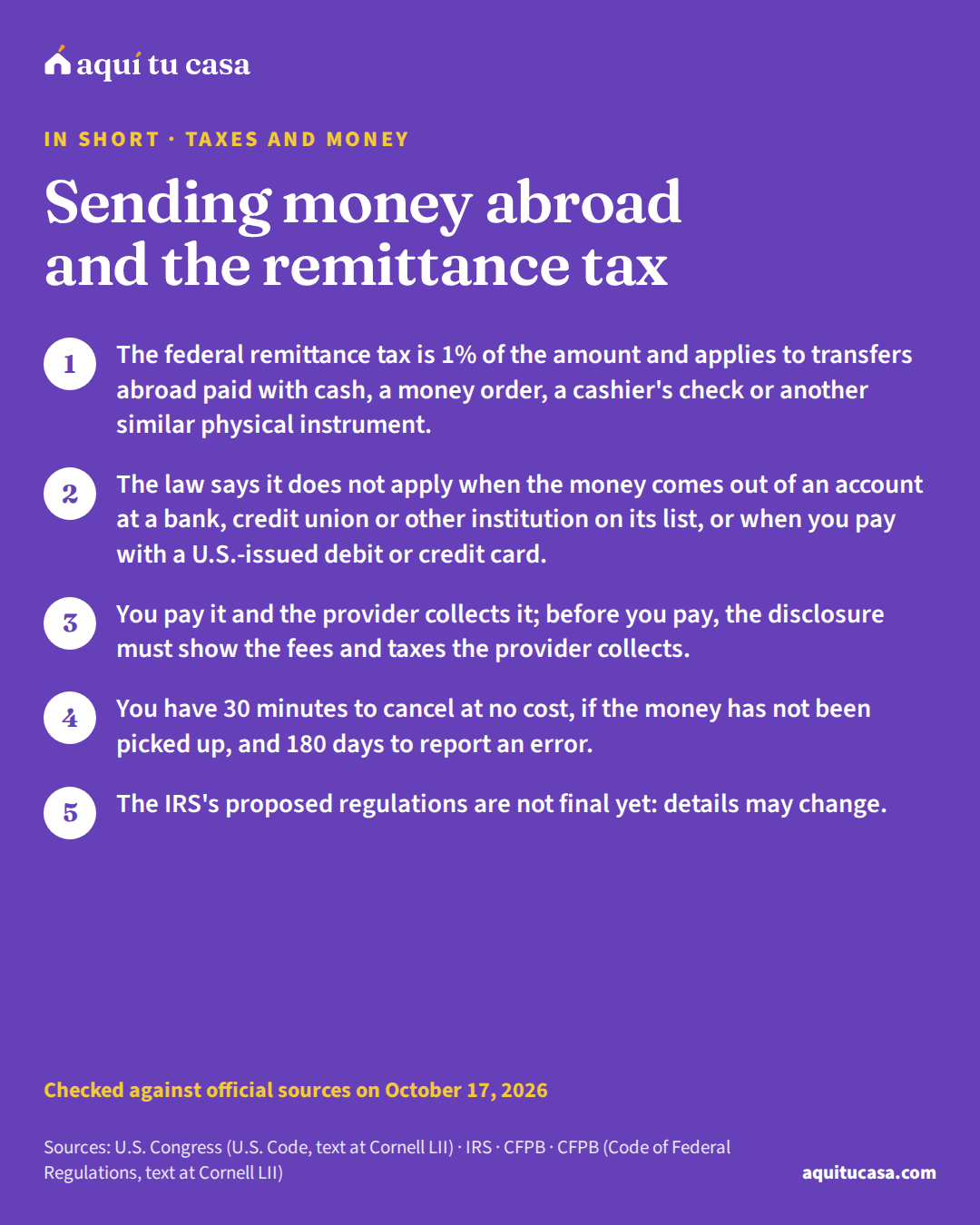
From the guide
The federal tax on cash-funded remittances: which transfers it applies to, which it does not, who collects it and your rights when you send money abroad.
Verified on October 17, 2026 12 official sources
Federal law imposes 1% of the remittance amount, but only when you give the provider cash, a money order, a cashier's check or another similar physical instrument. It applies to transfers made after December 31, 2025.
Read the full guideThe law says it does not apply when the money is withdrawn from an account at a financial institution on its list, such as an insured bank, a credit union or a thrift institution, or when you pay with a debit or credit card issued in the United States.
Read the full guideThe sender pays it, and the provider collects it from you and sends it to the government every quarter. If the provider does not collect it at the time of the transfer, the law says the provider must pay it.
Read the full guideUnder Regulation E, before you pay the provider must give you a disclosure with the amount, the fees, the taxes it collects, the total and the exchange rate. When you pay, you get a receipt with that information and the date the money will be available.
Read the full guideYes, if you ask no later than 30 minutes after paying and the money has not been picked up or deposited. The provider must refund everything you paid, including fees, within three business days. If you scheduled the transfer in advance, you can cancel up to three business days before.
Read the full guideTell the provider as soon as you can; you have up to 180 days from the date the money was supposed to be available. The provider has 90 days to investigate and must give you the results. If the money never arrived, you may get a refund or have it resent. If the problem is not solved, you can complain to the CFPB.
Read the full guideThe provider. The law says the provider collects the tax from the sender and sends it to the Treasury every quarter, and it reports it on Form 720. If you have questions about your own tax return, an IRS VITA site prepares basic returns for free for people who qualify.
Read the full guide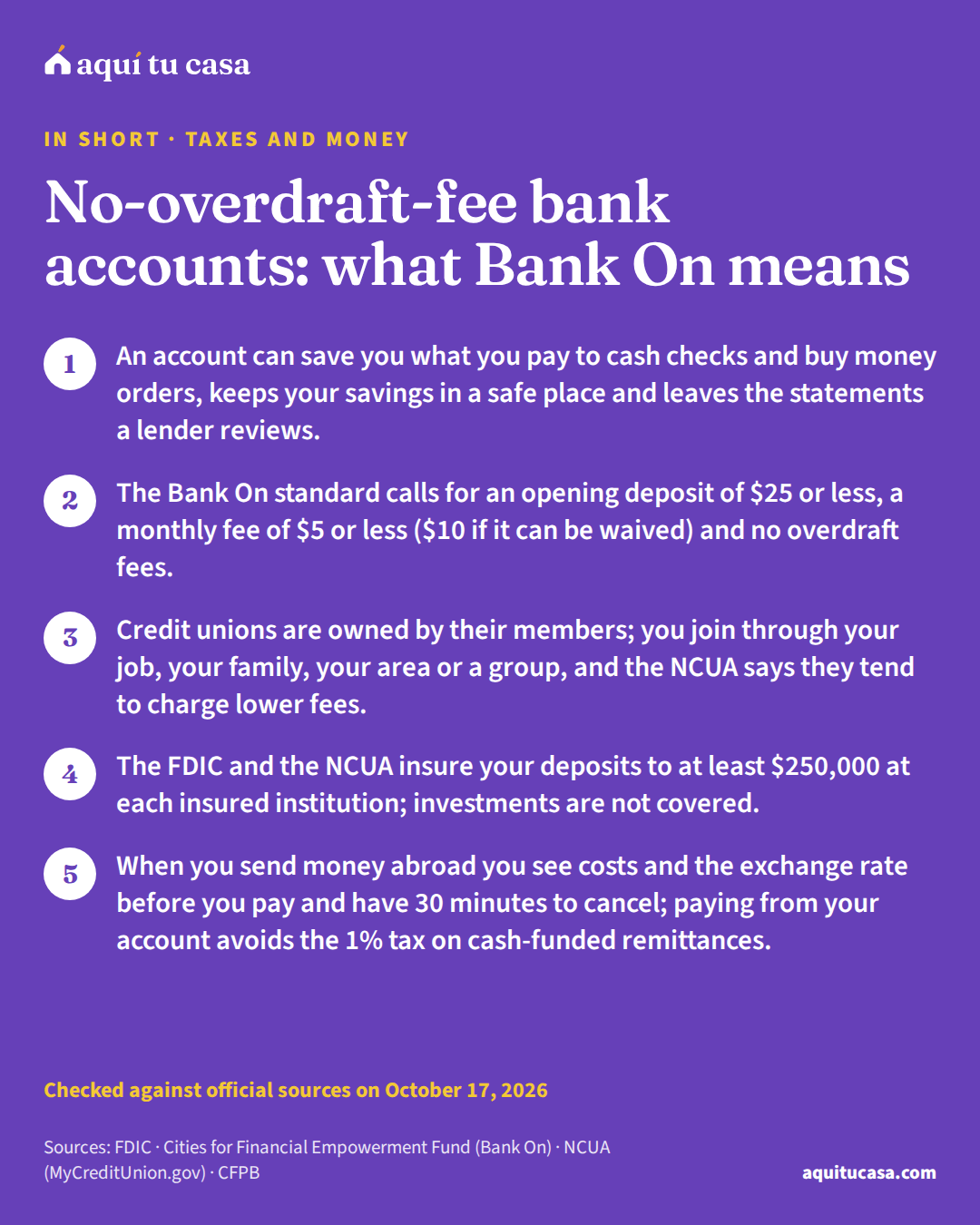
From the guide
What a Bank On certified account is, why an account helps you save and buy a home, credit unions, FDIC/NCUA insurance, check cashing and remittances.
Verified on October 17, 2026 20 official sources
Not always. The standard allows a monthly fee of $5 or less, or $10 or less if a single transaction such as a direct deposit can waive it. What it does not allow are overdraft, insufficient funds, activation, closure, inactivity or low balance fees.
Read the full guideIt depends on each bank or credit union. According to the CFPB, some accept foreign passports and consular IDs, each with its own policy; the Bank On standard recommends accepting ITINs and consular IDs. For an interest-bearing account you will be asked for a Social Security number or an ITIN.
Read the full guideBoth work if they are insured (FDIC or NCUA). The NCUA says credit unions, on average, pay more on savings, charge less on loans and tend to have lower fees, but you have to be able to join. Compare each account's actual fees using the CFPB checklist questions.
Read the full guideA deposit account is not a loan. The FDIC explains that a relationship with a bank can be a first step toward other financial products, and the Bank On standard recommends access to credit-building products. The step-by-step plan is in the credit-from-zero guide.
Read the full guideBecause, for transfers made after December 31, 2025, federal law taxes remittances funded with cash, money orders or cashier's checks at 1%, but not those withdrawn from a bank or credit union account or paid with a debit or credit card issued in the U.S. Whatever way you pay, you have the right to see the cost and the exchange rate before you pay.
Read the full guideGenerally 30 minutes after you pay, if the money has not been picked up or deposited into the recipient's account. The provider must refund everything, fees included, within three business days. Transfers scheduled in advance follow a different rule.
Read the full guideOnly if the card offers FDIC or NCUA insurance and you register it. If something says “insured,” ask which bank or credit union holds the money and look it up yourself with the FDIC's BankFind or the NCUA's Find a Credit Union.
Read the full guideTools
The calculators these guides use. Each one leaves you with a result you can use today.
How much is left for housing each month.
What you get → what is left
How many months until your down payment.
What you get → months of saving
The steps to build or improve your credit.
What you get → steps in order
The documents you'll be asked for.
What you get → your document list
From the guide
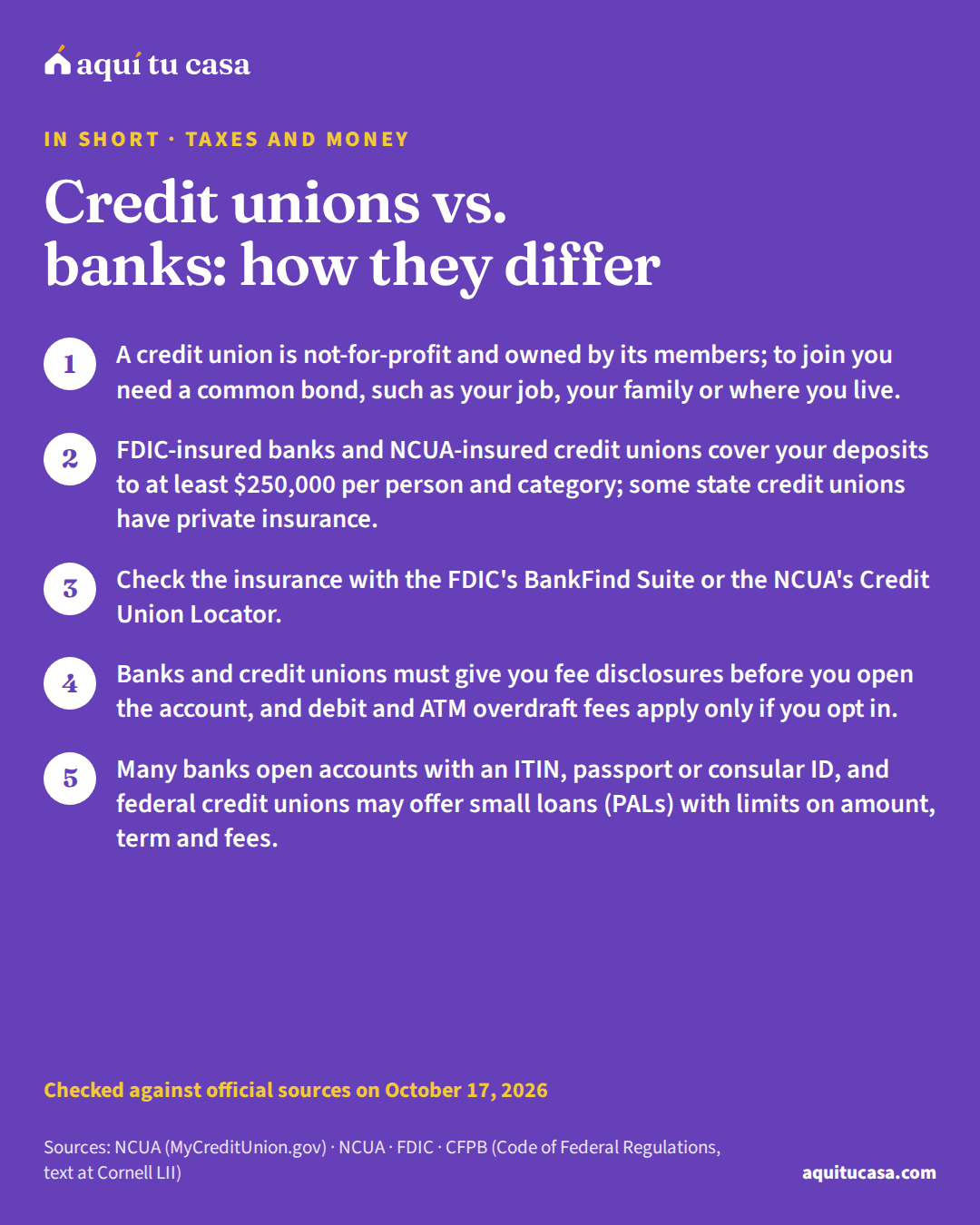
Credit unions and banks: who can join, NCUA and FDIC insurance, fees and overdrafts, accounts with an ITIN, small-dollar loans and CDFIs.
Verified on October 17, 2026 16 official sources
If the bank is FDIC-insured or the credit union NCUA-insured, your deposits are covered to at least $250,000 per person and account category, backed by the U.S. government. Watch out: some state-chartered credit unions have private insurance, which does not have that backing.
Read the full guideFor a bank, look it up in the FDIC's BankFind Suite. For a credit union, use the NCUA's Credit Union Locator. Insured credit unions must also display the official NCUA sign at their teller stations and on their website.
Read the full guidePeople who share its common bond: many accept anyone who lives, works, worships or attends school in an area; others serve an employer or a group, such as a school or labor union; and most let members' families join.
Read the full guideAccording to the FDIC, many banks let you open an account even if you are not a citizen, with a foreign passport, a consular ID or an ITIN. The federal customer identification rule allows, for non-U.S. persons, a taxpayer identification number, a passport number or another government document with a photo.
Read the full guideUnder Regulation E, a bank or credit union may not charge you for covering an ATM withdrawal or a one-time debit card purchase through its overdraft service unless you opted in to that service. You can revoke your consent.
Read the full guideIt is a payday alternative loan a federal credit union may offer. For PAL I, the rule sets conditions including: $200 to $1,000, one to six months, no rollovers, membership for at least one month first and an application fee that never exceeds $20.
Read the full guideIt is a Community Development Financial Institution certified by the Treasury's CDFI Fund: it provides financial services in low-income communities and to people who lack access to financing. It can be a bank, a credit union or a loan fund, and there are CDFIs in every state and in Puerto Rico.
Read the full guide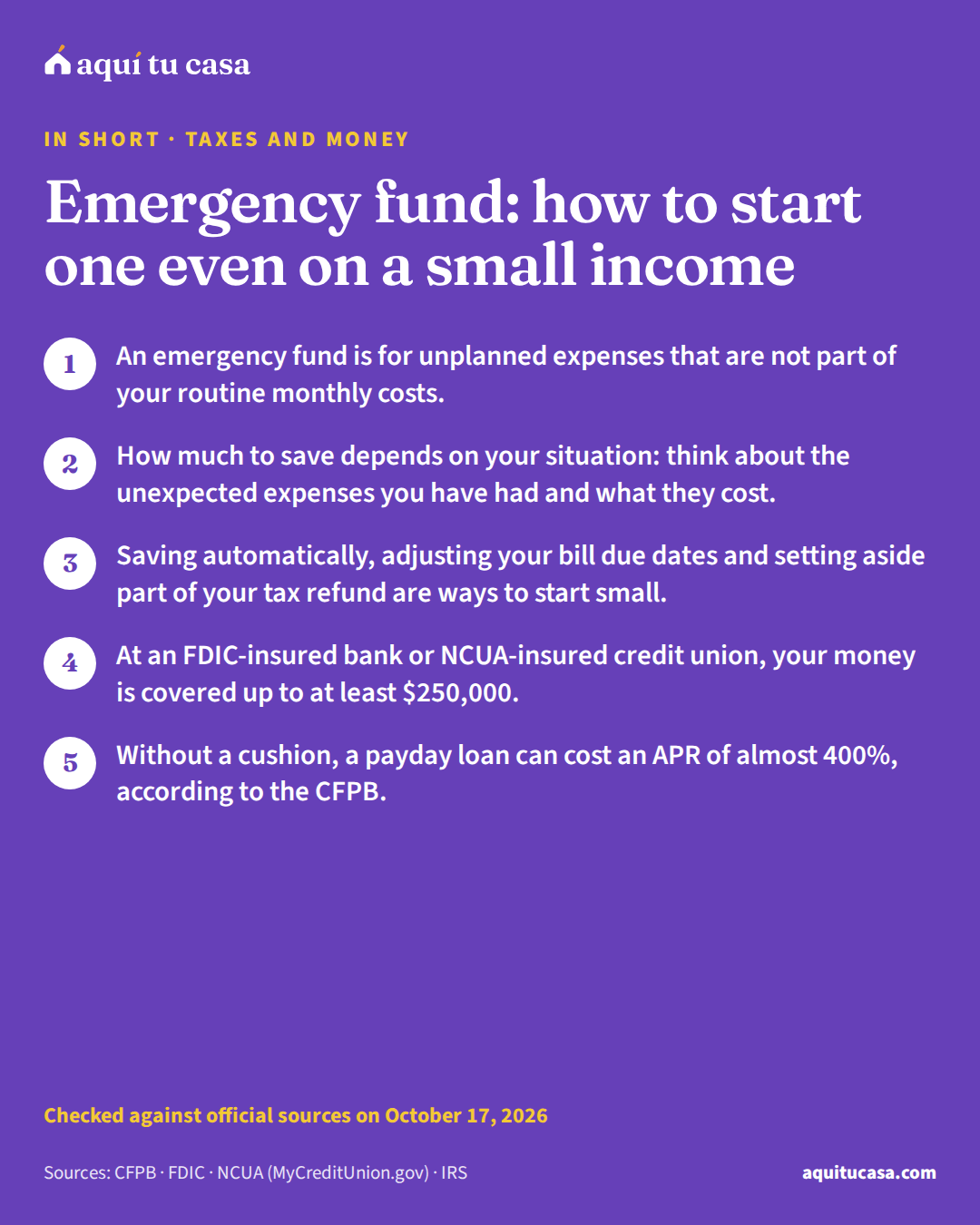
From the guide
What an emergency fund is, how much to save for your situation, how to start with little money, where to keep it safe and what it costs not to have one.
Verified on October 17, 2026 8 official sources
The CFPB does not set an amount: it says it depends on your situation. It suggests thinking about the most common unexpected expenses you have had and what they cost, and using that to set a goal. If you live paycheck to paycheck, even a small amount gives you some security.
Read the full guideAccording to the CFPB, a bank or credit union account is generally considered one of the safest places, and a dedicated account may make sense. At an FDIC-insured bank or NCUA-insured credit union, your deposits are covered up to at least $250,000.
Read the full guideThe CFPB mentions it as an option, at home or with a trusted relative. But it warns that cash can be stolen, lost or destroyed, and it does not have the insurance of an insured account.
Read the full guideThe CFPB suggests managing your cash flow: use the weeks when more money comes in to move a little extra into savings, and ask your creditors to change due dates if they do not line up with your income. It also recommends saving part of any one-time money, such as a tax refund.
Read the full guideYes. The IRS can deposit your refund into one, two or three accounts. You split it with your tax software or, on a paper return, with Form 8888. The accounts must be in your name, your spouse's name or both.
Read the full guideThe CFPB suggests setting your own guidelines and staying consistent: for example, a car or home repair, a medical bill not covered by insurance or a loss of income. Routine monthly expenses are not emergencies.
Read the full guideThe CFPB explains that they typically charge $10 to $30 for every $100, which on a typical two-week loan equals an APR of almost 400%. Before taking one, it suggests looking at alternatives: advances from your employer or community groups, help from family, options at your bank or credit union, or negotiating with whoever you owe.
Read the full guide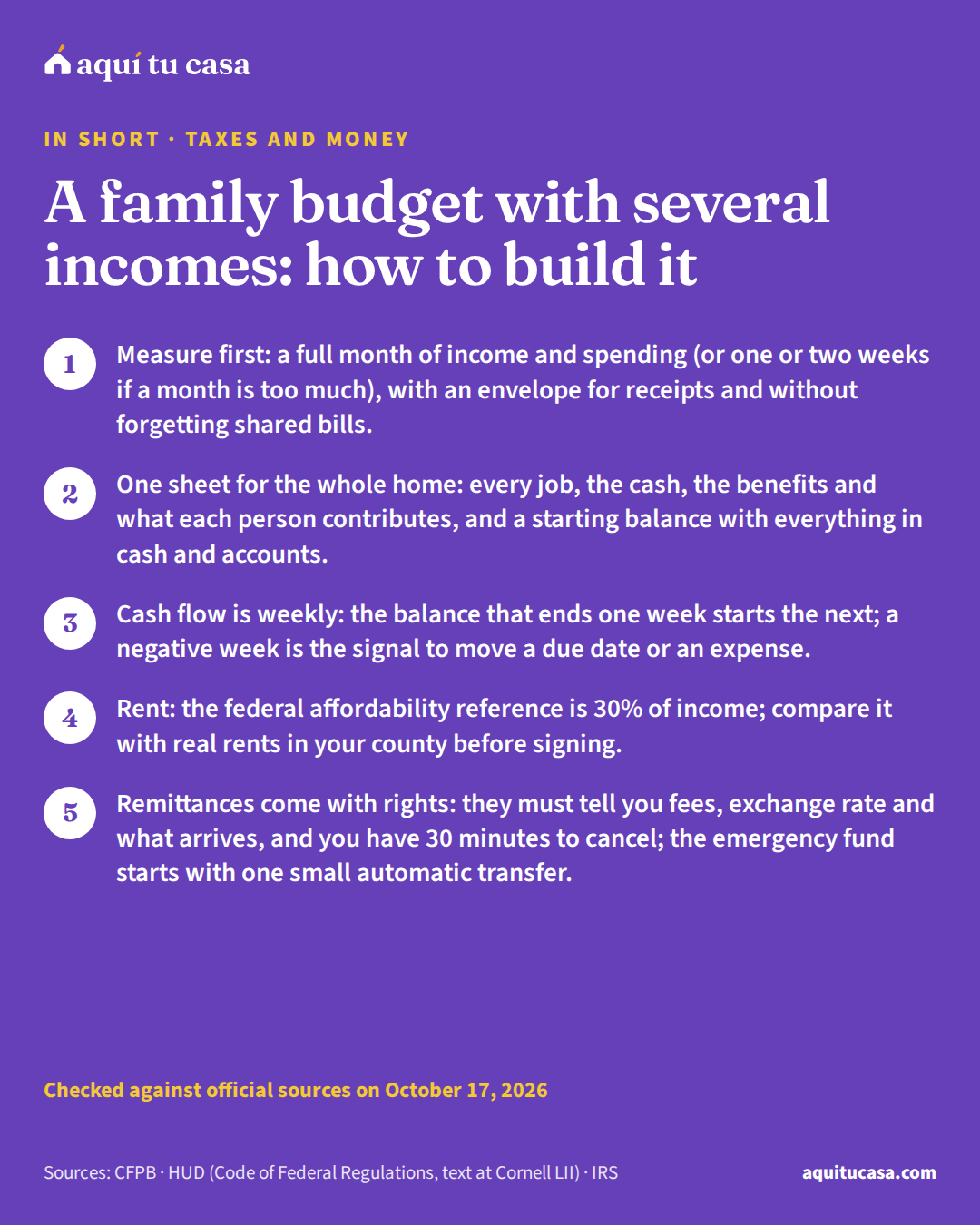
From the guide
How to budget when several incomes, cash and remittances come into the home: tracking, weekly cash flow, rent and the emergency fund.
Verified on October 17, 2026 10 official sources
With a weekly cash flow instead of a monthly total: write down what actually came in that week, subtract what went out and carry the balance to the next. The weeks that come out negative tell you where to move a payment or what to cut. In good weeks, set something aside for the slow ones: that is your cushion.
Read the full guideYes. The budget belongs to the home, not the bank: write down cash the day it comes in and what each person contributes, even if it never touches an account. To keep your savings, the CFPB considers a bank or credit union account one of the safest places; our guide explains how to open one without a Social Security number.
Read the full guideThe federal reference is 30% of monthly income: it is the rule HUD uses to set the tenant's payment in its programs, and the one we use to talk about affordable rent. With the typical US household income, $6,728 a month, that comes to $2,018. This site's rent calculator runs the numbers with your income and your county's rent.
Read the full guideAs a fixed line, like rent or electricity, with the amount and date the family agrees on. When you send them, the provider must tell you in writing the fees, the exchange rate and how much will arrive; compare two or three providers on that basis, and remember you have 30 minutes to cancel at no charge if something went wrong.
Read the full guideIf a week's balance comes out negative, you are falling short, and it is better to know ahead of time. The CFPB has a tool, «Improving cash flow», to brainstorm strategies. Look at which payment or expense that week can be moved or cut; if what does not fit is the rent or mortgage, a HUD-approved housing counselor can guide you, often for free.
Read the full guideThe CFPB does not give a single number: it suggests thinking about the most common unexpected expenses you have had and how much they cost, and says even a small amount provides some security. Start with an automatic transfer, however small, to a separate account.
Read the full guideThe IRS's VITA and TCE programs prepare basic returns for free for people who generally make about $70,244 or less, persons with disabilities and limited English-speaking taxpayers. Each site may set its own limit; find one with the IRS locator or at 800-906-9887.
Read the full guideChange topic without leaving the questions.

These answers explain the rules but do not know your situation. These organizations go over it with you, free.