
How much house can I afford?
The price your income can carry.
What you get → maximum price
Someone shared this page with you.
Questions and answers
Every question our 36 guides about buying a home in the United States answer, grouped by guide. Each answer is the guide's own and leads to it, with its sources.
Open a question to read its answer. Each group ends with the full guide, its sources and, when it has one, its calculator.
We found no questions with those words. Try another word or open a topic.
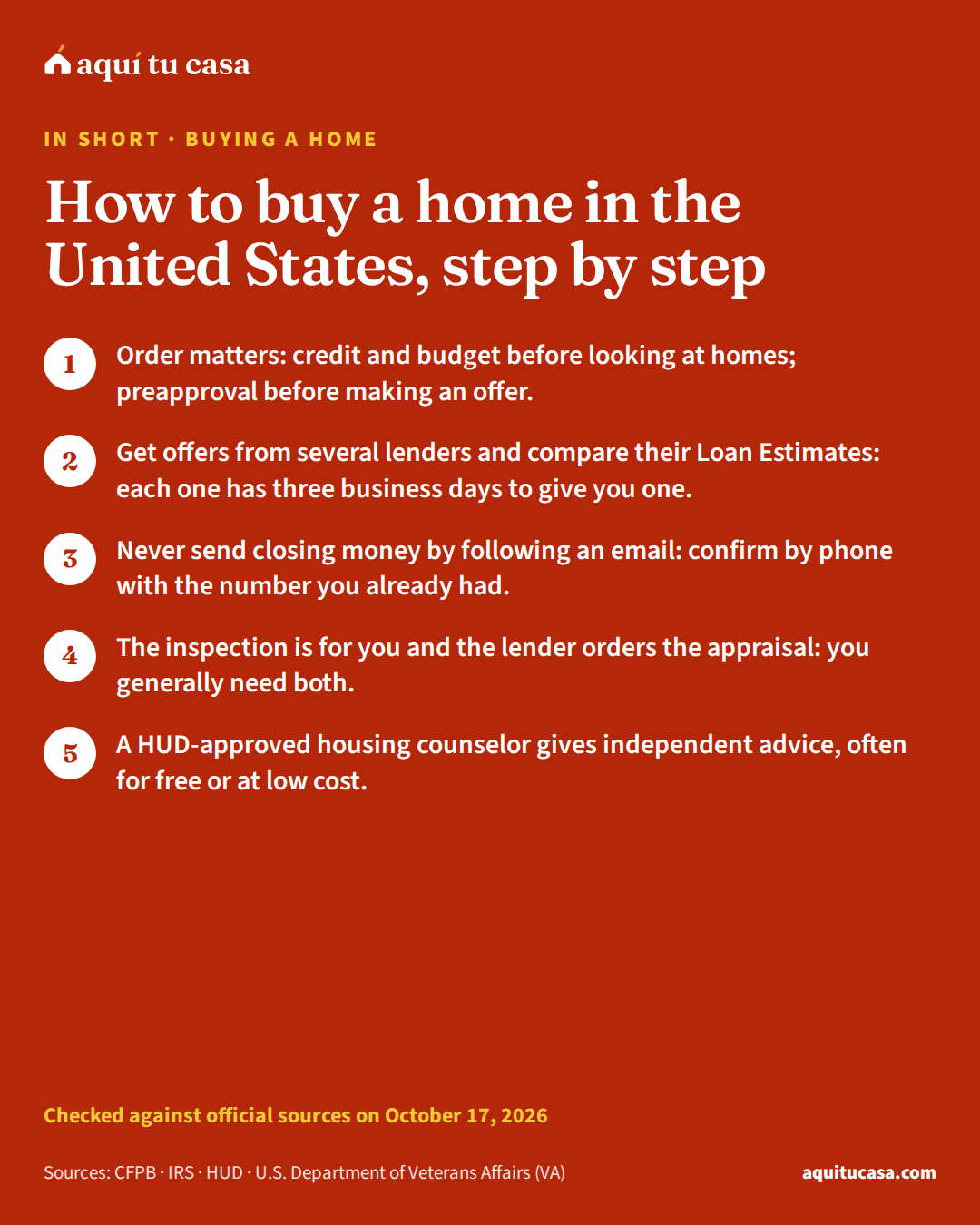
From the guide
The nine steps to buying a home: paperwork, credit, budget, assistance, preapproval, offer, inspection, closing and the first year, with official sources.
Verified on October 17, 2026 28 official sources
Read the full guide Do the math: How much house can I afford?
It depends on you and on the market. The part you control (credit, savings, paperwork, preapproval) can take months. The CFPB warns that once a seller accepts your offer you may have as little as a couple of days to line up financing, so it pays to shop for a lender first. The fixed deadlines are the Loan Estimate's and the Closing Disclosure's: three business days each.
Read the full guideNo. The CFPB says that even if your real estate agent or homebuilder has a preferred lender, you can and should shop around for the best deal. Borrowers who shop around can save thousands of dollars.
Read the full guideThe steps in this guide are the same; what changes is the type of loan and the documents each lender asks for. The IRS issues the ITIN for federal tax purposes only, and it does not change your immigration status. The ITIN mortgage guide explains which options exist, and a housing counselor can guide you for free or at low cost.
Read the full guideYou need the down payment plus closing costs. On a $332,700 home, the typical US value, the FHA minimum (3.5%) is $11,645, and Freddie Mac says to be prepared to pay between 2% and 5% of the price in closing costs. In total, between $18,299 and $28,280, before assistance or credits. Your real number is on your Loan Estimate.
Read the full guideIt depends on the loan and the lender. For FHA, HUD's handbook says that with 580 or higher you can get maximum financing (a 3.5% down payment); from 500 to 579 the loan goes up to 90% of the value; below 500 you do not qualify. If you have no traditional credit history, FHA can underwrite you manually.
Read the full guideEach lender's check lowers your score a little, but according to the CFPB, multiple checks from mortgage lenders within 45 days count as a single inquiry. Checking your own credit does not affect it.
Read the full guideAccording to the CFPB, if your contract is contingent on a satisfactory inspection, you can cancel the sale without penalty if you are not satisfied with the results. You can also negotiate for the seller to make repairs or give you a credit for their cost.
Read the full guideYes. The CFPB publishes its home loan toolkit in Spanish, 'Su conjunto de herramientas para préstamos hipotecarios: guía paso a paso', with the steps to choose your mortgage, understand closing and own your home.
Read the full guideThe data behind these guides
The guides on Buying a home cite these figures. They update when their sources publish new ones; what you see here is current.
See all the dataSources: U.S. Census Bureau (Average 2020–2024) · HUD (2026 data) · Freddie Mac (As of November 5, 2026)
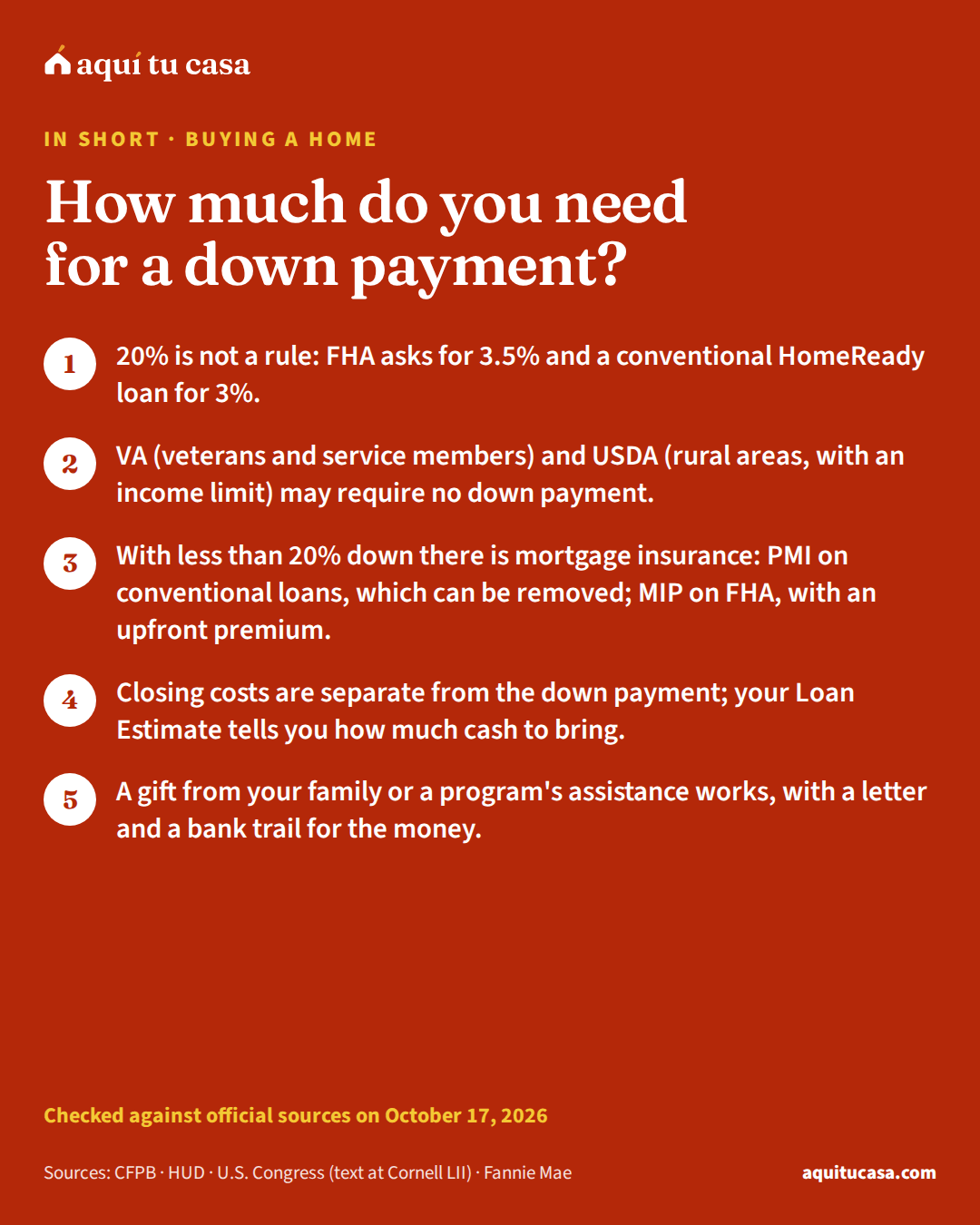
From the guide
20% is not required: what each loan asks for (FHA, conventional, VA, USDA), what changes with less than 20% down, and where the money can come from.
Verified on October 17, 2026 22 official sources
No. FHA accepts 3.5% with a score of 580 or higher, and a conventional HomeReady loan can accept 3%. What changes with less than 20% is that you pay mortgage insurance, and on a conventional loan that insurance can be removed as you pay down the debt.
Read the full guideNo. The down payment is the part of the price you put in; closing costs are the charges to make your loan and transfer the home to you. Freddie Mac says to be prepared to pay between 2% and 5% of the price in closing costs. Your Loan Estimate shows the total cash you need.
Read the full guideYes, with rules. On a conventional loan for your one-unit principal residence, all the money can come from a gift from a relative or another acceptable donor. FHA also accepts gifts from family members, your employer or certain programs. Either way you need a gift letter and proof of the transfer.
Read the full guideYes, for those who qualify. A VA loan often requires no down payment if the price is not higher than the appraised value, and it carries a one-time funding fee unless you are exempt. A USDA guaranteed loan can cover the full price in designated rural areas, with an income limit.
Read the full guideFor FHA, cash kept outside a bank must be deposited in a financial institution or given to the title company, and the lender will ask you to explain how you saved it and over what time. Deposit it early and without splitting it into small amounts: the law prohibits splitting deposits to avoid a bank's reports.
Read the full guideOn FHA, no: your minimum down payment cannot come from the seller or anyone who benefits from the sale. The seller can contribute up to 6% of the price toward your closing costs, prepaid items and points. On a conventional loan, whoever gives you a gift cannot be the seller, the agent or the builder.
Read the full guideBy law, on a fixed-rate mortgage you can ask in writing for it to be canceled when your balance, per your payment schedule, reaches 80% of the home's original value, if you have a good payment history. It ends on its own when it reaches 78%, if you are current.
Read the full guideOn a $332,700 home, the typical US value, the FHA minimum is $11,645, a conventional loan at 3% needs $9,981, and 20% would be $66,540. Closing costs come on top.
Read the full guide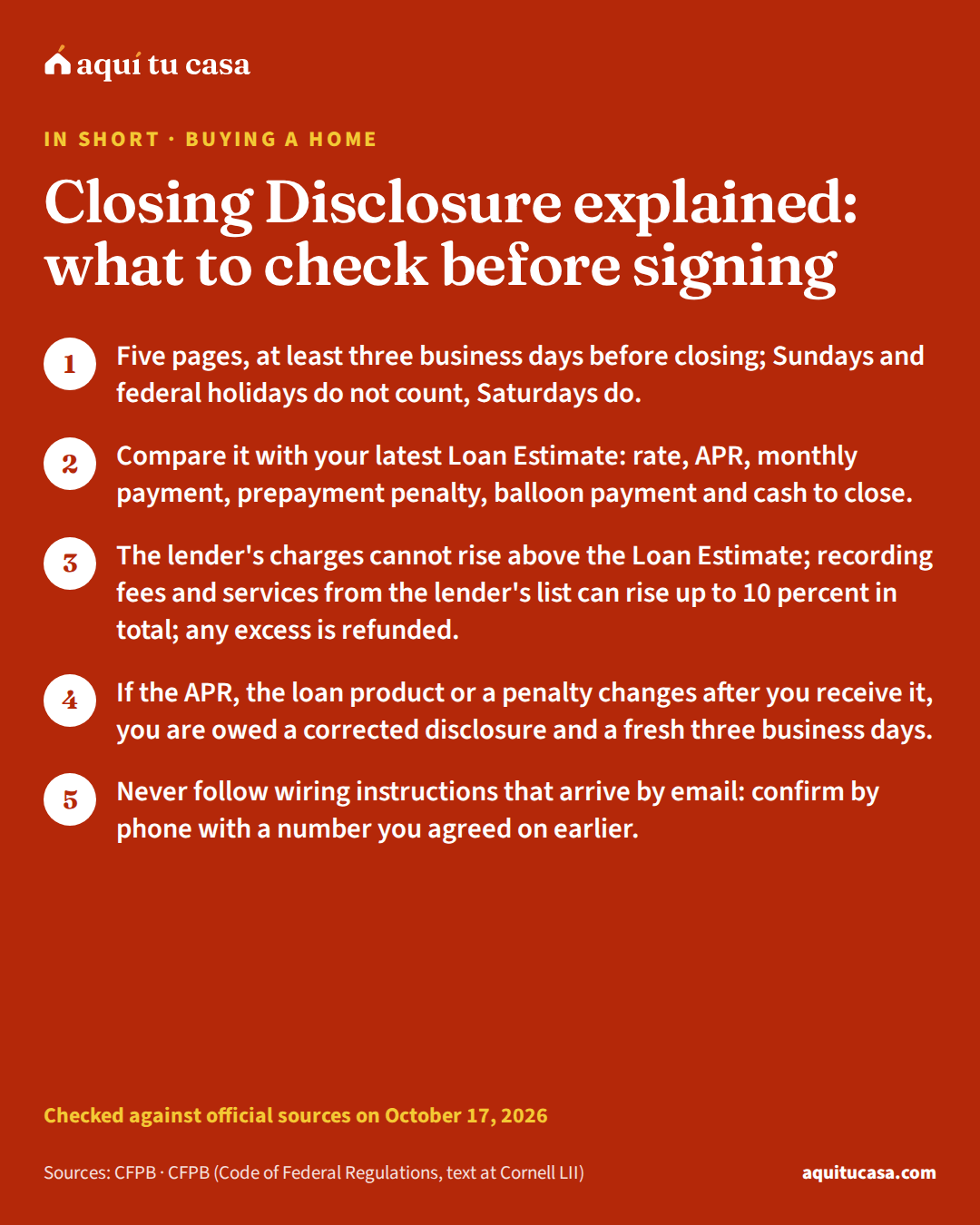
From the guide
What the Closing Disclosure is, when it must reach you, what to check on each of its five pages and which closing costs are not allowed to go up.
Verified on October 17, 2026 18 official sources
The deadline is the lender's, not yours: it must make sure you receive it at least three business days before you sign. If it arrives late, the closing has to move to respect the three days. Say so in writing to the lender and the closing agent, and do not sign in a hurry.
Read the full guideWhat you can demand is that the lender's charges not exceed what the Loan Estimate said and that the services you shopped for cost what you agreed. If a figure rose beyond the tolerances the regulation allows, ask for the correction before signing; if you signed and find it later, the excess must be refunded within 60 days.
Read the full guideNo. If the form has the 'Confirm Receipt' line, the regulation's wording says that by signing you are only confirming you received the document and that you do not have to accept the loan because you signed or received it. The CFPB explains that you are not committed until you sign the closing documents, such as the promissory note and the mortgage.
Read the full guideThe Spanish version of this guide explains each block in Spanish, and the CFPB publishes its home loan toolkit in Spanish, 'Su conjunto de herramientas para préstamos hipotecarios', with a section on the Closing Disclosure. The CFPB also says you can ask the lender whether help is available in your preferred language and that you should never feel pressured to sign. You can go over it with someone you trust or a HUD-approved housing counselor, often for free or at low cost.
Read the full guideThe CFPB says to contact your lender or settlement agent right away to have it corrected. A misspelled name or a wrong amount can delay closing by a few hours or a few days, so review it as soon as it arrives. If the problem continues, you can submit a complaint to the CFPB online or at (855) 411-2372.
Read the full guideAccording to the CFPB, you are not committed until you sign the closing documents, and you can always walk away if you are not comfortable. But you might lose the deposit you gave the seller, face other consequences for breaking the purchase contract and lose application or appraisal fees you paid. Read your contract before you go to closing.
Read the full guideThe CFPB suggests comparing the APR on the Closing Disclosure with the APR on your latest Loan Estimate: it is an easy way to see whether your costs increased. Then check page 2 to see which charges changed and which group they belong to.
Read the full guideBecause the total payment adds mortgage insurance, if you need it, and escrow for property taxes and homeowners insurance. On a typical home with an FHA loan, principal and interest come to $2,213 a month and the estimated total payment reaches $2,759. Your own figure is in the 'Projected Payments' block on page 1.
Read the full guide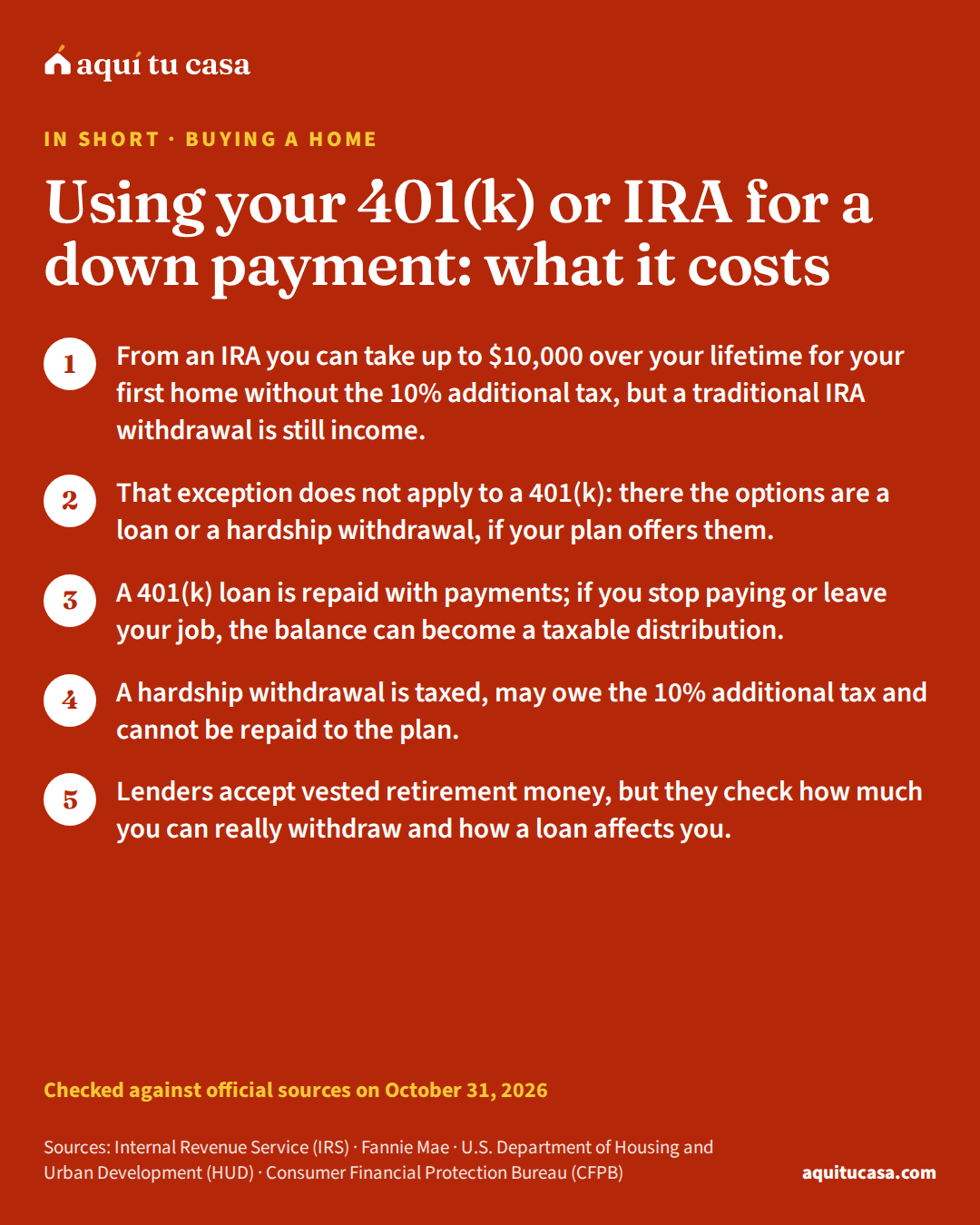
From the guide
The IRS first-home exception for IRAs, 401(k) loans and hardship withdrawals: the taxes, the deadlines and what a mortgage lender looks at.
Verified on October 31, 2026 11 official sources
Without the 10% additional tax, yes, up to $10,000 over your lifetime, if you meet the IRS rules. But if the IRA is traditional, that money generally counts as income and you pay income tax on it. With a Roth, your contributions come out first and are not taxed.
Read the full guideGenerally, someone who had no present interest in a main home during the 2 years before signing the purchase contract. If you are married, your spouse must also meet this. You can use it for your own home or for your child's, grandchild's, parent's or other ancestor's.
Read the full guideNo. In the IRS table, the up-to-$10,000 first-time homebuyer exception applies to IRAs, not to workplace plans like a 401(k). Your plan may offer a loan or a hardship withdrawal, each with its own rules.
Read the full guideWhatever your plan allows, up to a legal maximum: the lesser of $50,000 or the greater of $10,000 or half of your vested balance. The plan does not have to offer loans, so ask first.
Read the full guideIt depends on your plan. Many reduce your account by what you owe. If that happens because you left your job, the IRS gives you until your tax return due date, including extensions, to roll that amount into another plan or an IRA so it does not count as a distribution.
Read the full guideWith Fannie Mae, the lender does not have to count that payment in your monthly debts if it has a copy of the loan document. But if you use the same account as reserves, it subtracts what you borrowed. Ask your lender how it counts it in your case.
Read the full guideNot necessarily. The IRS says that if the purchase is canceled or delayed, you can generally put the money back into an IRA within 120 days without income tax or the 10% additional tax.
Read the full guide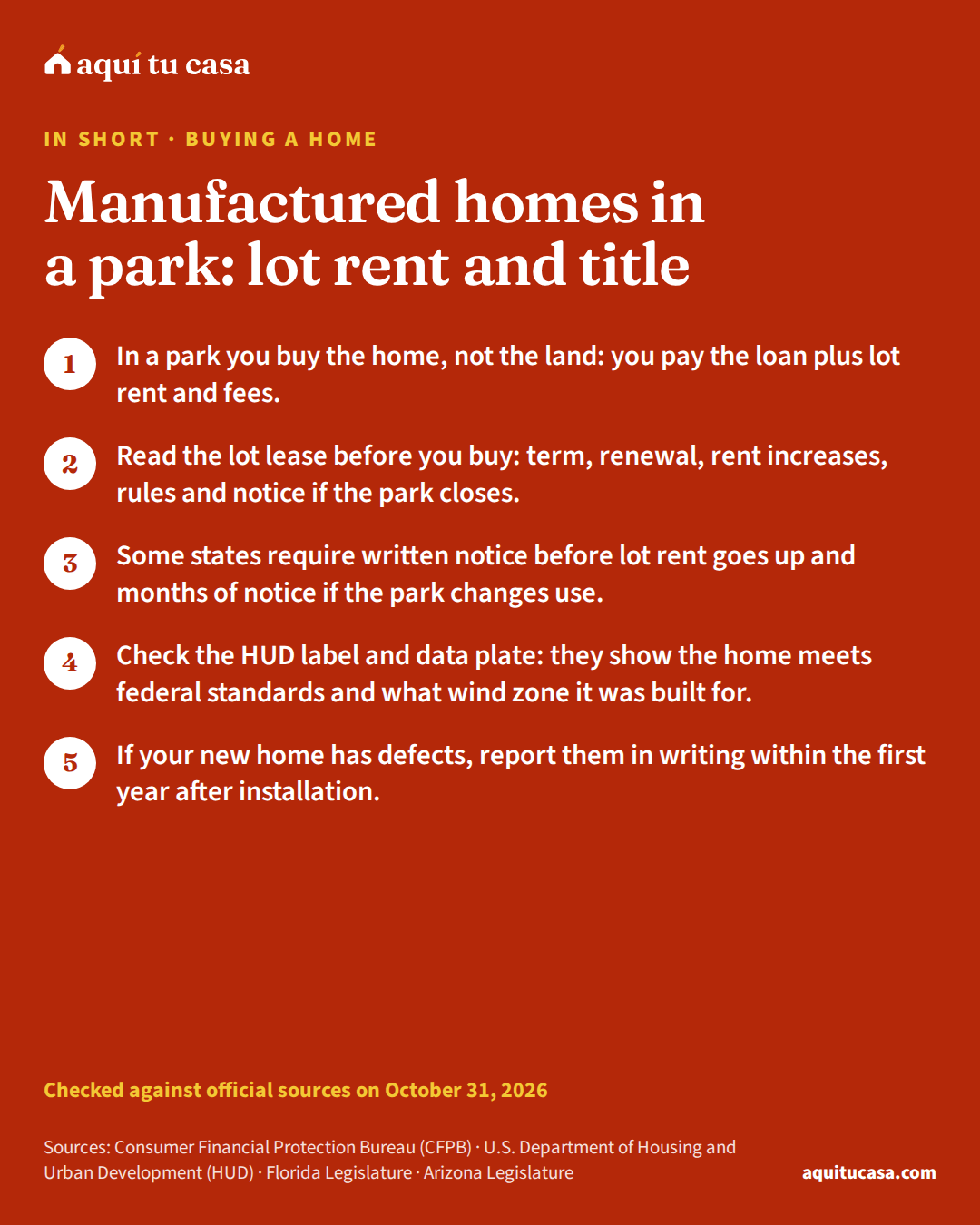
From the guide
What you buy when the home sits on a rented lot, what to check in the lot lease, the HUD label, and what happens if lot rent goes up or the park closes.
Verified on October 31, 2026 14 official sources
Usually not. The CFPB explains that many manufactured homes sit on rented lots in a community that charges ground rent plus fees for shared amenities and services. Always ask whether the lot is sold or rented.
Read the full guideIt depends on your state and your lease. In Florida, the park owner must give you written notice at least 90 days before raising rent. In Arizona, rent can change only when the agreement expires or renews, with at least ninety days' written notice.
Read the full guideIt depends on the state. In Florida, if the land use changes, you must get at least 6 months' notice and you may be entitled to compensation from a state fund. In Arizona, the notice is at least one hundred eighty days and there is a relocation fund.
Read the full guideIn most states, according to the CFPB, it is an option if the home is permanently affixed to land you own, or to rented land with a sufficiently lengthy lease. Each state has its own process; ask the agency that issues titles.
Read the full guideIt is a metal plate on the outside of the home, with three letters and six numbers, showing that section was built to federal standards. The same numbers are on the data plate inside. If it is missing, HUD does not reissue it, but you can request a letter of label verification.
Read the full guideReport it in writing, with a date, to the retailer and the manufacturer. If they do not fix it, contact your state agency or HUD's dispute resolution program, which is free. For HUD, you must have reported it within a year of installation and be the first owner.
Read the full guideMany are chattel loans, secured by the home and not the land. The CFPB says they generally have higher rates and fewer protections than a mortgage, and limited chances to refinance.
Read the full guide
From the guide
How HUD sells its homes on HUD Homestore, the priority period for buyers who will live in the home and the rules of the Good Neighbor Next Door discount.
Verified on October 31, 2026 6 official sources
Read the full guide Do the math: How much house can I afford?
Yes. Under HUD's regulation, anyone may bid regardless of race, color, religion, sex, national origin, familial status, age or disability. There are few exceptions, such as a former owner who did not live in the home and whose default led FHA to pay the claim.
Read the full guideNot on your own. HUD Homestore says you need a HUD-registered real estate broker to submit your bid, and the site has a broker search.
Read the full guideNo. It generally sells as-is, without repairs or warranties. That is why it makes sense to pay for an inspection and check whether the home can be financed with FHA, with a repair escrow or with a 203(k) loan.
Read the full guideFull-time law enforcement officers, pre-K through grade 12 teachers, firefighters and emergency medical technicians whose jobs serve the home's locality. Also, neither you nor your spouse may have owned a home in the year before the bid, or have bought through the program before.
Read the full guideNot exactly. You sign a second mortgage to HUD for the discount amount. You pay no interest or payments if you live in the home 36 months, and the debt drops 1/36 each month. If you sell or move out early, you owe what is left.
Read the full guideYou owe HUD what is left on the second mortgage on the date you sell or leave the home. HUD says its contractor processes those payoffs, for example after a job relocation.
Read the full guideIn a regular HUD sale it is $500 if the price is $50,000 or less; above that, the local HUD office sets it between $500 and $2,000. In Good Neighbor Next Door it is 1% of the list price, between $500 and $2,000. If you fail to close, you can lose it.
Read the full guide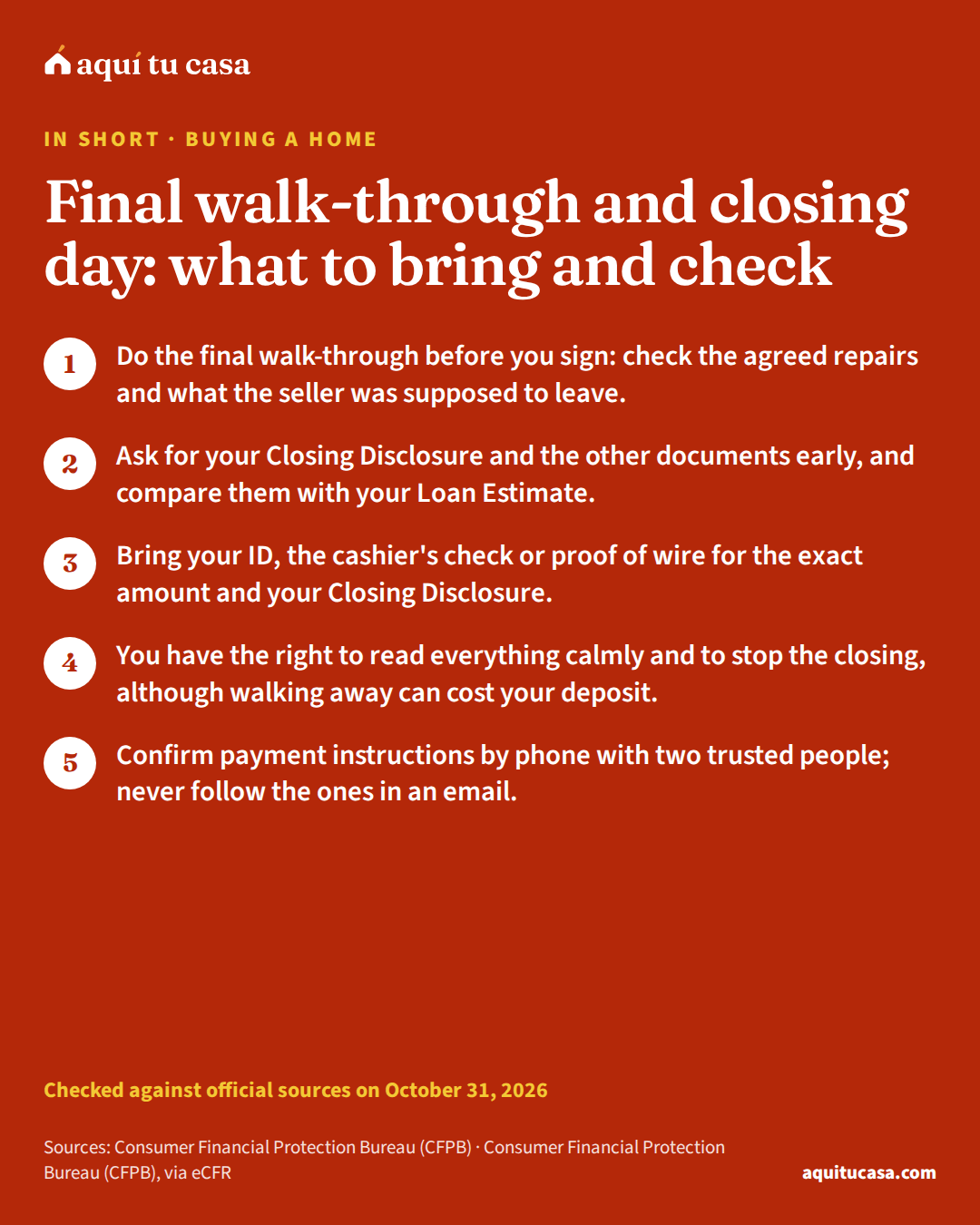
From the guide
How to do the final walk-through, what to bring to closing, what to ask before you sign, when you can stop the closing and what to keep afterward.
Verified on October 31, 2026 7 official sources
It is your last visit to the home before you sign. The CFPB recommends using it to confirm that everything you and the seller agreed would be repaired was repaired and that what the seller agreed to leave is still there. If something is missing, tell the seller right away.
Read the full guideContact the seller right away, through your agent. Sometimes, instead of making the repair, the seller gives you money toward your closing costs, called a seller credit. Get any change in writing before you sign.
Read the full guidePer the CFPB checklist: your ID, a cashier's check or proof of wire transfer for the exact amount, your Closing Disclosure, the list of people to call, your checkbook in case of changes and your co-borrower. Ask the person running the closing whether you need anything else.
Read the full guideYes. The CFPB says you are not committed until you sign. But you might lose your deposit, face other consequences for breaking the contract and lose fees you already paid the lender. Read your contract beforehand to know what is at stake.
Read the full guideSome costs can change slightly. If something important changes, you get a new Closing Disclosure. If the APR rises beyond what is allowed, the loan product changes or a prepayment penalty is added, the law gives you a new waiting period before closing.
Read the full guideDo not wire anything. Call your agent or settlement agent at the number you saved earlier, not the one in the email. The CFPB says never follow instructions contained in an email. If you already sent the money, call your bank right away and file a complaint at ic3.gov.
Read the full guideThe whole packet. The CFPB says to check that you have the Closing Disclosure, the promissory note, the mortgage or deed of trust and the deed. The Closing Disclosure helps with taxes, refinancing and when you sell.
Read the full guideTools
The calculators these guides use. Each one leaves you with a result you can use today.
The price your income can carry.
What you get → maximum price
Your monthly payment with taxes and insurance.
What you get → monthly payment
The cash you need on closing day.
What you get → cash to close
The documents you'll be asked for.
What you get → your document list
From the guide
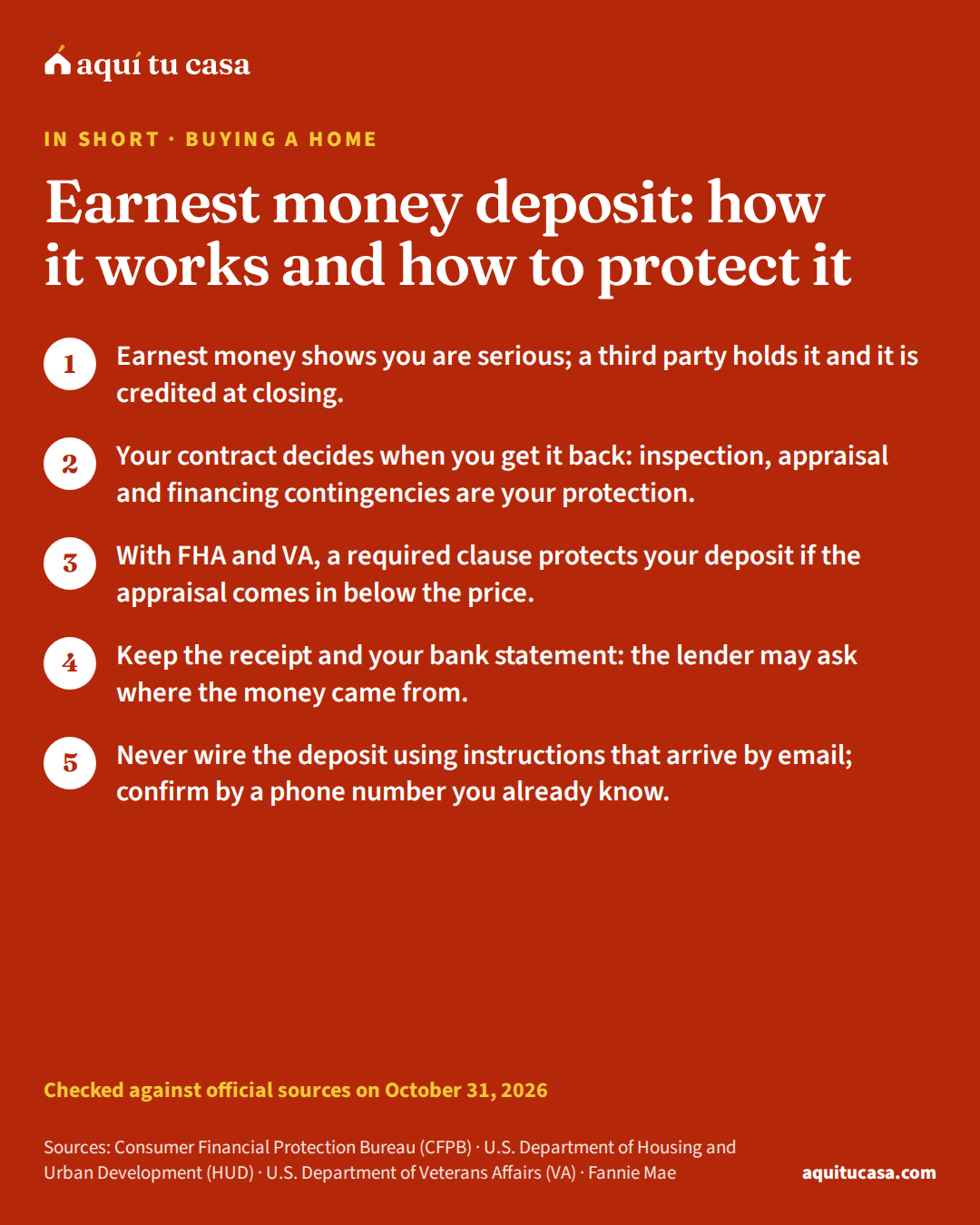
What the earnest money deposit is when you make an offer on a home, who holds it, when you get it back, when you can lose it and how to avoid wire fraud.
Verified on October 31, 2026 9 official sources
No. The CFPB explains that if the purchase closes, the deposit may be applied to your closing costs or down payment. That is why your cash to close already subtracts the deposit you paid.
Read the full guideUsually a third party, such as the title company or a real estate agent; sometimes the seller. Before you pay, ask in writing who will hold it and in what account, and get a receipt.
Read the full guideIf the contract is terminated for a permissible reason, you get it back. Your contract sets those reasons: for example, an inspection contingency lets you cancel without penalty if you are not satisfied with the inspection.
Read the full guideIf you walk away without a reason the contract allows, or you miss its deadlines, the seller may keep the deposit. Read the date of each contingency and meet it in writing.
Read the full guideWith FHA, an amendatory clause says you do not have to complete the purchase or lose your deposit if the appraisal comes in below the price. With VA, the escape clause does the same against VA's reasonable value.
Read the full guideIt is better to pay by check or transfer from your account. The lender may ask for your canceled check or a statement from whoever received the money, and a bank statement showing your balance was enough.
Read the full guideYes, but as a documented gift. On an FHA loan, if the deposit came from a gift, the lender checks that the gift meets the gift rules. Read our guide on gift money from family.
Read the full guide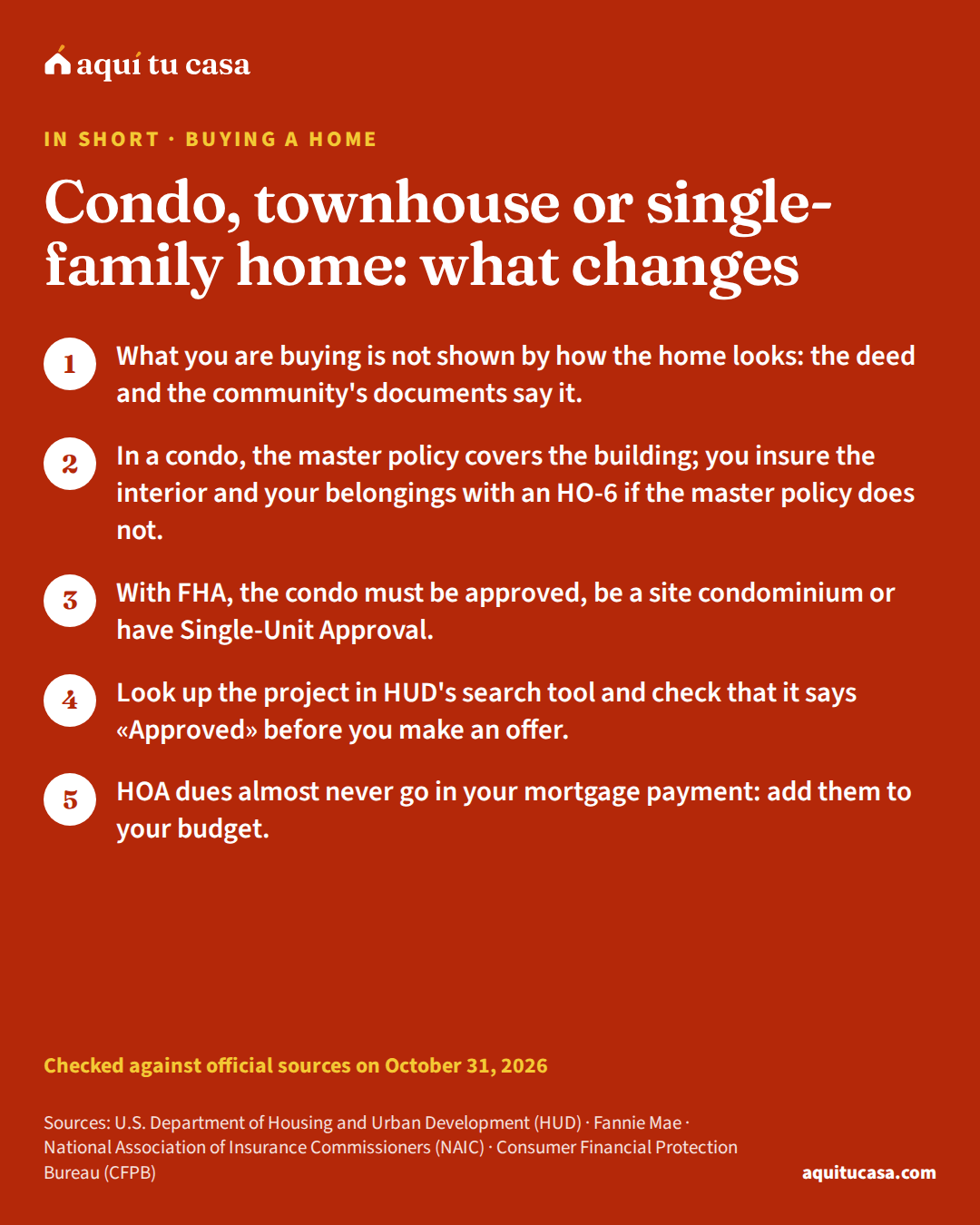
From the guide
What you own in each type of home, how the HOA and insurance (HO-6) change, and how to check whether a condo is FHA-approved before you make an offer.
Verified on October 31, 2026 8 official sources
The form of ownership, not the design. In a condo you own your unit and an undivided share of the common areas. A townhouse can be a condo or a house on its own lot in a development with an HOA. The deed and the community's documents say which.
Read the full guideIt is the policy for owners of a condo unit. According to the NAIC, it insures your belongings and your walls, floors and ceiling. The association's master policy covers the building and common areas; if it does not cover your unit's interior or your improvements, you need your own policy.
Read the full guideLook it up in HUD's public search tool by state, city, ZIP code or name. If it shows «Approved», FHA loans can be processed for its units. If it says «Expired», «Rejected» or «Withdrawn», ask your lender about Single-Unit Approval.
Read the full guideSometimes. HUD allows Single-Unit Approval if the project is complete and ready for occupancy, has at least five units, is not manufactured housing and meets other requirements, such as FHA concentration and financial condition. Your lender makes the request.
Read the full guideUsually not. The CFPB explains that they are paid directly to the association and can range from a few hundred to more than a thousand dollars a month. Add them to your budget before deciding how much you can pay.
Read the full guideIt is a condo project of detached homes, or of townhouse-style homes where the unit includes the dwelling and land, with no manufactured homes. For FHA, the owner pays all the insurance and maintenance of the dwelling and no project approval is needed.
Read the full guideBecause your unit depends on the project. Fannie Mae explains that the lender reviews the project's financial stability, its condition and what you can decide as an owner, because those risks affect your unit's value.
Read the full guide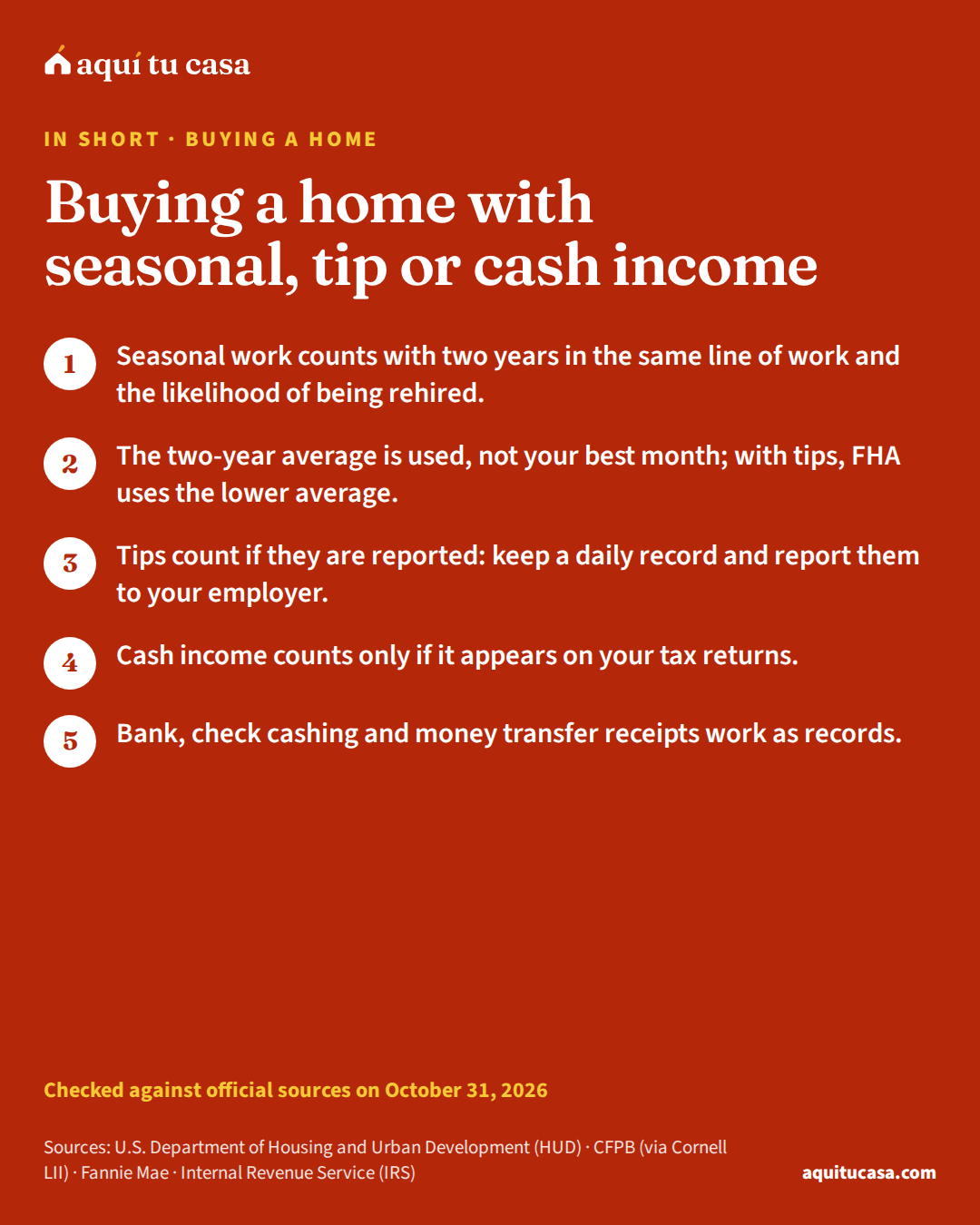
From the guide
How FHA and Fannie Mae count seasonal and farm work, tips and cash income for a mortgage, and which records to start keeping today.
Verified on October 31, 2026 9 official sources
Yes, if you have worked the same line of work for the past two years and are likely to be rehired. FHA uses the average of the previous two full years; Fannie Mae, the year to date plus the two previous years.
Read the full guideIt can. FHA accepts it if documented for two full years and reasonably likely to continue. Fannie Mae requires it to be tied to seasonal layoffs, to recur and to appear on your tax returns.
Read the full guideReport them yourself. If you did not report them to your employer, the IRS asks for Form 4137 on your return. Fannie Mae accepts two years of returns with that form instead of the W-2.
Read the full guideThey can. FHA accepts less than two years if it is documented that you earned them consistently for at least one year. Fannie Mae may accept 12 months with positive factors.
Read the full guideNot what you do not report. On FHA, the lender can only count income reported on your tax returns when required. The IRS says cash income must be reported too.
Read the full guideWith Fannie Mae, if it declined, the lender must confirm it has stabilized; otherwise it cannot be used. With FHA, the lesser of the two-year average and the last-year average is used.
Read the full guideFannie Mae calculates your farm income from Schedule F and can add back depreciation and other deductions. Some farm program or insurance payments may not count if they are one-time.
Read the full guide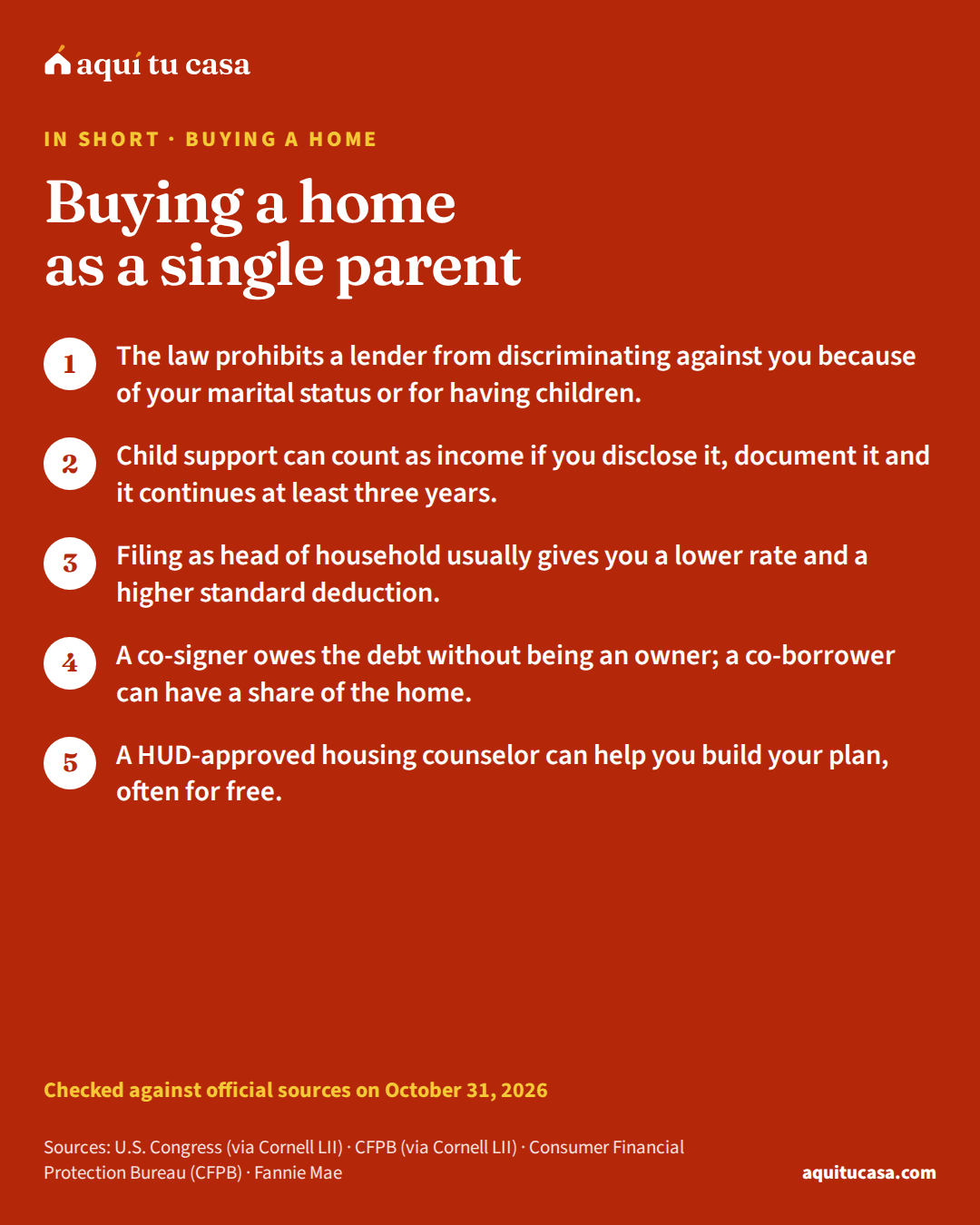
From the guide
How to buy a home on one income: your rights, child support as income, filing as head of household, co-borrower or co-signer, and help programs.
Verified on October 31, 2026 9 official sources
Read the full guide Do the math: How much house can I afford?
Not for that. The Equal Credit Opportunity Act prohibits discrimination based on marital status or sex, and Regulation B prohibits assuming your income will drop because you have children. The Fair Housing Act also protects families with children under 18 in home loans.
Read the full guideOn a mortgage it can ask, but only with the options married, unmarried and separated. Unmarried includes single, divorced and widowed.
Read the full guideIt can, if you choose to disclose it. With Fannie Mae you need a written agreement or order, six months of full, timely payments, and for it to continue at least three years. Read the guide on child support and your mortgage for details.
Read the full guideIt is an IRS filing status for someone who is unmarried on the last day of the year, paid more than half the cost of keeping up their home and lived more than half the year with a qualifying person, such as a child. It usually gives you a lower rate and a higher standard deduction.
Read the full guideFor Fannie Mae, a co-signer signs the note and owes the debt, but has no share of the home on the title. A non-occupant borrower also owes it and may or may not be on the title. Either way, your mom owes the whole debt if you do not pay.
Read the full guideEach down payment assistance program has its own requirements. Use the which-programs-do-I-qualify-for tool to find the ones in your area and ask a HUD-approved housing counselor.
Read the full guideKeep everything in writing and read the guide Lending discrimination: your rights, which explains how to file a complaint.
Read the full guide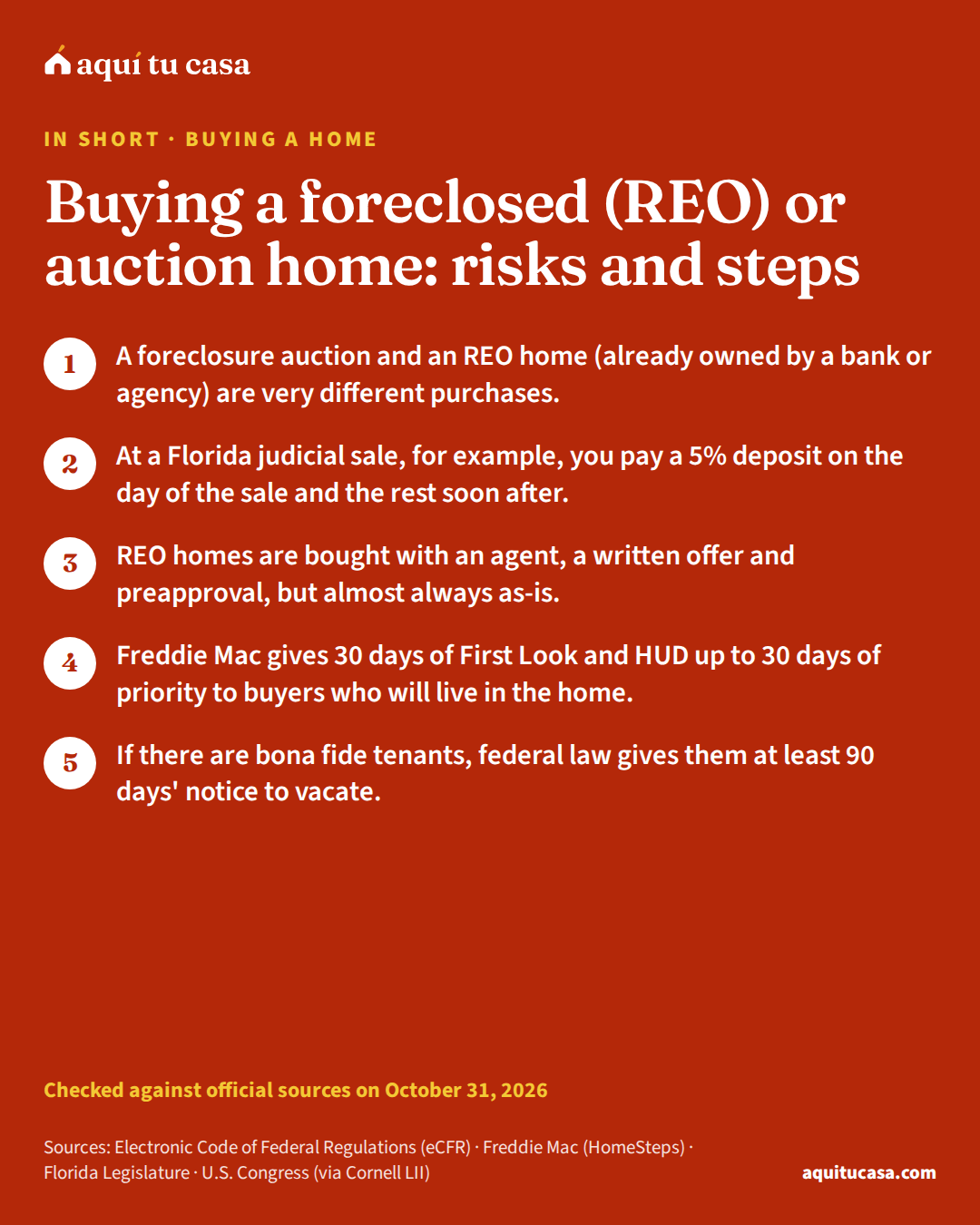
From the guide
Buying a home the bank already owns or at a foreclosure auction: Freddie Mac's First Look period, the offer, tenants in the home and the risks to check.
Verified on October 31, 2026 7 official sources
Read the full guide Do the math: How much house can I afford?
It is a home that became the property of a bank or an agency, such as Freddie Mac or HUD, after a foreclosure and that no one bought at the auction. It is sold through an agent, almost always as-is.
Read the full guideYou can usually get an inspection as in any purchase, but the seller almost never makes repairs. HUD, for example, sells without repairs or warranties. So the inspection helps you decide how much to offer or whether to walk away.
Read the full guideIt is the first 30 days a HomeSteps home is on the market. During that time only buyers who will live in the home, certain stabilization program grantees and nonprofits can buy, without competing with investors.
Read the full guideIt depends on the state. In Florida, for example, the law requires the winner to post a deposit of 5% of the bid on the day of the sale and pay the rest within the set time; if they do not, the sale is repeated and the deposit pays the costs.
Read the full guideFederal law requires giving them at least 90 days' notice to vacate. If they have a bona fide lease, they can stay until it ends, unless you buy the home to live in it, and even then they get the 90-day notice. Some state laws give more protection.
Read the full guideAccording to HomeSteps, complete offers are usually answered or countered within about 48 hours, though final approval can take longer. Legal acceptance happens only when all parties sign the contract.
Read the full guideYes, if the home is marked as eligible for a 203(k), which pays for the purchase and the repairs. Investors cannot use a 203(k) for HUD homes.
Read the full guide
From the guide
What it costs to offer more than the appraisal, how an escalation clause works and what you risk if you waive the inspection or appraisal to win.
Verified on October 31, 2026 10 official sources
Read the full guide Do the math: How much house can I afford?
It is the difference between the price you offered and the appraised value, when the appraisal comes in lower. Because the lender figures the loan on the lower of the two, you pay that difference in cash, on top of your down payment.
Read the full guideNot always, but the CFPB says it is very risky to buy for more than the appraised value. If you offer more, be clear on how much extra cash you might need if the appraisal comes in low, and whether that money leaves you with no cushion.
Read the full guideIt is part of your offer saying you will pay a set amount more than the highest competing offer, with or without a cap. The North Carolina Real Estate Commission discourages them, partly because you may pay more than you wanted or reveal your top price.
Read the full guideIt depends on the state. In Texas and North Carolina, licensed agents may not draft them, because that is the unauthorized practice of law. Ask your agent which approved forms your state uses.
Read the full guideThe penalty-free exit. According to the CFPB, if your contract is contingent on a satisfactory inspection, you can cancel without penalty if you are not satisfied with the results. Without that condition, if you find a serious defect and walk away, you can lose your deposit.
Read the full guideWith FHA, if you did not have the appraised value when you signed, the contract must include a clause that lets you walk away without losing your deposit if the value does not reach the price. With VA, the escape clause does the same. In both cases you can choose to proceed and pay the difference.
Read the full guideIf you did not win, your savings are still with you. Go over with your agent what made the other offer win and get ready for the next one with your top price and extra cash already decided.
Read the full guideChange topic without leaving the questions.

These answers explain the rules but do not know your situation. These organizations go over it with you, free.