Earnest money deposit: how it works and how to protect it
What the earnest money deposit is when you make an offer on a home, who holds it, when you get it back, when you can lose it and how to avoid wire fraud.
Verified against official sources on October 31, 2026 9 official sources

Show contents
In short
What you need to know
Quick answer
Earnest money is the money you put down when the seller accepts your offer, to show you are serious. You do not hand it straight to the seller: usually a third party, such as the title company, holds it. If the purchase closes, it is credited against what you pay at closing. If the contract ends for a reason the contract allows, such as an inspection contingency, you get it back. If you walk away without an allowed reason, you can lose it. Never wire it using instructions that arrive only by email: confirm by phone.
What matters most
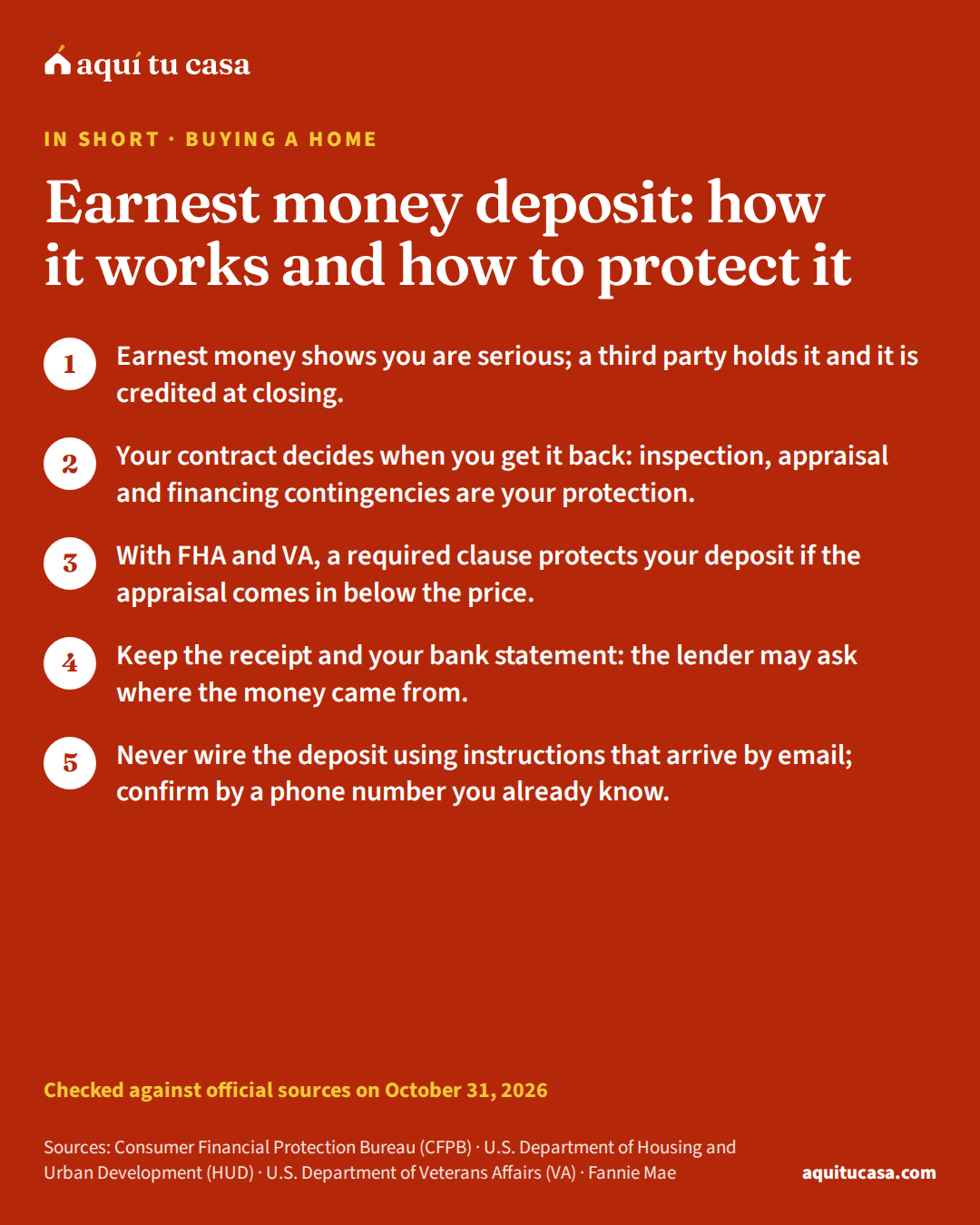
- Earnest money shows you are serious; a third party holds it and it is credited at closing.
- Your contract decides when you get it back: inspection, appraisal and financing contingencies are your protection.
- With FHA and VA, a required clause protects your deposit if the appraisal comes in below the price.
- Keep the receipt and your bank statement: the lender may ask where the money came from.
Is this for you?
This guide is for you if…
- You are about to make an offer on a home and you are asked for an earnest money deposit.
- You already paid the deposit and want to know what happens to it if the inspection or appraisal goes badly.
- The purchase fell through and you want to know whether you should get your money back.
Get direct help first if…
- You rent and are being asked for a security deposit: read our security deposit guide for renters.
- You already sent money to an account you got by email and now nobody answers: read «I was scammed, what now?» today and call your bank.
When the seller accepts your offer, you will almost always be asked for a deposit. It is called earnest money, or an earnest money depositearnest moneyEarnest money is a deposit the buyer pays when signing the purchase contract to show good faith that the offer is serious. The seller does not keep it: a neutral third party (the title company or a closing agent) normally holds it, and at closing it is applied to your down payment or closing costs. If you back out for a reason the contract allows, such as an inspection or financing contingency, you get it back; if you back out without a valid reason, you can lose it.See the full definition. It shows you are serious about the purchase.1 It is your money, often from years of savings. This guide explains who holds it, when you get it back, when you can lose it and how to keep it safe from scams.
What earnest money is and how it works
Earnest money is the money you pay when you sign the contract to buy a home. The CFPB puts it this way: the seller or a third party, such as a real estate agentreal estate agentA real estate agent (often called a realtor) is the professional who helps you buy or sell a home. There are buyer's agents and seller's agents (listing agents). A buyer's agent helps you find homes that fit your needs and budget, gives you information about neighborhoods and property taxes, prepares and presents your offer, negotiates with the seller and guides you to closing. Their commission is negotiable and not set by law; it is written into the agreement you sign with your agent. On the Closing Disclosure, the agent appears in the contact table, usually with a state license number.See the full definition or a title companytitle companyA title company is a company, or its authorized agent, that is qualified to issue title insurance. It searches public records for problems with the home's title (a title search), prepares the title commitment and issues the lender's and owner's policies. In most states, the fee for conducting your closing is also part of its charges. If title services are listed in section C of your Loan Estimate, you can shop for them yourself. Under the federal Real Estate Settlement Procedures Act (RESPA), a seller may not require you to buy title insurance from a particular company.See the full definition, holds it. Then one of three things happens:1
- The purchase closes. The deposit goes toward your closing costsclosing costsClosing costs are all of the costs you pay on closing day on top of the down payment: lender fees, the appraisal, the credit report, title insurance, the closing agent's fees, any transfer taxes your state or county charges and the first deposits into the escrow account. The lender must itemize them on the Loan Estimate within days of your application and confirm them on the Closing Disclosure before you sign. Some can be paid by the seller, and several state programs help cover them.See the full definition or your down paymentdown paymentThe down payment is the part of the home's price you pay out of your own pocket when you buy; the loan covers the rest. In U.S. Spanish it is also called enganche, cuota inicial or entrada. Each loan type has its own minimum: FHA requires at least 3.5% of the value, VA and USDA loans may require none, and conventional loans ask for more if you want to avoid private mortgage insurance. A larger down payment lowers the loan, the monthly payment and the total interest; many state programs help families put it together.See the full definition.
- The contract ends for a permissible reason. You get it back.
- You do not perform in good faith. You can lose it, and it is paid to the seller.
The deposit is not an extra cost. On your Loan EstimateLoan EstimateThe Loan Estimate is a three-page form you receive from the lender within days of applying for a mortgage. In the same format at every bank, it sums up the terms of the loan being offered: amount, interest rate, whether the payment can change, the estimated monthly payment with taxes and insurance, the itemized closing costs and how much cash you need at closing. Because every lender uses the same form, it lets you compare offers side by side. It commits you to nothing: requesting one is not accepting the loan.See the full definition, the cash to close includes your down payment and closing costs, minus the deposit you already paid.2 You will see the same on your Closing Disclosure. Our guide Closing Disclosure explained shows where it appears.
Federal law does not set an amount. Your offer sets it and the seller accepts it. But if you put down a lot, the lender will look at it: with FHA, if it exceeds 1% of the price, the lender must verify where it came from.5
Who holds your money
The safest setup is for a neutral third party, such as the title company or the settlement agentsettlement agentThe settlement agent (also called a closing agent) is the person or company that coordinates the closing so that everything the contract requires is accounted for. Depending on the location, it may be a title company, an escrow company (in most western states) or a closing attorney (in some eastern states). It collects the money from the lender and from you, pays the seller, distributes the closing costs and records the documents with the county. It works for all the parties; it is not your personal representative. Ask it how to pay the money you need to bring to closing.See the full definition, to hold the money in a separate account until closing.1 Before you pay, get these three things in writing:
- The name of who holds the money. It should be in the contract.
- How to pay. By check made out to that company or by transfer from your account. Avoid cash: later you will need to prove the payment.
- A receipt. The lender verifies the deposit with your canceled check or a written statement from the holder.7
Do not hand the money to anyone, not even your agent, without a receipt and without the contract saying who holds it. If the seller wants the money directly, ask why and ask for a third party to hold it.
Contingencies: your safety net
A contingencycontingencyA contingency is a condition you add to your offer or purchase contract to protect yourself: if it is not met, you can change or end the contract and, in general, get your earnest money back. The most common are the inspection contingency, if the inspection finds problems; the appraisal contingency, if the appraisal comes in below the price; the financing or mortgage contingency, if you cannot get the loan within the agreed time; and the home sale contingency, tied to selling your current home. Contingencies are a normal part of buying, but too many can make your offer less attractive to the seller.See the full definition is a condition in your contract. If it is not met, you can leave the purchase without losing the deposit. Contingencies are the permissible reason the CFPB talks about.1 The three most common:
- Inspection. If your contract is contingent on a satisfactory inspectionhome inspectionA home inspection is a review of the property's physical condition by an inspector before you finish buying: roof, foundation, plumbing, electrical, heating and cooling, signs of moisture or pests. It is often part of the home buying process and you pay for it, not the lender; unlike the appraisal, it does not say what the home is worth but what problems it has. With the report you can ask for repairs, negotiate the price or walk away if your contract includes an inspection contingency. Some assistance programs require one.See the full definition, you can cancel without penalty if you are not satisfied with the results. If the inspection finds repairs, you can negotiate with the seller over who pays, but the seller may say no.3 FHA does not inspect the home for you: an inspection only happens if you arrange one, and if you ask early you may be able to make your contract contingent on it.4
- Appraisalhome appraisalAn appraisal is a written document that gives a professional appraiser's opinion of how much a property is worth. The lender orders it before approving the mortgage, because the home is the loan's collateral and the lender does not want to lend more than it is worth. If the appraisal comes in below the price you agreed, the bank bases the loan on the lower value and you will have to cover the difference, renegotiate the price or walk away if your contract allows it. An appraisal is not an inspection: it measures value, not the home's condition.See the full definition. It protects you if the home is worth less than the price. Our guide What if the appraisal comes in low? explains your options.
- Financing. It protects you if you do not get the loan. Ask for it even if you have a preapprovalpreapproval letterA preapproval or prequalification letter is a document from a lender saying it is generally willing to lend you up to a certain amount. It is not a guaranteed loan offer. Lenders use the two words differently: some issue a prequalification based on information you report, without verifying it, and only issue a preapproval after reviewing your documents; others use the words the other way around or interchangeably. That is why it pays to ask what the letter is based on. Sellers often ask for one before accepting an offer.See the full definition: our guide Preapproval vs. prequalification explains why a preapproval is not a promise of a loan.
Each contingency usually has a deadline in your contract. Read what happens if that deadline passes, and write every date on your calendar the day you sign.
You get your deposit back, or you can lose it
Permissible reason
You get it back
- The inspection does not satisfy you and your contract depends on it
- With FHA, the appraisal comes in below the contract price
- With VA, the price exceeds VA's reasonable value
- Another contract condition is not met, within its deadline
No permissible reason
You can lose it
- You change your mind with no contingency to cover you
- You let a contingency expire, if your contract treats it that way
- You waived the contingency to win the offer
- You do not do what the contract requires on time
Your contract decides. Read the contingencies and their dates before you sign.
Example with real numbers
A couple making their first offer
An example in words, not a real case, of what can happen to the deposit.
- When they sign the offer
- They pay the deposit by check to the title company and keep the receipt
- Their contract
- It has inspection, appraisal and financing contingencies, each with its own date
- The inspection finds a roof problem
- They ask the seller to fix it; the seller can say yes or no
- If the seller says no
- They can cancel within the contingency period and ask for their deposit in writing
- If they go ahead and close
- The deposit is subtracted from their cash to close
The rules in this example come from the CFPB.32 Use the closing costs calculator to see what you need on closing day.
Run it with your numbersClosing costs
If your loan is FHA or VA: extra protection
With FHA and VA, a special clause protects your deposit if the appraisal comes in low, even if your contract has no appraisal contingency.
FHA: the amendatory clause. If you did not receive the statement of appraised value before signing the contract, the contract must be amended before closing with a clause saying you are not obligated to complete the purchase or lose your deposit unless you receive a written appraised value of at least the contract price. You decide whether to go ahead. The clause is not required in certain sales, such as HUD-owned homes or the 203(k) program, or when the seller is a government agency.5 Our FHA loan guide explains the rest.
VA: the escape clause. If you sign before you receive VA’s Notice of Value, the escape clause lets you back out without penalty, and without losing your deposit, if the price exceeds the reasonable value VA sets. You can also go ahead, but the loan is capped at the lesser of the price or that value. Watch out with new homes: deposits to the builder for upgrades are not earnest money, and the clause does not cover them.6 Our guide Buying a new construction home explains those deposits.
From deposit to closing, step by step
1. Read the deposit section of the contract
Before you sign the offer
How much it is, who holds it and which contingencies protect you.1
2. Confirm who holds the money
The day you sign
Call the title company at a number you took from its official site, not from an email.8
3. Pay from your account and get a receipt
Within the contract deadline
Keep the receipt and the statement; the lender may ask for them.7
4. Schedule the inspection early
The first few days
That way your contract can depend on the results.4
5. Meet each date in writing
During the contract
If you will use a contingency, give written notice before its deadline.3
6. Check the credit at closing
When you get the Closing Disclosure
The deposit you paid should be subtracted from your cash to close.2
The lender will ask where the money came from
The deposit counts toward your down payment and closing costs, so the lender reviews it like the rest of your money.7 Be ready:
- With FHA. If the deposit exceeds 1% of the price, or is large compared with your history of saving, the lender must verify the amount and source: with your canceled check, a statement from whoever received the money, a bank statement showing your average balance was enough, or electronic verification.5
- With Fannie Mae. If the deposit counts toward your minimum contribution, your statements must show your average balance over the previous two months was enough. Large deposits, or ones above what is customary in your area, are closely reviewed.7
- If a relative helped. With FHA, if the deposit came from a gift, the lender checks that the gift meets the gift rules.5 Our guide Gift money from family explains the gift lettergift letterA gift letter is a document signed by the person who gives you money to buy a home, stating that the money is a gift and not a loan. For some loans, a gift can pay the down payment, closing costs or reserves, as long as you can prove where the money came from. Under Fannie Mae's rules, the letter states the amount of the gift, says no repayment is expected, and gives the donor's name, address, phone number and relationship to you. The lender also verifies that the money moved from the donor's account to yours or to the closing agent.See the full definition.
If you keep cash at home, put it in your account well before you pay the deposit. Our guide Cash savings and your mortgage explains how to document it.

Watch out for wire fraud
The deposit is one of the first large payments in a purchase, and scammers know it. The CFPB warns that they pose as your agent or the settlement agent and send emails with fake wiring instructions, or a last-minute change of account.8 If you send the money to that account, you can lose all of it. This is called wire fraudwire fraud at closingThis is a scam aimed at people about to close on a home. Days before closing, the scammer sends an email that looks like it comes from your real estate agent or settlement agent with "new" instructions to wire or electronically transfer your down payment or closing costs to a different account. If it works, getting the money back can be very hard. The CFPB recommends writing down two trusted contacts ahead of time, confirming any instructions with them using only those numbers, and not using phone numbers or links in the email. If it happens to you, call your bank right away to stop or reverse the transfer.See the full definition.
To protect yourself, the CFPB recommends:8
- Pick two trusted people (your agent and the settlement agent, for example) and talk with them in person or by phone about how you will pay.
- Never follow instructions contained in an email. Confirm the account name and number in person or by the phone number you agreed on earlier.
- If you already sent money to a fake account, call your bank immediately and ask for a wire recall. Then file a complaint with the FBI at ic3.gov.
Our guide I was scammed, what now? explains the steps if it already happened.
If this is you
It is your first offer
Ask for the contract to say who holds the deposit and to include inspection, appraisal and financing contingencies.1
Your savings are in cash
Deposit them in your account before you pay; the lender reviews your balance and where the money came from.7
You are buying with a VA loan
The escape clause protects your deposit if the price exceeds VA's reasonable value.6
Your family is helping with the deposit
Make it a documented gift; with FHA, the lender checks that the gift meets the rules.5
You are buying with FHA and the appraisal comes in low
The amendatory clause lets you walk away without losing your deposit.5
You got an email with a new account
Do not wire anything. Call the title company at a number you looked up yourself.8
If your deposit is not returned
If the contract ended for a permissible reason, your deposit should be returned.1 But whoever holds the money follows what the contract says. VA explains it this way for its clause: the title company or other entity holding the money must follow the contract and return the deposit, but VA cannot intervene in civil disputes.6
If there is a disagreement:
- Gather your contract, the deposit receipt, the contingency dates and every notice you sent in writing.
- Ask the holder in writing to return the money, and explain which contingency you used and when you gave notice.
- If you cannot agree, look for free legal aidlegal aidLegal aid is the free civil legal help that nonprofit organizations and their lawyers provide to low-income people in civil, not criminal, matters. In housing, that includes representing families facing eviction or foreclosure, alongside matters such as custody, child support, protection from domestic violence and access to benefits. In the United States, the Legal Services Corporation, created by Congress, funds a nationwide network of these organizations; its finder points you to the one in your area. Each sets its own income limits.See the full definition. Our guide Free legal aid explains how to find it.
A HUD-approved housing counselorHUD-approved housing counselorA HUD-approved housing counselor works at an agency HUD has approved to provide housing counseling: independent, expert advice customized to your situation about buying a home, renting, a missed mortgage payment, a foreclosure or credit problems. The agencies usually charge little or nothing; many serve in Spanish and offer the homebuyer education course several assistance programs require. They are not lenders or real estate agents and sell you nothing. Your county page lists the official agencies with phone numbers.See the full definition can also walk you through the buying process, often for free or at low cost.9

Mistakes that cost you
Mistake: Paying the deposit in cash with no receipt.
Instead: Pay from your account and get a receipt; the lender verifies payment with your check or a statement from the holder.7
Mistake: Wiring the deposit using instructions from an email.
Instead: Confirm the account in person or by a phone number you already knew.8
Mistake: Waiving the inspection to win the offer without thinking it through.
Instead: With an inspection contingency you can cancel without penalty if it does not satisfy you.3
Mistake: Letting a contingency deadline pass.
Instead: Write down every deadline in the contract and, if you will use a contingency, give written notice in time.
Mistake: Thinking a low appraisal costs you the deposit with FHA.
Instead: FHA's amendatory clause lets you walk away without losing your deposit.5
Mistake: Giving a builder an upgrade deposit and thinking it is earnest money.
Instead: With VA, those deposits are not earnest money and the escape clause does not cover them.6
Mistake: Putting down a large deposit with money you cannot document.
Instead: With FHA, above 1% of the price the lender verifies where it came from.5
What to do this week
- Before you make an offer, ask your agent for a sample contract and read the deposit and contingency sections.1
- Decide how much you can put down without leaving yourself short at closing; the closing costs calculator helps you see the total.2
- Gather your bank statements for the last two months.7
- Look up the title company’s phone number on its official site and save it.8
- If you are buying with FHA or VA, ask your lender about the amendatory clause or the escape clause.6
- Read our guide How to buy a home step by step to see where the deposit fits in the process.
Your numbers
We start with the typical home value in the United States ($332,700). Enter the price you are looking at.
Adjust advanced details
The minimum for this loan is 3.5%. A larger down payment lowers the monthly payment but takes longer to save.
As a share of the price. It is an example; your lender's Loan Estimate has the real figure.
Annual interest of the account where you keep the money. Leave it at zero if you do not know.
Let's do the math
Time to reach your goal
Enter how much you can save each month.
Your goal
- Down payment (3.5% of the price)
- $11,645
- Closing costs (3% of the price)
- $9,981
- Savings target
- $21,626
- You already have
- $0
- Still missing
- $21,626
What helps
- Set up an automatic transfer on payday into a separate account you do not use for spending.
- Ask about your state's and city's assistance programs before setting the goal: many cover part of the down payment or closing costs.
- If family gives you part of it, the lender usually asks for a gift letter and the transfer record; ask beforehand how they want it.
- Revisit the goal whenever the price you are looking at, the loan type or what you can save changes.
An educational estimate, not a loan offer. Closing costs are an example (3% of the price); the real figure comes in the Loan Estimate. We do not count the reserves some lenders require after closing.
Ready to see the numbers? Find your county here
See how this applies in your county: its loan limits, prices and rents, from the official data.
Printable checklist
Frequently asked questions
Is earnest money extra money on top of everything else?
No. The CFPB explains that if the purchase closes, the deposit may be applied to your closing costs or down payment. That is why your cash to close already subtracts the deposit you paid.
Who holds my money?
Usually a third party, such as the title company or a real estate agent; sometimes the seller. Before you pay, ask in writing who will hold it and in what account, and get a receipt.
When do I get it back?
If the contract is terminated for a permissible reason, you get it back. Your contract sets those reasons: for example, an inspection contingency lets you cancel without penalty if you are not satisfied with the inspection.
When can I lose it?
If you walk away without a reason the contract allows, or you miss its deadlines, the seller may keep the deposit. Read the date of each contingency and meet it in writing.
What happens if the appraisal comes in low with FHA or VA?
With FHA, an amendatory clause says you do not have to complete the purchase or lose your deposit if the appraisal comes in below the price. With VA, the escape clause does the same against VA's reasonable value.
Can I pay the deposit in cash?
It is better to pay by check or transfer from your account. The lender may ask for your canceled check or a statement from whoever received the money, and a bank statement showing your balance was enough.
Can a relative give me the deposit money?
Yes, but as a documented gift. On an FHA loan, if the deposit came from a gift, the lender checks that the gift meets the gift rules. Read our guide on gift money from family.
Sources
Every figure in this guide comes from one of these official sources. The number next to a sentence leads to the source behind it.
Each source on one line: who publishes it, its title, its address and the date we read it.
- 1. Consumer Financial Protection Bureau (CFPB) · Mortgage key terms · consumerfinance.gov · Accessed October 31, 2026
- 2. Consumer Financial Protection Bureau (CFPB) · Loan Estimate Explainer · consumerfinance.gov · Accessed October 31, 2026
- 3. Consumer Financial Protection Bureau (CFPB) · Schedule a home inspection · consumerfinance.gov · Accessed October 31, 2026
- 4. U.S. Department of Housing and Urban Development (HUD) · For Your Protection: Get a Home Inspection (HUD-92564-CN) · hud.gov · Accessed October 31, 2026
- 5. U.S. Department of Housing and Urban Development (HUD) · Handbook 4000.1, FHA Single Family Housing Policy Handbook · hud.gov · Accessed October 31, 2026
- 6. U.S. Department of Veterans Affairs (VA) · VA Escape Clause · benefits.va.gov · Accessed October 31, 2026
- 7. Fannie Mae · Selling Guide B3-4.3-09, Earnest Money Deposit · selling-guide.fanniemae.com · Accessed October 31, 2026
- 8. Consumer Financial Protection Bureau (CFPB) · Mortgage closing scams: How to protect yourself and your closing funds · consumerfinance.gov · Accessed October 31, 2026
See the other 1 sources
- 9. Consumer Financial Protection Bureau (CFPB) · Find a housing counselor · consumerfinance.gov · Accessed October 31, 2026
Keep reading
Related guides
If this guide helped, these follow the same path.

Buying a home 15 minute read
How to buy a home in the United States, step by step
The nine steps to buying a home: paperwork, credit, budget, assistance, preapproval, offer, inspection, closing and the first year, with official sources.
- Order matters: credit and budget before looking at homes; preapproval before making an offer.
- Get offers from several lenders and compare their Loan Estimates: each one has three business days to give you one.
- Never send closing money by following an email: confirm by phone with the number you already had.
- Buying a home Home inspection: what it covers and when to get it What a home inspection is, how it differs from the appraisal, when to get it under a contingency, radon and lead tests, and what to do with the report. 12 minute read
- Buying a home What if the appraisal comes in low, and what you can do Why a low appraisal matters, your right to a copy, how to negotiate, pay the difference or cancel, and how to ask for a reconsideration of value. 11 minute read
- Buying a home Gift money from family to buy a home Who can give you money for the down payment, what the gift letter must say, how the transfer is documented and what happens with taxes. 11 minute read

Tools for this topic
Was this guide useful?
Thank you. Your answer stays in your browser; nothing is sent.