Preapproval vs. prequalification: what each letter means
What prequalification and preapproval letters are, what lenders check, why neither one is a loan, and how to compare lenders without hurting your credit.
Verified against official sources on October 17, 2026 14 official sources

Show contents
In short
What you need to know
Quick answer
Both are letters from a lender saying how much it is willing to lend you, up to a certain amount and based on certain assumptions; neither one is a guaranteed loan offer. Lenders use the names differently: some call a letter based on what you tell them a prequalification and one based on verified information a preapproval, so ask what the lender actually checked. The letter does not commit you to that lender: to compare real offers, get Loan Estimates from several lenders, and remember that, according to the CFPB, multiple credit checks from mortgage lenders within 45 days count as a single inquiry.
What matters most
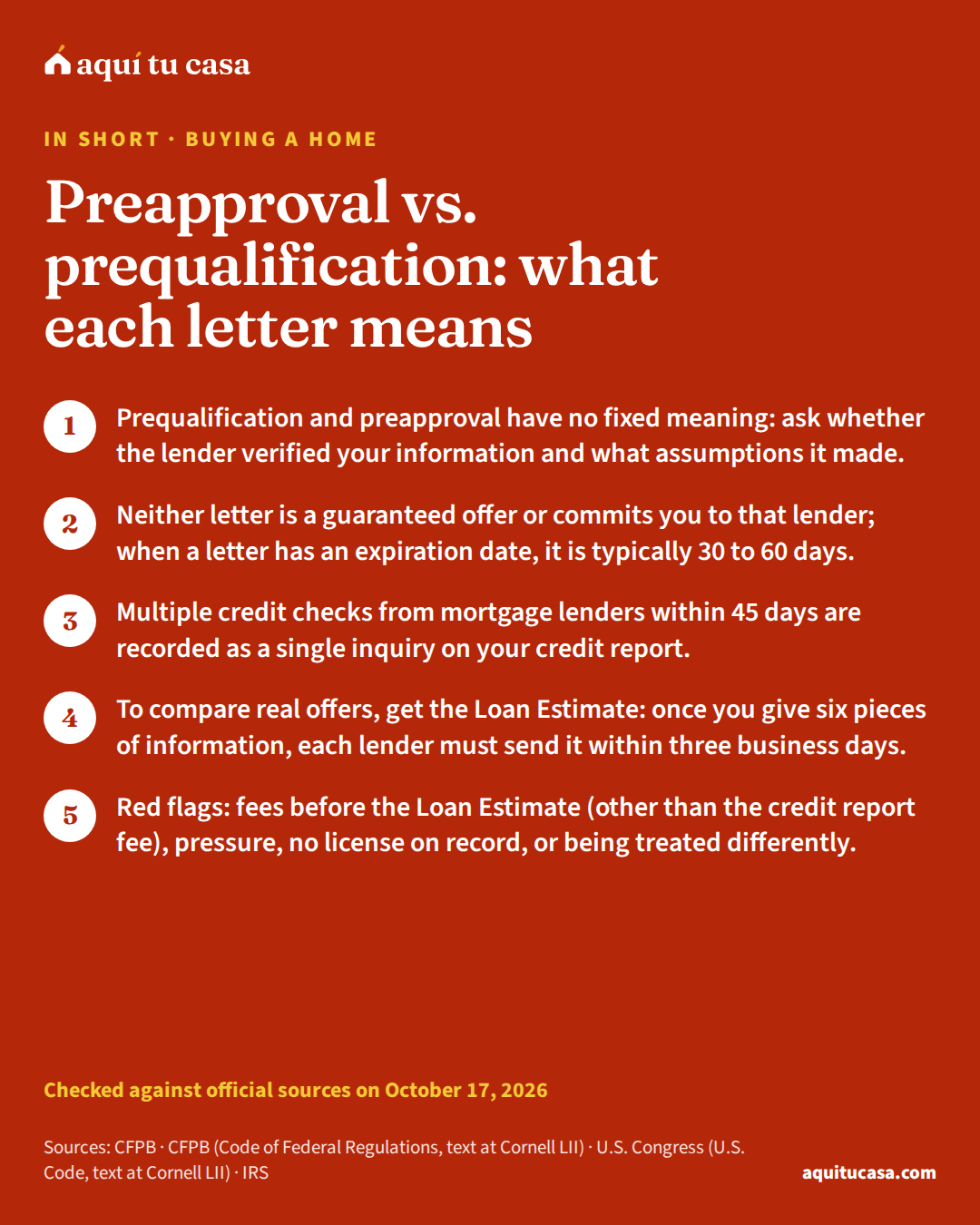
- Prequalification and preapproval have no fixed meaning: ask whether the lender verified your information and what assumptions it made.
- Neither letter is a guaranteed offer or commits you to that lender; when a letter has an expiration date, it is typically 30 to 60 days.
- Multiple credit checks from mortgage lenders within 45 days are recorded as a single inquiry on your credit report.
- To compare real offers, get the Loan Estimate: once you give six pieces of information, each lender must send it within three business days.
Is this for you?
This guide is for you if…
- You are about to start house hunting and an agent or a seller asked you for a preapproval letter.
- A lender gave you a 'prequalification' and you do not know whether it is good enough to make an offer.
- You want to talk to several lenders and worry that it will hurt your credit.
- You have an ITIN and want to know which papers to gather before talking to lenders.
Get direct help first if…
- You already chose a lender and received your Closing Disclosure: read the Closing Disclosure guide.
- You believe a lender discriminated against you: besides this guide, look for free legal help.
When you start house hunting, you hear about “preapproval” and “prequalification”, sometimes as if they were the same thing. This guide is for first-time buyers: what each letter is, what the lender looks at, why neither one is an approved loan, how to compare lenders without hurting your credit and which papers to have ready.
- Window in which several mortgage credit checks count as one
- 45 days4
- Of information that oblige a lender to give you a Loan Estimate
- 6 pieces5
- To receive the Loan Estimate after you give that information
- 3 business days5
- How long a preapproval letter typically lasts, if it has an expiration date
- 30 to 60 days2
Two names for a similar letter
A preapproval letterpreapproval letterA preapproval or prequalification letter is a document from a lender saying it is generally willing to lend you up to a certain amount. It is not a guaranteed loan offer. Lenders use the two words differently: some issue a prequalification based on information you report, without verifying it, and only issue a preapproval after reviewing your documents; others use the words the other way around or interchangeably. That is why it pays to ask what the letter is based on. Sellers often ask for one before accepting an offer.See the full definition, or prequalification letter, says how much a lender is willing to lend you, up to a certain amount and based on certain assumptions. According to the CFPB (the Consumer Financial Protection Bureau), both give you a sense of your chances of getting a mortgage, but neither one is a guaranteed loan offer.1
The confusion is in the names: each lender uses them its own way. Some give a prequalification based on what you tell them, without checking it, and a preapproval only once they have verified your information. That is why the CFPB says not to worry about the word: it tells you little about what the lender actually did.1
Prequalification, preapproval and the Loan Estimate
At some lenders
Prequalification letter
At some lenders
Preapproval letter
The names change from lender to lender: ask what the lender checked, not what the letter is called.1
Some lenders may also give you a commitment letter: a written commitment, valid for a set time, to lend you up to a certain amount, subject to limited conditions.1 The Loan EstimateLoan EstimateThe Loan Estimate is a three-page form you receive from the lender within days of applying for a mortgage. In the same format at every bank, it sums up the terms of the loan being offered: amount, interest rate, whether the payment can change, the estimated monthly payment with taxes and insurance, the itemized closing costs and how much cash you need at closing. Because every lender uses the same form, it lets you compare offers side by side. It commits you to nothing: requesting one is not accepting the loan.See the full definition is the official form for comparing offers.5
What the letter is for, and when to get it
The letter gives the seller confidence that you will be able to get financing,1 and sellers frequently require one before accepting your offer on a house.2
Lenders typically check your credit before issuing it, and the letter can expire, typically in 30 to 60 days.2 That is why many people wait until they are ready to shop seriously. But getting one earlier lets you spot credit problems while there is still time to fix them.1
Do not leave it to the last minute: once a seller accepts your offer, you may have as little as a couple of days to line up financing.3

What the lender looks at
According to the CFPB, the lender looks at your income, your assets (what you have saved), your debts and your credit record. Some lenders write the letter based only on what you tell them; others go through your documents up front.2
One of their measures is your debt-to-income ratio (DTI)debt-to-income ratio (DTI)Your debt-to-income ratio (DTI) is all your monthly debt payments divided by your gross monthly income, that is, income before taxes. If you pay a certain amount each month across a car, cards, student loans and the mortgage you are asking for, and you earn three times that, your DTI is one third. Lenders use it to measure whether you can manage the payment; each loan type and lender sets its own limit, and assistance programs usually publish theirs. Paying down debt before applying improves your DTI.See the full definition: your monthly debt payments divided by your gross monthly income. Each loan product and each lender sets its own limit.13
Example with real numbers
How much a typical payment weighs on a typical income
With the typical US home value, an FHA loan with the minimum down payment and the country's typical household income.
- Typical household income per month, before taxes
- $6,728
- Estimated monthly payment on a typical home (FHA)
- $2,759
- Share of income that would go to the home
- 41%
This is an example with national numbers. For your DTI, the lender also adds your other debts,13 and only you can decide how much you are comfortable paying.2 Run the numbers with your own figures.
Run it with your numbersHow much house can I afford?The amount on the letter is not your budget: only you can decide how much you are comfortable paying upfront and each month. If you are preapproved for more, you do not have to raise your target price; if it is for less, ask which factor held it down.2 To work out your own number, use how much house can I afford and the mortgage calculator.
Neither one is an approved loan
Getting a letter is not applying for the loan: the letter only says the lender is willing to lend to you pending confirmation of the details. It does not commit you to that lender, and it does not tell you who offers the best deal; for that, the CFPB suggests waiting until you have an offer on a home and official Loan Estimates from each lender.2
The Loan Estimate is a different document. A lender is required to give you one once you provide six pieces of information: your name, your income, your Social Security number (so it can pull your credit report), the property address, an estimate of its value and the loan amount you want. It cannot require more, such as a signed purchase contract or proof of income. Each lender must send it within three business days, and when it arrives the loan is not yet approved or denied.5

Step by step: from the first call to the Loan Estimate
How to get your letter and reach the Loan Estimate
1. Check your credit and build your packet
Before you call
Get your report free at annualcreditreport.com; checking your own credit does not affect it.4
Try it with your numbersDocument checklist3. Get your letters in the same window
Within 45 days
Several checks from mortgage lenders in that window count as a single inquiry.4
4. Ask what assumptions each one made
When you get each letter
And whether anything in your situation could lead to a denial later or raise your rate or costs.2
5. Make your offer with the letter
When you find a home
The letter does not commit you to that lender; you can choose another one later.2
6. Ask each lender for a Loan Estimate
Arrives within 3 business days
Six pieces of information are enough; they cannot require a purchase contract or proof of income to give you one.5
Try it with your numbersCompare loans
Each step has more detail below. For the whole buying road, the how to buy a home step by step guide lays it out in nine steps.
Compare several lenders without hurting your credit
The CFPB recommends talking to at least three lenders (your bank, your credit union, others that serve your area): borrowers who shop around can save thousands of dollars. Ask each one for the interest rateinterest rateThe interest rate on a mortgage is what you pay each year to borrow the money, expressed as a percentage of the loan balance. It does not include fees or other charges; that is what the annual percentage rate (APR) is for. On a fixed-rate loan the rate never changes over the life of the loan; on an adjustable-rate loan it can go up or down after an initial period. The rate you are offered depends on your credit score, your down payment, the loan type and the market, and you see it on the first page of the Loan Estimate.See the full definition, the APRannual percentage rate (APR)The annual percentage rate (APR) is a broader measure of the cost of borrowing money than the interest rate. Besides the interest, it includes certain loan charges, such as discount points and some lender fees, spread over the life of the loan and expressed as a yearly percentage. That is why the APR is almost always a little higher than the interest rate. It is useful for comparing offers: if two loans have the same interest rate but a different APR, the one with the higher APR charges more in fees.See the full definition, estimated fees and the monthly payment for a couple of options. Even if your agent or the homebuilder has a preferred lender, you can and should shop around.3

What about your credit? Each lender’s credit check shows up as an “inquiry”, which typically lowers your score a little. But according to the CFPB, multiple checks from mortgage lenders within 45 days are recorded as a single inquiry, no matter how many lenders you talk to. Checking your own credit has no effect. The CFPB suggests not applying for credit cards or other credit right before or during the process.4
To compare, get Loan Estimates from three or more lenders; if you do not go ahead with one, you do not have to do anything. A lender only has to honor its Loan Estimate for 10 business days, and it cannot treat your silence as a yes.6 The compare loans tool puts them side by side.
Until then, Regulation Z limits what you can be charged: no one may charge you a fee in connection with your application before you receive the Loan Estimate and say you want to proceed, except a bona fide and reasonable fee for pulling your credit report.7 Once you say you are going ahead, you typically pay the application or appraisalhome appraisalAn appraisal is a written document that gives a professional appraiser's opinion of how much a property is worth. The lender orders it before approving the mortgage, because the home is the loan's collateral and the lender does not want to lend more than it is worth. If the appraisal comes in below the price you agreed, the bank bases the loan on the lower value and you will have to cover the difference, renegotiate the price or walk away if your contract allows it. An appraisal is not an inspection: it measures value, not the home's condition.See the full definition fee and hand over your full documentation.6
Which papers to have ready
The CFPB suggests putting together a packet before you meet with lenders:10
- A pay stub for the last 30 days and proof of any other income.
- W-2 forms and signed federal tax returns for the last two years.
- Your two most recent bank statements.
- Proof of where your down paymentdown paymentThe down payment is the part of the home's price you pay out of your own pocket when you buy; the loan covers the rest. In U.S. Spanish it is also called enganche, cuota inicial or entrada. Each loan type has its own minimum: FHA requires at least 3.5% of the value, VA and USDA loans may require none, and conventional loans ask for more if you want to avoid private mortgage insurance. A larger down payment lowers the loan, the monthly payment and the total interest; many state programs help families put it together.See the full definition comes from, with at least two months of history; if part of it is a gift, a signed letter from the giver.
- Documents for a recent name change.
- ID (typically a driver’s license or other ID) and your Social Security number.
- A housing counseling or homebuyer education certificate, if you have one.
Include every page of each document. If you are self-employed, you may need more.10 For child support or alimony to count, you need proof of that income.11
If your situation is different
You have an ITIN
Ask on the first call whether the lender works with ITIN borrowers and which papers it needs.2 Keep the CP565 notice the IRS sent with your number.12
You are self-employed or your income varies
You will need to document your income more thoroughly; gather the papers early.11
If your situation is not here, a housing counselor can go over it with you, often at little or no cost.14
Red flags
- Pressure, or no straight answers. If a loan officer makes you uncomfortable, cannot answer your questions or pushes you, the CFPB says to look for another lender. Check that your documents match what you were told, and check whether the loan officer is authorized in your state: most are listed in NMLS Consumer Access.3
- Different treatment. It is illegal to discriminate in credit because of race, color, religion, national origin, sex, marital status, age or receiving public assistance. Warning signs: being discouraged from applying, being steered to a worse loan, or being treated differently in person than on the phone.9 If you think you were discriminated against, look for free legal aidlegal aidLegal aid is the free civil legal help that nonprofit organizations and their lawyers provide to low-income people in civil, not criminal, matters. In housing, that includes representing families facing eviction or foreclosure, alongside matters such as custody, child support, protection from domestic violence and access to benefits. In the United States, the Legal Services Corporation, created by Congress, funds a nationwide network of these organizations; its finder points you to the one in your area. Each sets its own income limits.See the full definition.
- Calls from companies you never contacted. A 2025 amendment to the federal Fair Credit Reporting Act limits when a credit reporting agency may pass on a report pulled for your mortgage: only for a firm offer, and only to someone who has your authorization, made or services your current mortgage, or is a bank or credit union where you have an account.8 You can also opt out of offers you did not ask for at optoutprescreen.com, the site the CFPB links to.3

Costly mistakes
Mistake: Thinking the letter is an approved loan.
Instead: It only says the lender is willing to lend to you pending confirmation of the details.2
Mistake: Getting letters from different lenders months apart.
Instead: Get them within 45 days so they count as a single inquiry.4
Mistake: Using the amount on the letter as your budget.
Instead: Decide what you can pay each month; you can shop without changing your target price.2
Mistake: Paying fees before you receive the Loan Estimate.
Instead: Before you say you will proceed, the only fee allowed is for your credit report.7
Mistake: Sticking with the lender you were referred to without comparing.
Instead: Talk to at least three: borrowers who shop around can save thousands of dollars.3
Mistake: Opening new cards or loans while your mortgage is in process.
Instead: The CFPB suggests avoiding it right before and during the process.4
What to do this week
- Get your free credit report at AnnualCreditReport.com and look for errors.4
- Put together your document packet using the list above.10
- List at least three lenders and check their licenses on NMLS Consumer Access.33
- Request your letters within the same 45-day window and ask each lender what assumptions it made.42
- Set your budget with the calculator before you look at homes, not with the amount on the letter.2
- For a second opinion, find a HUD-approved housing counselor with the CFPB’s tool or at 1-855-411-2372.14
Your numbers
The minimum for this loan is 3.5%. More down lowers the monthly payment.
Adjust advanced details
First number: share of income for housing. Second: housing plus debts. Lender references, not fixed rules.
Let's do the math
Estimated top price
National figure$227,000
Limited by the housing payment: at that price it would be about $1,883 a month, 28% of your income.
- By the housing payment (28% of income)Limits you$227,000
- By your total debts (36% of income)$292,000
- By your cash (down payment + closing)$330,500
- Typical home in the United States
- $332,700
- Your cap is 68% of the typical home.
What changes if…?
- …you save $10,000 more$227,000
- …you cut $200 a month in debts$227,000
Your maximum price with four loans
Same income, debts and savings; only the down payment and the loan type change. ITIN uses an example down payment and rate.
| FHA 3.5% | Conventional 5% | Conventional 20% | ITIN 15% (example) | |
|---|---|---|---|---|
| Maximum price | $227,000 | $232,000 | $93,000 | $119,000 |
| Payment per month | $1,883 | $1,882 | $616 | $898 |
Educational estimate, not a pre-approval. Uses example insurance (0.5% of value per year) and example closing costs (3% of price); the tax is the place’s typical rate.
Ready to see the numbers? Find your county here
See how this applies in your county: its loan limits, prices and rents, from the official data.
Printable checklist
Frequently asked questions
Which is better, a prequalification or a preapproval?
It depends on what the lender did, not on the name. According to the CFPB, some lenders call a letter based on what you report a prequalification and one based on verified information a preapproval, but other lenders use a different word for the same letter. Ask whether it checked your credit, verified your income and what assumptions it made.
Will getting several preapprovals lower my credit score?
Each credit check by a lender typically lowers your score a little. But according to the CFPB, multiple checks from mortgage lenders within 45 days are recorded as a single inquiry, so you can shop around. Checking your own credit does not affect your score.
Can I make an offer with one lender's letter and get the loan from another?
Yes. According to the CFPB, a preapproval letter does not commit you to that lender. The CFPB suggests choosing after you have an offer on a home and official Loan Estimates from each lender.
Can a lender charge me before giving me a Loan Estimate?
Under Regulation Z, no one may charge you a fee in connection with your mortgage application before you receive the Loan Estimate and say you want to proceed. The only exception is a bona fide and reasonable fee for pulling your credit report.
I have an ITIN. Can I ask for a letter?
You can ask; every lender has its own process and asks for its own documents. Ask on the first call whether the lender works with ITIN borrowers and which papers it needs, and read the ITIN mortgages guide to see which options exist.
How long does a preapproval letter last?
According to the CFPB, the letter can have an expiration date, typically 30 to 60 days. If it expires before you find a home, ask the lender what it needs to renew it. If you get letters from several lenders, do it within the same 45-day window so the checks count as a single inquiry on your credit.
What information do I have to give to get a Loan Estimate?
Six pieces: your name, your income, your Social Security number (so the lender can pull your credit report), the property address, an estimate of its value and the loan amount you want. According to the CFPB, the lender cannot require more to give you one, such as a purchase contract or proof of income, and it must send it within three business days.
Can I be denied the loan after a preapproval?
It can happen: the letter is based on assumptions and is not a guaranteed offer. The CFPB suggests asking the lender what assumptions it made and whether anything in your situation could lead to a denial later or raise your rate or costs. Meanwhile, avoid applying for other credit.
Sources
Every figure in this guide comes from one of these official sources. The number next to a sentence leads to the source behind it.
Each source on one line: who publishes it, its title, its address and the date we read it.
- 1. CFPB · What’s the difference between a prequalification letter and a preapproval letter? · consumerfinance.gov · Accessed October 17, 2026
- 2. CFPB · Owning a Home: Get a preapproval letter · consumerfinance.gov · Accessed October 17, 2026
- 3. CFPB · Owning a Home: Contact multiple lenders · consumerfinance.gov · Accessed October 17, 2026
- 4. CFPB · What exactly happens when a mortgage lender checks my credit? · consumerfinance.gov · Accessed October 17, 2026
- 5. CFPB · What information do I have to provide a lender in order to receive a Loan Estimate? · consumerfinance.gov · Accessed October 17, 2026
- 6. CFPB · My loan officer said that I need to express my Intent to Proceed in order for my mortgage loan application to move forward. What does that mean? · consumerfinance.gov · Accessed October 17, 2026
- 7. CFPB (Code of Federal Regulations, text at Cornell LII) · Regulation Z, 12 CFR §1026.19, Certain mortgage and variable-rate transactions · law.cornell.edu · Accessed October 17, 2026
- 8. U.S. Congress (U.S. Code, text at Cornell LII) · Fair Credit Reporting Act, 15 U.S.C. §1681b, Permissible purposes of consumer reports · law.cornell.edu · Accessed October 17, 2026
See the other 6 sources
- 9. CFPB · Credit discrimination is illegal · consumerfinance.gov · Accessed October 17, 2026
- 10. CFPB · Owning a Home: Create a loan application packet · consumerfinance.gov · Accessed October 17, 2026
- 11. CFPB · Owning a Home: Gather and update your paperwork · consumerfinance.gov · Accessed October 17, 2026
- 12. IRS · Individual Taxpayer Identification Number (ITIN) · irs.gov · Accessed October 17, 2026
- 13. CFPB · What is a debt-to-income ratio? · consumerfinance.gov · Accessed October 17, 2026
- 14. CFPB · Find a Housing Counselor · consumerfinance.gov · Accessed October 17, 2026
Keep reading
Related guides
If this guide helped, these follow the same path.

Buying a home 15 minute read
How to buy a home in the United States, step by step
The nine steps to buying a home: paperwork, credit, budget, assistance, preapproval, offer, inspection, closing and the first year, with official sources.
- Order matters: credit and budget before looking at homes; preapproval before making an offer.
- Get offers from several lenders and compare their Loan Estimates: each one has three business days to give you one.
- Never send closing money by following an email: confirm by phone with the number you already had.
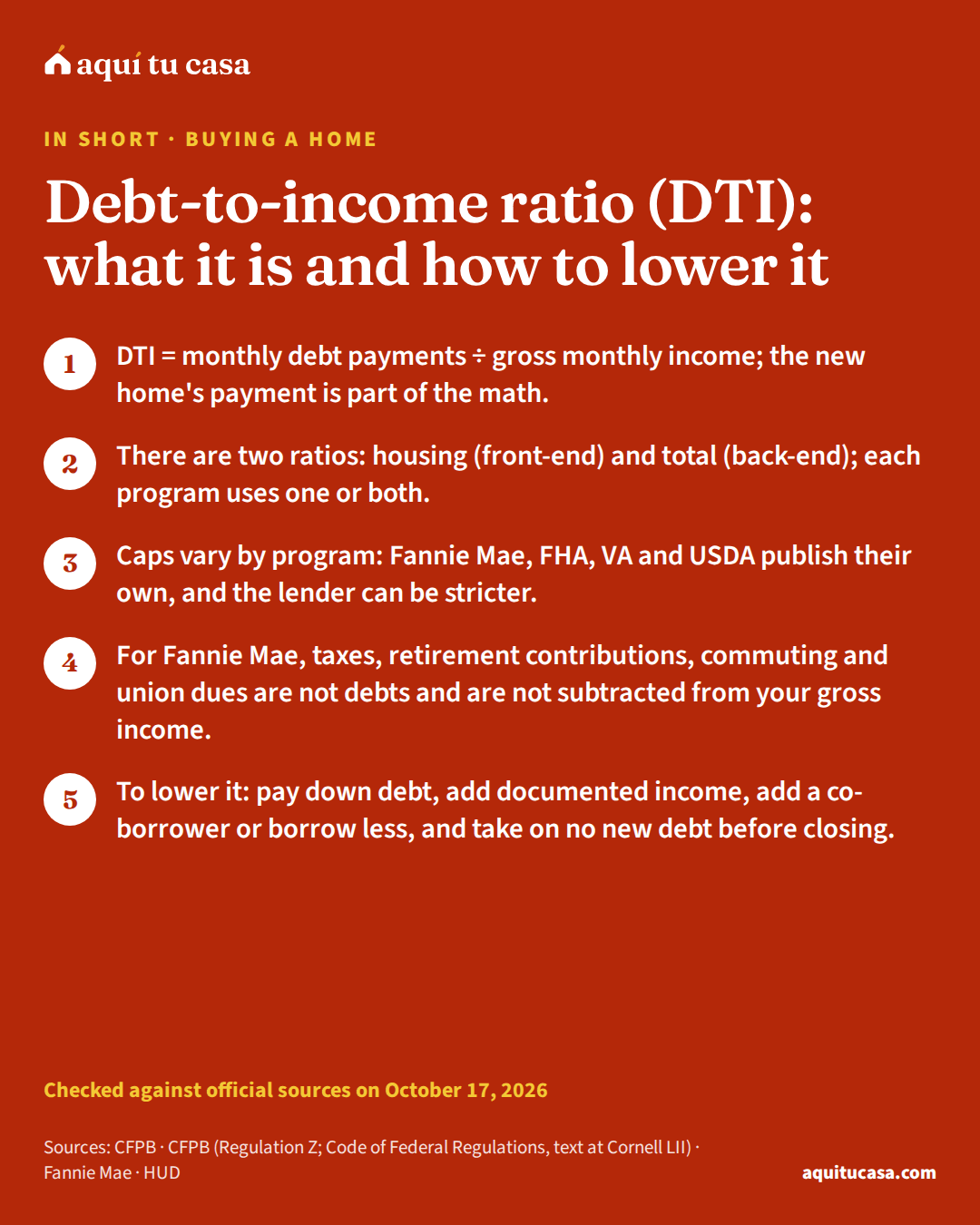
- Buying a home Debt-to-income ratio (DTI): what it is and how to lower it What the debt-to-income ratio (DTI) is, how to calculate it, which payments count, the caps FHA, Fannie Mae, VA and USDA publish and how to lower it. 14 minute read
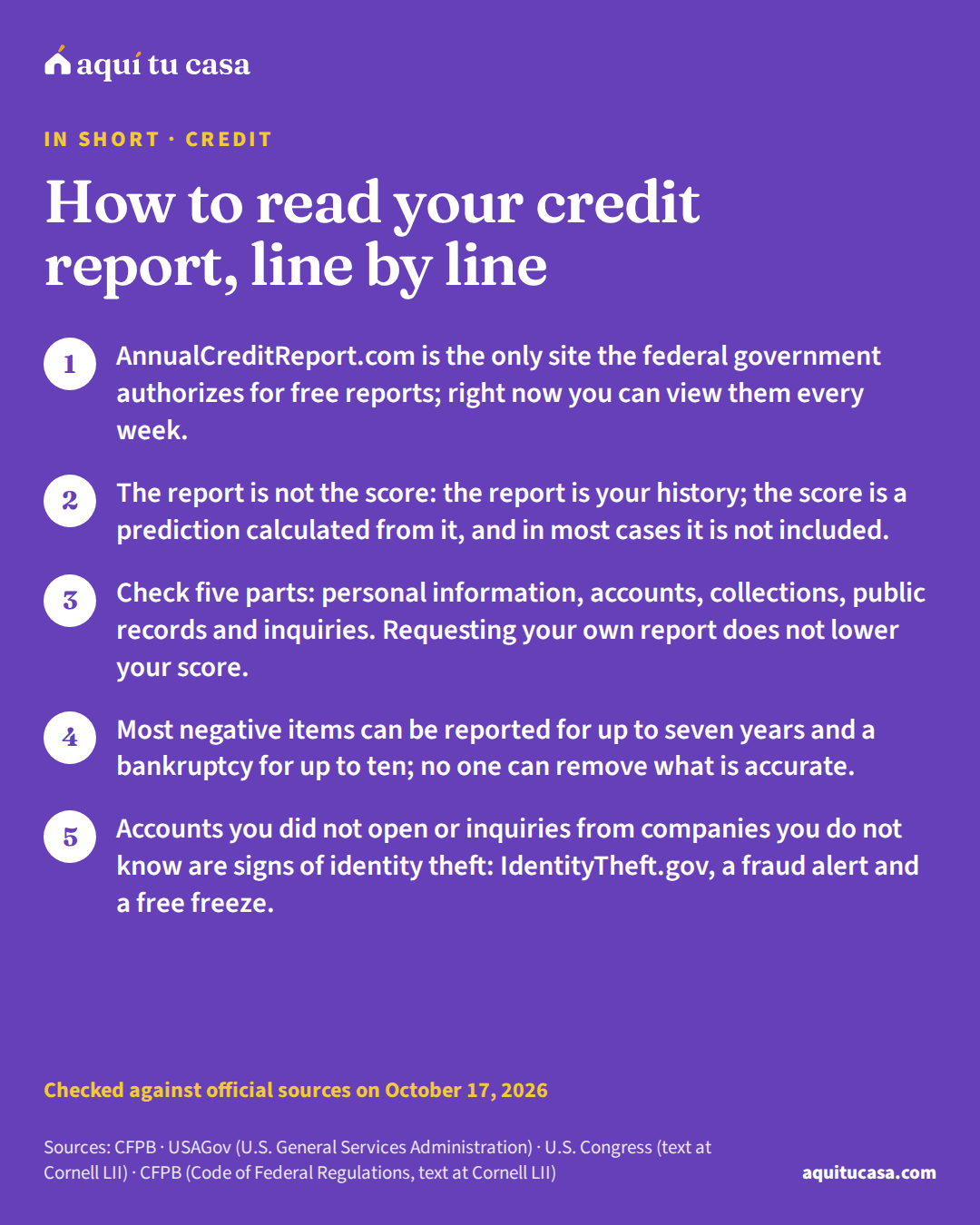
- Credit How to read your credit report, line by line Where to get your free credit reports, what each part says, how long negative items can stay and how to spot errors or identity theft. 13 minute read
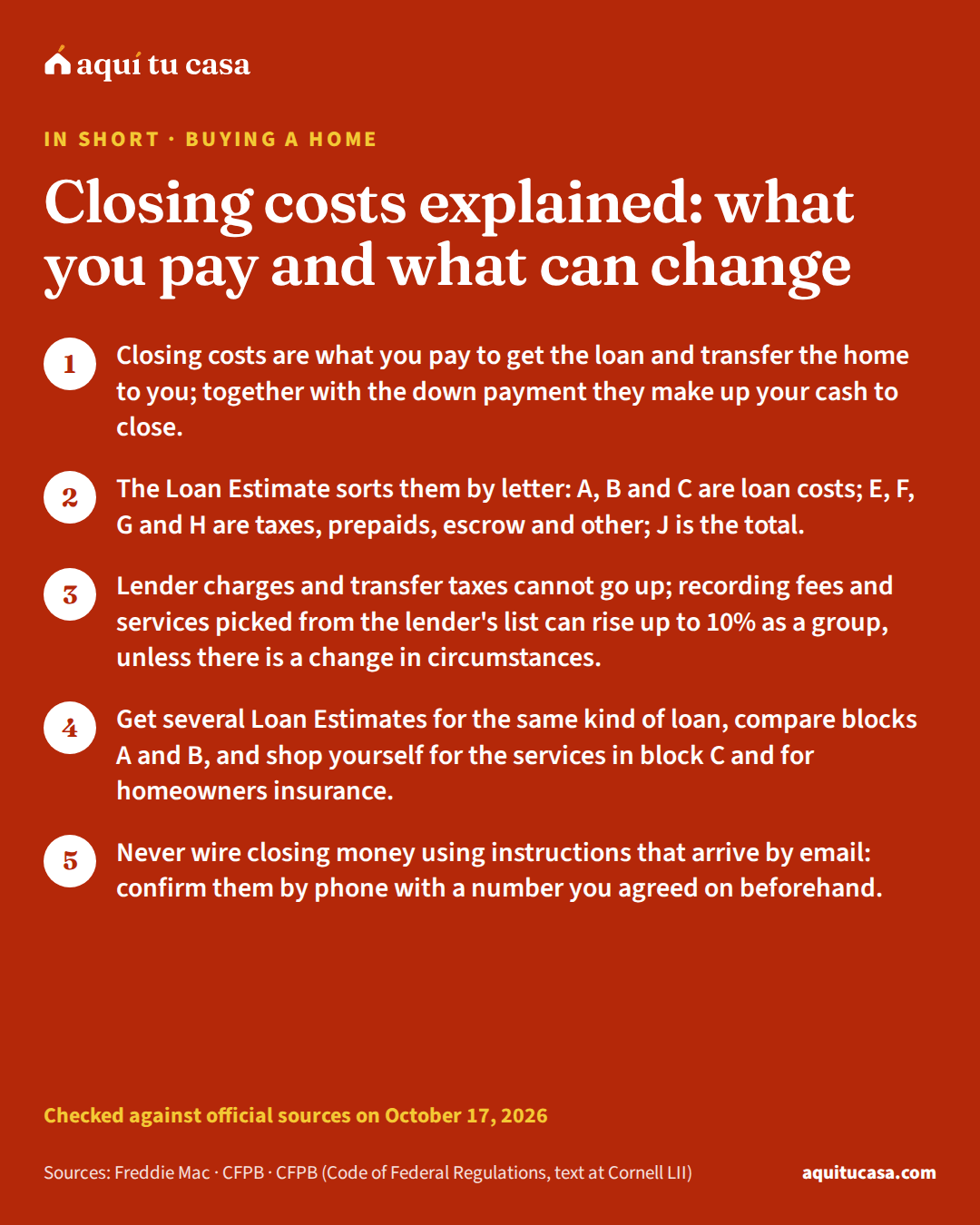
- Buying a home Closing costs explained: what you pay and what can change What closing costs are, how to read them on your Loan Estimate, which charges cannot go up before closing and how to compare offers to pay less. 14 minute read
Tools for this topic
Was this guide useful?
Thank you. Your answer stays in your browser; nothing is sent.