Mortgage loans Essential guide
ITIN mortgages: what exists and what lenders ask for
Which home loans accept an ITIN and which do not: Fannie Mae's rule, what FHA and USDA say, who lends and how to compare offers.
Verified against official sources on October 17, 2026 17 official sources

Show contents
In short
What you need to know
Quick answer
Yes, there are home loans for people with an ITIN, but not every program accepts them. Fannie Mae's guide accepts an SSN or an ITIN, plus documented legal residency, so a conventional loan is possible if your lender offers it and your status qualifies. FHA, on the other hand, shut out non-permanent residents in 2025, and USDA requires being a citizen, national or qualified alien. Many ITIN loans are made by banks, credit unions and CDFIs under their own rules, so the key is to compare several offers with the Loan Estimate in hand.
What matters most
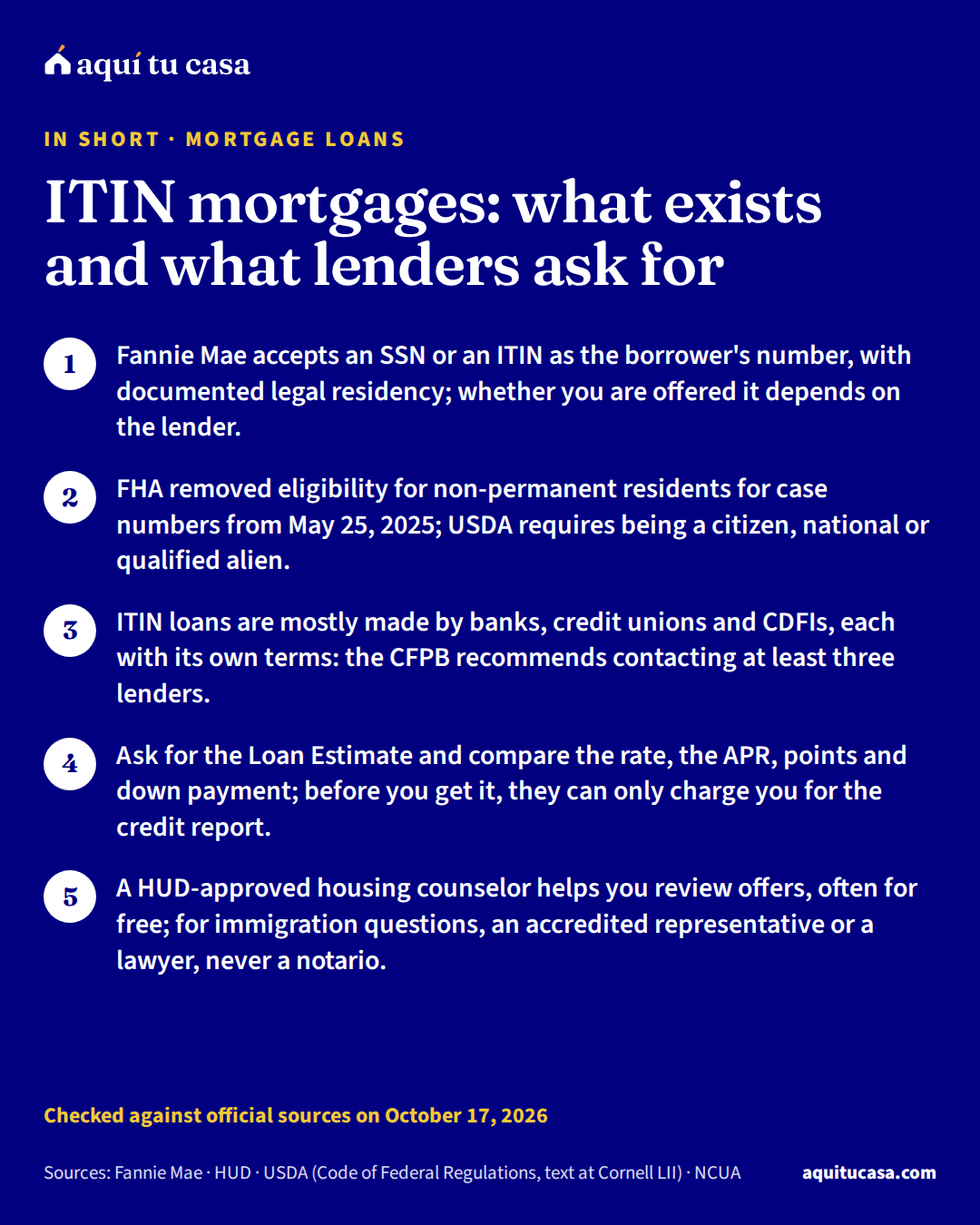
- Fannie Mae accepts an SSN or an ITIN as the borrower's number, with documented legal residency; whether you are offered it depends on the lender.
- FHA removed eligibility for non-permanent residents for case numbers from May 25, 2025; USDA requires being a citizen, national or qualified alien.
- ITIN loans are mostly made by banks, credit unions and CDFIs, each with its own terms: the CFPB recommends contacting at least three lenders.
- Ask for the Loan Estimate and compare the rate, the APR, points and down payment; before you get it, they can only charge you for the credit report.
Is this for you?
This guide is for you if…
- You have an ITIN, file taxes and want to know whether you can buy a home with a loan.
- A lender told you 'no' and you want to know whether another would say 'yes'.
- You are buying with a relative who has an SSN and do not know how the loan would look.
Get direct help first if…
- Your question is whether buying a home affects your immigration status: this guide does not answer that. If you wish, you can ask a representative accredited by the Department of Justice or an immigration lawyer.
- You already signed an ITIN loan offer and want to know whether it suits you: you can take it to a HUD-approved housing counselor before closing.
“Can I buy a home with an ITINITIN (Individual Taxpayer Identification Number)An ITIN is a nine-digit number the IRS, the federal tax agency, issues to people who need a U.S. taxpayer identification number to file taxes and are not eligible for a Social Security number. It is for tax purposes only: it does not authorize you to work in the United States, does not qualify you for Social Security benefits or the Earned Income Tax Credit, and says nothing about your immigration status. You apply with Form W-7, and it expires if it goes unused for several years. Some lenders accept an ITIN for a mortgage.See the full definition?” is one of the questions we get most, and the short answer is: it depends on the program, not on you. There are loans that accept the ITIN with conditions, there are federal programs that do not, and there are lenders who say “no” simply because they do not offer that product. This guide separates the three using the rules published by Fannie Mae, HUD, USDA, the NCUA, the FDIC and the CFPB. It is a topic that changes; that is why we review it more often and show the date of the last verification above.
First: the ITIN is not the problem, each program’s rule is
An ITIN mortgagemortgageA mortgage is an agreement between you and a lender (a bank, a credit union or a mortgage company) that gives the lender the right to take your property if you do not repay the money it lent you, plus interest. Mortgage loans are used to buy a home or to borrow money against the value of a home you already own. You repay it in monthly payments that cover the principal (the money borrowed) and the interest, and often the property taxes and insurance as well. In Spanish, "hipoteca" and "préstamo hipotecario" mean the same thing.See the full definition is not a different kind of loan: it is a loan whose borrower is identified with an ITIN instead of a Social Security number. What decides whether you get it is (1) the rule of the program backing the loan, (2) your residency status and how you document it and (3) the usual: income, credit, down payment and debt-to-income ratiodebt-to-income ratio (DTI)Your debt-to-income ratio (DTI) is all your monthly debt payments divided by your gross monthly income, that is, income before taxes. If you pay a certain amount each month across a car, cards, student loans and the mortgage you are asking for, and you earn three times that, your DTI is one third. Lenders use it to measure whether you can manage the payment; each loan type and lender sets its own limit, and assistance programs usually publish theirs. Paying down debt before applying improves your DTI.See the full definition, which each product and each lender limits in its own way.14
Three paths and what each rule says
Accepts an ITIN, with legal residency
Conventional (Fannie Mae)
No non-permanent residents
FHA
Always ask under which program you are being offered the loan and which residency documents it requires.2
Conventional loan: what Fannie Mae says
Fannie Mae’s Selling Guide, which sets the rules for a large share of conventional loansconventional loanA conventional loan is any mortgage that is not insured or guaranteed by the federal government: it is not FHA, VA or USDA. The lender, or the companies that buy the loans (Fannie Mae and Freddie Mac), carry the risk. When the amount is within the conforming loan limit the loan is called "conforming"; above it, it is a "jumbo" loan. It usually asks for a higher credit score than an FHA loan and, if your down payment is less than 20% of the price, you are normally required to buy private mortgage insurance (PMI) until you build enough equity in the home.See the full definition, requires that each borrower have a valid Social Security number or an ITIN, in addition to meeting the legal residency and documentation requirements.1 On residency, Fannie Mae purchases mortgages made to people who are not citizens but are lawful permanent or non-permanent residents, under the same terms available to citizens. It does not specify the exact documentation: the lender decides, case by case, using documentation it deems appropriate, and warrants to Fannie Mae that the borrower is legally present in the country.2
In practice that means two things. First, a conventional ITIN loan exists in the rule. Second, the decision on which status documents to accept belongs to the lender, which is why some offer it and others do not.2 Ask directly: “Do you offer conventional loans to borrowers with an ITIN, and what residency documentation do you accept?” The other loan types are in mortgage loan types.
FHA and USDA: what the federal rules say
The FHA loanFHA loanAn FHA loan is a mortgage made by a private lender and insured by the Federal Housing Administration (FHA), an agency of the U.S. government. That insurance protects the lender if you stop paying, which is why the lender can accept a lower down payment and a less-than-perfect credit history than on a conventional loan. Federal law sets the minimum cash investment at 3.5% of the property's value and caps the loan amount at the FHA limit, which changes by county. In exchange for the insurance you pay a mortgage insurance premium.See the full definition, the one first-time buyers use most, changed its rules. HUD Mortgagee Letter 2025-09 removed eligibility for non-permanent residents entirely, for case numbers assigned on or after May 25, 2025. Lawful permanent residents remain eligible, with USCIS evidence and on the same terms as citizens, as do citizens of the Federated States of Micronesia, the Marshall Islands and Palau. A Social Security card is not enough to prove immigration or work status.3
Before that change, FHA’s requirement for non-permanent residents already included a valid Social Security number (with exceptions for employees of the World Bank, a foreign embassy or an equivalent employer) and permission to work, and FHA stated that people without lawful residency were not eligible.4 In other words: FHA has not been the ITIN path, and today it is even less so.
The guaranteed USDA loanUSDA loanA USDA loan is a mortgage from the Rural Housing Service, part of the U.S. Department of Agriculture (USDA). It is meant for low- and moderate-income families buying a home in an area the USDA considers rural, and it can be offered with no down payment. There are two paths: the USDA guarantees a loan made by a private lender, or it lends directly to very-low-income families. To qualify, your income must be within the limit for your area and the home must be in an eligible area, which you can check on the USDA's map.See the full definition has its own rule: applicants must provide evidence that they are U.S. citizens, U.S. non-citizen nationals or “qualified aliens,” as the regulation defines them.5 If you do not know whether your status fits one of those categories, that is an immigration question: you can ask an accredited representativeDOJ-accredited representativeAn accredited representative is a non-attorney whom the U.S. Department of Justice, through its Recognition and Accreditation Program, authorizes to represent people in immigration matters before DHS and, with full accreditation, before the immigration courts. They may only do so through a recognized organization, which must be a non-profit, federally tax-exempt entity. It is the safe way to get low-cost immigration help: the Department of Justice publishes the official roster by state. Anyone who is not on that roster and is not a lawyer is not authorized to represent you.See the full definition.17

Who lends with an ITIN: banks, credit unions and CDFIs
Outside the federal programs, many ITIN loans are made by the bank or credit union itself under its own rules. There are three kinds of lenders worth looking for:
- Community banks. The FDIC’s public Community Reinvestment Act evaluations document banks with ITIN mortgage programs. One from July 2024, for example, describes a program designed for people who earn an income in the United States but do not qualify for a Social Security number, and who typically cannot get a conventional loan.7 Those evaluations are public: searching for “ITIN” in the evaluation of a bank in your area tells you whether it has a program.
- Credit unions. Their federal regulator, the NCUA, said back in 2003 that it saw no legal impediment to a federal credit unioncredit unionA credit union is a not-for-profit financial institution that, like a bank, accepts deposits, makes loans and offers other services, but is owned by its members. Members elect a volunteer board of directors, and profits go back to them as lower fees, higher savings rates and lower loan rates. To join you need a common bond, such as your employer, your family, where you live or a group you belong to. It is chartered by the NCUA, a federal agency, or by a state. If the credit union is federally insured, your deposits are protected by the NCUA's insurance fund.See the full definition lending to members who use an ITIN or a Matrícula Consular, as long as it identifies and addresses the risks.6 To borrow from a credit union you first have to become a member; the bank account without a Social Security number guide explains how to open the account.
- CDFIs. CDFIsCommunity Development Financial Institution (CDFI)A CDFI (Community Development Financial Institution) is an organization whose primary mission is community development. It provides loans, investments and other financial services in low-income communities and to people who lack access to financing. It can be a community development bank or credit union, or a loan fund that is not a bank. The law requires that it not be a government agency, that it be accountable to the community it serves and that it offer services such as financial and credit counseling along with its loans. The Treasury Department's CDFI Fund certifies them.See the full definition (community development financial institutions) are specialized organizations that provide financial services in low-income communities and to people without access to financing: community development banks and credit unions, and loan funds. There are certified CDFIs in all 50 states, the District of Columbia, Guam and Puerto Rico, and the CDFI Fund publishes the list.8
How to find and compare offers
The CFPB recommends contacting at least three lenders: borrowers who shop around can save thousands of dollars. It suggests starting with your local bank or credit union and other lenders that serve your area, and says a housing counselor can help you identify lenders.9
From your search to the offer you choose
1. Make your list of lenders
Before you apply
Your local bank or credit union, other lenders in your area and a CDFI in your state.9
2. Ask about their ITIN program
On the first call
Under which program they would lend to you and which residency documents they accept.2
3. Ask for a preapproval letter
Before you make an offer
It gives the seller confidence, but it is not a guaranteed loan offer.10
4. Apply and get the Loan Estimate
No later than 3 business days after you apply
Before you get it, they can only charge you for the credit report.12
Try it with your numbersClosing costs5. Compare at least three
Before you say you want to proceed
Rate, APR, points, down payment and closing costs, side by side.13
Try it with your numbersCompare loans6. Review the offer with a counselor
Before you sign
A HUD-approved counselor tells you whether the terms fit your goals.16
A preapprovalpreapproval letterA preapproval or prequalification letter is a document from a lender saying it is generally willing to lend you up to a certain amount. It is not a guaranteed loan offer. Lenders use the two words differently: some issue a prequalification based on information you report, without verifying it, and only issue a preapproval after reviewing your documents; others use the words the other way around or interchangeably. That is why it pays to ask what the letter is based on. Sellers often ask for one before accepting an offer.See the full definition letter says how much the lender is willing to lend you, based on certain assumptions; it gives the seller confidence, but it is not a guaranteed loan offer.10 The document for comparing is the Loan EstimateLoan EstimateThe Loan Estimate is a three-page form you receive from the lender within days of applying for a mortgage. In the same format at every bank, it sums up the terms of the loan being offered: amount, interest rate, whether the payment can change, the estimated monthly payment with taxes and insurance, the itemized closing costs and how much cash you need at closing. Because every lender uses the same form, it lets you compare offers side by side. It commits you to nothing: requesting one is not accepting the loan.See the full definition: the lender must give it to you within three business days of receiving your application, every lender uses the same form and getting one does not mean the loan is approved.11 Before you receive it and say you want to proceed, the only fee allowed is a bona fide and reasonable charge for your credit report.12
Look at these side by side:
- The rate and the APRannual percentage rate (APR)The annual percentage rate (APR) is a broader measure of the cost of borrowing money than the interest rate. Besides the interest, it includes certain loan charges, such as discount points and some lender fees, spread over the life of the loan and expressed as a yearly percentage. That is why the APR is almost always a little higher than the interest rate. It is useful for comparing offers: if two loans have the same interest rate but a different APR, the one with the higher APR charges more in fees.See the full definition. The rate is what you pay each year to borrow; the APR is a broader measure that adds pointsdiscount pointsDiscount points are a payment you make to the lender at closing in exchange for a lower interest rate over the life of the loan. Each point costs a percentage of the loan amount. The opposite is lender credits: the bank lowers your closing costs today in exchange for a higher rate. Buying points only pays off if you keep the loan long enough for the monthly savings to exceed what you paid. Points appear on the Loan Estimate, in section A of the closing costs.See the full definition, broker fees and other charges, which is why it is usually higher than the rate.13 Two offers with the same rate can have very different APRs.
- The down payment each one requires. The how much down payment you need guide explains the federal programs’ minimums; on a bank’s own ITIN loan, the lender sets the minimum.
- The closing costsclosing costsClosing costs are all of the costs you pay on closing day on top of the down payment: lender fees, the appraisal, the credit report, title insurance, the closing agent's fees, any transfer taxes your state or county charges and the first deposits into the escrow account. The lender must itemize them on the Loan Estimate within days of your application and confirm them on the Closing Disclosure before you sign. Some can be paid by the seller, and several state programs help cover them.See the full definition on page 2 of the Loan Estimate. The closing costs explained guide walks through them block by block.
- Whether the rate is fixed or adjustable, and for how long.
Example with real numbers
What it costs to close on a typical home
On top of the down payment your lender sets, with the typical U.S. home value and the closing cost range Freddie Mac gives.
- Home price (typical U.S. value)
- $332,700
- Closing costs (2% to 5% of the price)
- $6,654 to $16,635
- Down payment
- The percentage each lender asks of you
This is an example with national numbers.15 Your real figures are on each lender's Loan Estimate; try the down payment you are offered in the calculator.11
Run it with your numbersClosing costs
A HUD-approved housing counselorHUD-approved housing counselorA HUD-approved housing counselor works at an agency HUD has approved to provide housing counseling: independent, expert advice customized to your situation about buying a home, renting, a missed mortgage payment, a foreclosure or credit problems. The agencies usually charge little or nothing; many serve in Spanish and offer the homebuyer education course several assistance programs require. They are not lenders or real estate agents and sell you nothing. Your county page lists the official agencies with phone numbers.See the full definition can sit down with you and the Loan Estimates: they give independent advice on buying and on whether a set of loan terms fits your goals, often for free or at low cost.16 The HUD-approved housing counselors guide explains how to find one.

Costly mistakes
Mistake: Believing the first lender who tells you “it can't be done with an ITIN.”
Instead: Contact at least three: each lender offers different kinds of loans.9
Mistake: Comparing only the interest rate.
Instead: Compare the APR, which adds the points and the loan's charges.13
Mistake: Paying a middleman an upfront “processing” fee to get you the loan.
Instead: Before you get the Loan Estimate and decide to proceed, they can only charge you for the credit report.12
Mistake: Assuming FHA is for you because it is the “first-time buyer” loan.
Instead: Since May 2025, FHA does not accept non-permanent residents.3
Mistake: Asking a “notario” whether buying a home affects your status.
Instead: A notario cannot give you legal advice; an accredited representative or a lawyer can.17
If this is you
You have an ITIN and file taxes
Look for banks, credit unions and CDFIs with their own program, and ask under which program they lend.78
You are buying with someone who has an SSN
With Fannie Mae, each borrower needs an SSN or an ITIN and must meet legal residency; ask how the lender treats the combination.1
You are self-employed
Each lender has its own debt-to-income limits; ask which proof of income it accepts.14
You are buying for the first time
Some CDFIs use their funds for loans to first-time homebuyers.8
If someone offers you something that sounds too good
If something does not add up, get the offer in writing and take it to a housing counselor before you sign.16 The housing scams guide has more warning signs.

What to do this week
- Gather your returns filed with your ITIN, your proof of income and your account statements.
- Make a list of three kinds of lenders: your local bank or credit union, other lenders in your area and a CDFI in your state.98
- Ask each one, before you apply: “Do you lend to borrowers with an ITIN, under which program, and what residency documentation do you accept?”2
- Ask at least three for a Loan Estimate and compare rate, APR, points and down payment with the compare loans tool.11
- Take the Loan Estimates to a HUD-approved housing counselor before you sign anything.16
Your numbers
Starts at the typical home value in the United States. Change it to the price you have in mind.
That is $11,645 (3.5% of the price). The usual minimum for this loan is 3.5%.
This week's average ± a quarter or half point.
National average as of November 5, 2026 (Freddie Mac); your rate may be different.
Adjust advanced details
Let's do the math
Estimated monthly payment
National figure$2,759
at 7.18% · 30 years
- Loan amount
- $326,673
- Total interest
- $470,006
- Paid off in
- November 2056
Includes $5,618 FHA upfront mortgage insurance premium.
Does it fit the income?
Comfortable
up to $1,884 a month
Tight
$1,884 to $2,422 a month
Hard
more than $2,422 a month
Your payment · 41%
Compared with the typical household income in the United States ($80,734 a year). Reference: HUD calls paying more than 30% of income for housing a cost burden.
| Principal & interest | $2,213 |
|---|---|
| Property tax | $261 |
| Home insurance | $139 |
| FHA mortgage insurance (MIP) | $147 |
How does it compare with incomes?
For this payment to be 28% of your income, you'd need to earn about $118,260 a year. With your other debts, to stay under 36%: about $91,980 a year.
You need at least $11,645 for the down payment, plus closing costs.
This is an estimate to give you an idea, not a loan offer. Your real payment depends on your rate, your credit, and the insurance and taxes on the home you buy.
Total monthly payment $2,759; principal and interest $2,213.
Ready to see the numbers? Find your county here
See how this applies in your county: its loan limits, prices and rents, from the official data.
Printable checklist
Frequently asked questions
Can I get a mortgage with just an ITIN?
It depends on the program and the lender. Fannie Mae accepts the ITIN as the borrower's number if you meet legal residency; FHA no longer accepts non-permanent residents. On top of that, some banks, credit unions and CDFIs offer ITIN loans under their own rules. If one lender says no, ask another: each one offers different kinds of loans.
Will they ask me for a bigger down payment than someone with an SSN?
Each lender sets its own down payment, rate and documents for its ITIN loans; that is why there is no single figure. Compare several offers using the Loan Estimate and look at the APR, not just the rate.
What if I buy with my partner or a relative who has an SSN?
Each person who signs the loan is a borrower and each program decides what it asks of each one; with Fannie Mae, every borrower needs an SSN or an ITIN and must meet legal residency. Ask the lender, before you apply, how it treats your income and your ITIN in that combination.
Can I use an FHA loan with an ITIN?
For case numbers assigned on or after May 25, 2025, FHA only accepts citizens, lawful permanent residents and citizens of Micronesia, the Marshall Islands and Palau. A Social Security card is not enough to prove status. If you are a permanent resident, FHA is open to you on the same terms as citizens.
Where do I find a lender that makes ITIN loans?
Start with your local bank or credit union and the CDFI Fund's list of certified CDFIs, which exist in every state. The FDIC's public Community Reinvestment Act evaluations also document which banks have ITIN programs. A HUD-approved housing counselor can help you identify lenders.
How much money do I need besides the down payment?
Closing costs. Freddie Mac says to be prepared to pay between 2% and 5% of the price; on a $332,700 home, the typical U.S. value, that is between $6,654 and $16,635. Your real figure is on the Loan Estimate.
Can they charge me to give me an offer?
Before you receive the Loan Estimate and say you want to proceed, Regulation Z only allows a bona fide and reasonable fee for your credit report. Be wary of anyone who asks for an upfront 'processing' fee.
Does buying a home with an ITIN affect my status?
That is an immigration question that neither a lender nor this site can answer. You can ask a representative accredited by the Department of Justice or an immigration lawyer; never a notario.
Sources
Every figure in this guide comes from one of these official sources. The number next to a sentence leads to the source behind it.
Each source on one line: who publishes it, its title, its address and the date we read it.
- 1. Fannie Mae · Fannie Mae Selling Guide B2-2-01, General Borrower Eligibility Requirements · selling-guide.fanniemae.com · Accessed October 17, 2026
- 2. Fannie Mae · Fannie Mae Selling Guide B2-2-02, Non–U.S. Citizen Borrower Eligibility Requirements · selling-guide.fanniemae.com · Accessed October 17, 2026
- 3. HUD · HUD Mortgagee Letter 2025-09, Revisions to Residency Requirements · hud.gov · Accessed October 17, 2026
- 4. HUD · HUD Mortgagee Letter 2021-12, Eligibility Requirements for Certain Non-Permanent Resident Borrowers · hud.gov · Accessed October 17, 2026
- 5. USDA (Code of Federal Regulations, text at Cornell LII) · 7 CFR §3555.151, Eligibility requirements (Single Family Housing Guaranteed Loan Program) · law.cornell.edu · Accessed October 17, 2026
- 6. NCUA · NCUA Legal Opinion 03-0964: Individual Taxpayer Identification and Matricula Consular Numbers for Credit Reporting Purposes · ncua.gov · Accessed October 17, 2026
- 7. FDIC · Community Reinvestment Act Performance Evaluation (July 8, 2024) · crapes.fdic.gov · Accessed October 17, 2026
- 8. CDFI Fund, U.S. Department of the Treasury · CDFI Certification · cdfifund.gov · Accessed October 17, 2026
See the other 9 sources
- 9. CFPB · Contact multiple lenders · consumerfinance.gov · Accessed October 17, 2026
- 10. CFPB · What's the difference between a prequalification letter and a preapproval letter? · consumerfinance.gov · Accessed October 17, 2026
- 11. CFPB · What is a Loan Estimate? · consumerfinance.gov · Accessed October 17, 2026
- 12. CFPB (Code of Federal Regulations, text at Cornell LII) · Regulation Z, 12 CFR §1026.19, Certain mortgage and variable-rate transactions · law.cornell.edu · Accessed October 17, 2026
- 13. CFPB · What is the difference between a mortgage interest rate and an APR? · consumerfinance.gov · Accessed October 17, 2026
- 14. CFPB · What is a debt-to-income ratio? · consumerfinance.gov · Accessed October 17, 2026
- 15. Freddie Mac · What Are Closing Costs and How Much Will I Pay? · myhome.freddiemac.com · Accessed October 17, 2026
- 16. CFPB · Find a Housing Counselor · consumerfinance.gov · Accessed October 17, 2026
- 17. U.S. Department of Justice (EOIR) · Can Someone Represent You Before EOIR? · justice.gov · Accessed October 17, 2026
Keep reading
Related guides
If this guide helped, these follow the same path.

ITIN 15 minute read
What an ITIN is and what it is for
The ITIN is the IRS number for filing taxes without a Social Security number: what it does and does not do, how to apply with Form W-7, timing and expiry.
- The ITIN is a tax number, nothing more: not a work permit, not a status and not an ID.
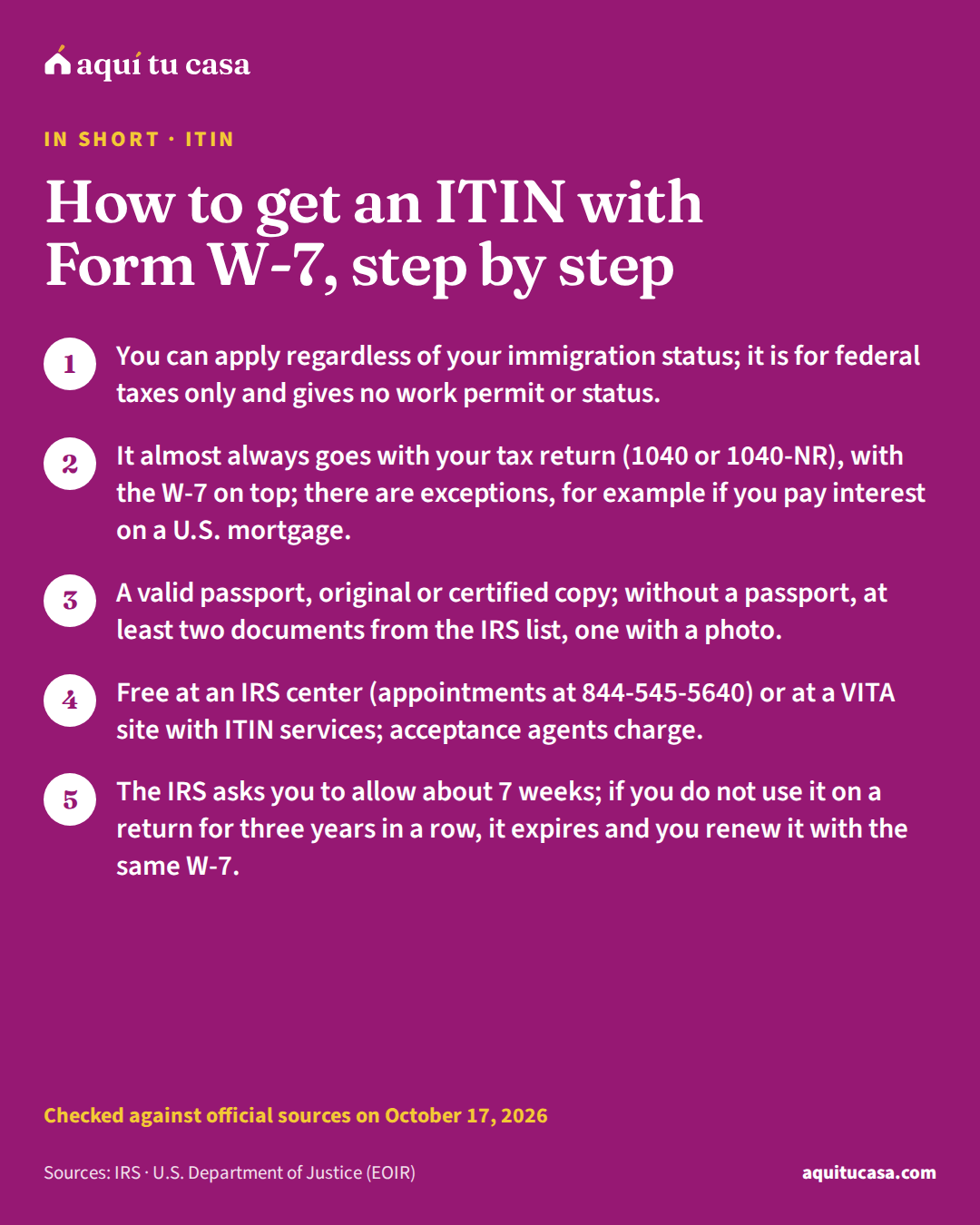
- You can apply regardless of immigration status, with the W-7 in the same package as your federal return; the passport is the only document that works on its own.
- It is free at an IRS center or a VITA site with ITIN services; an acceptance agent charges a fee.
- ITIN How to get an ITIN with Form W-7, step by step Who can apply for an ITIN, which documents the IRS accepts, where to file Form W-7 for free, how long it takes and how to renew it. 15 minute read
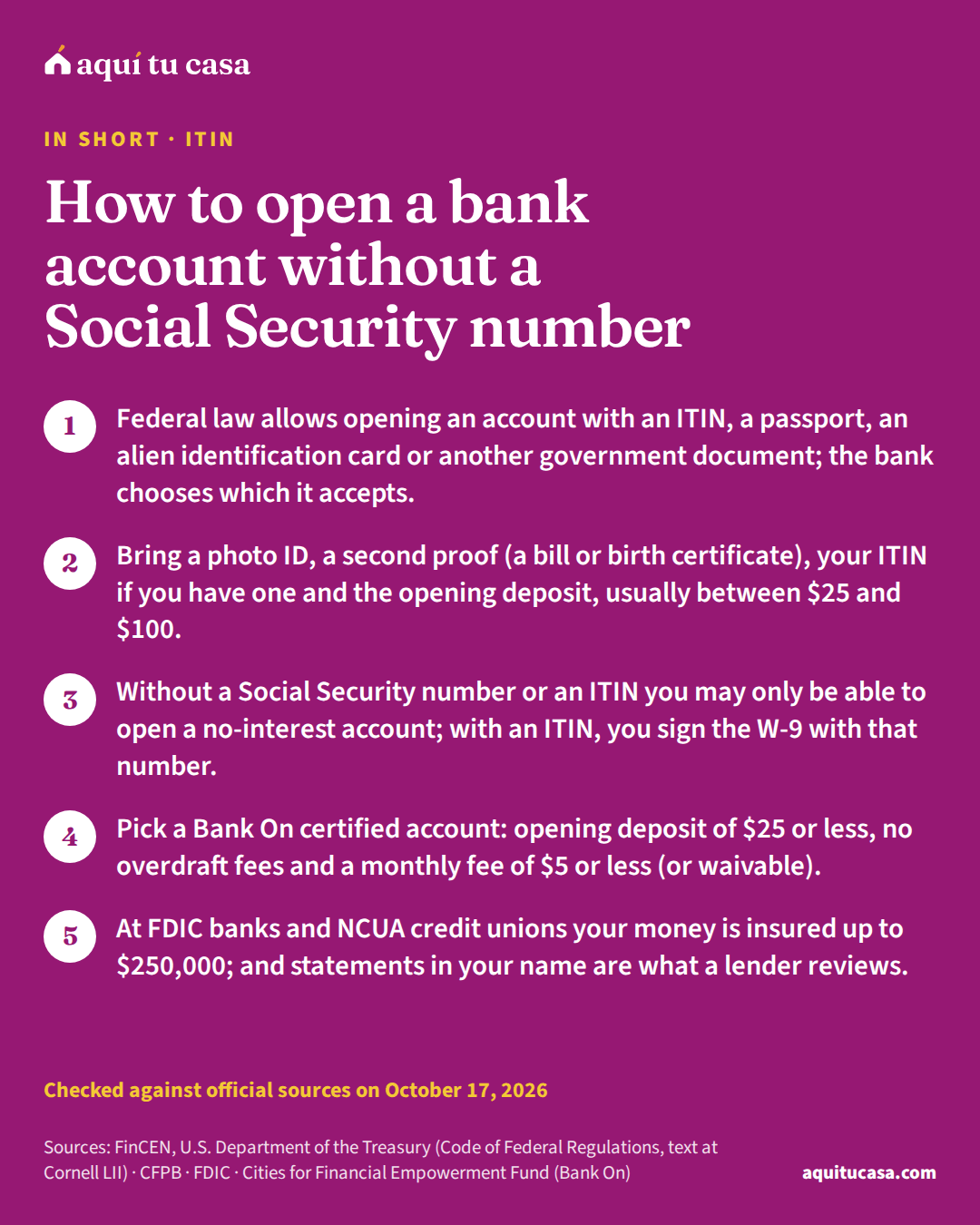
- ITIN How to open a bank account without a Social Security number What banks and credit unions ask for to open an account without a Social Security number (ITIN, passport or consular ID) and which account to pick. 11 minute read
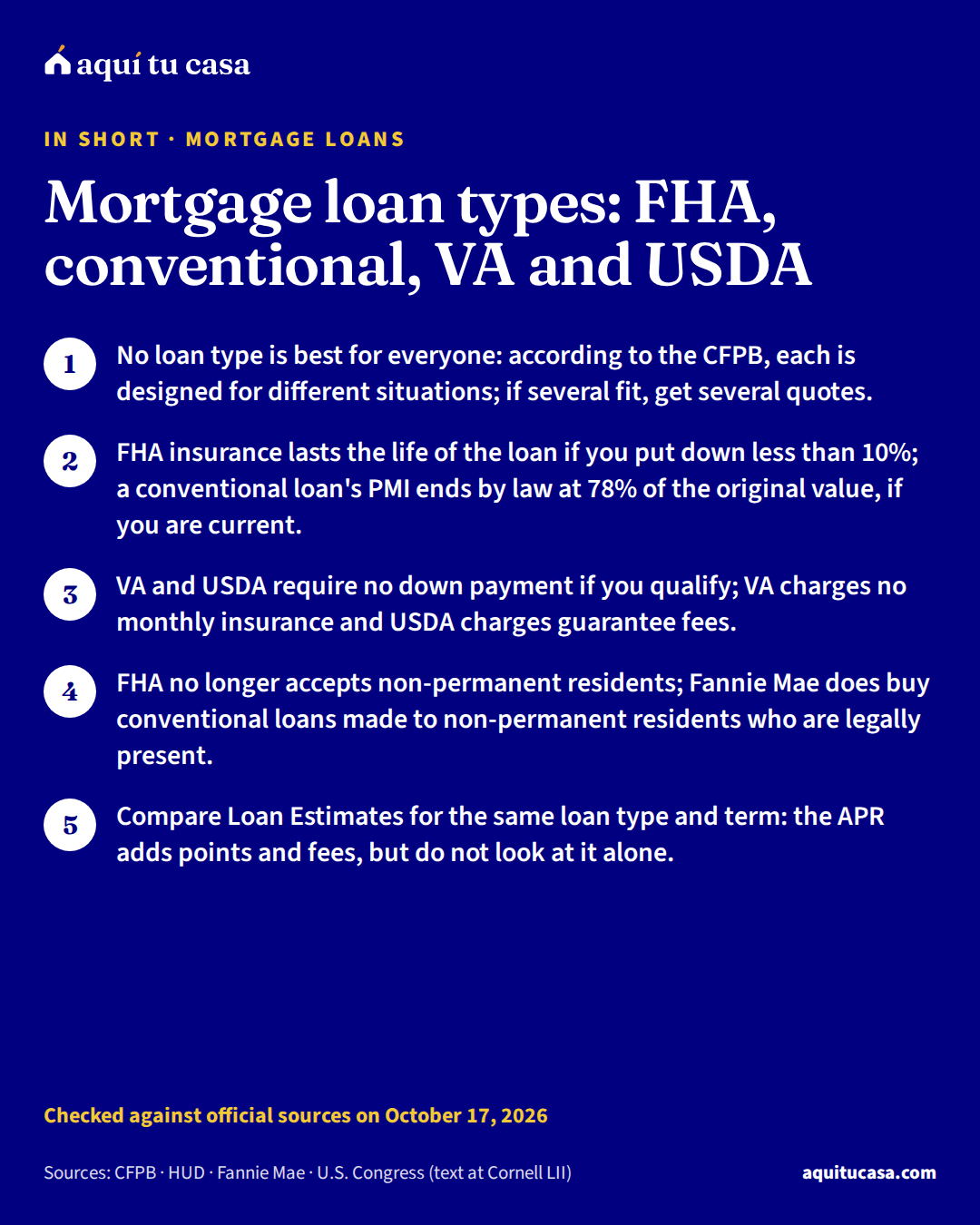
- Mortgage loans Mortgage loan types: FHA, conventional, VA and USDA What each mortgage type asks for, what its insurance costs, fixed or adjustable rate, points and APR. A neutral comparison with official sources. 14 minute read
Tools for this topic
Was this guide useful?
Thank you. Your answer stays in your browser; nothing is sent.