Buying a home Essential guide
How much do you need for a down payment?
20% is not required: what each loan asks for (FHA, conventional, VA, USDA), what changes with less than 20% down, and where the money can come from.
Verified against official sources on October 17, 2026 22 official sources
Show contents
In short
What you need to know
Quick answer
You do not need 20%. With an FHA loan the minimum is 3.5% of the home's value if your score is 580 or higher; with a conventional loan such as HomeReady it can be 3%; VA and USDA may require no down payment if you qualify. With less than 20% down you pay mortgage insurance, and you also need money for closing costs. The money can come from your savings, a gift from a relative or an assistance program, always documented.
What matters most
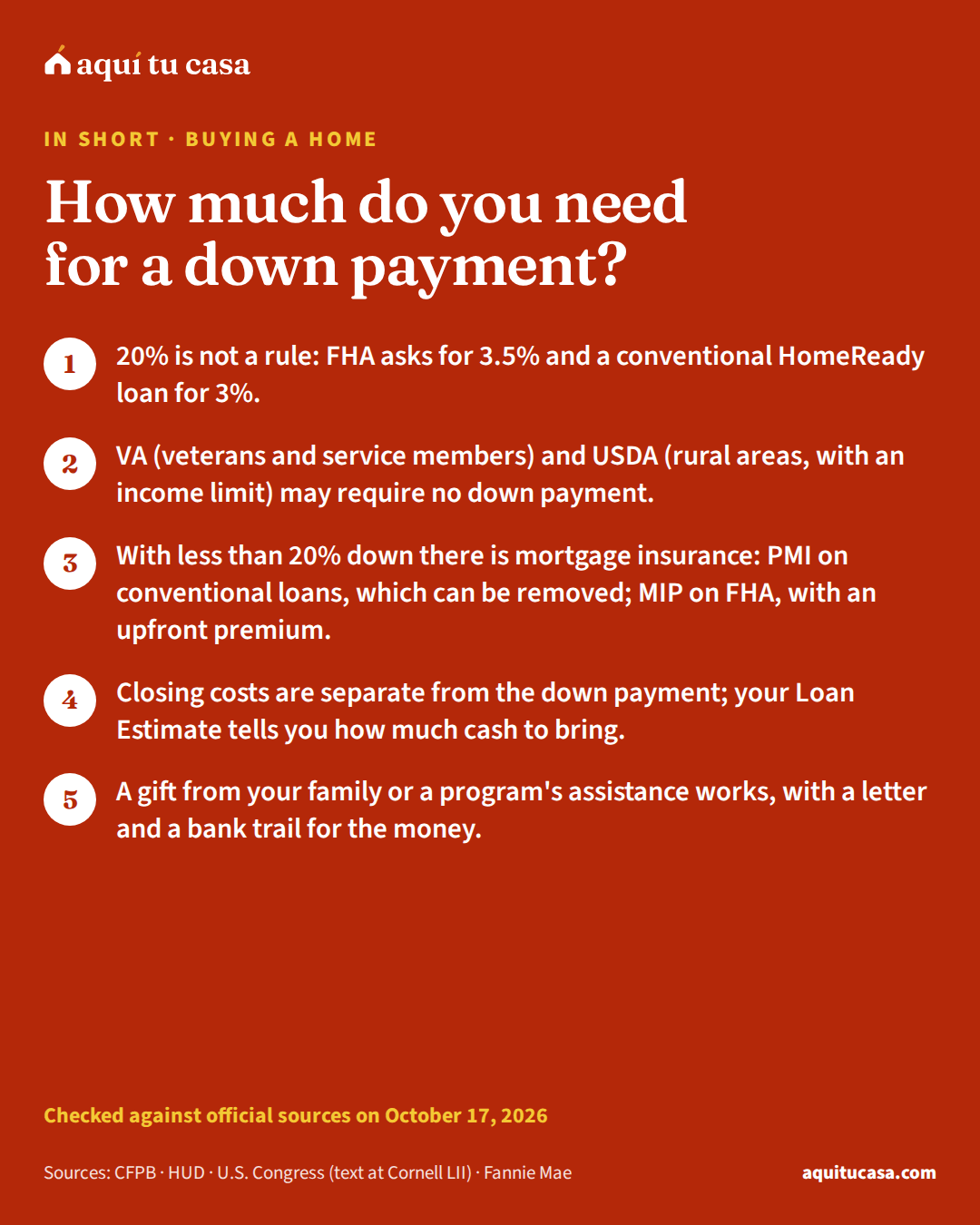
- 20% is not a rule: FHA asks for 3.5% and a conventional HomeReady loan for 3%.
- VA (veterans and service members) and USDA (rural areas, with an income limit) may require no down payment.
- With less than 20% down there is mortgage insurance: PMI on conventional loans, which can be removed; MIP on FHA, with an upfront premium.
- Closing costs are separate from the down payment; your Loan Estimate tells you how much cash to bring.
Is this for you?
This guide is for you if…
- You want to buy a home and do not know how much you have to save first.
- Someone told you that you need 20% and you want to know whether that is true.
- You have part of the money and want to know whether a relative or a program can help with the rest.
Get direct help first if…
- You already have an accepted offer and a closing date: check your Loan Estimate and the closing costs guide, and ask your lender about your case.
- Your immigration status changed recently: a housing counselor can explain which programs accept you today.
The down paymentdown paymentThe down payment is the part of the home's price you pay out of your own pocket when you buy; the loan covers the rest. In U.S. Spanish it is also called enganche, cuota inicial or entrada. Each loan type has its own minimum: FHA requires at least 3.5% of the value, VA and USDA loans may require none, and conventional loans ask for more if you want to avoid private mortgage insurance. A larger down payment lowers the loan, the monthly payment and the total interest; many state programs help families put it together.See the full definition is the part of the home’s price you pay with your own money; the loan covers the rest. It is the question that stops the most families: “how much do I have to put together?”. This guide is for anyone saving for a first home: what each loan type asks for, how much that is in dollars, what changes if you put down little and where the money can come from. The short answer: less than you have been told.
20% is not required
The 20% idea comes from a real rule, but about something else: on a conventional loan, with less than 20% down you pay an extra insurance. It does not mean you are turned down.
The CFPB’s homebuying toolkit puts it this way: a down payment of 20% or more likely gives you the best rates and the most options, but think twice if it drains all your savings. With less, you probably pay higher interest rates or fees, and low down payment programs are typically more expensive. Among the options to ask about, the CFPB lists conventional loans with low down payments, FHA, VA and USDA.1
According to HUD’s handbook, an FHA loanFHA loanAn FHA loan is a mortgage made by a private lender and insured by the Federal Housing Administration (FHA), an agency of the U.S. government. That insurance protects the lender if you stop paying, which is why the lender can accept a lower down payment and a less-than-perfect credit history than on a conventional loan. Federal law sets the minimum cash investment at 3.5% of the property's value and caps the loan amount at the FHA limit, which changes by county. In exchange for the insurance you pay a mortgage insurance premium.See the full definition requires at least 3.5% of the home’s value when your credit score is 580 or higher.2 And a conventional loanconventional loanA conventional loan is any mortgage that is not insured or guaranteed by the federal government: it is not FHA, VA or USDA. The lender, or the companies that buy the loans (Fannie Mae and Freddie Mac), carry the risk. When the amount is within the conforming loan limit the loan is called "conforming"; above it, it is a "jumbo" loan. It usually asks for a higher credit score than an FHA loan and, if your down payment is less than 20% of the price, you are normally required to buy private mortgage insurance (PMI) until you build enough equity in the home.See the full definition under Fannie Mae’s HomeReady program can finance up to 97% of the value, that is, ask you for only 3%.4
What each loan type asks for
| Loan type | Minimum down payment | What to know |
|---|---|---|
| FHA | 3.5% with a score of 580 or higher2 | With a score from 500 to 579, the loan only reaches 90% of the value; it carries mortgage insurance (MIP)8 |
| Conventional (HomeReady) | 3%4 | One-unit principal residence and income up to 80% of the area median income; with less than 20%, it carries PMI5 |
| VAVA loanA VA loan is a mortgage program offered by the U.S. Department of Veterans Affairs (VA) to help servicemembers, veterans and some surviving spouses buy a home. The VA does not lend the money: it guarantees part of a loan made by a private lender, and with that guarantee the lender can offer terms other loans do not have, such as buying with no down payment. Only people who meet the VA's service requirements can use it; the lender will ask for your certificate of eligibility.See the full definition | 0% if the price does not exceed the appraisal9 | You need a VA Certificate of Eligibility (COE); no monthly mortgage insurance, but a one-time funding fee unless you are exempt10 |
| USDAUSDA loanA USDA loan is a mortgage from the Rural Housing Service, part of the U.S. Department of Agriculture (USDA). It is meant for low- and moderate-income families buying a home in an area the USDA considers rural, and it can be offered with no down payment. There are two paths: the USDA guarantees a loan made by a private lender, or it lends directly to very-low-income families. To qualify, your income must be within the limit for your area and the home must be in an eligible area, which you can check on the USDA's map.See the full definition | 0%: it can cover the full price11 | Only in areas USDA designates as rural13 and with a household income limit12 |

Every program has more requirements (income, type of home, score, residency). Here we cover the down payment. Ask your lender whether it asks for more than the minimum. The mortgage loan types guide explains the rest of each one.
How much that is in dollars: an example
Percentages become dollars with the price of the home. This example uses the typical US home value; your county’s can be very different.
Example with real numbers
The down payment on a typical home, by loan type
With the typical US home value ($332,700) and each loan type's minimum.
- FHA (3.5%)
- $11,645
- Conventional HomeReady (3%)
- $9,981
- Conventional without mortgage insurance (20%)
- $66,540
- VA or USDA, if you qualify (0%)
- No down payment
This is an example with national numbers.2459 Closing costs come on top. Put your goal and your date into the savings plan.
Run it with your numbersDown payment savings planTwo more limits depend on your county: the FHA loan limitFHA loan limitThe FHA loan limit is the maximum mortgage amount the Federal Housing Administration can insure in a county or metropolitan area. The law computes it from the area's median home price: in general it is 115% of that price, but never less than a national floor (65% of the conforming loan limit) nor more than a national ceiling (150% of that limit). That is why expensive counties have higher limits. There is a separate limit for one-, two-, three- and four-unit homes. HUD publishes the limits every year and we show them for every county.See the full definition, which HUD publishes by county and which falls between a national ceiling and floor (the national floor is $541,287),21 and the conforming limit for conventional loans. Both are on your county’s page under Places, and the how much house can I afford calculator uses your numbers.

Putting down a little or 20%: what changes
Here is the real rule behind the myth. On a conventional loan, when the loan-to-value ratioloan-to-value ratio (LTV)The loan-to-value ratio (LTV) compares the amount of your mortgage with the appraised value of the property. It is expressed as a percentage: a loan that covers almost the whole value has a high LTV; one with a large down payment, a low LTV. Lenders use it to measure risk: the higher the LTV, the stricter the requirements and the more likely you will be asked for mortgage insurance. Over time, as you pay down principal or the home gains value, your LTV falls, which can let you cancel PMI on a conventional loan.See the full definition is above 80% (that is, you put down less than 20%), the lender must obtain private mortgage insurance (PMI)private mortgage insurance (PMI)Private mortgage insurance (PMI) is a type of mortgage insurance you might be required to buy on a conventional loan when your down payment is less than 20% of the purchase price. It protects the lender, not you, if you stop making payments. It is normally paid monthly as part of your payment, and the cost depends on your credit score and how much you put down. Unlike FHA insurance, PMI can be canceled once your balance falls far enough relative to the home's value; the lender must explain the rules to you.See the full definition. On a purchase, that ratio uses the lower of the price and the appraisal.5 That insurance protects the lender, not you, and it is added to your monthly payment.1
A small down payment or 20%
FHA from 3.5%, conventional from 3%
Small down payment
The CFPB suggests looking at total fees, interest rate and monthly payment when you compare, not only the down payment.1
The good news is that PMI does not last forever. Under the Homeowners Protection Act, on a fixed-rate mortgage you can ask in writing for it to be canceled when your balance, per your original payment schedule, reaches 80% of the home’s original value,6 if you have a good payment history, among other requirements. And it ends on its own when it reaches 78%, if you are current.7
On FHA loans the mortgage insurancemortgage insuranceMortgage insurance protects the lender, not you, if you fall behind on your loan payments. You pay for it, as part of the monthly payment and sometimes also as an upfront charge. It exists because it lets the lender accept a lower down payment. On an FHA loan it is called the mortgage insurance premium (MIP) and is charged by the FHA; on a conventional loan with a small down payment it is called private mortgage insurance (PMI) and comes from a private insurer. The rules for when you can stop paying it differ in each case.See the full definition is called MIPFHA mortgage insurance premium (MIP)The FHA mortgage insurance premium (MIP) is what you pay for the insurance the FHA requires on all of its loans. That insurance protects the lender, not you, if you fall behind. It has two parts: an upfront premium (upfront MIP or UFMIP), paid with your closing costs or added to the loan, and an annual premium collected in your monthly payment. Federal law authorizes HUD to charge both and caps them. According to the CFPB, it costs the same no matter your credit score. If you add the upfront premium to the loan, the loan amount and the total cost go up.See the full definition and works differently: there is an upfront premium of 1.75% of the base loan amount,8 which is either financed entirely into the loan or paid entirely in cash, plus an annual premium payable monthly.2 On a typical home, the upfront premium would be $5,618 and the monthly one $147. The mortgage calculator shows the options side by side.
The down payment is not the only cost: closing costs
Besides the down payment, at signing you pay closing costsclosing costsClosing costs are all of the costs you pay on closing day on top of the down payment: lender fees, the appraisal, the credit report, title insurance, the closing agent's fees, any transfer taxes your state or county charges and the first deposits into the escrow account. The lender must itemize them on the Loan Estimate within days of your application and confirm them on the Closing Disclosure before you sign. Some can be paid by the seller, and several state programs help cover them.See the full definition: the charges to make your loan and transfer the home to you. Freddie Mac says to be prepared to pay between 2% and 5% of the price.16 The cash to close on your Loan EstimateLoan EstimateThe Loan Estimate is a three-page form you receive from the lender within days of applying for a mortgage. In the same format at every bank, it sums up the terms of the loan being offered: amount, interest rate, whether the payment can change, the estimated monthly payment with taxes and insurance, the itemized closing costs and how much cash you need at closing. Because every lender uses the same form, it lets you compare offers side by side. It commits you to nothing: requesting one is not accepting the loan.See the full definition adds the down payment and closing costs, then subtracts the deposit you already gave and what the seller agreed to pay; the lender will ask you to show where that money comes from.15
On FHA loans, the seller and other interested parties can contribute up to 6% of the price toward your closing costs, prepaid items and points, but not toward your minimum down payment.2 The closing costs guide explains each charge, and the closing cost calculator estimates yours.
Example with real numbers
Cash to close on a typical home with FHA
- FHA minimum down payment (3.5%)
- $11,645
- Closing costs (2% to 5% of the price)
- $6,654 to $16,635
- Cash to close, before assistance and credits
- $18,299 to $28,280
This is an example with national numbers.16 When you set your savings goal, add the two: if you only save the down payment, you will be short on signing day.
Run it with your numbersClosing costsWhere the money can come from
Your savings. The usual way. The CFPB suggests having your two most recent bank statements and proof of where your down payment comes from, with at least two months of history.17 The lender will want to see where every large deposit came from.
A gift from your family. The rules change with the loan:
- On a conventional loan, a gift can pay all or part of the down payment and closing costs on your principal residence or second home, but not on an investment property. It can come from a relative or someone with a family-like relationship, never the builder, the agent or another interested party. On a one-unit principal residence, all the money can be a gift.18
- On FHA, it can come from a family member, your employer or union, a close friend with a clearly defined and documented interest in you, a charitable organization or a government homeownership assistance program. The donor cannot give it from cash kept outside a bank.2
How to use a gift for your down payment
4. Give the proof to your lender
Put together the letter, the proof of transfer and your bank statements.17
Down payment assistancedown payment assistance (DPA)Down payment assistance (DPA) is money a public or nonprofit program contributes toward your down payment and sometimes your closing costs. Many states, local governments and nonprofits offer programs to make homeownership more affordable; most focus on low- and moderate-income families buying their first home, and some target teachers, firefighters and other public service employees. The help can be a grant you never repay, a second loan with no payments that is forgiven over the years or repaid when you sell, and many can be used with a regular FHA or conventional loan.See the full definition. According to the CFPB, many states and local organizations have programs to help first-time buyers with the down payment or closing costs.20 On a conventional loan, Fannie Mae accepts grants from government agencies, housing finance agencies, nonprofits and employers, as long as they are not the seller or another interested party and the letter says the money does not have to be repaid.19 Our list of assistance programs holds 134 verified programs, and the down payment assistance guide explains how grants and second loans work.

If your situation is different
You are buying for the first time
Many states and local organizations help with the down payment or closing costs.20 Find your state's in assistance programs.
You are a veteran or service member
A VA loan often requires no down payment if the price is not higher than the appraisal.9 The funding fee may not apply if you receive compensation for a service-connected disability.10
If you are not sure which applies to you, a HUD-approved housing counselorHUD-approved housing counselorA HUD-approved housing counselor works at an agency HUD has approved to provide housing counseling: independent, expert advice customized to your situation about buying a home, renting, a missed mortgage payment, a foreclosure or credit problems. The agencies usually charge little or nothing; many serve in Spanish and offer the homebuyer education course several assistance programs require. They are not lenders or real estate agents and sell you nothing. Your county page lists the official agencies with phone numbers.See the full definition can go over it with you, often for free or at low cost.22

Costly mistakes
Mistake: Waiting to save 20% without asking about other options.
Instead: FHA starts at 3.5% and HomeReady at 3%; compare the total cost.1
Mistake: Saving only for the down payment.
Instead: Add closing costs: Freddie Mac puts them at 2% to 5% of the price.16
Mistake: Taking the gift in cash or without a letter.
Instead: Get the gift letter and move the money through the bank, with proof.18
Mistake: Depositing your cash savings in small pieces.
Instead: Deposit them early and explain where they come from; splitting them to avoid reports is prohibited.3
Mistake: Letting the seller “cover” your down payment on an FHA loan.
Instead: The seller can only help with closing costs, up to 6% of the price.2
Mistake: Forgetting to ask for PMI to be removed.
Instead: You can ask in writing once you reach 80% of the original value.7
What to do this week
- Pick the loan type that looks most like your case from the table above.2
- Look up your county’s typical home value and FHA limit under Places.21
- Work out your goal with the down payment savings plan and add closing costs.16
- If part of the money will be a gift, ask your relative to prepare the letter and send the money through the bank.18
- Look for assistance programs with which programs do I qualify for and talk to a HUD-approved housing counselor.22
Your numbers
We start with the typical home value in the United States ($332,700). Enter the price you are looking at.
Adjust advanced details
The minimum for this loan is 3.5%. A larger down payment lowers the monthly payment but takes longer to save.
As a share of the price. It is an example; your lender's Loan Estimate has the real figure.
Annual interest of the account where you keep the money. Leave it at zero if you do not know.
Let's do the math
Time to reach your goal
Enter how much you can save each month.
Your goal
- Down payment (3.5% of the price)
- $11,645
- Closing costs (3% of the price)
- $9,981
- Savings target
- $21,626
- You already have
- $0
- Still missing
- $21,626
What helps
- Set up an automatic transfer on payday into a separate account you do not use for spending.
- Ask about your state's and city's assistance programs before setting the goal: many cover part of the down payment or closing costs.
- If family gives you part of it, the lender usually asks for a gift letter and the transfer record; ask beforehand how they want it.
- Revisit the goal whenever the price you are looking at, the loan type or what you can save changes.
An educational estimate, not a loan offer. Closing costs are an example (3% of the price); the real figure comes in the Loan Estimate. We do not count the reserves some lenders require after closing.
Ready to see the numbers? Find your county here
See how this applies in your county: its loan limits, prices and rents, from the official data.
Printable checklist
Frequently asked questions
Is it true that without 20% I cannot get a loan?
No. FHA accepts 3.5% with a score of 580 or higher, and a conventional HomeReady loan can accept 3%. What changes with less than 20% is that you pay mortgage insurance, and on a conventional loan that insurance can be removed as you pay down the debt.
Does the down payment include closing costs?
No. The down payment is the part of the price you put in; closing costs are the charges to make your loan and transfer the home to you. Freddie Mac says to be prepared to pay between 2% and 5% of the price in closing costs. Your Loan Estimate shows the total cash you need.
Can my family give me the money?
Yes, with rules. On a conventional loan for your one-unit principal residence, all the money can come from a gift from a relative or another acceptable donor. FHA also accepts gifts from family members, your employer or certain programs. Either way you need a gift letter and proof of the transfer.
Are there loans with no down payment?
Yes, for those who qualify. A VA loan often requires no down payment if the price is not higher than the appraised value, and it carries a one-time funding fee unless you are exempt. A USDA guaranteed loan can cover the full price in designated rural areas, with an income limit.
Can I use cash I keep at home?
For FHA, cash kept outside a bank must be deposited in a financial institution or given to the title company, and the lender will ask you to explain how you saved it and over what time. Deposit it early and without splitting it into small amounts: the law prohibits splitting deposits to avoid a bank's reports.
Can the seller pay my down payment?
On FHA, no: your minimum down payment cannot come from the seller or anyone who benefits from the sale. The seller can contribute up to 6% of the price toward your closing costs, prepaid items and points. On a conventional loan, whoever gives you a gift cannot be the seller, the agent or the builder.
When does PMI go away?
By law, on a fixed-rate mortgage you can ask in writing for it to be canceled when your balance, per your payment schedule, reaches 80% of the home's original value, if you have a good payment history. It ends on its own when it reaches 78%, if you are current.
How much is the down payment on a typical home?
On a $332,700 home, the typical US value, the FHA minimum is $11,645, a conventional loan at 3% needs $9,981, and 20% would be $66,540. Closing costs come on top.
Sources
Every figure in this guide comes from one of these official sources. The number next to a sentence leads to the source behind it.
Each source on one line: who publishes it, its title, its address and the date we read it.
- 1. CFPB · Your home loan toolkit: A step-by-step guide · files.consumerfinance.gov · Accessed October 17, 2026
- 2. HUD · HUD Handbook 4000.1, FHA Single Family Housing Policy Handbook (update of August 12, 2026) · hud.gov · Accessed October 17, 2026
- 3. U.S. Congress (text at Cornell LII) · 31 U.S.C. §5324, Structuring transactions to evade reporting requirement prohibited · law.cornell.edu · Accessed October 17, 2026
- 4. Fannie Mae · Fannie Mae Selling Guide B5-6-01, HomeReady Mortgage Loan and Borrower Eligibility · selling-guide.fanniemae.com · Accessed October 17, 2026
- 5. Fannie Mae · Fannie Mae Selling Guide B7-1-01, Provision of Mortgage Insurance · selling-guide.fanniemae.com · Accessed October 17, 2026
- 6. U.S. Congress (text at Cornell LII) · Homeowners Protection Act, 12 U.S.C. §4901, Definitions · law.cornell.edu · Accessed October 17, 2026
- 7. U.S. Congress (text at Cornell LII) · Homeowners Protection Act, 12 U.S.C. §4902, Termination of private mortgage insurance · law.cornell.edu · Accessed October 17, 2026
- 8. HUD · HUD Mortgagee Letter 2023-05, Reduction of FHA Annual MIP Rates · hud.gov · Accessed October 17, 2026
See the other 14 sources
- 9. U.S. Department of Veterans Affairs (VA) · VA: Purchase loan · va.gov · Accessed October 17, 2026
- 10. U.S. Department of Veterans Affairs (VA) · VA funding fee and loan closing costs · va.gov · Accessed October 17, 2026
- 11. USDA (Code of Federal Regulations, text at Cornell LII) · 7 CFR §3555.103, Maximum loan amount (Guaranteed Rural Housing Program) · law.cornell.edu · Accessed October 17, 2026
- 12. USDA (Code of Federal Regulations, text at Cornell LII) · 7 CFR §3555.151, Eligibility requirements (Guaranteed Rural Housing Program) · law.cornell.edu · Accessed October 17, 2026
- 13. USDA (Code of Federal Regulations, text at Cornell LII) · 7 CFR §3555.201, Site requirements (Guaranteed Rural Housing Program) · law.cornell.edu · Accessed October 17, 2026
- 14. HUD · HUD Mortgagee Letter 2025-09, Revisions to Residency Requirements · hud.gov · Accessed October 17, 2026
- 15. CFPB · Loan Estimate Explainer · consumerfinance.gov · Accessed October 17, 2026
- 16. Freddie Mac · What Are Closing Costs and How Much Will I Pay? · myhome.freddiemac.com · Accessed October 17, 2026
- 17. CFPB · Owning a Home: Create a loan application packet · consumerfinance.gov · Accessed October 17, 2026
- 18. Fannie Mae · Fannie Mae Selling Guide B3-4.3-04, Personal Gifts · selling-guide.fanniemae.com · Accessed October 17, 2026
- 19. Fannie Mae · Fannie Mae Selling Guide B3-4.3-06, Grants and Lender Contributions · selling-guide.fanniemae.com · Accessed October 17, 2026
- 20. CFPB · Where can I find information on programs for first-time home buyers? · consumerfinance.gov · Accessed October 17, 2026
- 21. HUD · FHA Mortgage Limits (lookup by county) · entp.hud.gov · Accessed October 17, 2026
- 22. CFPB · Find a Housing Counselor · consumerfinance.gov · Accessed October 17, 2026
Keep reading
Related guides
If this guide helped, these follow the same path.

Buying a home 15 minute read
How to buy a home in the United States, step by step
The nine steps to buying a home: paperwork, credit, budget, assistance, preapproval, offer, inspection, closing and the first year, with official sources.
- Order matters: credit and budget before looking at homes; preapproval before making an offer.
- Get offers from several lenders and compare their Loan Estimates: each one has three business days to give you one.
- Never send closing money by following an email: confirm by phone with the number you already had.
- Buying a home Closing costs explained: what you pay and what can change What closing costs are, how to read them on your Loan Estimate, which charges cannot go up before closing and how to compare offers to pay less. 14 minute read
- Mortgage loans Mortgage loan types: FHA, conventional, VA and USDA What each mortgage type asks for, what its insurance costs, fixed or adjustable rate, points and APR. A neutral comparison with official sources. 14 minute read
Tools for this topic
Was this guide useful?
Thank you. Your answer stays in your browser; nothing is sent.