The EITC and Child Tax Credit for mixed-status families
Which number the IRS requires for the EITC and child tax credit, what an ITIN filer can claim and how the credit for other dependents works.
Verified against official sources on October 31, 2026 8 official sources

Show contents
In short
What you need to know
Quick answer
For the EITC, the IRS requires a Social Security number valid for work for you, for your spouse if you file jointly and for each child you claim a higher credit for; with an ITIN you cannot get it. For the child tax credit, on a joint return only one spouse needs a valid Social Security number, and each child needs one too. If you or your child do not meet that rule, the credit for other dependents, up to $500, can be claimed with an ITIN if the dependent is a U.S. citizen, national or resident.
What matters most
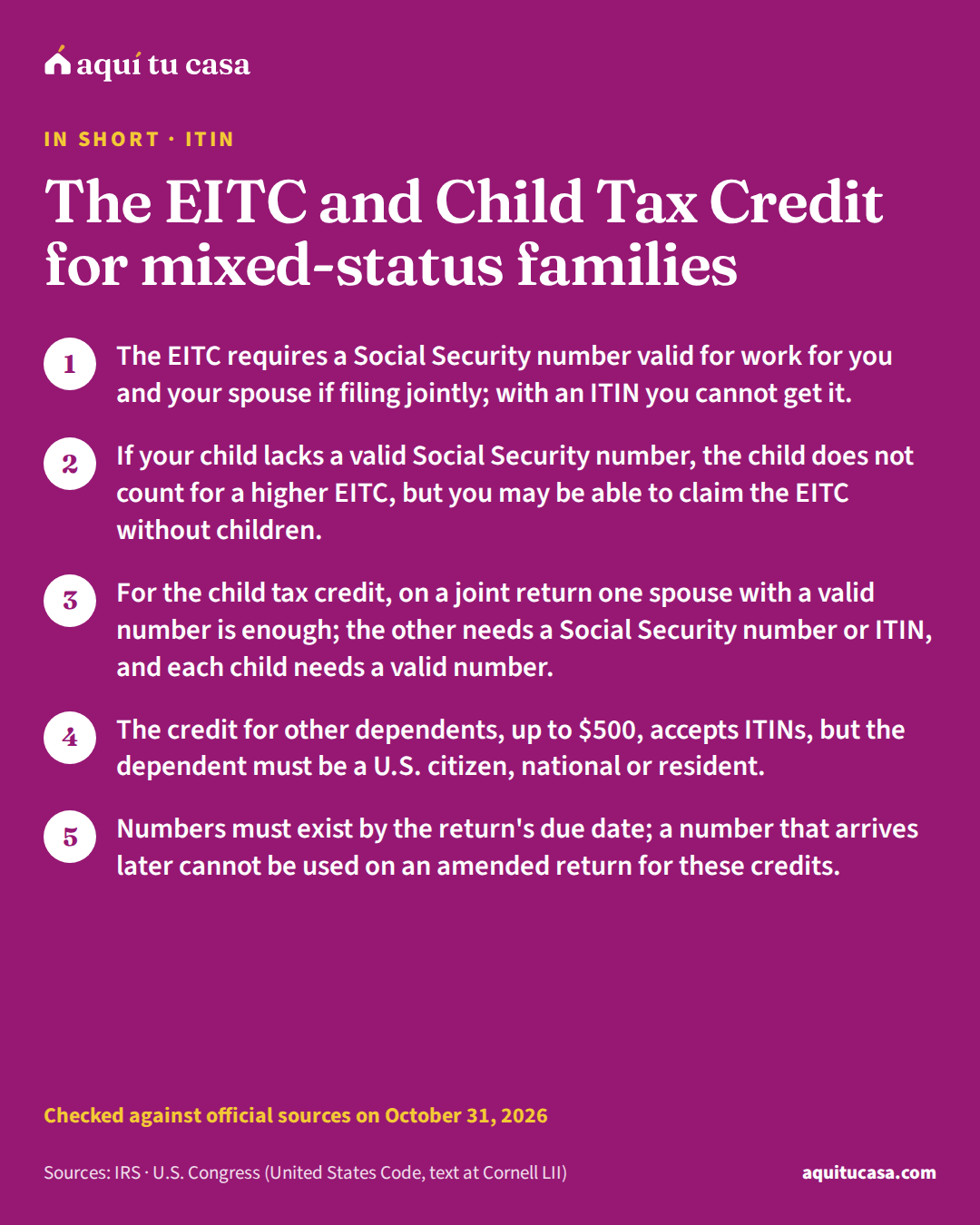
- The EITC requires a Social Security number valid for work for you and your spouse if filing jointly; with an ITIN you cannot get it.
- If your child lacks a valid Social Security number, the child does not count for a higher EITC, but you may be able to claim the EITC without children.
- For the child tax credit, on a joint return one spouse with a valid number is enough; the other needs a Social Security number or ITIN, and each child needs a valid number.
- The credit for other dependents, up to $500, accepts ITINs, but the dependent must be a U.S. citizen, national or resident.
Is this for you?
This guide is for you if…
- In your family some people have Social Security numbers and others have ITINs or no number, and you want to know which credits the IRS allows for each.
- You have an ITIN and your children were born in the United States.
- You were told that with an ITIN you cannot claim anything for your children, and you want to know what the IRS says.
Get direct help first if…
- You already received an IRS letter denying or reviewing a credit: a Low Income Taxpayer Clinic (LITC) can represent you, free or for a small fee.
- Your question is about your immigration status: this guide covers taxes only. If you wish, you can consult a representative accredited by the Department of Justice.
In many families, the father has a Social Security number, the mother has an ITINITIN (Individual Taxpayer Identification Number)An ITIN is a nine-digit number the IRS, the federal tax agency, issues to people who need a U.S. taxpayer identification number to file taxes and are not eligible for a Social Security number. It is for tax purposes only: it does not authorize you to work in the United States, does not qualify you for Social Security benefits or the Earned Income Tax Credit, and says nothing about your immigration status. You apply with Form W-7, and it expires if it goes unused for several years. Some lenders accept an ITIN for a mortgage.See the full definition and the children were born here. At tax time, each number carries different weight. This guide is for you if your family has mixed status: it explains which number the IRS requires for the Earned Income Tax Credit (EITC), the child tax credit and the credit for other dependents, in the exact words of the IRS and the law. It does not decide your case: it helps you arrive prepared for your appointment.
First: not every number counts the same
The IRS works with two kinds of numbers for people: the Social Security number (SSN), issued by the Social Security Administration, and the ITIN, which the IRS issues to people who cannot get a Social Security number. And not every Social Security number counts for these credits.
For the EITC, the IRS says a number is not valid if it was issued after your return’s due date (including extensions), or if it was issued only to apply for or receive a federally funded benefit, such as Medicaid, and does not authorize you to work.1 For the child tax credit, the number must be valid for employment and issued before the due date.5
The date also matters. If you did not have a valid number by the due date and get one later, Publication 596 says you cannot file an amended return to claim the EIC. There is an exception: if you had a number that was not valid for the EIC, but by the due date you were already eligible for a card without “Not valid for employment,” you can claim it even if the card was not updated in time.2
The Earned Income Tax Credit (EITC)
The EITC is a credit for people who work and have low or moderate income. According to the IRS, to qualify you must have earned income, have investment income below the limit, have a valid Social Security number by your return’s due date, be a citizen or resident alien all year, not file Form 2555 for foreign earned income, and meet certain rules if you are separated from your spouse.1
The number rule is strict: you, your spouse if filing jointly, and the child you claim must have a valid Social Security number.1 The law puts it this way: no credit is allowed if the return does not include the taxpayer’s number and, if married, the spouse’s; and for that rule only a Social Security number issued in time counts, excluding those issued only for non-work purposes.3
What about an ITIN? Publication 596 is direct: you cannot get the EIC if, instead of a Social Security number, you or your spouse on a joint return have an ITIN. If you do not have a valid number by the due date, you cannot claim it on either the original or an amended return.2 The IRS ITIN page also says an ITIN does not qualify you for this credit.7
What if I am a resident for tax purposes, but not all year? The IRS requires being a citizen or resident alien all year. If you were a nonresident alien for part of the year, you can only claim it if you file married filing jointly, your spouse is a citizen or resident, and you choose to be treated as a resident.1 The guide Filing taxes with an ITIN explains that “resident” for tax purposes is not your immigration status.
If your child does not have a valid Social Security number
Many families think that if a child lacks a Social Security number, the whole EITC is lost. Not always. Publication 596 explains that your child must have a valid number for you to claim a higher EIC for that child. But if you have a child who meets the conditions and lacks a valid number, you can claim the EIC for people without a qualifying child (the so-called self-only EIC), if you meet the other rules. If you have several children and only one has a valid number, only that child counts for a higher EIC. And you have to attach Schedule EIC even if your child does not have a valid number.2
For the EITC without a qualifying child, the IRS requires, in addition to the basic rules:1
- having lived in the United States more than half the year (the 50 states, the District of Columbia and military bases; territories such as Puerto Rico, Guam or the Virgin Islands do not count);
- that no one can claim you as a qualifying child or dependent;
- being at least 25 and under 65 at the end of the year; on a joint return, one spouse meeting the age rule is enough.
Remember that this does not change the number rule for you and your spouse: if one of you has an ITIN on a joint return, there is no EIC.2

If you are married but live apart
Generally, if you are married you have to file jointly for the EITC. But the IRS has a rule for separated spouses. You can claim the EITC without filing jointly if a qualifying child lived with you more than half the year and also:1
- you lived apart from your spouse for the last 6 months of the year; or
- you were legally separated under your state’s law, by a written separation agreement or a decree of separate maintenance, and did not live in the same household at the end of the year.
This rule exists for real separations, not to change how a couple living together files. If your family is going through a separation, the guide divorce, separation or a death in the family explains what happens with the house.
The child tax credit (CTC and ACTC)
The IRS describes three credits that go together. The child tax credit (CTC) reduces the tax you owe; it is not refundable. The additional child tax credit (ACTC) is the refundable part: if the credit is more than what you owe, you can receive the difference as a refund. And the credit for other dependents (ODC) is for dependents who do not qualify for the other two.4
According to the IRS page, for the tax year it names, the child tax credit is worth up to $2,200 per qualifying child, and the additional credit up to $1,700 per child depending on income, with earned income of at least $2,500. You get the full credit if your income is not more than $200,000 ($400,000 on a joint return).4 These amounts change; check the IRS page for the year you file.
The number rule. The IRS says you (or your spouse, if filing jointly) and each qualifying child must have a Social Security number valid for employment and issued before the due date.4 The Schedule 8812 instructions spell it out for mixed-status couples: on a joint return only one spouse needs a valid number, and the other must have a Social Security number or an ITIN issued in time. If neither spouse has a valid number, there is no CTC or ACTC, on the original return or an amended one.5 The law says the same: the taxpayer, or at least one spouse on a joint return, and the child must have a Social Security number issued to a citizen or with work authorization.6
The child’s other rules. Generally, the child must be under 17 at the end of the year; be your son, daughter, stepchild, eligible foster child, sibling or a descendant of one of them, such as a grandchild or nephew; have lived with you more than half the year; not provide more than half of their own support; be claimed as your dependent; and be a U.S. citizen, national or resident alien.4
The credit for other dependents (ODC): the one that accepts ITINs
This credit is the piece many mixed-status families do not know about. It is worth up to $500 per dependent and decreases if your adjusted gross income exceeds $200,000 ($400,000 on a joint return).4 According to the Schedule 8812 instructions, the dependent must:5
- be claimed as your dependent;
- not qualify you for the CTC or ACTC;
- be a U.S. citizen, national or resident alien;
- have a Social Security number, an ITIN or an ATIN (the adoption taxpayer identification number) issued by the due date.
And you, or your spouse if filing jointly, must have a Social Security number or an ITIN by that date. If you apply for the ITIN by the due date and the IRS issues it, it is considered issued in time.5
What about a child who does not count for the CTC because of the number rule? If the child has another identification number issued in time, you may be able to claim the ODC for that child.5 The law points the same way: a qualifying child for whom the child tax credit is denied because of the number rule is treated as a dependent for the $500 credit.6
If you apply for an ITIN for a dependent along with your return, the IRS requires the dependent to be a resident alien or U.S. national, that you check the “Credit for other dependents” box next to the dependent’s name and that you attach Schedule 8812. If you use tax software, check that box: it may not be checked automatically when there is no number yet.7 The guide how to get an ITIN with Form W-7 explains the application.
The three credits and the number each one requires
Earned income tax credit
EITC
CTC and ACTC
Child tax credit
If a number falls short for the child tax credit, check whether that child counts for the credit for other dependents.6
Three families: what the rules say
These examples apply the rules we cite; each family must also meet the other conditions of each credit.
| The family | EITC | Child tax credit | Credit for other dependents |
|---|---|---|---|
| He has a valid Social Security number, she has an ITIN, they file jointly; children with Social Security numbers | No, because one spouse has an ITIN | Possible, because one spouse with a valid number is enough | Not needed for those children |
| Both have ITINs; a child born here with a Social Security number | No | No, because neither spouse has a valid number | Possible, for that child |
| She has a valid Social Security number, no partner; a resident child with an ITIN | Only the EITC without children, if she meets the age and other rules | Not for that child | Possible, for that child |
The first row follows the EIC rules2 and the Schedule 8812 instructions.5 The second, the child tax credit law6 and the ODC conditions.5 The third, the self-only EIC2 and the ODC for a child without a valid Social Security number.5
Example with real numbers
What each number needs on a joint return
A couple in which he has a valid Social Security number and she has an ITIN, with two citizen children.
- His number
- Social Security, valid for work, issued before the due date
- Her number
- ITIN issued by the due date
- Each child's number
- Social Security, valid for work
- EITC
- Not allowed, because one spouse has an ITIN
- Child tax credit
- Can be claimed if they meet the other rules
That is what the Schedule 8812 instructions5 and Publication 596 say.2 A VITA site reviews the other rules with you.
Run it with your numbersDocument checklist
When the refund arrives and what happens if you get it wrong
If you claim the EITC or ACTC, the IRS cannot issue your refund before mid-February, and that applies to the entire refund, not just the part from those credits. The IRS suggests checking Where’s My Refund in mid-to-late February.4 The guide tax refunds, refund advances and scams explains why paying for an advance while you wait is not worth it.
Claiming a credit you are not entitled to has consequences. If the IRS determines the error was due to reckless or intentional disregard, you cannot claim the CTC, ACTC or ODC for 2 years even if you qualify; if it was fraud, for 10 years; and you may have to pay penalties.5 That is why it is worth reviewing your case with someone certified before you file.
What about benefits? The Schedule 8812 instructions say the ACTC refund is not counted as income for federal benefits or for state or local programs funded with federal money, such as TANF, Medicaid, SSI and SNAP, nor as a resource for at least 12 months.5 If you are worried about other benefit and immigration rules, the guide on public charge and housing explains what the agencies say.
Where to review your case for free
VITAVITA (free tax preparation)VITA (Volunteer Income Tax Assistance) and TCE (Tax Counseling for the Elderly) are IRS programs that offer free basic tax return preparation by IRS-certified volunteers. They are meant for people with moderate income, people with disabilities and limited-English speakers; TCE focuses on people sixty and older. The IRS sets no program-wide income limit, but individual sites may set their own. Many sites serve in Spanish and help with ITIN applications and renewals. Filing taxes every year builds the record lenders ask for.See the full definition sites prepare basic returns for free, and the program generally focuses on people who meet the EITC income guidelines. You find them with the IRS locator or at 800-906-9887.8 The guide free tax filing with VITA, TCE and Free File explains what to bring.
The IRS also has online tools: its EITC Assistant, if you are unsure whether you qualify,1 and its Interactive Tax Assistant for the CTC, ACTC and ODC.4 If you already have an IRS letter about a credit, a Low Income Taxpayer ClinicLow Income Taxpayer Clinic (LITC)A Low Income Taxpayer Clinic (LITC) is an organization that helps low-income people who have a dispute with the IRS, such as an audit, an appeal or a tax collection matter, for free or for a small fee. It can represent you before the IRS or in court. It also teaches taxpayer rights and responsibilities to people who speak English as a second language. To qualify, your income generally must be below a certain level. The clinics get part of their funding from the IRS but are independent of it.See the full definition can help.
If this is your situation
You have an ITIN and your husband a Social Security number
On a joint return, the child tax credit requires a valid number for at least one of you;5 the EITC is not allowed if one of you has an ITIN.2
Your children were born here and you both have ITINs
There is no child tax credit, but the law treats those children as dependents for the $500 credit.6
Your child has no Social Security number
The child does not count for a higher EITC, but you may be able to claim the EITC without children if you meet the other rules.2
You just got your Social Security number
A number that arrives after the due date cannot be used to amend and claim that year's EIC.2

Costly mistakes
Mistake: Claiming the EITC on a joint return when one spouse has an ITIN.
Instead: Publication 596 says the EIC is not allowed with an ITIN.2
Mistake: Assuming that with an ITIN there is no credit at all for the children.
Instead: Check the credit for other dependents, which accepts ITINs if the dependent is a citizen, national or resident.5
Mistake: Leaving the child without a Social Security number off Schedule EIC.
Instead: Attach Schedule EIC even if your child does not have a valid number.2
Mistake: Letting the software skip the ODC box.
Instead: Make sure the 'Credit for other dependents' box is checked next to each dependent with a pending ITIN.7
Mistake: Applying for the dependent's ITIN after the due date.
Instead: Apply by the due date, so it is considered issued in time.5
Mistake: Claiming a credit you are not entitled to in order to get more.
Instead: A reckless error takes away the credits for 2 years, and fraud for 10.5
What to do this week
- List each person on your return and their number: Social Security or ITIN, and what each card says.1
- If someone needs an ITIN, prepare their Form W-7 so they can apply before the due date.5
- If you have questions about the EITC, try the IRS EITC Assistant.1 Before that, the Can I get the EITC or Child Tax Credit? tool shows, from each person’s number, which rule decides each credit.
- Find a VITA site with the IRS locator or at 800-906-9887 and bring your list.8 The document checklist helps you organize your papers.
- Plan how you will use the refund with the family budget, knowing that with the EITC or ACTC it does not arrive before mid-February.4
Your household this month
Let's do the math
Left each month
Enter what at least one person takes home to see the result.
What helps
- Pay savings first: set the goal aside the day the money arrives, before flexible spending.
- Add up the bills that come every few months (car insurance, school) and divide by twelve.
- If income changes, plan on a low month and save the extra from good months.
- A HUD-approved housing counselor can go over the budget with you, often for free.
This is a planning tool with your numbers, not a credit evaluation or an approval. The split reference is only a guide.
Ready to see the numbers? Find your county here
See how this applies in your county: its loan limits, prices and rents, from the official data.
Printable checklist
Frequently asked questions
Can I get the EITC if I have an ITIN?
No. IRS Publication 596 says you cannot get the EIC if you, or your spouse on a joint return, have an ITIN instead of a Social Security number. The IRS ITIN page also says an ITIN does not qualify you for this credit.
My husband has a Social Security number and I have an ITIN. Can we claim the child tax credit?
According to the Schedule 8812 instructions, on a joint return only one spouse needs a Social Security number valid for work; the other must have a Social Security number or ITIN issued in time. Each child also needs a valid Social Security number, and you must meet the other rules.
My children were born here, but my partner and I both have ITINs. Is there any credit for them?
The law says the child tax credit requires the Social Security number of at least one spouse, so it is not allowed. But the same law treats those children as dependents for the $500 credit for other dependents, which accepts ITINs for the parents. Review the other rules with a VITA site.
My child has an ITIN. Does the child count for any credit?
Not for the child tax credit or a higher EITC, because those require a valid Social Security number. The child can count for the credit for other dependents if the child is a U.S. citizen, national or resident alien and has the ITIN in time.
Can I claim the credit for other dependents for a child who lives in Mexico?
The Schedule 8812 instructions give exactly that example: a child who lives in Mexico and is not a U.S. citizen, national or resident alien cannot be used for the credit for other dependents, even if the child is your dependent.
If I get my Social Security number later, can I amend my return for the EITC?
Generally no: Publication 596 says that if you did not have a valid number by the due date and get one later, you cannot amend to claim the EIC. There is an exception if your card said 'Not valid for employment' and by that date you were already eligible for a card without that legend.
Does the additional child tax credit refund affect my benefits?
The Schedule 8812 instructions say that refund is not counted as income for federal benefits or for state or local programs funded with federal money, such as TANF, Medicaid, SSI and SNAP, nor as a resource for at least 12 months.
Sources
Every figure in this guide comes from one of these official sources. The number next to a sentence leads to the source behind it.
Each source on one line: who publishes it, its title, its address and the date we read it.
- 1. IRS · Who qualifies for the Earned Income Tax Credit (EITC) · irs.gov · Accessed October 31, 2026
- 2. IRS · Publication 596, Earned Income Credit (EIC) · irs.gov · Accessed October 31, 2026
- 3. U.S. Congress (United States Code, text at Cornell LII) · 26 U.S.C. §32, Earned income · law.cornell.edu · Accessed October 31, 2026
- 4. IRS · Child Tax Credit · irs.gov · Accessed October 31, 2026
- 5. IRS · Instructions for Schedule 8812 (Form 1040), Credits for Qualifying Children and Other Dependents · irs.gov · Accessed October 31, 2026
- 6. U.S. Congress (United States Code, text at Cornell LII) · 26 U.S.C. §24, Child tax credit · law.cornell.edu · Accessed October 31, 2026
- 7. IRS · Individual taxpayer identification number (ITIN) · irs.gov · Accessed October 31, 2026
- 8. IRS · Free tax return preparation for qualifying taxpayers · irs.gov · Accessed October 31, 2026
Keep reading
Related guides
If this guide helped, these follow the same path.

Taxes and money 13 minute read
Free tax filing: IRS VITA, TCE and Free File
Who can file for free with VITA, TCE or Free File, what to bring, how to apply for an ITIN at a VITA site and how to find a free tax help site near you.
- VITA and TCE prepare basic returns for free; the IRS sets no program-wide income limit, but many sites serve people who make about $70,244 or less.
- Some VITA sites have Certifying Acceptance Agents who review your W-7, authenticate most documents and return them the same day.
- Bring photo ID, the whole family's Social Security cards or ITIN papers, your W-2s and 1099s and a blank check for direct deposit.
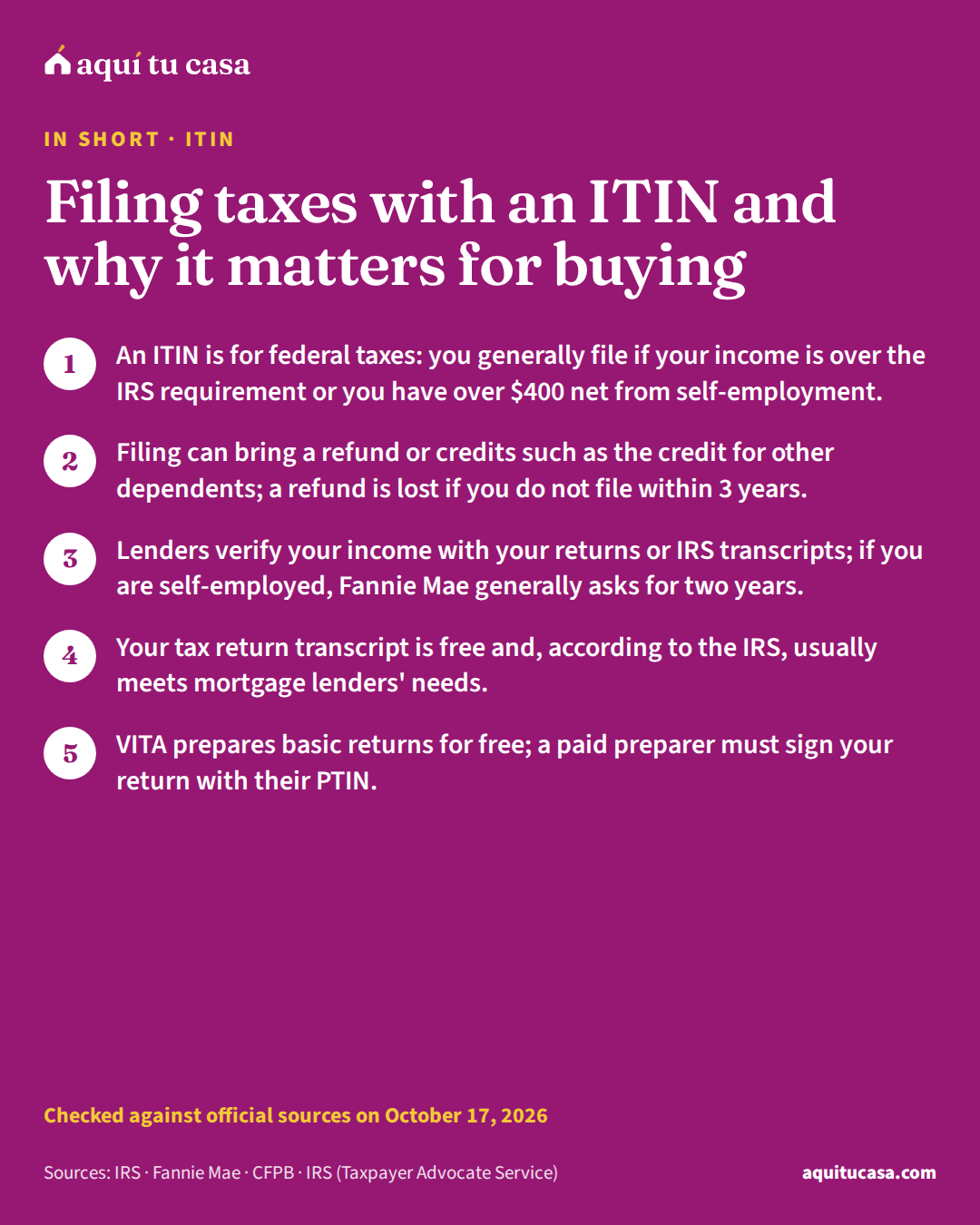
- ITIN Filing taxes with an ITIN and why it matters for buying Who has to file with an ITIN, what you gain by filing, how to get your IRS transcripts and why a lender will ask for your tax returns. 12 minute read
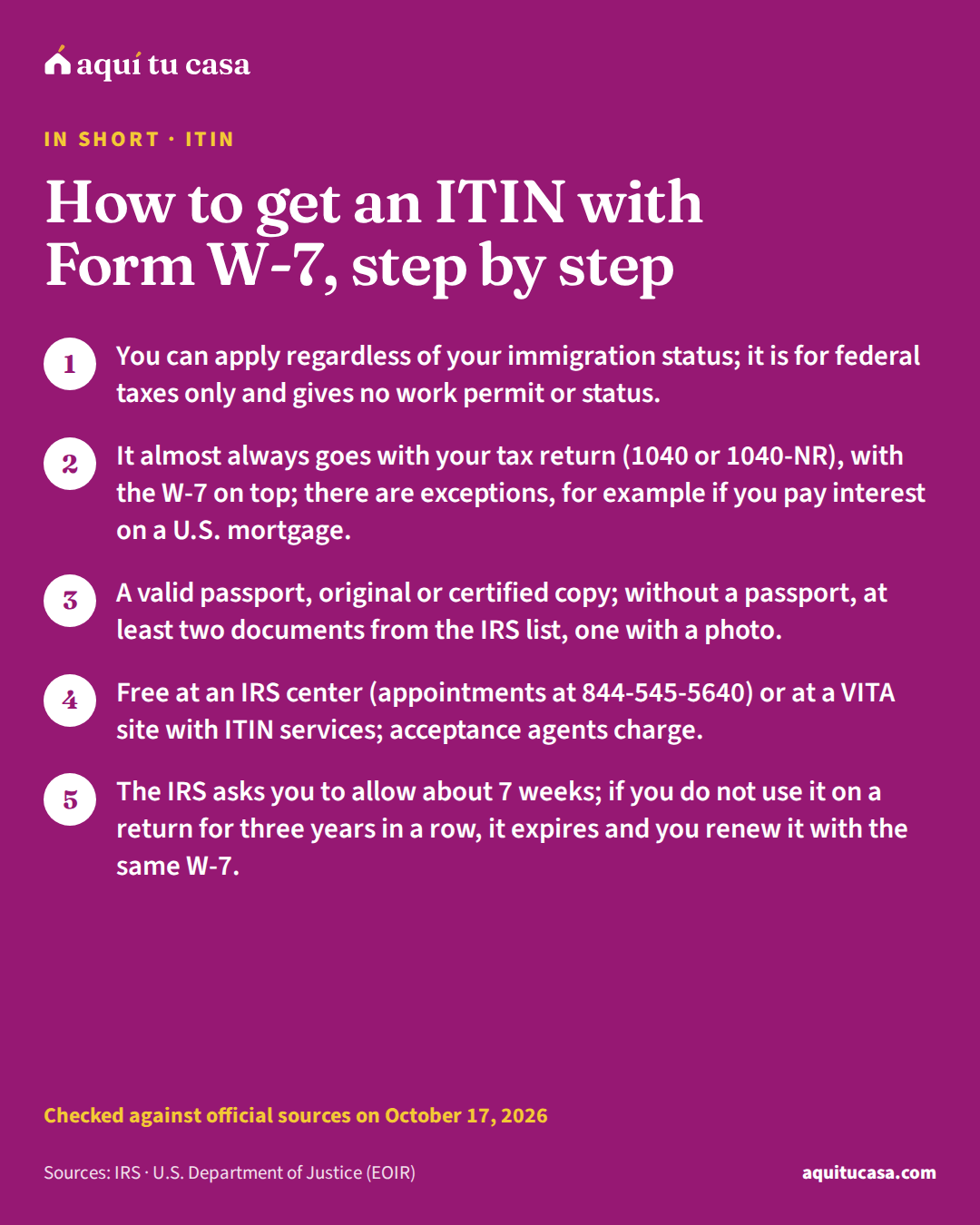
- ITIN How to get an ITIN with Form W-7, step by step Who can apply for an ITIN, which documents the IRS accepts, where to file Form W-7 for free, how long it takes and how to renew it. 15 minute read
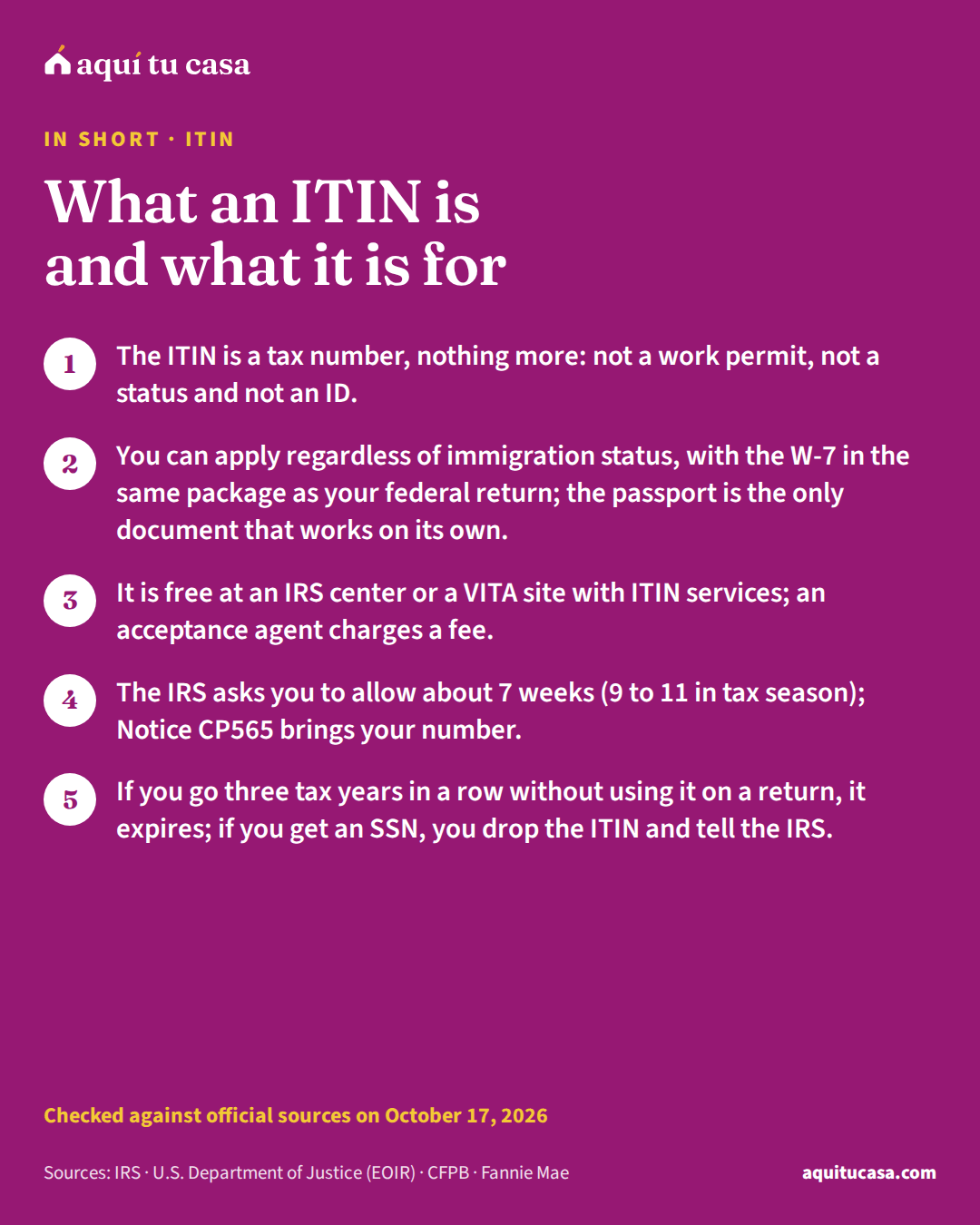
- ITIN What an ITIN is and what it is for The ITIN is the IRS number for filing taxes without a Social Security number: what it does and does not do, how to apply with Form W-7, timing and expiry. 15 minute read
Tools for this topic
Was this guide useful?
Thank you. Your answer stays in your browser; nothing is sent.