Filing taxes with an ITIN and why it matters for buying
Who has to file with an ITIN, what you gain by filing, how to get your IRS transcripts and why a lender will ask for your tax returns.
Verified against official sources on October 17, 2026 19 official sources

Show contents
In short
What you need to know
Quick answer
With an ITIN you file like any other taxpayer: you generally must file if your income is over the IRS filing requirement or if you made over $400 net from self-employment, and even when you do not have to, filing can get you back money that was withheld. It matters for buying a home because the lender verifies your income with your tax returns or with IRS transcripts, which are free. The IRS warns that not filing can delay a loan approval. VITA sites prepare basic returns for free.
What matters most
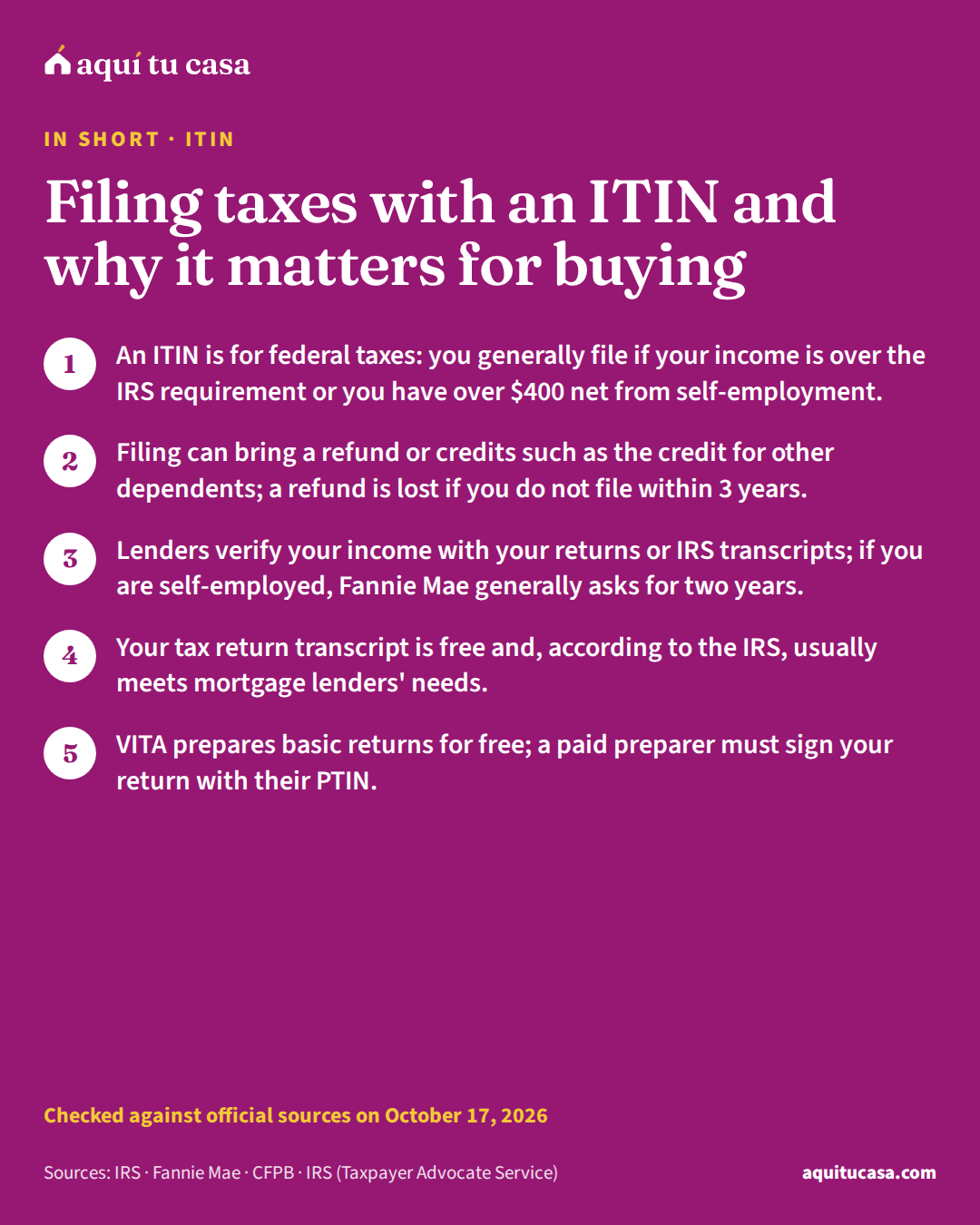
- An ITIN is for federal taxes: you generally file if your income is over the IRS requirement or you have over $400 net from self-employment.
- Filing can bring a refund or credits such as the credit for other dependents; a refund is lost if you do not file within 3 years.
- Lenders verify your income with your returns or IRS transcripts; if you are self-employed, Fannie Mae generally asks for two years.
- Your tax return transcript is free and, according to the IRS, usually meets mortgage lenders' needs.
Is this for you?
This guide is for you if…
- You have an ITIN, work in the United States and do not know whether you have to file taxes.
- You are self-employed or paid in cash and want your income to count toward a mortgage.
- You have years without filing and want to catch up before you apply for a loan.
Get direct help first if…
- You do not have an ITIN yet: start with the guide to getting an ITIN with Form W-7.
- You have an open dispute with the IRS (an audit or a collection): a Low Income Taxpayer Clinic can help, free or for a small fee.
- Your question is about your immigration status: the ITIN does not change it and this guide does not answer that. If you wish, you can consult a representative accredited by the Department of Justice.
Many families with an ITINITIN (Individual Taxpayer Identification Number)An ITIN is a nine-digit number the IRS, the federal tax agency, issues to people who need a U.S. taxpayer identification number to file taxes and are not eligible for a Social Security number. It is for tax purposes only: it does not authorize you to work in the United States, does not qualify you for Social Security benefits or the Earned Income Tax Credit, and says nothing about your immigration status. You apply with Form W-7, and it expires if it goes unused for several years. Some lenders accept an ITIN for a mortgage.See the full definition work, pay rent and save, but do not file taxes because nobody explained how or why. This guide is for you if you have an ITIN or are about to apply for one: it explains when you must file a tax returntax returnA tax return is the yearly form you use to report your income to the IRS and figure the tax you owe, so you can pay what is due or get a refund. The federal return for individuals is Form 1040. In general you must file if your gross income is above the minimum the IRS sets for your filing status, or if you had a certain amount of net earnings from self-employment; even when you do not have to, filing can pay off. You need your SSN or ITIN, and those of everyone else on the return, plus documents such as your W-2s and 1099s.See the full definition, what you can gain by filing and why your returns weigh so much on the day you apply for a mortgage. All of it based on what the IRS, Fannie Mae and the CFPB say.
Do you have to file?
The ITIN exists for taxes. The IRS says you have a federal tax purpose when the law requires you to file, when you want to claim a refund or a tax benefit, or when you want to report your income on a return.1 The number is issued for federal taxes only: it does not provide or change immigration status, and it does not qualify you for Social Security benefits or the Earned Income Tax Credit (EITC).1
In general, you have to file if your income is over the filing requirement or if you have over $400 in net earnings from working for yourself, through side jobs or other independent work. That requirement depends on your filing status and your age; the IRS publishes it in tables on its site. Even if you made less, it may pay to file, for example to get back taxes your employer withheld.2 The IRS says the same to ITIN holders: if you earned money but do not owe tax, you may want to file to get money back.1
Dates matter. If you need more time, you can request an extension by the April filing due date, and you do not need an ITIN to request it. The extension gives you until October 15 to file without penalties, but it is only for filing: whatever you owe is due in April.1
If you are self-employed or paid in cash
If you work for yourself, as the sole owner of your business or as an independent contractor, you are self-employedself-employedFor the IRS, you are self-employed if you run a business as a sole proprietor or work as an independent contractor, if you are a member of a partnership that runs a business, or if you are otherwise in business for yourself, including part-time or as a gig worker. Because no employer withholds taxes for you, you generally pay estimated taxes every quarter and file a yearly return. Besides income tax, you pay self-employment tax, which covers Social Security and Medicare. Your profit or loss is figured by subtracting your business expenses from your business income, usually on Schedule C.See the full definition. When your net earnings were $400 or more, you pay self-employment tax, which is the Social Security and Medicare tax of people who work for themselves, and you file Schedule SE. Earnings are generally figured on Schedule CSchedule C (Form 1040)Schedule C is the form attached to Form 1040 to report the profit or loss from a business you operated or a profession you practiced as a sole proprietor, including gig work. An activity counts as a business if your main purpose is income or profit and you do it with continuity and regularity. On the schedule you subtract your business expenses from your income: if expenses are lower, the difference is your net profit, which becomes part of your income on Form 1040. That figure is also used to calculate self-employment tax on Schedule SE.See the full definition.6
Being paid in cash does not change the rule. The IRS spells it out for gig or app-based work: that income is reported even if it comes from part-time or side work, even if you do not get a form such as a 1099, and even if you are paid in cash.5
If no one withholds taxes from your pay during the year, you may have to make estimated tax payments, even before you have an ITIN. In that case, on the payment voucher you write “ITIN TO BE REQUESTED” where the number goes.3
If the person who paid you sends a Form 1099Form 1099Form 1099 is a family of IRS information returns that report income other than employee wages. Anyone who paid you in the course of their business must file it with the IRS and send you a copy, on paper or electronically, early in the year. There are several types: 1099-NEC for freelance or contract work, 1099-K for payments by card or through online platforms, 1099-INT for bank interest, 1099-G for government payments such as unemployment, and 1099-MISC for other income. You use that information on your tax return.See the full definition, keep it with your papers for the year. And if you work for an employer, keep your Form W-2Form W-2Form W-2 (Wage and Tax Statement) is the document your employer must prepare for each employee. It shows the wages you were paid and the taxes withheld from your pay, such as income tax and Social Security and Medicare taxes. The employer files it with the government and sends you a copy, on paper or electronically, in January or February so you can file your tax return. If it does not arrive or has errors, you first ask your employer to fix it; if you still do not get it, the IRS can help you obtain it.See the full definition.
What you gain by filing and what you lose if you do not
Filing with an ITIN opens some benefits. If you are not eligible for an SSN, you can file a joint return with a spouse who is a citizen or resident alien. The credit for other dependents is a $500 non-refundable credit for people whose dependents do not qualify for the child tax credit. And the child and dependent care credit is also among the allowable benefits.1
Filing on time or letting it slide
Your record grows
You file every year
Every return you file is one more paper that shows your income when you apply for a loan.9

Why it matters for buying a home
When you apply for a mortgage, the lender verifies your income, and your tax returns are part of that proof. The IRS puts it plainly: if you do not file, a loan approval may be delayed, because to buy or refinance a home you must give lenders copies of the returns you filed.7
Fannie Mae’s rules, which govern the loans it buys, are a good example. They require each borrower to have a valid Social Security number or ITIN, in addition to meeting legal residency and documentation requirements.8 And they say tax returns and transcripts are used to calculate and verify income; when required, returns must be copies of the originals filed with the IRS, with all schedules, or the lender may use transcripts instead.9
If you are self-employed, the weight is greater. Fannie Mae generally asks for a two-year income history, which the lender verifies with your signed returns for the past two years, with all schedules, or with IRS transcripts.10 Not every loan follows Fannie Mae’s rules: each type of loan and each lender has its own limits.11 The ITIN mortgage guide explains the options.
Why does income weigh so much? Because the lender uses it to calculate your debt-to-income ratiodebt-to-income ratio (DTI)Your debt-to-income ratio (DTI) is all your monthly debt payments divided by your gross monthly income, that is, income before taxes. If you pay a certain amount each month across a car, cards, student loans and the mortgage you are asking for, and you earn three times that, your DTI is one third. Lenders use it to measure whether you can manage the payment; each loan type and lender sets its own limit, and assistance programs usually publish theirs. Paying down debt before applying improves your DTI.See the full definition: your monthly debt payments divided by your monthly gross incomegross incomeGross income is the total you earn before taxes and other deductions are taken out. On your pay stub it shows up as gross pay, not as what lands in your account. Lenders use it to figure your debt-to-income ratio (DTI): they add up your monthly debt payments and divide them by your gross monthly income. When you apply for a mortgage, your annual pre-tax income can include full-time or part-time work, self-employment, tips, commissions, overtime and bonuses; the lender looks at whether you can reasonably expect that income to continue.See the full definition. It is one way lenders measure whether you can make the payments, and each lender has different limits.11
Example with real numbers
How much of income goes to the home
With the typical US household income and the typical payment on a home with an FHA loan and the minimum down payment.
- Gross monthly income (US median)
- $6,728
- Monthly payment on a typical home (FHA)
- $2,759
- Home payment ÷ monthly income
- 41%
This is an example with national numbers. The lender does this math with the income it can verify on your returns or transcripts.911 Try it with your own numbers.
Run it with your numbersHow much house can I afford?
Your transcripts and Form 4506-C
A tax transcriptIRS tax transcriptAn IRS tax transcript is a free official summary of the information on your tax returns and tax account. It is not a photocopy of your return. There are several types: the tax return transcript shows most line items from your Form 1040 as filed and usually meets the needs of mortgage lenders; the tax account transcript shows changes made after you filed; the wage and income transcript shows what your W-2s and 1099s reported. You can get one through your IRS online account, by mail, by phone or with Form 4506-T.See the full definition is the IRS’s official summary of what you filed. The IRS offers its transcripts at no charge. The tax return transcript shows most line items from your original return as filed, covers the current year and the three before it and, according to the IRS, usually meets the needs of mortgage lenders. It is not a photocopy of your return.13
You can view it in your IRS online account or order it by mail: it arrives in 5 to 10 calendar days at the address the IRS has, and you can also order it at 800-908-9946. It partially masks your personal information but leaves financial data visible for income verification.12
The lender can also request it directly, but only with your permission. The IRS explains that through its Income Verification Express Service (IVES) you authorize banks and lenders to see your records when you apply for a mortgage; the IRS only gives records to a third party with your consent, and you give it through your account or with the Form 4506-C the lender gives you.14
From your tax return to your loan
1. You file every year
By April, or October with an extension
Whatever you owe is due in April, even with an extension.1
2. You keep a signed copy with all schedules
The day you file
The lender may ask for copies of the returns you filed.9
3. You order your transcripts
5 to 10 days by mail
They are free and usually meet mortgage lenders' needs.13
4. You gather two years if you are self-employed
When you apply for the loan
Signed returns for the past two years or their transcripts.10
Try it with your numbersDocument checklist5. You sign Form 4506-C
At or before closing
It lets the lender request your transcripts; it is valid for 120 days.9
6. The lender compares
Before closing
If it receives the transcripts before closing, it uses them to verify the papers you gave.9
On loans Fannie Mae buys, every borrower whose income counts toward qualifying signs their own Form 4506-C at or before closing. The form can request transcripts for up to four years and is valid for 120 days. If the lender receives the transcripts before closing, it has to use them to verify the income documents you provided.9 That is why it helps when what you filed and what you show match.

If you have years without filing
It is not too late to catch up. The IRS asks you to file every return that is due, even if you cannot pay in full, the same way and to the same place as an on-time return. You risk losing a refund if you do not file: to claim one for withholding you must file within 3 years of that return’s due date. If you do not file, the IRS may file a substitute return that might not give you the deductions you are entitled to.7
If you cannot pay everything you owe, you can ask for 60 to 120 more days to pay or, if you need more time, an installment agreement.7 If the IRS has no record that you filed a year, there is a verification of non-filing letter that confirms it.13
If you are just applying for your ITIN, keep in mind that in the year it is assigned you cannot e-file with it; from the following years, you can.15 If your ITIN expired because you went years without using it, see how to renew an ITIN.
Free help and how to choose who prepares your return
IRS VITAVITA (free tax preparation)VITA (Volunteer Income Tax Assistance) and TCE (Tax Counseling for the Elderly) are IRS programs that offer free basic tax return preparation by IRS-certified volunteers. They are meant for people with moderate income, people with disabilities and limited-English speakers; TCE focuses on people sixty and older. The IRS sets no program-wide income limit, but individual sites may set their own. Many sites serve in Spanish and help with ITIN applications and renewals. Filing taxes every year builds the record lenders ask for.See the full definition sites prepare basic returns for free. Many serve people who generally make about $70,244 or less (each site can set its own limit), people with disabilities and limited-English speakers. Their volunteers are trained, among other things, to keep your information confidential. You find them with the IRS locator or at 800-906-9887.16
If you already have a problem with the IRS, such as an audit or a collection, Low Income Taxpayer Clinics (LITCs) can represent you, free or for a small fee, and also educate people who speak English as a second language. They are completely independent of the IRS.17
If you pay a preparer, the IRS gives clear signs. A paid preparer must sign your return and include their preparer number (PTIN). Be wary of anyone who charges a percentage of your refund or wants the refund deposited in their account, and never hire someone who files with a pay stub instead of a W-2. In the end, you are responsible for what your return says, no matter who prepares it.18
Mistakes that can cost you the loan
Mistake: Not filing because you are paid in cash.
Instead: Gig income is reported even if it is paid in cash;5 with $400 or more net from self-employment, Schedule SE applies.6
Mistake: Waiting for the lender to ask for your returns before preparing them.
Instead: File every year: not filing can delay a loan approval.7
Mistake: Not keeping a copy of what you filed.
Instead: Keep a signed copy with all schedules, or order the free transcript.913
Mistake: Hiring a preparer who does not sign your return.
Instead: A paid preparer signs and includes their PTIN on every return.18
Mistake: Letting your refund go into the preparer's account.
Instead: The refund goes to your account; that request is a warning sign.18
Mistake: Writing off an old refund without checking.
Instead: You have 3 years from that return's due date to claim it.7
If this is you
You are paid in cash
The IRS says gig income is reported even if it is paid in cash.5 With $400 or more net from self-employment, Schedule SE applies.6
You have your own business
To buy, you are generally asked for two years of returns or their transcripts.10
Your partner is a citizen
You can file a joint return with a spouse who is a citizen or resident alien.1
You want to buy in a year or two
A HUD-approved housing counselor reviews your papers with you, often for free or at low cost.19

What to do this week
- Gather your W-2s, your 1099s and your income and expense records for each year.6
- Check which years you still need to file; if unsure, order your IRS transcripts.12
- Find a VITA site near you with the IRS locator or at 800-906-9887.16
- Keep a signed copy of each return, with all schedules, in a folder for your lender.9
- Estimate what you could pay for a home with the how much house can I afford tool.11
- If you want to buy soon, talk with a HUD-approved housing counselor about your papers.19
Your numbers
The minimum for this loan is 3.5%. More down lowers the monthly payment.
Adjust advanced details
First number: share of income for housing. Second: housing plus debts. Lender references, not fixed rules.
Let's do the math
Estimated top price
National figure$227,000
Limited by the housing payment: at that price it would be about $1,883 a month, 28% of your income.
- By the housing payment (28% of income)Limits you$227,000
- By your total debts (36% of income)$292,000
- By your cash (down payment + closing)$330,500
- Typical home in the United States
- $332,700
- Your cap is 68% of the typical home.
What changes if…?
- …you save $10,000 more$227,000
- …you cut $200 a month in debts$227,000
Your maximum price with four loans
Same income, debts and savings; only the down payment and the loan type change. ITIN uses an example down payment and rate.
| FHA 3.5% | Conventional 5% | Conventional 20% | ITIN 15% (example) | |
|---|---|---|---|---|
| Maximum price | $227,000 | $232,000 | $93,000 | $119,000 |
| Payment per month | $1,883 | $1,882 | $616 | $898 |
Educational estimate, not a pre-approval. Uses example insurance (0.5% of value per year) and example closing costs (3% of price); the tax is the place’s typical rate.
Ready to see the numbers? Find your county here
See how this applies in your county: its loan limits, prices and rents, from the official data.
Printable checklist
Frequently asked questions
Can I file taxes if I am undocumented?
The IRS issues ITINs to people who have a federal tax purpose and cannot get a Social Security number, and says you can apply regardless of immigration status; you use it to file. The ITIN is for taxes only: it does not provide or change immigration status. For immigration questions, you can consult a representative accredited by the Department of Justice.
Do I have to file if I am paid in cash?
Being paid in cash does not change the rule: the IRS says gig income must be reported even if it is paid in cash and even if you get no 1099. If you are self-employed and your net earnings were $400 or more, you pay self-employment tax and file Schedule SE; you generally figure your earnings on Schedule C.
What if I have years without filing?
The IRS asks you to file every return that is due, even if you cannot pay in full. If you are owed a refund, you can only claim it if you file within 3 years of that return's due date. If you cannot pay, you can ask for 60 to 120 more days or a payment plan.
How many years of tax returns will a lender ask for?
It depends on the loan and the lender. For example, on loans Fannie Mae buys, a self-employed borrower is generally asked for a two-year history, with the last two years of returns or their IRS transcripts.
What is Form 4506-C?
It is the permission you sign so the lender can request your transcripts from the IRS. The IRS only gives your records to a third party with your consent. On Fannie Mae loans, every borrower whose income counts signs one at or before closing, and it is valid for 120 days.
How much does an IRS transcript cost?
Nothing: the IRS offers its transcripts at no charge. You can view them in your online account or order them by mail; by mail they arrive in 5 to 10 calendar days. A photocopy of your original return is different: you request it with Form 4506, and it has a fee.
Can I file online with an ITIN?
Yes, but not in the calendar year your ITIN is assigned: that year the return goes on paper with your W-7. From the following years you can e-file.
Where can I get free help filing?
At IRS VITA sites, which prepare basic returns for free. Many serve people who make about $70,244 or less and limited-English speakers; you find them with the IRS locator or at 800-906-9887. If you already have a dispute with the IRS, a Low Income Taxpayer Clinic can help.
Sources
Every figure in this guide comes from one of these official sources. The number next to a sentence leads to the source behind it.
Each source on one line: who publishes it, its title, its address and the date we read it.
- 1. IRS · Individual taxpayer identification number (ITIN) · irs.gov · Accessed October 17, 2026
- 2. IRS · Check if you need to file a tax return · irs.gov · Accessed October 17, 2026
- 3. IRS · ITIN application frequently asked questions · irs.gov · Accessed October 17, 2026
- 4. IRS · How to renew an ITIN · irs.gov · Accessed October 17, 2026
- 5. IRS · Gig economy tax center · irs.gov · Accessed October 17, 2026
- 6. IRS · Self-employment tax (Social Security and Medicare taxes) · irs.gov · Accessed October 17, 2026
- 7. IRS · Filing past due tax returns · irs.gov · Accessed October 17, 2026
- 8. Fannie Mae · Selling Guide B2-2-01, General Borrower Eligibility Requirements · selling-guide.fanniemae.com · Accessed October 17, 2026
See the other 11 sources
- 9. Fannie Mae · Selling Guide B3-3.1-02, Tax Return and Transcript Documentation Requirements · selling-guide.fanniemae.com · Accessed October 17, 2026
- 10. Fannie Mae · Selling Guide B3-3.5-01, Underwriting Factors and Documentation for a Self-Employed Borrower · selling-guide.fanniemae.com · Accessed October 17, 2026
- 11. CFPB · What is a debt-to-income ratio? · consumerfinance.gov · Accessed October 17, 2026
- 12. IRS · Get transcript · irs.gov · Accessed October 17, 2026
- 13. IRS · Transcript types and ways to order them · irs.gov · Accessed October 17, 2026
- 14. IRS · Income Verification Express Service (IVES) · irs.gov · Accessed October 17, 2026
- 15. IRS · Instructions for Form W-7 (Rev. December 2024) · irs.gov · Accessed October 17, 2026
- 16. IRS · Free tax return preparation for qualifying taxpayers (VITA and TCE) · irs.gov · Accessed October 17, 2026
- 17. IRS (Taxpayer Advocate Service) · Low Income Taxpayer Clinics · irs.gov · Accessed October 17, 2026
- 18. IRS · IR-2024-96, Dirty Dozen: IRS urges taxpayers to not fall prey to untrustworthy tax preparers · irs.gov · Accessed October 17, 2026
- 19. CFPB · Find a Housing Counselor · consumerfinance.gov · Accessed October 17, 2026
Keep reading
Related guides
If this guide helped, these follow the same path.

Mortgage loans 12 minute read
ITIN mortgages: what exists and what lenders ask for
Which home loans accept an ITIN and which do not: Fannie Mae's rule, what FHA and USDA say, who lends and how to compare offers.
- Fannie Mae accepts an SSN or an ITIN as the borrower's number, with documented legal residency; whether you are offered it depends on the lender.
- FHA removed eligibility for non-permanent residents for case numbers from May 25, 2025; USDA requires being a citizen, national or qualified alien.
- ITIN loans are mostly made by banks, credit unions and CDFIs, each with its own terms: the CFPB recommends contacting at least three lenders.
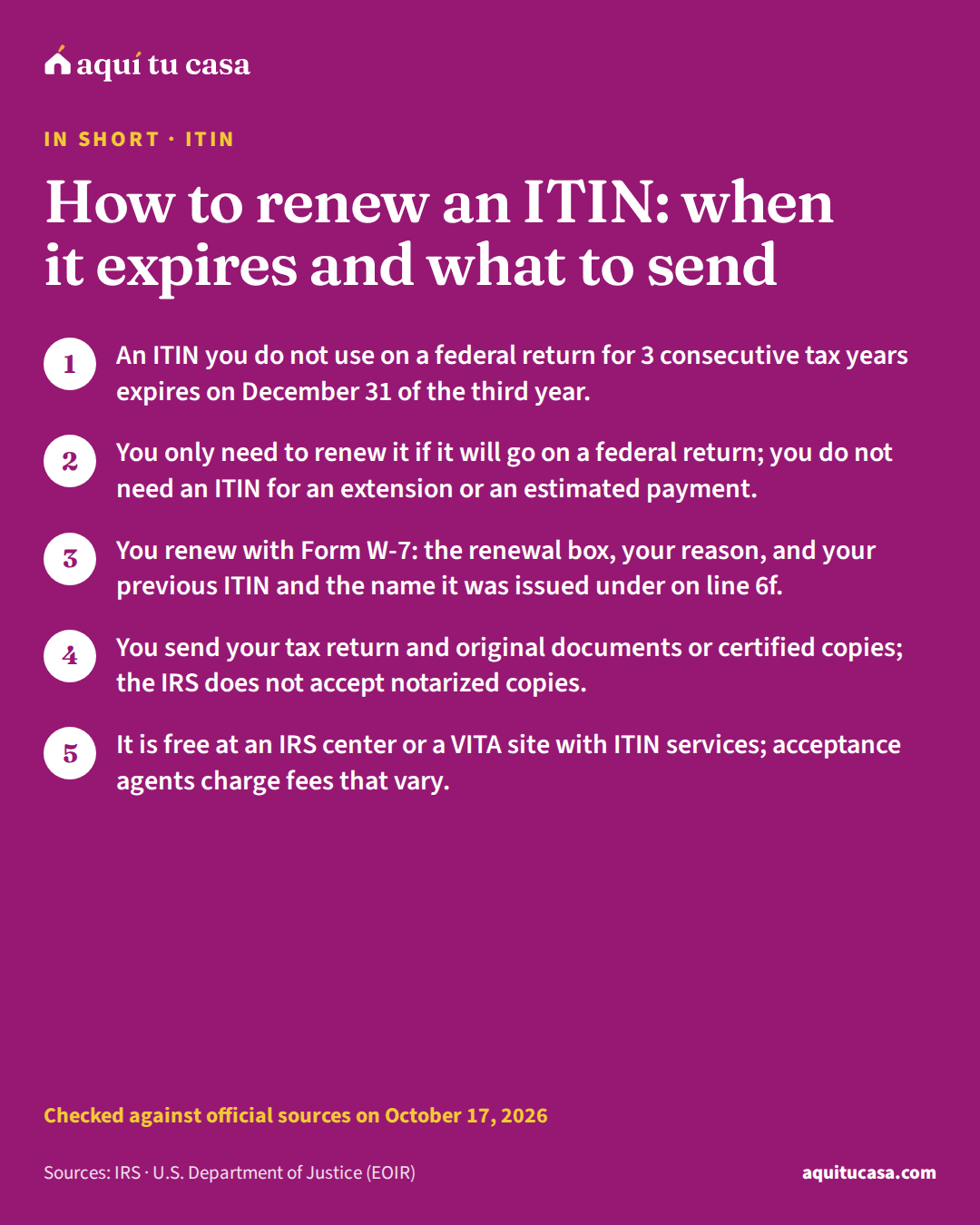
- ITIN How to renew an ITIN: when it expires and what to send When your ITIN expires, whether you really need to renew it, how to fill in a renewal Form W-7, which documents work and where to do it for free. 12 minute read
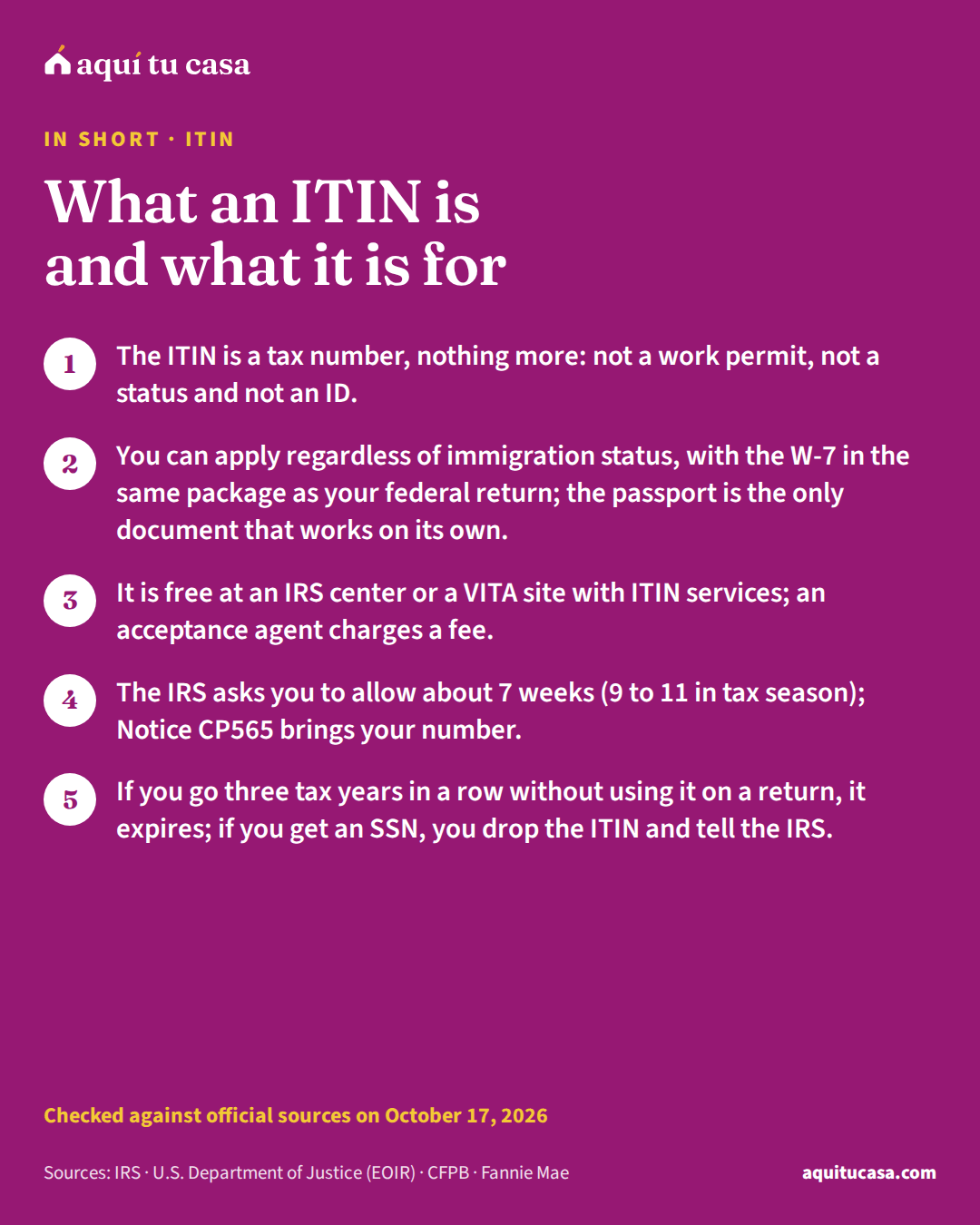
- ITIN What an ITIN is and what it is for The ITIN is the IRS number for filing taxes without a Social Security number: what it does and does not do, how to apply with Form W-7, timing and expiry. 15 minute read
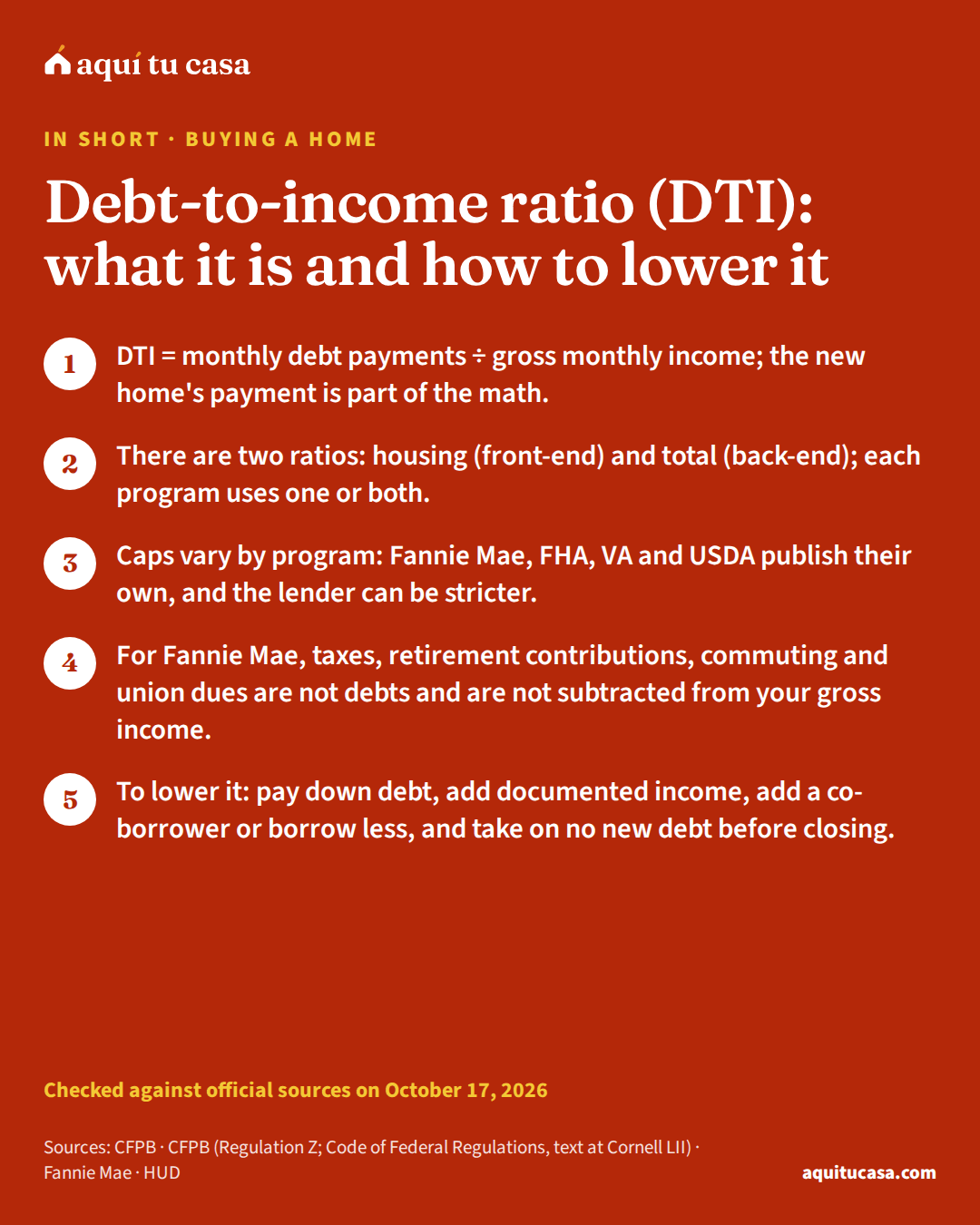
- Buying a home Debt-to-income ratio (DTI): what it is and how to lower it What the debt-to-income ratio (DTI) is, how to calculate it, which payments count, the caps FHA, Fannie Mae, VA and USDA publish and how to lower it. 14 minute read
Tools for this topic
Was this guide useful?
Thank you. Your answer stays in your browser; nothing is sent.