Protect yourself from scams Essential guide
Housing scams: the complete guide to spotting them
The rental, mortgage, title, contractor, credit and moving scams families run into most: how to spot them, what to do and where to report them.
Verified against official sources on October 17, 2026 30 official sources

Show contents
In short
What you need to know
Quick answer
Almost every housing scam runs on the same script: urgency, payment up front and a payment method that cannot be reversed (wire, gift card, cryptocurrency, cash). The ones families run into most are fake rental ads, the email that changes the account on closing day, "notarios" who are not lawyers, promises to save your home from foreclosure, deed theft, contractors who take the money and vanish, calls from fake officials, credit repair and "guaranteed" loans with a fee, and movers who hold your belongings. This guide sums up how the official agency that watches each one describes it, what to do if you already paid and where to report it. Legitimate housing help (HUD-approved counselors, legal aid, accredited representatives) is usually free.
What matters most
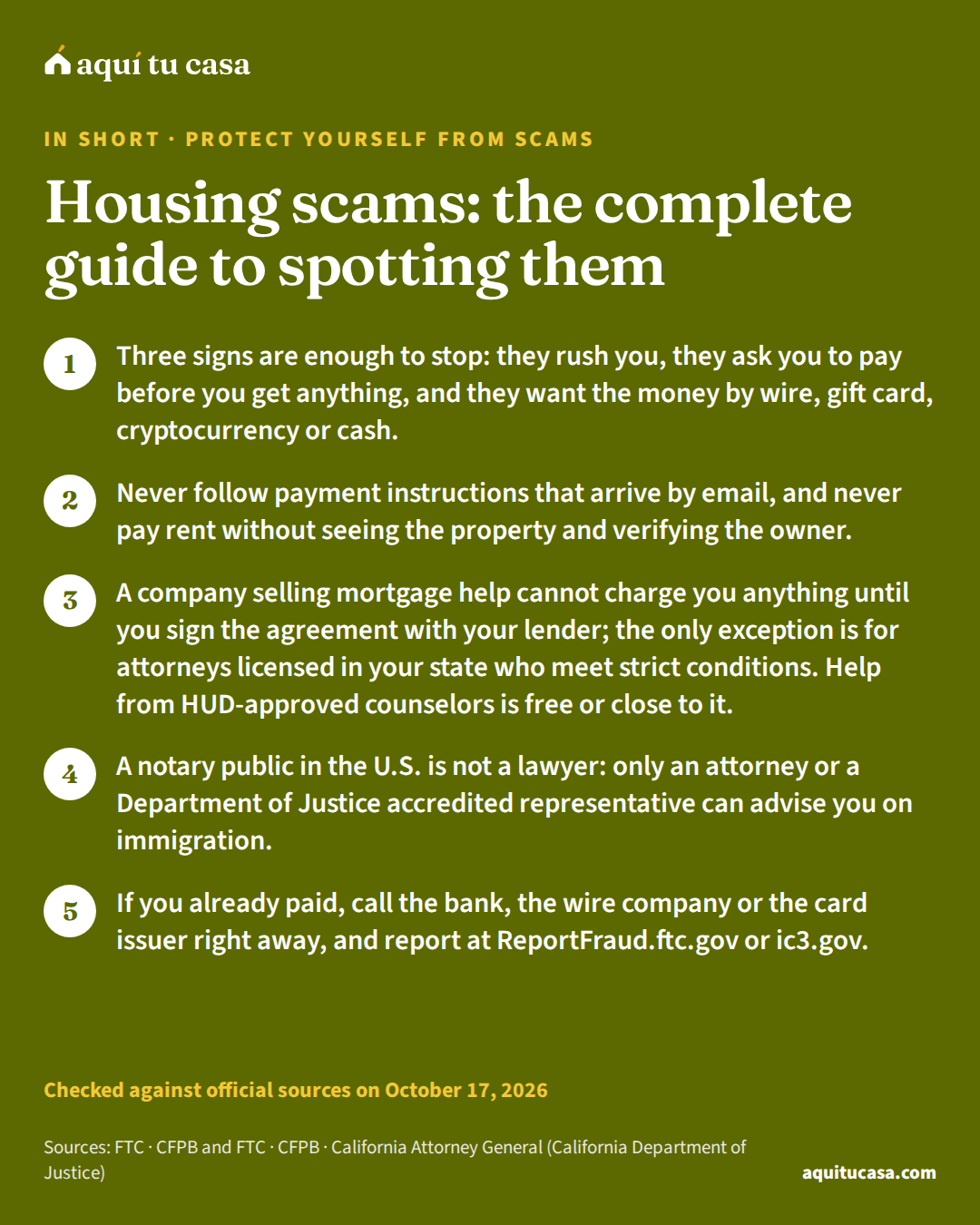
- Three signs are enough to stop: they rush you, they ask you to pay before you get anything, and they want the money by wire, gift card, cryptocurrency or cash.
- Never follow payment instructions that arrive by email, and never pay rent without seeing the property and verifying the owner.
- A company selling mortgage help cannot charge you anything until you sign the agreement with your lender; the only exception is for attorneys licensed in your state who meet strict conditions. Help from HUD-approved counselors is free or close to it.
- A notary public in the U.S. is not a lawyer: only an attorney or a Department of Justice accredited representative can advise you on immigration.
Is this for you?
This guide is for you if…
- Someone is offering you a home, a loan, a 'program' or a filing service and something feels off: you want to compare it with the warning signs the official agencies describe.
- You are about to rent, buy, remodel or move and want to know ahead of time where scammers strike.
- You already paid or handed over your information and want to know what to do in the first hours.
Get direct help first if…
- You are being turned away or treated differently because of your origin, language, family or status when renting or applying for a loan: that is not a scam, it is a Fair Housing Act violation, and it is reported to HUD.
- You already have a court summons or a notice of sale on your home: find a free legal aid office today; this guide explains the fraud, it does not replace a lawyer.
Housing scams strike at the moments of greatest pressure: when you are looking for a place to live, when you are about to close on a purchase, when you fall behind on the mortgage, when a storm damaged your roof, or when you need a filing done and someone “knows someone”. This guide is the index of all of them: it sums up how the official agency that watches each scam describes it, which signs give it away, what to do if you already paid and where to report it. Where we already have a full guide, we link it.
- What a mortgage relief company can charge you before you sign the agreement with your lender
- $013
- There is a narrow exception for attorneys.
- The initial intake at a HUD-approved counseling agency
- Free16
- To cancel a credit repair contract at no charge
- 3 business days22
- Of a non-binding estimate, the most a mover can demand at delivery on an interstate move
- 110%25
The script they all share
Before going one by one, notice what they have in common. The FTC describes it the same way in every scam: they rush you to decide now;18 they ask for money before giving you anything (a “processing” fee, a deposit “to hold it”, an advance to “save” your home);23 and they want payment by wire transfer, gift cards, cryptocurrency or cash, which is “the same as sending cash”: once sent, you probably will not get it back.1
The CFPB and the FTC explain why scammers want those methods: they move money quickly and anonymously. A wire is like sending cash. No legitimate business or government agency will insist that you pay with a gift card. And if you pay with cryptocurrency, you usually cannot get your money back unless the person sends it back.2
Government agencies never call, write or message you to ask for money.20 Real agencies and banks also do not threaten you or ask you to send money to “protect it”.28 And nobody legitimate will ask you to sign papers with blank spaces or to transfer the deed to your home.9
1. Fake rental ads
The FTC describes two patterns: scammers copy the pictures and description of a real listing and repost it with their own contact information, or they advertise places that are not for rent or do not exist, with surprisingly low rent; the fake owner often says they are out of the country and rushes you.1 The signs: rent far below the area’s, pressure to decide quickly, a home listed for sale rather than for rent, an owner who will not show the property, and requests for payment by wire, gift cards or cryptocurrency, or for your Social Security number and pay stubs before you have agreed to rent.1 Report it to local law enforcement, the site where the ad appeared, the FTC and your state attorney general.1
Full guide: How to avoid rental scams.
2. The email that changes the account on closing day
The CFPB warns that scammers send spoofed emails, posing as your agent or the settlement agent, with last-minute changes to the wiring instructions. What they are after is your down payment and closing costs, diverted into a fraudulent account, and the CFPB warns that a victim can lose their life savings.3 This kind of wire fraudwire fraud at closingThis is a scam aimed at people about to close on a home. Days before closing, the scammer sends an email that looks like it comes from your real estate agent or settlement agent with "new" instructions to wire or electronically transfer your down payment or closing costs to a different account. If it works, getting the money back can be very hard. The CFPB recommends writing down two trusted contacts ahead of time, confirming any instructions with them using only those numbers, and not using phone numbers or links in the email. If it happens to you, call your bank right away to stop or reverse the transfer.See the full definition arrives exactly when you have the most money in play.

The CFPB’s rule: pick two trusted people from the start; confirm the instructions, including the account name and number, in person or by the phone number you agreed on beforehand; never follow instructions received by email or use its links or phone numbers. If you already sent the money, call your bank or wire company immediately and ask for a “wire recall”: reporting it quickly improves the chance of getting it back. Then file a complaint at ic3.gov.3
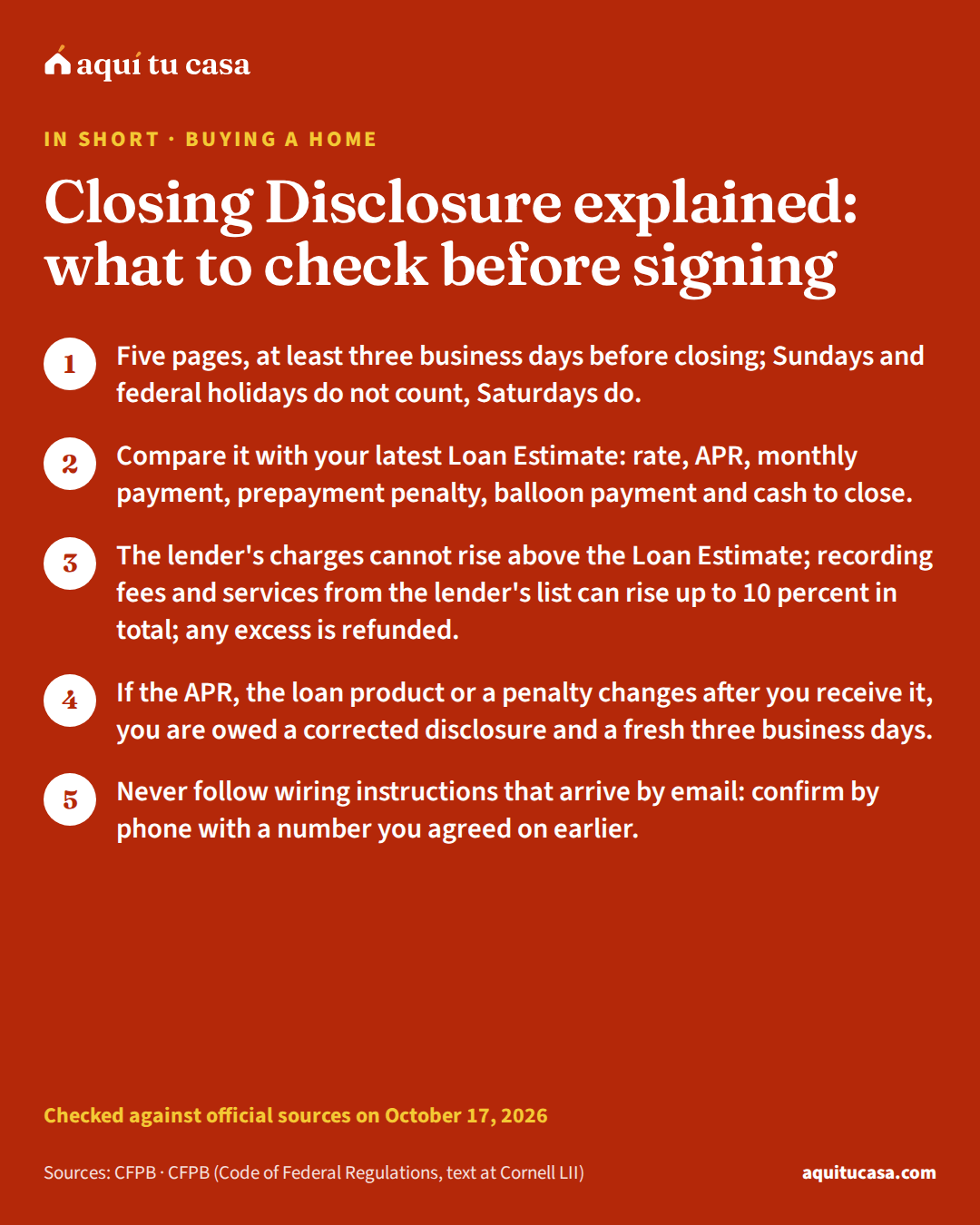
To know how much money you will move on closing day, read Closing costs explained, and to check the final papers, Closing Disclosure explained: what to check before signing.
3. “Notarios” and advisers who are not lawyers
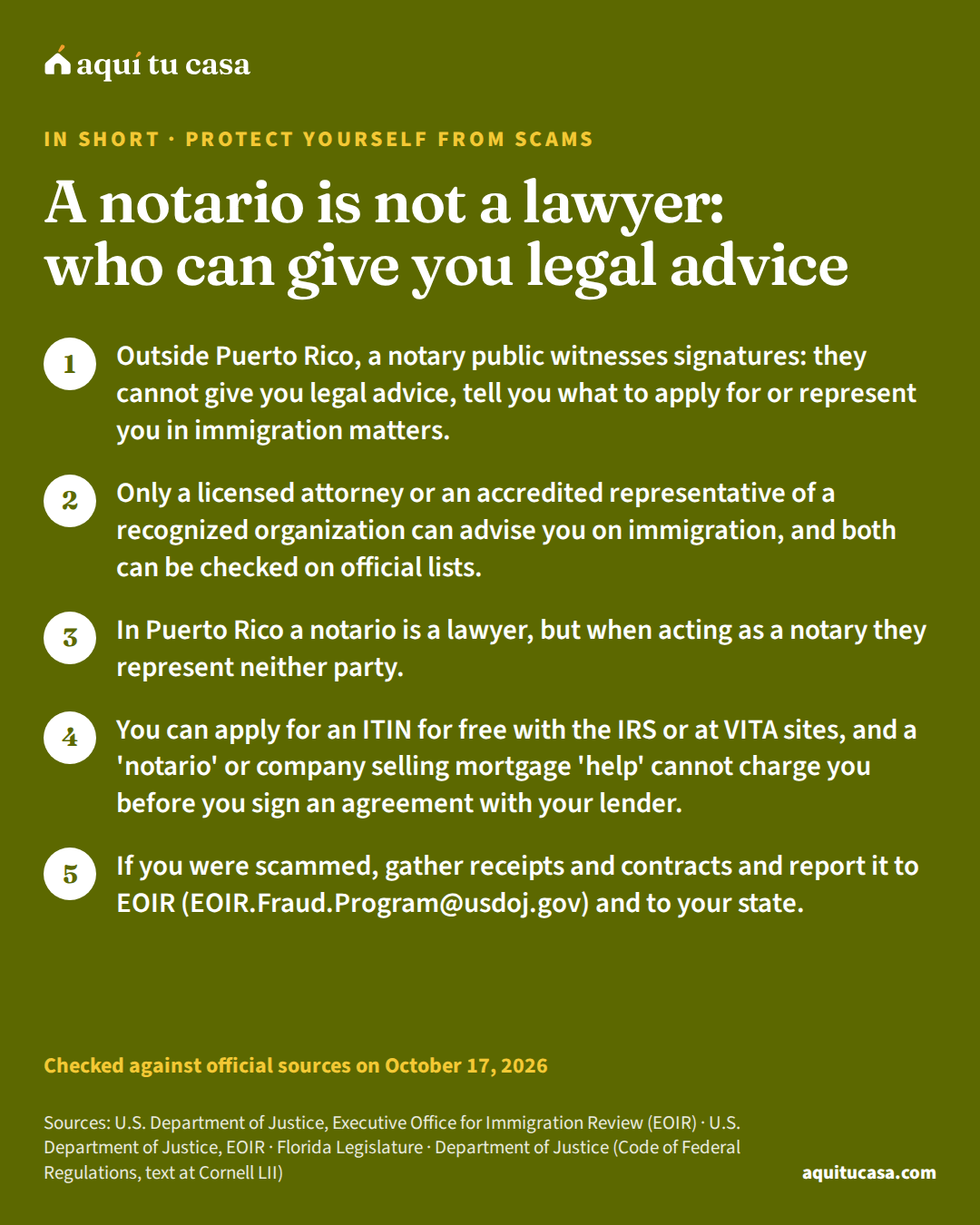
In many Spanish-speaking nations, notarios are attorneys with special credentials. Not here: in the United States, a notary public is a person authorized by the state to witness the signing of documents, and that does not authorize them to provide legal services, let alone immigration services.4 The Department of Justice confirms it: notarios, immigration consultants and “travel agents” cannot give you legal advice, tell you what immigration benefit to apply for or represent you in immigration court; only licensed attorneys and accredited representatives can.5
The same trick shows up in housing: someone who “fills out the papers” for a loan, a program or the ITIN for a steep fee. USCIS and immigration court forms are free on those agencies’ websites, and immigration court (EOIR) employees never call to ask for personal information or money.6 For the ITINITIN (Individual Taxpayer Identification Number)An ITIN is a nine-digit number the IRS, the federal tax agency, issues to people who need a U.S. taxpayer identification number to file taxes and are not eligible for a Social Security number. It is for tax purposes only: it does not authorize you to work in the United States, does not qualify you for Social Security benefits or the Earned Income Tax Credit, and says nothing about your immigration status. You apply with Form W-7, and it expires if it goes unused for several years. Some lenders accept an ITIN for a mortgage.See the full definition, the IRS helps you for free at its Taxpayer Assistance Centers and at some VITA sites.8
Full guide: Notario is not a lawyer: who can give you legal advice. For the ITIN, the steps are in How to get an ITIN: Form W-7.

4. Promises to save your home from foreclosure
When you fall behind, companies appear promising a modification or to stop the foreclosureforeclosureForeclosure is the process by which the lender or servicer takes back the property after the homeowner fails to make mortgage payments. The rules and timelines depend on each state; all of them include advance notices and, in general, time to catch up or ask for an alternative, such as a repayment plan or a loan modification. If you fall behind, call your servicer and a HUD-approved housing counseling agency early: foreclosure counseling is free and exists for exactly this.See the full definition. The FTC describes their signs: they promise changes they do not deliver, ask for an upfront fee, tell you to stop talking to your lender and pay them instead, try to get you to transfer the deed, and pressure you to sign quickly.9 The CFPB adds more: letters with logos that look like the government’s, the promise of a “forensic audit” of your loan and the advice to stop paying your mortgage, which can hurt your credit and limit your options.10
What the rule says. Under Regulation O, a company selling mortgage help cannot request or take any payment until you have signed a written agreement with your lender or loan servicerloan servicerThe loan servicer is the company that sends you your mortgage statements and handles the day-to-day tasks of the loan: it processes your payments, answers your questions, keeps track of principal and interest paid and manages your escrow account, if you have one. It can also offer options if you fall behind and, in certain cases, start a foreclosure. It may be the same company that lent you the money or a different one, and it is common for another company to take over the loan after closing.See the full definition that includes the offer the company obtained.13 Its messages must tell you that it is not associated with the government, that you can stop working with it at any time and that, if you reject the offer, you do not have to pay.12 It also cannot tell you not to talk to your lender or pose as part of the government or of a nonprofit counseling agency.11
The exception: attorneys. The rule does not apply the same way to an attorney who provides this help as part of practicing law, is licensed in the state where you live or where your home is, and complies with the state laws that cover the same conduct. Even then, they can only take money before doing the work if they deposit it in a client trust account and follow the state’s rules for those accounts.14 The CFPB puts it this way: if a lawyer, or someone claiming to offer legal help, wants to be paid before you receive a modification, they may be breaking the law. And no one can guarantee you a modification, because your mortgage company has to agree to it.15
Who helps with your mortgage, and when can they charge you?
Free or close to it
HUD-approved counselor
Nothing up front
Mortgage relief company
Before paying anyone, call your loan servicer and a HUD-approved counselor.10
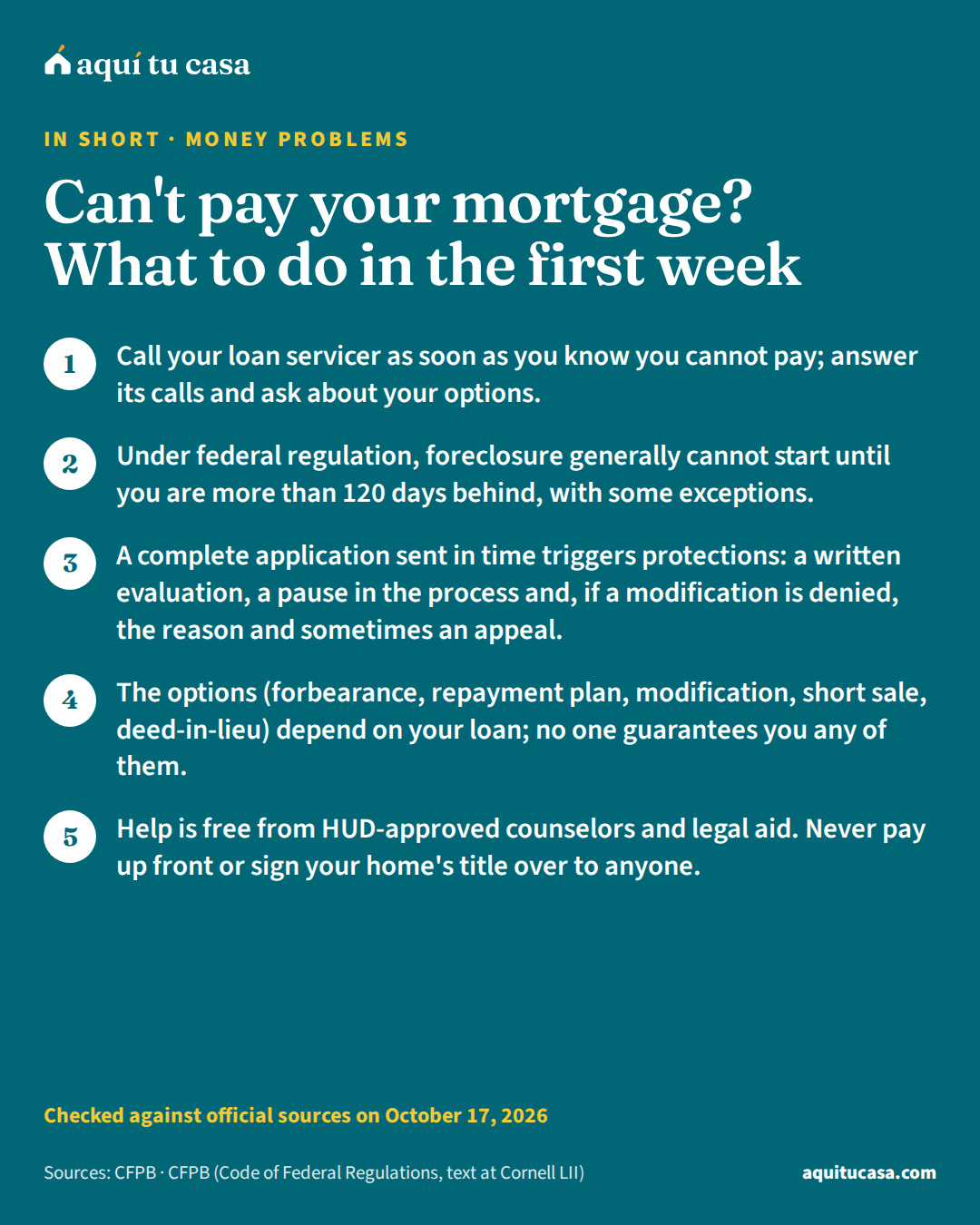
Your real options if you fell behind: If you can’t pay your mortgage.
5. Deed theft and the “title insurance” that insures nothing
The FTC explains that title fraud is identity theft: someone pretends to be you and transfers the deed to your home to someone else. The “title lock insurance” advertised on television is neither a lock nor insurance: it is a monitoring service that would tell you only afterward, and it does not stop the transfer. What does work, and is free: checking your title at your state’s or county’s land records office, signing up for the free notification program for ownership changes where one exists, and, if someone used your identity, following the recovery plan at IdentityTheft.gov.17 Do not confuse this with the title insurancetitle insuranceTitle is the legal right of ownership of the home, and title insurance protects you if, after closing, someone claims a right to it: an old debt, an heir, an error in the records. There are two policies. Most lenders require a lender's policy, which protects the amount they lent. The owner's policy is optional, paid once at closing, and protects you for as long as you own the home, including the legal costs of defending your right. You can shop for a title company; the price varies by state.See the full definition at closing, which is real insurance.
6. Contractors who take the money and vanish
The FTC sums up the signs: they knock on your door because they are “in the area”, say they have leftover materials, pressure you to decide now, ask for everything up front or cash only, ask you to pull the permits or suggest borrowing from a lender they know. What it recommends: licensed and insured contractors, several written estimates, a written contract with no blank spaces, never paying the full amount up front (some states limit the down payment) and no final payment until you are satisfied.18
After a hurricane or a flood the pattern repeats with more pressure: discounts “only if you sign today”, payment by wire or cash and the request that you sign over your insurance check. And FEMA charges no application fees, so anyone asking for money to “get you” FEMA help is a scammer.19
7. Calls from “HUD”, “the IRS” or “immigration”
Scammers pose as government agencies, say you owe money or are in trouble and threaten something bad if you do not pay or hand over your information. The FTC is categorical: government agencies never call, write or message you to ask for money; do not pay by wire, gift cards, cryptocurrency or payment apps to anyone who says they are with the government; hang up, do not trust caller ID and call the agency yourself using a number you know is correct.20 The same goes for anyone claiming to call from immigration court: its employees never call to ask for personal information or money.6
8. Credit repair and “guaranteed” loans with a fee
Two scams that feed on the same fear: your credit reportcredit reportA credit report is a statement that has information about your credit activity and current credit situation: your loans and cards, the balances, whether you have paid on time, accounts in collection and who has checked your credit. Credit reporting companies, also called credit bureaus, compile it from what banks and creditors report; your credit score is computed from it. When you apply for a mortgage, the lender pulls your report from the three bureaus. You have the right to see it for free and to dispute anything that is wrong.See the full definition. The FTC warns that scam credit repair companies ask you to pay before they help, tell you not to contact the bureaus, to dispute accurate information or to lie on applications, or promise a “new” credit identity; everything they do, you can do yourself for little or no cost.21
The CFPB is clear: no one can remove accurate negative information from your report, and a credit disputecredit report disputeA credit report dispute is the complaint you make when your credit report has wrong or incomplete information. You have the right to dispute it, and the investigation is free. It is usually done in two places: with the credit reporting company and with the company that supplied the information, called a furnisher, such as your bank, your landlord or your credit card company. You explain in writing what is wrong and why, with copies of your documents. The credit reporting company must investigate, generally within thirty days, and delete or correct anything found to be inaccurate, incomplete or unverifiable.See the full definition over errors is free and something you can do yourself. Knowingly filing a false identity theft report is a crime. If you already signed with a credit repair company, you have the right to cancel the contract for any reason within three business days, at no charge.22
In advance-fee loan scams they promise the loan “regardless of your history” and ask you to pay a “processing” or “insurance” fee first; nobody legitimate will tell you that paying a fee guarantees a loan, and it is illegal for a telemarketer to promise one and charge before delivering.23 If you see ads for “ITIN mortgages, guaranteed approval” that ask for money before the application, it is the same script.
To build real credit: Credit from zero. To fix errors: How to dispute credit report errors.
9. Movers who hold your belongings
The FTC recommends checking that the company is registered with the Department of Transportation for an interstate move, getting written estimates from several movers after they look at your belongings, asking about insurance, and not hiring anyone who asks you to sign paperwork with blank spaces or demands cash or a big deposit before the move.24 There is a legal cap on what you can be charged at delivery on an interstate move: the exact amount of a binding estimate or 110 percent of a non-binding one, plus any additional services you requested.25 If they ask for more to unload the truck, that is a warning sign: report to the Department of Transportation and the FTC.24
10. Loans against your home that push you to sign
Once you own, offers to refinance or to borrow against your home will come, sometimes hand in hand with a contractor. The FTC reminds you that you can cancel a loan or a line of credit on your main residence within three business days for any reason and without penalty; that if the financing is not what you expected, you should not sign; and that you should talk to an attorney, a financial advisor or someone else you trust before deciding.26 To know what to check in the papers of any loan secured by your home, see what a Closing DisclosureClosing DisclosureThe Closing Disclosure is a required five-page form with the final details of the mortgage you selected: the loan terms, your monthly payment, every closing cost and how much cash you must bring on signing day. The lender must give it to you at least three business days before closing, so you can compare it with your Loan Estimate and ask about any change. If an important number changes, the three-day period starts again. Keep it: you will need it for your taxes.See the full definition is.

If this is you
Some scams go after people in particular situations. These are the ones the official sources mention most.
What to watch most closely
You have or need an ITIN
Do not pay a “notario” for the ITIN: the IRS takes applications for free at its Taxpayer Assistance Centers and some VITA sites.8 And be wary of a “guaranteed” mortgage that asks for a fee before the application.23
You are looking for a place to rent
Do not pay without seeing the property, and do not give your Social Security number or pay stubs before agreeing to rent.1 More in How to avoid rental scams.
You own your home
No one can charge you to “save” your home before you sign the agreement with your lender,13 and “title lock insurance” does not stop deed theft.17
You are an older adult or care for one
The “grandchild in trouble” scam is often aimed at older adults: before sending money, call your relative at a number you trust.22
If you already paid: the first hours
Do not blame yourself: these scams are built to fool anyone. What matters now is acting fast and in order. The official agencies describe these steps:
If you already paid a scammer
1. Call your bank or the payment company
As soon as you notice
If you sent a transfer or an app payment, alert them that there may have been an unauthorized transaction.22
2. If it was your closing money, ask for a wire recall
Immediately
Ask the bank or wire company for a “wire recall”; reporting it quickly improves the chance of recovering it.3
3. If you paid with a gift card, cryptocurrency or cash by mail
The same day
Call the card issuer using the number on the back, the crypto exchange or ATM operator, or the U.S. Postal Inspection Service.27
4. Report the scam
As soon as you can
At ReportFraud.ftc.gov or ic3.gov, to your state attorney general and to your local police through their nonemergency number.28
5. If you gave your Social Security number or documents
That same week
Make your recovery plan at IdentityTheft.gov.27
6. If it was a fake notario
When you can
Call EOIR's Fraud and Abuse Prevention Program at 1-877-388-3840 or email EOIR.Fraud.Program@usdoj.gov, and keep every communication.7
7. Be wary of anyone who promises to recover your money
Always
The FBI's IC3 does not work with law firms or crypto services to recover funds, and never contacts you to ask for information or money.29
The FTC details each payment method: with a credit or debit card, call the issuer or your bank and ask for a refund; by bank transfer or Zelle, ask the bank to reverse the payment; by wire, the wire transfer company; with a payment app, the app. If you gave your Social Security number, IdentityTheft.gov gives you a recovery plan, because that can turn into identity theftidentity theftIdentity theft happens when someone uses your personal information without your permission to commit fraud: for example, your name, your Social Security or Medicare number, or your credit card or bank account number. With that information, a thief can rent a home, get credit cards, receive government benefits or tax refunds, or open other accounts in your name. You often find out when your credit report or a statement shows accounts or charges you do not recognize, or when a debt collector calls. The federal site IdentityTheft.gov takes reports and gives you a recovery plan.See the full definition.27 If it was a mortgage relief scam, the CFPB says you can find legal help through your local bar association or legal aid.22

Keep everything: ads, emails, messages, receipts, names and numbers. If it was a fake notario, EOIR asks you to recover and keep every communication and document from the scammer.7 And do not wait until you are sure to report: the IC3 asks you to file even if you are unsure whether your complaint qualifies.29
Warning signs and what to do instead
If you recognize any of these signs, stop. This is what the official sources say to do instead.
The warning sign and what you do instead
Mistake: They ask for an upfront fee to “save” your home.
Instead: Do not pay: the company cannot charge you until you sign the agreement with your lender,13 and a HUD-approved counselor helps you at no cost.10
Mistake: They demand payment by gift card, cryptocurrency or wire.
Instead: No legitimate business or government agency insists on a gift card; a wire is like sending cash.2
Mistake: An email arrives with new instructions for wiring your closing money.
Instead: Do not follow it: confirm the account in person or by the phone number you agreed on beforehand.3
Mistake: They ask you to sign your home's title over to them while they “fix” your loan.
Instead: Nobody legitimate asks for that. Talk to your loan servicer and a HUD counselor.10
Mistake: A “notario” tells you which immigration application to file.
Instead: That is legal advice: only an attorney or an accredited representative can give it.5
Mistake: Someone offers to recover what you lost for a fee.
Instead: Report it yourself at ic3.gov: the IC3 does not work with private companies to recover funds.29
To find a HUD-approved housing counselor who speaks Spanish, the HUD-approved housing counselors guide explains how to search and what to expect at the first appointment.
What to do this week
- If you are about to pay or sign something, run it through the questions in the checklist below and look at the payment method they want.2
- If you fell behind on the mortgage, book an appointment with a HUD-approved housing counselor and do not pay anyone who promises to “save” the home before you sign the agreement with your lender.13
- Homeowners: look your home up in the county’s land records and ask whether the free change alert exists.17
- If someone is helping you with an immigration filing, ask whether they are an attorney or an accredited representative before you pay.5
- Already paid? Call the bank or the issuer today and report at ReportFraud.ftc.gov or ic3.gov.28
Your situation
If you have never had a card or a loan in the U.S., choose "None".
Your credit plan
12 steps
You have done 0 of 12.
This week
Get your three credit reports for free
At AnnualCreditReport.com you can get the Equifax, Experian and TransUnion reports for free once a week. Checking your own report does not lower your score. If it comes up empty, that is not an error: you simply have no history yet.
Source: CFPB: How do I get a free copy of my credit reports? ↗ · CFPB: Does requesting my credit report hurt my credit score? ↗
Dispute any error in writing
Write to the credit bureau and to the company that reported the item, with copies of your proof, by certified mail. By law, the bureau must investigate again for free and resolve it within 30 days of receiving your notice.
Source: CFPB: How do I dispute an error on my credit report? ↗ · Congreso de EE. UU. (texto en Cornell LII): Fair Credit Reporting Act, 15 U.S.C. §1681i, Procedure in case of disputed accuracy ↗
Talk to a HUD-approved housing counselor
They give independent advice on buying, renting, defaults and credit, often free or at low cost. You can go over your report and your plan with them.
Source: CFPB: Find a Housing Counselor ↗
This month
Open a secured card
You deposit an amount (for example, $500) and can spend up to that amount. With on-time payments, the limit can go up, and the deposit comes back. Before signing, ask whether they report to all three bureaus and compare the annual fee and the rate: they can be high.
Source: CFPB: What are some ways to start or rebuild a good credit history? ↗ · CFPB: How to rebuild your credit ↗
Or a credit builder loan
The bank or credit union holds the money as savings while you make small payments, usually for six to 24 months; when you finish, you get it. You build history and savings at the same time.
Source: CFPB: What are some ways to start or rebuild a good credit history? ↗
Ask for your rent to be reported
On-time rent payments can help build your credit. Ask your landlord whether they take part in a rent reporting program (often through a payment app) and check its fees.
Set up automatic payments
An automatic payment or a reminder before the statement date prevents the costliest kind of slip: payment history is the main factor in most models.
What does not build credit
Paying with a debit card or cash, prepaid cards and payday loans do not build history, according to the CFPB. They are ways to pay, not accounts that get reported.
From here on
Do not close your first account
A long history of on-time payments helps your score. When a better card comes along, keep the first one open and current.
Only apply for the credit you need
Opening several accounts in a short time is a risk signal for lenders, and each application leaves a hard inquiry that does affect your score.
Source: CFPB: How do I get and keep a good credit score? ↗ · CFPB: What is a credit inquiry? ↗
Watch your debt-to-income ratio
Lenders divide your monthly debt payments by your gross monthly income to see whether you can handle a new loan. While you prepare, avoid new payments, such as a car.
Watch out for "credit repair"
It is a scam if they charge before doing anything, promise to remove accurate negative information, tell you not to contact the bureaus or to dispute everything. Disputing errors is free by law, and if you already signed up for something like this, you can cancel within three business days.
Source: CFPB: How can I tell a credit repair scam from a reputable credit counselor? ↗
An educational plan built on what the CFPB, the NCUA and the federal credit reporting law publish; not individual advice. We recommend no brands and are paid for no product.
Ready to see the numbers? Find your county here
See how this applies in your county: its loan limits, prices and rents, from the official data.
Printable checklist
Frequently asked questions
How do I know whether a 'housing program' is legitimate?
The CFPB reminds you that real government officials never ask for payment to help you, and that HUD-approved housing counselors are available at no cost to homeowners struggling with the mortgage. Legal aid offices and Department of Justice accredited representatives also serve people for free or at low cost. Look the organization up in the official directories, never through the link someone sent you.
They are asking me to pay with gift cards or cryptocurrency. Is that normal?
No. The CFPB and the FTC say no legitimate business or government agency will insist that you pay with a gift card, and that with cryptocurrency you usually cannot get your money back unless it is sent back. Wiring money is like sending cash. It is the clearest sign of a scam.
Is it legal to charge me up front to fix my mortgage?
Under Regulation O, a company selling mortgage help cannot request or take any payment until you sign a written agreement with your lender that includes the offer it obtained. The exception is narrow: an attorney licensed in the state where you live or where your home is, who provides the service as part of practicing law and deposits your money in a client trust account under your state's rules. No one can guarantee a modification: your lender has to agree to it.
Can I get the money back?
It depends on how you paid and how fast you act. The CFPB says that if you sent a transfer or an app payment, alert your bank or the payment company right away; and if it was your closing wire, ask for a wire recall, because reporting it quickly improves the chance of recovering it. With gift cards and cryptocurrency it is hard, but you still report it. Keep every message, receipt and ad.
Where do I report a housing scam?
The CFPB says to report it to the FTC at ReportFraud.ftc.gov or to the FBI at ic3.gov, to your state attorney general and to your local police through their nonemergency number. If it was a fake notario, also to EOIR's Fraud and Abuse Prevention Program (1-877-388-3840). If you are worried about how your immigration situation affects you, a free legal aid office or an accredited representative can look at your case.
Someone offers to recover the money I lost for a fee. Is it real?
Be very careful. The FBI's IC3 says it does not work with law firms or crypto services to recover funds, and that it will never contact you to ask for information or money. Report the scam yourself at ic3.gov or ReportFraud.ftc.gov; it is free.
Can a notary help me with my immigration case or my ITIN?
With immigration, no: EOIR says notarios and consultants cannot give legal advice, tell you what benefit to apply for or represent you; only attorneys and accredited representatives can. For the ITIN you do not need a notary: the IRS takes applications for free at its Taxpayer Assistance Centers and at some VITA sites.
A company offers to clean up my credit if I pay. What should I do?
The CFPB explains that no one can remove accurate negative information from your report, and that disputing errors is free and you can do it yourself. If you already signed with a credit repair company, you have three business days to cancel at no charge.
Sources
Every figure in this guide comes from one of these official sources. The number next to a sentence leads to the source behind it.
Each source on one line: who publishes it, its title, its address and the date we read it.
- 1. FTC · Rental Listing Scams · consumer.ftc.gov · Accessed October 16, 2026
- 2. CFPB and FTC · How to prevent and report scams targeting older adults · consumerfinance.gov · Accessed October 17, 2026
- 3. CFPB · Mortgage closing scams: How to protect yourself and your closing funds · consumerfinance.gov · Accessed October 17, 2026
- 4. California Attorney General (California Department of Justice) · Attorney General Bonta Issues Consumer Alert on Notario Fraud, Obtaining Immigration Legal Help, Locating Detained People · oag.ca.gov · Accessed October 17, 2026
- 5. Department of Justice, Executive Office for Immigration Review (EOIR) · Can Someone Represent You Before EOIR? · justice.gov · Accessed October 17, 2026
- 6. Department of Justice, EOIR · Fraud and Abuse Prevention Program · justice.gov · Accessed October 17, 2026
- 7. Department of Justice, EOIR · Self-Help Guide: Are You a Victim of Fraud? How to Protect Yourself from Fraud · justice.gov · Accessed October 17, 2026
- 8. IRS · How do I apply for an ITIN? · irs.gov · Accessed October 17, 2026
See the other 22 sources
- 9. FTC · Mortgage Relief Scams · consumer.ftc.gov · Accessed October 16, 2026
- 10. CFPB · How to spot and avoid foreclosure relief scams · consumerfinance.gov · Accessed October 17, 2026
- 11. CFPB (Code of Federal Regulations, text at Cornell LII) · Regulation O, 12 CFR §1015.3, Prohibited representations · law.cornell.edu · Accessed October 17, 2026
- 12. CFPB (Code of Federal Regulations, text at Cornell LII) · Regulation O, 12 CFR §1015.4, Disclosures required in commercial communications · law.cornell.edu · Accessed October 17, 2026
- 13. CFPB (Code of Federal Regulations, text at Cornell LII) · Regulation O, 12 CFR §1015.5, Prohibition on collection of advance payments · law.cornell.edu · Accessed October 17, 2026
- 14. CFPB (Code of Federal Regulations, text at Cornell LII) · Regulation O, 12 CFR §1015.7, Exemptions · law.cornell.edu · Accessed October 17, 2026
- 15. CFPB · Consumer advisory: Don’t fall for a foreclosure relief scam or bogus legal help · consumerfinance.gov · Accessed October 17, 2026
- 16. HUD (Code of Federal Regulations, text at Cornell LII) · 24 CFR §214.313, Housing counseling fees · law.cornell.edu · Accessed October 17, 2026
- 17. FTC · Home title lock insurance? Not a lock at all · consumer.ftc.gov · Accessed October 16, 2026
- 18. FTC · How To Avoid a Home Improvement Scam · consumer.ftc.gov · Accessed October 16, 2026
- 19. FTC · How To Avoid Scams After Weather Emergencies and Natural Disasters · consumer.ftc.gov · Accessed October 16, 2026
- 20. FTC · How To Avoid a Government Impersonator Scam · consumer.ftc.gov · Accessed October 16, 2026
- 21. FTC · Looking to fix your credit? An illegal credit repair scam isn't the answer · consumer.ftc.gov · Accessed October 16, 2026
- 22. CFPB · What are some common types of fraud and scams? · consumerfinance.gov · Accessed October 17, 2026
- 23. FTC · What To Know About Advance-Fee Loans · consumer.ftc.gov · Accessed October 16, 2026
- 24. FTC · Avoid scams when you hire a moving company · consumer.ftc.gov · Accessed October 16, 2026
- 25. FMCSA, Department of Transportation (Code of Federal Regulations, text at Cornell LII) · 49 CFR §375.703, Maximum collect-on-delivery amount · law.cornell.edu · Accessed October 17, 2026
- 26. FTC · Home Equity Loans and Home Equity Lines of Credit · consumer.ftc.gov · Accessed October 16, 2026
- 27. FTC · What To Do if You Were Scammed · consumer.ftc.gov · Accessed October 16, 2026
- 28. CFPB · Who do I contact for help with a scam or fraud? · consumerfinance.gov · Accessed October 17, 2026
- 29. FBI · Internet Crime Complaint Center (IC3) · ic3.gov · Accessed October 17, 2026
- 30. CFPB · Find a Housing Counselor · consumerfinance.gov · Accessed October 17, 2026
Keep reading
Related guides
If this guide helped, these follow the same path.

Renting 12 minute read
How to avoid rental scams: the signs and what to do
The signs of a fake rental listing, what never to pay up front, what not to share before you sign and where to report, according to the FTC and CFPB.
- See first, pay later: never send money for a place you, or someone you trust, have not seen inside.
- A wire transfer, gift cards or cryptocurrency for a deposit are 'the same as sending cash': anyone who demands them is a scammer.
- A landlord does not need your Social Security number or your credit score before you agree to rent.
- Protect yourself from scams A notario is not a lawyer: who can give you legal advice Outside Puerto Rico, a notary public is not a lawyer. What a notary can do, who can advise you for free or at low cost, warning signs and how to report it. 12 minute read
- Money problems Can't pay your mortgage? What to do in the first week Can't pay your mortgage? Call your servicer, learn the options that exist, the federal rules that protect you and the rescue scams to avoid. 14 minute read
- Buying a home Closing Disclosure explained: what to check before signing What the Closing Disclosure is, when it must reach you, what to check on each of its five pages and which closing costs are not allowed to go up. 18 minute read
Tools for this topic
Was this guide useful?
Thank you. Your answer stays in your browser; nothing is sent.