
Family budget
How much is left for housing each month.
What you get → what is left
Someone shared this page with you.
Questions and answers
Every question our 12 guides about housing scams answer, grouped by guide. Each answer is the guide's own and leads to it, with its sources.
Open a question to read its answer. Each group ends with the full guide, its sources and, when it has one, its calculator.
We found no questions with those words. Try another word or open a topic.
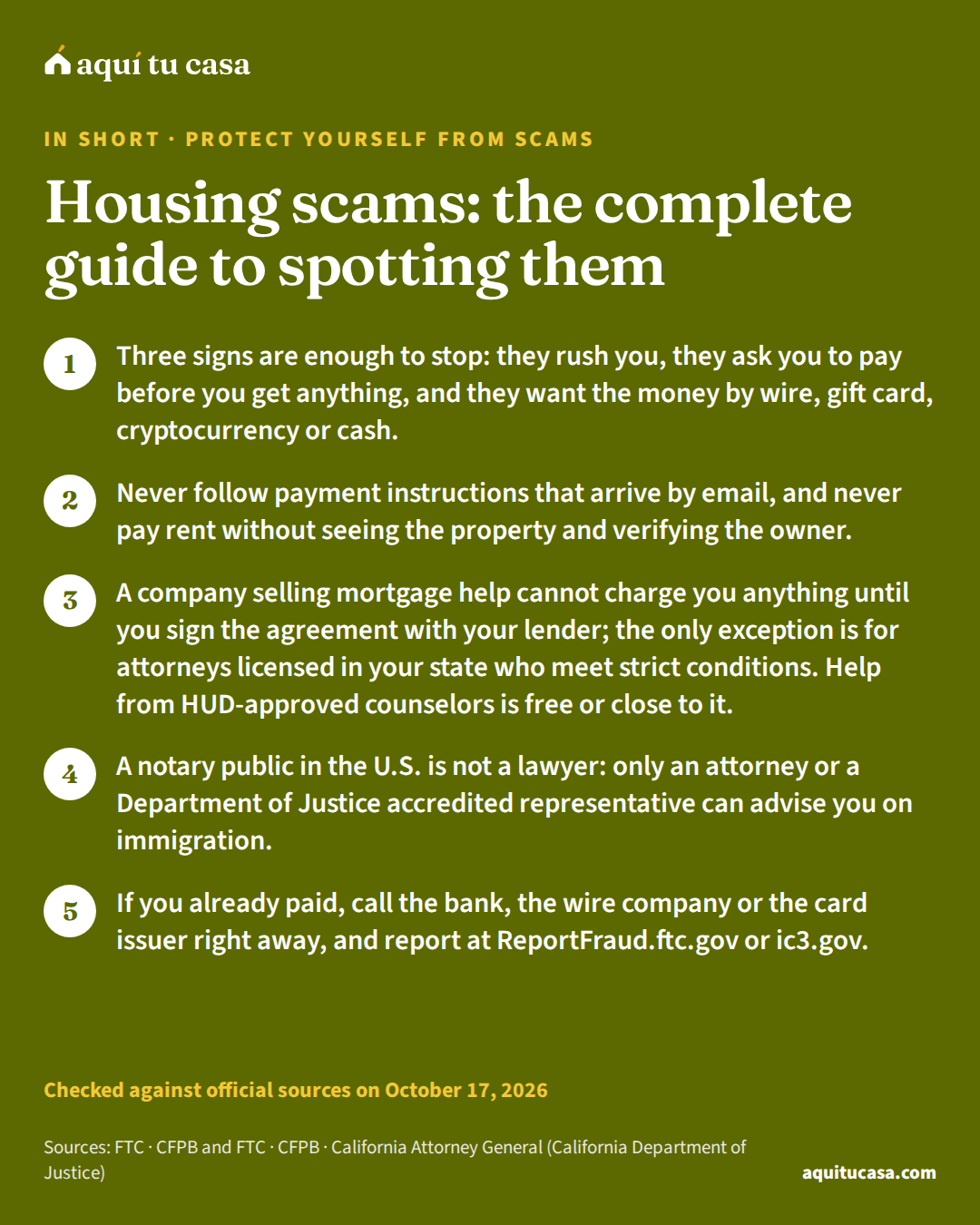
From the guide
The rental, mortgage, title, contractor, credit and moving scams families run into most: how to spot them, what to do and where to report them.
Verified on October 17, 2026 30 official sources
The CFPB reminds you that real government officials never ask for payment to help you, and that HUD-approved housing counselors are available at no cost to homeowners struggling with the mortgage. Legal aid offices and Department of Justice accredited representatives also serve people for free or at low cost. Look the organization up in the official directories, never through the link someone sent you.
Read the full guideNo. The CFPB and the FTC say no legitimate business or government agency will insist that you pay with a gift card, and that with cryptocurrency you usually cannot get your money back unless it is sent back. Wiring money is like sending cash. It is the clearest sign of a scam.
Read the full guideUnder Regulation O, a company selling mortgage help cannot request or take any payment until you sign a written agreement with your lender that includes the offer it obtained. The exception is narrow: an attorney licensed in the state where you live or where your home is, who provides the service as part of practicing law and deposits your money in a client trust account under your state's rules. No one can guarantee a modification: your lender has to agree to it.
Read the full guideIt depends on how you paid and how fast you act. The CFPB says that if you sent a transfer or an app payment, alert your bank or the payment company right away; and if it was your closing wire, ask for a wire recall, because reporting it quickly improves the chance of recovering it. With gift cards and cryptocurrency it is hard, but you still report it. Keep every message, receipt and ad.
Read the full guideThe CFPB says to report it to the FTC at ReportFraud.ftc.gov or to the FBI at ic3.gov, to your state attorney general and to your local police through their nonemergency number. If it was a fake notario, also to EOIR's Fraud and Abuse Prevention Program (1-877-388-3840). If you are worried about how your immigration situation affects you, a free legal aid office or an accredited representative can look at your case.
Read the full guideBe very careful. The FBI's IC3 says it does not work with law firms or crypto services to recover funds, and that it will never contact you to ask for information or money. Report the scam yourself at ic3.gov or ReportFraud.ftc.gov; it is free.
Read the full guideWith immigration, no: EOIR says notarios and consultants cannot give legal advice, tell you what benefit to apply for or represent you; only attorneys and accredited representatives can. For the ITIN you do not need a notary: the IRS takes applications for free at its Taxpayer Assistance Centers and at some VITA sites.
Read the full guideThe CFPB explains that no one can remove accurate negative information from your report, and that disputing errors is free and you can do it yourself. If you already signed with a credit repair company, you have three business days to cancel at no charge.
Read the full guideThe data behind these guides
The guides on Protect yourself from scams cite these figures. They update when their sources publish new ones; what you see here is current.
See all the dataSources: U.S. Census Bureau (Average 2020–2024)
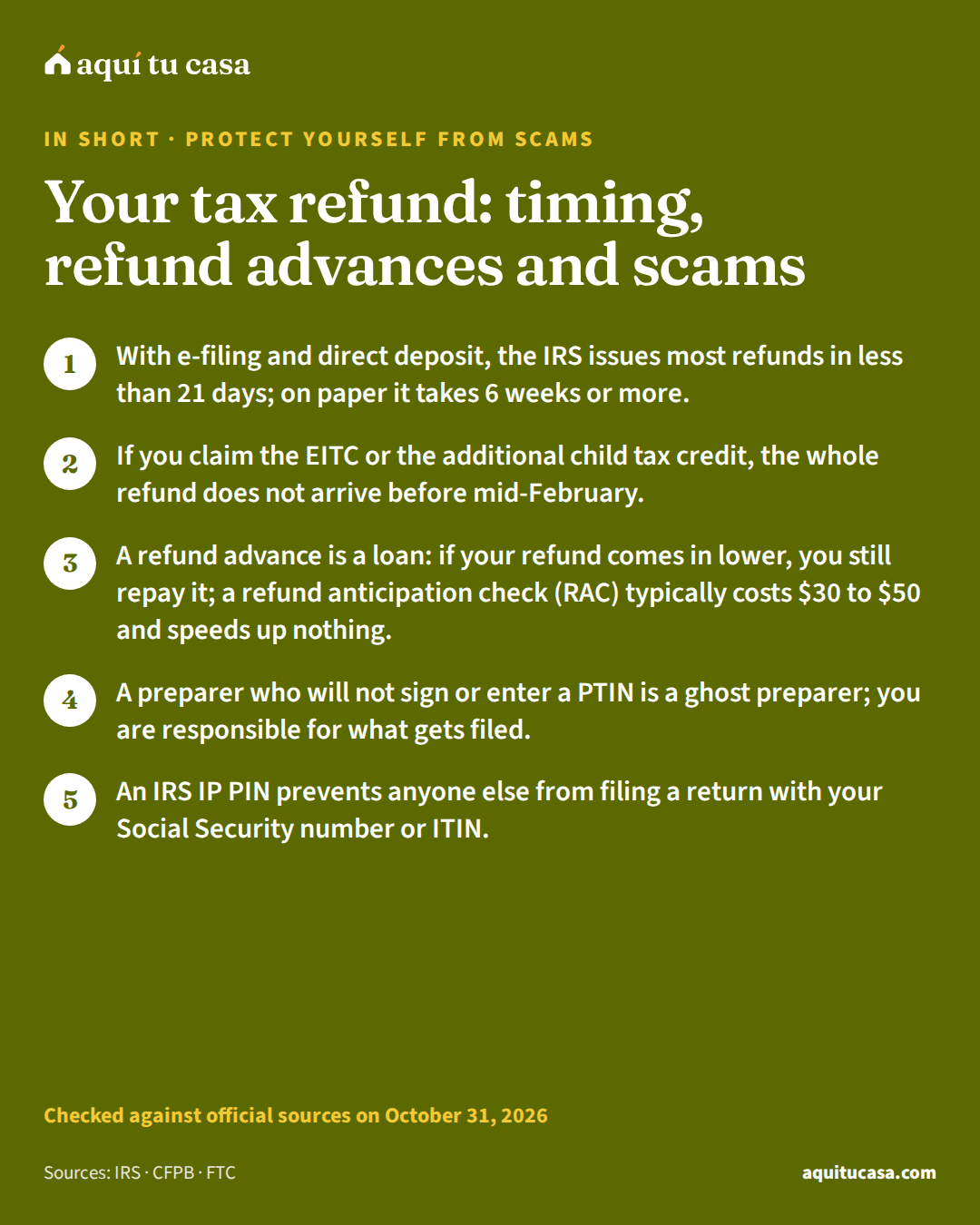
From the guide
How long an IRS refund takes, what preparer advances and refund checks cost, how to spot a ghost preparer and where to check the status of your refund.
Verified on October 31, 2026 13 official sources
According to the IRS, it typically takes 3 weeks from the date you e-filed, and 6 or more weeks from the date it received your mailed return. It can take longer if your return needs corrections or review, or if you claim the EITC or the additional child tax credit.
Read the full guideBy law, the IRS cannot issue refunds on returns claiming the Earned Income Credit or the additional child tax credit before mid-February, and that applies to the entire refund. The IRS suggests checking Where's My Refund in mid-to-late February.
Read the full guideYes. To check without signing in, the IRS asks for the exact refund amount, your Social Security number or ITIN, your filing status and the tax year.
Read the full guideNot from the IRS. An advance is a loan from the preparer for part of your expected refund. The CFPB warns that if your refund comes in lower or does not arrive, you still have to repay the loan, and that the IRS issues most e-filed refunds in less than 21 days.
Read the full guideSomeone who charges you to prepare your return but will not sign it or enter their preparer number (PTIN). The IRS says it is a major red flag, because you are legally responsible for what is filed, and that these preparers sometimes inflate deductions or credits and disappear.
Read the full guideThe IRS considers diverting your refund to an account that is not yours to be fraud. You can report the preparer and, as an individual taxpayer, ask the IRS to correct your account with Form 14157-A. If you did not receive your refund, the IRS also asks for an official police report.
Read the full guideThe IRS says it can be reduced to pay taxes you owed, or debts such as child support, federal nontax debts or state taxes. The Bureau of the Fiscal Service mails you a notice about the offset.
Read the full guide
From the guide
Before you sign for solar panels or a PACE loan: buying, leasing or a PPA, the tax credit that ended, the lien on your property tax and scam warning signs.
Verified on October 31, 2026 9 official sources
No. The FTC says 'free' or 'no cost' solar panel offers are scams, and that people claiming to be from the utility or the government are not. Also, DOE's Weatherization Assistance Program no longer installs new renewable electricity technologies starting in program year 2026.
Read the full guideNot for new systems. The IRS says the Residential Clean Energy Credit is not available for property placed in service after December 31, 2025. If a seller promises you that credit today, ask them to show you in writing what it is based on.
Read the full guideIf you buy, you pay the full cost and you own the system. If you lease or sign a PPA, the company owns the system and keeps the credits and incentives; you pay for years, sometimes 20, and the payment can go up.
Read the full guideIt is financing for home improvements that you repay as part of your property tax. The FTC explains that it puts a property tax lien on your home that can take priority over your mortgage, and that if you do not pay the tax you can face foreclosure.
Read the full guideYes. Since March 1, 2026, under Regulation Z, the creditor must make a reasonable and good faith determination that you can repay it, taking into account how much your escrow will rise. And you must get a Loan Estimate with the PACE information.
Read the full guideIt can get complicated. HUD says the PACE obligation stays with the property when it is sold and that homes that will keep PACE do not qualify for an FHA loan; that is why the contract must say the seller pays it off at or before closing.
Read the full guideIf it was a door-to-door sale of $25 or more made at your home, the FTC Cooling-Off Rule lets you cancel before midnight of the third business day. Do it in writing, with the cancellation form you must be given, and keep a copy.
Read the full guide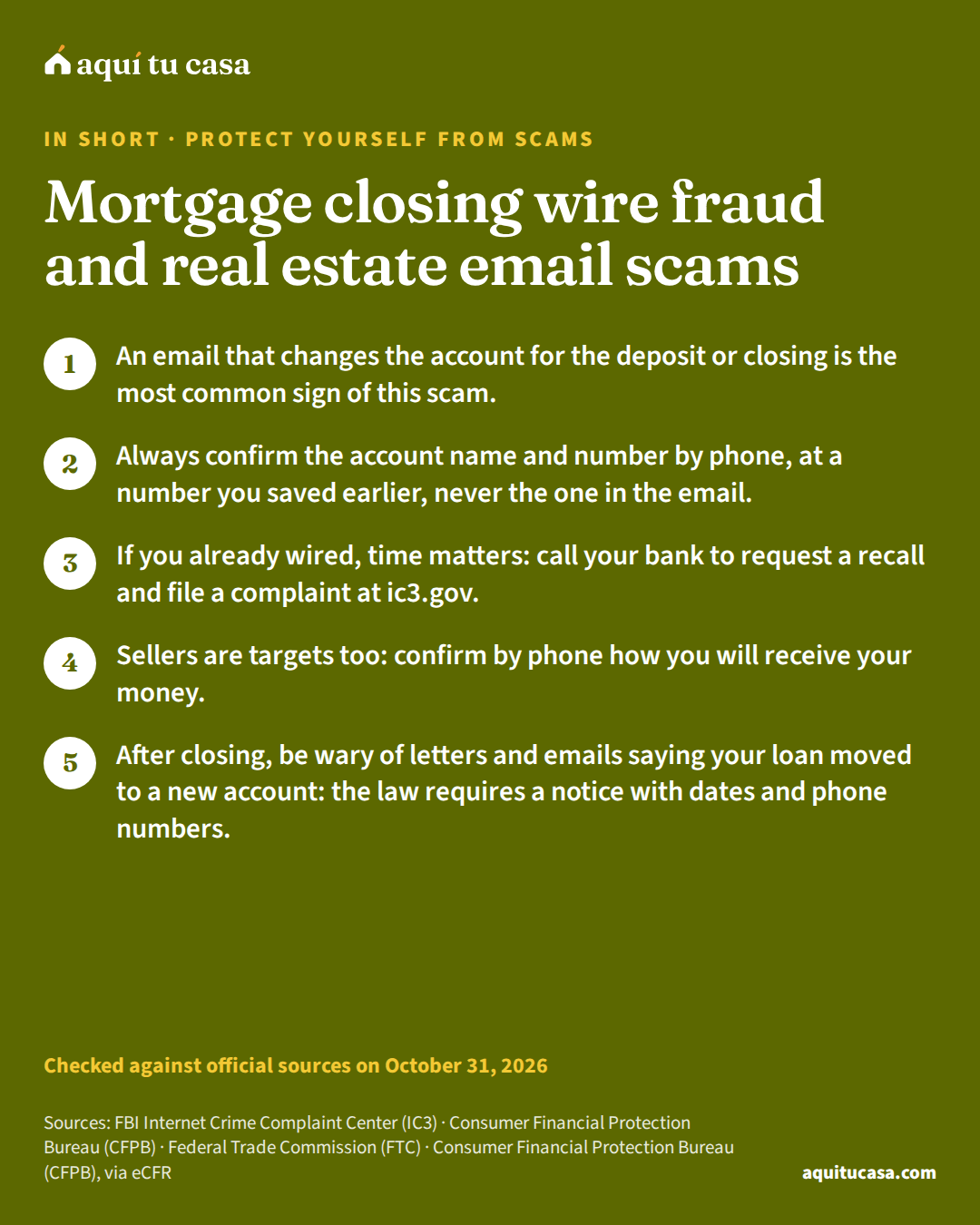
From the guide
How criminals steal closing money by email, the warning signs, how to confirm an account before you pay and what to do in the first hours after a wire.
Verified on October 31, 2026 9 official sources
The FBI explains that they get into the email account of someone involved in the purchase, such as an agent, a title company or the buyer, and watch the messages. That way they know the dates and send the account-change request at just the right moment.
Read the full guideYes. The CFPB warns that scammers can closely copy your agents' email address, phone number and writing style. That is why you never follow instructions from an email: call a number you saved earlier.
Read the full guideCall your bank right away and ask for a wire recall. Then file a complaint at ic3.gov with all the details. The FBI says time is of the essence: its recovery team works with banks to freeze funds.
Read the full guideThere is no guarantee. Each bank has its own policies. In 2025, the IC3 recovery team froze about 58% of the money at stake in the cases it acted on. The faster you report, the better your chances.
Read the full guideYes. The FBI says this scam targets both buyers and sellers. Confirm by phone with the title company how you will receive your money, and do not change your account by email.
Read the full guideIt may be. If your servicer changes, the law requires a notice with the transfer date and the name, address and a phone number for both the old and new servicer. Call the servicer you already know, at the number on your statement, before paying anyone else.
Read the full guideAt ic3.gov, the FBI's site, and at ReportFraud.ftc.gov, the FTC's. If the problem is with a financial company, you can also file a complaint with the CFPB.
Read the full guide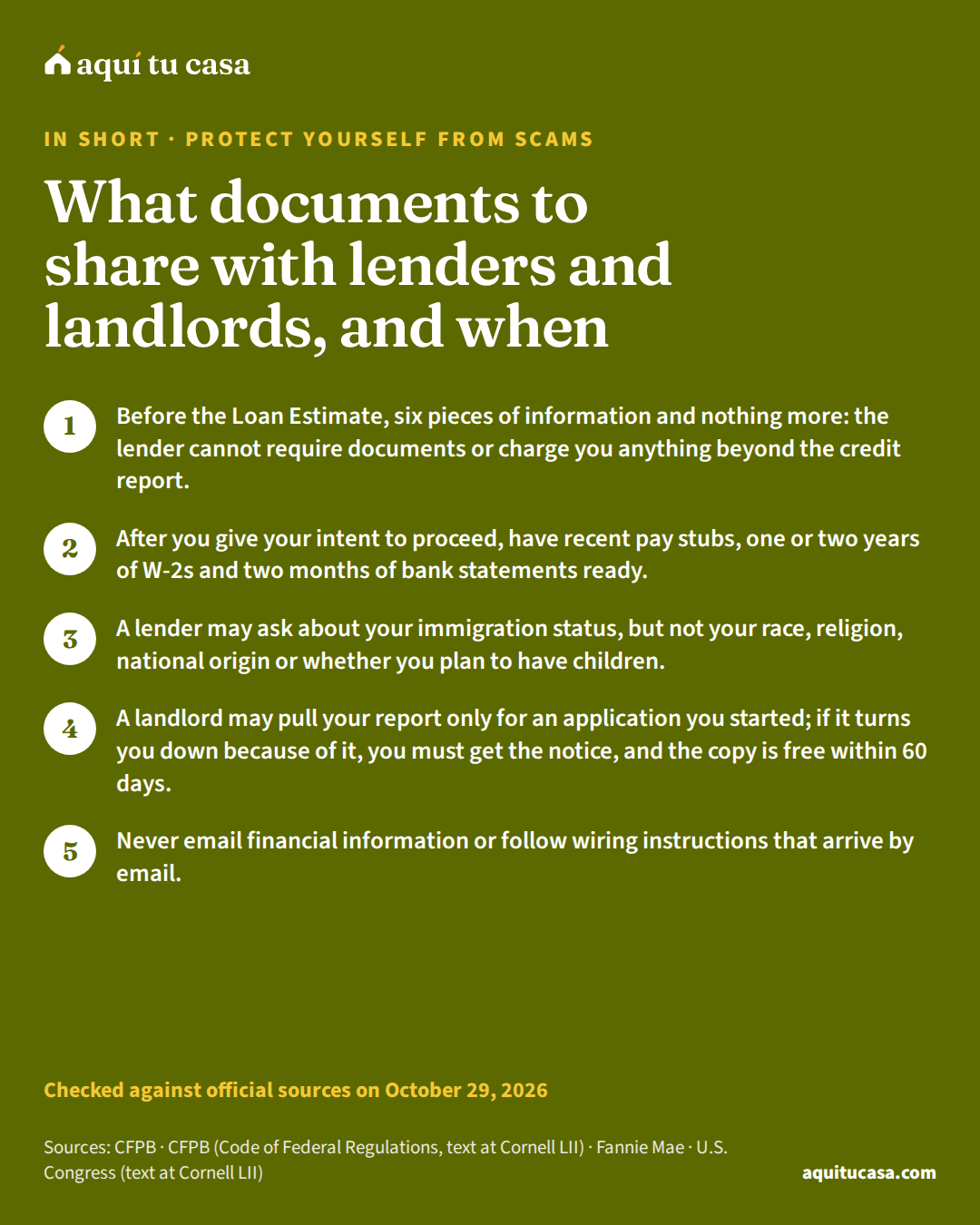
From the guide
What you give a lender before and after the Loan Estimate, what a landlord may ask for, who may see your credit report and how to spot a scam.
Verified on October 29, 2026 22 official sources
According to the CFPB, a lender or broker cannot require any documents as a condition for giving you the Loan Estimate, and Regulation Z bars requiring verification documents before providing it. You can share them if you want, because they make the Loan Estimate more accurate, but they cannot be demanded at that point.
Read the full guideUnder Regulation Z, before you receive the Loan Estimate no one may charge you a fee in connection with your application, except a bona fide and reasonable fee for obtaining your credit report. Application or appraisal fees come later, when you tell the lender you want to proceed.
Read the full guideThe CFPB explains that the lender is only required to honor the terms of the Loan Estimate for 10 business days, and that it cannot assume silence means you want to proceed. After that, it may give you a revised Loan Estimate with different costs.
Read the full guideYes. The federal credit reporting law allows your report to be furnished to someone with a legitimate business need in a transaction you initiated, such as your rental application. According to the CFPB, tenant screening companies verify credit, rental history, identity, income and employment. What each landlord asks for varies; in some states, such as Washington, it must tell you beforehand what it will check.
Read the full guideA lender can: Regulation B lets it ask about your permanent residency and immigration status and consider them. What it cannot do is ask your race, color, religion, national origin or sex, except to monitor compliance with the law. For landlords, the rule depends on your state; the guide on your immigration status and your landlord explains what the sources say.
Read the full guideIf it used a report, federal law requires it to tell you and to give you the company's name, address and phone number. Request your free copy within 60 days, review it and dispute anything wrong; the company generally has 30 days to investigate. You can also ask the landlord what information was the problem.
Read the full guideDo not follow it. The CFPB has warned that scammers imitate emails from the real estate agent or settlement agent with false instructions. Call the phone number you agreed on beforehand and confirm the account name and number in person or on that call. If you already wired the money, contact your bank immediately and ask for a wire recall.
Read the full guide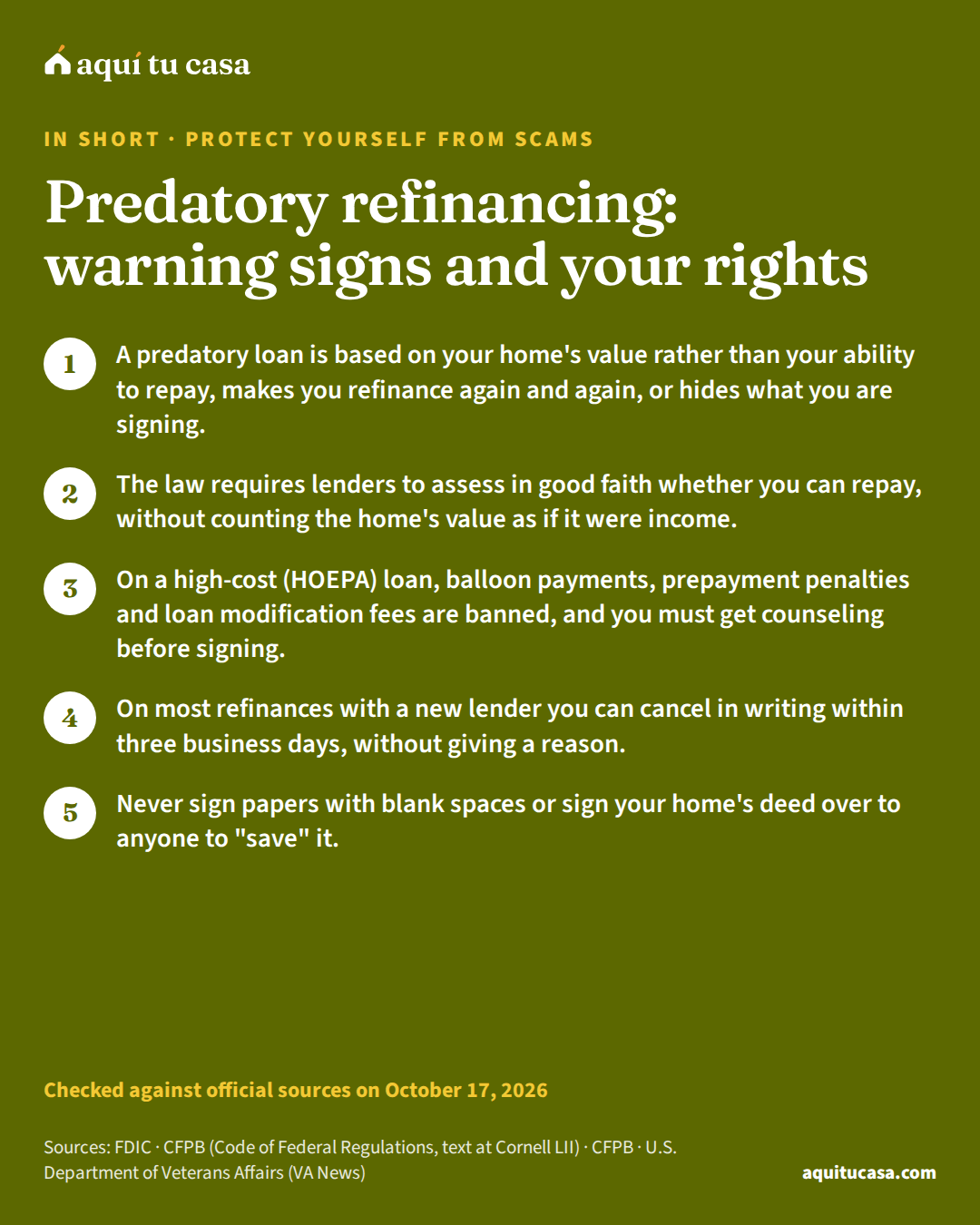
From the guide
How to spot a predatory refinance that eats your home equity, what the law bans in high-cost mortgages and how to cancel in time if you already signed.
Verified on October 17, 2026 15 official sources
On most refinances with a new lender, yes: according to the CFPB you have three business days to cancel, counting Saturdays but not Sundays or holidays, and the clock starts once you have signed, received the Closing Disclosure and received two copies of the notice of your right to cancel. You must notify the lender in writing; a phone call is not enough. If you refinance with the same lender without borrowing more, you do not have that right.
Read the full guideIt is a loan secured by your principal home whose APR or points and fees exceed certain Regulation Z limits, for example an APR more than 6.5 percentage points above the average rate for a first-lien loan. These loans come with extra protections: a special notice, required counseling before signing and a ban on balloon payments and prepayment penalties.
Read the full guideFor loans covered by the ability-to-repay rule, no: the lender must determine in good faith that you can repay, looking at your income or assets other than the home's value, your debts and your credit history. The FDIC describes lending based on a borrower's assets rather than ability to repay as predatory.
Read the full guideNo. On a high-cost loan, Regulation Z bans the lender or broker from recommending that you default on a loan being refinanced, and the FDIC lists that advice as a scam warning sign. Stopping payments can put you genuinely behind on your current loan.
Read the full guideAccording to the CFPB, if you were entitled to it and did not get it, you may still be able to cancel, but you must act within the first three years after signing or before you sell your home, whichever comes first. If you cancel, you will have to give back the money you borrowed. A free legal aid office can review your situation.
Read the full guideNo. The CFPB explains that every mortgage has costs: the lender covers them with a higher interest rate in exchange for a credit, or adds them to the loan amount. A higher rate means paying more over time, and a bigger loan increases your payments and reduces your equity.
Read the full guideYou can submit a complaint to the CFPB online or by calling (855) 411-CFPB (2372). To review your options, a HUD-approved housing counselor gives independent advice, often at little or no cost.
Read the full guide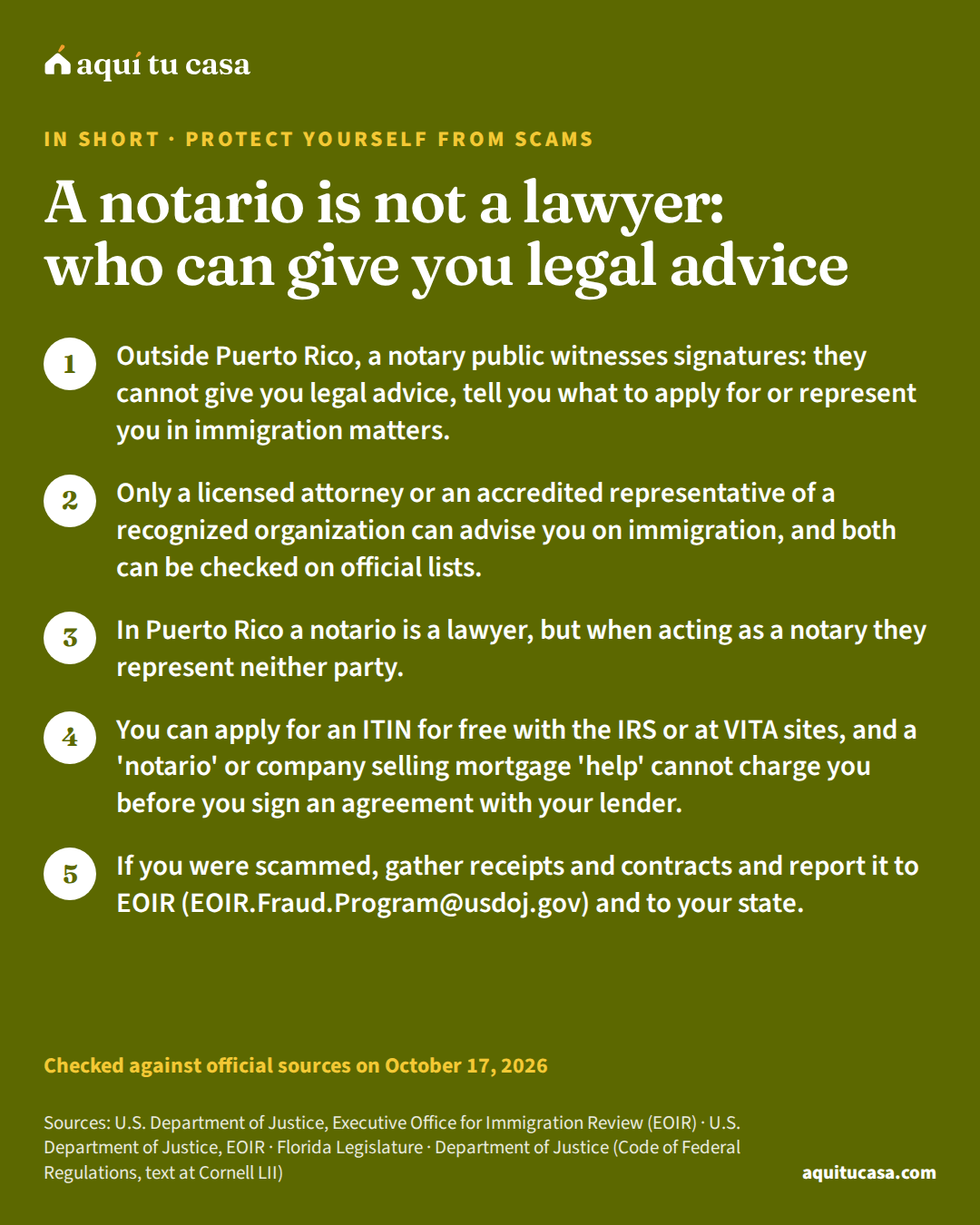
From the guide
Outside Puerto Rico, a notary public is not a lawyer. What a notary can do, who can advise you for free or at low cost, warning signs and how to report it.
Verified on October 17, 2026 21 official sources
They cannot tell you which form to use or what to answer: that is legal advice. Someone who is not an attorney or accredited representative can only do clerical work, like translating or writing in the blanks what you tell them. And USCIS and EOIR forms are free on their websites.
Read the full guideNo. In Puerto Rico a notario is an attorney authorized by the Supreme Court, so this warning is about the 50 states. Even so, when acting as a notary they represent the public faith, not either party.
Read the full guideLook them up on the Department of Justice's (EOIR) official roster, which lists recognized organizations and accredited representatives by state. Accreditation expires and only counts within the person's organization; if they are not listed and are not an attorney either, they are not qualified to give you immigration legal advice.
Read the full guideKeep receipts, contracts, ads and messages. File a complaint with EOIR's Fraud Program, at 1-877-388-3840 or EOIR.Fraud.Program@usdoj.gov, and with your state. For your immigration case, you can look for an attorney or an accredited representative; there are free and low-cost organizations.
Read the full guideAccording to EOIR's guide, it is a public officer authorized by law to certify documents, take affidavits and administer oaths. A notary is not an attorney or an accredited representative, so they cannot give you legal advice or services on your immigration case.
Read the full guideThey work for a non-profit organization that mainly serves low-income people. If that organization charges fees, it must have a written policy for clients who cannot pay. If you already have a case in immigration court, EOIR publishes a list of free legal service providers.
Read the full guideEOIR warns about anyone working in the United States who claims to be an attorney in a foreign country but is not licensed as an attorney in the United States. Before accepting their help, ask to see a state bar certificate or a Department of Justice accreditation letter.
Read the full guideTools
The calculators these guides use. Each one leaves you with a result you can use today.
How much is left for housing each month.
What you get → what is left
The documents you'll be asked for.
What you get → your document list
What each loan costs per month and over five years.
What you get → payment per loan
The steps to build or improve your credit.
What you get → steps in order
From the guide
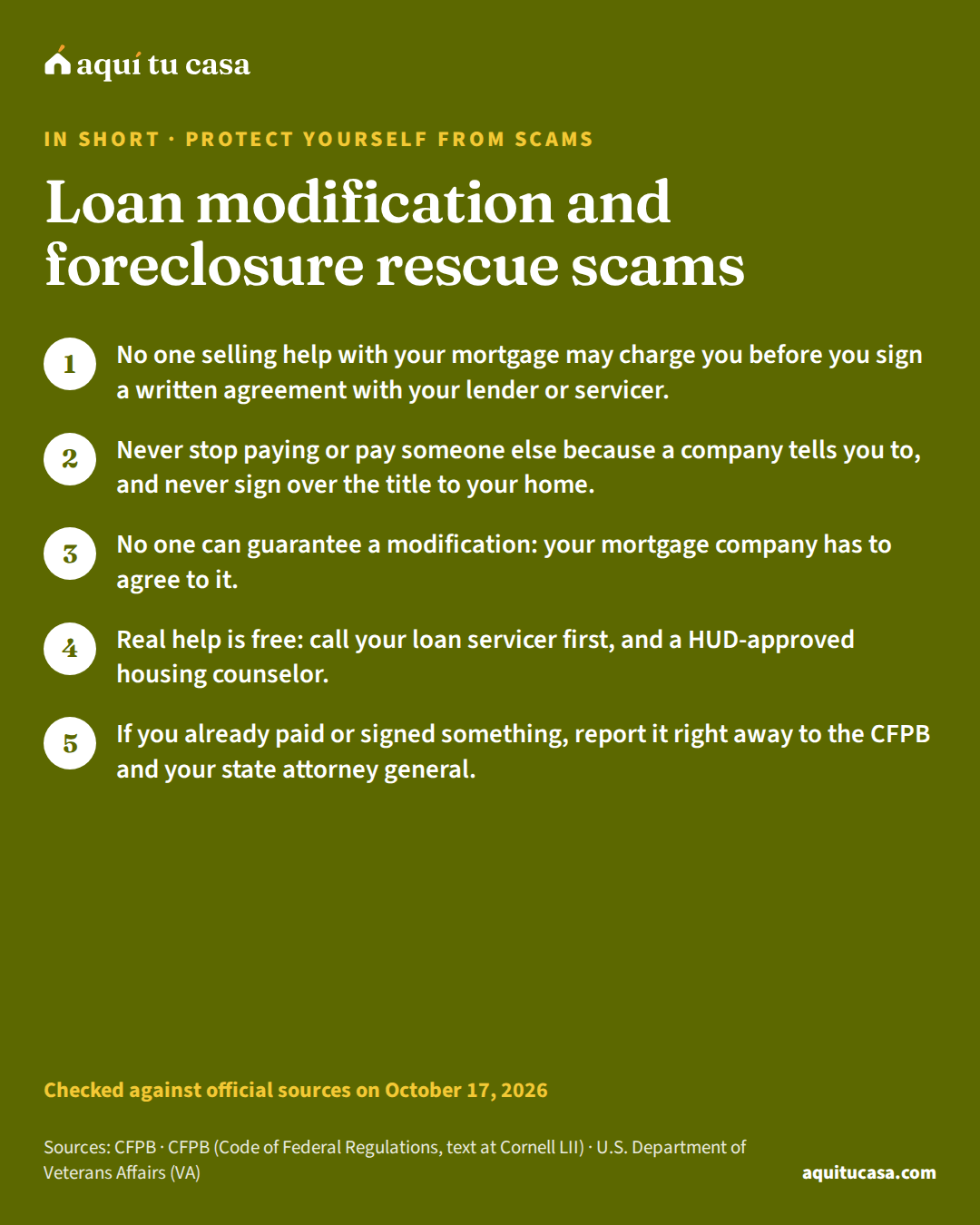
How to spot scams that promise to save your home from foreclosure, what federal law prohibits and where to get real, free help.
Verified on October 17, 2026 12 official sources
No. Under Regulation O, anyone selling mortgage assistance relief may not request or receive any payment until you have signed a written agreement with your lender or servicer that includes the offer they obtained. There is a limited exception for attorneys licensed in your state who deposit the money in a client trust account and follow state law.
Read the full guideThe CFPB lists these signs: they charge up front, guarantee they will change your mortgage or that you won't lose your home, tell you to stop paying or pay someone else, ask you to sign over title or sign papers you don't understand, pressure you to act now, talk about a 'forensic audit' or use logos that look like the government's.
Read the full guideAccording to the CFPB, you don't have to pay anyone: help is available at no cost from your loan servicer or a HUD-approved housing counseling agency. You can call the HOPE Hotline, 24 hours a day, at (888) 995-4673.
Read the full guideThe CFPB flags this as a scam sign: stopping payments can hurt your credit and limit your options. And if a company tells you this, Regulation O requires it to warn you that if you stop paying your mortgage, you could lose your home and damage your credit.
Read the full guideOnly in very limited circumstances. According to the CFPB, a lawyer can ask you to pay first only if licensed in the state where you live or where your home is and meeting other requirements, such as depositing the money in a client trust account. If someone claiming to offer legal help wants to be paid before you receive a modification, they may be breaking the law.
Read the full guideReport it right away. You can file a complaint with the CFPB online or at (855) 411-2372, which serves callers in more than 180 languages, and contact your state attorney general's office. Free legal aid in your area can review your case, if you wish. And call your loan servicer to confirm the real status of your mortgage.
Read the full guideNo. According to the CFPB, real government officials never ask for payment to help you. And by law, anyone selling mortgage relief must say in its ads that it is not associated with the government and that its service is not approved by the government or your lender.
Read the full guide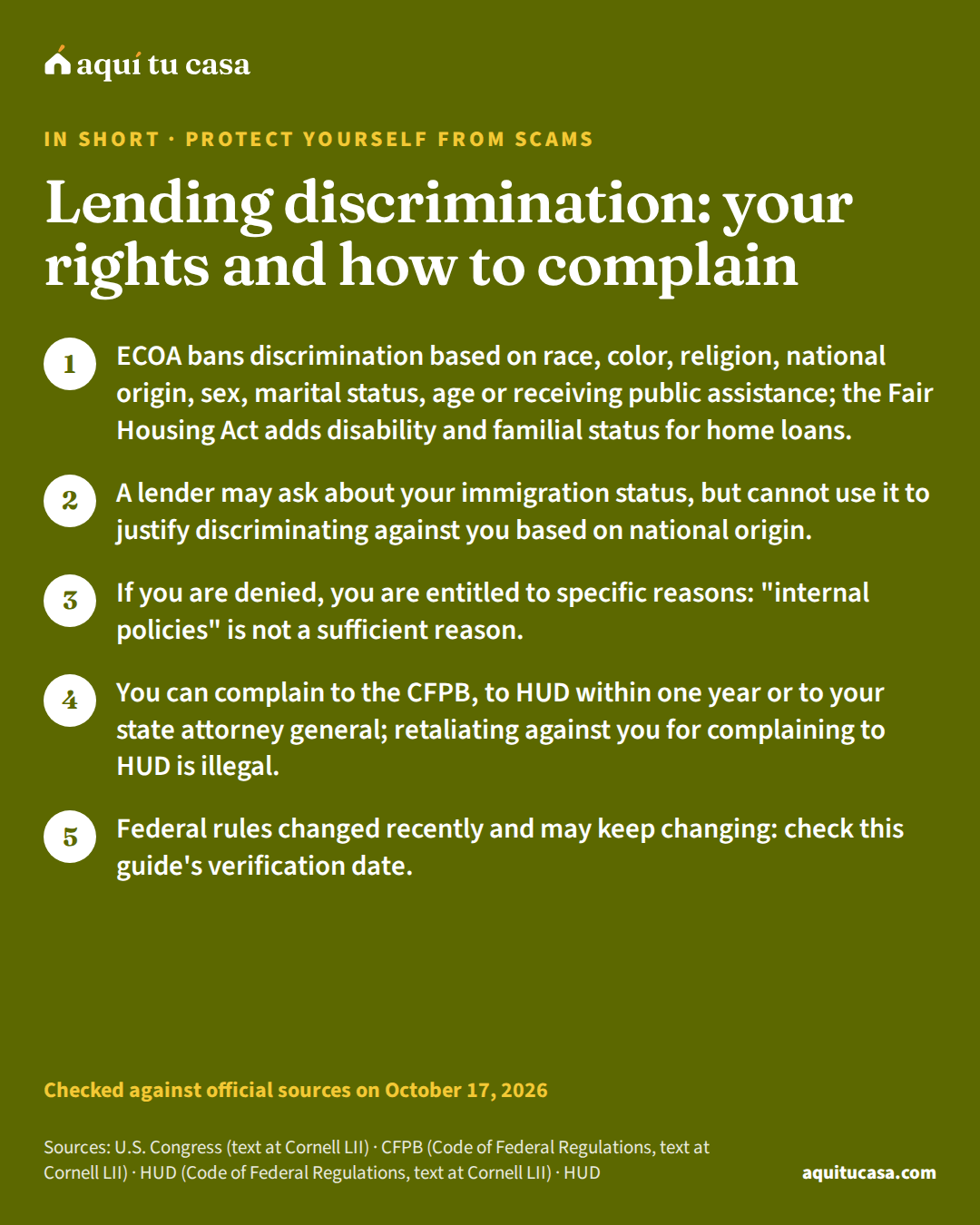
From the guide
What the law bans when you apply for a loan or mortgage, what lenders may ask, including immigration status, and how to complain to the CFPB or HUD.
Verified on October 17, 2026 21 official sources
Regulation B lets a lender ask about and consider your immigration status or whether you are a permanent resident. What it cannot do, according to the CFPB, is use immigration status to justify discriminating against you based on national origin, race or another protected characteristic. For questions about your immigration case, an accredited representative or a legal aid office can guide you.
Read the full guideOn a loan to buy or refinance the home you live in, the lender must ask so the federal government can monitor compliance with anti-discrimination laws, but you are not required to answer. If you do not, the lender notes ethnicity, race and sex based on visual observation or surname.
Read the full guideUnder Regulation B, it must tell you its decision within 30 days after receiving your completed application. If it denies you, the notice must be in writing and either give the specific reasons or tell you that you can request them within 60 days.
Read the full guideRegulation B allows disclosures in other languages as long as they are available in English on request, but it does not require Spanish. FHFA, Fannie Mae and Freddie Mac offer translated documents and a Spanish glossary of mortgage terms for information only. The CFPB warns never to sign anything you do not understand.
Read the full guideYou can complain to the CFPB online or at 1-855-411-CFPB (2372), to the FTC, or to your state attorney general or consumer protection office. If it was a home loan, you can also report it to HUD at 1-800-669-9777 no later than one year after it happened.
Read the full guideHUD says it is illegal to retaliate against anyone for filing a housing discrimination allegation. And ECOA bars a creditor from discriminating against you because you exercised in good faith a right under that law.
Read the full guide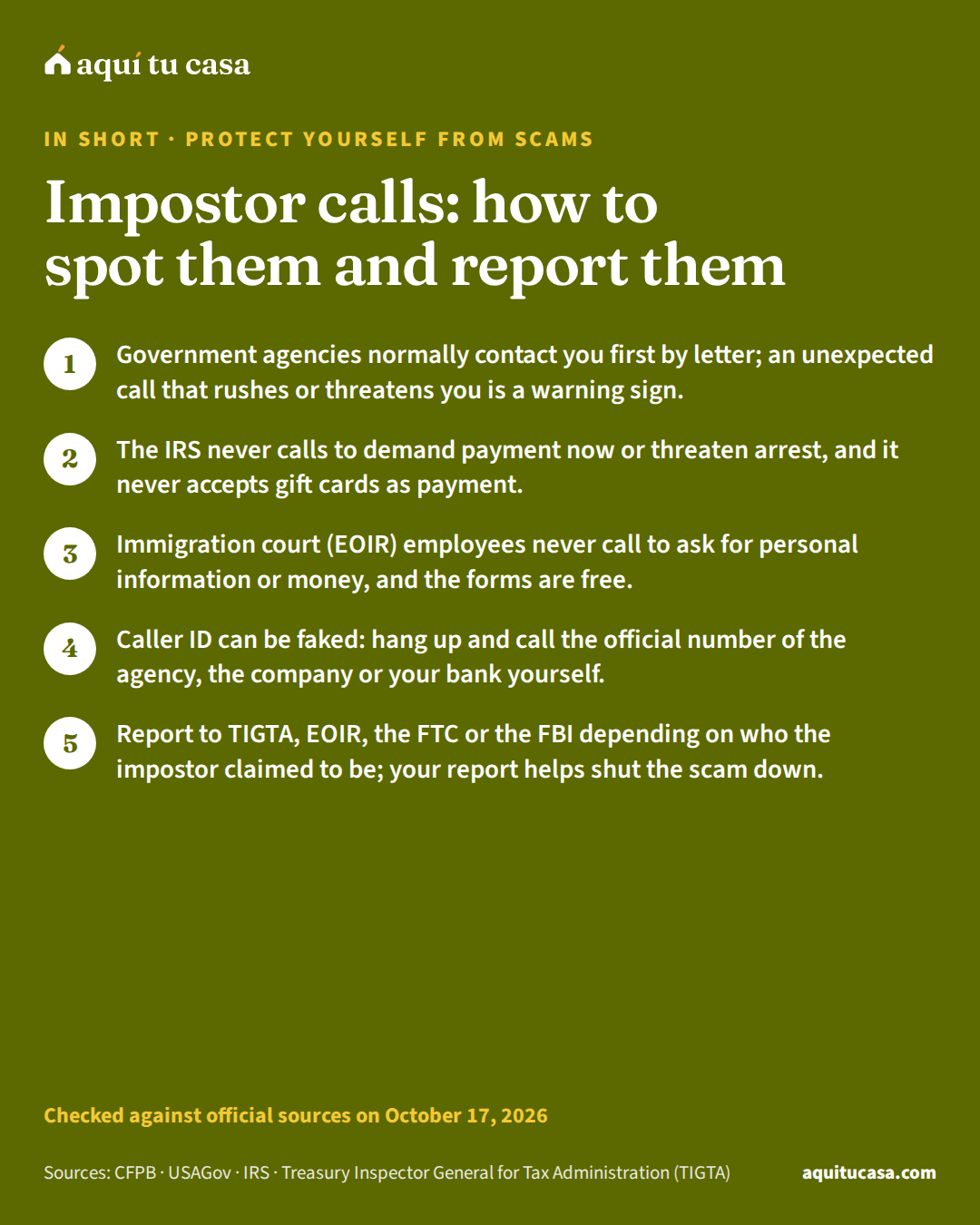
From the guide
How to tell whether a call or message from the IRS, immigration court, the power company or your bank is real, and where to report impostors.
Verified on October 17, 2026 17 official sources
Yes: the IRS or a private collection agency may call you about your account, although the IRS normally writes to you first by mail. But the IRS says it never calls to demand payment on the spot, threaten you with arrest or tell you about a refund. If a call does any of that, write down the number, hang up and report it to TIGTA at 800-366-4484.
Read the full guideEOIR, the Justice Department office that runs the immigration courts, says its employees never call to ask for personal information or money. To check on your case, do not use the number the caller gave you: EOIR says to call its Automated Case Information Hotline, 1-800-898-7180, or use its online case information system.
Read the full guideThe New York Attorney General warned that utility providers do not call and threaten to shut off service if you do not pay on the spot, and that they do not accept gift cards as payment. Hang up and call the company's official number yourself to ask about your account.
Read the full guideNot necessarily. The CFPB and USAGov warn that caller ID can be faked. The FDIC recommends calling your bank directly at a number you know, such as the one on your debit or credit card.
Read the full guideIf they claimed to be the IRS, report it to TIGTA (800-366-4484); fake IRS emails go to phishing@irs.gov. If they claimed to be immigration court, report it to EOIR's Fraud and Abuse Prevention Program. For other scams, the CFPB points to the FTC at reportfraud.ftc.gov, the FBI at ic3.gov, your state attorney general or your local police.
Read the full guideEOIR says all EOIR and USCIS forms are available for free on their websites. If someone wants to sell them to you, be wary; you can report it to EOIR's Fraud and Abuse Prevention Program.
Read the full guideThe IRS says to stop interacting with the scammer, not send money, contact your bank and follow the steps on IdentityTheft.gov; if your Social Security number or ITIN was stolen, also report it to the IRS. Our guide 'I was scammed: what now' walks through the first hours step by step.
Read the full guide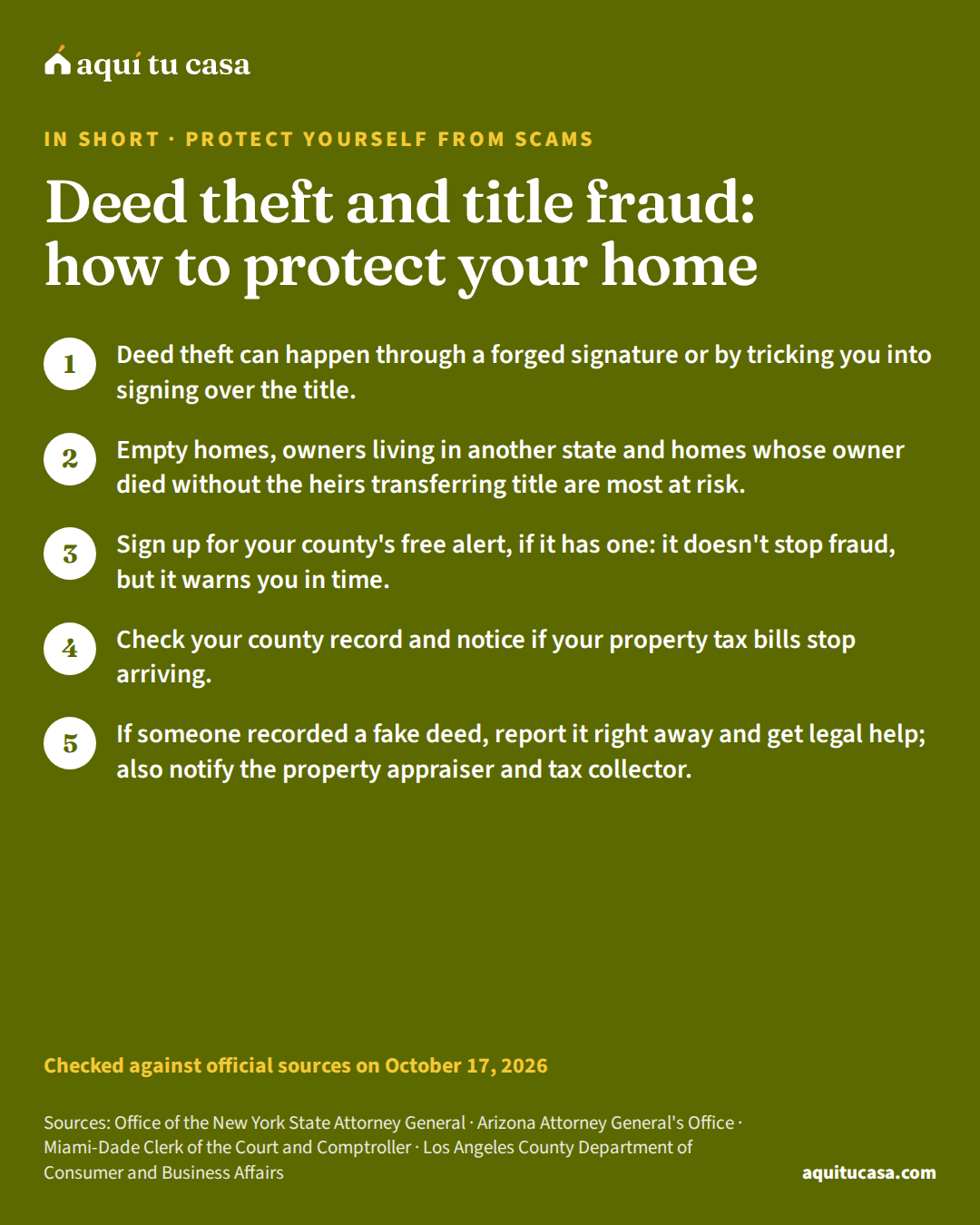
From the guide
What deed theft is, who is most at risk, the warning signs, your county's property alerts and what to do if someone records a fake deed.
Verified on October 17, 2026 8 official sources
Someone can record a deed with your forged signature and make it look as if the home changed owners. The Arizona Attorney General's office reported cases where the criminal quickly sold the home. Removing that change from your title can be complicated, which is why it helps to catch it early.
Read the full guideSeveral counties offer a free alert service that notifies you when a document is recorded under your name; in Miami-Dade, for example, the alert arrives within 24 hours. You can also check your county recorder's and assessor's websites from time to time.
Read the full guideIt depends on the county. Miami-Dade, Tarrant and Bexar, among others, offer free alerts, and Los Angeles sends notices by mail and by email. Look on your county recorder's or clerk's website for a service called 'Property Fraud Alert' or something similar.
Read the full guideThe Miami-Dade Clerk suggests reporting it right away to the police, because it is a crime, and filing a court case to quiet title. It also helps to notify the property appraiser and tax collector, so your bills don't go to another address. Free legal aid in your area can help.
Read the full guideThe CFPB describes owner's title insurance as protection if someone claims a right to the home from before you bought it. Check your own policy to see what it covers; the title insurance guide explains how it works.
Read the full guideAccording to the New York and Arizona attorneys general, empty or abandoned homes, owners who live in another state, properties in foreclosure or with liens, and homes whose owner died without the heirs transferring title. New York adds that scammers also target seniors, immigrants and people of color.
Read the full guideNo. The New York Attorney General's office says legitimate organizations will not ask you to transfer your property rights or promise you can buy the property back. Never sign anything you don't understand.
Read the full guide
From the guide
How to spot a dishonest contractor, check a license, sign a solid contract, pay safely and cancel a sale made at your home.
Verified on October 17, 2026 12 official sources
Ask for the license or registration number and look it up on your state contracting board or agency's website, or call its hotline. The CFPB says that if they aren't listed, they are not a good option. In California, for example, the CSLB lets you search by number, business name or contractor name.
Read the full guideIt depends on your state. In California, the law does not allow a down payment of more than 10 percent of the price or $1,000, whichever is less. The CFPB recommends paying nothing up front without a signed contract and holding the final payment until the work is done to your satisfaction.
Read the full guideIf it was a door-to-door sale of $25 or more at your home, the FTC Cooling-Off Rule gives you until midnight of the third business day to cancel, in writing. The seller must give you two copies of the cancellation notice and refund what you paid within 10 business days.
Read the full guideIn a door-to-door sale, the Cooling-Off Rule says the contract or receipt must be in the same language the seller mainly used to sell to you, for example Spanish, and so must the cancellation notice.
Read the full guideThe CFPB says never to pay by wire transfer, gift card, virtual currency or cash, because it can be harder to get your money back. Pay in a way that leaves a record and get a receipt for every payment.
Read the full guideThe CFPB recommends shopping for the lender yourself instead of just taking the contractor's referral. A PACE loan is repaid through your property taxes and could put you at risk of losing your home in a tax sale. And if the loan places a lien on your home, you have three business days to cancel it and work cannot start during that period.
Read the full guideAccording to the CFPB, you can complain to local law enforcement, your state attorney general and the state or local agency that licenses contractors. You can also consult a lawyer; free legal aid in your area is an option.
Read the full guideChange topic without leaving the questions.

These answers explain the rules but do not know your situation. These organizations go over it with you, free.