Impostor calls: how to spot them and report them
How to tell whether a call or message from the IRS, immigration court, the power company or your bank is real, and where to report impostors.
Verified against official sources on October 17, 2026 17 official sources

Show contents
In short
What you need to know
Quick answer
An impostor pretends to be from the IRS, immigration court, the power company or your bank, rushes you and asks for money or personal information. The IRS never calls to demand payment on the spot or threaten arrest, and immigration court employees never call to ask for personal information or money. Because the number on your screen can be faked, hang up and call the official number yourself. Then report the call to TIGTA, EOIR, the FTC or the FBI, depending on who they claimed to be.
What matters most
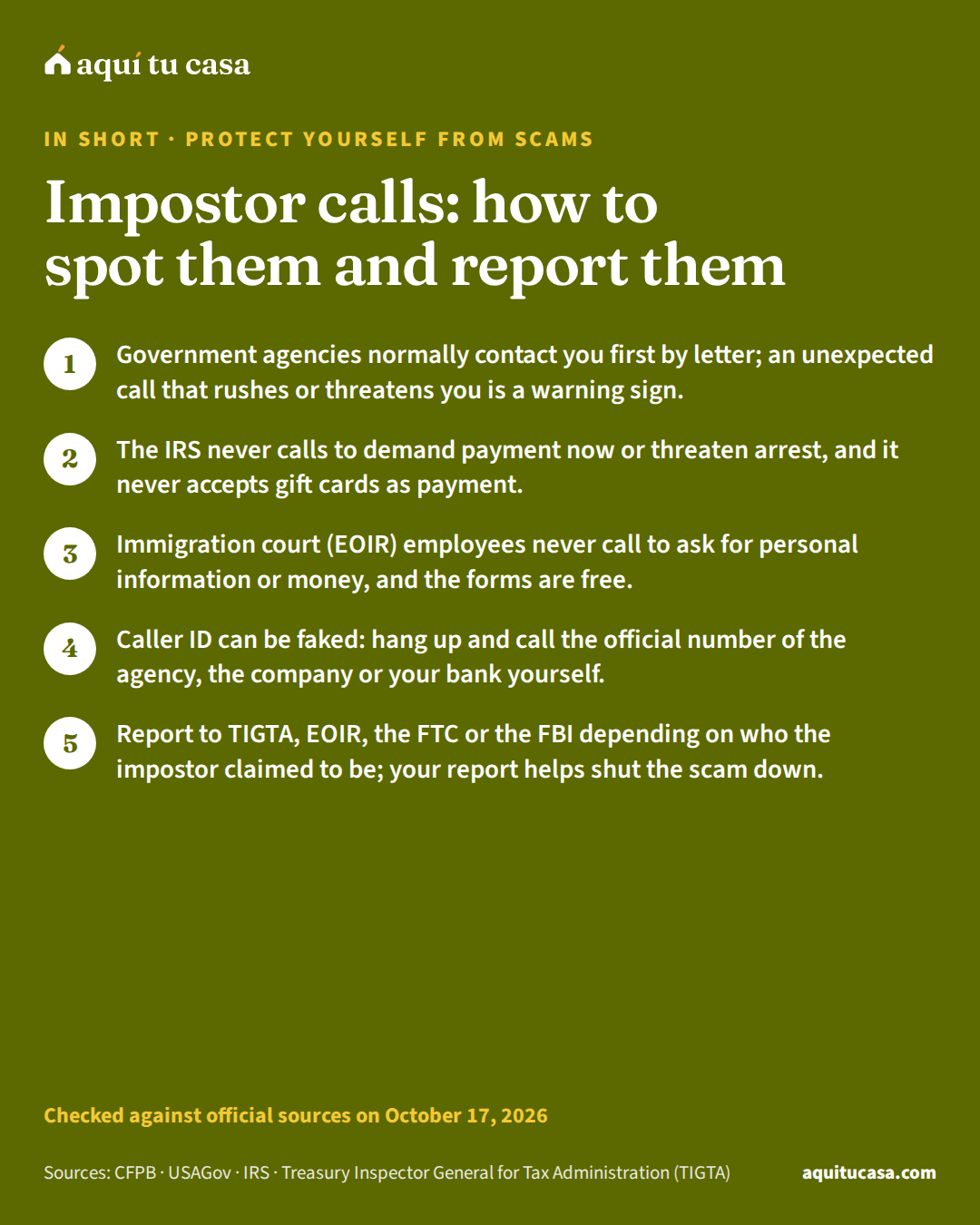
- Government agencies normally contact you first by letter; an unexpected call that rushes or threatens you is a warning sign.
- The IRS never calls to demand payment now or threaten arrest, and it never accepts gift cards as payment.
- Immigration court (EOIR) employees never call to ask for personal information or money, and the forms are free.
- Caller ID can be faked: hang up and call the official number of the agency, the company or your bank yourself.
Is this for you?
This guide is for you if…
- Someone called or texted claiming to be from the IRS, immigration, the power company or your bank, and asked for money or information.
- You want to know how these agencies really contact people so you do not fall for a trap.
- You want to help your parents, grandparents or children recognize these calls.
Get direct help first if…
- You already paid or gave your information to an impostor: start with the guide 'I was scammed: what now', which goes step by step through the first hours.
- You have a real letter or hearing in immigration court and have questions about your case: this guide does not answer case questions; an accredited representative or a free legal service can guide you.
The phone rings and someone says they are calling from the IRS, immigration court, the power company or your bank. They talk fast, frighten you and ask for money or information. This guide is for you if you got a call or message like that, or if you want to prepare your family: it explains how these agencies really contact people, what they never do and where to report impostors.
How an impostor works
An impostor pretends to be someone you trust: a government agency, your bank, the police or a relative. According to the CFPB, the goal is to get you to send money or share your account details, sometimes with threats of legal consequences if you do not pay.1 USAGov adds that impostors may call, text, email or knock at your door.4
The same signs give them away almost every time:
- They reach out when you do not expect it. Unless you contact them first, government agencies typically start communicating with you by letter.4
- They rush and scare you. They pressure you to act now, with no time to ask questions or think.2
- They want an unusual payment method. Wire transfers, gift cards, payment apps or cryptocurrency: all hard to trace and hard to get back.1
- They ask for information. Account numbers, passwords or your Social Security number.2
Do not trust your phone screen. Caller ID, texts and emails can be faked, and voices can now be cloned.1 Seeing the name of an agency or your bank proves nothing.4 The CFPB sums it up: real government agencies and banks do not threaten you, do not ask you to send money to “protect it,” and do not tell you to withdraw cash, buy gift cards or use cryptocurrency.3
If what they want is your Social Security number or your ITIN, the risk is bigger than losing money: with that information someone can pretend to be you, which is called identity theftidentity theftIdentity theft happens when someone uses your personal information without your permission to commit fraud: for example, your name, your Social Security or Medicare number, or your credit card or bank account number. With that information, a thief can rent a home, get credit cards, receive government benefits or tax refunds, or open other accounts in your name. You often find out when your credit report or a statement shows accounts or charges you do not recognize, or when a debt collector calls. The federal site IdentityTheft.gov takes reports and gives you a recovery plan.See the full definition.
“We’re calling from the IRS”: what the IRS does and never does
The IRS publishes how it contacts you. It normally reaches you the first time by mail, through the U.S. Postal Service. It sends emails or texts only if you opted in, and a social media direct message is never from the IRS.6
The IRS or a private collection agency may call you about your account. But the IRS says it never calls to demand payment on the spot, threaten you with arrest or tell you about a refund.7 It also never asks for or accepts gift cards as payment.8
According to the IRS, a call, email or text is not from the IRS if it:6
- Is unexpected.
- Rushes you.
- Threatens you.
- Asks for personal or financial information.
- Demands payment now.
What if someone knocks on your door? Unannounced visits are rare, and the IRS generally sends a letter first. Only four types of IRS employees may visit your home or business. Revenue agents and revenue officers carry an IRS credential (a pocket commission) and an HSPD-12 card, and you can ask to see both. If you owe taxes and pay an officer, the payment is made out to “United States Treasury.” If you feel unsafe, call 911.6
The real IRS and the impostor, side by side
How it contacts you
The real IRS
If anything in the second column happens to you, write down the number, hang up and report it to TIGTA.7
TIGTA (the Treasury Inspector General for Tax Administration) is the office that takes reports about people pretending to be the IRS. Its complaint form lists threats like these: being arrested if you do not pay, or having your driver’s license revoked or your Social Security number suspended if you do not pay immediately.10 If you file taxes with an ITIN and worry about what the IRS does with your information, read the IRS and the privacy of your tax data.
Calls from “immigration” or immigration court
Some calls claim to come from immigration court. EOIR, the Justice Department’s Executive Office for Immigration Review, runs those courts, and it is clear: its employees never call to ask for personal information or money.11
EOIR has also warned about calls that faked the number of a real immigration court on caller ID. The callers said they were from EOIR, claimed the person’s Social Security number had been “compromised” and asked for money. EOIR staff do not call about Social Security numbers or to ask for money, and EOIR says never to give personal information over the phone to people you do not know.12
If you have a case in immigration court and want to know your hearing date or how your case is going, do not use the number the caller gave you. EOIR says to call its Automated Case Information Hotline, 1-800-898-7180, or use its online Automated Case Information System.12
Another common trick is selling forms. All EOIR and USCIS forms can be downloaded for free from their websites.11 And someone offering to “fix your papers” over the phone may be a fake notarionotary publicIn the United States, a notary public is a person authorized by law to administer oaths and witness signatures on legal documents; the notary verifies who is signing and certifies the signature. The rules for becoming a notary vary by state. It is not the same as a "notario público" in many Latin American countries, where the title means someone with the equivalent of a law license. Here, a notary who is not a lawyer cannot give you legal advice or help you with immigration paperwork. Some states, such as Oregon, forbid them from advertising as a "notario" or "notario público".See the full definition: the guide a notario is not a lawyer explains the difference.
The “power company” threatening to cut off your service
Another call officials have described: someone says they are from the electric or gas company, that your bill is overdue and that your service will be cut off today unless you pay. The New York Attorney General described this scheme: the impostor tells you to buy gift cards and call back with the serial numbers. Many of the people who get these calls do not owe anything.15
According to that alert, utility providers do not call and threaten to shut off service if you do not pay on the spot, and they do not accept gift cards as payment. Scammers fake the company’s number so it shows on your screen, so do not give out bank or personal information over the phone, even if you see the company’s name.15
What to do: hang up and call the company’s official number yourself to ask about your account.1 If you rent and it is your landlord who shuts off your power or water to push you out, that is not a phone scam: the guide on illegal lockouts and utility shutoffs explains your rights.

Fake banks and fake lenders
The FDIC, the federal agency that insures bank deposits, explains the scam that imitates your bank: you get a text that looks like a security alert, for example asking you to confirm a large purchase you did not make. If you answer, someone claiming to be from the bank calls and asks for your personal information, then uses it to take money from your account.16
What the FDIC recommends: call your bank directly at a number you know, such as the one on your debit or credit card; do not click links in the message; and if something seems off, contact the FDIC before giving out any information. There are also fake bank websites that use the FDIC name: you can look the bank up in the FDIC’s BankFind tool or call 1-877-ASK-FDIC (1-877-275-3342).16
Loans work the same way. The FDIC describes fake lenders who convince you by phone or online to apply for a low-rate mortgagemortgageA mortgage is an agreement between you and a lender (a bank, a credit union or a mortgage company) that gives the lender the right to take your property if you do not repay the money it lent you, plus interest. Mortgage loans are used to buy a home or to borrow money against the value of a home you already own. You repay it in monthly payments that cover the principal (the money borrowed) and the interest, and often the property taxes and insurance as well. In Spanish, "hipoteca" and "préstamo hipotecario" mean the same thing.See the full definition, collect your Social Security and bank account numbers, “approve” the loan right away and have you send documents and wire payments without ever meeting them. You end up with your information stolen and at risk of identity theft. Others pose as brokers or lenders who will “refinance” you, and the papers you sign actually transfer your home’s deed to someone else. If they demand a fee in advance, that is a warning sign.17
Before you give a lender your information, you can check its license: the guide how to choose a mortgage lender explains how. If you are offered a refinance that sounds too good to be true, read predatory refinancing. And if you are behind on your mortgage and someone promises to “save your home,” read loan modification and foreclosure rescue scams.

How to check whether a call is real
You do not have to guess. These steps get you out of doubt without giving the impostor anything:
If someone calls claiming to be the government, your bank or a company
1. Do not share information or pay during the call
Right then
Real agencies and banks do not ask you to send money to “protect it” or to pay with gift cards or cryptocurrency.3
2. Write down the number and hang up
Right then
The IRS says to record the number and hang up if a call seems suspicious.7
3. Look up the official number yourself
Before calling back
Use the official website of the agency or company, never the number the caller gave you.1
4. Call and ask whether there is a real problem
Once you have the number
If it was your bank, the FDIC suggests using the number on your debit or credit card.16
5. If they say a relative is in trouble, call that relative
If you still have doubts
The CFPB recommends contacting your relative directly at a trusted number to verify the story.1
6. Report the call
The same day
Each type of impostor is reported in a different place; the table below tells you where.5
Example with real numbers
A call from “the IRS,” line by line
An example of what an impostor usually says and what the IRS says about each line.
- “You owe taxes and must pay today”
- The IRS never calls to demand payment on the spot.7
- “If you don't pay, you will be arrested”
- The IRS never calls to threaten arrest.7
- “Buy gift cards and read us the numbers”
- The IRS never asks for or accepts gift cards.8
- Your screen says “IRS”
- Caller ID can be faked.4
- What to do
- Write down the number, hang up and report it to TIGTA.7
This is a practice example. If you really have a question about your taxes, look up the phone number on the official IRS website yourself.1
Where to report an impostor
Reporting helps even if you did not lose money: the IRS says your reports help shut these scams down.7 Each impostor is reported in a different place:
| If they claimed to be… | Where to report it |
|---|---|
| The IRS, by phone | TIGTA, through its complaint form or at 800-366-4484 |
| The IRS, by email or text | The email to phishing@irs.gov; the text forwarded to 7726 |
| Immigration court (EOIR) | The Fraud and Abuse Prevention Program: EOIR.Fraud.Program@usdoj.gov |
| Your bank, a company or another agency | The FTC at reportfraud.ftc.gov or the FBI at ic3.gov |
| Anyone, if you lost money | Your local police (non-emergency number) and your state attorney general |
For the IRS, these details come from its own pages and TIGTA’s.710 USAGov adds that impostor scams are reported to the FTC, and tax-related ones to the IRS.4 For EOIR, the address is its fraud program’s.11 And the CFPB points to the FTC, the FBI, your state attorney general and your local police.3
If you are not sure where your case goes, USAGov’s where-to-report-a-scam tool tells you after a few questions. If the problem is with a legitimate business that treated you badly, it may not be a scam but a complaint.5
When you report, give details. EOIR asks you to be as specific as possible, with dates, addresses and other identifying information, and to include evidence such as receipts, contracts or advertisements.13 Keep a note with the date, time and number of each call.
If this is you
If this is you
You are an older adult or care for one
Scammers call seniors pretending to be the IRS, Social Security or Medicare and ask for wire transfers or gift cards.8 If they call about a “grandchild in trouble,” call the relative yourself.1
You have an ITIN or an immigration case
EOIR never calls to ask for information or money, and its forms are free.11 If your ITIN was stolen, the IRS says to report it.9
You own a home or are about to buy
Be wary of anyone who “approves” a loan over the phone and asks for wire transfers or an upfront fee.17
You want to protect the whole family
Set a house rule: nobody shares information or pays during a call; you hang up and call the official number yourselves.1
Mistakes that help impostors
Mistake: Believing the call is real because your screen says “IRS” or your bank's name.
Instead: Caller ID can be faked: hang up and call the official number yourself.1
Mistake: Paying with gift cards to “avoid” an arrest or a shutoff.
Instead: The IRS and utility providers do not accept gift cards as payment.815
Mistake: Calling the number the impostor left you to “confirm.”
Instead: Look up the number on the official website or on your bank card.16
Mistake: Buying immigration forms.
Instead: EOIR and USCIS forms are free on their websites.11
Mistake: Giving your Social Security number or ITIN to “verify your identity.”
Instead: Being asked for personal or financial information is one of the signs the IRS lists.6
Mistake: Staying quiet out of embarrassment.
Instead: Report it: your report helps shut the scam down.7
If you already paid or gave your information
Do not blame yourself: these calls are designed to frighten anyone. What matters now is acting fast. The IRS says to stop interacting with the scammer, not send any more money or information, contact your bank or credit union and follow the steps on IdentityTheft.gov. If your Social Security number or ITIN was stolen, also report it to the IRS. An IP PINIRS Identity Protection PIN (IP PIN)The IP PIN (Identity Protection PIN) is a six-digit number from the IRS that keeps anyone else from filing a tax return with your Social Security number or ITIN. Only you and the IRS know it. Anyone with an SSN or ITIN who can verify their identity can get one: online, by application or in person at an IRS office. It changes every year, and you must use it on every federal return you file that year. The IRS will never ask for your IP PIN by phone, email or text message: that is a scam.See the full definition (Identity Protection PIN) keeps anyone else from filing a tax return in your name.9
Watch out for a second trap: some victims get scammed again by someone who offers to “recover” their money.9 The guide I was scammed: what now goes step by step through the first hours, and the complete guide to housing scams gathers the other warning signs in the protect yourself topic.
What to do this week
- Talk with your family and set a rule: nobody pays or shares information during a call; you hang up and call the official number.1
- Put your numbers on the National Do Not Call Registry at www.donotcall.gov or (888) 382-1222.2
- Save the official numbers in your phone: your bank’s, from your card,16 and, if you have an immigration case, EOIR’s hotline, 1-800-898-7180.12
- If you file taxes, consider getting an IP PIN to protect your number.9
- If you got a suspicious call, report it today: to TIGTA if they claimed to be the IRS, to EOIR if they claimed to be the court.1011
- If you have an immigration case and questions, look for free guidance on EOIR’s pro bono list or with an accredited representative.14
Ready to see the numbers? Find your county here
See how this applies in your county: its loan limits, prices and rents, from the official data.
Printable checklist
Frequently asked questions
Can the IRS call me on the phone?
Yes: the IRS or a private collection agency may call you about your account, although the IRS normally writes to you first by mail. But the IRS says it never calls to demand payment on the spot, threaten you with arrest or tell you about a refund. If a call does any of that, write down the number, hang up and report it to TIGTA at 800-366-4484.
How do I know if a call from immigration court is real?
EOIR, the Justice Department office that runs the immigration courts, says its employees never call to ask for personal information or money. To check on your case, do not use the number the caller gave you: EOIR says to call its Automated Case Information Hotline, 1-800-898-7180, or use its online case information system.
Can the power company shut off my service today if I do not pay with gift cards?
The New York Attorney General warned that utility providers do not call and threaten to shut off service if you do not pay on the spot, and that they do not accept gift cards as payment. Hang up and call the company's official number yourself to ask about your account.
If my bank's number shows up on my screen, is it my bank?
Not necessarily. The CFPB and USAGov warn that caller ID can be faked. The FDIC recommends calling your bank directly at a number you know, such as the one on your debit or credit card.
Where do I report a fake call?
If they claimed to be the IRS, report it to TIGTA (800-366-4484); fake IRS emails go to phishing@irs.gov. If they claimed to be immigration court, report it to EOIR's Fraud and Abuse Prevention Program. For other scams, the CFPB points to the FTC at reportfraud.ftc.gov, the FBI at ic3.gov, your state attorney general or your local police.
Do I have to pay for immigration forms?
EOIR says all EOIR and USCIS forms are available for free on their websites. If someone wants to sell them to you, be wary; you can report it to EOIR's Fraud and Abuse Prevention Program.
I already gave my information to an impostor. What do I do?
The IRS says to stop interacting with the scammer, not send money, contact your bank and follow the steps on IdentityTheft.gov; if your Social Security number or ITIN was stolen, also report it to the IRS. Our guide 'I was scammed: what now' walks through the first hours step by step.
Sources
Every figure in this guide comes from one of these official sources. The number next to a sentence leads to the source behind it.
Each source on one line: who publishes it, its title, its address and the date we read it.
- 1. CFPB · What are some common types of fraud and scams? · consumerfinance.gov · Accessed October 17, 2026
- 2. CFPB · What are some classic warning signs of possible fraud and scams? · consumerfinance.gov · Accessed October 17, 2026
- 3. CFPB · Who do I contact for help with a scam or fraud? · consumerfinance.gov · Accessed October 17, 2026
- 4. USAGov · Imposter scams · usa.gov · Accessed October 17, 2026
- 5. USAGov · Learn where to report a scam · usa.gov · Accessed October 17, 2026
- 6. IRS · How to know it's the IRS · irs.gov · Accessed October 17, 2026
- 7. IRS · Report fake IRS, Treasury or tax-related emails and messages · irs.gov · Accessed October 17, 2026
- 8. IRS · Tax scams · irs.gov · Accessed October 17, 2026
See the other 9 sources
- 9. IRS · If you were scammed · irs.gov · Accessed October 17, 2026
- 10. Treasury Inspector General for Tax Administration (TIGTA) · Submit a Complaint · tigta.gov · Accessed October 17, 2026
- 11. U.S. Department of Justice, EOIR · Fraud and Abuse Prevention Program · justice.gov · Accessed October 17, 2026
- 12. U.S. Department of Justice, EOIR · EOIR Warns of Scammers Spoofing Agency Phone Number · justice.gov · Accessed October 17, 2026
- 13. U.S. Department of Justice, EOIR · Fraud and Abuse Prevention Program: How to File a Complaint · justice.gov · Accessed October 17, 2026
- 14. U.S. Department of Justice, EOIR · List of Pro Bono Legal Service Providers · justice.gov · Accessed October 17, 2026
- 15. New York Attorney General · Consumer Alert: Attorney General James Warns Consumers to Remain Vigilant Against Rise in Telephone Scams · ag.ny.gov · Accessed October 17, 2026
- 16. FDIC · Bank Impersonation Scams and Fake Banks · fdic.gov · Accessed October 17, 2026
- 17. FDIC · Mortgage Scams · fdic.gov · Accessed October 17, 2026
Keep reading
Related guides
If this guide helped, these follow the same path.

Protect yourself from scams 17 minute read
Housing scams: the complete guide to spotting them
The rental, mortgage, title, contractor, credit and moving scams families run into most: how to spot them, what to do and where to report them.
- Three signs are enough to stop: they rush you, they ask you to pay before you get anything, and they want the money by wire, gift card, cryptocurrency or cash.
- Never follow payment instructions that arrive by email, and never pay rent without seeing the property and verifying the owner.
- A company selling mortgage help cannot charge you anything until you sign the agreement with your lender; the only exception is for attorneys licensed in your state who meet strict conditions. Help from HUD-approved counselors is free or close to it.
- Protect yourself from scams A notario is not a lawyer: who can give you legal advice Outside Puerto Rico, a notary public is not a lawyer. What a notary can do, who can advise you for free or at low cost, warning signs and how to report it. 12 minute read
- Money problems I was scammed: what to do in the first hours If you sent money or personal information to a scammer: who to call first, how to dispute a charge, where to report it and how to stop identity theft. 13 minute read
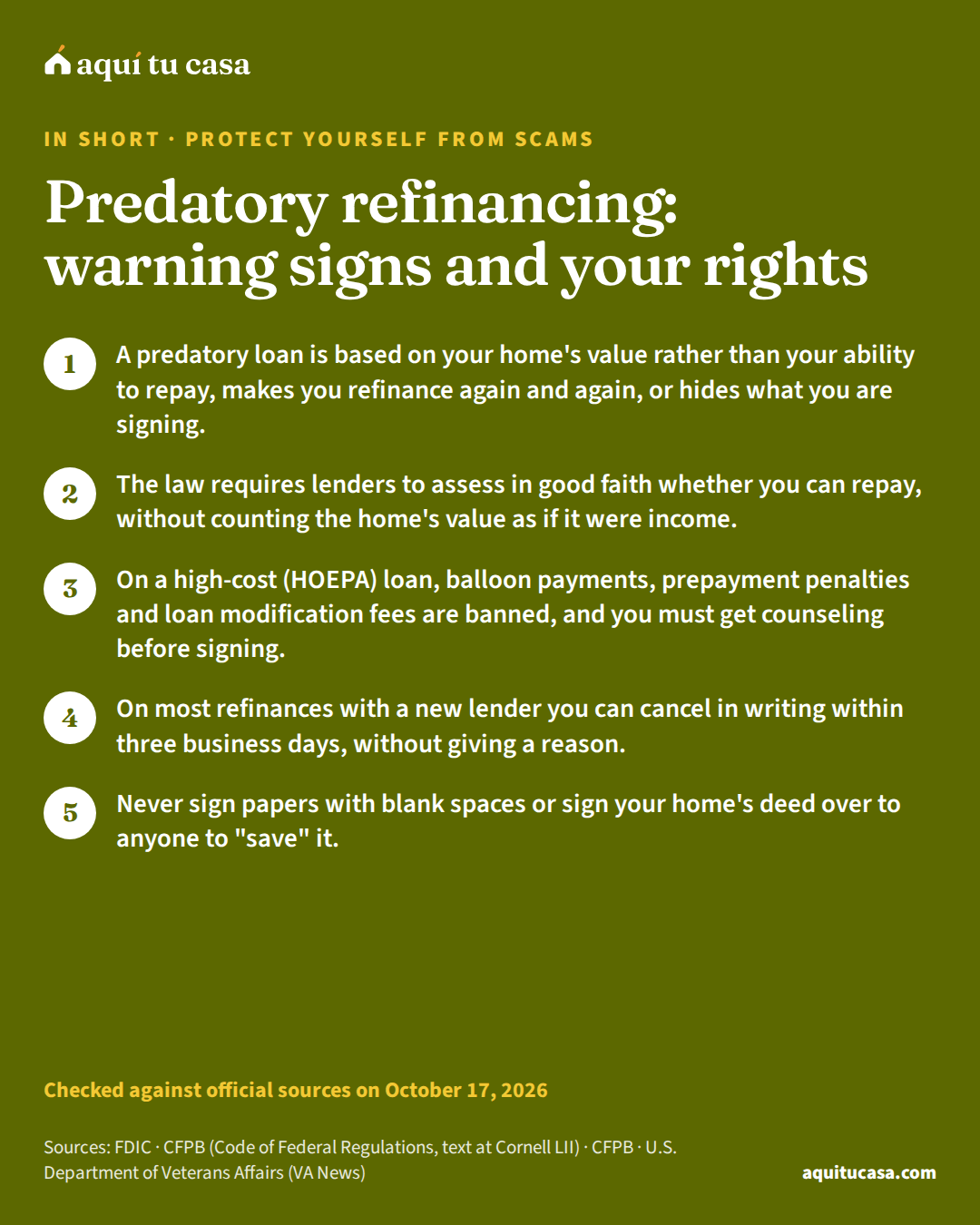
- Protect yourself from scams Predatory refinancing: warning signs and your rights How to spot a predatory refinance that eats your home equity, what the law bans in high-cost mortgages and how to cancel in time if you already signed. 14 minute read
Was this guide useful?
Thank you. Your answer stays in your browser; nothing is sent.