Illegal lockouts and utility shutoffs by a landlord
If your landlord changed the locks, removed your things or cut off water or power to make you leave: what several states' laws say and what to do today.
Verified against official sources on October 17, 2026 15 official sources

Show contents
In short
What you need to know
Quick answer
According to the CFPB, your landlord cannot force you out by changing the locks without a court order. The laws of the states we reviewed require going through court, and several expressly prohibit removing your belongings or cutting off water, power or gas to make you leave; Texas allows a lock change for unpaid rent only with advance notice and handing you the new key whether or not you pay. If it happens to you, document everything and call free legal aid today; depending on the state, you can ask to get back in and recover damages, and in Arizona you can call the police.
What matters most
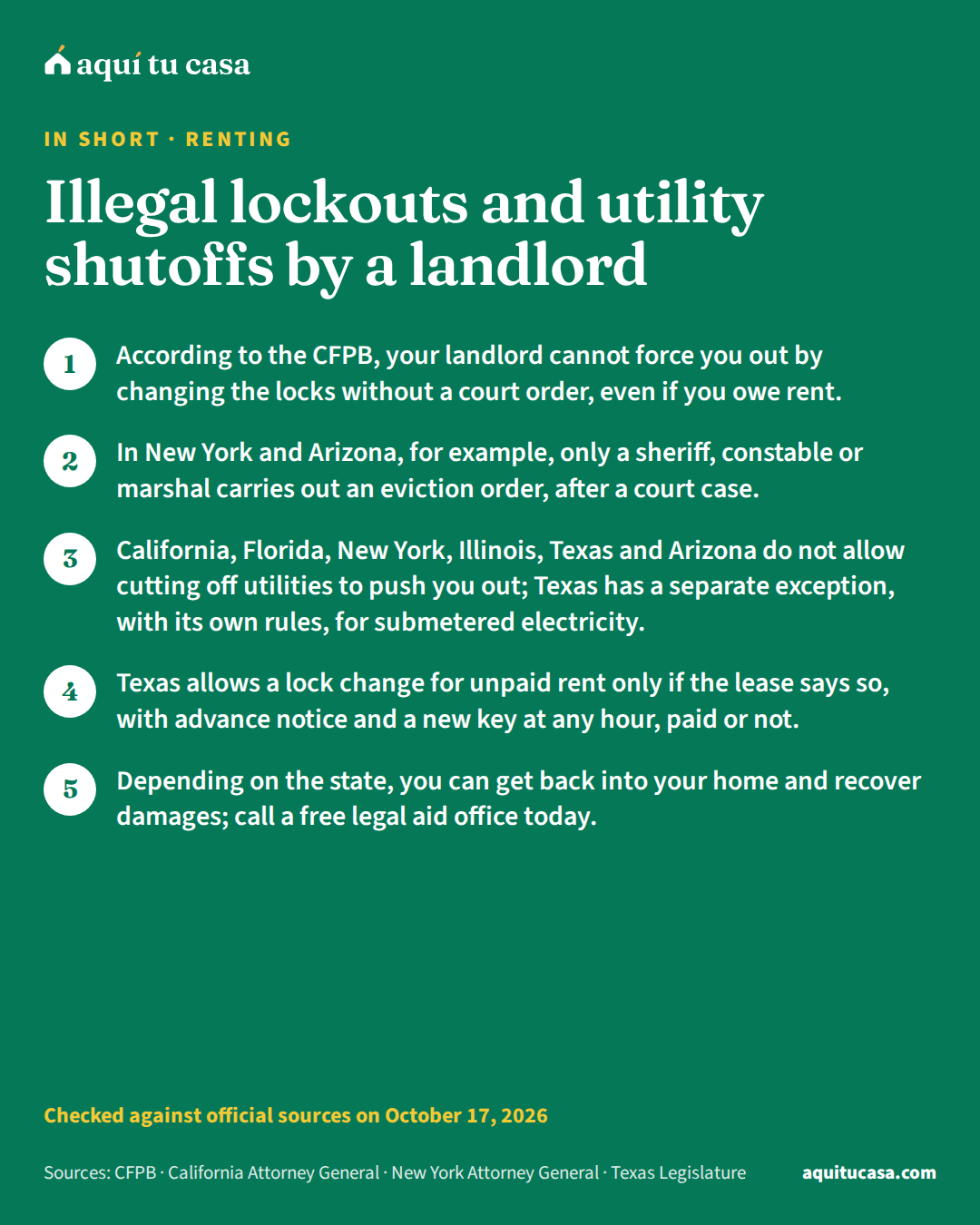
- According to the CFPB, your landlord cannot force you out by changing the locks without a court order, even if you owe rent.
- In New York and Arizona, for example, only a sheriff, constable or marshal carries out an eviction order, after a court case.
- California, Florida, New York, Illinois, Texas and Arizona do not allow cutting off utilities to push you out; Texas has a separate exception, with its own rules, for submetered electricity.
- Texas allows a lock change for unpaid rent only if the lease says so, with advance notice and a new key at any hour, paid or not.
Is this for you?
This guide is for you if…
- You came home and your key doesn't work, or you found your things outside, and no judge has ordered an eviction.
- Your landlord cut off your water, power or gas, or is threatening to, to make you leave.
- You owe rent and your landlord says they can put you out whenever they want.
Get direct help first if…
- A judge already ordered your eviction and a sheriff, marshal or constable came to carry it out: that is the legal process; read the guide on what to do if you get an eviction notice and call legal aid.
- A utility was shut off because the account is in your name and wasn't paid: look for help with utility bills in the guide on what to do if you can't pay your rent.
- You are in danger: call 911.
You come home and your key doesn’t turn. Or your belongings are on the sidewalk. Or the water goes off right after your landlord told you to leave. Removing a tenant this way, without going through the courts, is known as a self-help eviction or illegal lockout. This guide explains what the CFPB and several states’ laws say, the only legal path to remove you from your home and what you can do the same day. The exact rules belong to each state, and sometimes each city, so the guide always points you to free legal aid.
What an illegal lockout is
According to the CFPB, your landlord cannot force you out by changing the locks without a court order. Nor can they fail to pay for utilities under their control or endanger your health and safety.1 That holds even if you owe rent: owing money does not give your landlord permission to remove you on their own.
The state laws we reviewed say it in more detail. The California Attorney General explains that it is illegal to try to “evict” a tenant by locking them out, shutting off the water or electricity or removing their belongings, and that the only lawful way to evict is to file a case in court.4 The New York Attorney General adds that a landlord cannot use threats of violence, remove your belongings, lock you out or willfully cut essential services such as water or heat.5 The Illinois courts warn landlords themselves: trying to evict without a court order is against the law, and they may not change locks or cut utilities to force someone to leave.13
That is an illegal lockoutillegal lockoutAn illegal lockout happens when the landlord shuts you out of your home by changing the locks without a court order. A landlord cannot force you out that way, or pressure you by cutting off utilities under the landlord's control. To evict you, the landlord must follow the legal process: written notice, a court case and a judge's order. Most states prohibit removing or shutting out a tenant without a court order. Depending on your state's law, you may be able to get back into the home, end the lease or recover damages.See the full definition. It can come with other pressure, such as removing your things or cutting the power. It almost always aims at the same thing: getting you out without a judge deciding.
The only legal path: the courts
A legal evictionevictionEviction is the legal process a landlord uses to get back a rented home when the tenant does not want to leave. The most common reasons are unpaid rent, serious lease violations or a lease that has ended. First the landlord must give you written notice. If it is not resolved, the landlord needs a court order, and a law enforcement officer must carry out the removal. If you are sued, you have the right to file a written answer explaining to the court why you should not be evicted. The rules change by state and city.See the full definition has steps, and the landlord does none of them alone. In New York, the Attorney General explains you can be evicted only after a court case and a judgment, and only a sheriff, marshal or constable can carry out the order.5 In Arizona, the courts explain that the writ of restitution is carried out by a constable or sheriff, and the landlord may not change the locks or enter until the court issues it and it is served.8 In North Carolina, the law says a tenant can be removed only through the procedure the law prescribes.11
How a legal eviction works (with variations by state)
1. Written notice
The first step
The landlord delivers a notice. How many days it gives is set by your state's law; the table below shows the notice for late rent.2
Try it with your numbersEviction timelines by state2. Lawsuit in court
If you don't work it out
The only lawful way to evict is to file a case in court and go through the process.4
3. Hearing and judgment
On the date the court sets
A judge decides. You can answer and defend yourself; legal aid can help.2
4. Order carried out by an officer
After the judgment
In Arizona, a constable or the sheriff; in New York, a sheriff, marshal or constable. Never the landlord alone.8
Notice for late rent, by state
| State | Notice for late rent |
|---|---|
| Alabama | 7 business days |
| Alaska | 7 days |
| Arizona | 5 calendar days |
| Arkansas | 3 days |
| California | 3 court days |
| Colorado | 10 days |
| District of Columbia | 10 days |
| Florida | 3 days |
| Georgia | 3 business days |
| Hawaii | 10 calendar days |
| Idaho | 3 days |
| Illinois | 5 days |
| Indiana | 10 days |
| Iowa | 3 days |
| Kansas | 3 calendar days |
| Kentucky | 7 days |
| Louisiana | 5 days |
| Maryland | 10 days |
| Massachusetts | 14 days |
| Michigan | 7 days |
| Minnesota | 14 days |
| Mississippi | 3 days |
| Montana | 3 days |
| Nebraska | 7 calendar days |
| Nevada | 7 judicial days |
| New Hampshire | 7 days |
| New Mexico | 3 days |
| New York | 14 days |
| North Carolina | 10 days |
| North Dakota | 3 days |
| Ohio | 3 days |
| Oklahoma | 5 days |
| Oregon | 10 days |
| Pennsylvania | 10 days |
| Rhode Island | 5 days |
| South Carolina | 5 days |
| Tennessee | 14 days |
| Texas | 3 days |
| Utah | 3 business days |
| Vermont | 14 days |
| Virginia | 14 days |
| Washington | 14 days |
| Wisconsin | 5 days |
| Wyoming | 3 days |
This is the first step of the legal path; your city may have its own rules.2 Tap your state for the other rules, including lockouts. Source: each state's laws
The tenant rights pages for Texas, Florida, California, New York, Illinois, Arizona and North Carolina collect the rules we verified in each state. The guide What to do if you get an eviction notice explains how to defend yourself at each step.
Legal eviction or illegal lockout
Goes through court
Legal eviction
If no one showed you a court order carried out by an officer, ask legal aid for help today.2
Texas is different: lock changes for unpaid rent
Texas shows why there is no national rule. Its law prohibits intentionally keeping a tenant out except by judicial process, but it allows one exception: changing the locks of a tenant who is behind on rent, under strict conditions.6
- The right to change the locks for unpaid rent has to be in your lease.
- The landlord must give you written notice in advance: mailed locally no later than the fifth calendar day before the change, or hand-delivered or posted inside your door no later than the third day.
- The locks cannot be changed while you or another lawful occupant are inside.
- When the locks are changed, the landlord must leave a notice on your door with a location or a phone number answered 24 hours a day, and get you the key within two hours of your call.
- The landlord must give you the new key even if you don’t pay the rent you owe.
That is all in Texas law.6 If the landlord doesn’t comply, you can recover possession or end the lease, and recover a penalty of one month’s rent plus $1,000, your damages, costs and attorney’s fees, minus the rent you owe. A lease clause asking you to give this up is void.6 The guide to your lease helps you check what you signed.

Water, power or gas shutoffs
Cutting off a utility to make you leave is another form of illegal lockout. Here is how the laws we reviewed treat it:
| State | What the law says about utilities |
|---|---|
| California | It is illegal to “evict” by shutting off water or electricity |
| Florida | The landlord may not cause the shutoff of any utility (water, heat, power, gas, elevator, garbage), whether or not it is in the landlord’s name |
| New York | The landlord may not willfully cut essential services such as water or heat |
| Texas | No shutoffs except for bona fide repairs, construction or emergencies; separate rules for submetered electricity |
| Arizona | No shutoff of utilities provided with the lease except for needed repairs, among other exceptions |
That is what the California Attorney General,4 Florida law,7 the New York Attorney General,5 Texas law6 and Arizona law10 say. The Texas exception is specific: a landlord who bills electricity through a submeter or proration can cut it off for an unpaid electric bill, but only by following that law’s notice rules.6
What if it’s the landlord who isn’t paying? In New York, when the owner of a multiple dwelling falls behind on utilities, the utility must give tenants written notice before shutting off, and it cannot shut off if tenants pay the current bill directly to the utility; that payment can be deducted from rent, and the Public Service Commission can help.5 The CFPB also says your landlord cannot fail to pay for utilities under their control.1
If the account is in your name and the utility shut it off for nonpayment, that is not a landlord lockout. The CFPB says LIHEAP helps with utility bills year-round, and the national referral line is (866) 674-6327.3 The guide on what to do if you can’t pay your rent explains where else to look for help.
If it happens today: what to do
You don’t have to handle this alone. This order brings together what this guide’s sources say; the details change by state.
The day of the lockout or shutoff
1. Get safe
First
If there are threats or violence, call 911. If you have nowhere to sleep, HUD says to dial 2-1-1 and press 6.15
2. Document what happened
As soon as you can
Photos or video of the lock, your belongings or the utility shutoff, with date and time. Write down who saw it.
3. Ask in writing to be let back in
The same day
A message to the landlord saying what happened and asking to get back in or have service restored. Keep a copy.
4. Ask whether you can call the police
Depends on your state
In Arizona, the courts say you can call the police if the landlord changes the locks before the writ is served.8
5. Seek a judge's order to get back in
In states that have one
In Texas, a sworn complaint at the justice court can get you a writ of reentry.6
6. Call legal aid today
Without waiting
You may qualify for free help based on your income. In California, the Attorney General says to ask about returning to your home and recovering damages.2
The CFPB recommends talking to a lawyer if your landlord is threatening to evict you or you need help understanding your rights, and says you may qualify for free legal aidlegal aidLegal aid is the free civil legal help that nonprofit organizations and their lawyers provide to low-income people in civil, not criminal, matters. In housing, that includes representing families facing eviction or foreclosure, alongside matters such as custody, child support, protection from domestic violence and access to benefits. In the United States, the Legal Services Corporation, created by Congress, funds a nationwide network of these organizations; its finder points you to the one in your area. Each sets its own income limits.See the full definition based on your income, through your local bar association or a legal aid office.2 The Legal Services Corporation, created by Congress, shows you the nearest legal aid organization when you enter your address or city.14 The guide to free legal aid explains who qualifies.
What the law lets you claim
If you were removed illegally, several laws give you two things: getting back into your home (or ending the lease, if you prefer) and money for damages. The amounts vary a lot:
- Florida: your damages or 3 months’ rent, whichever is greater, plus costs and attorney’s fees; the violation also counts as irreparable harm for an injunction.7
- Texas: recover possession or end the lease, plus a penalty of one month’s rent plus $1,000, on top of your damages, costs and fees, minus what you owe.6
- Arizona: recover possession or end the lease and recover up to two months’ rent or twice your damages, whichever is greater.9
- New York: up to triple damages; the landlord may face criminal and civil penalties, and you may be entitled to be restored to the home.5
- North Carolina: recover possession or end the lease, and your actual damages.12
- California: the Attorney General says to ask about returning to your home and recovering damages from the landlord.4
If the lockout came after you asked for repairs, it may also be retaliationlandlord retaliationLandlord retaliation happens when the landlord punishes you for using a legal right. For example, the landlord tries to evict you because you complained in good faith to a government office about health or safety problems in the home, or because you organized with other tenants. Not every state recognizes it, and each one defines and proves it differently. In addition, the federal Fair Housing Act prohibits retaliating against a person for filing a housing discrimination complaint or taking part in that process.See the full definition. The guide to repairs and housing conditions explains how states protect tenants who complain.

If this is you
You have nowhere to sleep tonight
HUD says to dial 2-1-1 and press 6 for homeless services.15 The next day, call legal aid.
You're being threatened with immigration
In California, a landlord can never threaten to reveal your immigration status to pressure you to leave.4 In other states, tell legal aid about it.
You have a voucher or live in HUD housing
Tell your public housing agency too; in HUD-assisted buildings, the complaint line is (800) 685-8470.15
Your belongings are inside or outside
In Florida, the landlord cannot remove your things except after a lawful eviction or if you abandoned the home, among other cases.7 Photograph everything.
Costly mistakes
Mistake: Thinking that because you owe rent, your landlord can put you out.
Instead: According to the CFPB, your landlord cannot force you out by changing the locks without a court order.1
Mistake: Waiting days before asking for help.
Instead: Call legal aid today; in Texas, a writ of reentry can give you immediate possession.6
Mistake: Treating a Texas lock change as an eviction.
Instead: Even if you owe rent, the landlord must give you the new key at any hour, paid or not.6
Mistake: Accepting a water or power shutoff meant to pressure you.
Instead: Florida, New York, California and other states prohibit it; document the shutoff and call legal aid.7
Mistake: Leaving your belongings behind without documenting them.
Instead: Photograph everything: several laws let you claim damages and get back into your home.9

What to do today
- Get safe; if you have nowhere to sleep, dial 2-1-1 and press 6.15
- Take photos and video of the lock, your belongings or the utility shutoff, with date and time.
- Ask your landlord in writing to let you back in or restore service, and keep a copy.
- Call a free legal aid office; you may qualify based on your income.2
- In Texas, ask your precinct’s justice court about the complaint for reentry.6
Ready to see the numbers? Find your county here
See how this applies in your county: its loan limits, prices and rents, from the official data.
Printable checklist
Frequently asked questions
Can my landlord change the locks if I owe rent?
According to the CFPB, your landlord cannot force you out by changing the locks without a court order. California, Florida, New York, Arizona, North Carolina and Illinois require the court process. Texas allows a lock change for unpaid rent only if the lease says so and with advance notice, and even then the landlord must give you the new key at any hour, whether you pay or not.
Can my landlord cut off water or power to make me leave?
Not in the states in this guide. California treats it as an illegal eviction; Florida prohibits causing the shutoff of any utility, whether or not it is in the landlord's name; New York prohibits willfully cutting essential services such as water or heat; Texas and Arizona allow it only for repairs or emergencies, with their own exceptions.
Can I call the police?
It depends on the state. The Arizona courts say a tenant can call the police if the landlord changes the locks or enters before the court's writ is served. In other states, ask legal aid; in Texas, for example, the path is asking the justice court for a writ of reentry.
What is a writ of reentry?
It is an order available in Texas. The tenant files a sworn complaint about the illegal lockout with the justice court in their precinct, and if the judge believes it likely happened, the judge can issue the writ, which gives the tenant immediate and temporary possession until the hearing.
Does the landlord owe me money if I was locked out?
It depends on the state. In Florida, your damages or 3 months' rent, whichever is greater, plus costs and fees; in Texas, a penalty of one month's rent plus $1,000, on top of your damages; in Arizona, up to two months' rent or twice your damages; in New York, up to triple damages. A legal aid office can tell you what applies.
Who is allowed to remove me from my home?
In the states we reviewed, eviction goes through a court order. In New York, the order is carried out by a sheriff, marshal or constable; in Arizona, by a constable or the sheriff. Your landlord cannot do it alone.
My power was cut because I didn't pay my bill. Is that illegal?
If the account is in your name and the utility cut service for nonpayment, that is not a landlord lockout. The CFPB says LIHEAP helps with utility bills year-round; the national referral line is (866) 674-6327.
Sources
Every figure in this guide comes from one of these official sources. The number next to a sentence leads to the source behind it.
Each source on one line: who publishes it, its title, its address and the date we read it.
- 1. CFPB · Your tenant and debt collection rights · consumerfinance.gov · Accessed October 17, 2026
- 2. CFPB · What to do if you're facing eviction · consumerfinance.gov · Accessed October 17, 2026
- 3. CFPB · Get help paying rent and bills · consumerfinance.gov · Accessed October 17, 2026
- 4. California Attorney General · Landlord-Tenant Issues · oag.ca.gov · Accessed October 17, 2026
- 5. New York Attorney General · Residential Tenants' Rights Guide · ag.ny.gov · Accessed October 17, 2026
- 6. Texas Legislature · Texas Property Code, Chapter 92, Residential Tenancies · tcss.legis.texas.gov · Accessed October 17, 2026
- 7. Florida Legislature · Florida Statutes, Chapter 83, Part II, Residential Tenancies · leg.state.fl.us · Accessed October 17, 2026
- 8. Arizona Judicial Branch (Legal Info Hub) · After an Eviction Judgment · azcourts.gov · Accessed October 17, 2026
See the other 7 sources
- 9. Arizona Legislature · Ariz. Rev. Stat. §33-1367, Tenant's remedies for landlord's unlawful ouster, exclusion or diminution of services · azleg.gov · Accessed October 17, 2026
- 10. Arizona Legislature · Ariz. Rev. Stat. §33-1364, Failure to deliver possession; wrongful failure to supply essential services · azleg.gov · Accessed October 17, 2026
- 11. North Carolina General Assembly · N.C. Gen. Stat. §42-25.6, Manner of ejectment of residential tenants · ncleg.gov · Accessed October 17, 2026
- 12. North Carolina General Assembly · N.C. Gen. Stat. §42-25.9, Remedies · ncleg.gov · Accessed October 17, 2026
- 13. Illinois Courts · How to File and Present an Eviction Case · ilcourtsaudio.blob.core.windows.net · Accessed October 17, 2026
- 14. Legal Services Corporation (LSC) · I Need Legal Help · lsc.gov · Accessed October 17, 2026
- 15. HUD · Helping Americans · hud.gov · Accessed October 17, 2026
Keep reading
Related guides
If this guide helped, these follow the same path.

Money problems 13 minute read
Can't pay your rent: what to do and where to get help
If you can't cover the rent: how to talk to your landlord, where to find rental assistance (211, local programs, HUD) and what an eviction requires.
- Talk to your landlord before you fall further behind: landlords very rarely prefer an eviction to getting paid, and many assistance programs need their help.
- Start local: programs in your city, county or state, and 211; assistance can take several weeks to arrive.
- LIHEAP helps with power and gas bills year-round; HUD-approved counselors (800-569-4287) who offer rental counseling can help you make a plan.
- Renting Repairs as a renter: how to ask and what to do Which repairs fall on the landlord, how to request them in writing, when to call your city's code inspectors and the risks of withholding rent. 13 minute read
- Renting Your lease explained: what to check before you sign What a lease is, which clauses to read before you sign, the lead paint disclosure, your fair housing rights and where to get free help. 15 minute read
Tools for this topic
Was this guide useful?
Thank you. Your answer stays in your browser; nothing is sent.