Can't pay your rent: what to do and where to get help
If you can't cover the rent: how to talk to your landlord, where to find rental assistance (211, local programs, HUD) and what an eviction requires.
Verified against official sources on October 17, 2026 10 official sources

Show contents
In short
What you need to know
Quick answer
If you can't cover the rent, act before a notice arrives. Talk to your landlord early with a concrete offer: the CFPB describes moving the due date, waiving late fees, smaller payments for a while or a plan to repay back rent. At the same time, look for assistance through local organizations and call 211; the money can take several weeks to arrive. Being behind is not an eviction: your landlord cannot force you out by changing the locks without a court order, and you may qualify for free legal aid based on your income.
What matters most
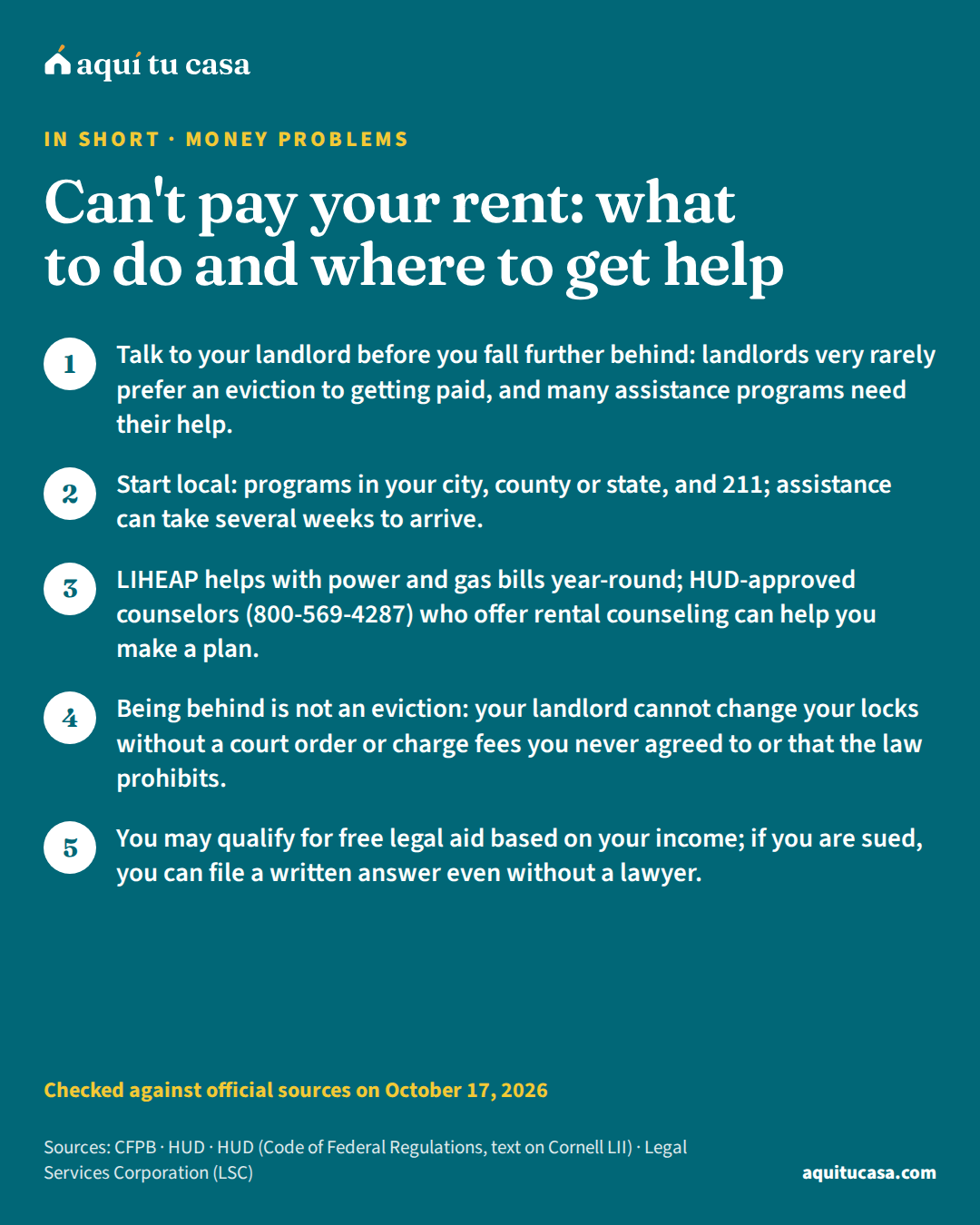
- Talk to your landlord before you fall further behind: landlords very rarely prefer an eviction to getting paid, and many assistance programs need their help.
- Start local: programs in your city, county or state, and 211; assistance can take several weeks to arrive.
- LIHEAP helps with power and gas bills year-round; HUD-approved counselors (800-569-4287) who offer rental counseling can help you make a plan.
- Being behind is not an eviction: your landlord cannot change your locks without a court order or charge fees you never agreed to or that the law prohibits.
Is this for you?
This guide is for you if…
- You can't cover the full rent this month, or you are already behind, and you want to know what to do before a notice arrives.
- You are looking for help with rent or utility bills and don't know where to start.
- You want to offer your landlord a payment plan and don't know what to ask for.
Get direct help first if…
- You already have court papers or an eviction order: start with the guide on what to do if you get an eviction notice and call a free legal aid office today.
- Your landlord already changed the locks or cut off your water or power: read the guide on illegal lockouts.
- Your question is whether asking for help affects your immigration case: this guide cannot answer that; a Justice Department accredited representative or a legal aid office can review your case.
Rent is due and the money isn’t there. It happens to many families, and there are usually more ways out than it seems. This guide is for anyone who does not yet have an eviction order: it explains how to talk to your landlord, where to look for help with rent and utility bills, what has to happen before anyone can remove you from your home, and where to find free legal aid. Everything comes from what the CFPB and HUD publish and, as examples of how a state handles it, the California and New York Attorneys General.
First: being behind is not an eviction
If you are having trouble paying rent, you are not alone, the CFPB says. As a renter you have local, state and federal rights, and some of them may help you stay in your home and postpone an evictionevictionEviction is the legal process a landlord uses to get back a rented home when the tenant does not want to leave. The most common reasons are unpaid rent, serious lease violations or a lease that has ended. First the landlord must give you written notice. If it is not resolved, the landlord needs a court order, and a law enforcement officer must carry out the removal. If you are sued, you have the right to file a written answer explaining to the court why you should not be evicted. The rules change by state and city.See the full definition.1 The same page warns about something worth knowing from the start: scammers target exactly the people who are looking for rental assistance.1
Falling behind does not give your landlord permission to remove you. According to the CFPB, your landlord cannot force you out by changing the locks without a court order, or demand fees or interest you never agreed to or that your state or city prohibits.5 The California Attorney General puts it plainly: the only lawful way to evict a tenant is to file a case in court and go through the legal process.10
That does not mean you can wait. The same office says to act quickly if you get an eviction notice or know you cannot afford your rent, because many legal processes affecting tenants move fast.10 What you do in the first few days matters.
Your first steps, in order
You don’t have to do everything in one day, but you do need to start early. This order follows what the CFPB and HUD recommend.
From "I can't cover it" to a plan
1. Run your numbers
Today
Write down what comes in, what goes out and what you can really pay this month. With that figure you can make a concrete offer.
Try it with your numbersHow much rent can I afford?2. Talk to your landlord
Before the due date, if you can
Ask whether they are willing to work with you. It is very rare for a landlord to prefer an eviction to getting paid.3
3. Call 211
The same day
From a cell phone or landline, a local specialist can tell you what help exists for rent and utility bills.2
4. Apply for local assistance
As soon as you can
Look for programs in your city, county and state. Keep the confirmation: the money can take several weeks.2
5. Ask for help with utility bills
If you also owe power or gas
LIHEAP helps year-round; the national referral line is (866) 674-6327.2
6. Find someone to guide you
This week
A HUD-approved housing counselor who offers rental counseling, or a legal aid office if a notice has already arrived.2
The how much rent can I afford tool helps with the first step, and the family budget tool brings together everyone who contributes at home. The guide to a budget with several incomes explains how to plan for the week when rent is due before the paycheck lands.

How to talk to your landlord
The CFPB points out that eviction can be costly and difficult for landlords too. That is why it suggests talking about a repayment plan in addition to applying for assistance. There is a practical reason as well: many programs accept applications from both landlords and renters, and where renters can apply, they often need the landlord’s help to finish the application. Working together gives you a better chance of getting the money.4
How do you start? The CFPB recommends explaining why you want to work things out: what staying means for your family, whether you live close to work and school, what you are doing to get back on your feet. And don’t assume your landlord already knows.4 Sometimes the hardest part is just getting the conversation started.3
Bring a concrete offer. The CFPB describes these options and who they fit:
What you can offer and when it fits, according to the CFPB
Move or split the due date
Pay less for a while
Put the agreement in writing, with dates and amounts, and keep a copy with your receipts.
About late fees: your landlord cannot demand charges you did not agree to or that your state or city prohibits.5 If you are asked for a fee you don’t recognize, ask where it appears in your lease.
Where to look for rental assistance
According to the CFPB, state, tribal and local organizations distribute money to help renters struggling with rent and other bills, and they are the best place to start. You can search online for rental assistance in your city, county, state or tribal nation; ask at your town hall, city council or your representative’s office; and visit your local library or a cultural center.2
211 is the shortcut. From a cell phone or landline, a local specialist who knows the resources in your area for rent and utility bills will answer.2 If you have already lost your housing, HUD says to dial 2-1-1 and press 6 for homeless services.6
Keep two things in mind. First, timing: after you apply, the money may take several weeks to arrive.2 Second, many of the large pandemic programs have closed or stopped taking applications, although some money may still be available.3 If one program is closed, ask 211 about another.
Help with utility bills. If you also owe for power or gas, LIHEAP helps year-round through its local offices, and the National Energy Assistance Referral Hotline is (866) 674-6327.2
Longer-term help from HUD. In subsidized housing, the government pays owners to offer reduced rents to tenants with low incomes. Housing choice vouchersHousing Choice Voucher (Section 8)The Housing Choice Voucher, the program almost everyone calls Section 8, is the country's largest federal rental assistance. HUD pays rental subsidies so eligible families can afford decent, safe and sanitary housing. Local public housing agencies administer it with HUD funds. The family finds its own home on the private market; if the agency approves the unit and the tenancy, it contracts with the owner to pay part of the rent, and the family pays the rest. Waiting lists are usually long and open for limited periods.See the full definition (Section 8) can pay all or part of the rent on privately owned housing; to find out whether you are eligible, contact your public housing agencypublic housing agency (PHA)A public housing agency (PHA) is a state, county, municipal or other governmental entity or public body authorized to operate public housing or rental assistance programs. These are the agencies that locally administer the Housing Choice Vouchers (Section 8) and public housing with HUD funds: they open and manage the waiting lists, review eligibility and income, inspect units and pay the owner its share of the rent. Each county usually has one or several; your page shows the ones serving your area with their phone numbers.See the full definition.2 HUD explains that the agency decides based on your yearly income, whether you are a family, an older adult or a person with disabilities, and your citizenship or eligible immigration status.6 Your state’s page under Places lists the housing agencies in your area. If not everyone in your family has the same immigration status, the guide on rental help and public charge sums up what the rules say.

The federal reference comes from HUD’s rule for its housing programs: the tenant’s payment is set at 30% of the family’s monthly adjusted income.7 According to the Census Bureau’s American Community Survey, 51% of renter households pay 30% or more of their income on rent. The rent burden page has the numbers for your area.
Example with real numbers
How much rent weighs on a typical income
With the typical US household income and HUD's federal reference.
- Typical household income, per month
- $6,728
- Rent that fits in 30% of that income
- $2,018
- Typical US rent
- $1,413
This is an example with national Census numbers. The 30% reference comes from HUD's rule for its programs.7 With your own numbers, the tool tells you how much fits in your budget.
Run it with your numbersHow much rent can I afford?If a notice arrives: what an eviction requires
If you stay behind, you may receive an eviction noticeeviction noticeAn eviction notice, also called a notice to quit or notice to vacate, is the written letter in which the landlord demands that you leave the home within a certain time. In general the landlord must give you this notice before starting an eviction case in court. At a minimum it should say why the landlord wants you out and what you can do to avoid it, such as paying the back rent. Your state's law decides when it can be given, how it must be delivered and how much time you get. The notice is not a court order: with the notice alone, the landlord cannot remove you.See the full definition from your landlord. A notice is not a judge’s order. How many days it gives you is set by each state’s law, and some states and cities have rules that can delay an eviction while you get help; local housing counselors, legal aid and social services organizations can explain how they work.3
Notice for late rent, by state
| State | Notice for late rent |
|---|---|
| Alabama | 7 business days |
| Alaska | 7 days |
| Arizona | 5 calendar days |
| Arkansas | 3 days |
| California | 3 court days |
| Colorado | 10 days |
| District of Columbia | 10 days |
| Florida | 3 days |
| Georgia | 3 business days |
| Hawaii | 10 calendar days |
| Idaho | 3 days |
| Illinois | 5 days |
| Indiana | 10 days |
| Iowa | 3 days |
| Kansas | 3 calendar days |
| Kentucky | 7 days |
| Louisiana | 5 days |
| Maryland | 10 days |
| Massachusetts | 14 days |
| Michigan | 7 days |
| Minnesota | 14 days |
| Mississippi | 3 days |
| Montana | 3 days |
| Nebraska | 7 calendar days |
| Nevada | 7 judicial days |
| New Hampshire | 7 days |
| New Mexico | 3 days |
| New York | 14 days |
| North Carolina | 10 days |
| North Dakota | 3 days |
| Ohio | 3 days |
| Oklahoma | 5 days |
| Oregon | 10 days |
| Pennsylvania | 10 days |
| Rhode Island | 5 days |
| South Carolina | 5 days |
| Tennessee | 14 days |
| Texas | 3 days |
| Utah | 3 business days |
| Vermont | 14 days |
| Virginia | 14 days |
| Washington | 14 days |
| Wisconsin | 5 days |
| Wyoming | 3 days |
This is the general notice to pay or leave; your city may have rules that change it.3 Tap your state for the details. Source: each state's laws
New York shows how the process continues. There, the Attorney General explains that the landlord cannot take you to court for non-payment unless they first gave you a 14-day written rent demand; that you can be legally evicted only after a court case and a judgment; and that only a sheriff, marshal or constable can carry out the order. It also says that until the warrant is carried out, you can have a non-payment case dismissed by paying all the rent you owe, and that you cannot be evicted for not paying other fees, such as late fees.9 Other states have different rules: don’t take New York’s as yours.
If you are sued, don’t give up. The CFPB says too many renters give up before they get to court. You have the right to file a written answer, even without a lawyer. If you applied for assistance and are waiting for a decision, say so: the judge may delay or dismiss the eviction because you are trying to get help.3 The guide What to do if you get an eviction notice walks through each stage, and the eviction timeline tool lays out your state’s dates.
If your landlord changes the locks, removes your belongings or cuts off utilities to make you leave, that is not a lawful eviction. The guide to illegal lockouts explains what to do that same day.

Free legal aid and housing counselors
You don’t have to pay to get guidance. The CFPB recommends talking to a lawyer if your landlord is threatening to evict you or you need help understanding your rights, and explains that you may qualify for free legal aidlegal aidLegal aid is the free civil legal help that nonprofit organizations and their lawyers provide to low-income people in civil, not criminal, matters. In housing, that includes representing families facing eviction or foreclosure, alongside matters such as custody, child support, protection from domestic violence and access to benefits. In the United States, the Legal Services Corporation, created by Congress, funds a nationwide network of these organizations; its finder points you to the one in your area. Each sets its own income limits.See the full definition based on your income, through your local bar association or a legal aid office.2 The California Attorney General adds that if you cannot afford a lawyer, you may qualify for free or low-cost legal aid.10
To find it, the Legal Services Corporation, created by Congress, funds civil legal aid for low-income Americans. On its site you type an address or city and it shows the nearest organization; LawHelp.org has legal information and free forms.8 The guide to free legal aid explains who qualifies.
A HUD-approved housing counselorHUD-approved housing counselorA HUD-approved housing counselor works at an agency HUD has approved to provide housing counseling: independent, expert advice customized to your situation about buying a home, renting, a missed mortgage payment, a foreclosure or credit problems. The agencies usually charge little or nothing; many serve in Spanish and offer the homebuyer education course several assistance programs require. They are not lenders or real estate agents and sell you nothing. Your county page lists the official agencies with phone numbers.See the full definition can help you find resources in your area and make a plan. Not all of them offer rental counseling, so check that it is among their services. The number is 800-569-4287.2 The guide to HUD-approved counselors explains how to choose one.
If the person collecting your back rent is your landlord’s lawyer or a collection agency, they may be a debt collector under federal law. Debt collectors cannot use unfair or deceptive practices; if you think one is, you can submit a complaint to the CFPB or call (855) 411-2372.2 The guide to debt collection explains your rights.
If this is you
You already have a voucher or live in subsidized housing
HUD says public housing residents and voucher holders who need help should contact their local public housing agency; call it early.6
You are an active servicemember
If you are taken to court, you and your dependents can ask for a pause of up to 90 days; talk with your Legal Assistance Office.3
You are facing violence at home
If you are in danger, call 911 or 1-800-799-7233.6 Federal law may protect you from eviction or losing your subsidy because of violence committed against you.5
Your family has mixed immigration status
211 and local programs can tell you what each one asks for. For public housing and vouchers, HUD looks at citizenship or eligible immigration status.6 For your own case, talk with an accredited representative or legal aid.
Costly mistakes
Mistake: Waiting for your landlord to contact you.
Instead: Reach out first: landlords very rarely prefer an eviction to getting paid.3
Mistake: Applying for assistance only after the lawsuit arrives.
Instead: Apply at the first missed payment: the money can take several weeks.2
Mistake: Paying someone who promises to get you assistance.
Instead: Scammers target people seeking that help; apply directly to the program or through 211.1
Mistake: Accepting fees that aren't in your lease.
Instead: Your landlord cannot charge fees you did not agree to or that your state prohibits.5
Mistake: Skipping court because you don't have a lawyer.
Instead: You can file a written answer on your own, and you may qualify for free legal aid.3

What to do this week
- Work out how much you can pay this month and write an offer with dates and amounts.4
- Talk to your landlord and ask whether they are willing to work with you.3
- Call 211 and apply for assistance in your city, county or state; keep the confirmation.2
- If you owe power or gas, call LIHEAP at (866) 674-6327.2
- If a notice arrives, call a free legal aid office or a housing counselor at 800-569-4287.2
Your income
Let's do the math
Rent that fits your budget (30% of income)
$2,018
With an income of $6,728 a month. Up to $3,364 would already be a severe burden (50% of income).
Compared with HUD’s Fair Market Rent in the United States
- 2 bedrooms$1,750Fits · 26%Needs $33.65 an hour
The wage needed pays that rent without going over 30% of income, working 40 hours a week all year.
The typical rent households actually pay in the United States is $1,413 a month (Census).
A reference to give you an idea. Each landlord and each program sets its own requirements.
Ready to see the numbers? Find your county here
See how this applies in your county: its loan limits, prices and rents, from the official data.
Printable checklist
Frequently asked questions
Can I be put out if I'm a month behind on rent?
Not overnight. According to the CFPB, your landlord cannot force you out by changing the locks without a court order. In the states we have verified, the law first requires a notice with its own deadline; the table in this guide shows it. Use that time to talk to your landlord and ask for help.
Where do I apply for help paying rent?
The CFPB says state, tribal and local organizations are the best place to start: look for rental assistance in your city, county and state, ask at local government offices and the library, and call 211 from any phone. A HUD-approved housing counselor can also help you find resources and make a plan.
How long does rental assistance take?
The CFPB warns that after you apply, the money may take several weeks to arrive. That is why it helps to apply early, keep your confirmation and tell your landlord. If a lawsuit has already been filed, say in your answer that you applied and are waiting for a decision.
Can I pay part of the rent?
You can offer it. The CFPB notes that some landlords accept a smaller payment for a few months as long as the agreed amount is paid each month, or a plan to repay back rent over six months to a year. Put the agreement in writing. If a notice or lawsuit already exists, the rules change by state and city: ask a legal aid office.
Can my landlord charge me late fees?
According to the CFPB, your landlord cannot demand fees, interest or other charges you did not agree to or that your state or city prohibits. Check what your lease says. In New York, for example, you cannot be evicted for not paying fees such as late fees in a non-payment case.
Is there help with power, gas or water bills?
Yes. The CFPB explains that you can get year-round help with utility bills through your local LIHEAP office or by calling the National Energy Assistance Referral Hotline at (866) 674-6327. 211 also knows the programs in your area.
Do I need a lawyer?
You don't need one to ask for help or to answer a lawsuit: the CFPB says that if you don't have a lawyer yet, you can file your answer on your own. But many landlords come to court with a lawyer, and you may qualify for free legal aid based on your income. The Legal Services Corporation helps you find the nearest office.
Sources
Every figure in this guide comes from one of these official sources. The number next to a sentence leads to the source behind it.
Each source on one line: who publishes it, its title, its address and the date we read it.
- 1. CFPB · Help for renters · consumerfinance.gov · Accessed October 17, 2026
- 2. CFPB · Get help paying rent and bills · consumerfinance.gov · Accessed October 17, 2026
- 3. CFPB · What to do if you're facing eviction · consumerfinance.gov · Accessed October 17, 2026
- 4. CFPB · Start a conversation about rent repayment · consumerfinance.gov · Accessed October 17, 2026
- 5. CFPB · Your tenant and debt collection rights · consumerfinance.gov · Accessed October 17, 2026
- 6. HUD · Helping Americans · hud.gov · Accessed October 17, 2026
- 7. HUD (Code of Federal Regulations, text on Cornell LII) · 24 CFR §5.628, Total tenant payment · law.cornell.edu · Accessed October 17, 2026
- 8. Legal Services Corporation (LSC) · I Need Legal Help · lsc.gov · Accessed October 17, 2026
See the other 2 sources
- 9. New York Attorney General · Residential Tenants' Rights Guide · ag.ny.gov · Accessed October 17, 2026
- 10. California Attorney General · Landlord-Tenant Issues · oag.ca.gov · Accessed October 17, 2026
Keep reading
Related guides
If this guide helped, these follow the same path.

Renting 14 minute read
What to do if you get an eviction notice
Notice, lawsuit and the judge's order: what you can do at each moment, where free legal help is and what federal law says about the 30-day notice.
- A paper from the landlord is not a court order: your landlord cannot force you out by changing the locks without a court order.
- You have the right to answer the lawsuit in writing, even without a lawyer; the judge may delay or dismiss the eviction if you are seeking help.
- In federally backed properties (Section 8, public housing, federally backed mortgages and others), federal law requires a 30-day notice before you can be required to leave.
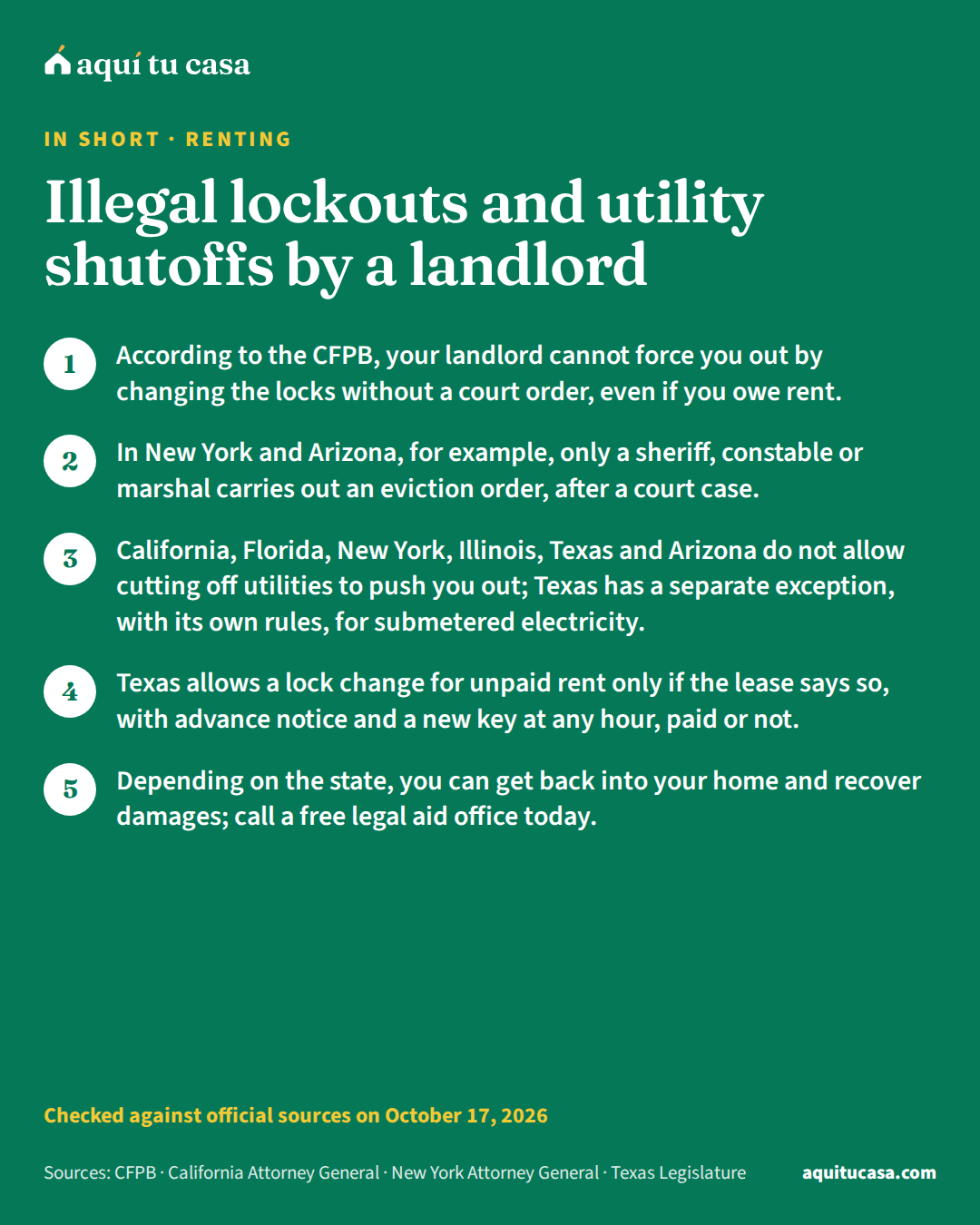
- Renting Illegal lockouts and utility shutoffs by a landlord If your landlord changed the locks, removed your things or cut off water or power to make you leave: what several states' laws say and what to do today. 12 minute read
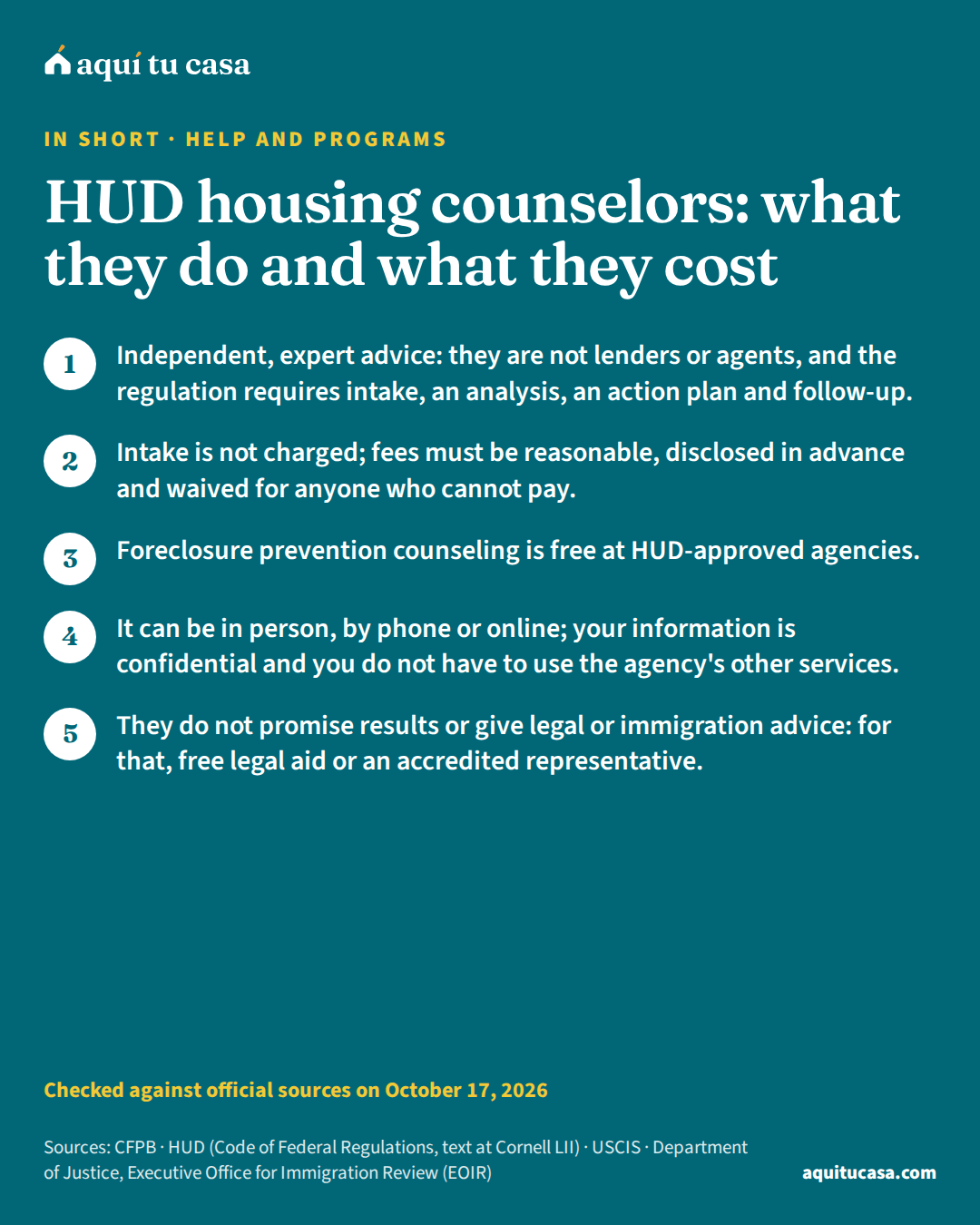
- Help and programs HUD housing counselors: what they do and what they cost What a HUD-approved housing counselor does, what they help with (buying, renting, missed payments, credit), what they may charge and how to find one. 11 minute read
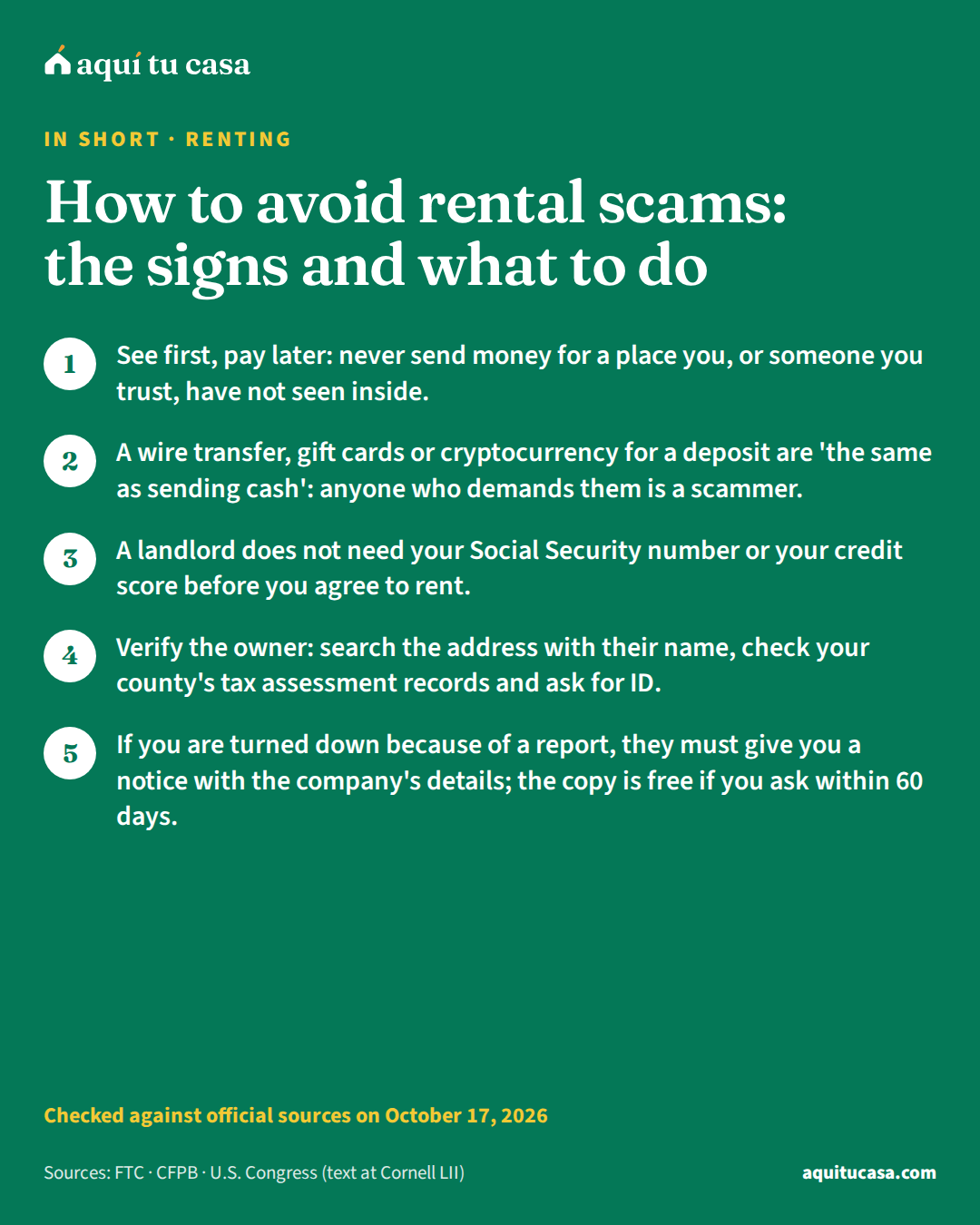
- Renting How to avoid rental scams: the signs and what to do The signs of a fake rental listing, what never to pay up front, what not to share before you sign and where to report, according to the FTC and CFPB. 12 minute read
Tools for this topic
Was this guide useful?
Thank you. Your answer stays in your browser; nothing is sent.