Rental help and public charge: what the rules say
What public charge is, what changed in September 2026, whether housing help counts, and where to find rent help and free advice.
Verified against official sources on October 17, 2026 14 official sources

Show contents
In short
What you need to know
Quick answer
Public charge is an immigration rule: when someone applies for a visa, admission or permanent residence, the government weighs whether they are likely to become dependent on it. Since September 18, 2026 a DHS rule that rescinded the 2022 rule has applied, and it says officers may consider means-tested housing assistance; help received before that date is measured under the 2022 rule. DHS says it generally does not consider benefits your family members receive, and some people, such as refugees and asylees adjusting status, are not subject to the rule. Before you decide, get free advice from an accredited representative.
What matters most
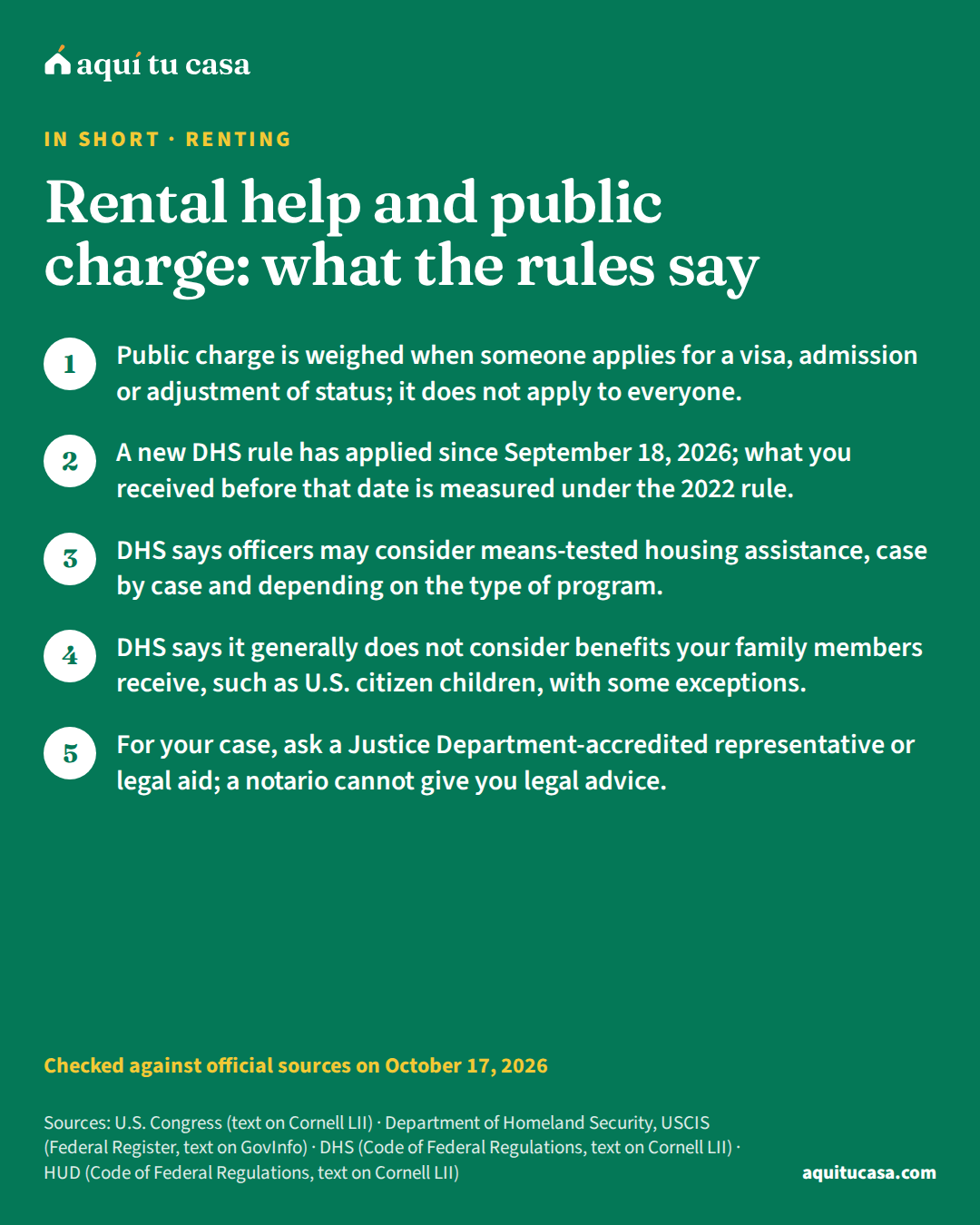
- Public charge is weighed when someone applies for a visa, admission or adjustment of status; it does not apply to everyone.
- A new DHS rule has applied since September 18, 2026; what you received before that date is measured under the 2022 rule.
- DHS says officers may consider means-tested housing assistance, case by case and depending on the type of program.
- DHS says it generally does not consider benefits your family members receive, such as U.S. citizen children, with some exceptions.
Is this for you?
This guide is for you if…
- You are struggling to pay rent and want to ask for help, but you are afraid it could affect your immigration case or a relative's.
- Your family has mixed immigration status: for example, your children are citizens and you are not.
- You heard the public charge rule changed and want to know what official sources say.
Get direct help first if…
- You already have an open immigration case or an appointment: take your questions to a Justice Department-accredited representative or a lawyer; this guide cannot say what will happen in your case.
- You got an eviction notice: start with the eviction notice guide, which covers the first steps and free legal help.
If you are struggling with rent and someone in your family is not a citizen, it is natural to wonder whether asking for help could affect an immigration case. This guide explains what “public charge” is, what changed in September 2026, what official sources say about housing assistance, and where to find help with rent and free advice. It does not predict what will happen in your case: only someone authorized, such as an accredited representativeDOJ-accredited representativeAn accredited representative is a non-attorney whom the U.S. Department of Justice, through its Recognition and Accreditation Program, authorizes to represent people in immigration matters before DHS and, with full accreditation, before the immigration courts. They may only do so through a recognized organization, which must be a non-profit, federally tax-exempt entity. It is the safe way to get low-cost immigration help: the Department of Justice publishes the official roster by state. Anyone who is not on that roster and is not a lawyer is not authorized to represent you.See the full definition, can review that.
What “public charge” is and who it applies to
Public charge is part of the Immigration and Nationality Act. It says a person is inadmissible if, in the opinion of the consular officer when applying for a visa, or of the government when applying for admission or adjustment of status (a green card), they are likely at any time to become a public charge.1
To decide, the law requires officials to consider at least five factors:1
- Age.
- Health.
- Family status.
- Assets, resources and financial status.
- Education and skills.
An affidavit of support may also be considered.1 This guide focuses on that review, which happens when someone applies for a visa, entry to the country or permanent residence, and which is the one that changed in 2026.4
What changed on September 18, 2026
On July 20, 2026, the Department of Homeland Security (DHS) published a final rule rescinding the 2022 public charge regulations. The rule took effect on September 18, 2026 and applies to applications for admission and adjustment of status submitted on or after that date. It also removes the 2022 definitions from the regulations. Means-tested benefits someone received before September 18, 2026 are measured under the 2022 rule.4
The 2022 rule and the 2026 rule
For help received before 9/18/2026
2022 rule
- Only counted cash assistance for income maintenance (SSI, TANF cash and state or local cash aid) and long-term institutional care.5
- Applying for a benefit, or receiving it only on someone else's behalf, did not count.5
- What did not count then still does not count if you received it before the change.4
For applications from 9/18/2026
2026 rule
Dates matter: what you received before September 18, 2026 is measured under the 2022 rule.4
The 2022 rule defined public charge as becoming primarily dependent on the government for subsistence, shown in one of two ways: receiving public cash assistance for income maintenance, or long-term institutional care paid for by the government.5 Under the new rule, DHS says it decides case by case. It also says it cannot ensure that a person will not be found inadmissible if they applied for, were approved for or received means-tested benefits.4
Does help with rent or housing count?
Under the 2026 rule, DHS considers all housing assistance the government provides, pays for or subsidizes, as long as it is means-tested. It does not exclude public housing or housing subsidies. Its officers will have discretion to decide how much that help weighs in your overall situation, taking the type of program into account.4
Two important details:
- What you received before September 18, 2026. DHS says benefits the 2022 rule did not consider will also not be considered if received before the new rule.4 The 2022 rule did not include housing assistance in its list: only cash assistance and institutional care.5
- Who receives the help. The rule focuses on the person applying for the visa or green card, not on family members; the next section explains.4
None of this says what will happen in your case. The decision is individual and depends on all the factors.4 That is why, before you apply for or drop a benefit, it makes sense to talk to someone authorized to review your situation.

Your citizen children and other family members
DHS says it only considers means-tested benefits received by the person themselves, not those of family members such as U.S. citizen children. There are two exceptions: the person is legally obligated to support those family members and they receive help because the person’s income is below a threshold, or the person lives off the family member’s benefits. In those cases, DHS counts it as part of the person’s assets, resources and financial status. Otherwise, it generally does not consider family members’ applications for or receipt of benefits.4
DHS also says the rule does not regulate who can receive benefits: it does not prohibit agencies from providing benefits to immigrants or any category of immigrants from receiving benefits they qualify for.4 Each program has its own eligibility rules.
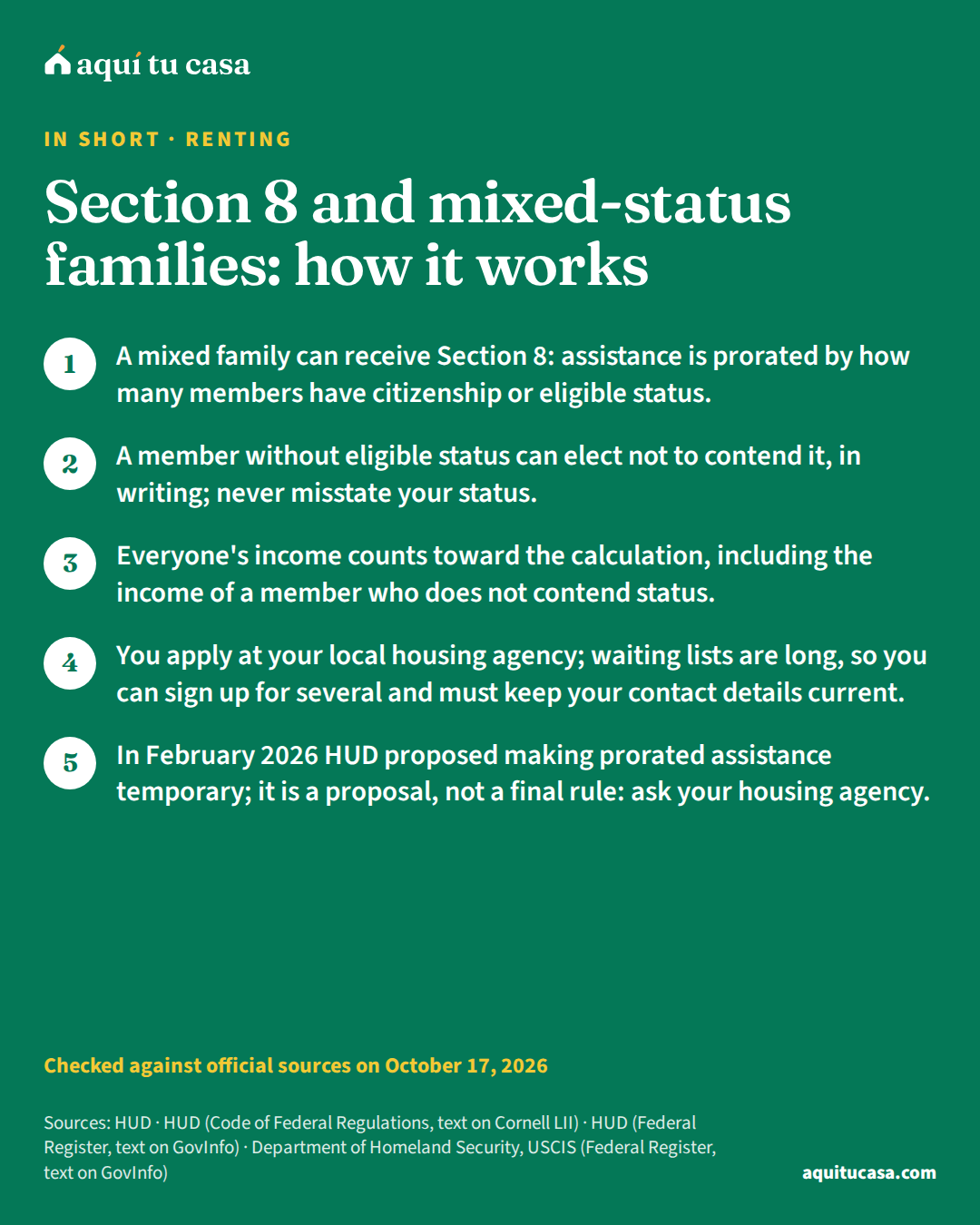
In HUD housing programs such as public housing and Section 8, assistance is limited to citizens and certain immigrants with eligible status. But a mixed family, with eligible and ineligible members, can receive help.6 The guide to Section 8 and mixed-status families explains how it is divided. HUD also published a proposal in February 2026 (not a final rule) that would change those rules.7
Who is not subject to public charge
Not everyone goes through this review. Under the law and the DHS rule, among others:
- People admitted as refugees.2
- People adjusting status as refugees or asylees.3
- VAWA self-petitioners, and people who have applied for or hold a U visa.1
- People seeking T or U visas, and certain battered noncitizens who are “qualified aliens.” DHS says their benefits are not considered when their adjustment of status is decided.4
There are more categories and exceptions. If you don’t know whether public charge applies to you, that is a good first question for an accredited representative.
Where to find help paying rent
If rent is more than you can manage, you are not alone. According to the Census Bureau’s American Community Survey, 51% of renter households pay 30% or more of their income on rent. The rent burden page has the numbers for your area.

The CFPB says state, tribal and local organizations are the best place to start. You can search online for rental assistance in your city, county and state, ask at local government offices or visit your library or a cultural center. 211 helps you find local resources. After you apply, the money may take several weeks. For utility bills there is LIHEAP, at (866)-674-6327.8
For longer-term help, HUD has subsidized housing and housing choice vouchersHousing Choice Voucher (Section 8)The Housing Choice Voucher, the program almost everyone calls Section 8, is the country's largest federal rental assistance. HUD pays rental subsidies so eligible families can afford decent, safe and sanitary housing. Local public housing agencies administer it with HUD funds. The family finds its own home on the private market; if the agency approves the unit and the tenancy, it contracts with the owner to pay part of the rent, and the family pays the rest. Waiting lists are usually long and open for limited periods.See the full definition (Section 8). To learn whether you qualify, contact your public housing agencypublic housing agency (PHA)A public housing agency (PHA) is a state, county, municipal or other governmental entity or public body authorized to operate public housing or rental assistance programs. These are the agencies that locally administer the Housing Choice Vouchers (Section 8) and public housing with HUD funds: they open and manage the waiting lists, review eligibility and income, inspect units and pay the owner its share of the rent. Each county usually has one or several; your page shows the ones serving your area with their phone numbers.See the full definition. Some HUD-approved counseling agencies offer free or low-cost rental counseling, at 800-569-4287.8 The guide If you can’t pay your rent explains how to talk with your landlord and what to do first.

Before you decide: free, trustworthy advice
According to the Justice Department’s EOIR, only certain people can represent you in immigration matters: licensed attorneys and accredited representatives. Notarios, document preparers and immigration consultants cannot give you legal advice or tell you whether you qualify for anything; if they do, they break the law.10 The guide A notario is not a lawyer explains why.
Accredited representatives are not lawyers, but they can represent you before DHS. They work at recognized non-profit organizations, and the program exists to expand representation for low-income people.11 EOIR publishes the list of organizations and representatives by state.12
Free legal aidlegal aidLegal aid is the free civil legal help that nonprofit organizations and their lawyers provide to low-income people in civil, not criminal, matters. In housing, that includes representing families facing eviction or foreclosure, alongside matters such as custody, child support, protection from domestic violence and access to benefits. In the United States, the Legal Services Corporation, created by Congress, funds a nationwide network of these organizations; its finder points you to the one in your area. Each sets its own income limits.See the full definition is another option. LSC has a search tool for organizations near you.13 Those funded by LSC have limits on helping ineligible noncitizens, although they can take your call and refer you.14 The free legal aid guide explains other options.
How to ask for help calmly
1. Write down who receives what help
Today
For each person in your household, note what help they receive and since when. The September 18, 2026 date matters.4
2. Find out whether public charge applies to you
Before you decide
It does not apply to everyone; for example, not to people adjusting status as refugees or asylees.3
3. Find an accredited representative
This week
Look in EOIR's list by state for a recognized organization near you.12
4. Ask for rental help in the right places
As soon as possible
Start with state and local organizations or 211; the money can take weeks.8
5. Be wary of anyone who charges to help
Always
A notario or consultant cannot give you legal advice about immigration.10
If this is you
Your children are citizens and you are not
DHS says it generally does not consider benefits your family members receive, with exceptions.4 Ask an accredited representative about your case.
You will apply for a green card or visa
Since September 18, 2026, officers may consider means-tested housing assistance you receive.4 Help received before that is measured under the 2022 rule.4
You already get HUD housing help
Mixed families can receive help under HUD's rules.6 HUD published a proposal to change them; a proposal is not a final rule.7
You are facing eviction
Ask for local help or call 211 right away, because the money can take time.8 Read the eviction notice guide.
Mistakes to avoid
Mistake: Dropping your citizen children's benefits without getting informed.
Instead: DHS says it generally does not consider your family members' benefits; ask about your case before deciding.4
Mistake: Believing public charge applies to every immigrant.
Instead: It does not apply, for example, to people adjusting status as refugees or asylees3 or to people seeking T or U visas.4
Mistake: Thinking the new rule bars you from getting help.
Instead: DHS says the rule does not prohibit receiving benefits you qualify for.4
Mistake: Paying a notario to tell you whether it affects you.
Instead: Only a lawyer or an accredited representative can give you legal advice.10
Mistake: Paying someone who offers 'rental help' over the phone.
Instead: Ask for help at government offices or through 211; scammers target people who need it.9

What to do this week
- Write down what help each person in your household receives and since what date.4
- Find a recognized organization near you on EOIR’s list and ask for an appointment.12
- Bring your questions in writing: whether public charge applies to you and what happens with your family’s benefits.4
- If you are short on rent, call 211 or look for local help today.8
- If you are interested in Section 8 or subsidized housing, contact your housing agency.8
- Don’t pay anyone who promises rental help or immigration advice without being authorized.10
Your income
Let's do the math
Rent that fits your budget (30% of income)
$2,018
With an income of $6,728 a month. Up to $3,364 would already be a severe burden (50% of income).
Compared with HUD’s Fair Market Rent in the United States
- 2 bedrooms$1,750Fits · 26%Needs $33.65 an hour
The wage needed pays that rent without going over 30% of income, working 40 hours a week all year.
The typical rent households actually pay in the United States is $1,413 a month (Census).
A reference to give you an idea. Each landlord and each program sets its own requirements.
Ready to see the numbers? Find your county here
See how this applies in your county: its loan limits, prices and rents, from the official data.
Printable checklist
Frequently asked questions
What is public charge?
It is a rule in immigration law. When someone applies for a visa, admission or adjustment of status, the government weighs whether they are likely to become dependent on the government, considering at a minimum their age, health, family status, assets and resources, and education and skills.
Will asking for rental help affect my immigration case?
We cannot say for your case. According to DHS, since September 18, 2026 its officers may consider means-tested housing assistance received by the person applying for a visa or green card, deciding case by case. Help received before that date is measured under the 2022 rule. An accredited representative can review your situation.
Do benefits my citizen children receive count?
DHS says it generally does not consider benefits received by your family members, such as U.S. citizen children. There are exceptions: if you are legally obligated to support them and they receive help because your income is below a threshold, or if you live off that help.
Does public charge apply to every immigrant?
No. The law says it does not apply, for example, to people adjusting status as refugees or asylees, people seeking T or U visas, or VAWA self-petitioners. If you don't know whether it applies to you, ask an accredited representative.
What happened to the 2022 public charge rule?
DHS rescinded it with a final rule published on July 20, 2026, which took effect on September 18, 2026. The 2022 rule only counted cash assistance and long-term institutional care. Benefits you received before September 18, 2026 are still measured under the 2022 rule.
Does the new rule bar me from getting help?
No. DHS says the rule does not regulate who can receive benefits or prohibit immigrants from receiving benefits they qualify for. But if you are subject to public charge, officers may consider certain benefits in your case.
Where can I get free advice about my case?
From a Justice Department-accredited representative, who works at a recognized non-profit organization; the list is on EOIR's website. Free legal aid is another option. A notario or consultant cannot give you legal advice.
Sources
Every figure in this guide comes from one of these official sources. The number next to a sentence leads to the source behind it.
Each source on one line: who publishes it, its title, its address and the date we read it.
- 1. U.S. Congress (text on Cornell LII) · 8 U.S.C. §1182, Inadmissible aliens (Immigration and Nationality Act §212) · law.cornell.edu · Accessed October 17, 2026
- 2. U.S. Congress (text on Cornell LII) · 8 U.S.C. §1157, Annual admission of refugees and admission of emergency situation refugees · law.cornell.edu · Accessed October 17, 2026
- 3. U.S. Congress (text on Cornell LII) · 8 U.S.C. §1159, Adjustment of status of refugees · law.cornell.edu · Accessed October 17, 2026
- 4. Department of Homeland Security, USCIS (Federal Register, text on GovInfo) · Public Charge Ground of Inadmissibility; Final Rule (91 FR 45324, FR Doc. 2026-14539) · govinfo.gov · Accessed October 17, 2026
- 5. DHS (Code of Federal Regulations, text on Cornell LII) · 8 CFR §212.21, Definitions (2022 public charge rule) · law.cornell.edu · Accessed October 17, 2026
- 6. HUD (Code of Federal Regulations, text on Cornell LII) · 24 CFR §5.506, General provisions (restrictions on assistance to noncitizens) · law.cornell.edu · Accessed October 17, 2026
- 7. HUD (Federal Register, text on GovInfo) · Housing and Community Development Act of 1980: Verification of Eligible Status; Proposed Rule (91 FR 8151) · govinfo.gov · Accessed October 17, 2026
- 8. CFPB · Get help paying rent and bills · consumerfinance.gov · Accessed October 17, 2026
See the other 6 sources
- 9. CFPB · Help for renters · consumerfinance.gov · Accessed October 17, 2026
- 10. U.S. Department of Justice, Executive Office for Immigration Review (EOIR) · Can Someone Represent You Before EOIR? · justice.gov · Accessed October 17, 2026
- 11. U.S. Department of Justice, EOIR · Recognition & Accreditation (R&A) Program · justice.gov · Accessed October 17, 2026
- 12. U.S. Department of Justice, EOIR · Recognition and Accreditation (R&A) Roster Reports · justice.gov · Accessed October 17, 2026
- 13. Legal Services Corporation (LSC) · I Need Legal Help · lsc.gov · Accessed October 17, 2026
- 14. LSC (Code of Federal Regulations, text on Cornell LII) · 45 CFR §1626.3, Prohibition (restrictions on legal assistance to aliens) · law.cornell.edu · Accessed October 17, 2026
Keep reading
Related guides
If this guide helped, these follow the same path.

Renting 11 minute read
How to rent without a Social Security number or credit
What a landlord can ask for, what to offer instead of an SSN and credit, how much rent fits your income and your rights if you are turned down.
- Each landlord decides what to ask for: ask what they accept instead of a Social Security number and a credit history.
- Without credit, your file speaks for you: photo ID, proof of income, bank statements and references.
- If a report gets you rejected or asked for a cosigner or a bigger deposit, they must name the company; the copy is free if you ask within 60 days.
- Renting Section 8 and mixed-status families: how it works How the Section 8 voucher works, how aid is prorated in a mixed-status family, how to apply through your housing agency and what HUD proposed. 12 minute read
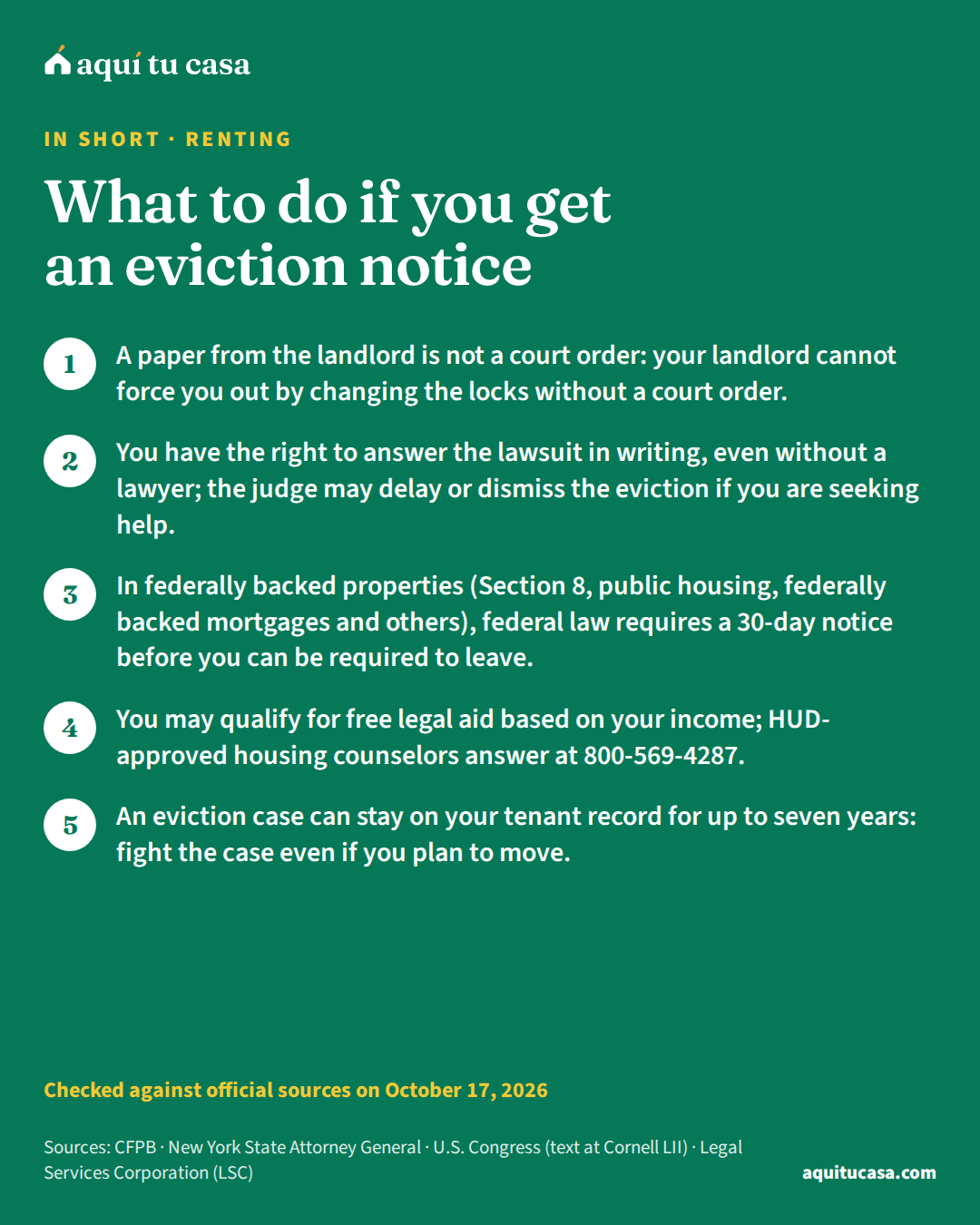
- Renting What to do if you get an eviction notice Notice, lawsuit and the judge's order: what you can do at each moment, where free legal help is and what federal law says about the 30-day notice. 14 minute read
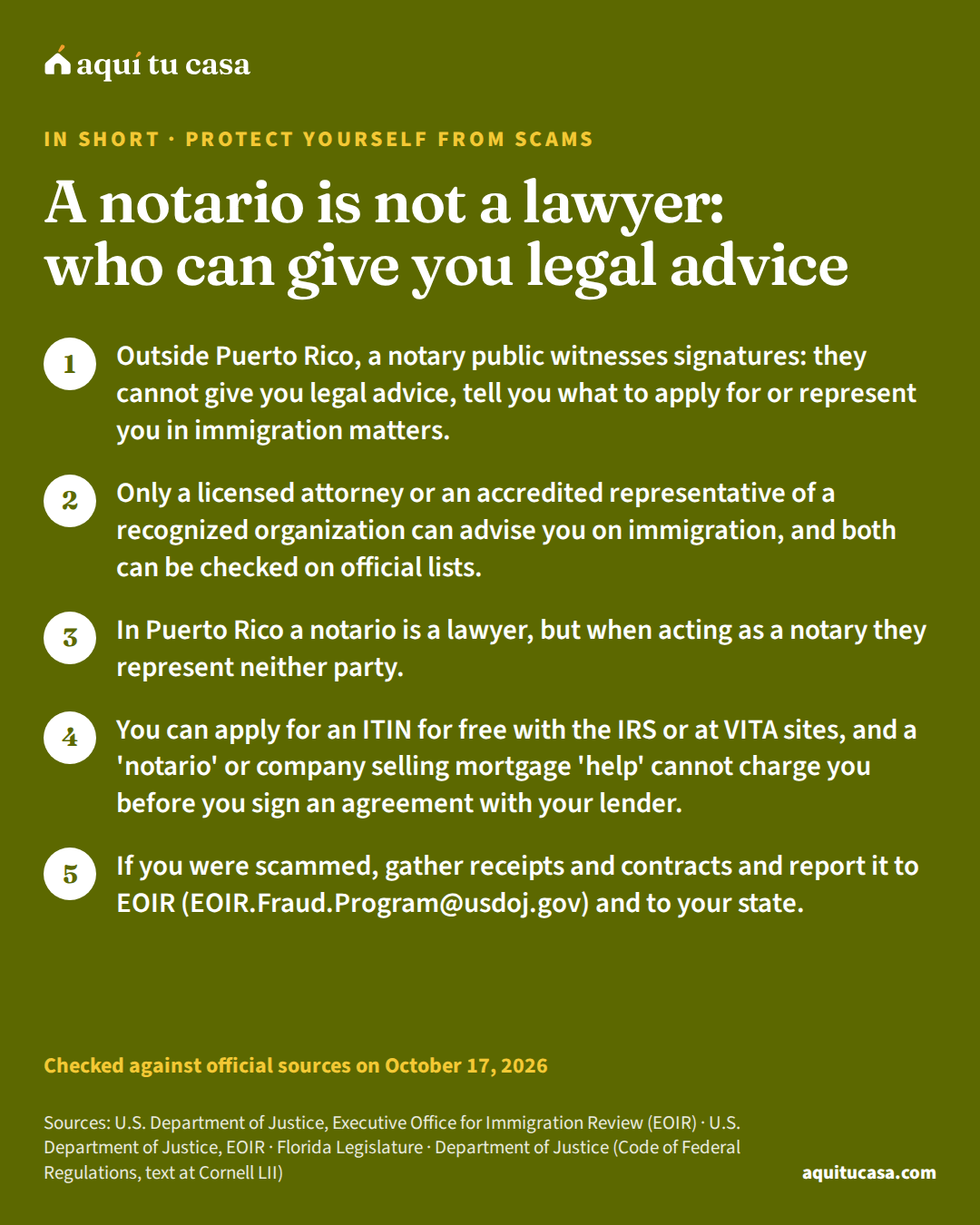
- Protect yourself from scams A notario is not a lawyer: who can give you legal advice Outside Puerto Rico, a notary public is not a lawyer. What a notary can do, who can advise you for free or at low cost, warning signs and how to report it. 12 minute read
Tools for this topic
Was this guide useful?
Thank you. Your answer stays in your browser; nothing is sent.