Section 8 and mixed-status families: how it works
How the Section 8 voucher works, how aid is prorated in a mixed-status family, how to apply through your housing agency and what HUD proposed.
Verified against official sources on October 17, 2026 17 official sources

Show contents
In short
What you need to know
Quick answer
Yes: a mixed-status family can receive a Section 8 voucher if at least one member has citizenship or eligible immigration status. The assistance is prorated: it is multiplied by the number of eligible members and divided by the total, and the family pays the rest of the rent. A member without eligible status can elect not to contend it, in writing, without submitting immigration documents. You apply at your local public housing agency, which usually has a waiting list. In February 2026 HUD proposed changing these rules; a proposal is not a final rule.
What matters most
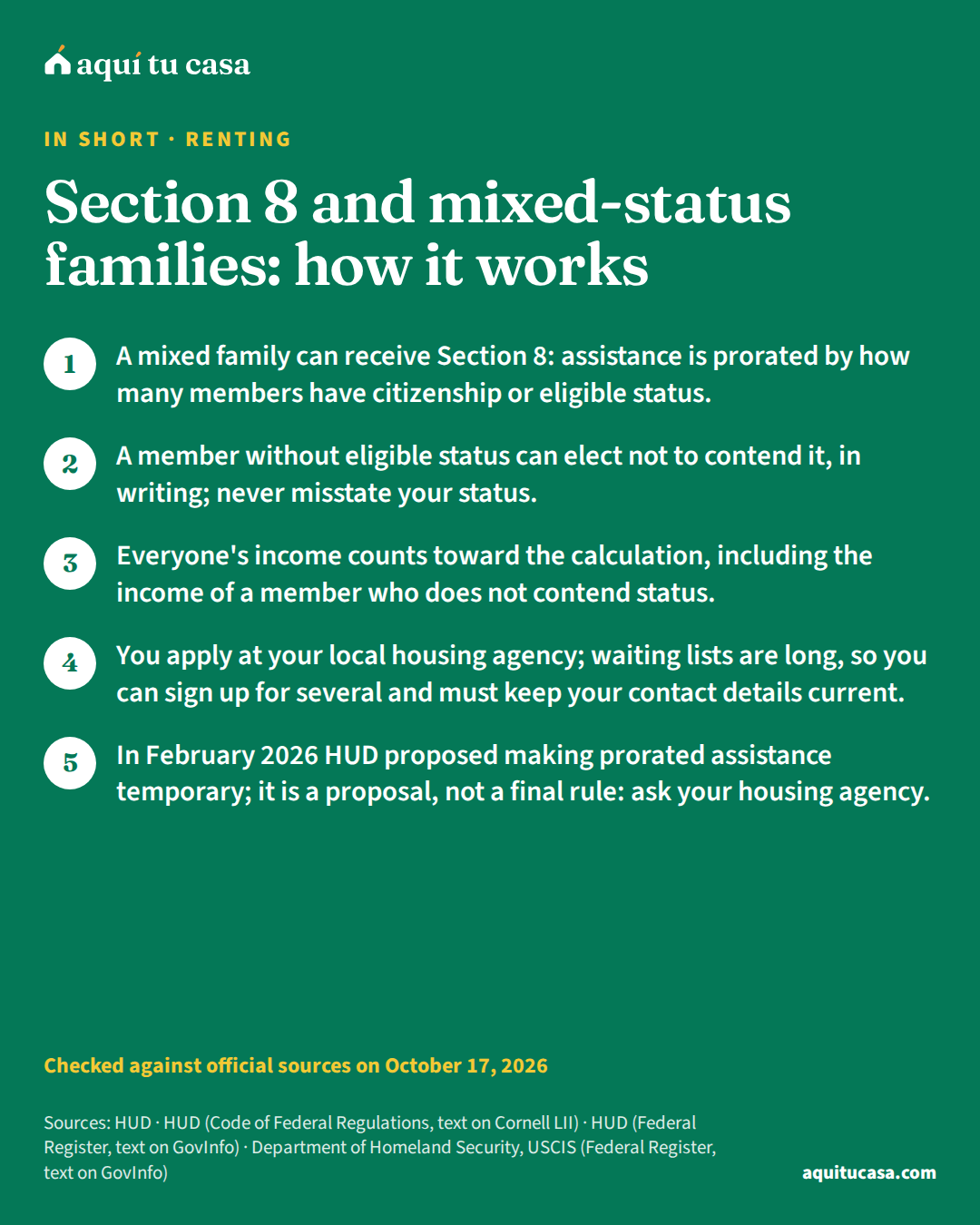
- A mixed family can receive Section 8: assistance is prorated by how many members have citizenship or eligible status.
- A member without eligible status can elect not to contend it, in writing; never misstate your status.
- Everyone's income counts toward the calculation, including the income of a member who does not contend status.
- You apply at your local housing agency; waiting lists are long, so you can sign up for several and must keep your contact details current.
Is this for you?
This guide is for you if…
- Your family has members with citizenship or eligible immigration status and others without it, and you want to know whether you can apply for a Section 8 voucher.
- You already have a voucher or live in public housing and someone in your family does not have eligible immigration status.
- You want to apply at your housing agency and understand the waiting list, the documents and the rent you would pay.
Get direct help first if…
- Your question is whether receiving housing assistance could affect an immigration case: read the guide on rental help and public charge, and talk to an accredited representative.
- The housing agency already sent you a denial or termination notice: the deadlines to ask for a review are short; look for legal aid today.
Many families have citizen children and parents without eligible immigration status, or grandparents with green cards and citizen grandchildren. This guide is for those families: it explains how the Housing Choice VoucherHousing Choice Voucher (Section 8)The Housing Choice Voucher, the program almost everyone calls Section 8, is the country's largest federal rental assistance. HUD pays rental subsidies so eligible families can afford decent, safe and sanitary housing. Local public housing agencies administer it with HUD funds. The family finds its own home on the private market; if the agency approves the unit and the tenancy, it contracts with the owner to pay part of the rent, and the family pays the rest. Waiting lists are usually long and open for limited periods.See the full definition (Section 8) works, how assistance is calculated when not everyone has eligible status, how to apply at your housing agency and what HUD proposed in 2026. It does not replace advice about your case; at the end we tell you where to get it for free.
What Section 8 is and who qualifies
According to HUD, the Housing Choice Voucher program, known as Section 8, helps low-income families, elderly people, veterans and people with disabilities afford housing in the private market. You can choose any eligible home: a house, a townhouse or an apartment. Part of the rent is covered by a subsidy paid directly to the landlord. Local public housing agencies run it with HUD funding.1
To qualify, HUD looks at annual income and family size. Generally, families must be extremely low-income or very low-income. Applicants must be citizens or eligible non-citizens as HUD defines them, and some crimes can make someone ineligible.1 The program regulations say the same about status: the family must be a citizen or have eligible immigration status under HUD’s noncitizen rules.3 To see whether your income qualifies, HUD points to its income limits for your area, and you apply at a public housing agencypublic housing agency (PHA)A public housing agency (PHA) is a state, county, municipal or other governmental entity or public body authorized to operate public housing or rental assistance programs. These are the agencies that locally administer the Housing Choice Vouchers (Section 8) and public housing with HUD funds: they open and manage the waiting lists, review eligibility and income, inspect units and pay the owner its share of the rent. Each county usually has one or several; your page shows the ones serving your area with their phone numbers.See the full definition.1
How much do you pay? The housing agency calculates your share, usually 30% of your adjusted monthly income, though it can reach 40%. It uses a “payment standard,” the most it can pay toward rent and utilities based on local rents and unit size, and pays the landlord the difference between that standard and your share. Many agencies charge a minimum rent, typically between $25 and $50 a month; if you cannot pay it, you can ask for a financial hardship exemption.1

What a mixed-status family is
HUD’s regulations call a family a “mixed family” when some members have citizenship or eligible immigration status and others do not.4 Assistance in HUD programs such as Section 8 and public housing is limited to citizens and noncitizens with eligible status. A family is not eligible unless everyone has eligible status or it meets the conditions for mixed families. And a mixed family can receive one of three types of assistance.5
The most common type is prorated assistance: the help is divided according to how many members are eligible. A mixed family that asks for it must receive it. It is also available to mixed families applying for the first time, and the housing agency must offer it to eligible families.9

DHS’s 2026 public charge final rule describes it this way: under current rules, people without eligible status may live in a mixed household with relatives who receive federal housing assistance, as long as they receive no assistance themselves and the family pays a greater share of the rent.14
How prorated assistance is calculated
With a voucher, the regulations set two steps. First, the agency calculates the assistance payment before proration, as if everyone were eligible, using the income of all members, including anyone who has not established eligible status. Second, it multiplies that by a fraction: the number of members with eligible status over the total number of members. The result is your assistance. The family pays the landlord the part of the rent that assistance does not cover.10
Example with real numbers
A family of four with three eligible members
An example in words. Your figures come from your housing agency's calculation.
- Family members
- Four (mom, dad and two children)
- Members with citizenship or eligible status
- Three (dad and the two children)
- Income used in the calculation
- All four members' income, including mom's10
- Assistance before proration
- What they would get if all four were eligible
- Prorated assistance
- Three quarters of the assistance before proration10
The family pays the rest of the rent. Your base share is usually 30% of adjusted monthly income.1 Use the calculator to see how much rent you can afford on your income.
Run it with your numbersHow much rent can I afford?Because assistance drops with each ineligible member, the family’s share goes up. That is why it helps to know, before you move, how much you would pay. Ask your housing agency to show you the calculation.
What documents each member provides
Each family member, regardless of age, provides something different depending on their situation:6
Contending eligible status or not
Counts toward assistance
Member who declares citizenship or eligible status
Never claim a status you don't have: anyone who intentionally misrepresents status must repay the assistance and may face prosecution.12
The declaration is signed under penalty of perjury. For each child, an adult in the household responsible for the child signs it.6 If a document is temporarily unavailable, you can ask for an extension of up to 30 days, and the agency must answer in writing.6
On the Social Security number: the regulations require the number of the applicant and of each member, with documentation, but say that rule does not apply to people who do not contend eligible status.11 HUD’s page for tenants says the head of household must have a valid Social Security number.1 If your head of household has no number, ask your housing agency how it applies this, and get legal help if your application is denied.

How to apply and the waiting list
From the first step to the keys
1. Find your housing agency
Today
You apply at your local public housing agency. You don't have to live in its area, but it may require you to live there for the first 12 months.1
2. Check whether the waiting list is open
When it opens
When it opens, the agency must publish where and when to apply. You can sign up for several lists.2
3. Turn in documents and declarations
When you apply
Income, bank information, other assistance and proof of citizenship or status for those who declare it.1
4. Keep your details current
While you wait
Report any change of address, phone number or household size; otherwise you may be removed from the list.1
5. Briefing and voucher
When you are selected
After your documents are verified, you attend a briefing and receive the voucher, with 60 to 120 days to search.1
6. Inspection and lease
When you find a home
You complete the Request for Tenancy Approval (RFTA), the agency inspects and reviews the rent, and you, the landlord and the agency sign.1
Reaching the top of the list depends on how many vouchers there are, when you applied and the preferences you marked, such as being a veteran or having a disability.1 When an agency decides its list has enough families, it may stop accepting applications.2
The housing agency pages by state help you find yours: Arizona, California, Florida, Illinois, New Jersey, New York, North Carolina and Texas. For other states, start at places.
To see what the voucher pays in your county, open its page in places and go to “Section 8.” It has HUD’s fair market rent by size and by ZIP code, the payment-standard range and the housing agencies based in the county. For example: Section 8 in Los Angeles County.
Your rights if assistance is denied or reduced
If the agency denies your application, it must tell you promptly and in writing, with the reasons and how to ask for an informal review.3 HUD says you typically have 10 to 14 days to ask in writing.1
When the issue is immigration status, the regulations add protections. Assistance cannot be delayed, denied, reduced or terminated because of a member’s status while verification of timely submitted documents is unfinished, while an appeal is pending, or if assistance is already prorated. You have 30 days to appeal the verification result and can ask for an informal hearing, with an interpreter and someone to represent you.8
If you cannot resolve a problem with your housing agency, HUD suggests calling the PIH Customer Service Center at (800) 955-2232.1
HUD’s 2026 proposal
On February 20, 2026, HUD published a proposed rule. It would require verifying the citizenship or eligible status of all applicants and recipients regardless of age, and would make prorated assistance only temporary while everyone is verified, instead of letting it continue indefinitely as now.13
The proposal would also remove the Social Security number exception for people who do not contend status. And it would require tenants in mixed families who have not submitted proof of status to do so within 90 days after a final rule takes effect.13
A proposal is not a final rule: on its own it does not change the regulations this guide explains; for that, HUD would have to publish a final rule.13 If your housing agency sends you a notice about these changes, read it calmly, write down the deadlines and get legal help.
If this is you
Your children are citizens and you don't have eligible status
Your family can receive prorated assistance; you can elect not to contend status, in writing.6 Your income counts in the calculation.10
You are a noncitizen aged 62 or older
You submit a declaration of eligible status and proof of age.6
You are on the waiting list
Report any change of address, phone number or household size so you are not removed from the list.1
Someone in your family will apply for a green card
DHS says it generally does not consider family members' benefits, with exceptions.14 Read the public charge guide and get advice about your case.
Mistakes that can cost you your assistance
Mistake: Claiming a status you don't have to get more assistance.
Instead: Elect not to contend, in writing; misrepresenting status means repaying the assistance and possible prosecution.12
Mistake: Not reporting a change of address or phone number while you wait.
Instead: Report every change to the housing agency; otherwise you may be removed from the list.1
Mistake: Letting a relative move in without approval.
Instead: Get approval first; living with an ineligible person without reporting it can end assistance for 24 months or more.8
Mistake: Missing the deadline to ask for a review.
Instead: Ask in writing as soon as you get the notice; there are usually 10 to 14 days.1
Mistake: Believing HUD's proposal is already law.
Instead: It is a proposal; ask your housing agency whether anything has changed.13
Mistake: Paying a notario to fix your immigration or housing case.
Instead: Only a lawyer or an accredited representative can give you legal advice about immigration.15

Where to get free help
For questions about your family’s immigration status, a Justice Department accredited representativeDOJ-accredited representativeAn accredited representative is a non-attorney whom the U.S. Department of Justice, through its Recognition and Accreditation Program, authorizes to represent people in immigration matters before DHS and, with full accreditation, before the immigration courts. They may only do so through a recognized organization, which must be a non-profit, federally tax-exempt entity. It is the safe way to get low-cost immigration help: the Department of Justice publishes the official roster by state. Anyone who is not on that roster and is not a lawyer is not authorized to represent you.See the full definition or a lawyer can give you legal advice; a notario or consultant cannot.15 EOIR publishes the list of recognized organizations and representatives by state.16
For a denial, a termination or a problem with your lease, free legal aidlegal aidLegal aid is the free civil legal help that nonprofit organizations and their lawyers provide to low-income people in civil, not criminal, matters. In housing, that includes representing families facing eviction or foreclosure, alongside matters such as custody, child support, protection from domestic violence and access to benefits. In the United States, the Legal Services Corporation, created by Congress, funds a nationwide network of these organizations; its finder points you to the one in your area. Each sets its own income limits.See the full definition is one option; LSC has a search tool for organizations near you.17 The free legal aid guide explains how it works.
What to do this week
- List who lives in your household and who has citizenship or eligible status.4
- Find your housing agency and ask whether its waiting list is open.2
- Gather proof of income for every adult, bank information and proof of status for those who declare it.1
- Decide calmly, and in writing, who declares status and who does not; never claim a status you don’t have.12
- Ask the agency to walk you through your prorated assistance calculation.10
- If you get a denial or change notice, request the review in writing on time and look for legal help.1
Your income
Let's do the math
Rent that fits your budget (30% of income)
$2,018
With an income of $6,728 a month. Up to $3,364 would already be a severe burden (50% of income).
Compared with HUD’s Fair Market Rent in the United States
- 2 bedrooms$1,750Fits · 26%Needs $33.65 an hour
The wage needed pays that rent without going over 30% of income, working 40 hours a week all year.
The typical rent households actually pay in the United States is $1,413 a month (Census).
A reference to give you an idea. Each landlord and each program sets its own requirements.
Ready to see the numbers? Find your county here
See how this applies in your county: its loan limits, prices and rents, from the official data.
Printable checklist
Frequently asked questions
Can a family with undocumented members get Section 8?
Yes, if at least one member has citizenship or eligible immigration status. HUD's regulations call this a 'mixed family' and say it can receive prorated assistance; the housing agency must offer it to eligible families.
How is assistance calculated for a mixed family?
The agency first calculates the full assistance using the income of all members, including anyone without eligible status. It then multiplies it by the number of members with eligible status and divides by the total number of members. The family pays the part of the rent that assistance does not cover.
Do I have to hand over immigration papers if I don't have eligible status?
Under the current regulations, a member can elect not to contend eligible status and then submits no immigration documents; the family must state in writing who elects not to contend. Misstating your status can require you to repay the assistance and lead to criminal prosecution.
Does everyone in the family need a Social Security number?
HUD's regulations require the Social Security number of the applicant and each member, but say that rule does not apply to people who do not contend eligible status. HUD's page for tenants says the head of household must have a valid number. Ask your housing agency how it applies this.
Where do I apply and how long does it take?
At your local public housing agency. If you are eligible, you usually go on a waiting list, which can be long; HUD suggests applying to several. Once you are selected and get the voucher, you have 60 to 120 days to find a home, depending on the agency.
Does getting Section 8 affect public charge?
It depends on who is applying for a visa or green card and on their case. DHS says it may consider means-tested housing assistance received by a person subject to public charge, but that it generally does not consider benefits received by family members. Read the public charge guide and talk to an accredited representative.
Are the rules for mixed families going to change?
In February 2026 HUD published a proposal that would make prorated assistance temporary and require proof of status from everyone regardless of age. A proposal is not a final rule. Ask your housing agency whether anything has changed and get legal advice if you receive a notice.
Sources
Every figure in this guide comes from one of these official sources. The number next to a sentence leads to the source behind it.
Each source on one line: who publishes it, its title, its address and the date we read it.
- 1. HUD · Housing Choice Voucher Tenants · hud.gov · Accessed October 17, 2026
- 2. HUD (Code of Federal Regulations, text on Cornell LII) · 24 CFR §982.206, Waiting list: Opening and closing; public notice · law.cornell.edu · Accessed October 17, 2026
- 3. HUD (Code of Federal Regulations, text on Cornell LII) · 24 CFR §982.201, Eligibility and targeting · law.cornell.edu · Accessed October 17, 2026
- 4. HUD (Code of Federal Regulations, text on Cornell LII) · 24 CFR §5.504, Definitions (restrictions on assistance to noncitizens) · law.cornell.edu · Accessed October 17, 2026
- 5. HUD (Code of Federal Regulations, text on Cornell LII) · 24 CFR §5.506, General provisions · law.cornell.edu · Accessed October 17, 2026
- 6. HUD (Code of Federal Regulations, text on Cornell LII) · 24 CFR §5.508, Submission of evidence of citizenship or eligible immigration status · law.cornell.edu · Accessed October 17, 2026
- 7. HUD (Code of Federal Regulations, text on Cornell LII) · 24 CFR §5.512, Verification of eligible immigration status · law.cornell.edu · Accessed October 17, 2026
- 8. HUD (Code of Federal Regulations, text on Cornell LII) · 24 CFR §5.514, Delay, denial, reduction or termination of assistance · law.cornell.edu · Accessed October 17, 2026
See the other 9 sources
- 9. HUD (Code of Federal Regulations, text on Cornell LII) · 24 CFR §5.516, Availability of preservation assistance to mixed families and other families · law.cornell.edu · Accessed October 17, 2026
- 10. HUD (Code of Federal Regulations, text on Cornell LII) · 24 CFR §5.520, Proration of assistance · law.cornell.edu · Accessed October 17, 2026
- 11. HUD (Code of Federal Regulations, text on Cornell LII) · 24 CFR §5.216, Disclosure and verification of Social Security and Employer Identification Numbers · law.cornell.edu · Accessed October 17, 2026
- 12. HUD (Code of Federal Regulations, text on Cornell LII) · 24 CFR §5.528, Liability of ineligible tenants for reimbursement of benefits · law.cornell.edu · Accessed October 17, 2026
- 13. HUD (Federal Register, text on GovInfo) · Housing and Community Development Act of 1980: Verification of Eligible Status; Proposed Rule (91 FR 8151) · govinfo.gov · Accessed October 17, 2026
- 14. Department of Homeland Security, USCIS (Federal Register, text on GovInfo) · Public Charge Ground of Inadmissibility; Final Rule (91 FR 45324, FR Doc. 2026-14539) · govinfo.gov · Accessed October 17, 2026
- 15. U.S. Department of Justice, Executive Office for Immigration Review (EOIR) · Can Someone Represent You Before EOIR? · justice.gov · Accessed October 17, 2026
- 16. U.S. Department of Justice, EOIR · Recognition and Accreditation (R&A) Roster Reports · justice.gov · Accessed October 17, 2026
- 17. Legal Services Corporation (LSC) · I Need Legal Help · lsc.gov · Accessed October 17, 2026
Keep reading
Related guides
If this guide helped, these follow the same path.

Renting 10 minute read
Rental help and public charge: what the rules say
What public charge is, what changed in September 2026, whether housing help counts, and where to find rent help and free advice.
- Public charge is weighed when someone applies for a visa, admission or adjustment of status; it does not apply to everyone.
- A new DHS rule has applied since September 18, 2026; what you received before that date is measured under the 2022 rule.
- DHS says officers may consider means-tested housing assistance, case by case and depending on the type of program.
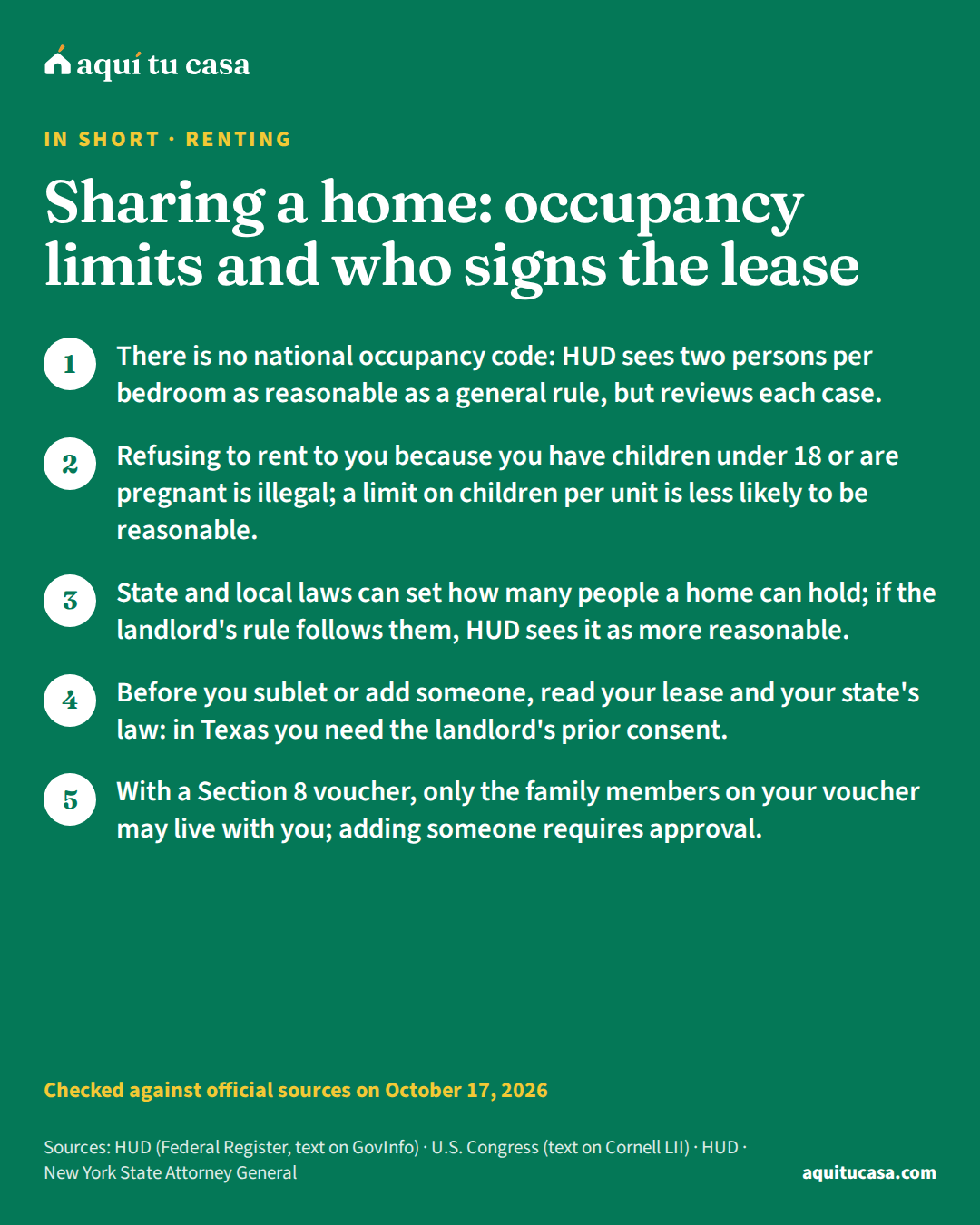
- Renting Sharing a home: occupancy limits and who signs the lease How many people can live in a home, when an occupancy limit discriminates against families with children, and what to know before subletting. 11 minute read
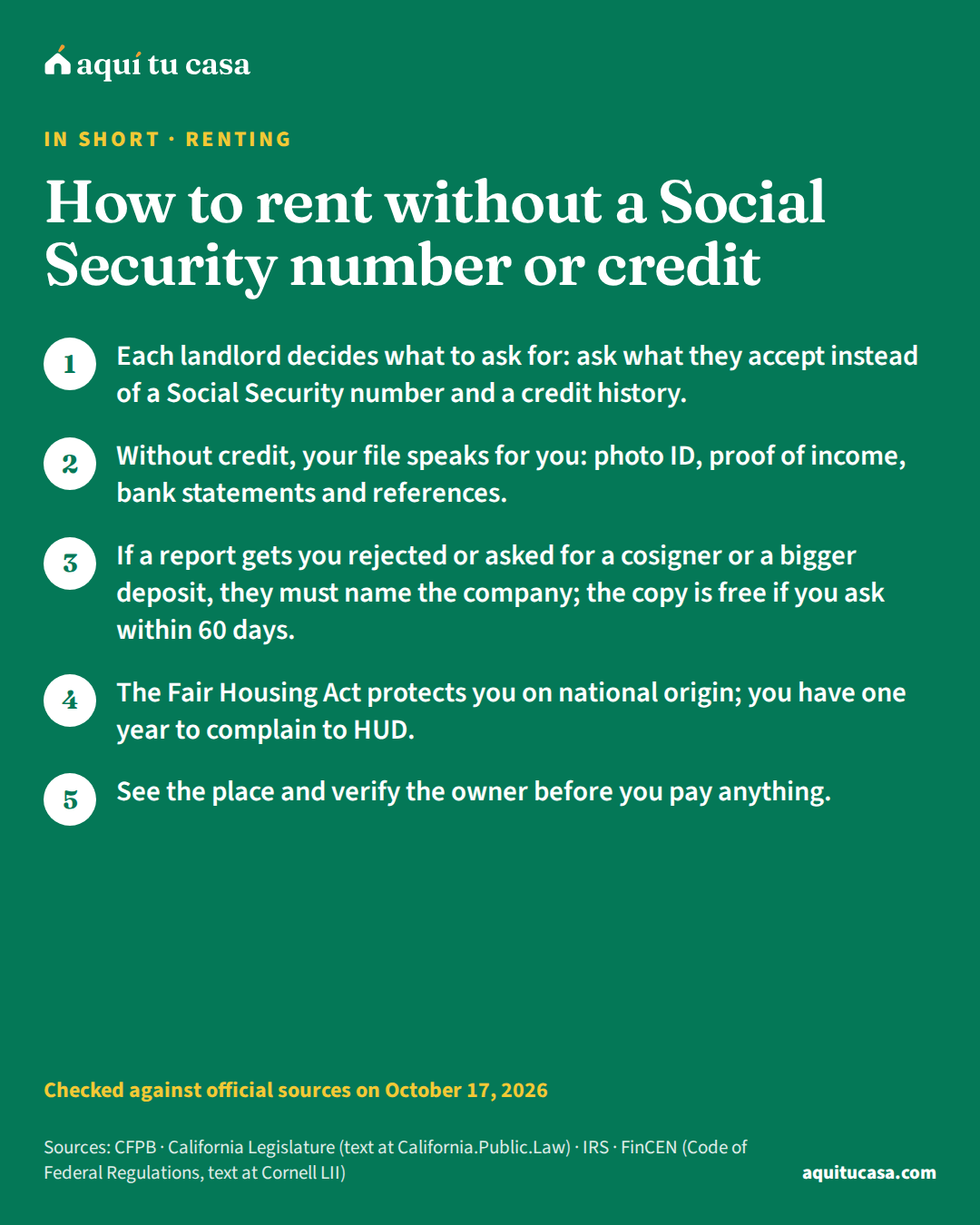
- Renting How to rent without a Social Security number or credit What a landlord can ask for, what to offer instead of an SSN and credit, how much rent fits your income and your rights if you are turned down. 11 minute read
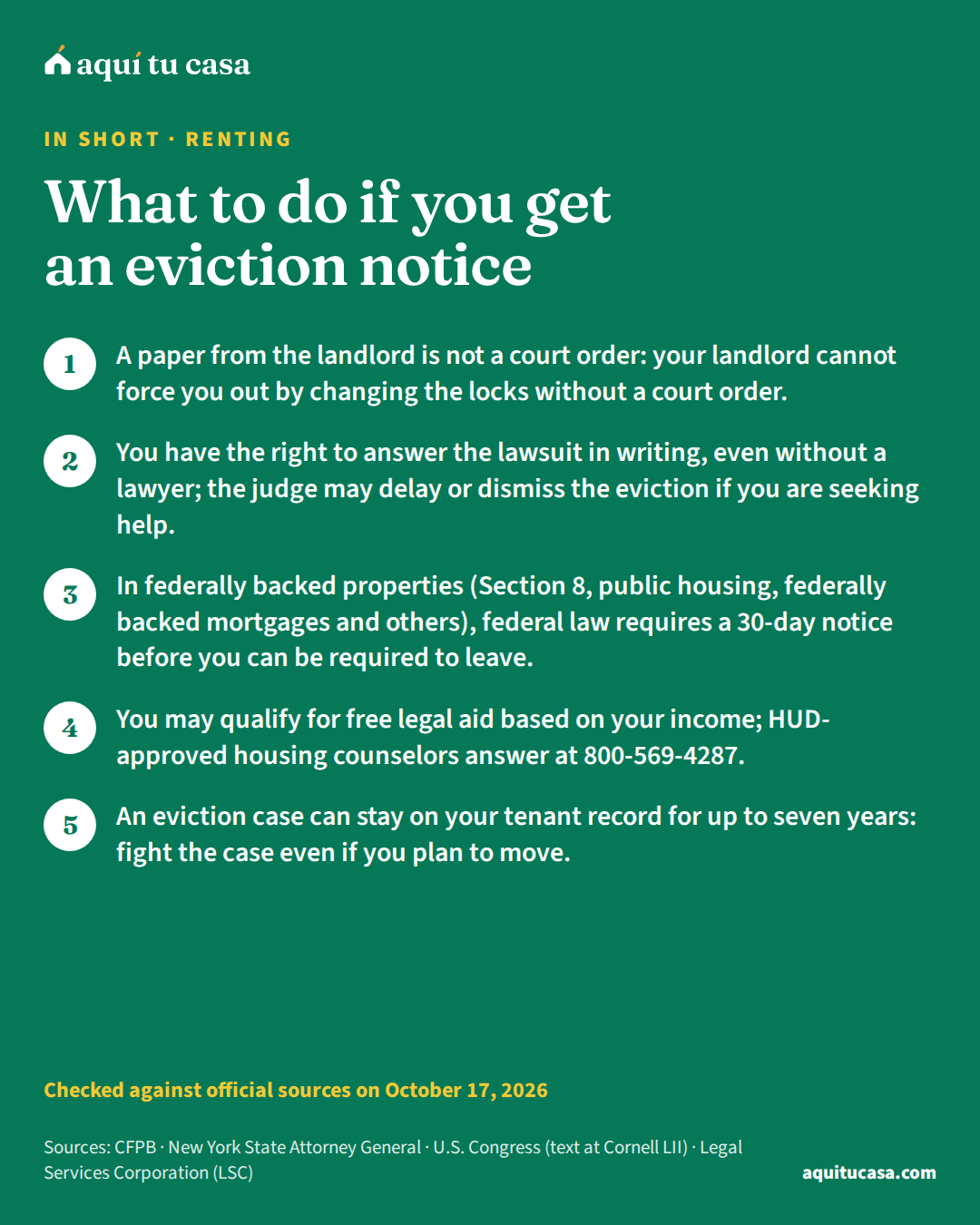
- Renting What to do if you get an eviction notice Notice, lawsuit and the judge's order: what you can do at each moment, where free legal help is and what federal law says about the 30-day notice. 14 minute read
Tools for this topic
Was this guide useful?
Thank you. Your answer stays in your browser; nothing is sent.