
How much rent can I afford?
The rent that fits your budget.
What you get → rent that fits
Someone shared this page with you.
Questions and answers
Every question our 29 guides about renting answer, grouped by guide. Each answer is the guide's own and leads to it, with its sources.
Open a question to read its answer. Each group ends with the full guide, its sources and, when it has one, its calculator.
We found no questions with those words. Try another word or open a topic.
From the guide
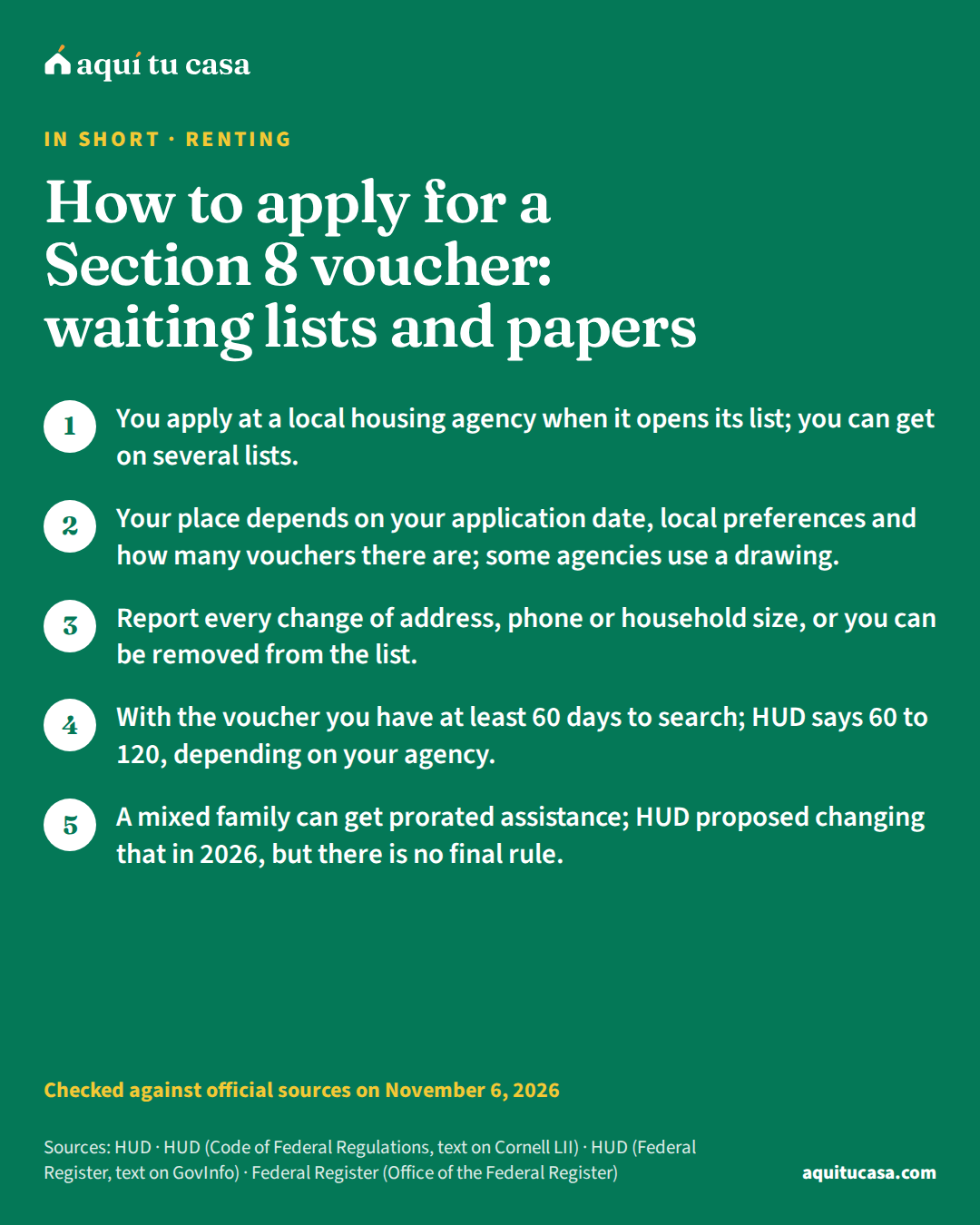
How to apply for a Section 8 voucher: where to apply, how waiting lists and preferences work, the papers you need and what changes for a mixed family.
Verified on November 6, 2026 13 official sources
Read the full guide Do the math: How much rent can I afford?
At a public housing agency. You don't need to live in its area to apply, but if you lived elsewhere when you applied, it may require you to live there for the first 12 months. HUD suggests applying to several lists because they are usually long.
Read the full guideWhen an agency opens its list it must publish a notice saying where and when to apply, in a local newspaper and through minority media. Check the agency's website and call; your county's Section 8 page lists the agencies based there.
Read the full guideIt varies by agency, but HUD says they typically ask for pay stubs, bank information, paperwork for other benefits like SSI or SNAP, and proof of citizenship and Social Security cards for those who have them.
Read the full guideIt depends on the agency. Among families with the same preference, the regulations allow selection by application date and time or by a drawing. Local preferences, such as working in the area or having a disability, are in each agency's administrative plan.
Read the full guideYes, if you don't answer when the agency asks for information or don't report a change of address or phone. If a disability is why you didn't answer, the agency must restore your place.
Read the full guideYes, if at least one member has citizenship or eligible immigration status. A member without it can choose not to contend status, in writing, and assistance is prorated. HUD proposed in February 2026 to make that temporary, but as of November 6, 2026 there is no final rule.
Read the full guideUsually yes: that is called portability. But if neither you nor your spouse lived in the agency's area when you applied, you don't have that right for the first 12 months unless the agency allows it or you are moving to protect yourself from domestic violence.
Read the full guideThe data behind these guides
The guides on Renting cite these figures. They update when their sources publish new ones; what you see here is current.
See all the dataSources: HUD (Fiscal year 2027) · U.S. Census Bureau (Average 2020–2024)
From the guide
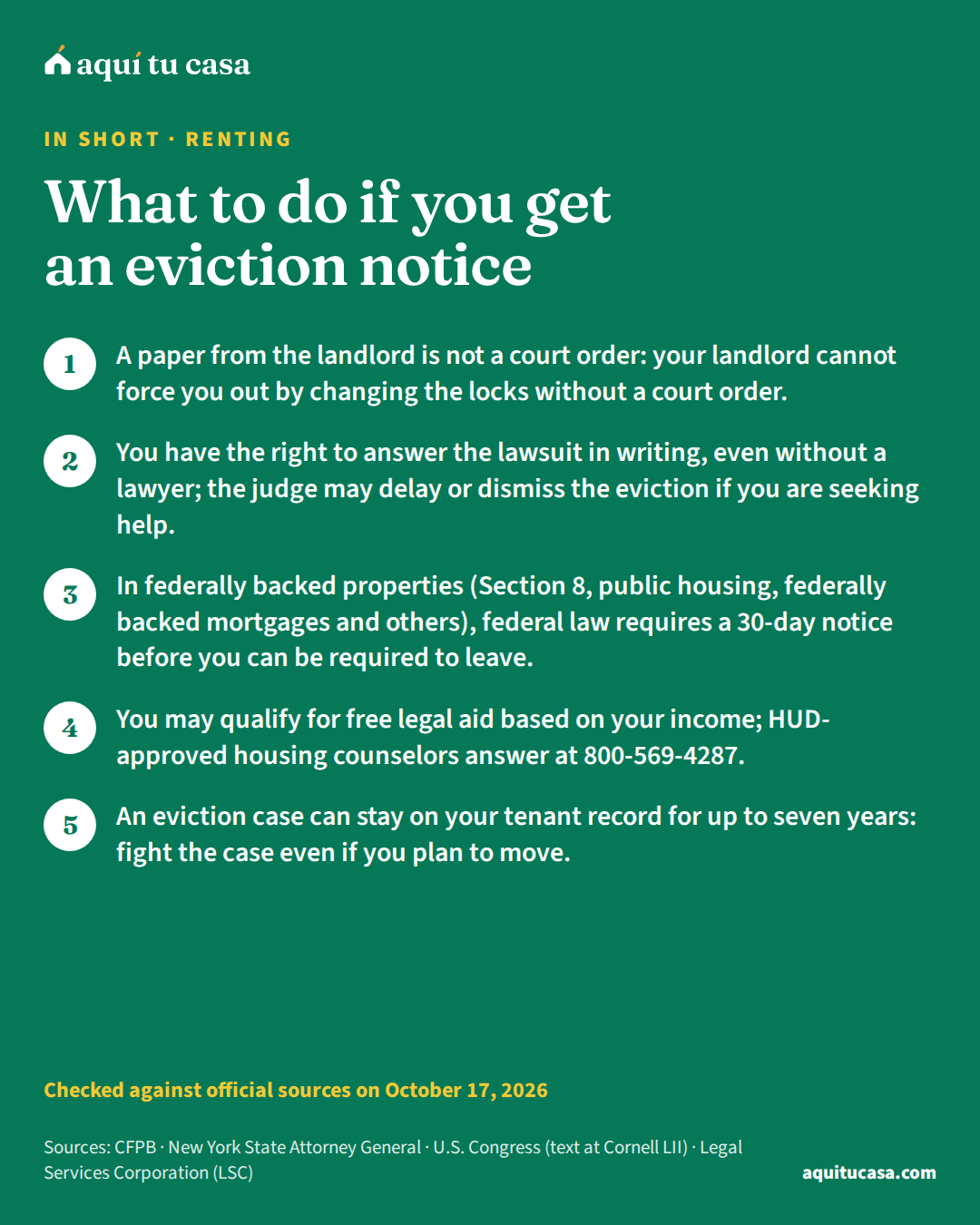
Notice, lawsuit and the judge's order: what you can do at each moment, where free legal help is and what federal law says about the 30-day notice.
Verified on October 17, 2026 12 official sources
Read the full guide Do the math: Eviction timelines by state
The notice is the first step, not the last. Your state's rules say how many days each kind of notice gives and what happens next; in general, the landlord has to file a lawsuit and a judge has to rule. Use those days to talk to the landlord, apply for assistance and call legal aid.
Read the full guideYes, go. You have the right to file a written answer even without a lawyer, and to explain your situation to the judge; ask the clerk for the date, whether there is mediation and whether the court refers people to housing counselors. The CFPB warns that too many renters give up before they go to court, and in New York, for example, an eviction notice can still be sent if the tenant does not appear.
Read the full guideA federal rule in the CARES Act for 'covered dwellings': properties in federal housing programs (such as Section 8 or public housing) or with federally backed mortgages. There, the landlord cannot require you to leave before 30 days after the notice. A legal aid office can find out whether your home is covered.
Read the full guideThe CFPB explains that your landlord cannot force you out by changing your locks without a court order. In New York, for example, only a sheriff, marshal or constable can carry out an eviction warrant. If it happens to you, call a free legal aid office today.
Read the full guideIt depends on your state and your case. In New York, for example, in a non-payment case you can have the case dismissed if you pay all the rent owed before the warrant is carried out. The CFPB also describes repayment plans with the landlord. Ask the legal aid office how it works where you live.
Read the full guideEviction court cases can appear on your tenant screening report for up to seven years, and many landlords will not rent if the report shows an eviction filing. Some states allow those records to be sealed. If the information is wrong, dispute it with the screening company and with the company that provided it.
Read the full guideThere may be. The CFPB explains that emergency rental assistance is not just for back rent: some programs help with moving costs, the deposit and application fees for a new home. Many have closed, but some money may still be available: ask your local program or a housing counselor.
Read the full guide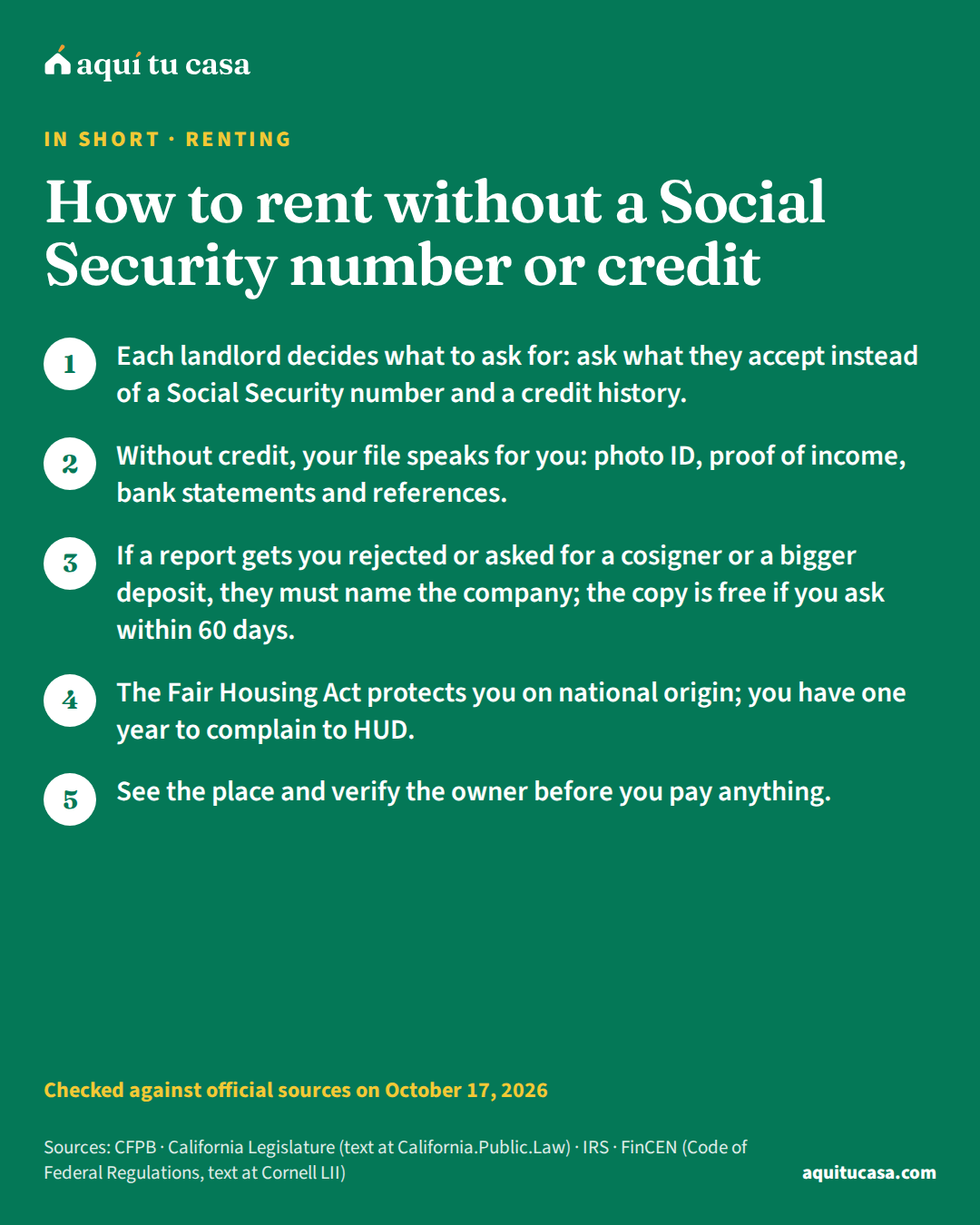
From the guide
What a landlord can ask for, what to offer instead of an SSN and credit, how much rent fits your income and your rights if you are turned down.
Verified on October 17, 2026 17 official sources
Read the full guide Do the math: How much rent can I afford?
It depends on the state. In California, the law prohibits a landlord from asking about your immigration status or requiring you to state it, but allows them to request documents to verify your identity and ability to pay. Nationwide, the Fair Housing Act prohibits refusing to rent to you because of your national origin. If you think you were treated differently because of your origin, keep the messages and find free legal aid.
Read the full guideAn ITIN is a number for federal taxes: the IRS says it does not serve as identification outside the tax system. Also bring photo ID, such as your passport or consular ID, and ask the landlord what they accept to check your history.
Read the full guideThe federal reference is 30% of monthly income: above that, rent weighs; at 50% or more, it weighs a lot. With the typical US household income ($6,728 a month), that comes to $2,018. The how-much-rent calculator does it with your income.
Read the full guideAccording to the CFPB, many landlords use the tenant screening report to decide how much to charge for the deposit. If you are asked for a larger deposit than other applicants because of what a report says, that is an adverse action: they must give you the notice naming the company that made the report. How large the deposit can be is set by your state's law.
Read the full guideDeposit your money in an account so your bank statements show it: the federal rule lets a bank identify you with your ITIN, your passport or another official photo document. If you file taxes, you can ask the IRS for a transcript of your return, which keeps your financial data visible for income verification.
Read the full guideThe CFPB mentions paying months of rent in advance as one of the conditions a landlord may set when your report has negative information. If you accept, ask for the lease to state how much you paid and for which months, and get a receipt for every payment. A housing counselor or a legal aid office can review it with you.
Read the full guideAsk the company that made it for a copy, review it and dispute what is wrong. The company generally has 30 days to investigate, and in some cases 45. The CFPB recommends checking your credit report before you apply, so you can fix errors in time.
Read the full guide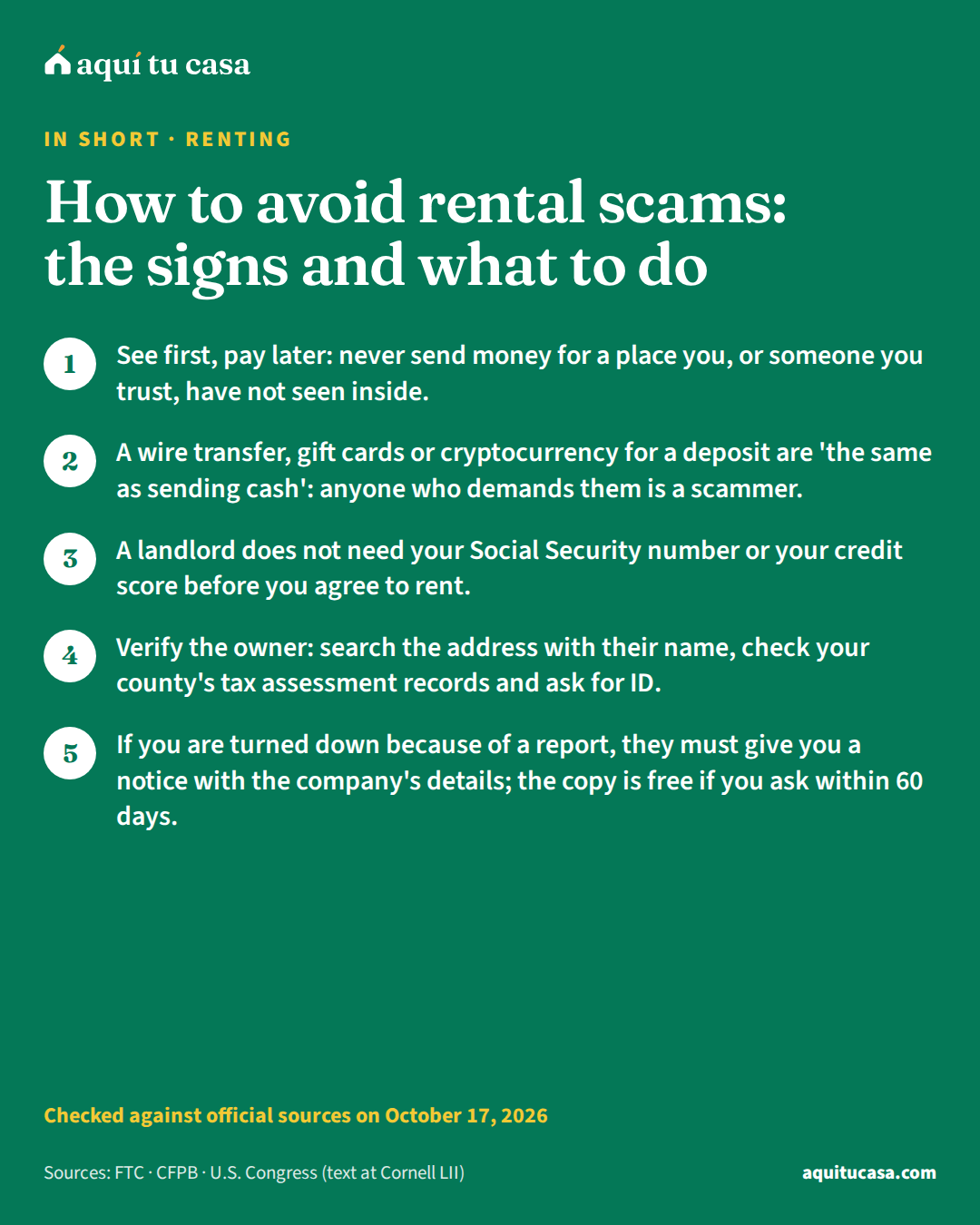
From the guide
The signs of a fake rental listing, what never to pay up front, what not to share before you sign and where to report, according to the FTC and CFPB.
Verified on October 17, 2026 15 official sources
Read the full guide Do the math: How much rent can I afford?
Search the address online together with their name, check whether the property appears on the website of the company they claim to represent, and look up your city or county tax assessment records, which show whose name the property is in. Then ask to see their ID. If they make excuses about showing you the place, walk away.
Read the full guideAsking for money up front to hold a property you have not seen is one of the most common scams the FTC reports. See the home inside and verify the owner before you sign or pay, and get a receipt for every payment.
Read the full guideNo. The FTC is clear: anyone who demands payment by gift cards, cryptocurrency, wire transfer or cash only is a scammer. Once that money is sent, you probably cannot get it back.
Read the full guideNot always, but it is a warning sign. The CFPB lists payment apps among the methods scammers use and recommends using them only with people you know and trust. If you already paid, call your bank or the app company right away and tell them there may have been an unauthorized transaction.
Read the full guideCall your bank or the payment company right away. Then report it to your local police, to the website where the ad appeared, to the FTC at ReportFraud.ftc.gov or the FBI at ic3.gov, and to your state attorney general. If you gave personal information, get your free credit reports and consider a fraud alert.
Read the full guideIt can. The CFPB explains that landlords may pull your credit report as a hard inquiry, which could lower your scores, and that this matters if you send several applications. Ask how they check credit before you apply.
Read the full guideAsk for the adverse action notice: it must name the company that made the report. Request your free copy within 60 days and dispute the errors; the company generally has 30 days to investigate. If you think you were turned down because of your origin, your family or another protected reason, you can complain to HUD.
Read the full guide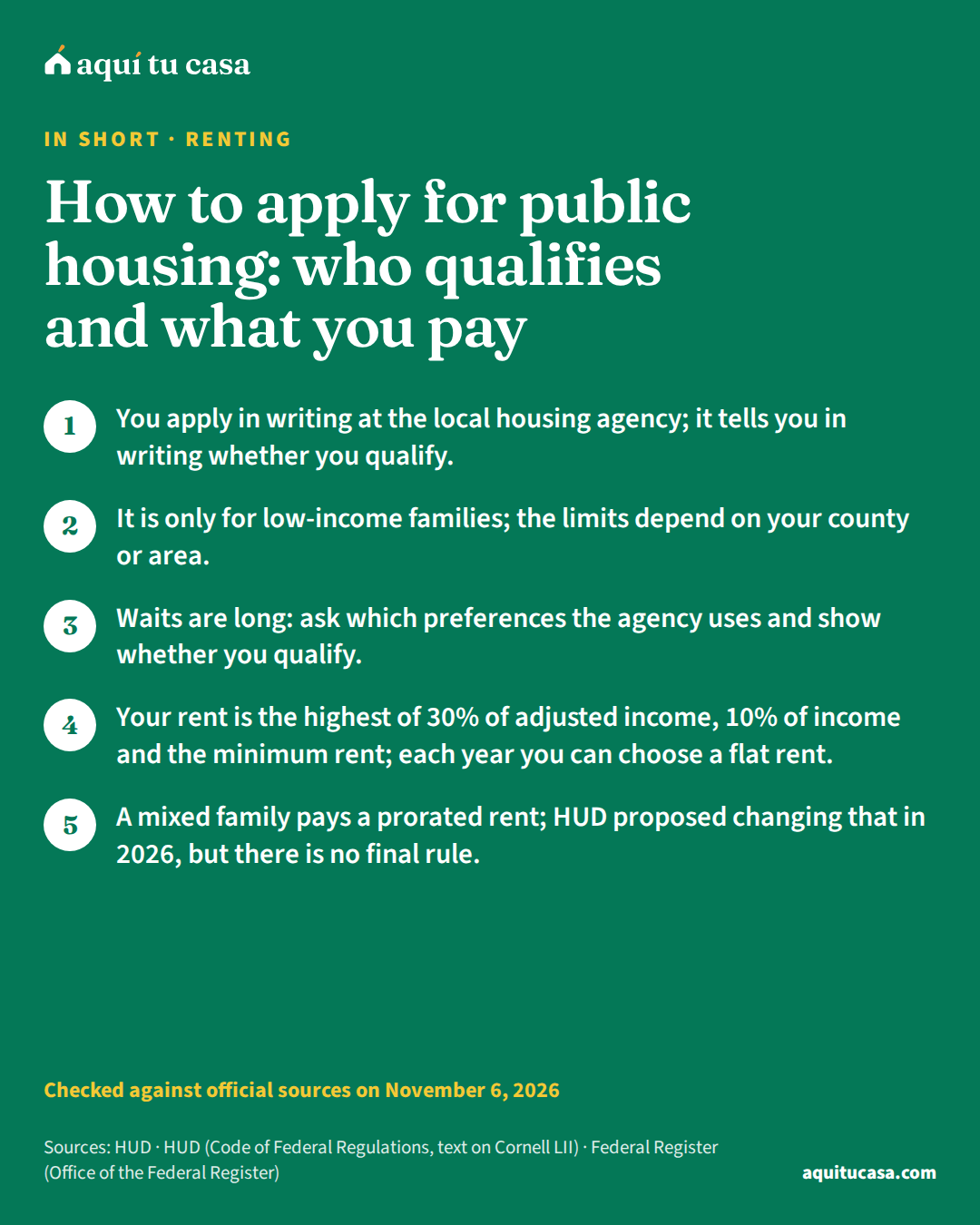
From the guide
How to apply for public housing: where you apply, who qualifies, what the application asks, waiting lists and preferences, and how your rent is set.
Verified on November 6, 2026 9 official sources
Read the full guide Do the math: How much rent can I afford?
At the housing agency that runs public housing in your city or county. If you can't reach it, HUD says to call its local field office. The application is in writing; you or an agency representative fills it out.
Read the full guideLow-income families and single people, elderly people and people with disabilities. The agency looks at your annual gross income, the kind of family and the citizenship or eligible immigration status of whoever claims it, and checks your references as a tenant.
Read the full guideIt depends on the agency. HUD says long waits are common and an agency may close its list when it has more families than it can help soon. If you qualify, the agency must give you the approximate date you could move in, if it can be determined.
Read the full guideThe highest of 30% of your adjusted monthly income, 10% of your monthly income, welfare rent if applicable, or a minimum rent of $25 to $50 set by the agency. Once a year you can choose to pay a flat rent instead of the income-based rent.
Read the full guideYes, if at least one member has citizenship or eligible status. A member without it can choose not to contend status, in writing, and the family pays a prorated rent. HUD proposed in 2026 to make that temporary; as of November 6, 2026 there is no final rule.
Read the full guideThe agency must tell you why in writing. You can request an informal hearing; ask for it soon and in writing, and look for free legal aid if you disagree.
Read the full guide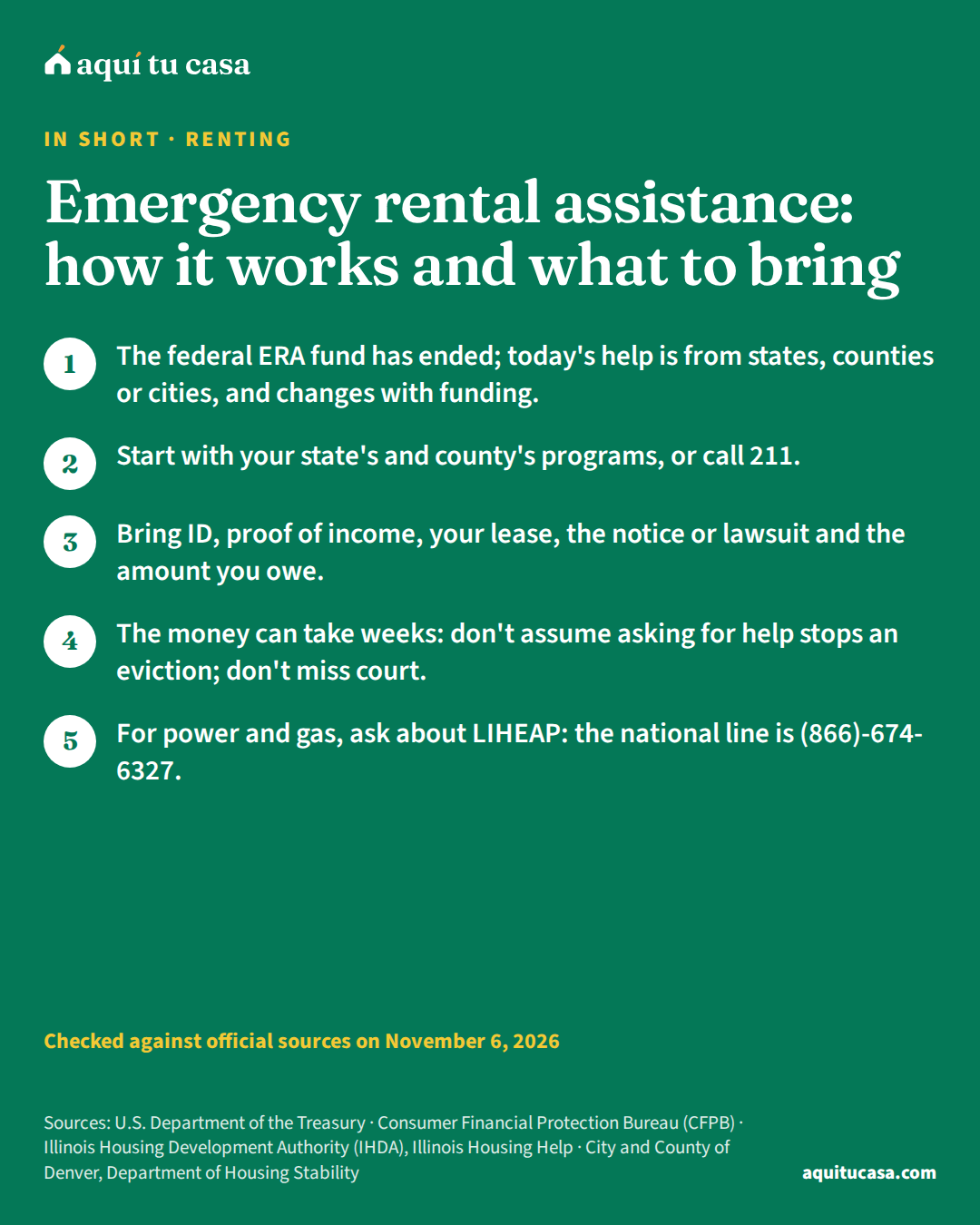
From the guide
How to get help with back rent or utility bills: who offers it today, what papers to bring, how long it takes and what to do if you have an eviction case.
Verified on November 6, 2026 7 official sources
Read the full guide Do the math: Eviction timelines by state
Treasury says the period of performance for the second round of emergency rental assistance (ERA2) has ended and the funds can no longer be used to help renters. What exists today are programs from states, counties and cities, each with its own funding and rules.
Read the full guideThe CFPB says local programs are the best place to start: look for help in your city, county and state, ask at local government offices or call 211. On our page for your state's programs, the 'Rent help' section lists the ones we checked, with what each page says about being open.
Read the full guideIt depends on the program, but they usually ask for a photo ID, proof of household income, your lease, the notice or eviction lawsuit, the landlord's letters showing what you owe and, in some programs, papers showing the crisis you went through.
Read the full guideThe CFPB says it may take several weeks to receive the money. If you have a court date, don't wait: go to the hearing, tell the judge you applied for help and look for legal aid.
Read the full guideIt depends on the program. Some say they don't require proof of citizenship, like Illinois's program for eviction cases; others say their funding may require verifying citizenship or status, like Maricopa County's. Ask before you apply, and if your question is about immigration, talk to an accredited representative.
Read the full guideIt depends on the program. For example, New York City says you may be required to pay back some or all of its emergency assistance. Always ask before you sign.
Read the full guide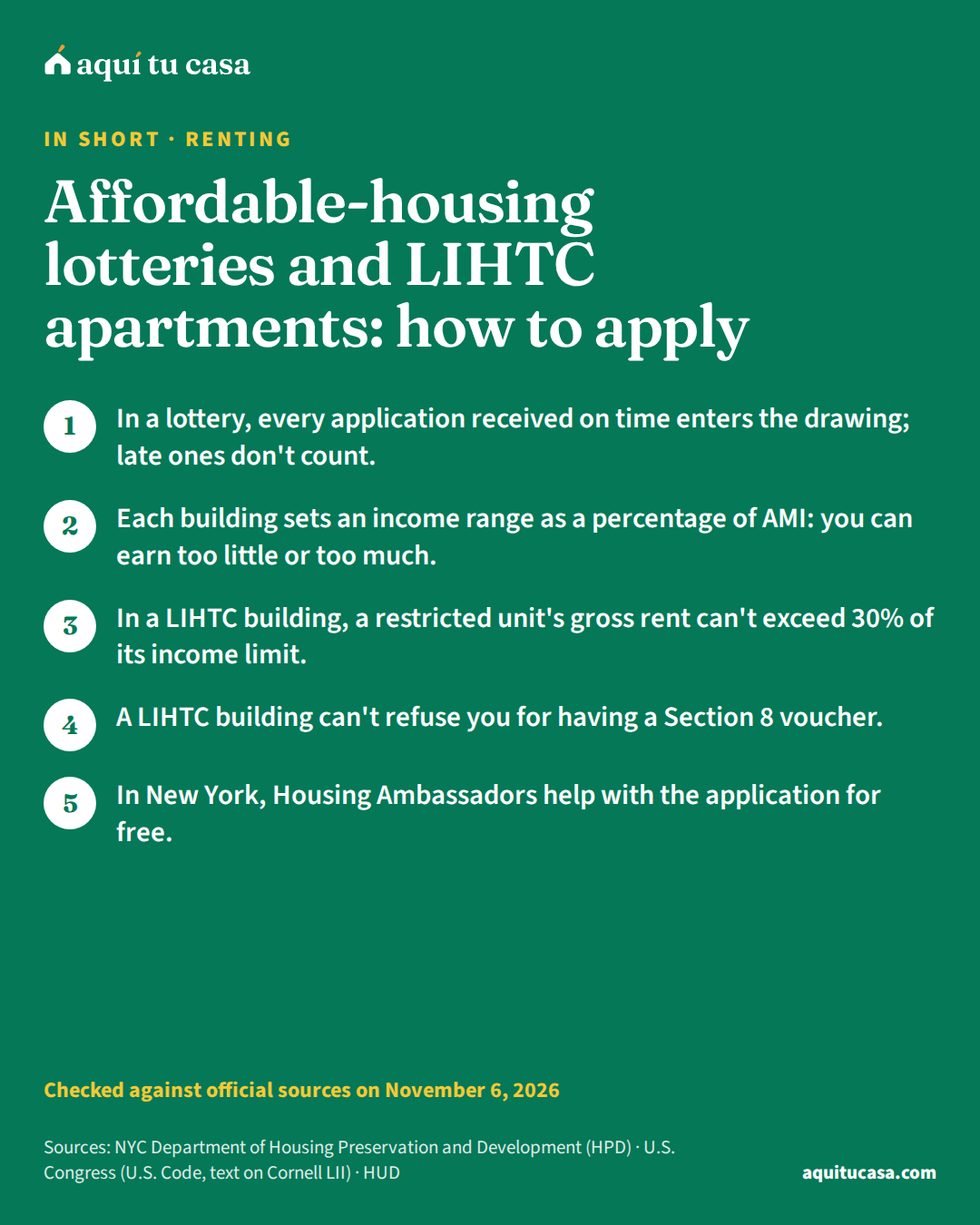
From the guide
How affordable-housing lotteries (like NYC Housing Connect) and tax-credit (LIHTC) apartments work: who qualifies, what they cost and how to apply.
Verified on November 6, 2026 6 official sources
Read the full guide Do the math: How much rent can I afford?
A drawing to assign rent-restricted apartments. In New York, HPD says that after the deadline applications are selected for review through a lottery; late applications are not considered.
Read the full guideIt depends on each building. HPD explains that affordable housing is based on a percentage of area median income (AMI) and your income must be within each opportunity's range. You can be left out for earning too little or too much.
Read the full guideAn apartment in a building that received the federal low-income housing tax credit. The law requires some of its units to be rent-restricted and reserved for people with incomes below certain percentages of area median.
Read the full guideNot for having the voucher: the law prohibits refusing to lease to a Section 8 voucher holder because they hold one. You still have to meet the building's income limit and selection criteria.
Read the full guideYou apply to NYC Housing Connect online or by mail, following the advertisement, and Housing Ambassadors help for free. If someone charges you to get into the lottery or to move you up, be wary. Some landlords charge an application fee once they review your case, according to HUD.
Read the full guideHUD has a locator for LIHTC properties. You can also ask your housing agency or your state's housing agency, and check your county's rent page.
Read the full guide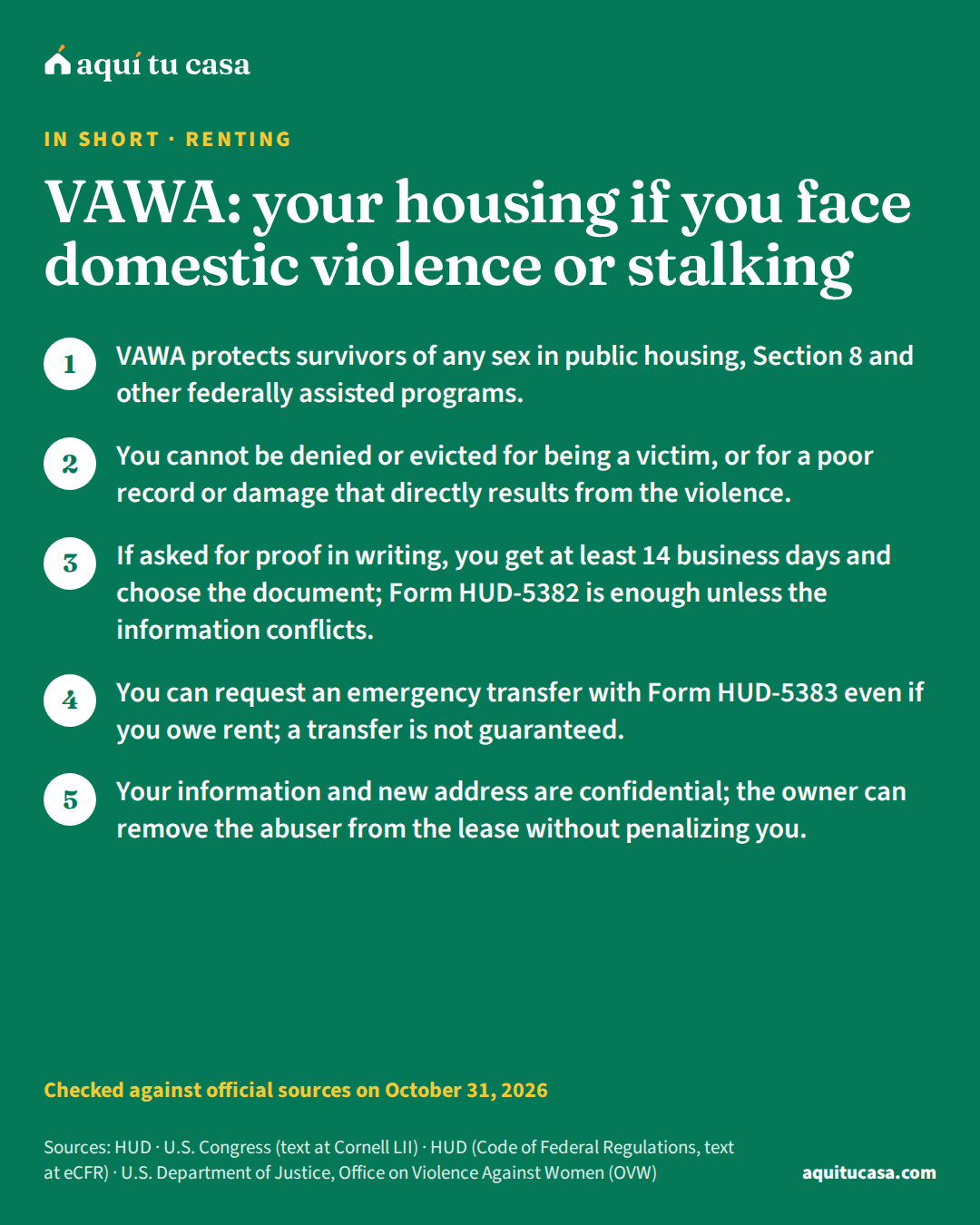
From the guide
How VAWA protects you in federally assisted housing: no denial or eviction for being a victim, Form HUD-5382 and emergency transfers to a safe home.
Verified on October 31, 2026 15 official sources
Read the full guide Do the math: Eviction timelines by state
In housing covered by VAWA, you cannot be evicted because you are a victim, and an incident of violence is not a serious lease violation. You also cannot lose your home just because of your abuser's criminal acts related to that violence. VAWA still allows eviction for other violations unrelated to the violence, as long as you are not held to a stricter standard than other tenants.
Read the full guideSometimes none: the owner does not have to ask. If they do, the request must be in writing and give you at least 14 business days. You choose the document: Form HUD-5382, a statement signed by a professional who helped you, a police or court record or, if the owner allows it, your own statement. They can ask for more only if they receive conflicting information.
Read the full guideOnly if you know it and it is safe to give. Form HUD-5382 says exactly that. It also asks for the safest way to contact you, so the owner does not leave messages where they could put you at risk.
Read the full guideYes, you can request an emergency transfer if you reasonably believe you are in danger if you stay, or if you suffered a sexual assault on the property in the past 90 days. HUD says that if you have a Section 8 voucher, you must be allowed to move with your assistance. You can ask even if you owe rent, but a transfer is not guaranteed.
Read the full guideThey must not. Everything you share about the violence is strictly confidential and does not go into any shared database. The emergency transfer plan must protect your new location, and Form HUD-5382 says the owner must keep your address strictly confidential.
Read the full guideNo. Despite the name, HUD's regulation says it protects victims regardless of sex, gender identity or sexual orientation. You do not have to be married to, related to or living with the abuser, and it does not matter how long ago the violence happened.
Read the full guideAccording to Form HUD-5380, in Section 8 and public housing, if the person removed was the only one who had established eligible citizenship or immigration status, the others get 30 calendar days to establish eligibility or find other housing. If your family has mixed immigration status, get free legal help before that time runs out.
Read the full guideIf you are in immediate danger, call 911. The Justice Department also lists the National Domestic Violence Hotline, 1-800-799-7233, and the National Sexual Assault Hotline, 1-800-656-4673, which connect you with services near you.
Read the full guideTools
The calculators these guides use. Each one leaves you with a result you can use today.
The rent that fits your budget.
What you get → rent that fits
The steps and periods of an eviction in your state.
What you get → steps and days
What your state's law says about the deposit, notices and repairs.
What you get → your state's rule, with its citation
Everything you pay before you get the keys.
What you get → move-in cash
From the guide
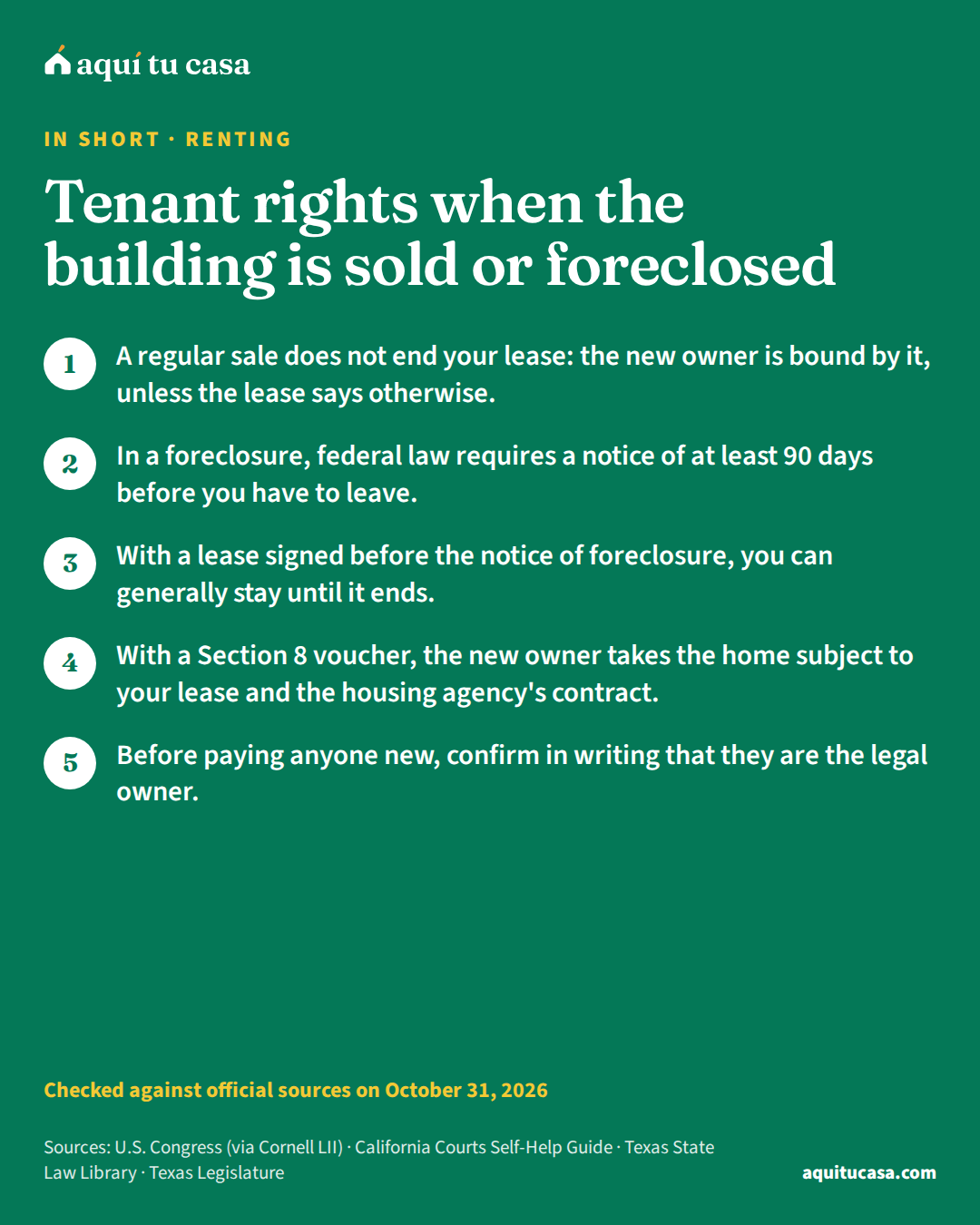
What happens to your lease, deposit and voucher if the owner sells or loses the building to foreclosure, and the federal 90-day notice.
Verified on October 31, 2026 8 official sources
Not because of the sale alone. According to the Texas State Law Library, the new owner is bound by your lease, and if the lease does not say it ends with a sale, the owner generally cannot remove you or change it. Check your lease and your state's laws.
Read the full guideUnder federal law, at least 90 days' notice to vacate. If you have a lease signed before the notice of foreclosure, you can generally stay until it ends, unless the home is sold to someone who will live in it. Your state may give you more.
Read the full guideYes. The law was set to end in late 2014, but in 2018 Congress repealed that end date and restored it.
Read the full guideYes. Federal law also requires the 90-day notice if you have no lease or one that can be ended at will, as long as you are a bona fide tenant.
Read the full guideUnder the program law, whoever takes the property in the foreclosure takes it subject to your lease and to the payments contract with the housing agency. Tell your public housing agency.
Read the full guideIt depends on your state. In Texas, after a sale the new owner is liable for the deposit and must give you a signed statement with the amount. In Florida, the deposit must pass to the new owner. In California, after a foreclosure the new owner must return it if the prior owner did not.
Read the full guideFirst confirm they are the legal owner: the California courts warn that scammers pose as owners. Ask for proof in writing and pay with a method that leaves a record.
Read the full guide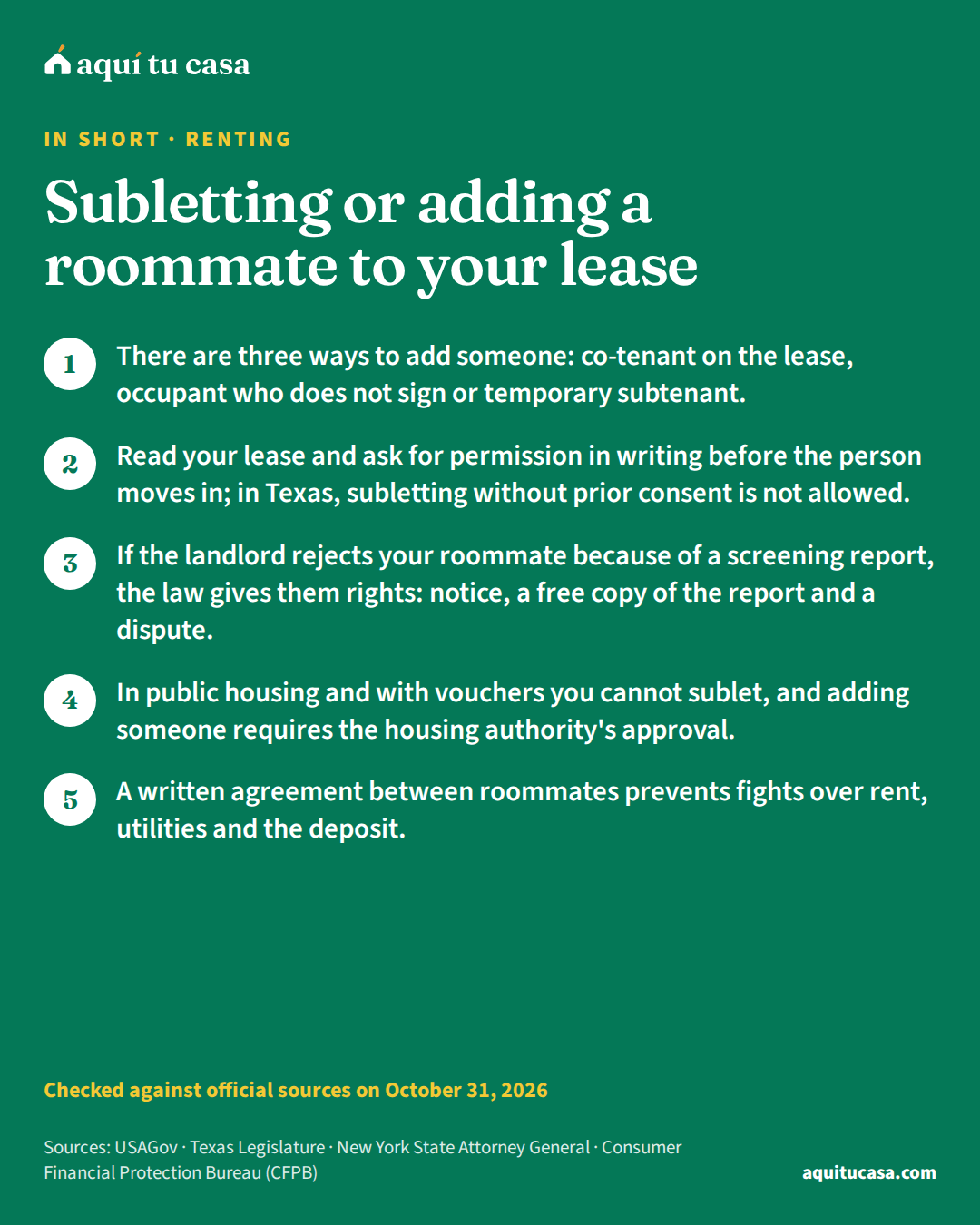
From the guide
How to add someone to your lease, when you can sublet, what the rules say in HUD-assisted housing and what to put in an agreement between roommates.
Verified on October 31, 2026 8 official sources
A roommate lives with you and may or may not be on the lease. A subtenant occupies your home, or part of it, while you are away for a while and rents your place from you. In New York, subletting means leaving the apartment temporarily.
Read the full guideIt is almost always wise to ask in writing, and it depends on your lease and your state. In Texas you may not sublet without the landlord's prior consent. In New York, if you are the only tenant, you may share with one additional occupant and their dependent children, and you must tell the landlord their name.
Read the full guideIn New York, even with the landlord's permission, you remain responsible for the whole lease, including future rent. In most cases the lease with the landlord is still yours, so their late rent is your problem.
Read the full guideAs a temporary guest, yes: HUD's rule gives you the right to reasonable accommodation of your guests. But you cannot sublet or take in paying boarders, and the unit is only for the household named in the lease.
Read the full guideOnly with the housing authority's approval. HUD's rule says nobody but the approved family may live in the unit. If a child is born or adopted, just report it promptly; for anyone else, ask for approval.
Read the full guideIf the rejection is based on a tenant screening report, the landlord must give an adverse action notice with the company's details. Your roommate can ask for a free copy within 60 days and dispute anything that is wrong.
Read the full guide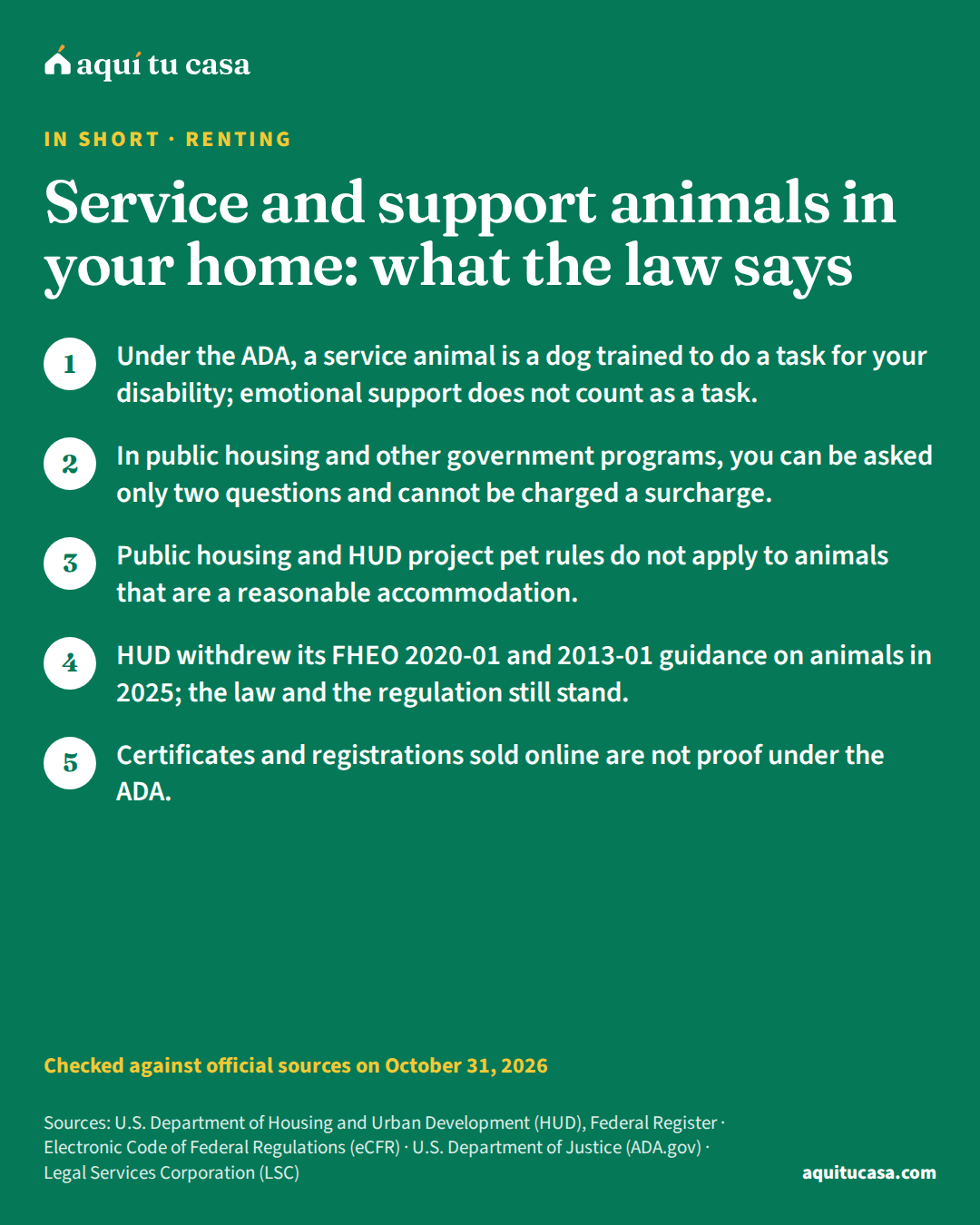
From the guide
Service animal or emotional support animal: what changed in HUD's guidance, what the ADA requires in public housing and what online certificates are worth.
Verified on October 31, 2026 7 official sources
Not under the ADA. The Justice Department says emotional support, therapy or companion animals are not service animals because they are not trained for a specific task. A dog trained to sense an anxiety attack and act to prevent it can be.
Read the full guideNo. The ADA does not require certificates, and the Justice Department says documents sold online are not proof that a dog is a service animal. Your dog must still follow local vaccination and licensing rules.
Read the full guideIn a state or local government program, such as a public housing authority, the ADA does not allow a surcharge for a service animal, even if people with pets are charged. You can be charged for damage if everyone is normally charged for damage.
Read the full guideNo. HUD withdrew guidance FHEO 2020-01 and FHEO 2013-01, effective September 17, 2025, and says it should no longer be relied on as authoritative. The Fair Housing Act and HUD's reasonable accommodation regulation remain in effect.
Read the full guideUnder the ADA, there is no breed restriction for service animals. In private housing, the question is decided under the Fair Housing Act; ask free legal aid for advice.
Read the full guideKeep everything in writing and get legal advice. You can file a complaint with HUD, and the law also lets you sue in federal or state court within two years.
Read the full guide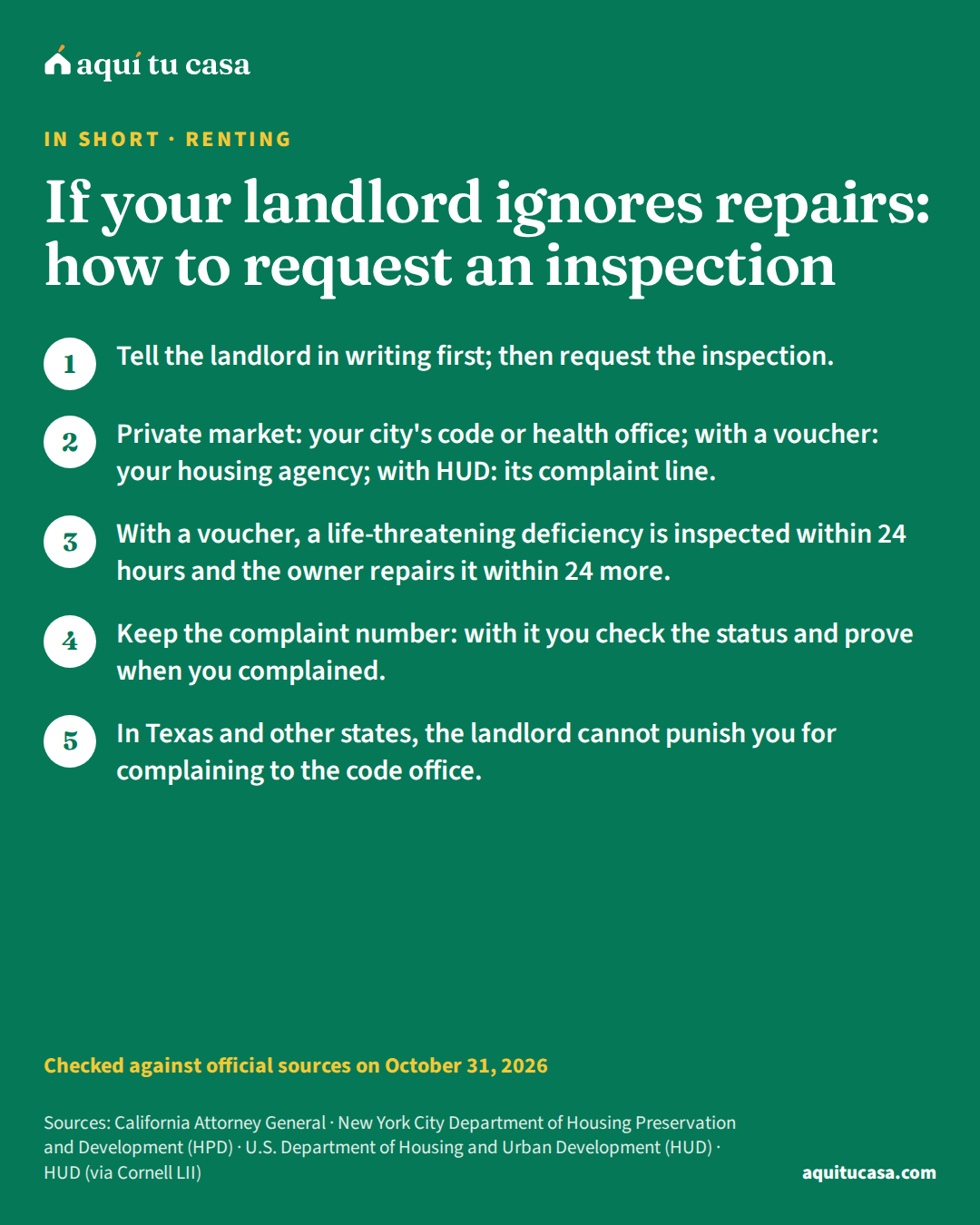
From the guide
When the landlord does not answer or fix things: who inspects your home, how to request a code inspection, what happens next and how the law protects you.
Verified on October 31, 2026 6 official sources
It depends on where you live. On the private market, your city's or county's code enforcement office or health department. With a voucher or in public housing, your housing agency. In a HUD-assisted building, HUD's complaint line at (800) 685-8470.
Read the full guideYes. HUD says always inform the landlord, and in New York the city asks you to contact the owner first before complaining to 311. Do it in writing and keep a copy.
Read the full guideIn New York City, no: according to HPD, the owner is not told the inspection date. Other cities may differ; ask when you file.
Read the full guideIt depends on your city and the problem. In New York, 90 days for non-hazardous violations, 30 for hazardous ones and 24 hours or immediately for the most serious. With a voucher, 24 hours if it is life-threatening and 30 days if not.
Read the full guideWith a Section 8 voucher, the housing agency cannot charge you for the inspection or reinspection. For other inspections, ask your code office.
Read the full guideIn several states, not as retaliation. In Texas, for example, the landlord cannot file to evict you, raise your rent or cut your services for six months after a good-faith complaint to the code office, except on grounds the law allows.
Read the full guideGet legal help today. The California Attorney General says it is very important to tell the lawyer or the court about the health or safety problems in your home.
Read the full guide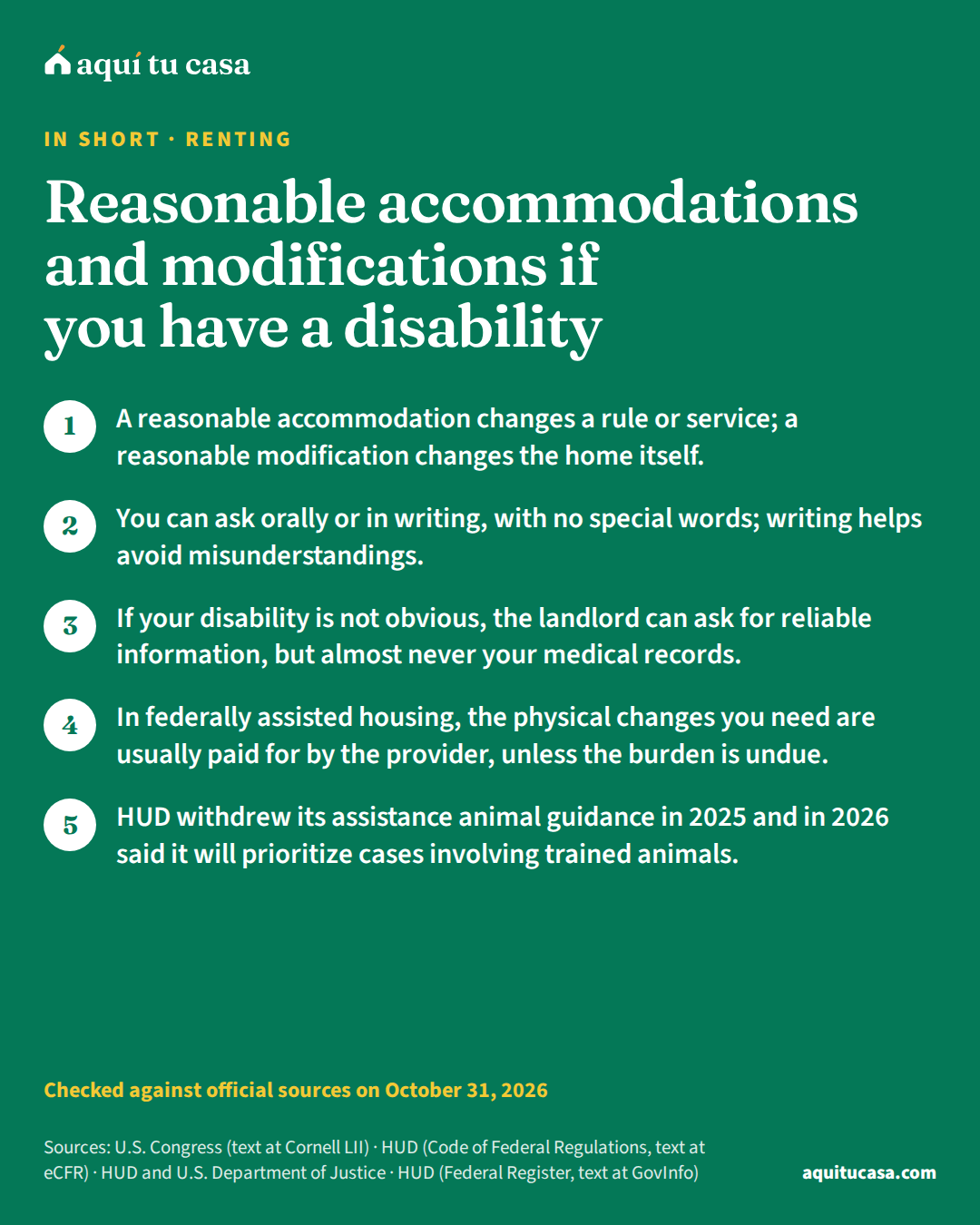
From the guide
What you can ask a landlord for because of a disability under the Fair Housing Act: rule changes, physical changes, assistance animals and complaints.
Verified on October 31, 2026 13 official sources
Read the full guide Do the math: Eviction timelines by state
It is a change, exception or adjustment to a rule, policy, practice or service that you need because of your disability to use your home like anyone else. For example, a reserved parking space near your door, or letting someone else mail your rent.
Read the full guideIn a private rental, the Fair Housing Act says the landlord must allow the change and you pay for it. But if the housing receives federal financial assistance, Section 504 treats those changes as reasonable accommodations the provider pays for, unless the burden is undue or it can meet your need another way, such as a transfer.
Read the full guideIn most cases they are not needed. If your disability and the need are obvious, the landlord cannot ask for more information. If they are not, it can ask for reliable information showing the disability, the accommodation and the link between them; often a credible statement from you or from a professional or agency that knows you is enough.
Read the full guideNo. According to HUD and the Justice Department, you can ask orally or in writing, and the landlord must consider your request even if you do not use its form. Putting it in writing and keeping a copy helps prove what you asked for and when.
Read the full guideThe HUD–Justice Department Joint Statement says they cannot charge extra fees or deposits as a condition of a reasonable accommodation, although they can charge for damage if they charge everyone. For a modification, the regulation bars raising your usual deposit, but the landlord may ask you to save gradually toward restoring the interior.
Read the full guideThis has changed. HUD withdrew its assistance animal guidance in 2025 and, in May 2026, said it will find cause only in complaints about animals trained for disability-related tasks. The regulation still gives the guide dog example. The law did not change and you can sue in court; ask free legal aid for advice.
Read the full guideThe landlord must respond promptly, and an undue delay can count as a denial. If you are denied, you can file a complaint with HUD no later than one year afterward, or sue in court no later than 2 years afterward.
Read the full guide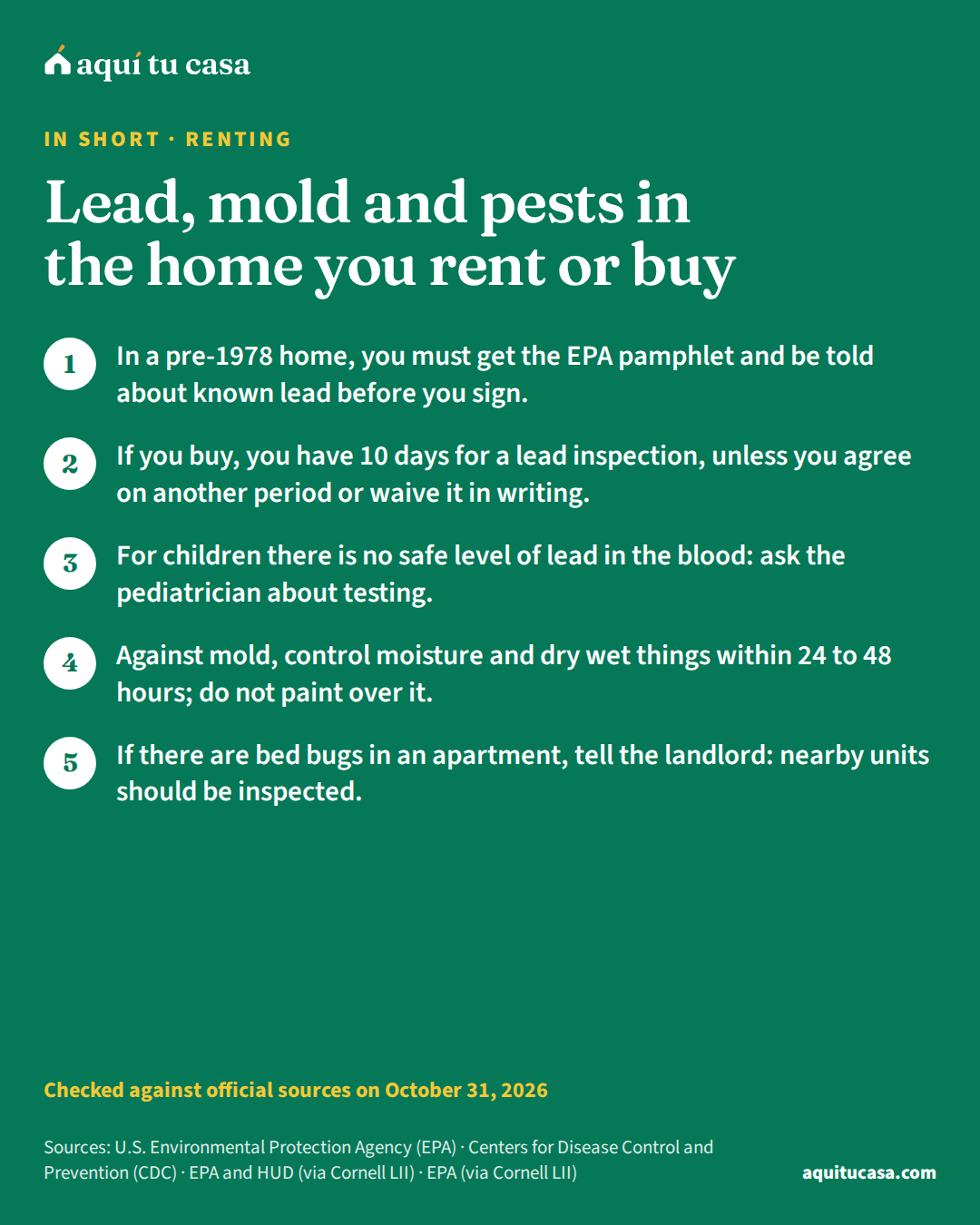
From the guide
What you must be told about lead paint before you rent or buy, how to handle mold and bed bugs, and what to do if your home is making your family sick.
Verified on October 31, 2026 10 official sources
If it was built before 1978, it may: EPA says about three-quarters of pre-1978 homes still have some. The way to know is an inspection or risk assessment by someone certified. Ask the seller or landlord whether they have reports.
Read the full guideThe federal disclosure rule does not require testing or repairs; it requires the landlord to tell you what it knows and give you the pamphlet before you sign. But if you have a Section 8 voucher and your child under 6 has an elevated blood lead level, there are deadlines to investigate and fix. Your state may have more rules.
Read the full guideYes, in writing. The rule gives you 10 days to inspect, or the period you agree on in writing, and you can waive it. If you have young children or are pregnant, think carefully before waiving it.
Read the full guideFollow your child's doctor and the health department. If you rent with a Section 8 voucher, tell your housing authority: under HUD's rule, an environmental investigation of the unit must be done within 15 days of the medical report.
Read the full guideUsually not. EPA says that if mold is visible, in most cases sampling is unnecessary, and that there are no federal limits for mold. What matters is cleaning it up and fixing the moisture source.
Read the full guideIf the area is less than about 10 square feet, EPA says in most cases yes. Wear gloves and protection, do not paint over it and never mix bleach with products that contain ammonia. If it is larger or there was a lot of water damage, it needs more careful cleanup.
Read the full guideEPA says to tell your landlord, because nearby units should be inspected, and that landlords may have a responsibility to take part in treatment. Who pays depends on your lease and your state's law; ask legal aid if you cannot agree.
Read the full guide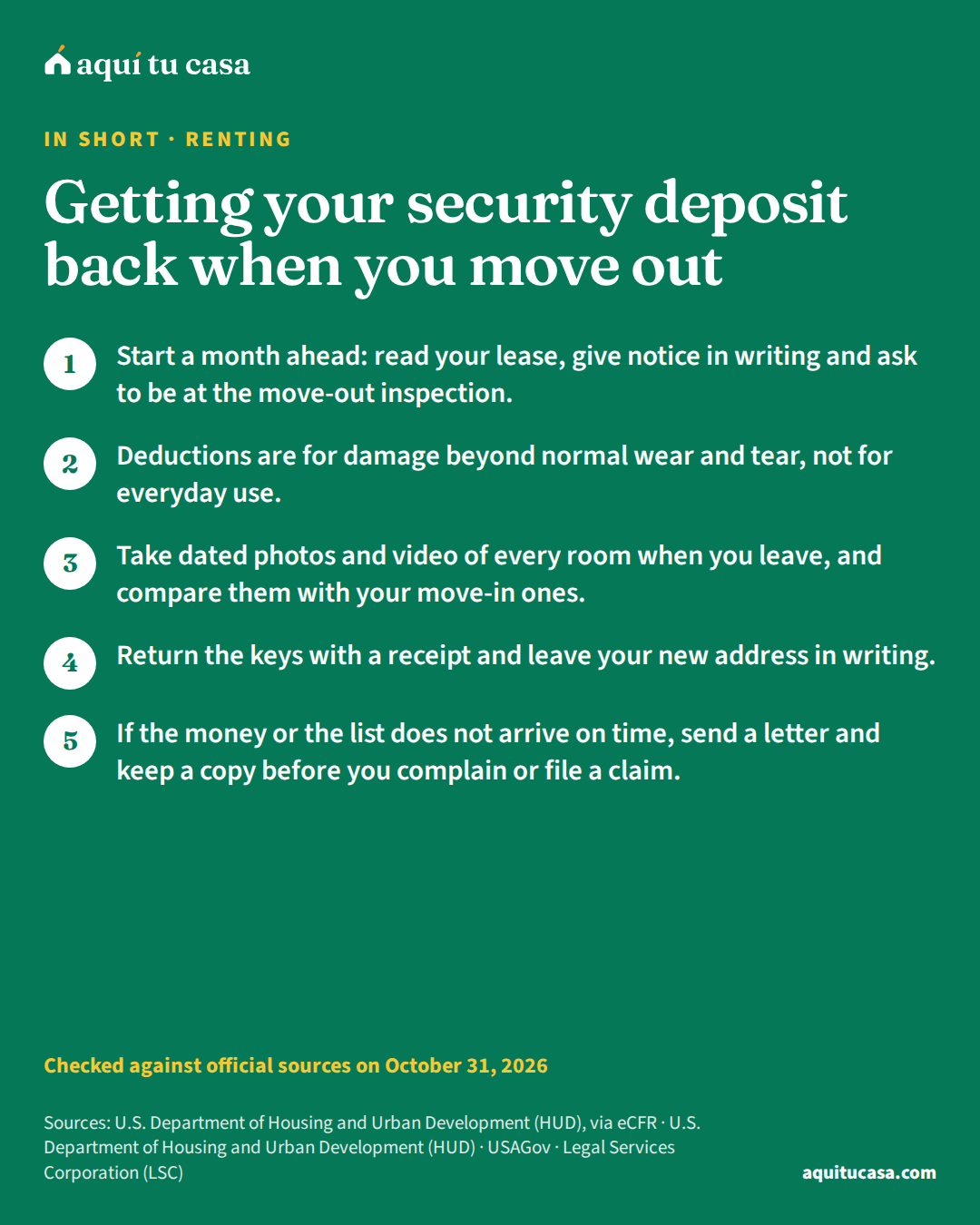
From the guide
A move-out plan: what to do before giving notice, the move-out inspection, photos, returning keys and the letter to request your deposit if it is late.
Verified on October 31, 2026 5 official sources
As soon as you can, ideally a month ahead. Read your lease to see how much notice it requires and what conditions it sets for returning the deposit. Give notice in writing and keep a dated copy.
Read the full guideGenerally, normal wear and tear is not charged: HUD's public housing rules speak of charges for repairs beyond normal wear and tear, and in HUD multifamily housing the move-out condition is compared with the move-in condition. Your state's rules may be more specific.
Read the full guideIn public housing, HUD's rule says the lease must let you take part, unless you leave without notice. In HUD multifamily housing, you should get prior notice and may accompany the owner. In private housing, it depends on your state: ask, and ask in writing.
Read the full guideIt depends on your state; the table in this guide and the tenant rights tool show the deadline. In HUD-assisted multifamily housing, it is 30 days after move-out, or less if your state's law requires.
Read the full guideIt can delay or complicate the refund. In HUD-assisted multifamily housing, to receive the deposit you must give an address or arrange to pick it up. Leaving it in writing when you return the keys protects you.
Read the full guideYour name, the rental's address, the date you moved out and returned the keys, your new address, the deposit amount, what you are asking for (the refund or the list of deductions) and a date to respond. Attach copies of your photos and keep a copy with the mailing date.
Read the full guideAsk in writing for an explanation of each charge and the receipts. If it is not resolved, look for your state's tenant agency, small claims court or free legal aid. If HUD insures or manages your building, you can also call its complaint line.
Read the full guideChange topic without leaving the questions.

These answers explain the rules but do not know your situation. These organizations go over it with you, free.