If your landlord ignores repairs: how to request an inspection
When the landlord does not answer or fix things: who inspects your home, how to request a code inspection, what happens next and how the law protects you.
Verified against official sources on October 31, 2026 6 official sources

Show contents
In short
What you need to know
Quick answer
If you already asked the landlord in writing for a repair and nothing happens, you can request an inspection. If you rent on the private market, call your city's or county's code enforcement office or health department, often through 311. If you have a Section 8 voucher, tell your housing agency: it must inspect within 24 hours if the deficiency is life-threatening and within 15 days if not. If you live in a HUD-assisted building, call HUD's line at (800) 685-8470. Keep your complaint number and dates. In several states, complaining to the government is protected against retaliation.
What matters most
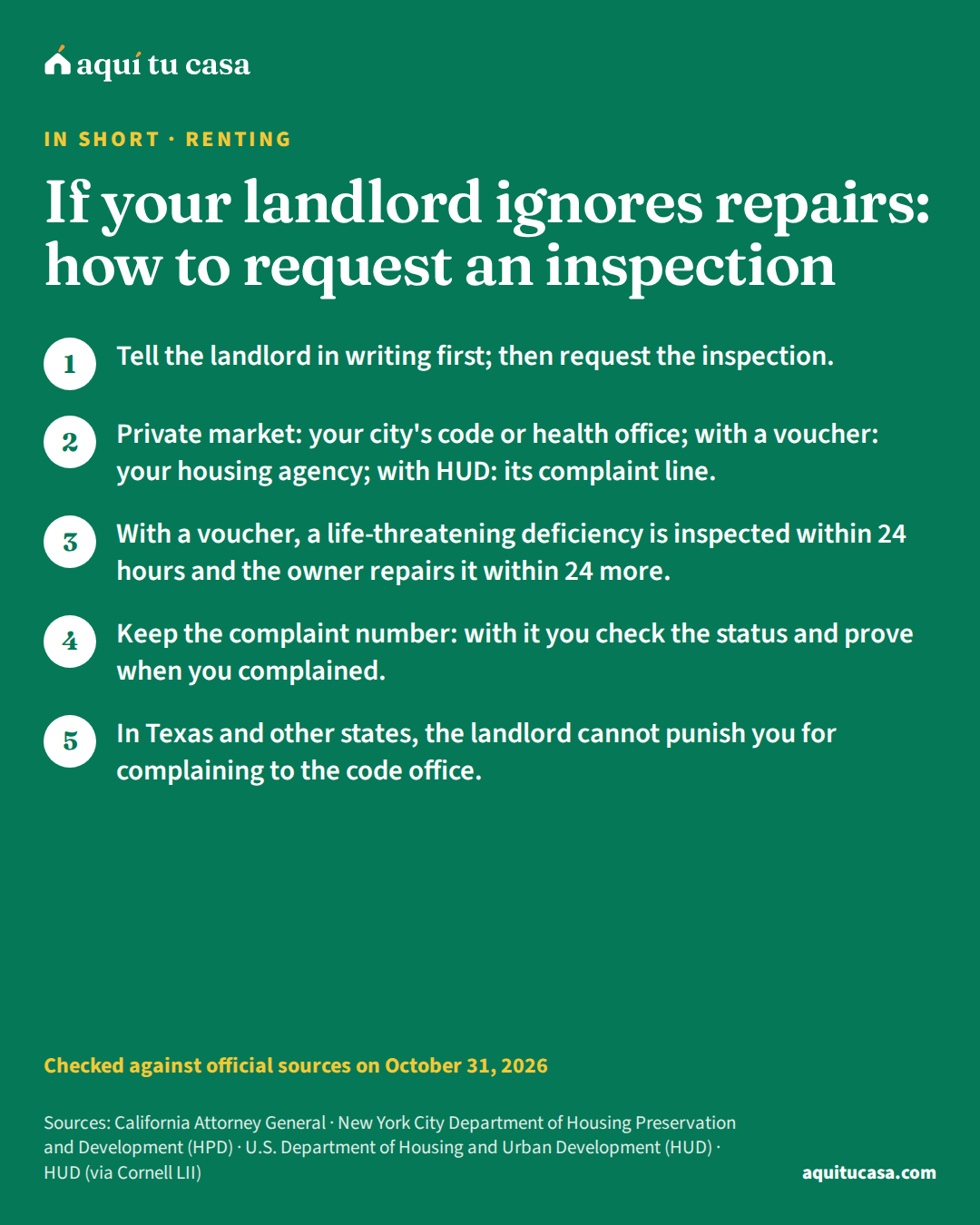
- Tell the landlord in writing first; then request the inspection.
- Private market: your city's code or health office; with a voucher: your housing agency; with HUD: its complaint line.
- With a voucher, a life-threatening deficiency is inspected within 24 hours and the owner repairs it within 24 more.
- Keep the complaint number: with it you check the status and prove when you complained.
Is this for you?
This guide is for you if…
- You already asked your landlord for a repair and they do not answer or do nothing.
- You have a serious problem in your home, such as leaks, pests, no hot water or dangerous wiring.
- You have a Section 8 voucher or live in HUD housing and the owner does not make repairs.
Get direct help first if…
- You have not asked your landlord for the repair yet: start with «Repairs and housing conditions».
- There is an immediate danger, such as a gas smell, fire or loose wires near water: get out and call 911.
You asked for the repair, you waited and nothing happened. The leak is still there, the roaches are still there or the hot water has not come back. When the landlord does not answer, a government inspection can make them fix it. This guide explains who inspects your home depending on where you live, how to request the inspection, what happens next and how the law protects you if you complain. What the landlord must maintain, and how to request a repair in writing, is in the guide Repairs and housing conditions.
Before you request the inspection: notify and document
Almost every office will ask whether you already told the landlord. HUD says always inform your landlord or manager about any problem with your unit.3 New York City asks for the same: contact the owner first, and if they do not respond, file the complaint.2
Give the notice in writing, with the date, what is happening and since when, and keep a copy. Take dated photos and videos. If the problem gets worse, take more. That file is useful for the inspection, for a retaliation complaint and, if it comes to that, for court.
Who inspects your home
It is not the same office for everyone. It depends on the type of housing:
Whom to call depending on where you live
City or county
Private market
- Code enforcement office
- Or the local health department
- In many cities, through 311
Housing agency
Section 8 voucher or public housing
- Your public housing agency (PHA)
- Federal deadlines to inspect
- No cost to your family
HUD
HUD-assisted building
- Multifamily Housing Complaint Line
- (800) 685-8470
- HUD inspects these properties
If you do not know which applies to you, ask your city's 311 or your housing agency.
Private market. According to the California Attorney General, if a landlord refuses to make repairs, tenants should contact their local code enforcement office or local health department. Some cities or counties also have a rent board that deals with building health and safety.1 In many cities you reach those offices through 311; look on your city’s or county’s website. Generally you can file the complaint yourself, by phone or online, without paying anyone to do it for you.
Voucher or public housing. Contact your public housing agencypublic housing agency (PHA)A public housing agency (PHA) is a state, county, municipal or other governmental entity or public body authorized to operate public housing or rental assistance programs. These are the agencies that locally administer the Housing Choice Vouchers (Section 8) and public housing with HUD funds: they open and manage the waiting lists, review eligibility and income, inspect units and pay the owner its share of the rent. Each county usually has one or several; your page shows the ones serving your area with their phone numbers.See the full definition.3 Its deadlines are below.
HUD-assisted building. Call HUD’s Multifamily Housing Complaint Line at (800) 685-8470. According to HUD, all its assisted properties are inspected to make sure they are decent, safe and sanitary.3
What to say in the complaint and what to ask
A clear complaint gets better attention. Have this information ready before you call or fill out the form:
- Your full address and apartment number.
- What the problem is, in which room and since when.
- When and how you told the landlord, and whether they answered.3
- Whether a baby, an older adult or someone sick lives in your home.
- How and when you can be reached, and which language you prefer.
And ask the office these questions: what is my complaint number? Will the inspector call me before coming? What happens if I am not home? How do I check my complaint’s status? What happens if the owner does not fix the problem in time? Write down the answers, with the name of the person who helped you and the date. Those notes help if you have to call again.
A warning sign: if the landlord asks you to withdraw the complaint in exchange for something, or threatens to call immigration, do not sign anything and get legal help. The guide Your immigration status and your landlord explains your rights.

How an inspection is requested: the New York example
Each city has its own process, but many are similar. New York City explains it step by step, and it works as an example of what to expect:2
A housing complaint, from notice to violation
3. Write down the complaint number
When you file
With the service request number you check the status.2
4. The city notifies the managing agent
After the complaint
HPD tries to contact the building's managing agent.2
5. The inspector comes
Without notice to the owner
A uniformed code inspector checks the problem; let them in.2
6. Notice of violation
If the problem is found
The city sends the managing agent a notice with the deadline to correct it.2
In New York, the owner is not told the date of the inspection.2 The city also publishes a tenant guide in Spanish on what to expect.2 In other cities, ask when you file whether the inspector will call you to set an appointment and what happens if they cannot get in.
What happens next: deadlines to correct
If the inspector finds the problem, the office gives the owner a deadline to fix it. In New York, the deadline depends on how serious the violation is:2
- Class A (non-hazardous): 90 days.
- Class B (hazardous): 30 days.
- Class C heat or hot water: immediately.
- Class C of other types: 24 hours, with different deadlines for some, such as 21 days for lead-based paint.
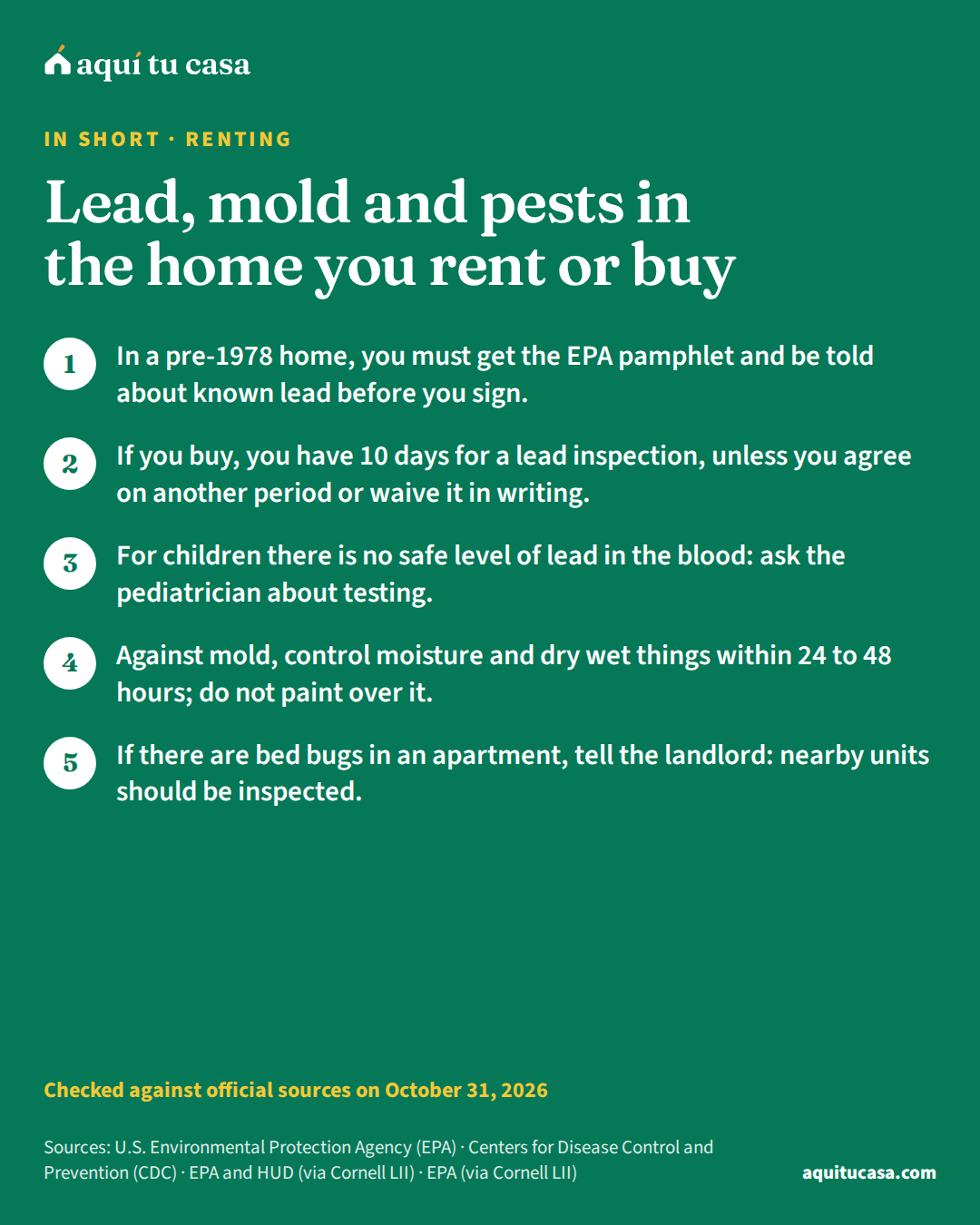
If the owner does not make the repair, New York City has an Emergency Repair Program that can fix certain conditions and bill the owner.2 Other cities have fines, reinspections or similar programs; ask your code office what happens if the owner does not comply. If the problem is lead, mold or pests, the guide Lead, mold and pests in your home explains special rules.
Example with real numbers
A complaint about a leak in New York
An example in words, not a real case, with HPD's deadlines.
- Week 1
- The tenant notifies the owner in writing and takes photos
- Week 2, no answer
- She files with 311 and writes down the number
- Inspector's visit
- Finds a violation and the city sends the notice to the managing agent
- If it is classified as hazardous (Class B)
- The owner has 30 days to correct it
- What she keeps
- Her notice, her photos, the complaint number and the violation notice
The steps and deadlines come from New York's HPD.22 In your city, the process may differ; also check tenant rights in your state.
Run it with your numbersTenant rights by stateIf you have a Section 8 voucher
With a housing choice voucherHousing Choice Voucher (Section 8)The Housing Choice Voucher, the program almost everyone calls Section 8, is the country's largest federal rental assistance. HUD pays rental subsidies so eligible families can afford decent, safe and sanitary housing. Local public housing agencies administer it with HUD funds. The family finds its own home on the private market; if the agency approves the unit and the tenancy, it contracts with the owner to pay part of the rent, and the family pays the rest. Waiting lists are usually long and open for limited periods.See the full definition, the federal rule sets clear deadlines. When you tell your housing agency about a possible deficiency:4
- If it is life-threatening, the agency must inspect and notify the owner within 24 hours, and the owner must repair it within the next 24 hours.
- If it is not life-threatening, the agency must inspect within 15 days, and the owner has 30 days to repair, or any extension the agency approves.
- The agency cannot charge you for the inspection or reinspection.
Give your notice to the agency in writing too, and keep the date: the deadlines are counted from it.
The law protects you if you complain
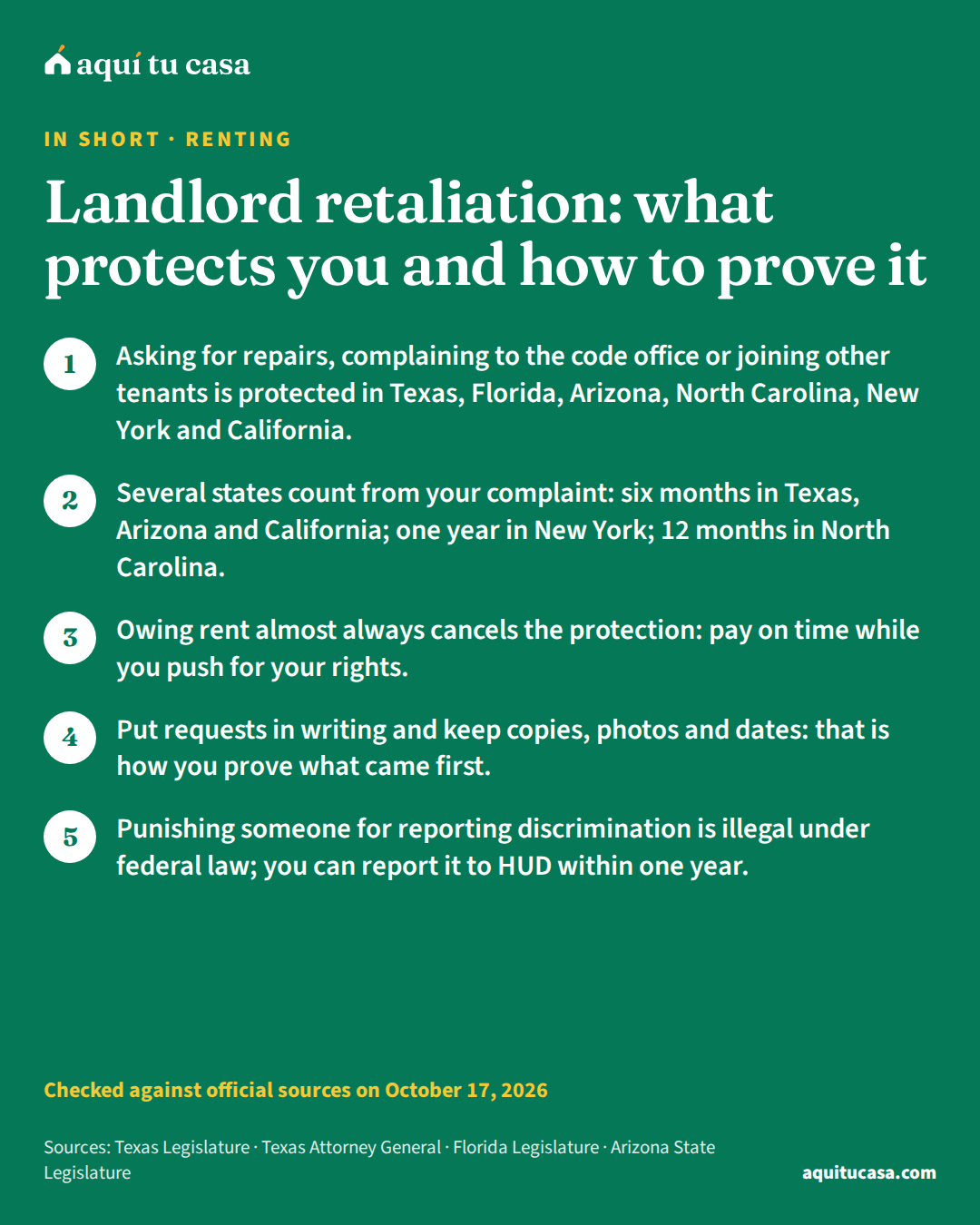
Many people do not complain for fear that the landlord will force them out. Several states prohibit that. In Texas, for example, the landlord may not retaliate because you complained in good faith to the office that enforces building or housing codes. For six months after your complaint, the landlord may not, in retaliation, file to evict you (except on grounds the law allows), deprive you of the use of the home, cut your services, raise your rent or end your lease.5
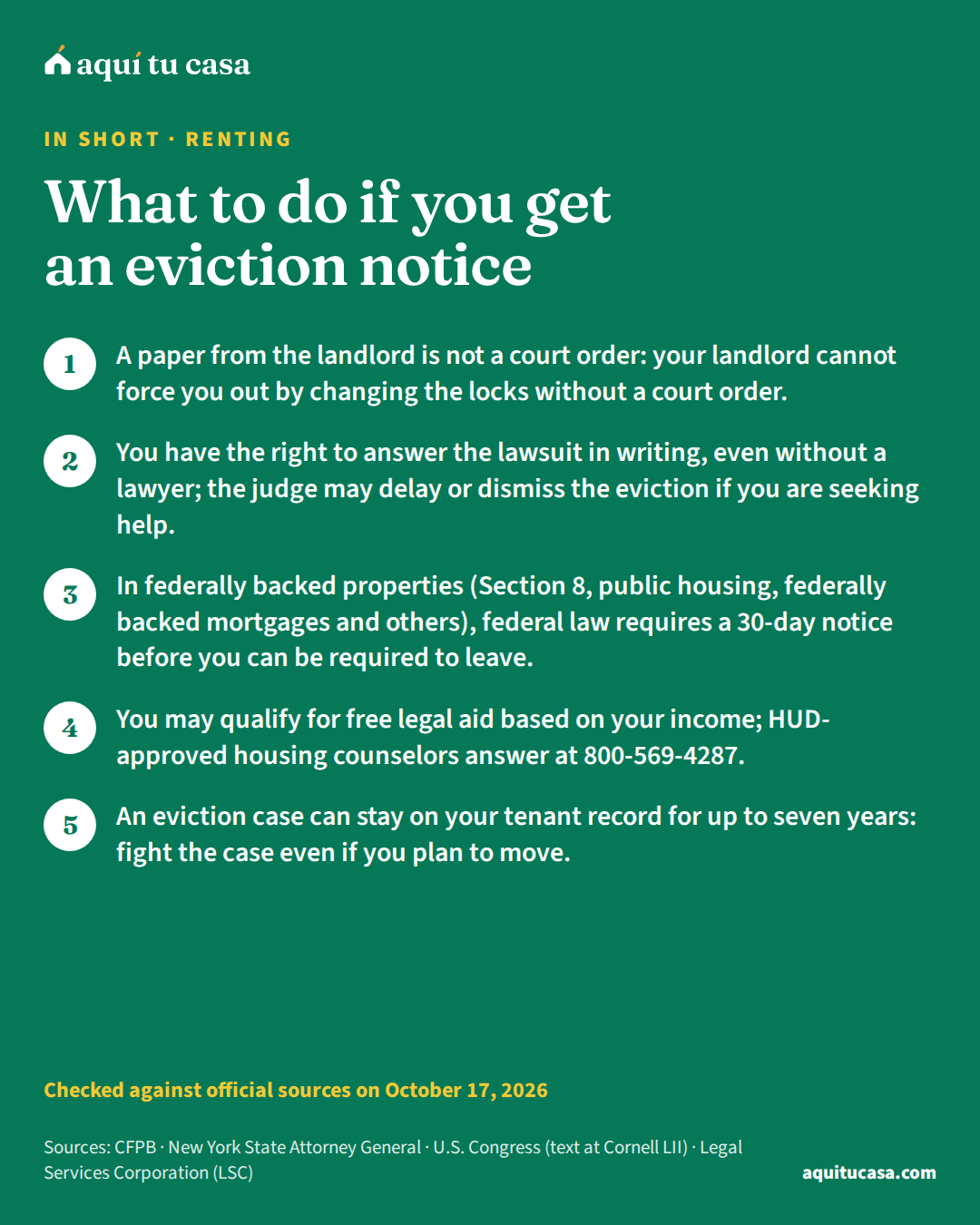
The guide Landlord retaliation explains other states’ rules and how to document. And if you get an eviction noticeeviction noticeAn eviction notice, also called a notice to quit or notice to vacate, is the written letter in which the landlord demands that you leave the home within a certain time. In general the landlord must give you this notice before starting an eviction case in court. At a minimum it should say why the landlord wants you out and what you can do to avoid it, such as paying the back rent. Your state's law decides when it can be given, how it must be delivered and how much time you get. The notice is not a court order: with the notice alone, the landlord cannot remove you.See the full definition while your home has problems, the California Attorney General says it is very important to tell a lawyer or the court.1 Read What to do if you get an eviction notice today.
If this is your situation
You rent on the private market
Call your city's code or health office, often through 311.1
You have a Section 8 voucher
Tell your housing agency: 24 hours if life is at risk, 15 days if not.4
You live in a HUD-assisted building
Call HUD's complaint line at (800) 685-8470.3
You have no heat or hot water
In New York, that violation must be corrected immediately.2
You are afraid to complain
In Texas, the landlord cannot punish you for six months after a good-faith complaint.5
You need a change because of a disability
Besides the complaint, you can ask for a reasonable accommodation; read the guide on reasonable accommodations.
If you need a change in your home because of a disability, such as a ramp or grab bars in the bathroom, also read Reasonable accommodations for disabilities.
Costly mistakes
Mistake: Calling the city without telling the landlord.
Instead: Notify in writing first; HUD and New York ask for it.32
Mistake: Not writing down the complaint number.
Instead: With it you check the status and prove when you complained.2
Mistake: Not being home or not letting the inspector in.
Instead: The inspector has to check the condition you reported; ask how and when they will come.2
Mistake: Stopping rent payments while you wait.
Instead: Stay current and ask a legal aid office before withholding rent.
Mistake: With a voucher, complaining only verbally.
Instead: Notify the housing agency in writing; deadlines are counted from your notice.4
Mistake: Keeping quiet about housing problems in an eviction.
Instead: Tell the lawyer or the court.1

Free help
A legal aidlegal aidLegal aid is the free civil legal help that nonprofit organizations and their lawyers provide to low-income people in civil, not criminal, matters. In housing, that includes representing families facing eviction or foreclosure, alongside matters such as custody, child support, protection from domestic violence and access to benefits. In the United States, the Legal Services Corporation, created by Congress, funds a nationwide network of these organizations; its finder points you to the one in your area. Each sets its own income limits.See the full definition office can help if the landlord does not comply after the inspection or threatens you. LSC helps you find the nearest one with your address or city.6 The guide Free legal aid explains what to bring.
What to do this week
- Send the landlord a dated written notice and keep a copy.3
- Take dated photos and videos of the problem.2
- If there is no answer, call your code or health office, your housing agency or HUD’s line, depending on your case.13
- Write down the complaint number and the inspection date.2
- Check tenant rights in your state, including retaliation protection.5
- If you get an eviction notice, check the eviction timeline and get legal help today.6
Ready to see the numbers? Find your county here
See how this applies in your county: its loan limits, prices and rents, from the official data.
Printable checklist
Frequently asked questions
Whom do I call if the landlord does not make repairs?
It depends on where you live. On the private market, your city's or county's code enforcement office or health department. With a voucher or in public housing, your housing agency. In a HUD-assisted building, HUD's complaint line at (800) 685-8470.
Do I have to tell the landlord first?
Yes. HUD says always inform the landlord, and in New York the city asks you to contact the owner first before complaining to 311. Do it in writing and keep a copy.
Is the owner told when the inspector is coming?
In New York City, no: according to HPD, the owner is not told the inspection date. Other cities may differ; ask when you file.
How long does the owner have to fix it?
It depends on your city and the problem. In New York, 90 days for non-hazardous violations, 30 for hazardous ones and 24 hours or immediately for the most serious. With a voucher, 24 hours if it is life-threatening and 30 days if not.
Does the inspection cost me anything?
With a Section 8 voucher, the housing agency cannot charge you for the inspection or reinspection. For other inspections, ask your code office.
Can I be evicted for complaining?
In several states, not as retaliation. In Texas, for example, the landlord cannot file to evict you, raise your rent or cut your services for six months after a good-faith complaint to the code office, except on grounds the law allows.
I got an eviction notice and my home has problems. What do I do?
Get legal help today. The California Attorney General says it is very important to tell the lawyer or the court about the health or safety problems in your home.
Sources
Every figure in this guide comes from one of these official sources. The number next to a sentence leads to the source behind it.
Each source on one line: who publishes it, its title, its address and the date we read it.
- 1. California Attorney General · Landlord-Tenant Issues · oag.ca.gov · Accessed October 31, 2026
- 2. New York City Department of Housing Preservation and Development (HPD) · Report a Maintenance Issue · nyc.gov · Accessed October 31, 2026
- 3. U.S. Department of Housing and Urban Development (HUD) · Helping Americans · hud.gov · Accessed October 31, 2026
- 4. HUD (via Cornell LII) · 24 CFR §982.405, PHA unit inspection · law.cornell.edu · Accessed October 31, 2026
- 5. Texas Legislature · Texas Property Code, Chapter 92, Residential Tenancies · tcss.legis.texas.gov · Accessed October 31, 2026
- 6. Legal Services Corporation (LSC) · I Need Legal Help · lsc.gov · Accessed October 31, 2026
Keep reading
Related guides
If this guide helped, these follow the same path.

Renting 13 minute read
Repairs as a renter: how to ask and what to do
Which repairs fall on the landlord, how to request them in writing, when to call your city's code inspectors and the risks of withholding rent.
- According to the CFPB, your landlord cannot refuse necessary repairs or endanger your health and safety; each state's law details what must be maintained.
- Request repairs in writing, document with photos and video, and keep copies of everything; in Texas, for example, trackable mail counts.
- If repairs don't happen, your city's code enforcement office or health department can inspect; with a Section 8 voucher, the housing agency inspects at no cost to you.
- Renting Landlord retaliation: what protects you and how to prove it If your rent went up, a service was cut or your landlord wants you out because you complained: what state laws say and how to keep proof. 12 minute read
- Renting Lead, mold and pests in the home you rent or buy What you must be told about lead paint before you rent or buy, how to handle mold and bed bugs, and what to do if your home is making your family sick. 12 minute read
- Renting What to do if you get an eviction notice Notice, lawsuit and the judge's order: what you can do at each moment, where free legal help is and what federal law says about the 30-day notice. 14 minute read
Tools for this topic
Was this guide useful?
Thank you. Your answer stays in your browser; nothing is sent.