Landlord retaliation: what protects you and how to prove it
If your rent went up, a service was cut or your landlord wants you out because you complained: what state laws say and how to keep proof.
Verified against official sources on October 17, 2026 17 official sources

Show contents
In short
What you need to know
Quick answer
Retaliation is when a landlord punishes you for using a right, such as asking for repairs, complaining to the city or joining other tenants: by raising your rent, cutting services, not renewing your lease or suing to evict you. Texas, Florida, Arizona, North Carolina, New York and California prohibit it, several with periods of six months to a year counted from your complaint, and federal law prohibits punishing anyone who reports discrimination. The protection almost never covers unpaid rent: keep paying, put every request in writing and keep copies.
What matters most
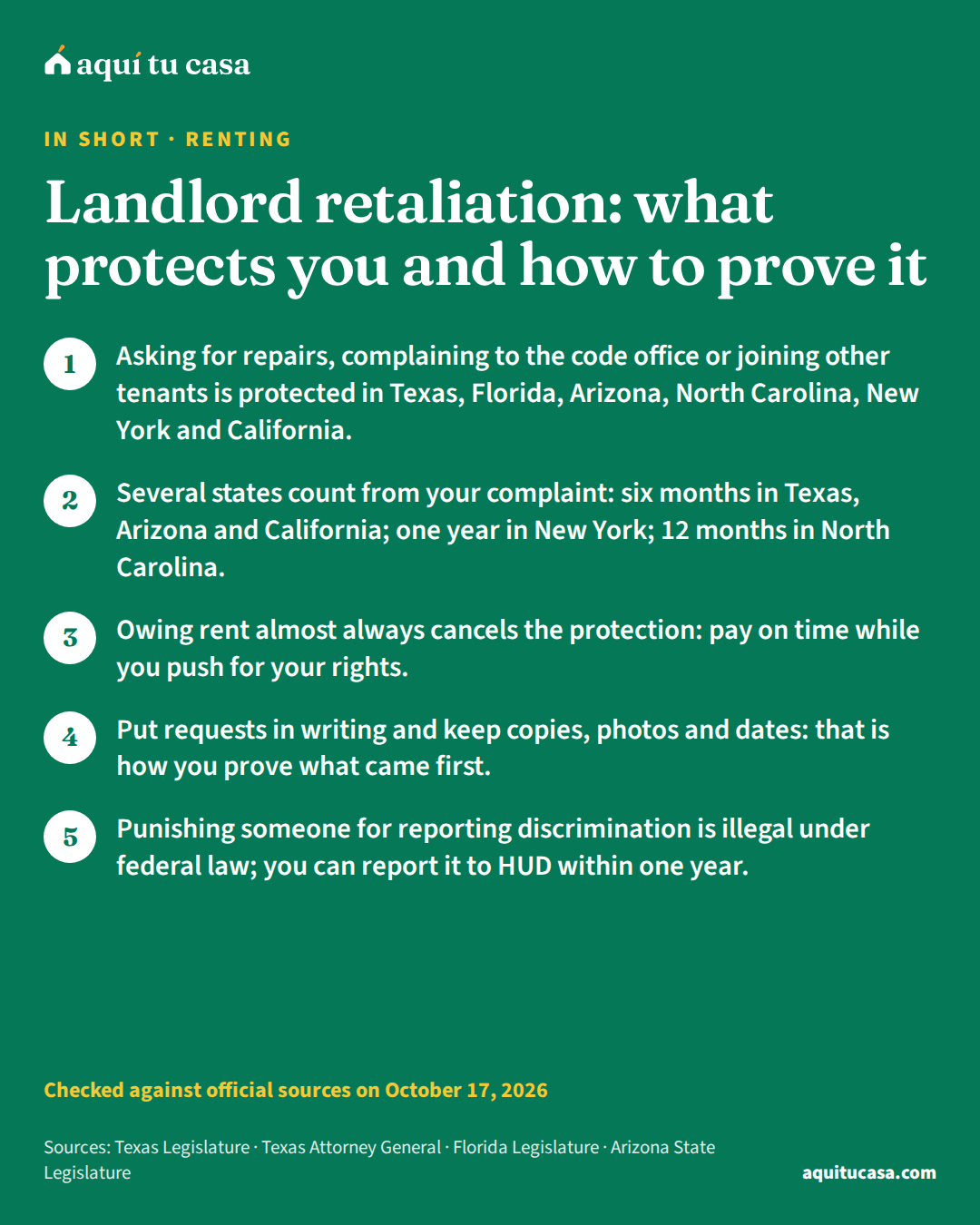
- Asking for repairs, complaining to the code office or joining other tenants is protected in Texas, Florida, Arizona, North Carolina, New York and California.
- Several states count from your complaint: six months in Texas, Arizona and California; one year in New York; 12 months in North Carolina.
- Owing rent almost always cancels the protection: pay on time while you push for your rights.
- Put requests in writing and keep copies, photos and dates: that is how you prove what came first.
Is this for you?
This guide is for you if…
- You asked for a repair or complained to the city and, soon after, your landlord raised the rent, took away a service or sent you a notice.
- You want to ask for a repair or join other tenants, but you are afraid your landlord will get back at you.
- You reported discrimination, or helped someone report it, and now you are being pressured to leave.
Get direct help first if…
- Your locks were already changed or your water or power was cut: start with the guide on illegal lockouts and utility shutoffs.
- You already got an eviction lawsuit with a hearing date: read the guide on what to do if you get an eviction notice and call legal aid today.
- You are in danger: call 911.
Asking for the heat to be fixed, calling the city inspector or joining other tenants are rights. This guide is for anyone who fears, or is already facing, landlord retaliationlandlord retaliationLandlord retaliation happens when the landlord punishes you for using a legal right. For example, the landlord tries to evict you because you complained in good faith to a government office about health or safety problems in the home, or because you organized with other tenants. Not every state recognizes it, and each one defines and proves it differently. In addition, the federal Fair Housing Act prohibits retaliating against a person for filing a housing discrimination complaint or taking part in that process.See the full definition: punishment for using those rights. It explains what the laws of several states and federal law say, the big limit on that protection, and how to keep proof from day one.
What retaliation is and what it looks like
Retaliation is a landlord’s response to something you did within your rights. The California Attorney General gives two clear examples: trying to evict a tenant who asked for repairs or pointed out that a rent increase was unlawful, and taking away services the tenant already had, like a storage space or parking.10
State laws name the most common forms. In Texas, for six months after your action, the landlord may not file an eviction or deprive you of the use of your home (except on grounds the law allows), decrease your services, raise your rent, terminate your lease or act in bad faith to interfere with your lease rights.1 Florida and Arizona talk about raising rent, decreasing services and suing or threatening to sue for possession.34
Florida adds a detail: for it to count as retaliation, you must be treated differently in the rent, the services or what the landlord does.3 In other words, if the increase only reaches the person who complained, that matters. In Texas, by contrast, an increase under a written lease clause for utilities, taxes or insurance, or one applied to the whole complex, may not count as retaliation.1
Retaliation or a valid reason
Prohibited
Can be retaliation
Allowed
The law treats it as a valid reason
What decides a case is the reason and the order of events: that is why your proof and your dates matter.11
What protects you, state by state
Each state decides which actions it protects and for how long. This is what the laws and official guides we reviewed say:
| State | What is protected | The period that counts |
|---|---|---|
| Texas | Using a lease or legal right in good faith, giving a repair notice, complaining to the code office, a utility or a nonprofit agency, and joining a tenant organization1 | 6 months after your action |
| Florida | Complaining to the building, housing or health code agency, complaining to the landlord, taking part in a tenant organization and using your fair housing rights; you must act in good faith3 | The section sets no time period |
| Arizona | Complaining to the code agency or to the landlord, and joining a tenants’ union4 | A complaint in the previous 6 months creates a presumption of retaliation4 |
| North Carolina | Asking for repairs or complaining in good faith to the landlord or the government, a formal government complaint, using lease or legal rights, and organizing6 | What you did in the 12 months before the lawsuit |
| New York | Complaining in good faith to the landlord or an agency about health, safety, repairs or the lease, and taking part in tenant organizations9 | Retaliation is presumed for 1 year after your complaint |
| California | Asking for repairs, complaining to the landlord or an agency, and having an agency inspect the home11 | Retaliation is presumed if the landlord tries to evict you within 6 months |
What does it mean that the law “presumes” retaliation? The judge starts from the idea that it was punishment, and it is up to the landlord to prove otherwise. In New York, if the eviction began within a year of your complaint and the landlord cannot prove it is not retaliation, the case ends.9 New York’s law does not apply to owner-occupied buildings with fewer than four units.9
The tenant rights pages for Texas, Florida, Arizona, North Carolina, New York and California have more of each state’s rules. If you live in another state, LawHelp.org has information on legal questions and free legal forms.17
The big limit: if you owe rent
This is the rule many people do not know. In Texas, an eviction because you owe rent when you are notified or sued is not retaliation.1 Arizona lets the landlord sue if you are behind on rent,4 North Carolina lets the landlord win if you did not pay and that is the reason for the eviction,6 and Florida says the rule does not apply if the landlord proves good cause, such as a good-faith action for unpaid rent.3
California goes further: to use the six-month defense, you must prove your rent is current.11 And the Texas Attorney General puts it plainly: you can always be evicted if you fail to pay your rent on time.2
So even if you are angry with your landlord, keep paying on time while you push for your rights, unless legal aid tells you otherwise. If you stop paying, what can arrive is the notice for late rent:
Notice for late rent, by state
| State | Notice for late rent |
|---|---|
| Alabama | 7 business days |
| Alaska | 7 days |
| Arizona | 5 calendar days |
| Arkansas | 3 days |
| California | 3 court days |
| Colorado | 10 days |
| District of Columbia | 10 days |
| Florida | 3 days |
| Georgia | 3 business days |
| Hawaii | 10 calendar days |
| Idaho | 3 days |
| Illinois | 5 days |
| Indiana | 10 days |
| Iowa | 3 days |
| Kansas | 3 calendar days |
| Kentucky | 7 days |
| Louisiana | 5 days |
| Maryland | 10 days |
| Massachusetts | 14 days |
| Michigan | 7 days |
| Minnesota | 14 days |
| Mississippi | 3 days |
| Montana | 3 days |
| Nebraska | 7 calendar days |
| Nevada | 7 judicial days |
| New Hampshire | 7 days |
| New Mexico | 3 days |
| New York | 14 days |
| North Carolina | 10 days |
| North Dakota | 3 days |
| Ohio | 3 days |
| Oklahoma | 5 days |
| Oregon | 10 days |
| Pennsylvania | 10 days |
| Rhode Island | 5 days |
| South Carolina | 5 days |
| Tennessee | 14 days |
| Texas | 3 days |
| Utah | 3 business days |
| Vermont | 14 days |
| Virginia | 14 days |
| Washington | 14 days |
| Wisconsin | 5 days |
| Wyoming | 3 days |
A complaint does not stop this notice: owing rent is a valid reason in several states.1 Tap your state for details. Source: each state's laws
The guide What to do if you get an eviction notice walks through each step, and the eviction timeline tool puts them in order by date.

How to document from day one
Retaliation is proved by the order of events: first your request or complaint, then the landlord’s response. Because several states count the period from your complaint, the date of your first letter may be your most important piece of evidence.49
Your file, step by step
1. Ask for the repair in writing
From the first problem
Describe the problem, how it affects you and how long it has existed. Always keep a copy.11
2. Send it in a way you can prove
The same day
The Texas Attorney General says to send a dated letter by certified mail, return receipt requested, by registered mail or in person.2
3. Gather photos, video and witnesses
Before and after you complain
In court, photos or video of the defects, witnesses and copies of your letters help.11
5. Pay rent on time
Every month
Be current on rent when the landlord receives your notice and while you press your case.2
6. Write down every landlord response
Every time something happens
Increases, notices, services taken away: with the date. HUD asks for the dates and a short description of what happened.15
California’s official tenant guide recommends communicating in writing especially when you need a record, and always keeping a copy of what you send.11 The same guide talks about sending the letter or an email: what matters is that you can show what you asked for and when.11

One risk in Texas: if you complain to the government and the inspector determines in writing that there is no violation, the law presumes you acted in bad faith, and a bad-faith lawsuit can cost you one month’s rent plus $500.1 Complain about what is really happening and keep the evidence. The guide on repairs and housing conditions explains how to ask for repairs in each state and what the warranty of habitabilitywarranty of habitabilityThe warranty of habitability is a tenant's right to a livable, safe and sanitary home. The rules depend on the state. In New York, according to the Attorney General's office, this right is implied in every written or oral residential lease, and a lease clause that waives it is void; it is breached, for example, when heat or hot water is not provided regularly. In California, the landlord must keep plumbing, heating, electrical equipment and locks in working order and keep the unit free of pests. In Arizona, the law requires keeping the home in a fit and habitable condition.See the full definition is.
If you are sued: retaliation as a defense
If the landlord files an evictionevictionEviction is the legal process a landlord uses to get back a rented home when the tenant does not want to leave. The most common reasons are unpaid rent, serious lease violations or a lease that has ended. First the landlord must give you written notice. If it is not resolved, the landlord needs a court order, and a law enforcement officer must carry out the removal. If you are sued, you have the right to file a written answer explaining to the court why you should not be evicted. The rules change by state and city.See the full definition after your complaint, retaliation is a defense in Texas,1 Florida3 and Arizona.4 In North Carolina you can raise it and show the eviction responds to something you did in the 12 months before the lawsuit; if the judge finds it is retaliation, the eviction must be denied, although the landlord can still collect rent you owe.67
The California Attorney General is firm: if you are sued or get an eviction notice, do not ignore it, and get legal help quickly.10
Besides defending yourself, you can sometimes recover money:
- Texas: one month’s rent plus $500, your actual damages, court costs and attorney’s fees, minus rent you owe.1
- Arizona: recover the home or end the lease, and collect up to two months’ rent or twice your damages, whichever is greater.5
- California: up to $2,000 for each retaliatory act, on top of your damages; you can sue even after moving out.11
- New York: tenants may collect damages from a landlord who violates this law.9
In North Carolina, a lease clause in which you give up these rights is void.8 But there are exceptions: the landlord can win if the lease was for a fixed term with no option to renew and you stay after it ends, if the landlord gave you notice in good faith before your complaint, or if, at the end of the lease, the landlord wants to live in the home.6
Retaliation for reporting discrimination
Federal law protects you separately. The Fair Housing ActFair Housing ActThe Fair Housing Act is the federal law that makes it illegal to refuse to sell or rent a dwelling, or to discriminate in its terms, because of race, color, religion, sex, familial status (having children), national origin or disability. It applies to landlords, real estate agents and managers, and also to banks and lenders when their practices make housing or credit unavailable for those reasons. National origin covers your language and the country you come from, regardless of immigration status. If you believe you were discriminated against, you can file a complaint with HUD at no cost; many states add protections.See the full definition makes it unlawful to coerce, intimidate, threaten or interfere with anyone who exercises fair housing rights, or who helps someone else exercise them.12 HUD’s rule prohibits retaliation because you filed a complaint, testified or reported a discriminatory practice to the landlord or another authority.13
Those rights cover, for example, discrimination based on national originnational originNational origin is one of the characteristics the Fair Housing Act protects. According to the Department of Justice, national origin discrimination can be based on the country where you were born or where your ancestors came from. The law prohibits refusing to sell or rent you a home, setting different terms or publishing ads that state a preference based on your national origin. According to the CFPB, the Equal Credit Opportunity Act also prohibits lenders from discriminating against you because of your national origin when you apply for credit, such as a mortgage.See the full definition or familial statusfamilial statusFamilial status is one of the characteristics the Fair Housing Act protects. The law defines it as having one or more children under 18 living with a parent, with another person who has legal custody of them or with someone that person designates in writing. It also protects anyone who is pregnant or is in the process of getting custody of a child. So, with some exceptions, such as certain housing for older persons, no one may refuse to rent or sell you a home, or impose special conditions, because you live with children.See the full definition (having children).15 HUD says retaliation is illegal at any time, even after an investigation ends, and that the Violence Against Women Act (VAWA) also prohibits retaliation in housing covered by that program.15
To report, HUD asks for a short description of what happened and the dates, and urges you to act as soon as possible: you can report online, by mail or by calling 1-800-669-9777.15 The law gives you one year from when it happened to file.14 The guide on housing discrimination explains the whole process.
Where to get free help
The CFPB points out that many landlords come to court with a lawyer, that you can get help too and that you could qualify for free legal aidlegal aidLegal aid is the free civil legal help that nonprofit organizations and their lawyers provide to low-income people in civil, not criminal, matters. In housing, that includes representing families facing eviction or foreclosure, alongside matters such as custody, child support, protection from domestic violence and access to benefits. In the United States, the Legal Services Corporation, created by Congress, funds a nationwide network of these organizations; its finder points you to the one in your area. Each sets its own income limits.See the full definition through your local bar association or a legal aid office. It also notes that some state and local governments have protections to help you avoid eviction.16
The Legal Services Corporation funds civil legal aid for low-income Americans: on its site you type your address or city and it shows the nearest office.17 In California, the Attorney General points to LawHelpCA.org.10 The guide on free legal aid explains how to ask for it.
If this is you
You asked for a repair and got a rent increase
Gather the copy of your request with its date and the increase notice. In Texas, a retaliatory increase is barred for six months.1
You complained about discrimination for having children
Punishing you for reporting is illegal under federal law; you can add the retaliation to your HUD complaint.13
You are threatened with a call to immigration
In California that kind of pressure is prohibited.10 In other states, talk to free legal aid first.
Your locks were changed or your power was cut
That is a different and urgent problem: read the guide on illegal lockouts and call legal aid today.16

Costly mistakes
Mistake: Stopping rent payments to pressure the landlord.
Instead: Pay on time: owing rent is a valid reason for eviction in several states.1
Mistake: Asking for repairs only out loud.
Instead: Put them in writing and keep a dated copy.11
Mistake: Ignoring a lawsuit because you think it is unfair.
Instead: Answer and show up: retaliation is a defense, but you have to raise it.1
Mistake: Staying quiet out of fear after reporting discrimination.
Instead: Retaliation can also be reported to HUD, within one year.14
Mistake: Signing a lease that says you give up these rights and assuming you lost them.
Instead: In North Carolina that waiver is void; ask legal aid about your state.8
What to do this week
- Write a list of dates: when you asked for the repair or complained, and when each landlord response arrived.15
- Gather copies of your letters or messages, proof of delivery and your photos.11
- If you have not done it yet, send your request in writing with a date and keep a copy.2
- Pay rent on time and keep the receipt.2
- Find your free legal aid office with your address on the LSC site.17
- If the retaliation is for reporting discrimination, report it to HUD online or at 1-800-669-9777.15
Ready to see the numbers? Find your county here
See how this applies in your county: its loan limits, prices and rents, from the official data.
Printable checklist
Frequently asked questions
Can my landlord raise my rent because I asked for a repair?
In several states, not as punishment. In Texas, a landlord may not raise your rent in retaliation for six months after your repair request; in Florida and Arizona the law prohibits raising rent to get back at you for a complaint. In Texas, an increase under a written lease clause, or one applied to the whole complex, may not count as retaliation.
How long does the law protect me after I complain?
It depends on the state. Texas protects you for six months; in Arizona and California, a complaint in the previous six months creates a presumption of retaliation; in New York the window is one year; in North Carolina the defense covers what you did in the 12 months before the lawsuit. In another state, ask legal aid.
Am I protected if I owe rent?
Almost never. Texas, Arizona, North Carolina and Florida say an eviction for unpaid rent is not retaliation, and in California the defense requires that your rent be current. That is why it makes sense to keep paying while you push for your rights, unless legal aid tells you otherwise.
Can my landlord refuse to renew my lease as punishment?
In Texas, terminating your lease is one of the retaliatory acts barred for six months. In New York, refusing to renew within a year of your complaint creates a presumption of retaliation. In North Carolina, though, if your lease was for a fixed term with no option to renew and you stay after it ends, the landlord can win the eviction.
What proof helps?
California's official tenant guide mentions photos or video of the defects, witnesses, copies of your letters to the landlord and a report from a health or building inspector. The Texas Attorney General says to send dated letters by certified mail, return receipt requested, and keep a copy. Also write down the date of every notice or rent increase.
Can my landlord threaten to call immigration if I complain?
In California, the Attorney General says a landlord may never threaten to disclose your immigration status to pressure you to leave, or disclose it to law enforcement as retaliation. In other states the rules differ: talk to a free legal aid office or a DOJ-accredited representative before you decide.
Can I report retaliation to HUD?
Yes, when the retaliation is for reporting discrimination or helping someone report it: HUD says that is illegal and you can report it as housing discrimination. The law gives you one year from when it happened to file. You can file online, by mail or at 1-800-669-9777.
What happens if the judge finds it was retaliation?
It depends on the state. In North Carolina, the judge must deny the eviction. In Texas you can recover one month's rent plus $500, your damages and attorney's fees, minus what you owe; in Arizona, up to two months' rent or twice your damages; in California, up to $2,000 for each act, on top of damages.
Sources
Every figure in this guide comes from one of these official sources. The number next to a sentence leads to the source behind it.
Each source on one line: who publishes it, its title, its address and the date we read it.
- 1. Texas Legislature · Texas Property Code, Chapter 92, Residential Tenancies (Subchapter H, Retaliation) · tcss.legis.texas.gov · Accessed October 17, 2026
- 2. Texas Attorney General · Renter's Rights · texasattorneygeneral.gov · Accessed October 17, 2026
- 3. Florida Legislature · Florida Statutes §83.64, Retaliatory conduct · leg.state.fl.us · Accessed October 17, 2026
- 4. Arizona State Legislature · Ariz. Rev. Stat. §33-1381, Retaliatory conduct prohibited · azleg.gov · Accessed October 17, 2026
- 5. Arizona State Legislature · Ariz. Rev. Stat. §33-1367, Tenant's remedies for landlord's unlawful ouster, exclusion or diminution of services · azleg.gov · Accessed October 17, 2026
- 6. North Carolina General Assembly · N.C. Gen. Stat. §42-37.1, Defense of retaliatory eviction · ncleg.gov · Accessed October 17, 2026
- 7. North Carolina General Assembly · N.C. Gen. Stat. §42-37.2, Remedies · ncleg.gov · Accessed October 17, 2026
- 8. North Carolina General Assembly · N.C. Gen. Stat. §42-37.3, Waiver · ncleg.gov · Accessed October 17, 2026
See the other 9 sources
- 9. New York State Attorney General · Residential Tenants' Rights Guide · ag.ny.gov · Accessed October 17, 2026
- 10. California Attorney General · Landlord-Tenant Issues · oag.ca.gov · Accessed October 17, 2026
- 11. California Department of Real Estate · California Tenants: A Guide to Residential Tenants' and Landlords' Rights and Responsibilities (2026) · dre.ca.gov · Accessed October 17, 2026
- 12. U.S. Congress (text at Cornell LII) · Fair Housing Act, 42 U.S.C. §3617, Interference, coercion, or intimidation · law.cornell.edu · Accessed October 17, 2026
- 13. HUD (Code of Federal Regulations, text at Cornell LII) · 24 CFR §100.400, Prohibited interference, coercion or intimidation · law.cornell.edu · Accessed October 17, 2026
- 14. U.S. Congress (text at Cornell LII) · Fair Housing Act, 42 U.S.C. §3610, Administrative enforcement · law.cornell.edu · Accessed October 17, 2026
- 15. HUD · Report Housing Discrimination · hud.gov · Accessed October 17, 2026
- 16. CFPB · Your tenant and debt collection rights · consumerfinance.gov · Accessed October 17, 2026
- 17. Legal Services Corporation · I Need Legal Help · lsc.gov · Accessed October 17, 2026
Keep reading
Related guides
If this guide helped, these follow the same path.

Renting 13 minute read
Repairs as a renter: how to ask and what to do
Which repairs fall on the landlord, how to request them in writing, when to call your city's code inspectors and the risks of withholding rent.
- According to the CFPB, your landlord cannot refuse necessary repairs or endanger your health and safety; each state's law details what must be maintained.
- Request repairs in writing, document with photos and video, and keep copies of everything; in Texas, for example, trackable mail counts.
- If repairs don't happen, your city's code enforcement office or health department can inspect; with a Section 8 voucher, the housing agency inspects at no cost to you.
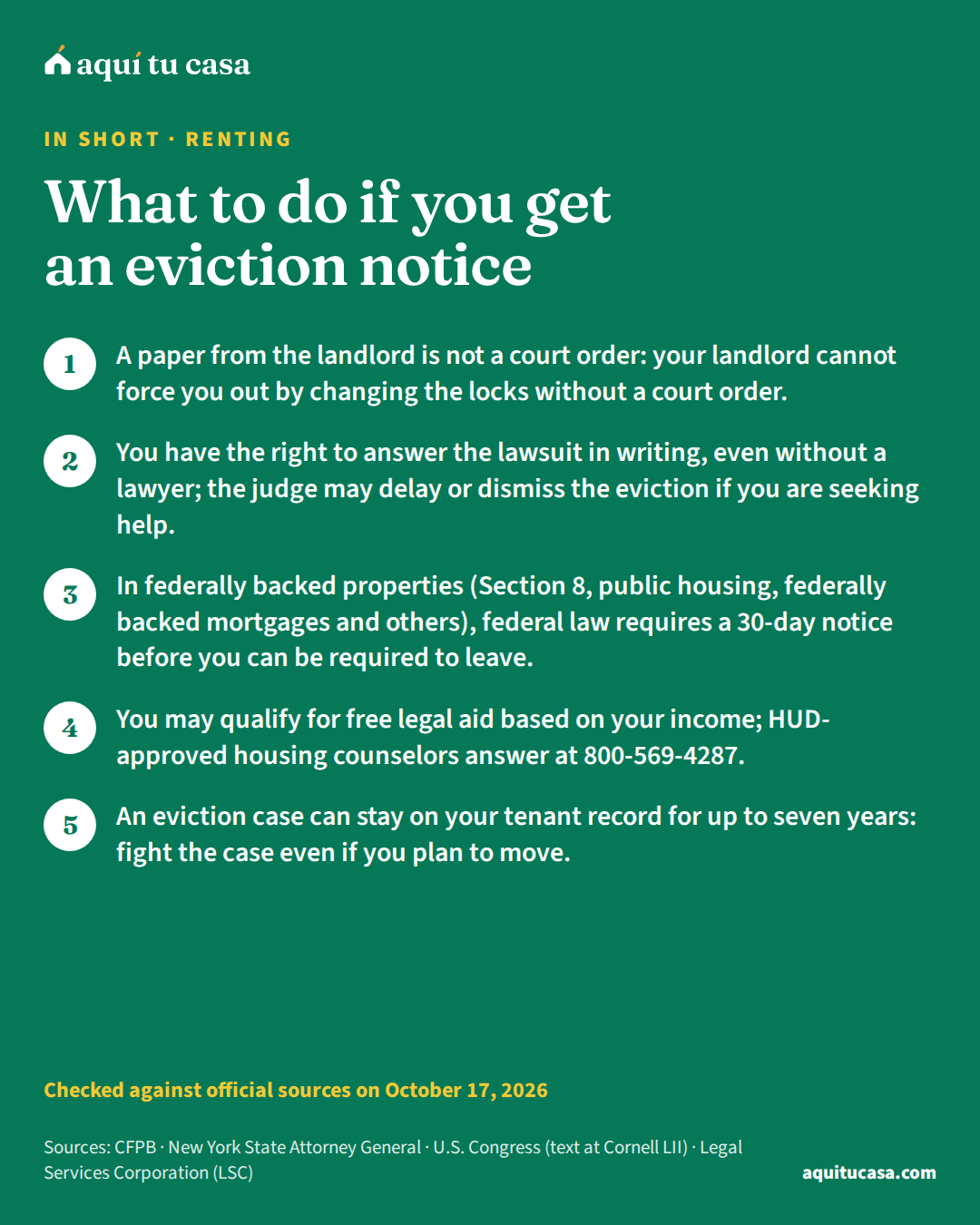
- Renting What to do if you get an eviction notice Notice, lawsuit and the judge's order: what you can do at each moment, where free legal help is and what federal law says about the 30-day notice. 14 minute read
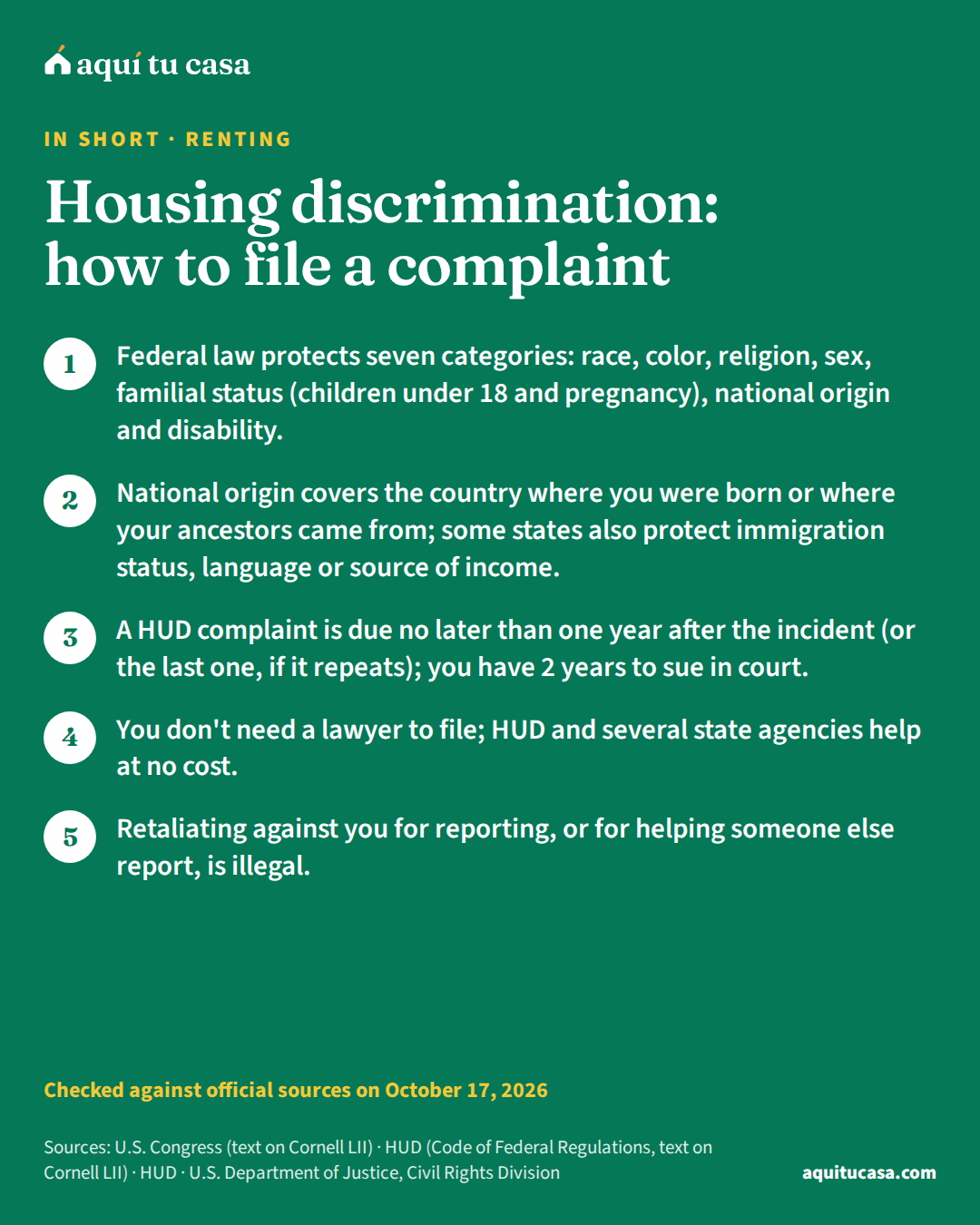
- Renting Housing discrimination: how to file a complaint What the Fair Housing Act prohibits when you rent, how national origin and children are covered, and how to file with HUD or your state on time. 11 minute read
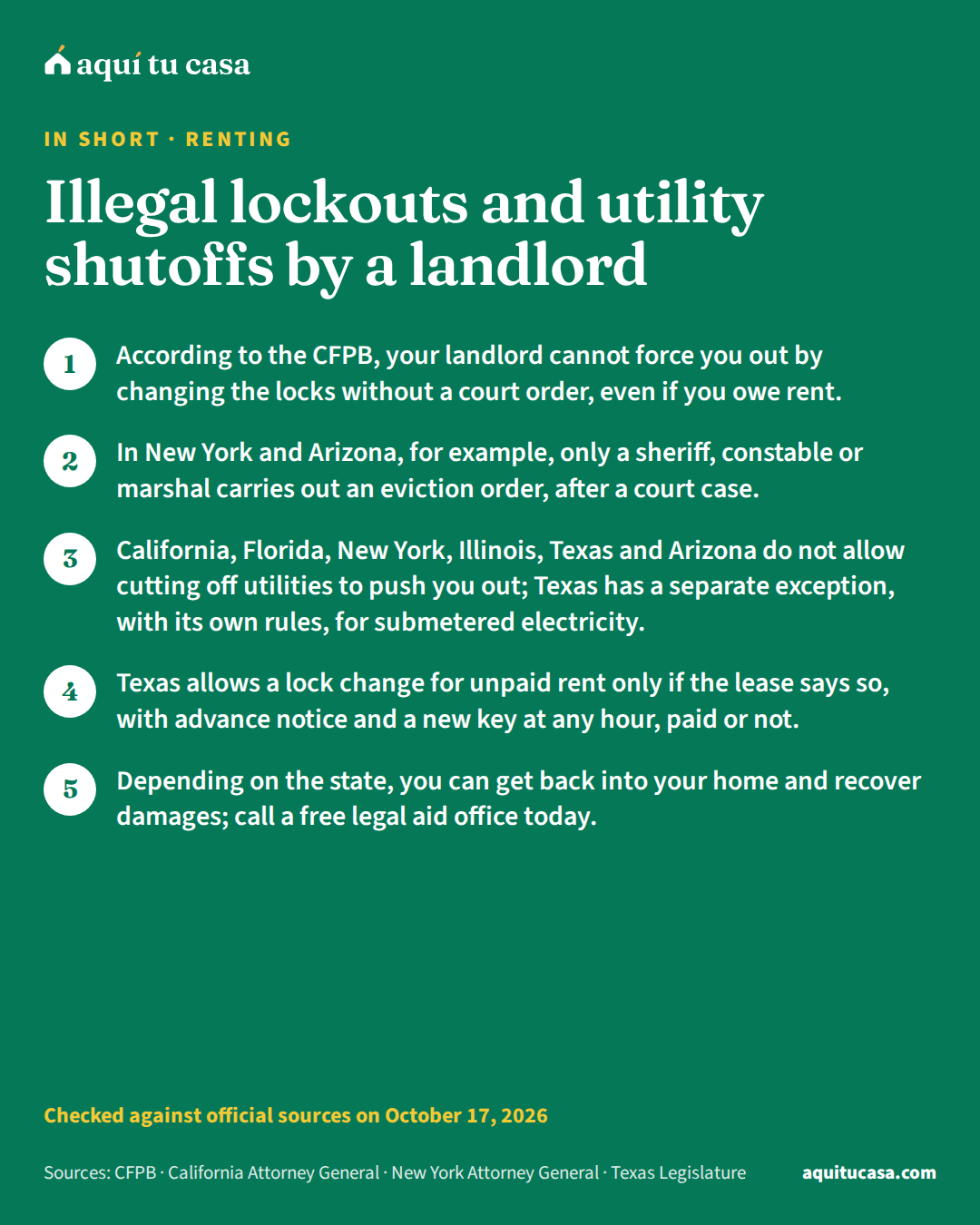
- Renting Illegal lockouts and utility shutoffs by a landlord If your landlord changed the locks, removed your things or cut off water or power to make you leave: what several states' laws say and what to do today. 12 minute read
Tools for this topic
Was this guide useful?
Thank you. Your answer stays in your browser; nothing is sent.