Renting Essential guide
How to avoid rental scams: the signs and what to do
The signs of a fake rental listing, what never to pay up front, what not to share before you sign and where to report, according to the FTC and CFPB.
Verified against official sources on October 17, 2026 15 official sources

Show contents
In short
What you need to know
Quick answer
A rental scam almost always has the same shape: a listing with rent that is too good, an "owner" who cannot show you the place (often "out of the country") and pressure to pay a deposit by wire transfer, gift cards, cryptocurrency or a payment app before you sign. The rule is simple: do not pay or hand over your Social Security number before you have seen the property, verified who owns it and have a lease. If you already paid, call your bank or the payment company and report it to the police, the website where the ad ran, the FTC and your state attorney general.
What matters most
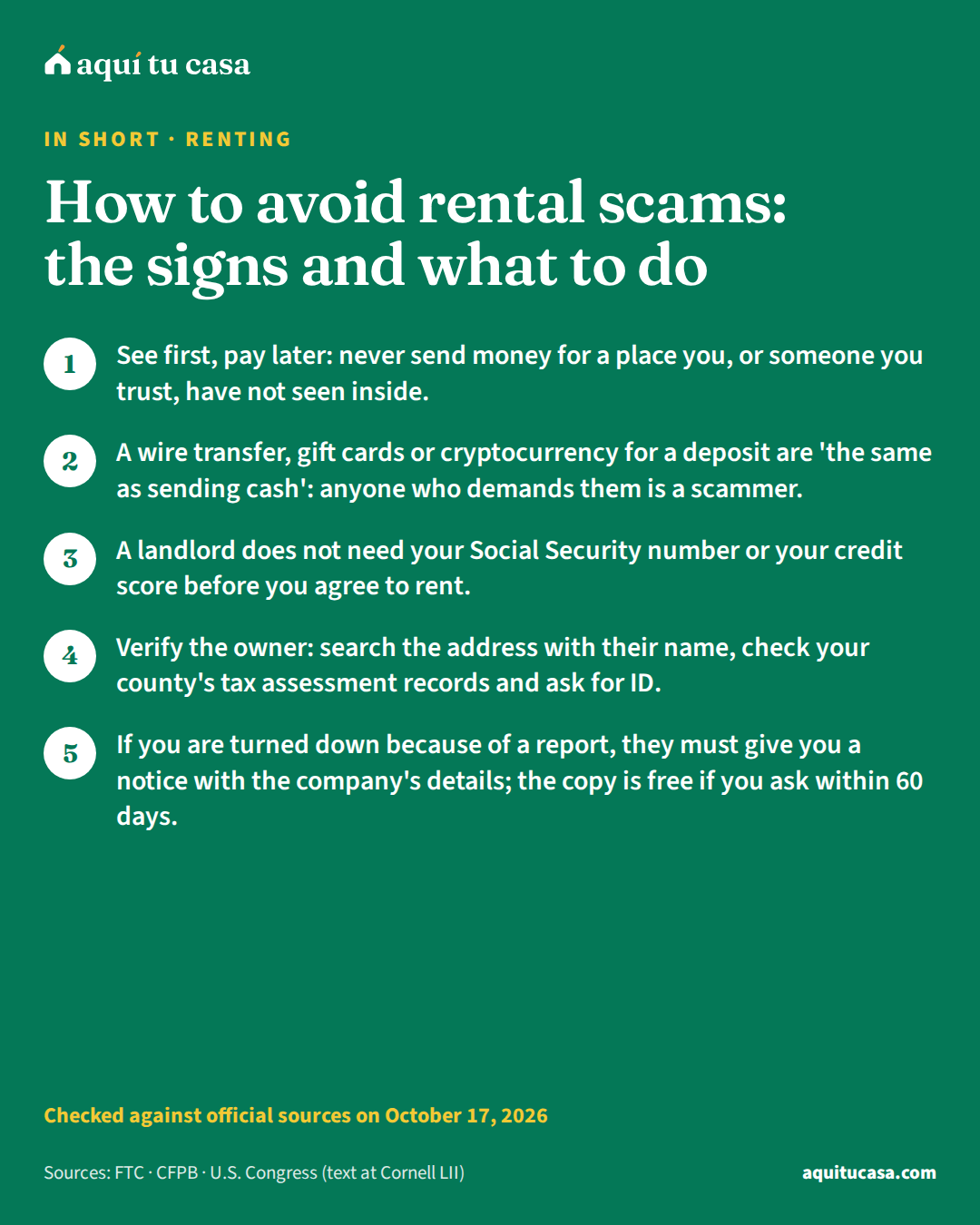
- See first, pay later: never send money for a place you, or someone you trust, have not seen inside.
- A wire transfer, gift cards or cryptocurrency for a deposit are 'the same as sending cash': anyone who demands them is a scammer.
- A landlord does not need your Social Security number or your credit score before you agree to rent.
- Verify the owner: search the address with their name, check your county's tax assessment records and ask for ID.
Is this for you?
This guide is for you if…
- You are looking for a home or apartment online and found an offer that is too good.
- An 'owner' asks for a deposit before showing you the place, or says they are out of the country.
- You just arrived and do not know what is normal to be asked for and what is not.
Get direct help first if…
- You already signed a lease and the problem is with your real landlord (repairs, deposit, eviction): look for free legal help; those are other guides.
- Your identity was stolen and accounts were opened in your name: start by getting your credit reports and disputing; the credit guide explains how.
Looking for a home online is fast, and scammers know it. They post listings that look real, ask for a deposit before you see anything and disappear. This guide gathers what the FTC (the federal consumer protection agency) and the CFPB (the federal consumer financial protection agency) publish on how these scams work, the signs that give them away and what to do if you already paid. The rest is a rule that fits in one sentence: see first, verify second, pay last, with a lease.
How rental scams work
The FTC describes two patterns. First, scammers copy the pictures, description or virtual tour from a real listing and repost it with their own contact details. Second, they advertise places that are not for rent or do not exist, with surprisingly low rent or amazing amenities. Either way, the fake owner often claims to be out of the country and rushes you.1
It is not a small problem. According to the FTC’s analysis, from January 2020 through June 2025 people reported nearly 65,000 rental scams with about $65 million in losses; the median reported loss was $1,000. About half said it started with a fake ad on Facebook and another 16% on Craigslist, and people ages 18 to 29 were three times more likely than other adults to report losing money. What they ask for is money up front: application fees, security deposits, first month’s rent to “hold” the property and $1 credit-check sign-ups that turn into recurring fees.2
The CFPB puts it the same way for every kind of fraud: scammers often ask for payment in ways that are hard to trace or recover, such as wire transfers, gift cards, mobile apps or cryptocurrency.9 That is why the payment method is almost always the last clue.
The signs
The FTC lists the signs of a fake listing:1
- The rent is much lower than typical rents in the area.
- You are pressured to decide quickly.
- The home is listed for sale, not for rent. The FTC calls this “a big red flag”: someone took the photos from a sale listing.
- The owner will not show the property and makes excuses.
- They insist on payment by wire transfer (Western Union or MoneyGram), gift cards or cryptocurrency.
- They ask for your Social Security number, a photo of your license or your pay stubs before you have agreed to rent. Also screenshots of your credit score, which can end in a paid “monitoring” subscription.
- Other ads show the same address under a different owner or company name.
The CFPB adds signs that apply to any fraud: someone asks for money or personal information, pressures you to act quickly or pretends to be someone you trust, and asks you to pay with gift cards, wire transfers, cryptocurrency or payment apps.8
Fake listing or safe process
Stop
Signs of a fake listing
- The rent is much lower than others in the area and you are rushed to decide.1
- The “owner” will not show the home or says they are out of the country.1
- They ask you to pay by wire transfer, gift cards, cryptocurrency or a payment app.8
- They ask for your Social Security number or pay stubs before you agree to rent.1
If you are being rushed, walk away: the CFPB advises not agreeing to anything when you have no time to read, ask questions or get advice.8

Before you pay a single dollar
The FTC recommends checking the listing and the owner before you sign or pay.1 These are its steps, in order:
Before you pay, step by step
1. Compare the price
See whether the rent is much lower than others in the area. Your county's typical rent and fair market rent are under Places.1
2. Search the address and the name
Search them together online, and the name with the words “complaint”, “review” or “scam”. If the same address shows up under another owner, that is a sign of a scam.1
3. Check the company's website
If they say a company manages the home, see whether it appears on that company's website.1
4. Confirm who owns it
Your city or county tax assessment records show whose name the property is in. Then ask for their ID.1
5. See the home inside
In person, with someone you trust or by video. It is no guarantee, but it rules out most fake listings.1
6. Get everything in writing
Read the application and the lease calmly. If they will not let you ask questions or get advice, walk away.8
7. Watch how you pay
Never by wire transfer, gift cards or cryptocurrency: to the FTC that is “the same as sending cash.” Get a receipt for every payment.1

If the price looks odd, the typical rent page shows the numbers for your area. To see how much you can pay without stretching, use the how much rent can I afford calculator.
Do not give personal or financial details to anyone claiming to work with the owner. Use the contact information you already had or found yourself, not what that person sends you.1 The CFPB says the same for any suspicious message: verify using contact information you know belongs to that person.8
The payment method decides almost everything. The FTC says paying by wire transfer, gift cards or cryptocurrency is “the same as sending cash”: once sent, you probably cannot get it back.1 Its most recent alert repeats it: do not send money if a landlord says you can only pay with cash, gift cards, cryptocurrency or a wire transfer; anyone who demands that you pay those ways is a scammer. Look for hidden fees too.3 Person-to-person payment apps are not safe with strangers either: the CFPB recommends using them only with people you know and trust.9
What they can ask for, and your rights
When the listing is real, the landlord can check your history before you sign. According to the CFPB, they use tenant screeningtenant screening reportA tenant screening report is a report many landlords use to decide whether to rent to you and how much to charge for the security deposit. Specialty companies prepare it, and it can include your credit report, your rental history including eviction cases and lawsuits, employment verification, criminal history and a score or recommendation. It is not the same as a credit report. If a landlord denies you, or asks for a larger deposit or higher rent, because of the report, federal law requires the landlord to tell you, name the company and explain your right to a free copy and to dispute errors.See the full definition reports that may include your credit reportcredit reportA credit report is a statement that has information about your credit activity and current credit situation: your loans and cards, the balances, whether you have paid on time, accounts in collection and who has checked your credit. Credit reporting companies, also called credit bureaus, compile it from what banks and creditors report; your credit score is computed from it. When you apply for a mortgage, the lender pulls your report from the three bureaus. You have the right to see it for free and to dispute anything that is wrong.See the full definition, your rental history (including eviction actions and lawsuits), employment verification, criminal history and a risk score or recommendation.4 That check comes after you decide to apply, with a formal application, and not by message before you have seen the place.
The CFPB explains that most tenant screening companies have no information on you until you apply for rental housing. A report with negative information can get you rejected, or approved with tough conditions, such as paying months of rent in advance or a higher security deposit. And if you send many applications, be careful: the landlord may pull your credit report as a hard inquiryhard inquiryA hard inquiry happens when a lender checks your credit report because you applied for a loan or a card, to decide whether to approve you. It can affect your score, because most scoring models look at how often and how recently you apply for credit, and other businesses that buy your report can see it. A single inquiry has little impact. Scoring models also allow for comparison shopping: several inquiries for the same type of loan, such as a mortgage, within a short period usually count as one.See the full definition, and that could lower your score.7
If you are denied housing because of one of those reports, federal law requires them to tell you, to give you the contact information of the company that made the report, and to tell you of your right to dispute the information and to a free copy if you request it within 60 days.4 The FTC adds that the same applies if you are charged higher rent, required to have a co-signer or a larger deposit because of your report: the notice can be written, electronic or verbal, and errors can be disputed.5 The reporting company generally has 30 days to investigate your dispute, and in some cases 45.6 The guide How to dispute credit report errors explains how, and How to rent without a Social Security number or credit explains what alternatives you can offer.
Before handing over any amount, ask for a written lease and a receipt for every payment. Deposit rules change from state to state; the security deposits guide explains them.
If this is you
You do not have a Social Security number
A landlord does not need your Social Security number before you agree to rent.1 If they ask for it “to hold” the place, stop.
They ask you to “verify your credit” for a dollar
The FTC describes $1 credit-check sign-ups that turn into recurring fees.2 Do not send your card details by message.
You are looking for rental assistance
The CFPB warns that scammers target people looking for that help.11 A HUD-approved housing counselor can guide you, often free or at low cost.15
If you already paid or gave your information
If you paid by wire transfer or through an app, call your bank or the payment company right away and tell them there may have been an unauthorized transaction. The CFPB says you can also file a complaint at ic3.gov, the FBI’s Internet Crime Complaint Center.9
The FTC asks you to report rental listing scams in four places: local law enforcement, the website where the ad appeared, the FTC at ReportFraud.ftc.gov and your state attorney general.1 To find your attorney general’s office, the CFPB points to the National Association of Attorneys General website; call the police or sheriff on their nonemergency number. Always use trusted websites and phone numbers.10
If you gave your Social Security number, your ITIN, a photo of your ID or your pay stubs, check your credit reports. If there is identity theft, the CFPB recommends closing the affected accounts, reporting it to the police and at IdentityTheft.gov, and placing a fraud alertfraud alertA fraud alert is a note in your credit file that requires creditors who check your report to verify your identity before opening a new account, issuing an additional card or raising your credit limit. You only need to ask one of the nationwide credit reporting companies, which must notify the others. An initial alert is for anyone who suspects they are, or are about to become, a victim of fraud or identity theft, and it lasts one year unless you ask to remove it sooner. An extended alert requires an identity theft report and lasts seven years. When you place one, you are entitled to free copies of your report.See the full definition or a security freezesecurity freezeA security freeze, also called a credit freeze, keeps new creditors from seeing your credit file, which helps stop an identity thief from opening new accounts in your name. By law it is free to place and to lift, and you must ask each of the three nationwide credit reporting companies separately. While it is on, only a few can see your file, such as creditors on accounts you already have, and you can still review your reports. It does not affect your score. Because creditors rarely lend without checking your file, it stops you too; you can lift it for free for a period of time when you need to.See the full definition on your reports. An alert requires creditors to make sure it is you before they open a new account. Asking one of the three companies is enough, since it must notify the others; an initial alert lasts one year and gives you a free copy of your report from each company.12 The guide How to read your credit report helps you check it.

When “screening” is discrimination
Some “requirements” are not risk filters but discrimination. The Fair Housing ActFair Housing ActThe Fair Housing Act is the federal law that makes it illegal to refuse to sell or rent a dwelling, or to discriminate in its terms, because of race, color, religion, sex, familial status (having children), national origin or disability. It applies to landlords, real estate agents and managers, and also to banks and lenders when their practices make housing or credit unavailable for those reasons. National origin covers your language and the country you come from, regardless of immigration status. If you believe you were discriminated against, you can file a complaint with HUD at no cost; many states add protections.See the full definition makes it unlawful to refuse to rent a dwelling, or otherwise make it unavailable, because of race, color, religion, sex, familial status or national origin, and also because of disability.13 According to the CFPB, familial status covers families with children and pregnancy, and national origin covers your country of origin or ancestry; if you think you were denied housing for one of those reasons, you can file a complaint with HUD.6 The complaint is filed not later than one year after the practice occurred or ended.14
Free legal aidlegal aidLegal aid is the free civil legal help that nonprofit organizations and their lawyers provide to low-income people in civil, not criminal, matters. In housing, that includes representing families facing eviction or foreclosure, alongside matters such as custody, child support, protection from domestic violence and access to benefits. In the United States, the Legal Services Corporation, created by Congress, funds a nationwide network of these organizations; its finder points you to the one in your area. Each sets its own income limits.See the full definition offices can tell you whether your case qualifies; you may qualify based on your income.11 A HUD-approved housing counselor can also help you review a lease before you sign it; they give independent advice on renting, buying, missed payments and credit, often free or at low cost.15 The housing scams complete guide covers other schemes, such as those around buying a home.
Costly mistakes
Mistake: Paying a deposit to “hold” a place you have not seen.
Instead: See the home inside, you or someone you trust, before you sign or pay.1
Mistake: Paying with gift cards, cryptocurrency or a wire transfer because the owner insists.
Instead: Anyone who demands payment that way is a scammer: do not send the money.3
Mistake: Checking out the owner with the phone number or link they sent you.
Instead: Use contact information you already knew or found yourself.8
Mistake: Sending your Social Security number or pay stubs by message.
Instead: A landlord does not need them before you agree to rent.1
Mistake: Sending many applications without asking how they check your credit.
Instead: A hard inquiry can lower your score; ask before you apply.7
Mistake: Waiting days to call the bank after paying a scammer.
Instead: Call your bank or the payment company right away, then report it.9

What to do this week
- Before answering a listing, compare the rent with your county’s typical rent.1
- Search the address with the owner’s name, and the name with the word “scam”.1
- Ask to see the property inside and the ID of the person showing it.1
- If something does not add up, do not pay or send information: the hurry is the scammer’s, not yours.1
- If you already paid, call your bank today and report it at ReportFraud.ftc.gov, to local police and to your state attorney general.1
Your income
Let's do the math
Rent that fits your budget (30% of income)
$2,018
With an income of $6,728 a month. Up to $3,364 would already be a severe burden (50% of income).
Compared with HUD’s Fair Market Rent in the United States
- 2 bedrooms$1,750Fits · 26%Needs $33.65 an hour
The wage needed pays that rent without going over 30% of income, working 40 hours a week all year.
The typical rent households actually pay in the United States is $1,413 a month (Census).
A reference to give you an idea. Each landlord and each program sets its own requirements.
Ready to see the numbers? Find your county here
See how this applies in your county: its loan limits, prices and rents, from the official data.
Printable checklist
Frequently asked questions
How do I know whether the person writing to me really owns the place?
Search the address online together with their name, check whether the property appears on the website of the company they claim to represent, and look up your city or county tax assessment records, which show whose name the property is in. Then ask to see their ID. If they make excuses about showing you the place, walk away.
Is it normal to be asked for a deposit to 'hold' the place?
Asking for money up front to hold a property you have not seen is one of the most common scams the FTC reports. See the home inside and verify the owner before you sign or pay, and get a receipt for every payment.
Can I pay rent with gift cards if the owner insists?
No. The FTC is clear: anyone who demands payment by gift cards, cryptocurrency, wire transfer or cash only is a scammer. Once that money is sent, you probably cannot get it back.
Is it a scam if they ask for the deposit through a payment app?
Not always, but it is a warning sign. The CFPB lists payment apps among the methods scammers use and recommends using them only with people you know and trust. If you already paid, call your bank or the app company right away and tell them there may have been an unauthorized transaction.
What do I do if I already sent the money?
Call your bank or the payment company right away. Then report it to your local police, to the website where the ad appeared, to the FTC at ReportFraud.ftc.gov or the FBI at ic3.gov, and to your state attorney general. If you gave personal information, get your free credit reports and consider a fraud alert.
Does a credit check for a rental lower my score?
It can. The CFPB explains that landlords may pull your credit report as a hard inquiry, which could lower your scores, and that this matters if you send several applications. Ask how they check credit before you apply.
What do I do if I am turned down because of a report with errors?
Ask for the adverse action notice: it must name the company that made the report. Request your free copy within 60 days and dispute the errors; the company generally has 30 days to investigate. If you think you were turned down because of your origin, your family or another protected reason, you can complain to HUD.
Sources
Every figure in this guide comes from one of these official sources. The number next to a sentence leads to the source behind it.
Each source on one line: who publishes it, its title, its address and the date we read it.
- 1. FTC · Rental Listing Scams · consumer.ftc.gov · Accessed October 16, 2026
- 2. FTC · Data Spotlight: Rental scams hit home with $65 million in reported losses · ftc.gov · Accessed October 16, 2026
- 3. FTC · Consumer Alert: Moving this summer? Watch for rental scams · consumer.ftc.gov · Accessed October 16, 2026
- 4. CFPB · What is a tenant screening report? · consumerfinance.gov · Accessed October 17, 2026
- 5. FTC · Tenant Background Checks and Your Rights · consumer.ftc.gov · Accessed October 16, 2026
- 6. CFPB · What should I do if my rental application is denied because of a tenant screening report? · consumerfinance.gov · Accessed October 17, 2026
- 7. CFPB · List of consumer reporting companies · consumerfinance.gov · Accessed October 17, 2026
- 8. CFPB · What are some classic warning signs of possible fraud and scams? · consumerfinance.gov · Accessed October 17, 2026
See the other 7 sources
- 9. CFPB · What are some common types of fraud and scams? · consumerfinance.gov · Accessed October 17, 2026
- 10. CFPB · Who do I contact for help with a scam or fraud? · consumerfinance.gov · Accessed October 17, 2026
- 11. CFPB · Help for renters · consumerfinance.gov · Accessed October 17, 2026
- 12. CFPB · What do I do if I am a victim of identity theft? · consumerfinance.gov · Accessed October 17, 2026
- 13. U.S. Congress (text at Cornell LII) · Fair Housing Act, 42 U.S.C. §3604, Discrimination in the sale or rental of housing · law.cornell.edu · Accessed October 17, 2026
- 14. U.S. Congress (text at Cornell LII) · Fair Housing Act, 42 U.S.C. §3610, Administrative enforcement · law.cornell.edu · Accessed October 17, 2026
- 15. CFPB · Find a Housing Counselor · consumerfinance.gov · Accessed October 17, 2026
Keep reading
Related guides
If this guide helped, these follow the same path.

Renting 11 minute read
How to rent without a Social Security number or credit
What a landlord can ask for, what to offer instead of an SSN and credit, how much rent fits your income and your rights if you are turned down.
- Each landlord decides what to ask for: ask what they accept instead of a Social Security number and a credit history.
- Without credit, your file speaks for you: photo ID, proof of income, bank statements and references.
- If a report gets you rejected or asked for a cosigner or a bigger deposit, they must name the company; the copy is free if you ask within 60 days.
- Protect yourself from scams Housing scams: the complete guide to spotting them The rental, mortgage, title, contractor, credit and moving scams families run into most: how to spot them, what to do and where to report them. 17 minute read
- Renting Security deposits: how much and how to get yours back What a security deposit is, how much a landlord may charge in your state, what can be deducted, when it must be returned and where to complain if it isn't. 14 minute read
- Renting Your lease explained: what to check before you sign What a lease is, which clauses to read before you sign, the lead paint disclosure, your fair housing rights and where to get free help. 15 minute read
Tools for this topic
Was this guide useful?
Thank you. Your answer stays in your browser; nothing is sent.