Security deposits: how much and how to get yours back
What a security deposit is, how much a landlord may charge in your state, what can be deducted, when it must be returned and where to complain if it isn't.
Verified against official sources on October 17, 2026 16 official sources

Show contents
In short
What you need to know
Quick answer
A security deposit is your money: the landlord holds it while you rent and, when you move out, returns it minus what the law allows, such as rent you owe or damage you caused beyond normal wear and tear. How much a landlord may charge and how fast it comes back depend on your state: in California and New York the general cap is one month's rent, and the landlord has 21 days (California), 14 (New York) or 30 (Texas) to return it with an itemized list of deductions; in Florida it is 15 days, or 30 to send notice of what the landlord plans to keep. If you do not get it back, ask in writing, file a complaint with your state or go to small claims court.
What matters most
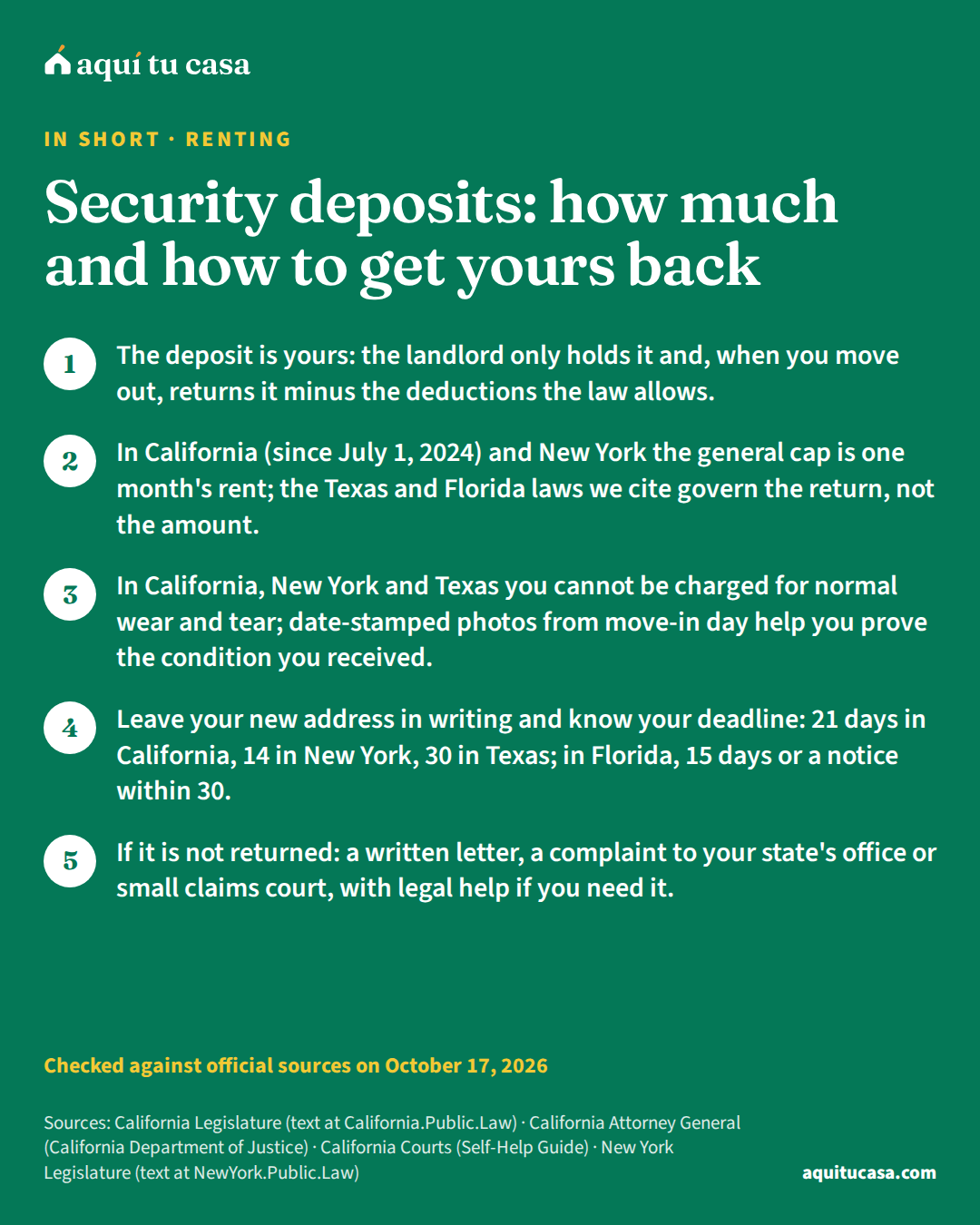
- The deposit is yours: the landlord only holds it and, when you move out, returns it minus the deductions the law allows.
- In California (since July 1, 2024) and New York the general cap is one month's rent; the Texas and Florida laws we cite govern the return, not the amount.
- In California, New York and Texas you cannot be charged for normal wear and tear; date-stamped photos from move-in day help you prove the condition you received.
- Leave your new address in writing and know your deadline: 21 days in California, 14 in New York, 30 in Texas; in Florida, 15 days or a notice within 30.
Is this for you?
This guide is for you if…
- You are about to rent, the landlord wants a deposit, and you want to know whether the amount is legal and how to protect yourself from day one.
- You are moving out and want your whole deposit back.
- You already moved out, the deadline passed, and the landlord kept your deposit or made deductions you do not understand.
Get direct help first if…
- You received an eviction notice or court papers: read the eviction notice guide first and look for free legal help today.
- You have not seen the place yet and someone wants a deposit to 'hold' it: read the rental scams guide first.
Most landlords ask for a security deposit when you sign a lease. That money is still yours, and getting it back depends a lot on what you do the day you move in and the day you move out. This guide explains what a deposit is, how much landlords can charge, where it is kept, what can be deducted, when it comes back and where to complain if it does not, with the laws of four large states and a table of more states.
What a security deposit is
A security depositsecurity depositA security deposit is money you pay the landlord when you start renting as security that you will follow the lease: pay the rent and take care of the home. The money still belongs to you. The landlord holds it and, when you move out, must return it minus the charges the law allows, such as past-due rent or damage beyond normal wear and tear. You should not be charged for damage that was already there when you moved in. The maximum amount and the deadline to return it depend on your state's law and sometimes your city's.See the full definition is money you give the landlord as security that you will follow the leaseleaseA lease, or rental agreement, is the contract in which the owner or landlord gives you the right to live in and use a property for a set period of time in exchange for payment, usually rent. While the lease lasts you have possession, but the landlord still owns the property. The lease says how much you pay and when, who handles maintenance and how the agreement can end. Your rights as a tenant are usually spelled out in the lease and in your state and local laws. Before complaining to the landlord, it helps to read the lease and make sure you are also following the rules you agreed to.See the full definition. Texas law, for example, defines it as an advance of money, other than an application deposit or prepaid rent, that is meant to secure the lease.7 The Texas Attorney General notes that most landlords require one.8
The money does not stop being yours. The California Attorney General puts it plainly: the deposit belongs to the tenant, the landlord holds it until you move out and, by law, returns it when you leave, minus allowed expenses.2
How much a landlord can charge and when it comes back
The rules come from each state’s law, and sometimes from your city or county, which may add protections.2 Here is what four large states say:
| State | Does the law set a cap? | Deadline to return it | What you must receive |
|---|---|---|---|
| California | Yes: one month’s rent, on top of the first month; certain small landlords, up to two months (not if the tenant is a service member)1 | 21 calendar days after you move out1 | Itemized statement; receipts and photos if deductions exceed $1251 |
| New York | Yes: one month’s rent5 | 14 days after you move out (units that are not rent stabilized)5 | Itemized statement; if it is late, the landlord forfeits the right to keep any of it5 |
| Texas | Not in the security deposit subchapter7 | The 30th day after you surrender the unit7 | Written description and itemized list of deductions, once you give a forwarding address in writing7 |
| Florida | Not in the deposit section; the state says the landlord “has the discretion” to collect deposits10 | 15 days if nothing is deducted; to deduct, written notice within 30 days9 | Notice with the amount and reason; you have 15 days to object in writing9 |
Rules change from state to state, and your city or county can add its own.2 This table brings together the cap and the deadline the law sets in the states where we have them verified; each state’s page has the details, the exceptions and the exact law. A dash (—) means there is no verified cap: in Texas and Florida, the sections of law we cite do not set a maximum amount.79
Deposit cap and return deadline, by state
| State | Deposit limit | Time to return the deposit |
|---|---|---|
| Alabama | Up to 1 month of rent | 60 calendar days |
| Arizona | Up to 1.5 months of rent | 14 business days |
| Arkansas | Up to 2 months of rent | 60 days |
| California | Up to 1 month of rent | 21 days |
| Colorado | Up to 2 months of rent | 1 day |
| Connecticut | Up to 2 months of rent | — |
| Delaware | Up to 1 month of rent | — |
| District of Columbia | Up to 1 month of rent | — |
| Florida | — | 15 days |
| Georgia | Up to 2 months of rent | 30 days |
| Hawaii | Up to 1 month of rent | 14 days |
| Idaho | — | 21 days |
| Illinois | — | 45 days |
| Indiana | — | 45 days |
| Iowa | Up to 2 months of rent | 30 days |
| Kansas | Up to 1 month of rent | 30 days |
| Louisiana | — | 1 day |
| Maine | Up to 2 months of rent | — |
| Maryland | Up to 1 month of rent | 45 days |
| Massachusetts | Up to 1 month of rent | 30 days |
| Michigan | Up to 1.5 months of rent | 30 days |
| Minnesota | — | 21 days |
| Mississippi | — | 45 days |
| Missouri | Up to 2 months of rent | 30 days |
| Nebraska | Up to 1 month of rent | 14 days |
| Nevada | Up to 3 months of rent | 30 days |
| New Hampshire | Up to 1 month of rent | 30 days |
| New Jersey | Up to 1.5 months of rent | 30 days |
| New York | Up to 1 month of rent | 14 days |
| North Carolina | — | 30 days |
| North Dakota | Up to 1 month of rent | 30 days |
| Ohio | — | 30 days |
| Oklahoma | — | 45 days |
| Oregon | — | 31 days |
| Pennsylvania | Up to 2 months of rent | 30 days |
| Rhode Island | Up to 1 month of rent | 20 days |
| South Carolina | — | 30 days |
| South Dakota | Up to 1 month of rent | 21 days |
| Texas | — | 30 days |
| Utah | — | 30 days |
| Vermont | — | 14 days |
| Virginia | Up to 2 months of rent | 45 days |
| Washington | — | 30 days |
| Wisconsin | — | 21 days |
| Wyoming | — | 30 days |
These are each state's general rules; your city may give more protection.2 Tap your state to see the exceptions. Source: each state's laws
In New York, the Attorney General adds that the one-month limit means a landlord cannot ask for last month’s rent and a security deposit.6 If your state is not in the table, look up its page under Places, with its tenant rules and sources. Before you sign, work out what you can afford with our rent calculator.

The amount can also depend on your history. According to the CFPB, many landlords use a tenant screeningtenant screening reportA tenant screening report is a report many landlords use to decide whether to rent to you and how much to charge for the security deposit. Specialty companies prepare it, and it can include your credit report, your rental history including eviction cases and lawsuits, employment verification, criminal history and a score or recommendation. It is not the same as a credit report. If a landlord denies you, or asks for a larger deposit or higher rent, because of the report, federal law requires the landlord to tell you, name the company and explain your right to a free copy and to dispute errors.See the full definition report to decide how much to charge for the deposit.14 If you are asked for a larger deposit than other applicants because of what that report says, federal law requires the landlord to give you a notice naming the company that made it and explaining your right to a free copy.15
If this is you
You cannot cover the deposit
The CFPB explains that some local rental assistance programs help with the deposit on a new home; many have closed, but some money may still be available.16 Look in assistance programs.
You are asked for more deposit because of your credit
If it is because of what a report says, they must give you a notice with the company and your right to a free copy.15 Read how to rent without a Social Security number or credit.
You serve in the military and rent in California
The exception that lets certain small landlords charge up to two months does not apply if the tenant is a service member.1
Where your money is kept while you rent
While you live in the home, the deposit is not the landlord’s money. Some laws say where and how it must be kept:
- New York. Every landlord must treat deposits as trust funds that belong to the tenants, without mixing them with their own money. In buildings with six or more apartments, deposits go into a New York bank account earning interest, and you must be told in writing the bank’s name and address and the amount. The landlord may keep 1% of the deposit a year for administration; the rest of the interest is yours. If the rent goes up, the landlord may ask for more to bring the deposit up to the new monthly rent.6
- Florida. The landlord must keep the deposit in a separate account at a Florida financial institution, without mixing it with their own money, or post a surety bond. A landlord who rents five or more units must give you written notice, in the lease or within 30 days, saying where your money is and whether you are entitled to interest.9
- California. The state Attorney General notes that some cities make landlords pay interest on security deposits.2
Keep those notices with your lease. When you move out, they tell you who to ask.

Before you move in: the inspection and photos
What you do not write down on day one is hard to prove later. That is what a move-in inspectionmove-in inspectionA move-in inspection is the walk-through of the home done before you move in to record in writing the condition of the unit and the equipment that comes with it. In public housing, the federal rule requires the agency and the tenant to inspect it together and sign a statement of its condition. Another inspection is done when you move out. The difference between the condition at move-in and at move-out is the basis for any charge against your deposit, if the damage goes beyond normal wear and tear. That record helps keep you from being charged for damage that was already there.See the full definition is for: putting the condition of the unit in writing.
- New York. Before you move in, the landlord must offer to inspect the unit with you. If you ask, you both sign an agreement listing existing defects, and nothing listed there can be deducted at move-out.5
- California. For tenancies that begin on or after July 1, 2025, the landlord must photograph the unit at the start. Since April 1, 2025, the landlord must also photograph it when you leave, before and after any repairs, and send you those photos with the statement of deductions.1
- Florida. The state agency recommends examining the unit before signing, noting anything damaged, taking date-stamped pictures, giving a copy to the landlord and keeping one.10

Pay the deposit in a way that leaves a record, and keep the receipt. In California, the law accepts a canceled check, a receipt or a lease stating the amount as proof.1
What can and cannot be deducted
In California, New York and Texas the idea is the same: the landlord can deduct what you owe or what you damaged, but not the normal wear and tear of living in the home.157
| Can be deducted | Cannot be deducted |
|---|---|
| Unpaid rent15 | Normal wear and tear157 |
| Damage caused by you or your guests15 | Damage that existed before your tenancy (California) or was left by a prior tenant (New York)15 |
| Cleaning to bring the unit back to move-in condition (California)1 | Anything noted in the move-in inspection agreement (New York)5 |
| Utilities payable to the landlord, and moving and storing your belongings (New York)5 | A “nonrefundable” deposit: in California a lease cannot call it that1 |
In California, the landlord may also charge to restore or replace furniture or other personal property, but only if the lease allows it.1
When you move out: the deadline and the itemized list
These are the steps from deciding to leave to getting your money back, with what the four states’ laws say:
From your move-out notice to your refund
3. Take photos when you hand it back
The day you move out
Repeat the date-stamped photos of every room. In California, the landlord must also take photos when you return the unit.1
5. Get the itemized statement and the rest of the deposit
21 days in California, 14 in New York, 30 in Texas
In California, if repair and cleaning deductions exceed $125, the statement comes with copies of receipts, or the time spent and hourly rate; if not, you can still ask for those papers within 14 days.571
6. In Florida, answer on time
15 days from receiving the notice
Object in writing to the notice of deductions. If you do not, the landlord deducts, but you can still claim damages later in a separate case.9
7. If it does not arrive or you disagree, ask in writing
When the deadline passes
A letter to the landlord, with a copy for you. If there is no answer, a complaint to your state or small claims court.4
If you do not get it back: how to ask and where to complain
1. Ask in writing. The California courts say that if you do not get the whole deposit on time or disagree with the deductions, you can send the landlord a letter and keep a copy.4 Florida law advises trying to settle before suing,9 and the Texas Attorney General says to contact the landlord if you have no answer after 30 days.8
2. File a complaint with your state.
- New York: the Attorney General may be able to help through its rent security complaint form.6
- Texas: you can file a complaint with the Attorney General.8
- Florida: you can file a complaint with FDACS or go to court.10
- Other states: USAGov suggests reading your lease carefully, then finding your state agency for tenant rights, such as the attorney general or housing agency.11
3. Go to small claims court. In California, a deposit case can go to small claims court if the amount is within its limit.14 This is what the laws say when a landlord does not comply:
| State | What the law says |
|---|---|
| California | For bad faith, up to twice the deposit plus actual damages; the landlord must prove the charges are reasonable1 |
| New York | No statement within 14 days means the landlord forfeits the right to keep any of it; up to twice the deposit for willful violations5 |
| Texas | For bad faith, $100, plus three times the amount wrongfully withheld, plus reasonable attorney’s fees; bad faith is presumed after 30 days7 |
| Florida | The winner, tenant or landlord, receives court costs and a reasonable attorney’s fee, generally paid by the losing party9 |
Complaining is your right. Florida’s agency explains that a landlord may not evict you solely in retaliationlandlord retaliationLandlord retaliation happens when the landlord punishes you for using a legal right. For example, the landlord tries to evict you because you complained in good faith to a government office about health or safety problems in the home, or because you organized with other tenants. Not every state recognizes it, and each one defines and proves it differently. In addition, the federal Fair Housing Act prohibits retaliating against a person for filing a housing discrimination complaint or taking part in that process.See the full definition for complaining to a government agency or asserting your tenant rights.10 If you also got an eviction notice, see your state’s eviction timeline and the guide What to do if you get an eviction notice.
You do not have to do this alone. The LSC funds civil legal aidlegal aidLegal aid is the free civil legal help that nonprofit organizations and their lawyers provide to low-income people in civil, not criminal, matters. In housing, that includes representing families facing eviction or foreclosure, alongside matters such as custody, child support, protection from domestic violence and access to benefits. In the United States, the Legal Services Corporation, created by Congress, funds a nationwide network of these organizations; its finder points you to the one in your area. Each sets its own income limits.See the full definition for low-income Americans, and its search tool finds an organization near you.12 A HUD-approved housing counselorHUD-approved housing counselorA HUD-approved housing counselor works at an agency HUD has approved to provide housing counseling: independent, expert advice customized to your situation about buying a home, renting, a missed mortgage payment, a foreclosure or credit problems. The agencies usually charge little or nothing; many serve in Spanish and offer the homebuyer education course several assistance programs require. They are not lenders or real estate agents and sell you nothing. Your county page lists the official agencies with phone numbers.See the full definition also gives advice on renting, often at little or no cost.13

Costly mistakes
Mistake: Moving in without date-stamped photos of every room.
Instead: Take photos or video the day you move in, send a copy to the landlord and keep one.10
Mistake: Paying the deposit in cash with no receipt.
Instead: Pay in a way that leaves a record: in California, a canceled check or a receipt works as proof.1
Mistake: Skipping the last month's rent so the landlord uses the deposit.
Instead: In Texas that is presumed bad faith and can cost you three times that rent.7
Mistake: Leaving without giving your new address in writing.
Instead: In Texas, the landlord does not have to refund it until you do; put it in writing and keep a copy.7
Mistake: Ignoring a notice of deductions in Florida.
Instead: You have 15 days from receiving it to object in writing.9
Mistake: Accepting a charge for a carpet worn down by normal use.
Instead: Normal wear and tear cannot be deducted in California, New York or Texas.1
What to do this week
- Find your state’s page under Places and write down the deposit cap and the return deadline.2
- If you are moving into a new place, ask for a move-in inspection and take date-stamped photos of every room.10
- Keep the deposit receipt and a signed copy of your lease.1
- If you are moving out, check how much notice your lease requires and give your new address in writing.7
- If the deadline has passed, send the landlord a letter asking for the deposit and keep a copy; if there is no answer, file a complaint or go to small claims court.411
Your income
Let's do the math
Rent that fits your budget (30% of income)
$2,018
With an income of $6,728 a month. Up to $3,364 would already be a severe burden (50% of income).
Compared with HUD’s Fair Market Rent in the United States
- 2 bedrooms$1,750Fits · 26%Needs $33.65 an hour
The wage needed pays that rent without going over 30% of income, working 40 hours a week all year.
The typical rent households actually pay in the United States is $1,413 a month (Census).
A reference to give you an idea. Each landlord and each program sets its own requirements.
Ready to see the numbers? Find your county here
See how this applies in your county: its loan limits, prices and rents, from the official data.
Printable checklist
Frequently asked questions
Can a landlord ask for last month's rent on top of the deposit?
In New York, no: the state Attorney General explains that the one-month limit means a landlord cannot ask for last month's rent and a security deposit. Elsewhere it depends on state law; check your state's page under Places.
Can I skip the last month's rent and let the landlord keep the deposit?
In Texas the law prohibits it: if you withhold the last month's rent on the grounds that the deposit covers it, you are presumed to have acted in bad faith and could owe the landlord three times that rent plus the landlord's attorney's fees. In other states, check your lease and your state's law first.
What happens if I do not give the landlord my new address?
In Texas, the landlord does not have to refund the deposit or send the list of deductions until you give your forwarding address in writing, although you do not lose your right to the deposit. In Florida, the disclosure you get at signing says you must give your new address when you move out. Always put it in writing and keep a copy.
Do I need a lawyer to get my deposit back?
You can start on your own: a letter asking for the deposit, a complaint to your state's office and, if needed, small claims court. If you want guidance, a legal aid organization or a HUD-approved housing counselor (often free or low cost) can look at your situation.
How long does the landlord have to return my deposit?
It depends on the state: 21 days in California, 14 in New York and 30 in Texas, with the itemized list of deductions. In Florida it is 15 days if nothing is deducted, or written notice within 30 days to deduct. The table in this guide and your state's page under Places have the deadline for more states.
Can they charge me for a worn carpet when I move out?
Not for the normal wear and tear of living there. The Texas Attorney General explains it with a carpet: if it wore down because people walked on it for a year, you cannot be charged for a new one; if it got mildewed because your water bed leaked, you can. In California, New York and Texas the landlord cannot deduct normal wear and tear.
Does the landlord have to pay me interest on my deposit?
It depends on where you live. In New York, in buildings with six or more apartments, the deposit goes into an account that earns interest, and almost all of the interest is yours. In Florida, a landlord who rents five or more units must tell you in writing where the deposit is held and whether you are entitled to interest. In California, some cities require interest.
Is there help paying the deposit on a new place?
There may be. The CFPB explains that some local rental assistance programs help with moving costs, the deposit and application fees for a new home; many have closed, but some money may still be available. Look for your area's programs among your state's assistance programs or ask a HUD-approved housing counselor.
Sources
Every figure in this guide comes from one of these official sources. The number next to a sentence leads to the source behind it.
Each source on one line: who publishes it, its title, its address and the date we read it.
- 1. California Legislature (text at California.Public.Law) · California Civil Code §1950.5 (Security for rental agreements) · california.public.law · Accessed October 17, 2026
- 2. California Attorney General (California Department of Justice) · Consumer Alert: Know Your Rights as a California Tenant, Security Deposits · oag.ca.gov · Accessed October 17, 2026
- 3. California Attorney General (California Department of Justice) · Landlord-Tenant Issues · oag.ca.gov · Accessed October 17, 2026
- 4. California Courts (Self-Help Guide) · Guide to security deposits in California · selfhelp.courts.ca.gov · Accessed October 17, 2026
- 5. New York Legislature (text at NewYork.Public.Law) · New York General Obligations Law §7-108 (Deposits made by tenants of non-rent stabilized dwelling units) · newyork.public.law · Accessed October 17, 2026
- 6. New York State Attorney General · Residential Tenants' Rights Guide · ag.ny.gov · Accessed October 17, 2026
- 7. Texas Legislature (Texas Constitution and Statutes) · Texas Property Code, chapter 92, subchapter C (Security Deposits) · tcss.legis.texas.gov · Accessed October 17, 2026
- 8. Texas Attorney General · Renter's Rights · texasattorneygeneral.gov · Accessed October 17, 2026
See the other 8 sources
- 9. Florida Legislature · Florida Statutes §83.49 (Deposit money or advance rent; duty of landlord and tenant) · leg.state.fl.us · Accessed October 17, 2026
- 10. Florida Department of Agriculture and Consumer Services (FDACS) · Landlord/Tenant Law in Florida · fdacs.gov · Accessed October 17, 2026
- 11. USAGov · How to file a complaint against a landlord · usa.gov · Accessed October 17, 2026
- 12. Legal Services Corporation (LSC) · I Need Legal Help · lsc.gov · Accessed October 17, 2026
- 13. CFPB · Find a Housing Counselor · consumerfinance.gov · Accessed October 17, 2026
- 14. CFPB · What is a tenant screening report? · consumerfinance.gov · Accessed October 17, 2026
- 15. CFPB · What should I do if my rental application is denied because of a tenant screening report? · consumerfinance.gov · Accessed October 17, 2026
- 16. CFPB · What to do if you're facing eviction · consumerfinance.gov · Accessed October 17, 2026
Keep reading
Related guides
If this guide helped, these follow the same path.

Renting 12 minute read
How to avoid rental scams: the signs and what to do
The signs of a fake rental listing, what never to pay up front, what not to share before you sign and where to report, according to the FTC and CFPB.
- See first, pay later: never send money for a place you, or someone you trust, have not seen inside.
- A wire transfer, gift cards or cryptocurrency for a deposit are 'the same as sending cash': anyone who demands them is a scammer.
- A landlord does not need your Social Security number or your credit score before you agree to rent.
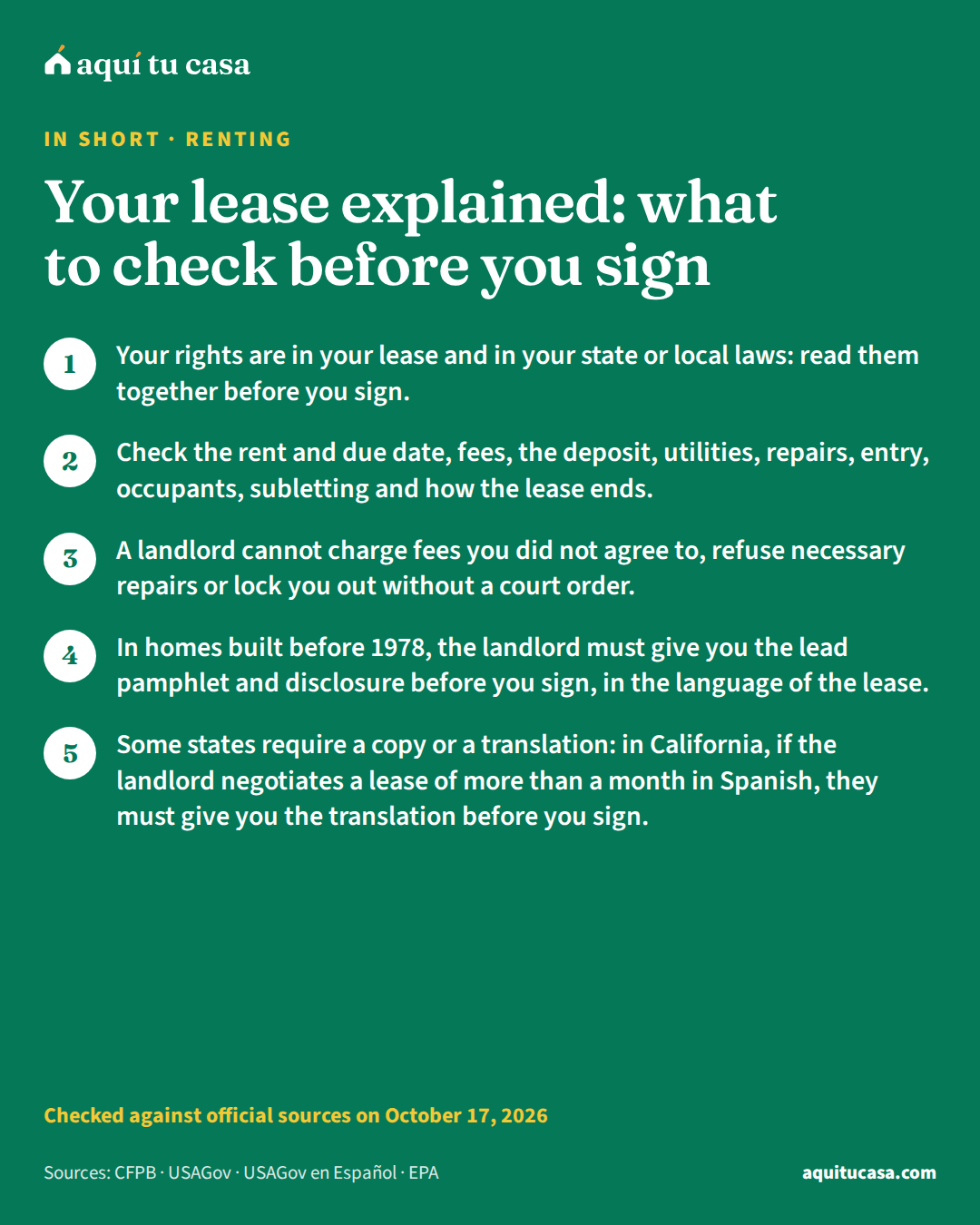
- Renting Your lease explained: what to check before you sign What a lease is, which clauses to read before you sign, the lead paint disclosure, your fair housing rights and where to get free help. 15 minute read
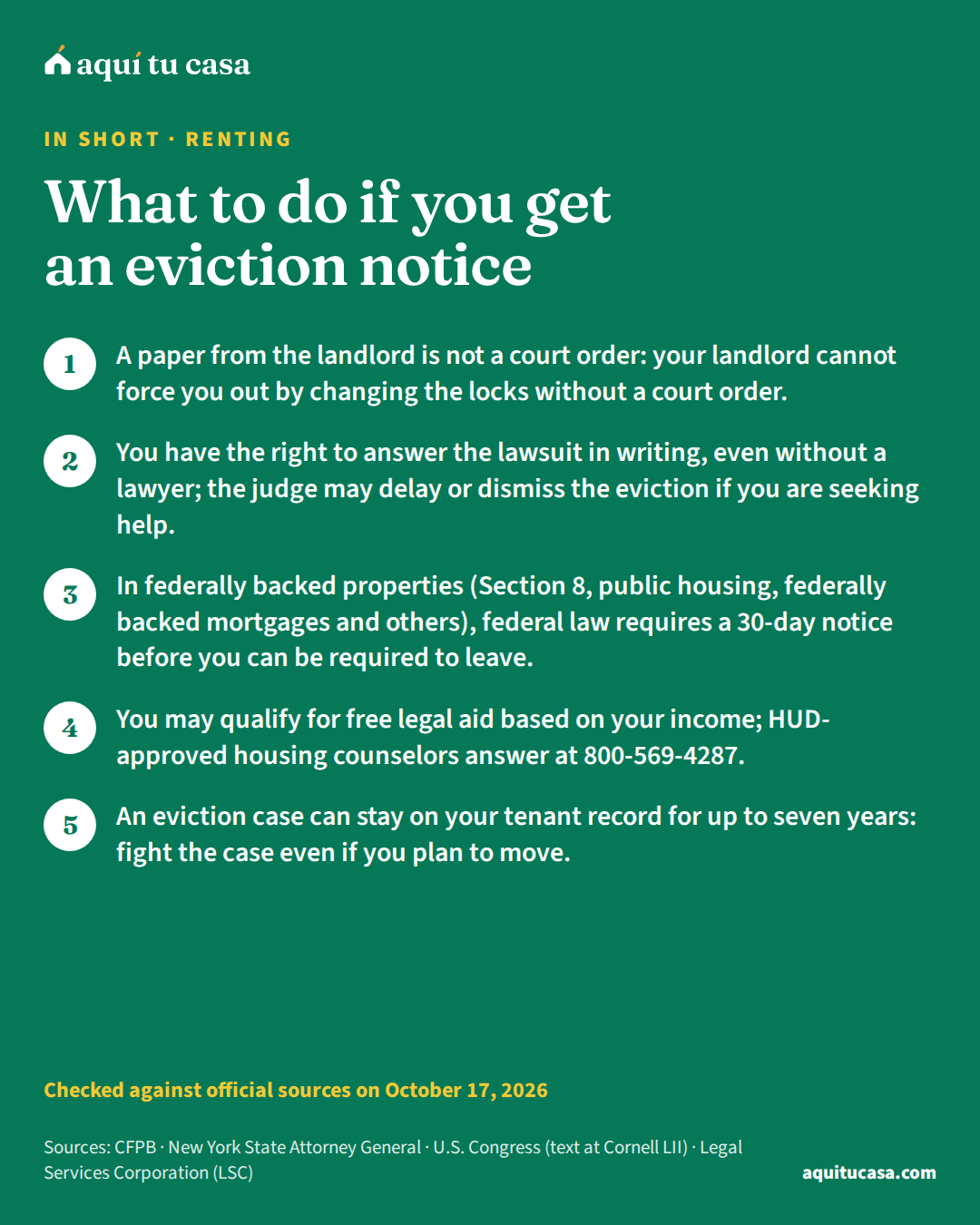
- Renting What to do if you get an eviction notice Notice, lawsuit and the judge's order: what you can do at each moment, where free legal help is and what federal law says about the 30-day notice. 14 minute read
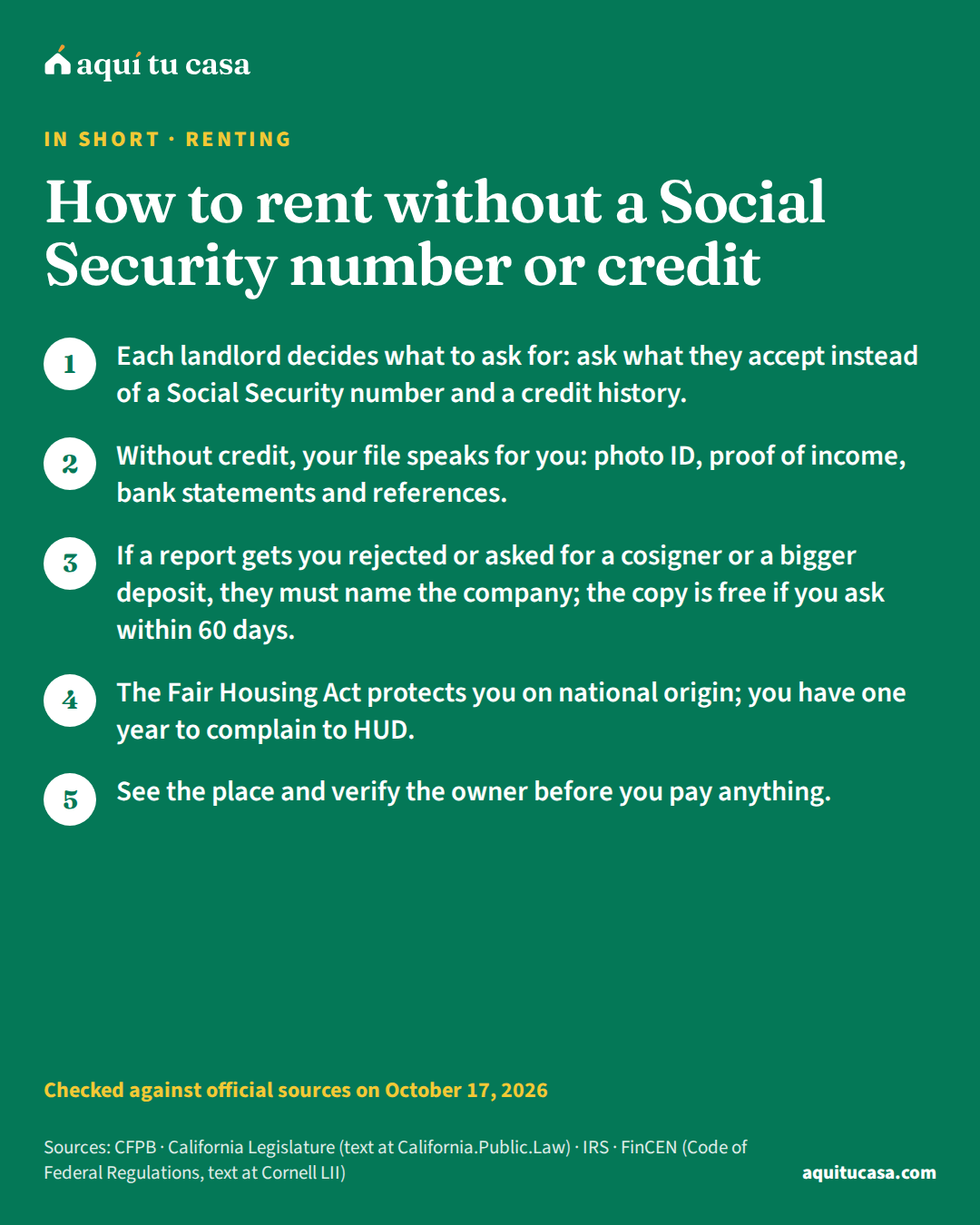
- Renting How to rent without a Social Security number or credit What a landlord can ask for, what to offer instead of an SSN and credit, how much rent fits your income and your rights if you are turned down. 11 minute read
Tools for this topic
Was this guide useful?
Thank you. Your answer stays in your browser; nothing is sent.