Your lease explained: what to check before you sign
What a lease is, which clauses to read before you sign, the lead paint disclosure, your fair housing rights and where to get free help.
Verified against official sources on October 17, 2026 14 official sources

Show contents
In short
What you need to know
Quick answer
A lease is the agreement that says how much you pay, when, who fixes what and how it ends; your rights are in that lease and in your state's laws. Before you sign, read the rent and due date, late fees, the deposit, utilities, repairs, the landlord's entry, occupants, subletting and how the lease renews or ends. If the home was built before 1978, the landlord must give you the federal lead disclosure before you sign. And no lease can set different rules for you because of your national origin, your family or any other ground the Fair Housing Act protects.
What matters most
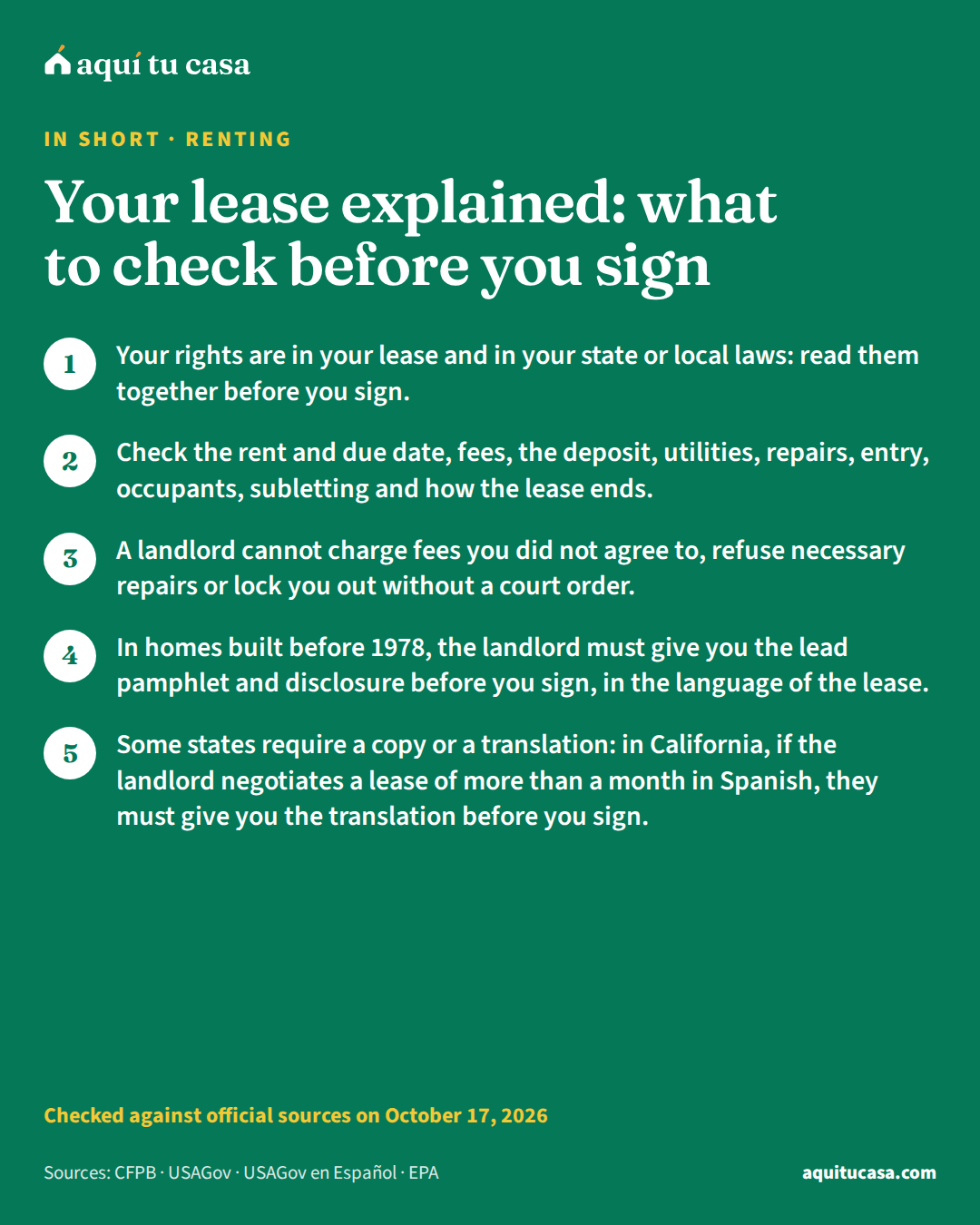
- Your rights are in your lease and in your state or local laws: read them together before you sign.
- Check the rent and due date, fees, the deposit, utilities, repairs, entry, occupants, subletting and how the lease ends.
- A landlord cannot charge fees you did not agree to, refuse necessary repairs or lock you out without a court order.
- In homes built before 1978, the landlord must give you the lead pamphlet and disclosure before you sign, in the language of the lease.
Is this for you?
This guide is for you if…
- You are about to sign a lease in the United States and want to know what to check first.
- You already signed and want to understand what it says about fees, repairs or how it ends.
- You negotiated in Spanish and the landlord handed you a lease in English.
Get direct help first if…
- You already received an eviction notice or court papers: go to the eviction guide and look for free legal aid today.
- You need your state's exact deposit cap or notice periods: this guide covers the basics; the exact rule is in your state's law.
Signing a lease is easy; understanding it takes more work. This guide is for anyone about to rent in the United States, or who already signed and wants to know what they agreed to. It covers which clauses to read, what some federal and state laws say, how a lease is renewed or ended, and where to get free help.
What a lease is, and the two common kinds
A leaseleaseA lease, or rental agreement, is the contract in which the owner or landlord gives you the right to live in and use a property for a set period of time in exchange for payment, usually rent. While the lease lasts you have possession, but the landlord still owns the property. The lease says how much you pay and when, who handles maintenance and how the agreement can end. Your rights as a tenant are usually spelled out in the lease and in your state and local laws. Before complaining to the landlord, it helps to read the lease and make sure you are also following the rules you agreed to.See the full definition, or rental agreement, is the contract between you, the tenant, and the owner or landlord. According to the CFPB (the federal consumer financial protection agency), you have local, state and federal rights as a renter, and your rights as a tenant are usually spelled out in your lease and in state or local laws.1
The New York Attorney General’s guide explains it well. A lease holds the terms and conditions of the rental, and it cannot be changed while it is in effect unless both parties agree. At a minimum, it should identify the home, the names and addresses of the parties, the rent and its due dates, how long it lasts, the conditions of occupancy and each side’s rights and obligations. If you change something, you both initial it. For units that are not rent stabilized a lease can be oral, but a written one helps avoid disputes.14
There are two common kinds. New York’s rules serve as an example; your state’s may differ.
Fixed-term or month-to-month
Has an end date
Fixed-term lease
No end date
Month-to-month
- In New York, a tenant who stays past the end of a lease becomes month-to-month if the landlord accepts the rent.14
- Either side can end it with notice; outside New York City, the tenant gives one month's notice.14
- In New York, the landlord needs your consent to raise the rent; if you do not agree, they can end the tenancy with notice.14
Check which one your lease is and how it ends: your rights are in the lease and in your state's law.1
Either way, look for how it ends: whether it renews automatically, whether it rolls over to month-to-month and how much notice you must give to leave. Rent can also go up; the CFPB explains that prior notice is required and that how much notice varies by state and local laws.2
USAGov advises reading your lease carefully before seeking outside help and making sure you are following the rules you agreed to; your state’s tenant rights agency may have a tenant handbook.3 Find your state under Places.
The money: rent, fees, deposit and utilities
Before you sign, find these clauses:
| Clause | What to check |
|---|---|
| Rent and due date | How much, which day, to whom and how. Ask for a receipt. |
| Late fees | How much and starting which day. |
| Security depositsecurity depositA security deposit is money you pay the landlord when you start renting as security that you will follow the lease: pay the rent and take care of the home. The money still belongs to you. The landlord holds it and, when you move out, must return it minus the charges the law allows, such as past-due rent or damage beyond normal wear and tear. You should not be charged for damage that was already there when you moved in. The maximum amount and the deadline to return it depend on your state's law and sometimes your city's.See the full definition | How much and when it comes back. |
| Utilities | Which ones you pay and which ones the landlord pays. |
| Pets | Whether they are allowed and with what deposit. |
| Renters insurancerenters insuranceRenters insurance, also called tenants insurance, protects your belongings and protects you when you rent. The landlord's insurance covers the building, but not your furniture, clothes or electronics. It usually includes three coverages: your personal property, even if it is stolen away from home; additional living expenses if a covered loss forces you to move out for a while; and personal liability if someone is hurt in your home. A standard policy does not cover floods, which are insured separately. Some landlords require it.See the full definition | Whether the lease requires it. |
According to the CFPB, your landlord cannot demand fees, interest or other charges you did not agree to or that state or local law prohibits, and cannot fail to pay for utilities under their control.1 Check what your monthly payment covers: water, sewer, garbage, internet, television and phone are generally not included.2
Some states limit late fees. In New York, for example, a payment only counts as late if it arrives more than five days after the due date, and the maximum fee is $50 or 5% of the monthly rent, whichever is less.14 There too, if you pay in cash, by money order or by cashier’s check, the landlord must give you a written receipt with the date, the amount, the period covered and the apartment number.14
On the deposit, the CFPB notes that a lower credit score may mean a higher deposit or a rejected application.2 Whether there is a cap, and how quickly the deposit must come back, is up to your state’s law;1 the security deposits guide explains more. With pets, the type and number are usually limited, and an extra deposit is often required.2
Is the rent you are being asked normal? Typical rent varies a lot from state to state. This table shows each state’s median according to the Census; your state’s and county’s pages have more detail.
Typical rent by state
| State | Typical rent |
|---|---|
| Alabama | $1,007 |
| Alaska | $1,419 |
| Arizona | $1,543 |
| Arkansas | $947 |
| California | $2,036 |
| Colorado | $1,761 |
| Connecticut | $1,488 |
| Delaware | $1,401 |
| District of Columbia | $1,954 |
| Florida | $1,669 |
| Georgia | $1,393 |
| Hawaii | $1,971 |
| Idaho | $1,238 |
| Illinois | $1,274 |
| Indiana | $1,062 |
| Iowa | $972 |
| Kansas | $1,060 |
| Kentucky | $967 |
| Louisiana | $1,064 |
| Maine | $1,139 |
| Maryland | $1,705 |
| Massachusetts | $1,762 |
| Michigan | $1,129 |
| Minnesota | $1,280 |
| Mississippi | $954 |
| Missouri | $1,033 |
| Montana | $1,081 |
| Nebraska | $1,072 |
| Nevada | $1,597 |
| New Hampshire | $1,491 |
| New Jersey | $1,720 |
| New Mexico | $1,067 |
| New York | $1,621 |
| North Carolina | $1,228 |
| North Dakota | $954 |
| Ohio | $1,034 |
| Oklahoma | $1,014 |
| Oregon | $1,525 |
| Pennsylvania | $1,209 |
| Puerto Rico | $578 |
| Rhode Island | $1,342 |
| South Carolina | $1,180 |
| South Dakota | $946 |
| Tennessee | $1,189 |
| Texas | $1,403 |
| Utah | $1,496 |
| Vermont | $1,234 |
| Virginia | $1,579 |
| Washington | $1,760 |
| West Virginia | $872 |
| Wisconsin | $1,087 |
| Wyoming | $992 |
This is each state's median gross rent (rent plus utilities); your city may differ. Source: Census Bureau (ACS)
The how much rent can I afford calculator helps you see whether it all fits your income.

The home: repairs, entry, occupants and subletting
- Repairs. Who fixes what and how to ask (in writing is best). According to the CFPB, renters do not pay for most regular maintenance and repair costs,2 and the landlord cannot refuse to make necessary repairs or endanger your health and safety.1
- Landlord entry. When the landlord may come in and with how much notice. In private housing, your lease and your state’s law decide. In public housing, federal regulation treats a written notice stating the purpose, delivered at least two days ahead, as reasonable notice, and the agency may enter without notice when there is reasonable cause to believe there is an emergency.10
- Occupants and guests. Who may live there and how long a guest may stay. The Fair Housing Act does not prevent reasonable local, state or federal limits on the maximum number of occupants,8 but a landlord generally cannot set different rules for you because you have children or are pregnant.1
- SublettingsubletTo sublet, or sublease, is to rent all or part of the home you rent to another person, for a shorter time than your own lease. It is a new contract between you and that person: you become their landlord, but the owner has no contract with them. You remain responsible to the owner for meeting your lease. The owner can forbid subletting, although some places allow it in certain cases despite that ban. In public housing, the federal rule requires the lease to prohibit subletting.See the full definition. Whether you may rent part or all of the home to someone else. In public housing, the tenant agrees not to sublease.10 If your lease is not clear, ask in writing first.

Inspect the home when you move in. Do a move-in inspectionmove-in inspectionA move-in inspection is the walk-through of the home done before you move in to record in writing the condition of the unit and the equipment that comes with it. In public housing, the federal rule requires the agency and the tenant to inspect it together and sign a statement of its condition. Another inspection is done when you move out. The difference between the condition at move-in and at move-out is the basis for any charge against your deposit, if the damage goes beyond normal wear and tear. That record helps keep you from being charged for damage that was already there.See the full definition: walk through every room with the landlord, write down what is already broken and take dated photos. In public housing it is part of the lease: the agency and the tenant inspect the unit before move-in and sign a written statement of its condition.10
If HUD manages the property where you live, USAGov points to HUD’s Multifamily Housing Complaint Line: 1-800-685-8470 (press 5 for Spanish).4

A copy, in a language you understand
Keep a signed copy of the lease, on paper and as a photo. Some states have rules about the copy and the language. California is one example; other states have different rules.
- The copy. In California, the owner (or whoever signs for the owner) must give you a copy within 15 days after you sign, and another once a year if you ask. The lease must also say whom you pay rent to, with name, phone number and address.13
- The language. If the landlord negotiates primarily in Spanish, Chinese, Tagalog, Vietnamese or Korean, orally or in writing, California law requires them to give you, before you sign, a translation with every term and condition. It covers residential leases longer than one month, and not cases where you negotiated through your own interpreter (an adult fluent in both languages who does not work for the landlord). The English lease is the one that sets your rights, but if the landlord does not comply, you may rescind (cancel) the lease. This protection cannot be waived.12
- Plain words. In New York, a lease must use words with common, everyday meanings and be clear.14
If the home was built before 1978, the lead attachment is in the language of the lease, for example English or Spanish.6
If the home was built before 1978: the lead disclosure
Lead from paint, paint chips and dust can pose health hazards if not managed properly, especially for young children and pregnant women.6 The federal disclosure rule applies to most housing built before 1978. According to the EPA, before you sign, the landlord or property manager must:5
- Give you the pamphlet Protect Your Family From Lead in Your Home, available in multiple languages.
- Disclose any known information about lead-based paint or its hazards in the home or building.
- Give you all available records and reports.
- Include a Lead Warning Statement in the language of the lease. That attachment carries your signature confirming you received the information and the pamphlet.6
The rule does not apply, for example, to zero-bedroom units or to housing specifically for older adults or people with disabilities (unless a child under six lives or is expected to live there), to leases of 100 days or less with no renewal, or to homes a certified inspector found free of lead-based paint.5
The rule does not require the landlord to get an inspection, but you can ask them to get one from a certified inspector before you sign. If you did not receive the disclosure, the EPA asks you to report it at epa.gov/lead/violation.5
Renewing or ending the lease
How a lease renews and how it ends are set by the lease and your state’s law.1 The CFPB warns that if you move out before the term ends, you may face financial penalties.2 In New York, for example, the landlord of a non-regulated apartment does not have to renew, and the Attorney General explains which notices you must receive:
The end of the lease, step by step
1. Find the end date and the renewal clause
When you sign
Write down when it ends, whether it renews automatically and how much notice it requires for you to leave.1
2. If it renews automatically, expect the landlord's reminder
15 to 30 days before your date to give notice (New York)
In New York, the landlord must remind you of the automatic renewal clause before the date you have to tell them you will not renew.14
3. If the landlord will not renew or raises rent more than 5%
30, 60 or 90 days ahead, depending on how long you have lived there (New York)
They must tell you in writing: 90 days if you have lived there two years or more, 60 if more than one, 30 if less.14
4. If you stay without a new lease
When the term ends
In New York you become a month-to-month tenant if the landlord accepts your rent; outside New York City, you give one month's notice to leave.14
5. If you leave, hand the home back with proof
The day you move out
Take dated photos, give your new address in writing and read the deposit guide to get it back.
A notice ending the tenancy is not an eviction order: in New York, the Attorney General notes that such a notice does not automatically allow the landlord to evict.14 Already received a notice to leave? Read What to do if you get an eviction notice and use the eviction timeline tool.
What a lease cannot take away
Signing does not mean accepting anything. According to the CFPB, the landlord cannot force you out by changing the locks without a court order, which is called an illegal lockoutillegal lockoutAn illegal lockout happens when the landlord shuts you out of your home by changing the locks without a court order. A landlord cannot force you out that way, or pressure you by cutting off utilities under the landlord's control. To evict you, the landlord must follow the legal process: written notice, a court case and a judge's order. Most states prohibit removing or shutting out a tenant without a court order. Depending on your state's law, you may be able to get back into the home, end the lease or recover damages.See the full definition.1
The Fair Housing ActFair Housing ActThe Fair Housing Act is the federal law that makes it illegal to refuse to sell or rent a dwelling, or to discriminate in its terms, because of race, color, religion, sex, familial status (having children), national origin or disability. It applies to landlords, real estate agents and managers, and also to banks and lenders when their practices make housing or credit unavailable for those reasons. National origin covers your language and the country you come from, regardless of immigration status. If you believe you were discriminated against, you can file a complaint with HUD at no cost; many states add protections.See the full definition prohibits discrimination in the terms or conditions of a rental because of race, color, religion, sex, familial status, national origin or disability, and publishing notices that show a preference on those grounds.7 According to the CFPB, a landlord generally also cannot sexually harass you, refuse to rent to you, evict you or set different rules for you on those grounds. National origin includes your country of origin or ancestry; familial status includes pregnancy and families with children. If you or your landlord receive federal housing assistance, you are also protected based on age.1
If you have a disability, refusing reasonable accommodations in the rules when you need them to use the home on equal terms is also discrimination, as is refusing reasonable modifications that you pay for.7 According to the CFPB, those accommodations include service and emotional support animals.2 A complaint to HUD must be filed no later than one year after the practice occurred or ended.9
Some states also ban certain clauses. In New York, a lease cannot release the landlord from liability for damage caused by their negligence, make you waive a jury trial in those suits, require you to pledge your furniture as security, waive the warranty of habitability or stop you from living with your immediate family. And if the lease lets the landlord collect attorney’s fees from you, you have the same right.14
If this is you
You live with your children or are expecting a baby
A landlord generally cannot set different rules for you because of that.1 Reasonable limits on the number of occupants can apply.8
You or a family member has a disability
You can ask for reasonable accommodations in the rules, including service and emotional support animals.2
You negotiated in Spanish
In California, the landlord must give you a translation of the lease before you sign.12 In other states, ask for time to read it with someone you trust.
You live in public housing
Federal regulation bars clauses such as waiving a jury trial or paying the landlord's legal costs even if you win.11

Costly mistakes
Mistake: Signing the same day you get the lease, without reading the attachments.
Instead: Ask for it ahead of time and read it calmly: your rights are in the lease and in your state's law.1
Mistake: Accepting fees that are not in the lease.
Instead: The landlord cannot demand charges you did not agree to or that the law prohibits.1
Mistake: Signing without the lead disclosure in a home built before 1978.
Instead: Ask for the pamphlet and attachment before you sign; if you did not get them, report it to the EPA.5
Mistake: Paying rent in cash without a receipt.
Instead: Ask for a receipt for every payment; in New York, the landlord is required to give one.14
Mistake: Missing the date to say you will not renew.
Instead: Read the renewal clause when you sign and put the date on your calendar.14
Mistake: Subletting a room without asking.
Instead: Check what your lease says and ask in writing; in public housing, the tenant agrees not to sublease.10
What to do this week
- Ask for the full lease, with every attachment, before signing day.1
- Mark the rent and due date, fees, deposit, utilities, repairs, entry, occupants, subletting and how the lease ends.2
- If the home was built before 1978, ask for the lead pamphlet and attachment before you sign.5
- On move-in day, do the inspection with photos and keep a signed copy of the lease.10
- If something is unclear or seems unfair, get free help from a legal aid office or a HUD-approved housing counselor (links at the end).
Your income
Let's do the math
Rent that fits your budget (30% of income)
$2,018
With an income of $6,728 a month. Up to $3,364 would already be a severe burden (50% of income).
Compared with HUD’s Fair Market Rent in the United States
- 2 bedrooms$1,750Fits · 26%Needs $33.65 an hour
The wage needed pays that rent without going over 30% of income, working 40 hours a week all year.
The typical rent households actually pay in the United States is $1,413 a month (Census).
A reference to give you an idea. Each landlord and each program sets its own requirements.
Ready to see the numbers? Find your county here
See how this applies in your county: its loan limits, prices and rents, from the official data.
Printable checklist
Frequently asked questions
Can I ask for the lease in Spanish?
It depends on your state. In California, if the landlord negotiates primarily in Spanish, Chinese, Tagalog, Vietnamese or Korean, they must give you a full translation before you sign a residential lease of more than one month. Other states have different rules; where there is no rule, ask for time to read it with someone you trust. The lead attachment, when it applies, is in the language of the lease.
What happens if I want to leave before the lease ends?
The CFPB warns that you may face financial penalties if you move out before the end of the term. Read the early termination clause and the notice it requires; the exact rules depend on your state's law. If you received an eviction notice, that is a different situation: go to our eviction guide.
Can the landlord come in whenever they want?
Entry rules depend on your lease and your state's law. In public housing, federal regulation treats a written notice stating the purpose, delivered at least two days ahead, as reasonable notice, and the agency may enter without notice when there is reasonable cause to believe there is an emergency.
Can a landlord set different rules because I live with my children?
Generally, no. The Fair Housing Act protects familial status, which includes pregnancy and families with children. What can apply are reasonable local, state or federal limits on the maximum number of occupants of a home.
What should I do if the lease has a clause that seems illegal?
Do not sign with doubts. Ask the landlord in writing and take the lease to a free legal aid office or a HUD-approved housing counselor. In public housing, federal regulation bars certain clauses, such as waiving a jury trial or paying the landlord's legal costs even if you win.
How much can they charge me if I pay rent late?
Your lease says, within what your state's law allows. In New York, for example, a payment only counts as late if it arrives more than five days after the due date, and the maximum fee is $50 or 5% of the monthly rent, whichever is less. Look up your state's rule on its page under Places.
Does my lease renew automatically?
It depends on what it says and on your state. In New York, if the lease has an automatic renewal clause, the landlord must remind you of it 15 to 30 days before the date you have to say you will not renew. And if the landlord will not renew or wants to raise the rent more than 5%, they must tell you in writing 30, 60 or 90 days ahead, depending on how long you have lived there.
Sources
Every figure in this guide comes from one of these official sources. The number next to a sentence leads to the source behind it.
Each source on one line: who publishes it, its title, its address and the date we read it.
- 1. CFPB · Your tenant and debt collection rights · consumerfinance.gov · Accessed October 17, 2026
- 2. CFPB · Buying or renting a home (Your Money, Your Goals tool) · files.consumerfinance.gov · Accessed October 17, 2026
- 3. USAGov · How to file a complaint against a landlord · usa.gov · Accessed October 17, 2026
- 4. USAGov en Español · Cómo poner una queja contra un arrendador · usa.gov · Accessed October 17, 2026
- 5. EPA · Real Estate Disclosures about Potential Lead Hazards · epa.gov · Accessed October 17, 2026
- 6. EPA (Code of Federal Regulations, text at Cornell LII) · 40 CFR §745.113, Certification and acknowledgment of disclosure · law.cornell.edu · Accessed October 17, 2026
- 7. U.S. Congress (text at Cornell LII) · Fair Housing Act, 42 U.S.C. §3604, Discrimination in the sale or rental of housing · law.cornell.edu · Accessed October 17, 2026
- 8. U.S. Congress (text at Cornell LII) · Fair Housing Act, 42 U.S.C. §3607, Religious organization or private club exemption · law.cornell.edu · Accessed October 17, 2026
See the other 6 sources
- 9. U.S. Congress (text at Cornell LII) · Fair Housing Act, 42 U.S.C. §3610, Administrative enforcement · law.cornell.edu · Accessed October 17, 2026
- 10. HUD (Code of Federal Regulations, text at Cornell LII) · 24 CFR §966.4, Lease requirements (public housing) · law.cornell.edu · Accessed October 17, 2026
- 11. HUD (Code of Federal Regulations, text at Cornell LII) · 24 CFR §966.6, Prohibited lease provisions (public housing) · law.cornell.edu · Accessed October 17, 2026
- 12. California Legislature (text at California.Public.Law) · California Civil Code §1632 (contract translations) · california.public.law · Accessed October 17, 2026
- 13. California Legislature (text at California.Public.Law) · California Civil Code §1962 (owner information and lease copy) · california.public.law · Accessed October 17, 2026
- 14. New York State Attorney General · Residential Tenants' Rights Guide · ag.ny.gov · Accessed October 17, 2026
Keep reading
Related guides
If this guide helped, these follow the same path.

Renting 12 minute read
How to avoid rental scams: the signs and what to do
The signs of a fake rental listing, what never to pay up front, what not to share before you sign and where to report, according to the FTC and CFPB.
- See first, pay later: never send money for a place you, or someone you trust, have not seen inside.
- A wire transfer, gift cards or cryptocurrency for a deposit are 'the same as sending cash': anyone who demands them is a scammer.
- A landlord does not need your Social Security number or your credit score before you agree to rent.
- Renting How to rent without a Social Security number or credit What a landlord can ask for, what to offer instead of an SSN and credit, how much rent fits your income and your rights if you are turned down. 11 minute read
- Renting What to do if you get an eviction notice Notice, lawsuit and the judge's order: what you can do at each moment, where free legal help is and what federal law says about the 30-day notice. 14 minute read
Tools for this topic
Was this guide useful?
Thank you. Your answer stays in your browser; nothing is sent.