Which documents to keep and for how long: home and taxes
How long to keep your tax returns, home papers and improvement records, how to protect them from a disaster or theft and how to replace what you lose.
Verified against official sources on October 31, 2026 7 official sources

Show contents
In short
What you need to know
Quick answer
According to the IRS, generally keep your tax returns and their supporting records for 3 years, but longer in some cases: 6 years if you left out a large amount of income and indefinitely if you did not file. Keep your home papers, such as the purchase and improvements, while you own it and until 3 years after you file for the year you sell. Keep your closing documents, such as the deed and the promissory note, complete. Protect the originals in a safe place, make copies on a drive or in the cloud, and shred anything with personal information when you no longer need it.
What matters most
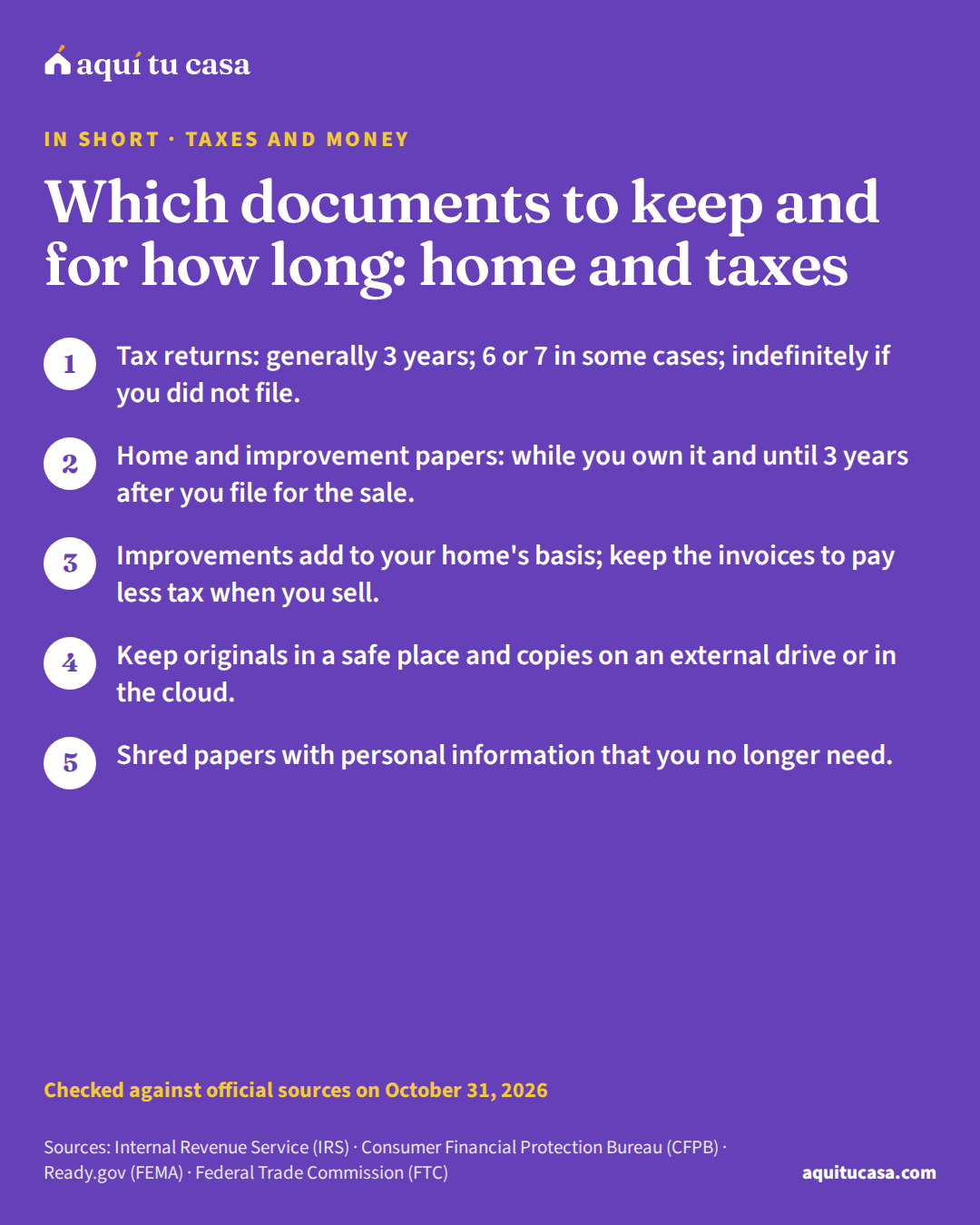
- Tax returns: generally 3 years; 6 or 7 in some cases; indefinitely if you did not file.
- Home and improvement papers: while you own it and until 3 years after you file for the sale.
- Improvements add to your home's basis; keep the invoices to pay less tax when you sell.
- Keep originals in a safe place and copies on an external drive or in the cloud.
Is this for you?
This guide is for you if…
- You have boxes of papers and do not know what to keep and what to throw away.
- You just bought a home and want to know which closing papers to keep.
- You want to protect your important documents from a fire, flood or theft.
Get direct help first if…
- You lost your papers because a family member was detained or deported: read «Money and documents if a family member is deported» first.
- You think someone used your information: read «Identity theft and credit freezes» first.
Many families keep everything in a box, or throw away papers they need later. Knowing what to keep and for how long saves you trouble with taxes, helps when you sell your home and protects you if there is a disaster or identity theft. This guide explains what the IRS, the CFPB and other official sources say, so you can build your family file once and keep it up to date. You do not need to buy anything expensive to start: some folders, a box and a dry place are enough.
Your taxes: how long to keep records
The IRS gives periods depending on your case. The idea is to keep your tax returnstax returnA tax return is the yearly form you use to report your income to the IRS and figure the tax you owe, so you can pay what is due or get a refund. The federal return for individuals is Form 1040. In general you must file if your gross income is above the minimum the IRS sets for your filing status, or if you had a certain amount of net earnings from self-employment; even when you do not have to, filing can pay off. You need your SSN or ITIN, and those of everyone else on the return, plus documents such as your W-2s and 1099s.See the full definition and the papers that back them up (W-2 and 1099 forms, receipts, proof) while the IRS can still review them:1
| If… | Keep your records |
|---|---|
| None of the cases below | 3 years |
| You claimed a credit or refund after filing | 3 years from your original return or 2 from when you paid, whichever is later |
| You claimed a loss from worthless securities or a bad debt | 7 years |
| You did not report income of more than 25% of the income on your return | 6 years |
| You did not file, or filed a fraudulent return | Indefinitely |
| You have employees (employment taxes) | At least 4 years |
And before you throw away something you no longer need for taxes, think about whether others may ask for it. The IRS reminds you that your insurer or creditors may require you to keep papers longer.1 If you are going to apply for a mortgage, you will also be asked for several years of returns; the document checklist tells you which.
Your home papers
The closing documents, complete. According to the CFPB, after closing keep all the final loan and purchase documents, on paper or as an electronic file. Check that you have four: the Closing DisclosureClosing DisclosureThe Closing Disclosure is a required five-page form with the final details of the mortgage you selected: the loan terms, your monthly payment, every closing cost and how much cash you must bring on signing day. The lender must give it to you at least three business days before closing, so you can compare it with your Loan Estimate and ask about any change. If an important number changes, the three-day period starts again. Keep it: you will need it for your taxes.See the full definition, the promissory notepromissory noteThe promissory note (or simply the note) is the document you sign at closing to promise you will repay the loan to the lender. It describes what you are agreeing to: how much you owe, the interest rate, the payment dates, the total you will pay, the length of the loan, whether the payments can change and where to send them. It is separate from the mortgage or deed of trust, the document that gives the lender the right to take the home if you do not pay. Some terms, such as a prepayment penalty, may be in an addendum to the note. You can ask for copies of the documents before closing to review them.See the full definition, the mortgage (also called the security instrument or deed of trustdeed of trustThe deed of trust is, along with the "mortgage," one of the most common names for the security instrument you sign at closing. With it, the home becomes collateral for the loan: if you do not make the payments or break the agreement, the lender can take the home and sell it to pay off the loan. Your signature on this document must be notarized. It is separate from the promissory note, which is your promise to pay. In some states, the lender can foreclose without going to court by following the notices in a "power of sale" clause in this document.See the full definition) and the deeddeedA deed is the legal document the seller uses to transfer ownership of the home to you. The seller signs it at closing, it lists the names of all the buyers and you receive a copy. Afterward, the settlement agent records it with the county records office; that recording puts the public on notice that you are now the owner. There are several types: a warranty deed gives the most promises about the title, and a quitclaim deed promises nothing. Do not confuse it with a deed of trust, which is the mortgage document.See the full definition. Also keep the budgeting papers you used, because they may help later, and remember that the Closing Disclosure can help you save money at tax time.3 The guide Closing Disclosure explained walks through each page.
The purchase and improvements, while you own it and a bit longer. The IRS says any time you buy real estate you should keep records that document its adjusted basis, generally until 3 years after the due date of the return for the year you sell the home.2 More broadly, keep records relating to a property until the period of limitations expires for the year you dispose of it, because you need them to figure the gain or loss.1
Why improvements matter. Improvements add to your home’s value, prolong its useful life or adapt it to new uses, and their cost is added to the basis. The IRS gives examples such as a new bedroom or bathroom, a deck, a fence, a heating or central air system, or a new roof. Repairs that only keep it in good condition, such as painting or fixing a leak, do not count.2 A higher basis can lower the gain figured when you sell; the guide Taxes when you sell your home and FIRPTA explains the math.
Improvement or repair: what to keep
Added to the basis
Improvement
- A new bedroom or bathroom
- A deck, a fence or a patio
- Heating or central air, a new roof
- Keep the invoice and contract while you own the home
Not added
Repair
- Painting inside or outside
- Fixing a leak
- Filling holes or cracks
- Keep it if it helps with insurance or a warranty
If you are unsure whether something is an improvement, keep the invoice: it is easier to throw it away later than to search for it years from now.
Other housing papers worth keeping handy
Besides taxes and closing, some papers have no fixed IRS period but protect you day to day. Ready.gov lists housing payments and insurance policies among a household’s financial and legal documents, and recommends documenting and insuring your belongings now.4
- If you have a mortgage: the loan statements, the Form 1098Form 1098Form 1098, Mortgage Interest Statement, is the IRS form on which whoever collects your mortgage interest, usually your lender or loan servicer, reports how much interest you paid during the year. It can also show points you paid when buying your main home, mortgage insurance premiums, the balance you owe and other items, such as property tax paid from the escrow account. You generally receive a copy. If you itemize deductions, you use it to deduct mortgage interest on Schedule A, only to the extent the law allows.See the full definition your lender sends you each year and every letter from your loan servicer. If you ever have a problem with a payment, those letters and statements are your proof.
- If you rent: your signed lease, rent receipts, the deposit receipt and photos of how the home looked when you moved in. They help you get your deposit back; read Security deposits.
- Your insurance: the complete policies and a list with photos or videos of your valuables. If there is a theft or a disaster, that list helps with the claim.
- Your family: birth certificates, Social Security cards, passports and any immigration documents, with copies stored apart from the originals.
Review this file once a year, for example when you file your taxes: add what is new, update the digital copies and destroy what has reached its period.

Where and how to store your documents
According to Ready.gov, before a disaster it is wise to gather your family’s financial, household and medical information: photo IDs, birth certificates and Social Security cards; housing papers, insurance policies, income sources and tax papers; and medical information. It recommends storing important documents in a safety deposit box, an external drive or the cloud.4
A simple way to do it: originals in a safe place, and scanned copies somewhere else, such as an external drive kept outside the home or a cloud account with a strong password. That way, if there is a fire or a flood, you do not lose everything at once. Ready.gov also offers the Emergency Financial First Aid Kit (EFFAK), made by Operation HOPE and FEMA, in several languages.4 If a disaster already happened to you, read After a hurricane, flood or fire.

Build your family file in an afternoon
Protect your information and destroy what is left over
Old papers can also be a risk. The Federal Trade Commission recommends closely guarding your Social Security number and shredding charge receipts, copies of credit applications and other sensitive documents. It also recommends reviewing your bills and credit reports regularly.5 If you think someone used your information, read Identity theft and credit freezes.
Be careful with mail too. According to the CFPB, your deed and mortgage details become public record, so do not assume a letter with your lender’s name comes from your lender.3 The guide Deed theft and title fraud explains how to watch your home’s title.
Example with real numbers
The file of a family that bought a home
An example in words, not a real case, of what a family keeps and for how long.
- The Closing Disclosure, promissory note, mortgage and deed
- All of them, in a safe place
- The invoice for the new roof
- While they own the home and until 3 years after filing for the sale
- Tax returns and their supporting records
- Generally 3 years; longer in some cases
- Old charge receipts
- Into the shredder once they are no longer needed
- Where they keep them
- Originals in a safe place and copies in the cloud
The periods come from the IRS and the CFPB.123 Use the document checklist to see which papers a lender asks for.
Run it with your numbersDocument checklistIf you lost a document
Not everything is lost. Many documents can be replaced:
- Your tax returns. You can view and download transcriptsIRS tax transcriptAn IRS tax transcript is a free official summary of the information on your tax returns and tax account. It is not a photocopy of your return. There are several types: the tax return transcript shows most line items from your Form 1040 as filed and usually meets the needs of mortgage lenders; the tax account transcript shows changes made after you filed; the wage and income transcript shows what your W-2s and 1099s reported. You can get one through your IRS online account, by mail, by phone or with Form 4506-T.See the full definition of past returns in your IRS online account. You can also request them by mail with the online form or at 800-908-9946; they arrive in 5 to 10 days at the address the IRS has on file.6
- Your birth certificate. Ask for a certified copy from the vital records office of the state or territory where you were born.7
- Your Social Security card. It can be replaced online, by mail or in person.7
- Your Green Card. To replace it, contact USCIS.7
Your deed is a public record:3 if you lose it, ask your county recorder’s office how to request a copy.
If this is your situation
You are self-employed
Keep your receipts with each return; if you leave out a large amount of income, the period rises to 6 years.1
You hold the whole family's papers
Gather IDs, certificates and Social Security cards and keep copies in the cloud.4
You live where hurricanes or wildfires strike
Keep copies outside the home: on an external drive or in the cloud.4
You file with an ITIN
Your returns prove your history; keep them and request transcripts if you lose them.6

Costly mistakes
Mistake: Throwing away the deed or promissory note after closing.
Instead: Keep all the closing documents in a safe place.3
Mistake: Not keeping invoices for improvements.
Instead: They are added to your home's basis and can lower the gain when you sell.2
Mistake: Keeping all the originals in one place.
Instead: Keep copies on an external drive or in the cloud.4
Mistake: Throwing papers with personal information in the trash.
Instead: Shred them.5
Mistake: Throwing out your returns after 3 years without thinking about your case.
Instead: In some cases the period is 6 or 7 years, or indefinitely.1
What to do this week
- Gather your tax, home, insurance, ID and health papers in one place.4
- Sort your returns by year and check which period applies to you.1
- If you own a home, find the four closing documents and start the improvements folder.32
- Scan the most important papers and keep the copies on an external drive or in the cloud.4
- Shred what you no longer need that has personal information.5
- If something is missing, request your IRS transcripts or replace your documents; to file for free, read Free tax filing: VITA, TCE and Free File.6
Your household this month
Let's do the math
Left each month
Enter what at least one person takes home to see the result.
What helps
- Pay savings first: set the goal aside the day the money arrives, before flexible spending.
- Add up the bills that come every few months (car insurance, school) and divide by twelve.
- If income changes, plan on a low month and save the extra from good months.
- A HUD-approved housing counselor can go over the budget with you, often for free.
This is a planning tool with your numbers, not a credit evaluation or an approval. The split reference is only a guide.
Ready to see the numbers? Find your county here
See how this applies in your county: its loan limits, prices and rents, from the official data.
Printable checklist
Frequently asked questions
How many years should I keep my tax returns?
According to the IRS, generally 3 years. But 6 years if you did not report income that was more than 25% of the income on your return, 7 years if you claimed certain losses, and indefinitely if you did not file a return.
Which home papers do I have to keep?
Those for the purchase and the improvements, while you own the home and until 3 years after the due date of the return for the year you sell it. And keep the closing documents complete: the Closing Disclosure, the promissory note, the mortgage and the deed.
Why keep the invoices for the new roof or the room I added?
Because improvements are added to your home's basis, and a higher basis can lower the gain figured when you sell. Repairs, such as painting or fixing a leak, do not count as improvements.
Where should I keep my important documents?
Ready.gov recommends a safety deposit box, an external drive or the cloud. Keep the originals in a safe place and copies somewhere else.
What do I do with papers I no longer need?
Shred the ones with personal information, such as charge receipts and copies of credit applications, as the FTC recommends. Do not throw them away whole.
I lost my tax returns. Can I get them back?
You can request transcripts from the IRS in your online account or by mail, at 800-908-9946. By mail they arrive in 5 to 10 days.
I lost my birth certificate or Social Security card. What do I do?
Ask for a certified copy of the certificate from the vital records office of the state where you were born. The Social Security card can be replaced online, by mail or in person.
Sources
Every figure in this guide comes from one of these official sources. The number next to a sentence leads to the source behind it.
Each source on one line: who publishes it, its title, its address and the date we read it.
- 1. Internal Revenue Service (IRS) · How long should I keep records? · irs.gov · Accessed October 31, 2026
- 2. Internal Revenue Service (IRS) · Publication 523, Selling Your Home · irs.gov · Accessed October 31, 2026
- 3. Consumer Financial Protection Bureau (CFPB) · After closing · consumerfinance.gov · Accessed October 31, 2026
- 4. Ready.gov (FEMA) · Financial Preparedness · ready.gov · Accessed October 31, 2026
- 5. Federal Trade Commission (FTC) · What Consumers Can Do About Identity Theft · ftc.gov · Accessed October 31, 2026
- 6. Internal Revenue Service (IRS) · Get transcript · irs.gov · Accessed October 31, 2026
- 7. USA.gov · Replace your vital documents · usa.gov · Accessed October 31, 2026
Keep reading
Related guides
If this guide helped, these follow the same path.

Owning a home 21 minute read
Taxes when you sell your home and FIRPTA withholding
When you owe no tax on the gain from selling your home (the $250,000 exclusion), Form 1099-S, forgiven mortgage debt and FIRPTA withholding.
- The $250,000 exclusion ($500,000 on a joint return) applies to your main home if you owned it and lived in it for 24 months of the last 5 years; only once every 2 years.
- If you receive a Form 1099-S at closing, you report the sale on Form 8949 even if the whole gain is excludable.
- Mortgage debt forgiven in a short sale, foreclosure or modification is generally taxable income; the special exclusion only covers written agreements made before January 1, 2026.
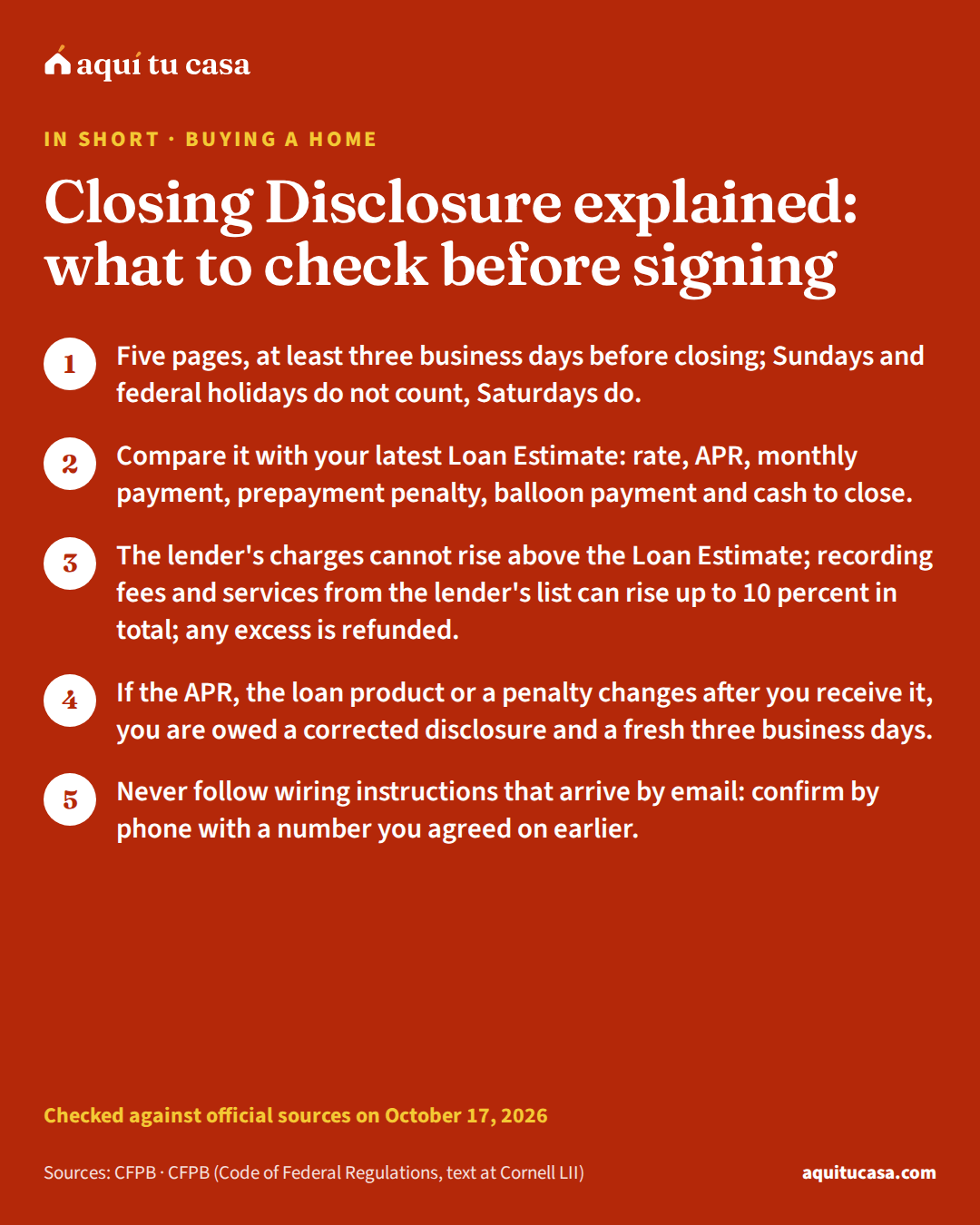
- Buying a home Closing Disclosure explained: what to check before signing What the Closing Disclosure is, when it must reach you, what to check on each of its five pages and which closing costs are not allowed to go up. 18 minute read
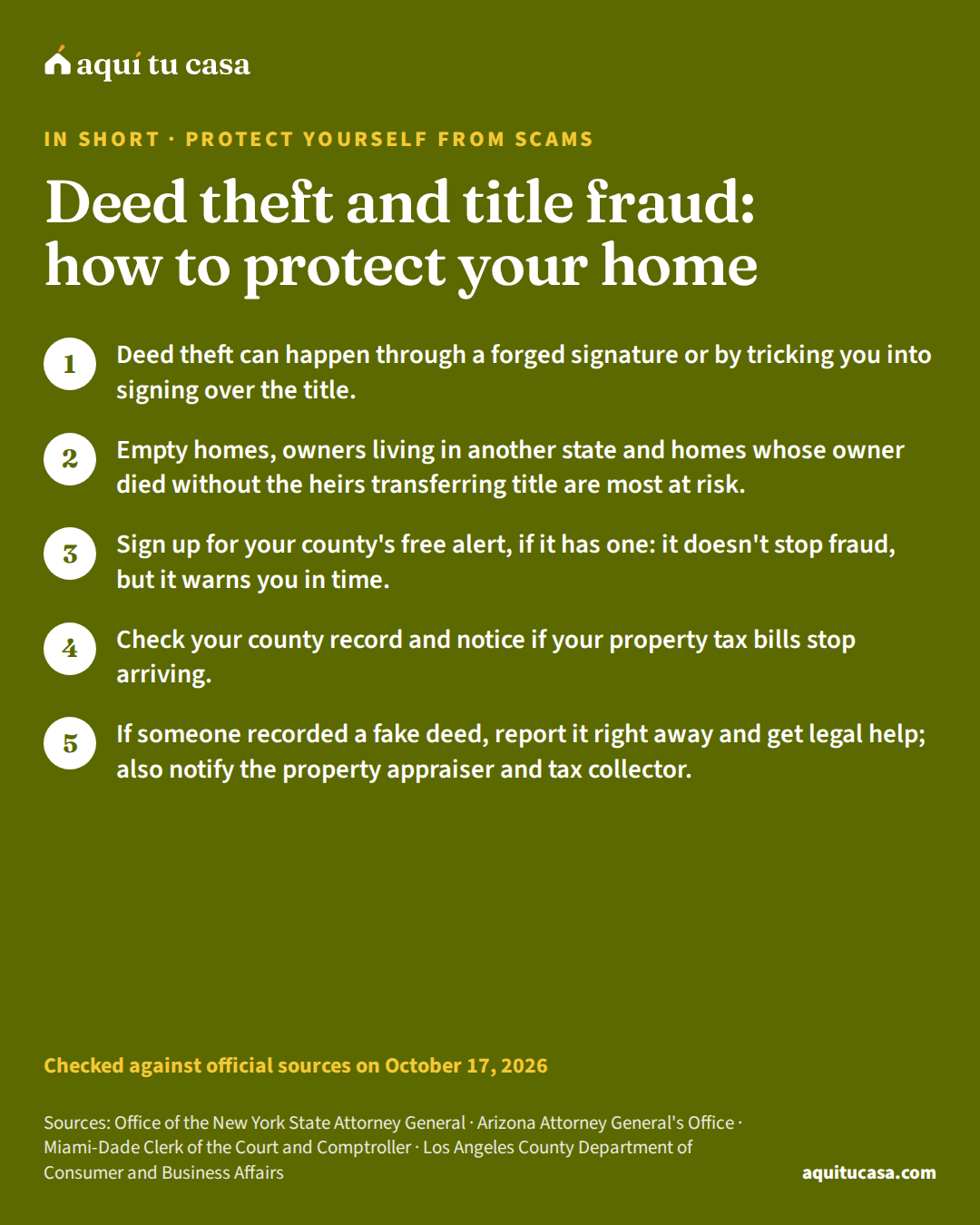
- Protect yourself from scams Deed theft and title fraud: how to protect your home What deed theft is, who is most at risk, the warning signs, your county's property alerts and what to do if someone records a fake deed. 10 minute read
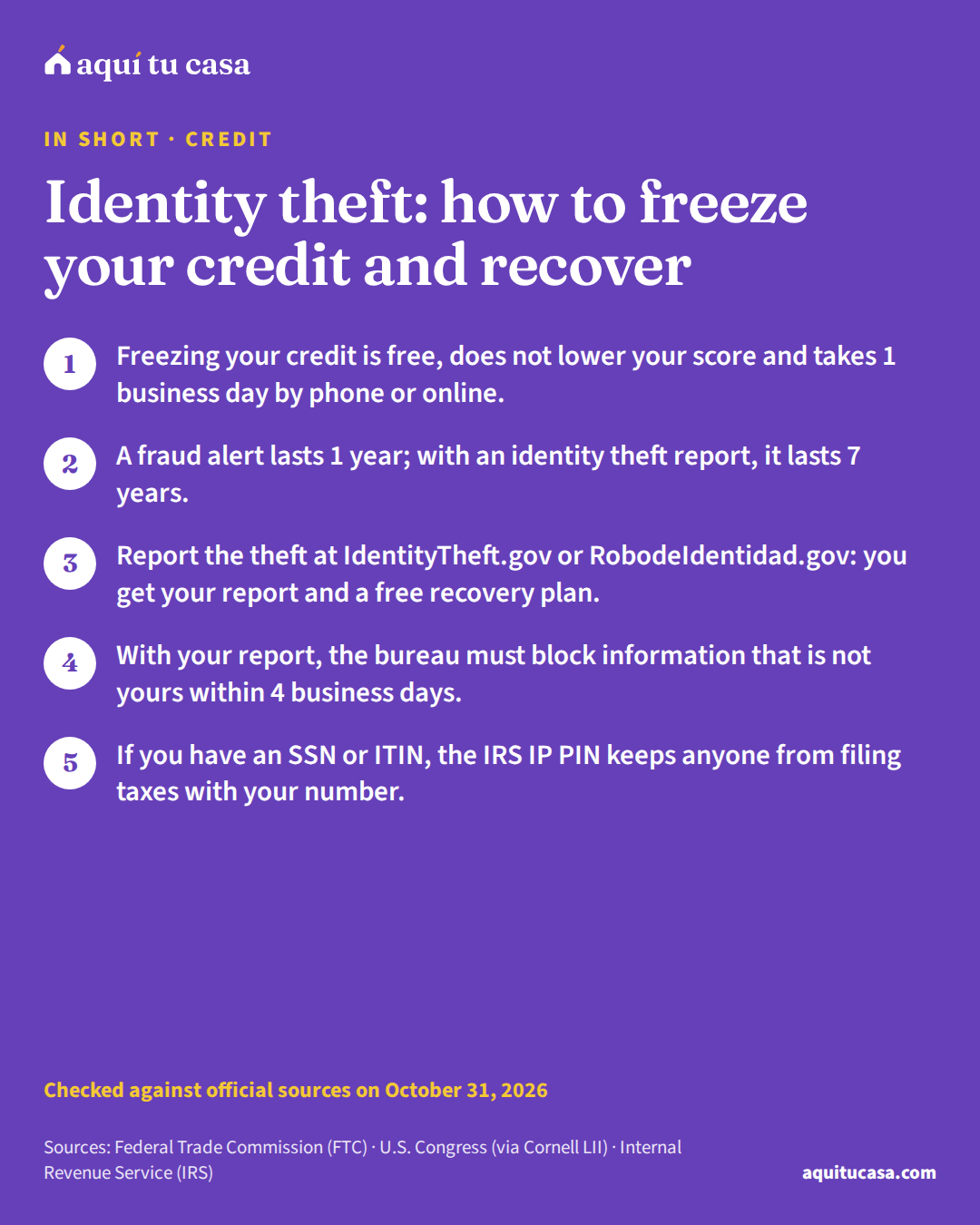
- Credit Identity theft: how to freeze your credit and recover What to do if your identity is stolen: close accounts, place a fraud alert, freeze your credit for free and report it at IdentityTheft.gov. 11 minute read
Tools for this topic
Was this guide useful?
Thank you. Your answer stays in your browser; nothing is sent.