Taxes when you sell your home and FIRPTA withholding
When you owe no tax on the gain from selling your home (the $250,000 exclusion), Form 1099-S, forgiven mortgage debt and FIRPTA withholding.
Verified against official sources on October 29, 2026 14 official sources

Show contents
In short
What you need to know
Quick answer
According to the IRS, if you sell the home you live in and you owned it and lived in it for at least 2 of the last 5 years, you can exclude up to $250,000 of gain from your income, or up to $500,000 if you file jointly with your spouse. If you receive a Form 1099-S, you report the sale even if you owe no tax. Debt the bank forgives in a short sale or foreclosure generally counts as income, and the special exclusion for that debt ended with cancellations in 2025. If the seller is a foreign person (a nonresident alien), the buyer must withhold 15% of the price, with exceptions, and the seller can ask the IRS for a withholding certificate or recover the excess on a tax return. VITA sites and LITC clinics help for free.
What matters most
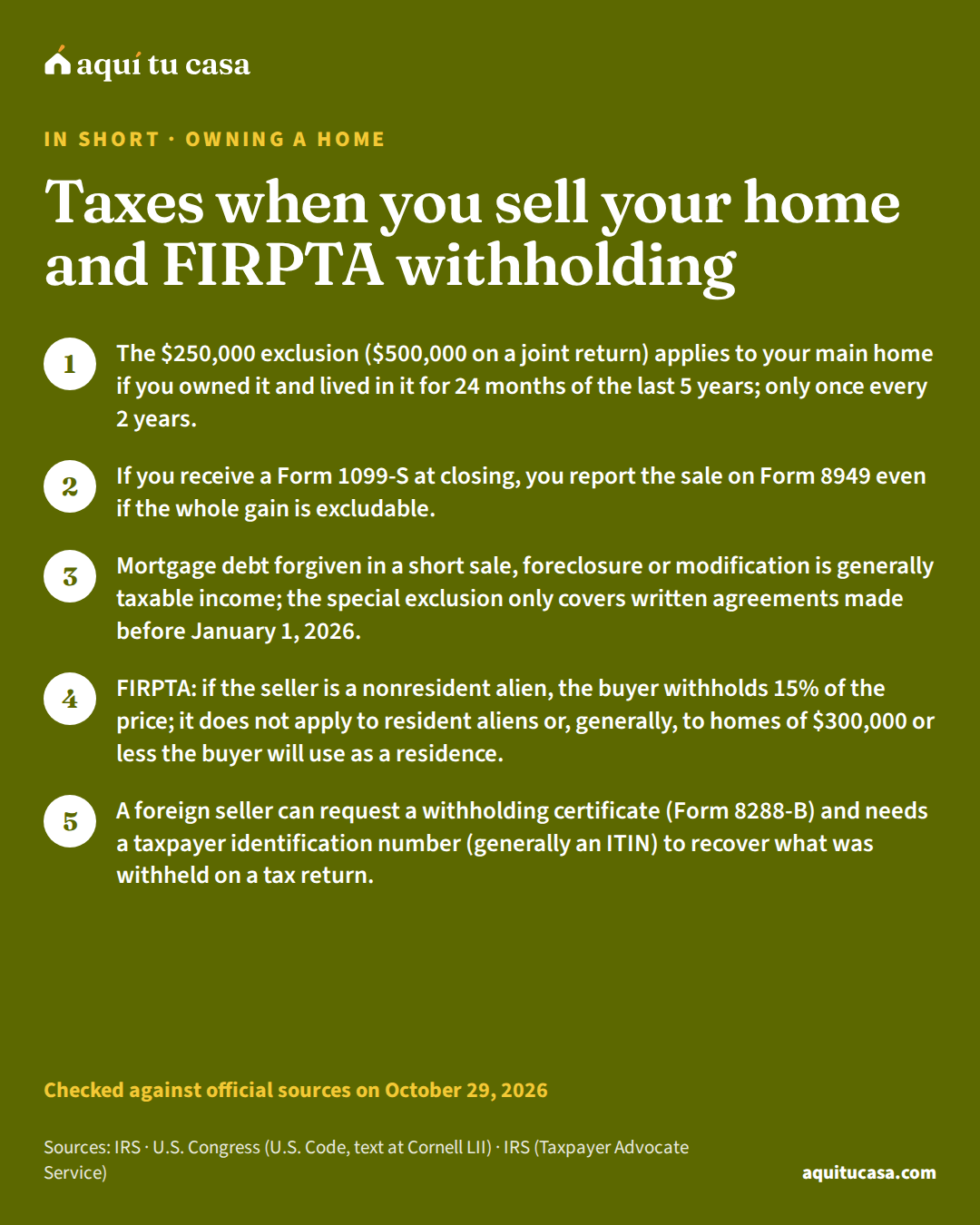
- The $250,000 exclusion ($500,000 on a joint return) applies to your main home if you owned it and lived in it for 24 months of the last 5 years; only once every 2 years.
- If you receive a Form 1099-S at closing, you report the sale on Form 8949 even if the whole gain is excludable.
- Mortgage debt forgiven in a short sale, foreclosure or modification is generally taxable income; the special exclusion only covers written agreements made before January 1, 2026.
- FIRPTA: if the seller is a nonresident alien, the buyer withholds 15% of the price; it does not apply to resident aliens or, generally, to homes of $300,000 or less the buyer will use as a residence.
Is this for you?
This guide is for you if…
- You are selling the home you live in and want to know whether you will owe federal tax on the gain and which papers you will see at closing.
- You are selling with an ITIN, or you are a nonresident alien, and someone mentioned a 15% withholding called FIRPTA.
- You sold through a short sale, foreclosure or modification and received a Form 1099-C for forgiven debt.
Get direct help first if…
- You are selling a property you only rented out or a business location: this guide covers the main home; the IRS has other rules for those sales.
- You already have an audit, a collection case or an open dispute with the IRS: a Low Income Taxpayer Clinic (LITC) can represent you for free or for a small fee.
- You want someone to figure your tax or tell you whether selling is a good idea: that is individual advice, and we do not give it here.
This guide explains what the IRS says about federal taxes when you sell the home you live in: when the gain owes no tax, what the Form 1099-S you get at closing is, what happens with debt the bank forgives, and how FIRPTA withholding works when the seller is a foreign person. It is not tax or legal advice. For your situation, VITA sites and Low Income Taxpayer Clinics are free options, never a requirement.
- Gain you can exclude when you sell your main home; $500,000 on a joint return
- $250,0001
- Minimum time as owner and as resident before the date of sale
- 2 of 5 years1
- FIRPTA withholding on the price when the seller is a foreign person
- 15%7
- Price up to which, generally, there is no withholding if the buyer will live in the home
- $300,0009
When the gain owes no tax: the section 121 exclusion
When you sell your home for more than it cost you, that difference is a capital gain, and in principle it owes federal tax. But the law has a big exception for the home you live in. According to the IRS, if you have a gain from the sale of your main home, you may qualify to exclude up to $250,000 of that gain from your income, or up to $500,000 if you file a joint return with your spouse.1 The statute says the same thing in other words: gross income does not include the gain if, during the 5 years ending on the date of sale, you owned the property and used it as your principal residence for periods adding up to 2 years or more.3
The key words are principal residenceprincipal residenceYour principal residence is the home where you live permanently and spend most of the year. According to FHA, a person can have only one principal residence at a time. Lenders tell it apart from a second home, which you occupy in addition to your principal residence but for less than most of the year, and from an investment property, which you own but do not live in. Fannie Mae buys loans on all three, but it applies a loan-level price adjustment (LLPA) to loans on investment properties.See the full definition. According to IRS Publication 523, you have only one main home at a time. If you own or live in more than one, the IRS looks at the facts: the most important factor is where you spend the most time, and the address you put on your tax returns counts too. A single-family home, a condominium, a cooperative apartment, a mobile home and even a houseboat can be your main home.2
The ownership and use tests, step by step
The IRS sums up the exclusion in two tests. The ownership test: you owned the home for at least 24 months of the last 5 years before the date of sale. The use test: you used it as your residence for at least 24 months of those 5 years. The two tests can be met during different 2-year periods, but always within the 5 years ending on the day of sale.1
The 24 months of residence (730 days) do not have to be in a row: they can fall anywhere within the 5 years. On a joint return, it is enough for one spouse to meet the ownership test, but each must meet the residence test individually for the full exclusion.2 And there is a third rule: you can take the exclusion only once every 2 years.2 Generally you are not eligible if you excluded the gain from another home in the two years before this sale.1
How to check whether you qualify, in the IRS order
1. Set the date of sale
The day of closing
Both tests count back from the date of sale: the 5 years end on that day.1
2. Ownership test
24 months of the last 5 years
Count the months the home was in your name. On a joint return, one of you meeting it is enough.1
3. Use test
24 months of the last 5 years, even if not in a row
Count the months you lived there as your main home. Each spouse meets it individually.2
4. Look back 2 years
One exclusion every 2 years
If you excluded the gain from another home in the previous 2 years, this sale does not qualify for the full exclusion.1
5. Check the special situations
Widowhood, divorce or military service
A surviving spouse who has not remarried can count the late spouse's time; if your spouse or ex-spouse transferred the home to you, you count the time they owned it; on qualified official extended duty the 5-year period can be suspended.2
The special situations matter in many families. If you are a surviving spouse and have not remarried, you can count the time your late spouse owned and lived in the home. And you can raise the exclusion from $250,000 to $500,000 if you meet all of the IRS conditions: you sell within 2 years of the death, you have not remarried, neither of you took the exclusion on another home sold less than 2 years before, and you meet the 2 years of ownership and residence counting your spouse’s time. If the home was transferred to you by your spouse or ex-spouse, the time that person owned it counts as yours, but you meet the residence test yourself.2 If you inherited the home, our guide on wills, TOD deeds and inheriting a home explains how your basis is figured. If you or your spouse are on qualified official extended duty in the Uniformed Services, the Foreign Service or the intelligence community, you may elect to suspend the 5-year period for up to 10 years.1
How the gain is figured, and the partial exclusion
The gain is not the sale price. According to Publication 523, you subtract selling expenses, such as the commission you pay your agent, from the selling price to get the amount realized. From that you subtract your adjusted basis, which starts with what you paid for the home and rises with the cost of additions and improvements. The result is your gain or loss. If it is negative, you sold at a loss: you cannot deduct it, but you owe no tax on the money you received either. The IRS recommends keeping basis records until 3 years after the due date of the return for the year you sold.2 The appreciationhome appreciationHome appreciation is the increase in your home's value over time. It is one of the two ways your home equity grows, equity being the difference between what the home is worth and what you owe; the other is paying down your mortgage principal. A home's value can go up or down: it can fall because of economic conditions, lack of upkeep or a drop in neighborhood home values, and some markets appreciate faster than others. The FHFA House Price Index (HPI) measures how single-family home values change.See the full definition your home built up is, in large part, that gain. The Closing DisclosureClosing DisclosureThe Closing Disclosure is a required five-page form with the final details of the mortgage you selected: the loan terms, your monthly payment, every closing cost and how much cash you must bring on signing day. The lender must give it to you at least three business days before closing, so you can compare it with your Loan Estimate and ask about any change. If an important number changes, the three-day period starts again. Keep it: you will need it for your taxes.See the full definition from when you bought and the one from when you sell hold almost all the numbers; our Closing Disclosure explained guide helps you read them.
There are two cuts to the exclusion worth knowing. By statute, the exclusion does not cover the portion of the gain allocated to periods of nonqualified use: periods after January 1, 2009 when the home was not your principal residence or your spouse’s, for example because you rented it out before moving in, with exceptions such as the time after the last date you lived there.3 And according to Publication 523, the exclusion does not apply to gain that comes from depreciation for periods after May 6, 1997, for example from renting out the home or using part of it for a business; if you did not deduct depreciation, you still must decrease your basis by what you could have deducted. If you rented out a room inside the home, you do not need to split the gain between the rented part and the part you lived in.2 Our guide on renting out a room or unit covers those cases.
If you do not reach the 24 months, all is not lost. According to Publication 523, you can qualify for a partial exclusion if the main reason for the sale was a change in workplace location, a health issue or an unforeseeable event. A work-related move includes a new job at least 50 miles farther from the home than the old one. Unforeseeable events include giving birth to two or more children from the same pregnancy, becoming eligible for unemployment compensation, and being unable to pay the household’s basic living expenses because of a change in employment.2
Example with real numbers
Partial exclusion: the share of the time you did meet
This is how Worksheet 1 of Publication 523 figures it. It is an example with round numbers, not your case.
- The shortest period (residence, ownership or time since your last exclusion)
- 12 months
- Divided by 24 months
- 12 ÷ 24 = one half
- Multiplied by $250,000
- $125,000 of exclusion
- If you file jointly
- Repeat the steps for your spouse and add the two
Only gain above that limit is taxable.2 The partial exclusion requires one of the reasons the IRS accepts: work, health or an unforeseeable event.2
Run it with your numbersHow much will I keep when I sell?
Form 1099-S and how the sale is reported
At closing you may be given a Form 1099-SForm 1099Form 1099 is a family of IRS information returns that report income other than employee wages. Anyone who paid you in the course of their business must file it with the IRS and send you a copy, on paper or electronically, early in the year. There are several types: 1099-NEC for freelance or contract work, 1099-K for payments by card or through online platforms, 1099-INT for bank interest, 1099-G for government payments such as unemployment, and 1099-MISC for other income. You use that information on your tax return.See the full definition (Proceeds From Real Estate Transactions). According to its instructions, it is filed by the person responsible for closing the transaction, who is the person listed as the settlement agentsettlement agentThe settlement agent (also called a closing agent) is the person or company that coordinates the closing so that everything the contract requires is accounted for. Depending on the location, it may be a title company, an escrow company (in most western states) or a closing attorney (in some eastern states). It collects the money from the lender and from you, pays the seller, distributes the closing costs and records the documents with the county. It works for all the parties; it is not your personal representative. Ask it how to pay the money you need to bring to closing.See the full definition on the Closing Disclosure. That person must request your taxpayer identification number no later than closing, on Form W-9 if you are a U.S. person, including resident aliens; if they file the 1099-S, they must give you a copy. They may skip filing if the home sells for $250,000 or less ($500,000 if the certification says you are married) and you sign a certification, under penalties of perjury, that it is your principal residence and that the full gain is excludable. They are not required to ask you for it, but if they do not, they must file the form.4
Getting the 1099-S changes what you do on your tax returntax returnA tax return is the yearly form you use to report your income to the IRS and figure the tax you owe, so you can pay what is due or get a refund. The federal return for individuals is Form 1040. In general you must file if your gross income is above the minimum the IRS sets for your filing status, or if you had a certain amount of net earnings from self-employment; even when you do not have to, filing can pay off. You need your SSN or ITIN, and those of everyone else on the return, plus documents such as your W-2s and 1099s.See the full definition. According to the IRS, if you receive an informational document such as the 1099-S, you must report the sale even if the gain is excludable, and also if you cannot exclude all of the gain, using Schedule D and Form 8949.1
Do you have to report the sale?
Yes, you report it
You received Form 1099-S
A 1099-S does not mean you owe tax: it means the IRS already knows about the sale and expects to see it on your return.1
If you sell with an ITINITIN (Individual Taxpayer Identification Number)An ITIN is a nine-digit number the IRS, the federal tax agency, issues to people who need a U.S. taxpayer identification number to file taxes and are not eligible for a Social Security number. It is for tax purposes only: it does not authorize you to work in the United States, does not qualify you for Social Security benefits or the Earned Income Tax Credit, and says nothing about your immigration status. You apply with Form W-7, and it expires if it goes unused for several years. Some lenders accept an ITIN for a mortgage.See the full definition, none of this changes: the tests and the exclusion are the same. Publication 523 notes that a nonresident or resident alien who does not have and cannot get a Social Security number may be issued an ITIN with Form W-7Form W-7Form W-7 is the IRS's official application to get an ITIN, or to renew one that has expired or is about to. It is filed together with a federal tax return, with some exceptions, and with original documents or certified copies that prove your identity and foreign status, such as a passport. You can mail it, bring it to an IRS center or go to a Certifying Acceptance Agent, who reviews the documents and returns them on the spot. It is free; be wary of anyone who charges to "get" you a fast ITIN.See the full definition.2 Our guides on filing taxes with an ITIN and how to get an ITIN explain the process.
One last point that surprises many families: if you bought with a mortgage credit certificatemortgage credit certificate (MCC)A mortgage credit certificate (MCC) is a document issued by a state or local housing agency that entitles you to a credit on your federal income tax return for part of the interest you pay on your mortgage each year. Unlike a deduction, the credit directly reduces the tax you owe. You claim it with IRS Form 8396, and any credit you cannot use in one year can be carried forward to the next. Each agency sets who qualifies, normally first-time buyers within income and price limits; you apply through a participating lender.See the full definition (MCC) or a loan from tax-exempt qualified mortgage bonds, and you sell within the following 9 years, you may have to pay back part of the benefit. That is the recapture taxfederal mortgage subsidy recapture taxThe recapture tax is a federal tax you may owe if you sell or transfer a home you bought with a federal mortgage subsidy, such as a mortgage credit certificate (MCC) or a loan funded by tax-exempt bonds. It pays back all or part of the benefit you received. According to the IRS, it applies if you sell within the early years the law sets, and it depends on whether you made money on the sale and whether your income is above a certain limit. It is figured on Form 8828 and added to your tax for the year of the sale, even if the gain is excluded from income.See the full definition, figured on Form 8828, and it can be owed even if you exclude all of your gain; if you sold at a loss you pay back nothing, but the form is filed anyway.2 Our MCC tax credits guide has the details.
If the bank forgave debt: short sales, foreclosures and modifications

Sometimes the home sells for less than is owed, or the bank takes it. According to the IRS, if your debt is forgiven or canceled for less than the amount owed, in general the canceled amount is taxable income and you report it on the return for the year the cancellation occurred. For a debt secured by the home, that can happen through a foreclosureforeclosureForeclosure is the process by which the lender or servicer takes back the property after the homeowner fails to make mortgage payments. The rules and timelines depend on each state; all of them include advance notices and, in general, time to catch up or ask for an alternative, such as a repayment plan or a loan modification. If you fall behind, call your servicer and a HUD-approved housing counseling agency early: foreclosure counseling is free and exists for exactly this.See the full definition, a voluntary transfer of the home to the lender, an abandonment or a loan modificationloan modificationA loan modification is a change in the terms of your mortgage that you agree on with your loan servicer when you have trouble paying. It is a type of loss mitigation, meaning one of the options to avoid foreclosure. It can extend the time you have to repay, lower the interest rate, or defer or reduce part of the principal balance, which can lower your monthly payment. Often you start with a trial modification for a few months; if you make those payments on time, the change becomes permanent.See the full definition that reduces the balance. The creditor may send you a Form 1099-C with the amount; if it has incorrect information, contact the creditor, and if it keeps trying to collect after the 1099-C, the debt may not have been canceled. If the bank took the home or you abandoned it, you may receive a Form 1099-A; the IRS explains it in its Topic 432.5 A short saleshort saleA short sale is selling your home for less than what you still owe on the mortgage, with your lender's or servicer's permission. It is an alternative to foreclosure, but because it is a sale, you have to leave the home. If the lender approves, the sale proceeds pay off the mortgage even if they do not cover the whole balance. In some states the lender can later sue you for the difference, called the deficiency. That is why the CFPB says to ask the lender to waive the deficiency and to keep the waiver in writing.See the full definition can also leave forgiven debt, so the 1099-C may be part of the package.
Here there is a recent change that matters. For years there was a special exclusion for qualified principal residence indebtedness: the mortgage you took out to buy, build or substantially improve your main home. According to Publication 4681, that canceled debt could be excluded from income for discharges before January 1, 2026, up to a maximum of $750,000, but it cannot be excluded for discharges completed or agreements entered into after December 31, 2025.6 Publication 523 says the same: if you had a written agreement for the forgiveness of the debt in place before January 1, 2026, you may be able to exclude it; if not, you generally report it as income.2
What still exists is the insolvency exclusion: it applies to the extent the total of your debts exceeded the value of all your assets immediately before the cancellation, and it is claimed on Form 982 by checking the box on line 1b.6 If you are behind on the mortgage and have not sold yet, our guide on what to do if you can’t pay your mortgage explains the options before reaching a short sale or a foreclosure. And if someone charges you to “negotiate” the forgiveness of your debt, our guide on loan modification and rescue scams tells you which signs to watch for.
FIRPTA: withholding when the seller is a foreign person
FIRPTA stands for a federal law from 1980 (the Foreign Investment in Real Property Tax Act). According to the IRS, the sale of U.S. real property by a foreign person is subject to income tax withholding: the buyer, certain purchasers’ agents and settlement officers must withhold 15% of the amount realized. In most cases the buyer is the withholding agent; it must find out whether the seller is a foreign person and, if it fails to withhold, it may be held liable for the tax. The amount realized is the cash paid, the value of other property transferred and the debts the buyer assumes: in practice, the price.7 The statute sets that 15 percent of the amount realized.10
The key question is who is a foreign person. According to the IRS, for FIRPTA it is a nonresident alien, a foreign corporation, a foreign partnership, a foreign trust or a foreign estate; it does not include a resident alien.8 Publication 523 says that both a nonresident alien and a resident alien may have an ITIN, so having an ITIN does not by itself make you a foreign person.2 “Resident” here is the IRS classification for tax purposes; our guide on what an ITIN is explains how it differs from immigration status. If you are a resident for tax purposes, you are not a foreign person for FIRPTA.8
When the home belongs to two people and one is foreign, the IRS allocates the amount realized by each owner’s capital contribution; it treats spouses as having contributed 50% each, and all of it cannot be assigned to the U.S. spouse to avoid withholding.7 Our guide on how to hold title with family explains the forms of title behind that math.
| Seller’s situation | Is there FIRPTA withholding? |
|---|---|
| Citizen or resident alien for tax purposes | No; the seller gives a certification that they are not a foreign person9 |
| Nonresident alien, home of $300,000 or less the buyer will use as a residence | Generally no, if the buyer meets the plan to live there9 |
| Nonresident alien, home over $300,000 and up to $1,000,000 the buyer will use as a residence | Yes, at 10 percent10 |
| Nonresident alien, other cases | Yes, at 15 percent10 |
The exceptions come from the statute and the IRS explains them. Withholding is not required when the buyer acquires the property for use as a residence and the amount realized is not more than $300,000, as long as the buyer or a family member has definite plans to live there for at least 50% of the days the home is used during each of the first two 12-month periods, not counting days it is vacant, and the buyer is an individual. It is also not required when the seller gives a certification, under penalties of perjury, that they are not a foreign person, with their name, U.S. taxpayer identification number and home address; when the buyer receives a withholding certificate from the IRS that excuses it; or when the amount realized is zero.9 Between $300,000 and $1,000,000, if the buyer will use the home as a residence, the statute lowers the rate to 10 percent.10 The withholding agent is personally liable for the full tax it should have withheld, plus penalties and interest.9
If this is you
You sell with an ITIN and live in the United States
If you are a resident for tax purposes, you are not a foreign person for FIRPTA: you can give the certification with your name, TIN and home address.89 The exclusion tests are the same as for any seller.1
You are buying a home and the seller lives abroad
As buyers you are the withholding agents: you must find out whether the seller is a foreign person and withhold 15%, or meet the $300,000 exception if you will live there.79
You sell the home after being widowed
If you have not remarried, you can count the time your spouse owned and lived in the home, and the exclusion can rise to $500,000 if you sell within 2 years of the death and meet the other IRS conditions.2

Withholding certificates, the ITIN and how to recover what was withheld
The 15% withholding is figured on the price, not on the gain, so it can be more than the actual tax.7 The statute recognizes this: the withholding may not exceed the seller’s maximum tax liability, and the IRS determines that maximum at the request of the seller or the buyer.10 The tool is the withholding certificate. According to the IRS, the buyer, the buyer’s agent or the seller may request one; the IRS generally decides within 90 days of receiving a complete application, with the taxpayer identification numbers of all parties; and a seller who applies must notify the buyer in writing, on the day of or the day before the transfer. It may be issued, for example, because the withholding would be more than the maximum tax or because all of the gain is exempt.11 The application is made on Form 8288-B.12
A nonresident alien can also use the section 121 exclusion. According to the IRS, the exclusion may apply when they sell their U.S. personal residence; they must meet the eligibility test, the maximum on Form 1040-NR is $250,000 and, since the withholding can exceed the tax, they may request the withholding certificate to give to the buyer.7
If you are a nonresident alien seller, in order
1. Sign the sales contract
Before requesting the ITIN
Without another valid reason, the IRS denies an ITIN requested before the contract. With a binding contract, you request it on Form W-7 under Exception 4.7
2. Request the withholding certificate
Before closing, on Form 8288-B
The IRS usually decides within 90 days. If you request the ITIN at the same time, that request is processed within 10 days.7
3. Notify the buyer in writing
The day of closing or the day before
It is required if you applied for the certificate. While the IRS decides, the buyer withholds but does not pay right away.11
4. The buyer reports and pays
Day 20 after closing, or 20 days after the IRS decision
It uses Forms 8288 and 8288-A. If a Form 8288-B was pending, it pays within 20 days after the IRS mails the certificate or the denial.12
5. Recover the excess on your return
During tax season
The IRS stamps copy B of Form 8288-A and sends it to you; you file it with your return to receive the credit. Without your TIN on the form, you are not sent the stamped copy.12
If you have no taxpayer identification number but qualify for an ITIN, you can apply by attaching Form 8288-B to Form W-7.12 Our guide on the IRS and the privacy of your tax data explains, with dates, what the IRS says about the use of that information.
Where to get free help
IRS VITA sites prepare basic returns for free for people who qualify. Many serve people who generally make about $70,244 or less, people with disabilities and limited-English speakers, although each site may set its own limit. Their volunteers are trained to keep your information confidential. Find one with the IRS locator tool or at 800-906-9887.13 VITA prepares basic returns; before you go, ask whether the site handles a home sale, FIRPTA withholding or forgiven debt.
If you already have a dispute with the IRS, for example withheld tax that is not refunded or a letter about a 1099-C, Low Income Taxpayer ClinicsLow Income Taxpayer Clinic (LITC)A Low Income Taxpayer Clinic (LITC) is an organization that helps low-income people who have a dispute with the IRS, such as an audit, an appeal or a tax collection matter, for free or for a small fee. It can represent you before the IRS or in court. It also teaches taxpayer rights and responsibilities to people who speak English as a second language. To qualify, your income generally must be below a certain level. The clinics get part of their funding from the IRS but are independent of it.See the full definition (LITCs) can represent you before the IRS or in court, for free or for a small fee; they also educate people who speak English as a second language and are independent of the IRS.14 For legal questions about the sale, the title or a foreclosure, our free legal aid guide explains where to look. All of these are options, not requirements.

Mistakes that cost money when you sell
Mistake: Thinking the sale price is the gain.
Instead: The gain is the price minus selling expenses and minus your adjusted basis; keep the receipts for improvements.2
Mistake: Throwing away Form 1099-S because you owe no tax.
Instead: If you received it, report the sale on Form 8949 even if the whole gain is excludable.2
Mistake: Selling two homes with the exclusion in less than 2 years.
Instead: The exclusion is taken once every 2 years; the second sale may be left out.2
Mistake: Assuming debt forgiven in a short sale is not reported.
Instead: It is generally income in the year of cancellation; the special exclusion ended with the 2025 agreements, but check the insolvency exclusion.56
Mistake: Putting the whole sale in the citizen spouse's name to avoid FIRPTA.
Instead: The IRS treats spouses as contributing 50% each and does not allow assigning everything to one.7
Mistake: Requesting the ITIN before you have a sales contract.
Instead: Without another valid reason, the IRS denies it; with a signed contract you request it on the W-7 under Exception 4.7
Mistake: Forgetting Form 8828 if you bought with an MCC or bonds.
Instead: It is filed even if you sold at a loss, and the recapture can be owed even if you exclude the gain.2
What to do this week
- Find the date you bought and count back 5 years from the planned date of sale: write down the months as owner and the months living there.1
- Gather the Closing Disclosure from the purchase and the receipts for major improvements: they are your adjusted basis.2
- If you do not reach 24 months, check whether your reason for selling is among those the IRS accepts for the partial exclusion.2
- Ask the settlement agent whether they will file Form 1099-S or will ask you for the principal residence certification.4
- If you are a nonresident alien, decide early whether you will request the withholding certificate: the IRS generally acts within 90 days.11
- If you had forgiven debt, keep the 1099-C and check the insolvency exclusion before you file.6
- Find a VITA site near you with the IRS locator tool or at 800-906-9887; it is a free option, not a requirement.13
Ready to see the numbers? Find your county here
See how this applies in your county: its loan limits, prices and rents, from the official data.
Printable checklist
Frequently asked questions
Do I pay tax when I sell my home?
According to the IRS, only on gain above the exclusion. If you owned and lived in the home for at least 24 months of the last 5 years, you can exclude up to $250,000 of gain, or up to $500,000 on a joint return. Gain is the price minus selling expenses and minus your adjusted basis.
What if I sell before I reach 2 years?
You may qualify for a partial exclusion if the main reason for the sale was a change in workplace location, a health issue or an unforeseeable event, such as becoming eligible for unemployment compensation. It is figured as the share of the 24 months you did meet.
Do I have to report the sale if I owe no tax?
If you received a Form 1099-S, yes: the IRS asks you to report it on Form 8949 even with no taxable gain. If you did not receive a 1099-S, have no taxable gain and do not choose to report it, Publication 523 says you do not need to report the sale.
What is Form 1099-S and who gives it to me?
It is the information return the settlement agent uses to report the sale to the IRS, with a copy to you. The agent may skip it if the home sells for $250,000 or less ($500,000 if you are married) and you sign a certification, under penalties of perjury, that it is your principal residence and that the full gain is excludable.
Do I have to report the debt the bank forgave?
Generally yes: the IRS treats canceled debt as income in the year it was canceled, and the creditor may send you a Form 1099-C. The exclusion for principal residence debt does not cover cancellations or agreements after December 31, 2025, but the insolvency exclusion still exists and is claimed on Form 982.
I am selling with an ITIN. Does FIRPTA apply to me?
It depends on whether you are a foreign person for the IRS. FIRPTA applies to nonresident aliens, not to resident aliens for tax purposes. An ITIN does not decide your tax residency. If you are not a foreign person, you can give a certification under penalties of perjury with your name, TIN and home address so that nothing is withheld.
I am a nonresident alien. How do I avoid over-withholding?
You can ask the IRS for a withholding certificate on Form 8288-B before closing; the IRS usually decides within 90 days and you must notify the buyer in writing. If tax is withheld anyway, you file your return with the stamped copy B of Form 8288-A to receive credit for the amount withheld.
Where can I get free help with my return?
IRS VITA sites prepare basic returns for free for people who qualify; find one with the IRS locator tool or at 800-906-9887. If you already have a dispute with the IRS, a Low Income Taxpayer Clinic (LITC) can represent you for free or for a small fee.
Sources
Every figure in this guide comes from one of these official sources. The number next to a sentence leads to the source behind it.
Each source on one line: who publishes it, its title, its address and the date we read it.
- 1. IRS · Topic no. 701, Sale of your home · irs.gov · Accessed October 29, 2026
- 2. IRS · Publication 523, Selling Your Home · irs.gov · Accessed October 29, 2026
- 3. U.S. Congress (U.S. Code, text at Cornell LII) · 26 U.S.C. §121, Exclusion of gain from sale of principal residence · law.cornell.edu · Accessed October 29, 2026
- 4. IRS · Instructions for Form 1099-S, Proceeds From Real Estate Transactions · irs.gov · Accessed October 29, 2026
- 5. IRS · Topic no. 431, Canceled debt – Is it taxable or not? · irs.gov · Accessed October 29, 2026
- 6. IRS · Publication 4681, Canceled Debts, Foreclosures, Repossessions, and Abandonments · irs.gov · Accessed October 29, 2026
- 7. IRS · FIRPTA withholding · irs.gov · Accessed October 29, 2026
- 8. IRS · Definitions of terms and procedures unique to FIRPTA · irs.gov · Accessed October 29, 2026
See the other 6 sources
- 9. IRS · Exceptions from FIRPTA withholding · irs.gov · Accessed October 29, 2026
- 10. U.S. Congress (U.S. Code, text at Cornell LII) · 26 U.S.C. §1445, Withholding of tax on dispositions of United States real property interests · law.cornell.edu · Accessed October 29, 2026
- 11. IRS · Withholding certificates · irs.gov · Accessed October 29, 2026
- 12. IRS · Reporting and paying tax on U.S. real property interests · irs.gov · Accessed October 29, 2026
- 13. IRS · Free tax return preparation for qualifying taxpayers (VITA and TCE) · irs.gov · Accessed October 29, 2026
- 14. IRS (Taxpayer Advocate Service) · Low Income Taxpayer Clinics · irs.gov · Accessed October 29, 2026
Keep reading
Related guides
If this guide helped, these follow the same path.

ITIN 12 minute read
Filing taxes with an ITIN and why it matters for buying
Who has to file with an ITIN, what you gain by filing, how to get your IRS transcripts and why a lender will ask for your tax returns.
- An ITIN is for federal taxes: you generally file if your income is over the IRS requirement or you have over $400 net from self-employment.
- Filing can bring a refund or credits such as the credit for other dependents; a refund is lost if you do not file within 3 years.
- Lenders verify your income with your returns or IRS transcripts; if you are self-employed, Fannie Mae generally asks for two years.
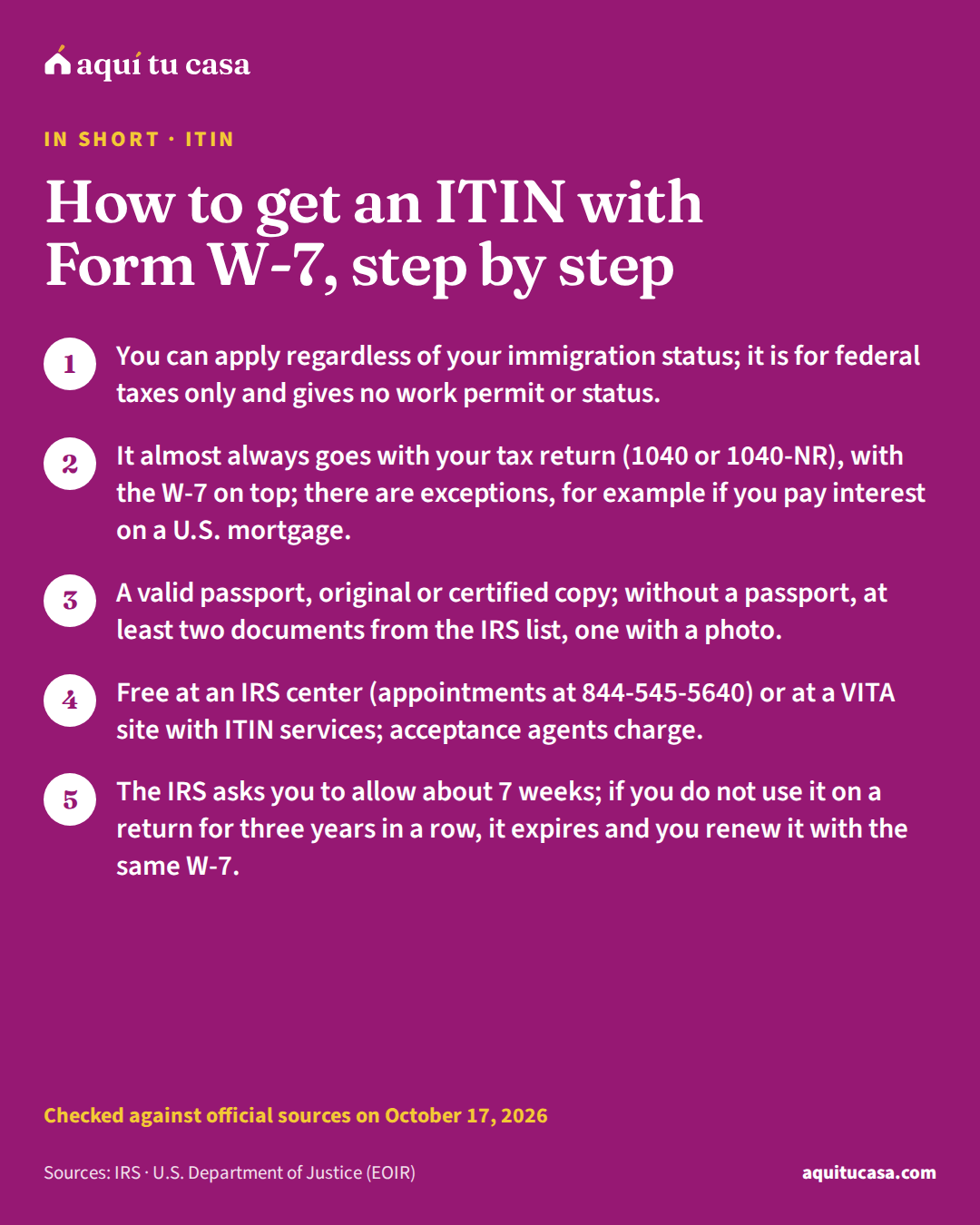
- ITIN How to get an ITIN with Form W-7, step by step Who can apply for an ITIN, which documents the IRS accepts, where to file Form W-7 for free, how long it takes and how to renew it. 15 minute read
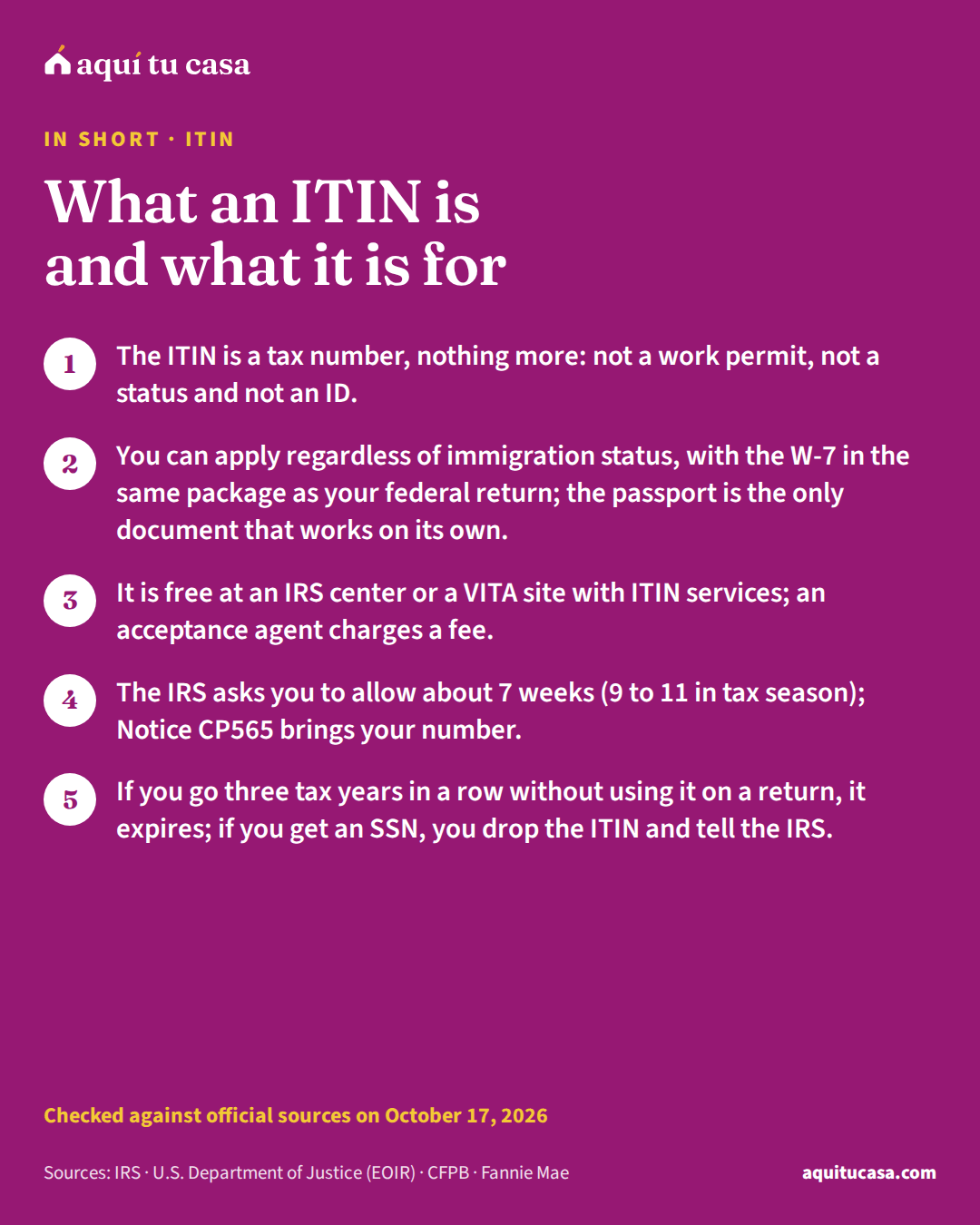
- ITIN What an ITIN is and what it is for The ITIN is the IRS number for filing taxes without a Social Security number: what it does and does not do, how to apply with Form W-7, timing and expiry. 15 minute read
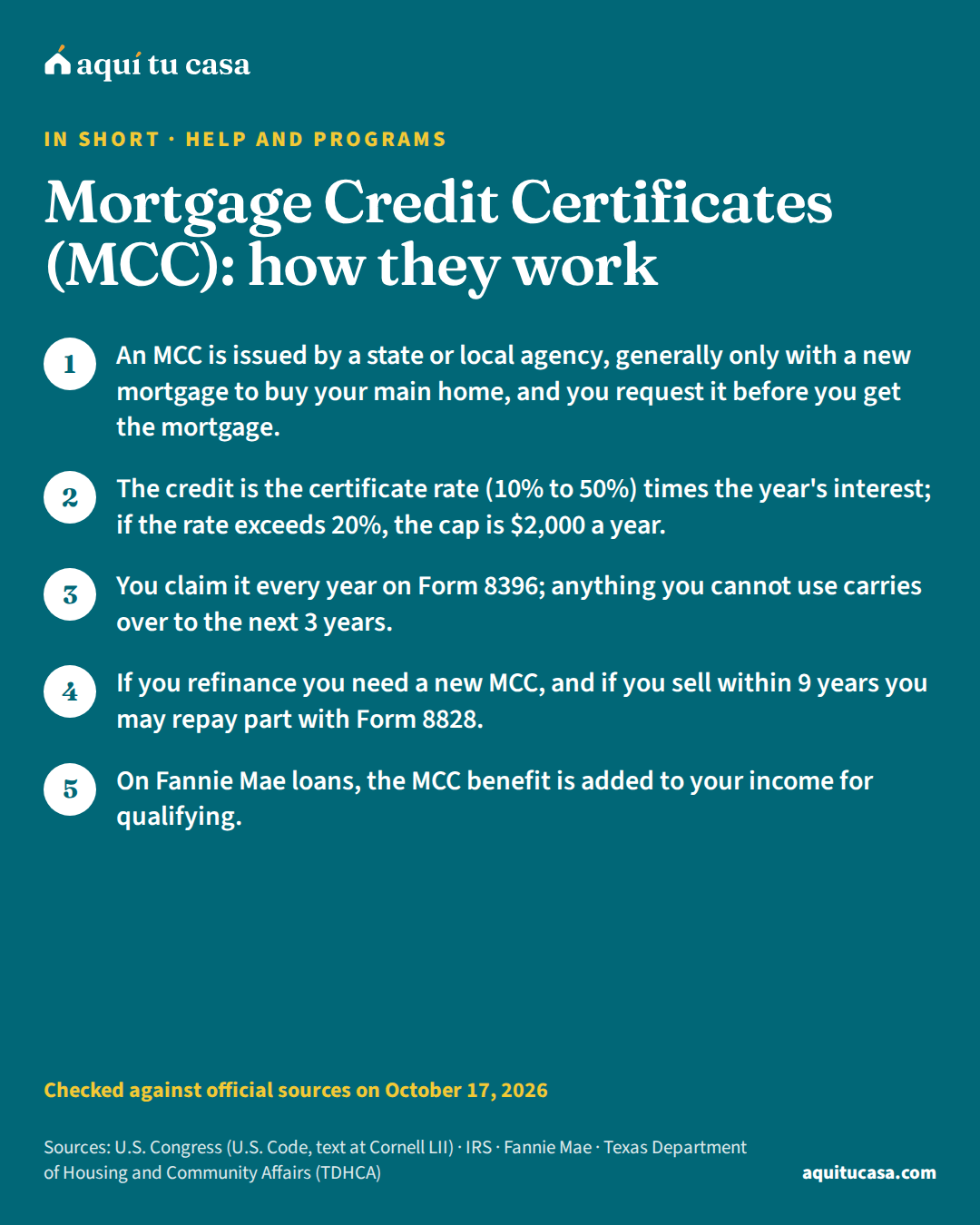
- Help and programs Mortgage Credit Certificates (MCC): how they work What an MCC is, how much it can cut your federal tax, who issues it, how to claim it on Form 8396 and when you might repay part of it if you sell. 11 minute read
Tools for this topic
Was this guide useful?
Thank you. Your answer stays in your browser; nothing is sent.