Renting Essential guide
What to do if you get an eviction notice
Notice, lawsuit and the judge's order: what you can do at each moment, where free legal help is and what federal law says about the 30-day notice.
Verified against official sources on October 17, 2026 12 official sources

Show contents
In short
What you need to know
Quick answer
An eviction notice is not an eviction order. The CFPB separates three moments: the notice or demand for payment, the court lawsuit and the judge's ruling; at all three there is something you can do. Talk to your landlord and apply for rental assistance; if you are sued, answer in writing and go to the hearing; if the judge has already ruled, ask whether the order can be paused while help arrives. Deadlines are set by your state, so call a free legal aid office today (you may qualify based on your income) or a HUD-approved housing counselor at 800-569-4287.
What matters most
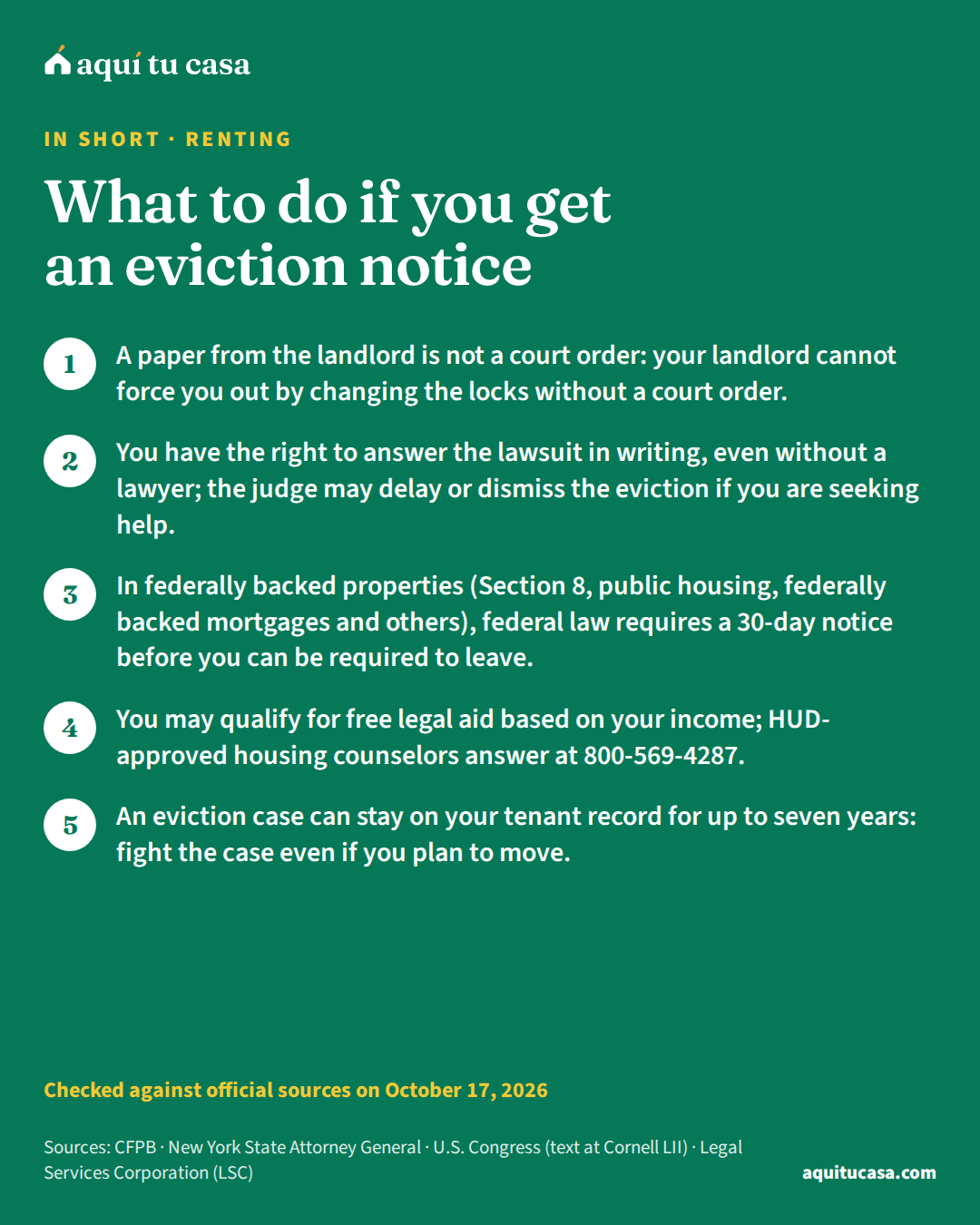
- A paper from the landlord is not a court order: your landlord cannot force you out by changing the locks without a court order.
- You have the right to answer the lawsuit in writing, even without a lawyer; the judge may delay or dismiss the eviction if you are seeking help.
- In federally backed properties (Section 8, public housing, federally backed mortgages and others), federal law requires a 30-day notice before you can be required to leave.
- You may qualify for free legal aid based on your income; HUD-approved housing counselors answer at 800-569-4287.
Is this for you?
This guide is for you if…
- You fell behind on rent and your landlord gave you a paper telling you to leave.
- You received a lawsuit from the court and do not know whether you have to go.
- A judge already ordered the eviction and you need time or help to move.
Get direct help first if…
- Your landlord changed the lock or put your things out without a judge's order: call a free legal aid office today; your state's rules decide what they can and cannot do.
- Your question is whether the eviction affects your immigration status: only an attorney or a representative accredited by the Department of Justice can advise you.
A paper taped to the door, a letter with the word “eviction”, a message saying you have three days. Fear makes many people leave without a fight or sign whatever is put in front of them. This guide explains, using what the CFPB publishes, federal law and the New York Attorney General as one state’s example, what each moment of the process means and what you can do at each one. The exact deadlines (how many days each notice gives, when the hearing is) are set by your state’s law; that is why, at every step, the guide points you to the free legal help that does know those rules.
First: a notice is not an order
The CFPB explains that if you are behind on rent and received a demand for payment, an eviction notice or a court lawsuit, help is available. It sorts what you can do into three situations: no lawsuit has been filed yet, one has been filed, or a court has already ruled that you can be evicted.1 As a renter you have local, state and federal rights, and some may help you stay in your home and postpone the evictionevictionEviction is the legal process a landlord uses to get back a rented home when the tenant does not want to leave. The most common reasons are unpaid rent, serious lease violations or a lease that has ended. First the landlord must give you written notice. If it is not resolved, the landlord needs a court order, and a law enforcement officer must carry out the removal. If you are sued, you have the right to file a written answer explaining to the court why you should not be evicted. The rules change by state and city.See the full definition.2
A paper from the landlord does not give them permission to put you out. According to the CFPB, your landlord cannot force you out by changing your locks without a court order.4
How an eviction moves forward
This is how the CFPB describes the process, with the New York Attorney General as an example for the last part. The names of the papers and the deadlines change from state to state.
From notice to the judge's order, step by step
1. You get a notice or a demand for payment
The first paper
It is a notice from the landlord, not a judge's order. How many days it gives you is set by your state's law.1
Try it with your numbersEviction timelines by state2. The landlord files a lawsuit in court
If you cannot work it out
You get court papers, such as the summons. Ask the clerk how long you have to answer.1
3. You file your written answer
Within the time the court gives you
Explain your situation and what you are doing to get help. You can file it even if you do not have a lawyer yet.1
4. You go to the hearing
On the date the court sets
Ask whether there is mediation or a referral to a housing counselor. The judge may delay or dismiss the eviction because you are trying to get help.1
5. The judge decides
At the end of the case
If the ruling goes against you, ask whether the order can be placed on hold while your assistance application is processed.1
6. Only an officer carries out the order
After the judgment
In New York, for example, only a sheriff, marshal or constable can carry out the court's warrant.5
The first notice for late rent and its deadline change from state to state, and some local areas have their own rules that can delay an eviction.1 This table shows the notice the law sets in the states where we have it verified; each state’s page has the details, and the eviction timeline tool lays them out by date.
Notice for late rent, by state
| State | Notice for late rent |
|---|---|
| Alabama | 7 business days |
| Alaska | 7 days |
| Arizona | 5 calendar days |
| Arkansas | 3 days |
| California | 3 court days |
| Colorado | 10 days |
| District of Columbia | 10 days |
| Florida | 3 days |
| Georgia | 3 business days |
| Hawaii | 10 calendar days |
| Idaho | 3 days |
| Illinois | 5 days |
| Indiana | 10 days |
| Iowa | 3 days |
| Kansas | 3 calendar days |
| Kentucky | 7 days |
| Louisiana | 5 days |
| Maryland | 10 days |
| Massachusetts | 14 days |
| Michigan | 7 days |
| Minnesota | 14 days |
| Mississippi | 3 days |
| Montana | 3 days |
| Nebraska | 7 calendar days |
| Nevada | 7 judicial days |
| New Hampshire | 7 days |
| New Mexico | 3 days |
| New York | 14 days |
| North Carolina | 10 days |
| North Dakota | 3 days |
| Ohio | 3 days |
| Oklahoma | 5 days |
| Oregon | 10 days |
| Pennsylvania | 10 days |
| Rhode Island | 5 days |
| South Carolina | 5 days |
| Tennessee | 14 days |
| Texas | 3 days |
| Utah | 3 business days |
| Vermont | 14 days |
| Virginia | 14 days |
| Washington | 14 days |
| Wisconsin | 5 days |
| Wyoming | 3 days |
This is the general notice to pay or leave; your city may have rules that change it.1 Tap your state to see the details. Source: each state's laws
Moment 1: you received a notice or a demand for payment
This is the moment with the most options. The CFPB advises finding out whether your landlord is willing to work with you or plans to file an eviction lawsuit, and reminds you that it is very rare for a landlord to prefer going through the eviction process instead of receiving their rent.1 Besides applying for assistance, the CFPB suggests talking about a repayment plan. Many assistance programs accept applications from both the landlord and the renter, and renters often need the landlord’s help to complete theirs.3
Ways to catch up, according to the CFPB
Change when you pay
Pay less for a while
Put what you agree on in writing and keep a copy with your receipts.
At the same time, ask for help. Some states or local areas have rules that could delay your eviction while you get help, and local housing counselorsHUD-approved housing counselorA HUD-approved housing counselor works at an agency HUD has approved to provide housing counseling: independent, expert advice customized to your situation about buying a home, renting, a missed mortgage payment, a foreclosure or credit problems. The agencies usually charge little or nothing; many serve in Spanish and offer the homebuyer education course several assistance programs require. They are not lenders or real estate agents and sell you nothing. Your county page lists the official agencies with phone numbers.See the full definition, legal aidlegal aidLegal aid is the free civil legal help that nonprofit organizations and their lawyers provide to low-income people in civil, not criminal, matters. In housing, that includes representing families facing eviction or foreclosure, alongside matters such as custody, child support, protection from domestic violence and access to benefits. In the United States, the Legal Services Corporation, created by Congress, funds a nationwide network of these organizations; its finder points you to the one in your area. Each sets its own income limits.See the full definition and social services organizations can explain how they work. You can also apply to state or local organizations for federal money for rent, utilities and other housing costs; many pandemic programs have closed, but some money may still be available.1 Keep proof of every application: you will need it if the case reaches court.
If you are having trouble paying rent, you are not alone, the CFPB says.2 According to the Census Bureau’s American Community Survey, 51% of renter households pay 30% or more of their income on rent; the rent burden page has the numbers for your area.

There is a federal rule worth knowing. Under the CARES Act, the landlord of a “covered dwelling” may not require you to leave before 30 days have passed since giving you the notice to vacate. A covered dwelling is one occupied by a tenant on a property that participates in a covered federal housing program or the rural housing voucher program, or that has a federally backed mortgage, single-family or multifamily.6 Covered programs include, among others, public housing and Section 8, the low-income housing tax credit, the HOME program, homeless assistance programs, housing for the elderly and for persons with disabilities, USDA rural housing programs and several veterans’ programs.7 If you have a housing voucherHousing Choice Voucher (Section 8)The Housing Choice Voucher, the program almost everyone calls Section 8, is the country's largest federal rental assistance. HUD pays rental subsidies so eligible families can afford decent, safe and sanitary housing. Local public housing agencies administer it with HUD funds. The family finds its own home on the private market; if the agency approves the unit and the tenancy, it contracts with the owner to pay part of the rent, and the family pays the rest. Waiting lists are usually long and open for limited periods.See the full definition or live in a subsidized building, ask whether your home is covered; if you do not know whether the building’s mortgage is federally backed, a legal aid office can find out.

Moment 2: you were sued in court
If you receive court papers, the case already exists and has a date. The CFPB warns that too many renters give up before they have a chance to go to court. When you respond, you can share information that might help you avoid eviction and object to anything that is not true.1 You have the right to file a written answer explaining to the court why you should not be evicted: your situation, what your landlord has or has not done to get rental assistance funds and any pending applications. The judge may delay or dismiss the eviction because you are trying to get help.1
Call the court clerk and ask how long you have to answer from the date you received the summons, whether there is a court date yet, whether the court offers mediation or refers people to housing counselors, and whether you have the right to a lawyer. If you do not have a lawyer yet, you can file an answer on your own; LawHelp.org explains how in your state.1
This is the moment for legal help. Many landlords are represented by a lawyer in court, and you can get legal help too.4 The CFPB recommends talking to a lawyer if your landlord is threatening to evict you or you need help understanding your rights; you may qualify for free legal aid based on your income, through your local bar association or a legal aid office.1 The Legal Services Corporation, established by Congress, funds civil legal aid for low-income Americans, and on its site you find the nearest office by entering an address or city.9 The link is at the end of this guide.
Moment 3: the judge has already ruled
If a court has already ruled that you can be evicted, there is still something to ask: the CFPB says to ask the judge or the court clerk whether the eviction order can be placed on hold while your rental assistance application is processed.1 Emergency assistance is not just for back rent: you can ask for help with moving costs, the security deposit and application fees for a new home.1
What comes next depends on the state. In New York, for example, in a non-payment case you can have the case dismissed if you pay all the rent owed before the warrant is carried out, and if you lose you can ask the court for up to one year to move if you show you cannot find a similar apartment in your neighborhood; the judge decides.5 Ask the legal aid office what options your state’s law gives you.
A HUD-approved housing counselor can also help you plan the move and look for housing; they give independent advice on renting, missed payments and credit, often free or at low cost,12 and you reach them at 800-569-4287.1 Your state’s page under Places lists the agencies and the public housing authoritypublic housing agency (PHA)A public housing agency (PHA) is a state, county, municipal or other governmental entity or public body authorized to operate public housing or rental assistance programs. These are the agencies that locally administer the Housing Choice Vouchers (Section 8) and public housing with HUD funds: they open and manage the waiting lists, review eligibility and income, inspect units and pay the owner its share of the rent. Each county usually has one or several; your page shows the ones serving your area with their phone numbers.See the full definition in your area.
What a landlord cannot do on their own
Even if you owe rent, an eviction goes through the court. According to the CFPB, your landlord cannot force you out by changing your locks without a court order; that is an illegal lockoutillegal lockoutAn illegal lockout happens when the landlord shuts you out of your home by changing the locks without a court order. A landlord cannot force you out that way, or pressure you by cutting off utilities under the landlord's control. To evict you, the landlord must follow the legal process: written notice, a court case and a judge's order. Most states prohibit removing or shutting out a tenant without a court order. Depending on your state's law, you may be able to get back into the home, end the lease or recover damages.See the full definition.4 In New York, the Attorney General adds that a landlord also cannot use threats, remove your belongings or willfully cut off services such as water or heat, and that in a non-payment case you cannot be evicted for not paying other fees, such as late fees.5
If the person collecting your back rent is the landlord’s lawyer or a collection agency, they may be a debt collector under federal law. Debt collectors cannot use unfair, deceptive or abusive practices; if you believe one is, you can submit a complaint to the CFPB or call (855) 411-2372.4
If this is you
You are an active servicemember
You and your dependents can ask for a pause of up to 90 days in an eviction; talk with your local Legal Assistance Office.1
You have a voucher or live in subsidized housing
If your home is covered, the landlord cannot require you to leave before 30 days after the notice.6 Your local public housing authority and legal aid can confirm it.
You are experiencing violence at home
Federal law may protect you from eviction or from losing your subsidy because of domestic violence, dating violence, sexual assault or stalking committed against you.4 Call legal aid.
They want you out because of your family or your origin
The Fair Housing Act prohibits discrimination in the terms of a rental because of familial status or national origin, among other reasons.11

If the reason is not the rent
Sometimes the “eviction” comes after you asked for a repair, after a baby was born or after the landlord found out where you are from. The Fair Housing ActFair Housing ActThe Fair Housing Act is the federal law that makes it illegal to refuse to sell or rent a dwelling, or to discriminate in its terms, because of race, color, religion, sex, familial status (having children), national origin or disability. It applies to landlords, real estate agents and managers, and also to banks and lenders when their practices make housing or credit unavailable for those reasons. National origin covers your language and the country you come from, regardless of immigration status. If you believe you were discriminated against, you can file a complaint with HUD at no cost; many states add protections.See the full definition makes it unlawful to discriminate in the terms, conditions or privileges of a rental, or in related services, because of race, color, religion, sex, familial status or national origin, and also because of disability.11 If you think that is your case, tell the legal aid office on the first call.
Rules on retaliationlandlord retaliationLandlord retaliation happens when the landlord punishes you for using a legal right. For example, the landlord tries to evict you because you complained in good faith to a government office about health or safety problems in the home, or because you organized with other tenants. Not every state recognizes it, and each one defines and proves it differently. In addition, the federal Fair Housing Act prohibits retaliating against a person for filing a housing discrimination complaint or taking part in that process.See the full definition for requesting repairs are set by each state. The LSC Eviction Laws Database, built with Temple University, lets you explore the entire legal process of eviction for all 50 states, the District of Columbia, Puerto Rico and other territories, with the laws in effect as of January 1, 2021.10 It is a reference for understanding the map; the current dates and forms come from the legal aid office.
Afterward: your record and your next rental
Fighting the case matters even if you end up moving. According to the CFPB, eviction court cases can appear on your tenant screening report for up to seven years, and many landlords will not rent to someone whose report shows an eviction filing. Under the Fair Credit Reporting Act, lawsuit and judgment information can be reported for seven years or until the statute of limitations runs out, whichever is longer. Some states allow eviction records to be sealed or expunged, or prohibit using them. If the information is wrong or outdated, dispute it with the screening company and with the company that provided it, and you can submit a complaint to the CFPB online or at (855) 411-2372.8
Our guide How to rent without a Social Security number or credit explains what you can be asked for and your rights when applying for your next home, and the security deposits guide explains how to get back the deposit on the home you leave.

Costly mistakes
Mistake: Not answering the lawsuit or not going to the hearing.
Instead: Answer in writing and go: too many renters give up before they go to court.1
Mistake: Leaving without a fight because you plan to move anyway.
Instead: An eviction case can stay on your report for up to seven years, and many landlords will not rent if they see it.8
Mistake: Paying someone who promises to get you rental assistance.
Instead: Scammers target people looking for that help; apply directly to the program.2
Mistake: Accepting a lock change without a court order.
Instead: Your landlord cannot force you out that way; call a free legal aid office today.4
Mistake: Waiting for the judge to rule before applying for assistance.
Instead: Apply from the first notice and keep the proof: the judge may delay the eviction if you are seeking help.1
What to do today
- Write the date you received it on the paper and keep the envelope.
- Call your landlord and ask whether they are willing to set up a payment plan or whether they will sue.1
- Apply for rental assistance and keep the proof.1
- Call your local legal aid office or a housing counselor at 800-569-4287.1
- If there are already court papers, file your written answer and note the hearing date.1
Your income
Let's do the math
Rent that fits your budget (30% of income)
$2,018
With an income of $6,728 a month. Up to $3,364 would already be a severe burden (50% of income).
Compared with HUD’s Fair Market Rent in the United States
- 2 bedrooms$1,750Fits · 26%Needs $33.65 an hour
The wage needed pays that rent without going over 30% of income, working 40 hours a week all year.
The typical rent households actually pay in the United States is $1,413 a month (Census).
A reference to give you an idea. Each landlord and each program sets its own requirements.
Ready to see the numbers? Find your county here
See how this applies in your county: its loan limits, prices and rents, from the official data.
Printable checklist
Frequently asked questions
Can I stay in my home after receiving the notice?
The notice is the first step, not the last. Your state's rules say how many days each kind of notice gives and what happens next; in general, the landlord has to file a lawsuit and a judge has to rule. Use those days to talk to the landlord, apply for assistance and call legal aid.
Do I have to go to court if I have no lawyer?
Yes, go. You have the right to file a written answer even without a lawyer, and to explain your situation to the judge; ask the clerk for the date, whether there is mediation and whether the court refers people to housing counselors. The CFPB warns that too many renters give up before they go to court, and in New York, for example, an eviction notice can still be sent if the tenant does not appear.
What is the 30-day notice people mention?
A federal rule in the CARES Act for 'covered dwellings': properties in federal housing programs (such as Section 8 or public housing) or with federally backed mortgages. There, the landlord cannot require you to leave before 30 days after the notice. A legal aid office can find out whether your home is covered.
Can my landlord change my lock or put my things out?
The CFPB explains that your landlord cannot force you out by changing your locks without a court order. In New York, for example, only a sheriff, marshal or constable can carry out an eviction warrant. If it happens to you, call a free legal aid office today.
Can I pay what I owe and stay?
It depends on your state and your case. In New York, for example, in a non-payment case you can have the case dismissed if you pay all the rent owed before the warrant is carried out. The CFPB also describes repayment plans with the landlord. Ask the legal aid office how it works where you live.
Does the eviction show up on my record?
Eviction court cases can appear on your tenant screening report for up to seven years, and many landlords will not rent if the report shows an eviction filing. Some states allow those records to be sealed. If the information is wrong, dispute it with the screening company and with the company that provided it.
Is there help paying for the move if I have to leave?
There may be. The CFPB explains that emergency rental assistance is not just for back rent: some programs help with moving costs, the deposit and application fees for a new home. Many have closed, but some money may still be available: ask your local program or a housing counselor.
Sources
Every figure in this guide comes from one of these official sources. The number next to a sentence leads to the source behind it.
Each source on one line: who publishes it, its title, its address and the date we read it.
- 1. CFPB · What to do if you're facing eviction · consumerfinance.gov · Accessed October 17, 2026
- 2. CFPB · Help for renters · consumerfinance.gov · Accessed October 17, 2026
- 3. CFPB · Start a conversation about rent repayment · consumerfinance.gov · Accessed October 17, 2026
- 4. CFPB · Your tenant and debt collection rights · consumerfinance.gov · Accessed October 17, 2026
- 5. New York State Attorney General · Residential Tenants' Rights Guide · ag.ny.gov · Accessed October 17, 2026
- 6. U.S. Congress (text at Cornell LII) · CARES Act, 15 U.S.C. §9058, Temporary moratorium on eviction filings (notice to vacate) · law.cornell.edu · Accessed October 17, 2026
- 7. U.S. Congress (text at Cornell LII) · 34 U.S.C. §12491, Housing protections for victims (definition of 'covered housing program') · law.cornell.edu · Accessed October 17, 2026
- 8. CFPB · How long can information, like eviction actions and lawsuits, stay on my tenant screening record? · consumerfinance.gov · Accessed October 17, 2026
See the other 4 sources
- 9. Legal Services Corporation (LSC) · Get Legal Help · lsc.gov · Accessed October 17, 2026
- 10. Legal Services Corporation (LSC) · LSC Eviction Laws Database · lsc.gov · Accessed October 17, 2026
- 11. U.S. Congress (text at Cornell LII) · Fair Housing Act, 42 U.S.C. §3604, Discrimination in the sale or rental of housing · law.cornell.edu · Accessed October 17, 2026
- 12. CFPB · Find a Housing Counselor · consumerfinance.gov · Accessed October 17, 2026
Keep reading
Related guides
If this guide helped, these follow the same path.

Help and programs 11 minute read
HUD housing counselors: what they do and what they cost
What a HUD-approved housing counselor does, what they help with (buying, renting, missed payments, credit), what they may charge and how to find one.
- Independent, expert advice: they are not lenders or agents, and the regulation requires intake, an analysis, an action plan and follow-up.
- Intake is not charged; fees must be reasonable, disclosed in advance and waived for anyone who cannot pay.
- Foreclosure prevention counseling is free at HUD-approved agencies.
- Renting Security deposits: how much and how to get yours back What a security deposit is, how much a landlord may charge in your state, what can be deducted, when it must be returned and where to complain if it isn't. 14 minute read
- Renting Your lease explained: what to check before you sign What a lease is, which clauses to read before you sign, the lead paint disclosure, your fair housing rights and where to get free help. 15 minute read
- Renting How to rent without a Social Security number or credit What a landlord can ask for, what to offer instead of an SSN and credit, how much rent fits your income and your rights if you are turned down. 11 minute read
Tools for this topic
Was this guide useful?
Thank you. Your answer stays in your browser; nothing is sent.