Owning a home Essential guide
Property tax explained: how it is calculated and paid
Who charges property tax, how it is calculated, how it is paid through escrow, which exemptions and appeals exist and what part is deductible.
Verified against official sources on October 17, 2026 9 official sources

Show contents
In short
What you need to know
Quick answer
Property tax is charged by your county, your city and your school district, not by the federal government: they multiply the assessed value they assign to your home by their rates, subtract the exemptions you have claimed and send you the bill. If you have a mortgage, you almost always pay it through the escrow account, and when the tax goes up, your monthly payment goes up. Exemptions and the deadlines to appeal the value vary by state and county; on this site we gather them on your state's page. On your federal return you can deduct the tax only if you itemize and within a limit.
What matters most
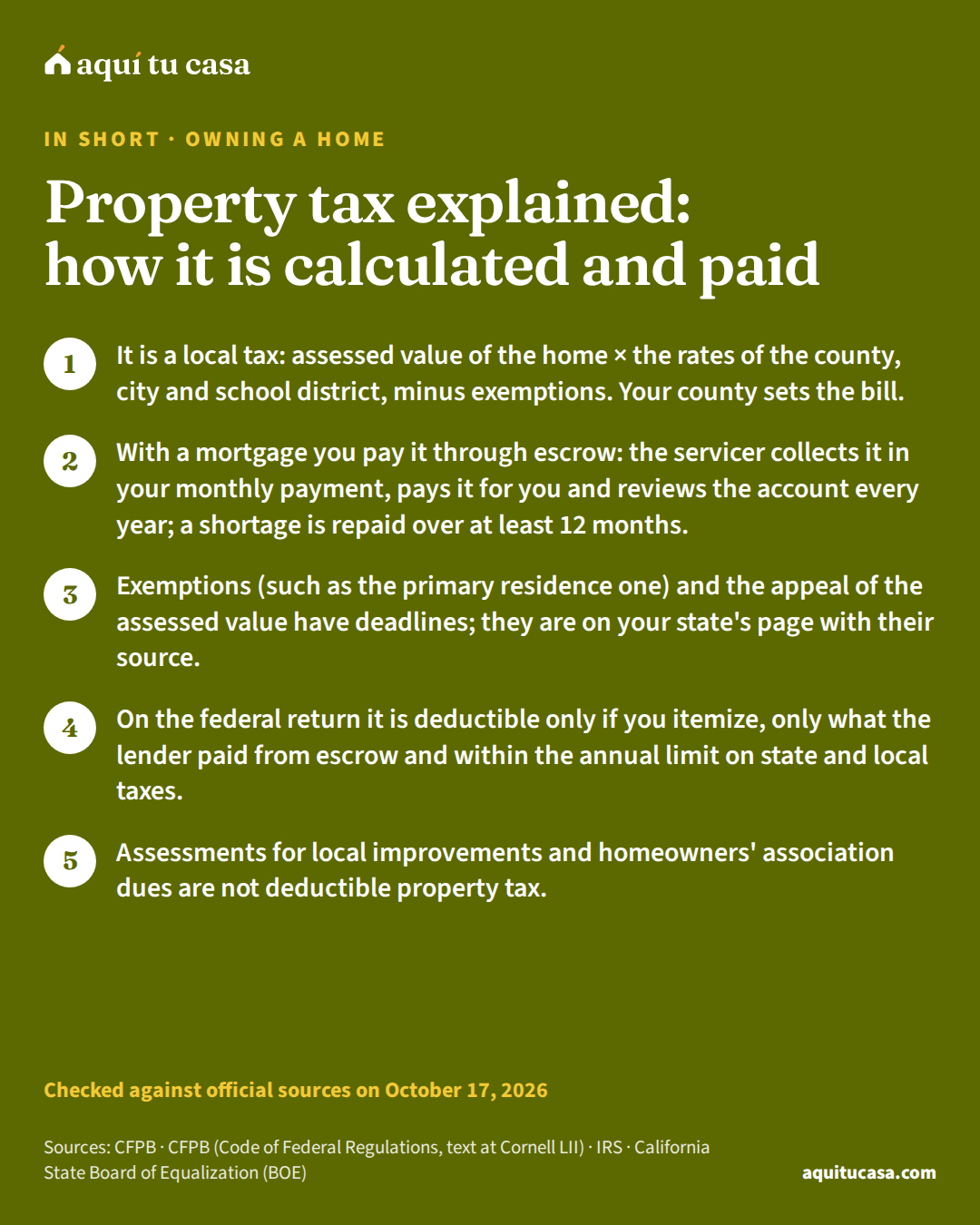
- It is a local tax: assessed value of the home × the rates of the county, city and school district, minus exemptions. Your county sets the bill.
- With a mortgage you pay it through escrow: the servicer collects it in your monthly payment, pays it for you and reviews the account every year; a shortage is repaid over at least 12 months.
- Exemptions (such as the primary residence one) and the appeal of the assessed value have deadlines; they are on your state's page with their source.
- On the federal return it is deductible only if you itemize, only what the lender paid from escrow and within the annual limit on state and local taxes.
Is this for you?
This guide is for you if…
- You just bought and got a county bill you do not understand, or your mortgage payment went up without the rate changing.
- You want to know whether you are overpaying, whether you can claim an exemption or whether it pays to appeal the value.
- You are about to buy and want to put this expense in your budget from the start.
Get direct help first if…
- You already have a tax sale notice or a tax lien on your home: find a free legal aid office and a HUD-approved housing counselor today.
- Your question is about the transfer tax when buying or selling: it is on your state's page under Places.
Property taxproperty taxProperty tax is the tax the county, city, school district and other local bodies charge real property owners every year to pay for schools, police, fire and other public services. It is computed on the value the assessor's office assigns to your home, at each body's rate, minus the exemptions you qualify for, such as the primary-residence exemption in many states. If you have a mortgage you normally pay it month by month inside your payment, through the escrow account. It is generally deductible on your federal return if you itemize.See the full definition is the ownership expense that surprises people most, because no one charges it at a register: it shows up in the mortgage payment or in a county bill once or twice a year, and it goes up without warning. This guide explains who charges it, how much people pay, how it is calculated, how it is paid through escrow, which exemptions and appeals exist and what part you can deduct on your federal return.
- Typical effective rate in the US; what owners pay divided by the home's value (Census, ACS)
- 0.94%
- What the typical US homeowner pays per year (Census, ACS)
- $3,119
- To receive your annual escrow statement after the account year closes
- 30 days2
- To repay an escrow shortage of one month's payment or more, if the servicer asks
- 12+ months2
Who charges it and what for
Property tax is local. It is charged by the county, the city, the school district and sometimes special districts (water, fire, hospital), and it pays for schools, police, streets and services. The federal government charges no property tax; all it does is allow part of it to be deducted on your tax return, as you will see below.
The office that puts a value on your home is usually called the “assessor”, “appraisal district” or “property appraiser”, depending on the state. That office sets the assessed valueassessed valueAssessed value, or assessment, is the value the local government's assessor gives your property to calculate property tax. It is only for taxes: it is not the appraisal a lender orders for your mortgage. The assessor first estimates market value, usually by comparing your home with similar homes that sold recently. In some places the assessment equals full market value, and in others it is a fraction of it. The assessor does not decide how much you pay: that depends on the rates set by the county, the city and the school district.See the full definition; the boards of each jurisdiction set the rates; the county treasurer or tax collector sends the bill and collects.
How much people pay: the typical bill and your state
According to the Census Bureau’s American Community Survey (ACS), the typical US homeowner pays $3,119 a year in property tax. If you divide that medianmedian (typical value)The median is the value in the middle when you sort all the data from smallest to largest: half of the cases fall below it and half above. If the number of data points is even, it is the average of the two middle values. On aquitucasa, when we say "typical value", "typical rent" or "typical income" we mean the median published by the Census Bureau, not the average: the average is pulled up by a few very expensive homes or very high salaries, while the median better describes what an ordinary family experiences. Every figure carries its source and date.See the full definition by the typical home value, $332,700, you get an effective rate of 0.94%. The effective rate is a simple way to compare places: how much tax is paid for each dollar of home value.
Example with real numbers
The tax on a typical home, per year and per month
With national Census (ACS) numbers, not the bill for a real home.
- Typical US home value
- $332,700
- What the typical homeowner pays per year (median)
- $3,119
- Effective rate (what is paid divided by the home's value)
- 0.94%
- Per month, the tax share that would go into escrow
- $261
This is an example with national numbers. With escrow, part of your monthly payment covers the tax and the servicer pays it for you.1 Your number depends on your county's assessed value, rates and exemptions.
Run it with your numbersMortgage calculatorThat national figure hides big differences. The table compares the effective rate and the typical home value in the states that already have their own page on this site; tap the name to see each state’s details.
Property tax and home value by state
| State | Property tax (effective rate) | Typical home value |
|---|---|---|
| Alabama | 0.38% | $209,900 |
| Alaska | 1.11% | $352,900 |
| Arizona | 0.48% | $394,500 |
| Arkansas | 0.55% | $188,000 |
| California | 0.7% | $734,700 |
| Colorado | 0.48% | $539,400 |
| Connecticut | 1.81% | $366,900 |
| Delaware | 0.5% | $352,000 |
| District of Columbia | 0.58% | $737,100 |
| Florida | 0.76% | $359,000 |
| Georgia | 0.77% | $303,300 |
| Hawaii | 0.27% | $839,100 |
| Idaho | 0.49% | $418,600 |
| Illinois | 2.01% | $263,300 |
| Indiana | 0.74% | $218,200 |
| Iowa | 1.39% | $208,000 |
| Kansas | 1.29% | $217,200 |
| Kentucky | 0.75% | $205,600 |
| Louisiana | 0.55% | $216,500 |
| Maine | 1.02% | $296,600 |
| Maryland | 0.97% | $419,900 |
| Massachusetts | 1.07% | $562,100 |
| Michigan | 1.25% | $231,600 |
| Minnesota | 1.02% | $329,300 |
| Mississippi | 0.72% | $169,800 |
| Missouri | 0.85% | $230,300 |
| Montana | 0.72% | $375,800 |
| Nebraska | 1.49% | $238,600 |
| Nevada | 0.47% | $435,400 |
| New Hampshire | 1.66% | $402,500 |
| New Jersey | 2.11% | $454,400 |
| New Mexico | 0.7% | $248,100 |
| New York | 1.55% | $423,800 |
| North Carolina | 0.66% | $288,900 |
| North Dakota | 0.99% | $249,900 |
| Ohio | 1.31% | $214,800 |
| Oklahoma | 0.8% | $199,800 |
| Oregon | 0.81% | $477,600 |
| Pennsylvania | 1.3% | $254,500 |
| Puerto Rico | 0.49% | $131,500 |
| Rhode Island | 1.21% | $404,200 |
| South Carolina | 0.48% | $259,000 |
| South Dakota | 1.06% | $257,400 |
| Tennessee | 0.5% | $286,700 |
| Texas | 1.49% | $283,800 |
| Utah | 0.52% | $489,400 |
| Vermont | 1.59% | $316,600 |
| Virginia | 0.73% | $383,700 |
| Washington | 0.81% | $564,600 |
| West Virginia | 0.53% | $162,600 |
| Wisconsin | 1.42% | $266,500 |
| Wyoming | 0.57% | $309,700 |
The effective rate divides the median that owners pay by the median home value. Source: Census Bureau (ACS)
A low effective rate does not always mean a low bill: where homes are worth a lot, the tax in dollars can be high. With Census data we also compute what owners pay in each county; it is on your county’s page and on the property tax data page, with source and date.

How it is calculated
The formula is the same almost everywhere; what changes are the names and the percentages in each state:
- Assessed value. The county office assigns a value to your home, from comparable sales or a formula. In some states that value is a fraction of market value; in others, the full market value.
- Exemptions. The ones you are entitled to and have claimed are subtracted: the most common is the primary residence (homesteadhomestead exemptionA homestead exemption is a legal protection for the home where you and your family live. It can keep certain creditors from collecting your debts out of your main home, and it can also lower the property tax on that home. In Texas, for example, the residence homestead exemption removes part of your home's value from the tax calculation; to get it you must own the home, live there as your principal residence and apply. State laws vary widely: some cap the amount protected and others depend on the size of the property or the owner's age.See the full definition) exemption, and there are others for older adults, veterans, people with disabilities and widows or widowers, depending on the state.
- Rates. Each jurisdiction applies its rate to the remaining value; the bill adds them all up.
- Caps. Some states cap how much the assessed value can rise from one year to the next while you do not sell the home; when you sell, the value resets and the buyer may pay much more than the seller did. In California, for example, yearly increases are capped at 2 percent and the base value is set when the home changes ownership;4 in Florida, a primary home with the homestead exemption cannot rise more than 3 percent a year (or the change in the consumer price index, if lower) and is assessed at just value on the January 1 after the change of ownership.5
That is why two identical houses on the same street can pay very different amounts, and why the seller’s bill does not tell you what you will pay. Before buying, ask the county what that home would pay with the reset value and your exemptions. The mortgage calculator lets you enter that number and see how your monthly payment changes.

How it is paid: the escrow account
If you have a mortgage, you almost never pay the bill directly. According to the CFPB, the escrowescrow accountAn escrow account is an account set up by your mortgage lender to pay certain property-related expenses on your behalf, mainly property taxes and homeowners insurance. The money comes from a portion of your monthly mortgage payment: each month you contribute a share and the loan servicer pays the bills when they come due. That is why your payment is higher than principal and interest alone, and why it can change when taxes or the insurance premium go up. In some states the word also names the period between the offer and the closing.See the full definition account is set up by your lender to cover certain property expenses; part of your monthly payment funds it, so you pay those costs in small monthly amounts instead of one large bill. Many lenders require that you pay taxes and insurance through escrow, the loan servicerloan servicerThe loan servicer is the company that sends you your mortgage statements and handles the day-to-day tasks of the loan: it processes your payments, answers your questions, keeps track of principal and interest paid and manages your escrow account, if you have one. It can also offer options if you fall behind and, in certain cases, start a foreclosure. It may be the same company that lent you the money or a different one, and it is common for another company to take over the loan after closing.See the full definition manages the account and pays those bills for you, and because taxes and premiums change from year to year, your escrow payment and your total monthly payment change accordingly.1
Your escrow account's year
1. You pay every month
Every month
Part of your monthly payment goes into the escrow account for the tax and the insurance.1
2. The servicer pays the bill
Before the deadline
It must pay on time to avoid a penalty, as long as you are not more than 30 days behind.2
3. Account analysis
At the end of the account year
It reviews what came in and went out, and works out your payment for next year.2
4. Annual statement
Within 30 days
It sends you the annual statement with what it paid and what it projects.2
5. If there is extra or too little
After the analysis
A surplus of 50 dollars or more is refunded within 30 days; a shortage of one month's payment or more can be spread over at least 12 months.2
6. Your payment changes
The next year
If the tax or the insurance went up, your monthly payment goes up even if your rate is fixed.1
There are federal rules for that account. Under Regulation X, the servicer must analyze the account at the end of each computation year and send you the annual statement within 30 days; the cushion it may require may be no greater than one-sixth of the estimated annual payments; if there is a surplus of 50 dollars or more, it must refund it within 30 days; if there is a shortage of one month’s payment or more, it may require you to repay it in equal monthly payments over at least 12 months; and it must pay taxes and insurance on or before the deadline to avoid a penalty, as long as you are not more than 30 days behind.2
Exemptions and appeals: where the savings are
Two things depend on you and have deadlines:
- Claim the exemptions. They usually do not apply on their own: you have to file a form with the county office, normally once, and sometimes renew it. In California, for example, the homeowners’ exemption takes $7,000 off the taxable value, is filed once and must be in by February 15 to get the full exemption that year;6 in Florida, the application is due by March 1 and the appraiser then mails you a renewal every year.7 If you just bought, the primary residence exemption is the first one to check.
- Appeal the assessed valueproperty tax appealA property tax appeal is the formal process to ask that the value the local government gave your property be changed, if you think it is too high or has errors. Each state calls it something different: in Texas it is a protest to the appraisal review board, and in New York it is a grievance with the municipality. Often you can first talk informally with the assessor's office. There are strict deadlines and it is up to you to bring evidence, such as sales of similar homes. The appeal reviews the value, not the tax rate.See the full definition. If the value you were assigned is above what comparable homes sold for, you can ask for a review. It usually starts with an informal request to the county office and, if that fails, a hearing before a board. In Florida, for example, you can ask the appraiser for an informal conference and, if you still disagree, file a petition with the value adjustment board within 25 days after the assessment notice is mailed.8 Bring comparable sales, photos and, if you have them, repair estimates.
Two ways to pay less
Lowers the taxable value
Claim an exemption
Fixes a value that is too high
Appeal the assessed value
Forms and dates change by state and by county: look them up on your state's page.
What part is deductible on your federal return
According to IRS Publication 530 for tax year 2025, you can deduct the property tax if it is assessed uniformly at a like rate on all real property throughout the community and the proceeds are used for general community or governmental purposes. To deduct it you must itemize on Schedule A (if you itemize, you cannot take the standard deduction), and the overall deduction for state and local taxes (income, sales and property) has an annual limit, whose 2025 figure and income phase-downs are in the publication itself.3
Three details that tend to confuse:3
- Assessments for local improvements that increase your property’s value (streets, sidewalks, water and sewer) are not deductible: they are added to the home’s basis. The part that is for maintenance, repair or interest is deductible, if you can show how much it is.
- Homeowners’ associationhomeowners association (HOA)A homeowners association (HOA) is the organization formed in many subdivisions and condominium buildings to manage shared expenses such as landscaping, a pool, maintenance of common areas and, in condos, the roof and exteriors. Each owner pays dues, normally monthly, and must follow its rules, which can cover anything from the color of your door to renting the home out. If you do not pay, the association can add charges and, in several states, place a lien on your home. The dues count toward your monthly payment when lenders judge whether you can afford the mortgage.See the full definition dues are not deductible tax, because the association, not a government, imposes them.
- Taxes on real estate in another country are not deductible.
And two timing rules: if you pay through escrow, you deduct only the taxes the lender actually paid from escrow to the taxing authority, not everything you deposited; and in the year of purchase, the seller is treated as paying up to the day before the sale and the buyer from the date of sale, each with their own share.3

If you cannot pay
The consequences of not paying property tax are set by each state and can go as far as a tax sale of the home, with interest and penalties along the way. If you have escrow, the servicer pays the bill while you are current on the mortgage; the risk appears when there is no escrow or when you fall behind. In that case, ask the county tax collector about payment plans and about exemptions or deferrals for older adults or low incomes, and talk to a HUD-approved housing counselorHUD-approved housing counselorA HUD-approved housing counselor works at an agency HUD has approved to provide housing counseling: independent, expert advice customized to your situation about buying a home, renting, a missed mortgage payment, a foreclosure or credit problems. The agencies usually charge little or nothing; many serve in Spanish and offer the homebuyer education course several assistance programs require. They are not lenders or real estate agents and sell you nothing. Your county page lists the official agencies with phone numbers.See the full definition: they give independent advice on missed payments and credit, often free or at low cost.9 If there is already a lien or sale notice, free legal aid comes first. If the problem is the whole mortgage, the If you can’t pay your mortgage guide explains your options.
Costly mistakes
Mistake: Assuming you will pay the same as the seller.
Instead: The value can reset when the home changes hands: in Florida, to just value on the following January 1.5
Mistake: Not claiming the primary residence exemption.
Instead: You have to apply: in California, by February 15 to get the full exemption that year.6
Mistake: Missing the appeal deadline.
Instead: Write down the date: in Florida, the petition to the board is due by the 25th day after the assessment notice is mailed.8
Mistake: Throwing away the annual escrow statement unread.
Instead: It explains why your payment changed, and a shortage of a month or more can be repaid over at least 12 months.2
Mistake: Deducting everything you deposited into escrow.
Instead: Only what the lender actually paid to the taxing authority is deductible.3
Mistake: Deducting homeowners' association dues as tax.
Instead: They are not deductible tax: the association imposes them, not a government.3
If you just bought, the first year as a homeowner guide puts these dates together with the home’s other bills, and the home insurance guide explains the other half of your escrow.

What to do this week
- Find your home’s most recent tax bill and the assessed value the county assigned.
- Check on your state’s page which exemptions exist and whether you have already claimed the primary residence one.
- Read your latest annual escrow statement and confirm what the servicer paid.2
- Compare the assessed value with recent comparable sales; if it is above, note the appeal deadline.
- For your federal return, add up only what the lender paid from escrow and ask at a VITA site whether itemizing pays.3
Your home and your county
We use the typical rate and value of the place you pick.
Typical home value in the United States (Census, ACS 2024). Enter your assessed value.
Let's do the math
Estimated tax per year
$3,127
About $261 a month, at a rate of 0.94% on $332,700.
Per month
$261
If you pay through escrow, your lender adds about this much to your payment.
The math
- Your home's value
- $332,700
- Taxable value
- $332,700
- Rate
- × 0.94%
- Tax per year
- $3,127
The rate changes within the county
Each home pays the districts it sits in (city, schools, services), and each sets its own rate. This rate is a county average, not your home's.
Your county's tax or assessor's office publishes your assessment, each district's rate and how to apply for an exemption or appeal.
This is an educational estimate from county averages, not your tax bill. Your bill depends on your home's districts, your assessment and your exemptions.
Ready to see the numbers? Find your county here
See how this applies in your county: its loan limits, prices and rents, from the official data.
Printable checklist
Frequently asked questions
Why did my mortgage payment go up if my rate is fixed?
Because the property tax and insurance paid from your escrow account change every year, and the servicer adjusts your payment after the annual analysis. Ask for the annual escrow statement: it shows what went up.
Can I pay less property tax?
There are two paths: claim the exemptions you are entitled to (for example, the primary residence exemption where it exists) and appeal the assessed value if you think it is above market value. Both have deadlines set by your state or county; check your state's page.
Can I deduct what I pay in property tax?
Only if you itemize deductions on Schedule A, only the part that actually reached the taxing authority (if you pay through escrow, what the lender paid) and within the annual limit on the deduction for state and local taxes. An IRS VITA site helps you for free to decide whether itemizing pays.
What happens if I do not pay the property tax?
Penalties and consequences are set by each state and can go as far as a tax sale of the home. If you have a mortgage with escrow, the servicer pays it while you are current; if you have no escrow or fell behind, talk as soon as possible to a HUD-approved housing counselor and to free legal aid.
How much property tax do people pay in the United States?
According to the Census Bureau's American Community Survey (ACS), the typical homeowner pays $3,119 a year, and dividing that median by the typical home value gives an effective rate of 0.94%. But it varies a lot from state to state and county to county: look yours up in the state table or on your county's page.
Why doesn't the seller's bill tell me what I will pay?
Because in some states the assessed value resets when the home changes hands. In California, the base value is set when the home changes ownership; in Florida, the home is assessed at just value on January 1 of the year after the change of ownership. Ask the county what that home would pay with the reset value and your exemptions.
What happens if my escrow account has extra or too little money?
After the annual analysis, if there is a surplus of 50 dollars or more, the servicer must refund it within 30 days. If there is a shortage of one month's payment or more, it may ask you to repay it in equal monthly payments over at least 12 months. You will see it on the annual escrow statement.
When do I have to file for the primary residence exemption?
It depends on the state. In California you file once with the county assessor, by February 15 to get the full exemption that year; in Florida, by March 1. Check your state's page for the dates and your county's form.
Sources
Every figure in this guide comes from one of these official sources. The number next to a sentence leads to the source behind it.
Each source on one line: who publishes it, its title, its address and the date we read it.
- 1. CFPB · What is an escrow or impound account? · consumerfinance.gov · Accessed October 17, 2026
- 2. CFPB (Code of Federal Regulations, text at Cornell LII) · Regulation X, 12 CFR §1024.17, Escrow accounts · law.cornell.edu · Accessed October 17, 2026
- 3. IRS · Publication 530 (2025), Tax Information for Homeowners · irs.gov · Accessed October 17, 2026
- 4. California State Board of Equalization (BOE) · Decline in Value (Proposition 8) · boe.ca.gov · Accessed October 17, 2026
- 5. Florida Legislature · Florida Statutes §193.155, Homestead assessments · leg.state.fl.us · Accessed October 17, 2026
- 6. California State Board of Equalization (BOE) · Homeowners' Exemption · boe.ca.gov · Accessed October 17, 2026
- 7. Florida Legislature · Florida Statutes §196.011, Annual application required for exemption · leg.state.fl.us · Accessed October 17, 2026
- 8. Florida Legislature · Florida Statutes §194.011, Assessment notice; objections to assessments · leg.state.fl.us · Accessed October 17, 2026
See the other 1 sources
- 9. CFPB · Find a Housing Counselor · consumerfinance.gov · Accessed October 17, 2026
Keep reading
Related guides
If this guide helped, these follow the same path.

Buying a home 13 minute read
Your first year as a homeowner: escrow, taxes and insurance
Who collects your mortgage and what happens if that changes, the yearly escrow review, taxes, exemptions, insurance, records and scams aimed at new owners.
- Your servicer generally sends a statement every billing cycle; if servicing moves to another company, you get written notice and 60 days of protection from late fees.
- Escrow is reviewed once a year: a surplus of $50 or more is refunded if you are current, and a shortage of one month's escrow or more can be repaid over at least 12 months.
- Your tax can go up after the purchase, and homestead exemptions have deadlines: check your state's page.
- Buying a home How to buy a home in the United States, step by step The nine steps to buying a home: paperwork, credit, budget, assistance, preapproval, offer, inspection, closing and the first year, with official sources. 15 minute read
- Buying a home Closing costs explained: what you pay and what can change What closing costs are, how to read them on your Loan Estimate, which charges cannot go up before closing and how to compare offers to pay less. 14 minute read
Tools for this topic
Was this guide useful?
Thank you. Your answer stays in your browser; nothing is sent.