Homestead exemption: what it is, what it saves, how to apply
What the homestead exemption is, who qualifies, how much it lowers your home's value in Texas, Florida and California, how to apply and which dates matter.
Verified against official sources on October 17, 2026 14 official sources

Show contents
In short
What you need to know
Quick answer
The homestead exemption takes part of the value of the home you live in off the table before your property tax is calculated. It is not automatic: in Texas, Florida and California you apply at your county's appraisal or assessor office, on a form and by a deadline the state sets. In Texas, school districts exempt $140,000; in Florida it can reach $50,000 and the deadline is March 1; in California it lowers the value by $7,000 and you file by February 15 to get the full amount.
What matters most
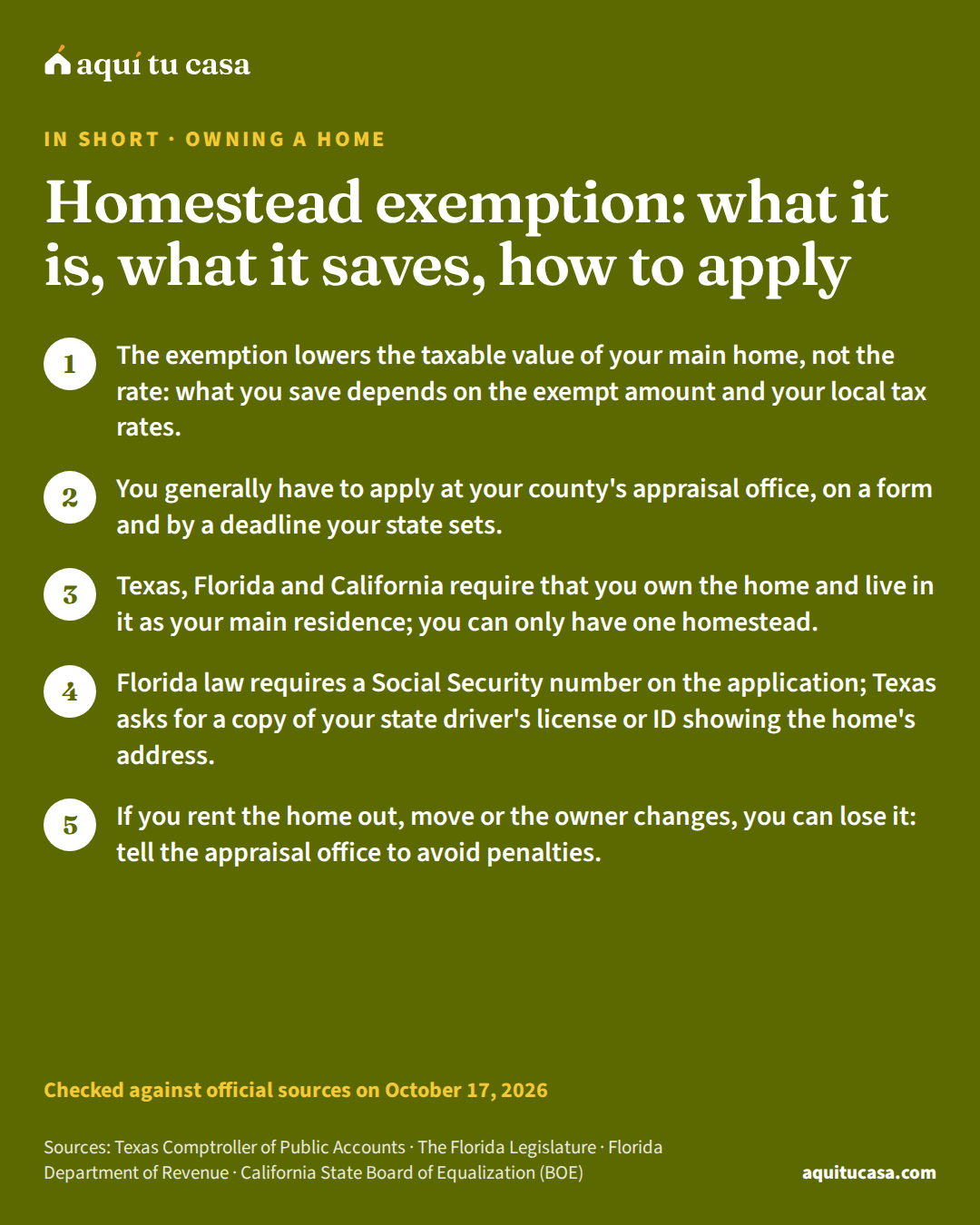
- The exemption lowers the taxable value of your main home, not the rate: what you save depends on the exempt amount and your local tax rates.
- You generally have to apply at your county's appraisal office, on a form and by a deadline your state sets.
- Texas, Florida and California require that you own the home and live in it as your main residence; you can only have one homestead.
- Florida law requires a Social Security number on the application; Texas asks for a copy of your state driver's license or ID showing the home's address.
Is this for you?
This guide is for you if…
- You own the home you live in and want to know whether you pay less property tax because it is your main home.
- You just bought and do not know whether the seller's exemption carries over or you have to apply yourself.
- You are nearing 65, have a disability, are a veteran or inherited the home, and want to know what changes.
Get direct help first if…
- The home is not your main home (you rent it out or it is a vacation home): this exemption is generally only for the home you live in.
- You already received a notice of a tax sale for unpaid taxes: contact free legal aid and a HUD-approved housing counselor today.
If you own the home you live in, your state may take part of its value off the table before calculating your property taxproperty taxProperty tax is the tax the county, city, school district and other local bodies charge real property owners every year to pay for schools, police, fire and other public services. It is computed on the value the assessor's office assigns to your home, at each body's rate, minus the exemptions you qualify for, such as the primary-residence exemption in many states. If you have a mortgage you normally pay it month by month inside your payment, through the escrow account. It is generally deductible on your federal return if you itemize.See the full definition. That discount is called the homestead exemptionhomestead exemptionA homestead exemption is a legal protection for the home where you and your family live. It can keep certain creditors from collecting your debts out of your main home, and it can also lower the property tax on that home. In Texas, for example, the residence homestead exemption removes part of your home's value from the tax calculation; to get it you must own the home, live there as your principal residence and apply. State laws vary widely: some cap the amount protected and others depend on the size of the property or the owner's age.See the full definition, or principal residence exemption. This guide is for owners who live in their home, especially recent buyers: it explains what the exemption is, who qualifies, how much it lowers the value in three large states, how to apply, which dates you must not miss and when you lose it.
What it is and what exactly it lowers
Property tax is local. In Texas, for example, the state Comptroller explains that there is no state property tax: the county, city, school district and other districts set and collect it.1 Each one starts from the value the appraisal office gives your home, the assessed valueassessed valueAssessed value, or assessment, is the value the local government's assessor gives your property to calculate property tax. It is only for taxes: it is not the appraisal a lender orders for your mortgage. The assessor first estimates market value, usually by comparing your home with similar homes that sold recently. In some places the assessment equals full market value, and in others it is a fraction of it. The assessor does not decide how much you pay: that depends on the rates set by the county, the city and the school district.See the full definition, and applies its rate.
The homestead exemption works before that calculation: it takes part of your main home’s value out of what gets taxed.1 It does not lower the rate or erase the bill. The Texas Comptroller explains it with an example: if your home is appraised at $300,000 and you qualify for the $140,000 school exemption, you pay school taxes as if the home were worth only $160,000.1 What you save is that exempt value times your local tax rates.
In some states the exemption also brings a limit on how fast the value can rise. In Florida, homestead property is reassessed every January 1, and the increase cannot exceed the lower of two caps: 3% of the prior year’s value or inflation as measured by the Consumer Price Index.6 That limit is called “Save Our Homes.” That is why, in Florida, applying on time also protects your bills in later years.

This guide uses Texas, Florida and California as examples because their agencies publish the rules in detail. Your state’s rules may be very different: look them up on your state’s page, under the property tax tab, where we gather exemptions and deadlines with their official source.
Who qualifies
The three states ask for the same core things: that you own the home, that you live in it as your main residence and that you have only one homestead. The details and the date that counts differ.
| Requirement | Texas | Florida | California |
|---|---|---|---|
| Own it | Ownership interest in the home | Legal or beneficial title on January 1, with the deed recorded | Owner who occupies the home |
| Live there | Principal residence | Your permanent residence or your dependents’ | Principal residence on January 1 |
| Only one | No other homestead, in or outside Texas | No residency-based exemption in another state | One principal residence |
In Texas, a person must have an ownership interest in the home and use it as their principal residence, and must state that they do not claim another homestead in or outside the state. If you bought after January 1, you may receive it right away for the rest of the year, as long as the previous owner did not receive it that year.1
In Florida, the exemption goes to a person who on January 1 holds title to the home and in good faith makes it their permanent residence or that of their dependents. The deed must be recorded in the county. A person receiving an exemption or credit in another state that requires permanent residency does not qualify.4
In California, the home must be the owner’s principal residence on January 1, the lien date.9

How much it lowers: three states, three rules
The main home exemption in three states
Exempt value per taxing unit
Texas
Up to $50,000 plus a cap on increases
Florida
The amount and the deadline change by state: check yours before assuming you already have it.
Texas has more layers. Counties that collect farm-to-market road or flood control taxes provide another $3,000.1 For people 65 or older or with a disability, each taxing unit may add a local exemption of at least $3,000; for the disability exemption, the Social Security definition counts, and benefits from other programs do not qualify on their own.1
In Florida, the additional part of the exemption is adjusted every January 1 for inflation, if the index goes up.7 Outside these three states there are other examples. In Illinois, the General Homestead Exemption is annual and lowers the equalized assessed value (EAV) by up to $10,000 in Cook County, $8,000 in the counties next to Cook and $6,000 everywhere else.11 In New York, the main relief is STAR, for school taxes: new homeowners register for the STAR credit, which arrives by check or direct deposit, because the STAR exemption is no longer available to them.12
What the exemption is worth in dollars also depends on your local rates. The table compares the effective tax rate and the typical home value in the states that already have a page on this site; tap your state’s name to see its exemptions and deadlines.
Effective property tax rate and typical home value by state
| State | Property tax (effective rate) | Typical home value |
|---|---|---|
| Alabama | 0.38% | $209,900 |
| Alaska | 1.11% | $352,900 |
| Arizona | 0.48% | $394,500 |
| Arkansas | 0.55% | $188,000 |
| California | 0.7% | $734,700 |
| Colorado | 0.48% | $539,400 |
| Connecticut | 1.81% | $366,900 |
| Delaware | 0.5% | $352,000 |
| District of Columbia | 0.58% | $737,100 |
| Florida | 0.76% | $359,000 |
| Georgia | 0.77% | $303,300 |
| Hawaii | 0.27% | $839,100 |
| Idaho | 0.49% | $418,600 |
| Illinois | 2.01% | $263,300 |
| Indiana | 0.74% | $218,200 |
| Iowa | 1.39% | $208,000 |
| Kansas | 1.29% | $217,200 |
| Kentucky | 0.75% | $205,600 |
| Louisiana | 0.55% | $216,500 |
| Maine | 1.02% | $296,600 |
| Maryland | 0.97% | $419,900 |
| Massachusetts | 1.07% | $562,100 |
| Michigan | 1.25% | $231,600 |
| Minnesota | 1.02% | $329,300 |
| Mississippi | 0.72% | $169,800 |
| Missouri | 0.85% | $230,300 |
| Montana | 0.72% | $375,800 |
| Nebraska | 1.49% | $238,600 |
| Nevada | 0.47% | $435,400 |
| New Hampshire | 1.66% | $402,500 |
| New Jersey | 2.11% | $454,400 |
| New Mexico | 0.7% | $248,100 |
| New York | 1.55% | $423,800 |
| North Carolina | 0.66% | $288,900 |
| North Dakota | 0.99% | $249,900 |
| Ohio | 1.31% | $214,800 |
| Oklahoma | 0.8% | $199,800 |
| Oregon | 0.81% | $477,600 |
| Pennsylvania | 1.3% | $254,500 |
| Puerto Rico | 0.49% | $131,500 |
| Rhode Island | 1.21% | $404,200 |
| South Carolina | 0.48% | $259,000 |
| South Dakota | 1.06% | $257,400 |
| Tennessee | 0.5% | $286,700 |
| Texas | 1.49% | $283,800 |
| Utah | 0.52% | $489,400 |
| Vermont | 1.59% | $316,600 |
| Virginia | 0.73% | $383,700 |
| Washington | 0.81% | $564,600 |
| West Virginia | 0.53% | $162,600 |
| Wisconsin | 1.42% | $266,500 |
| Wyoming | 0.57% | $309,700 |
The effective rate divides the median amount owners pay by the median home value. Where the rate is higher, each exempt dollar counts for more. Source: Census Bureau (ACS)
How to apply, step by step
From the appraisal office to your bill
5. Check your notice and your bill
When the appraisal notice arrives
In Florida, the property appraiser mails you a renewal every year by February 1.5
In Texas, the application goes to the appraisal district in each county where the property is located, never to the Comptroller. Form 50-114 says it is generally due no later than April 30 of the year you are applying for. If you missed it, you can file a late application up to two years after the deadline. And once it is granted, you do not have to reapply every year unless the chief appraiser requires it.2 The chief appraiser decides whether you qualify.1
In Florida, the law says that if you do not file by March 1 you waive the exemption for that year, with some exceptions.5 One of them: you can still file until the 25th day after the property appraiser mails the assessment notice, and the appraiser can grant it if you show extenuating circumstances. If the appraiser does not, you can petition the value adjustment board within the same period, with a nonrefundable $15 fee.5
In California, the owner files Form BOE-266 once with the county assessor. You can file as soon as you qualify, but to receive the full exemption for that year it must arrive no later than February 15.9
Documents, Social Security numbers and ITINs
Each state decides which documents it asks for. In Texas, you must attach a copy of each owner’s driver’s license or state-issued ID certificate, and the address must match the home’s; there are exceptions only for certain cases. The form also asks for the driver’s license, ID or Social Security number, and it states that the driver’s license or ID number is confidential and not open to public inspection.2
In Florida, the law requires the form to include a space for the Social Security number of the applicant and the applicant’s spouse. If the application arrives on time but without those numbers, it is incomplete: the property appraiser contacts you and you can refile a complete application by April 1.5 The appraiser may also ask for proof of residency, such as your Florida driver license or ID number, the address on your last IRS return or utility payments at the home.7
If this is you
You just bought
In Florida, the previous owner's exemption stays with the home for the rest of the year, and the home is reassessed the next January 1.8 Apply for yours in time for that year.
You are 65 or older or have a disability
In Texas, school districts exempt $60,000 more for people who qualify by age or disability.1 You apply on the same form.
You are a disabled veteran
In Texas, the amount depends on your disability rating, and at 100% your main home can be fully exempt.1
You inherited the family home
In Texas, if your name is not on the deed, the district asks for an affidavit, the death certificate and a utility bill.1

When you lose it and who to tell
The exemption is for the home you live in. When that changes, so does your right to it, and telling the office is your responsibility.
- Texas: you must notify the chief appraiser in writing before May 1 of the year after your right to the exemption ends.2
- Florida: you are no longer eligible if you rent the unit out, if it is no longer your permanent home or if you are no longer a permanent Florida resident.7 If the home changes owners, it is assessed at just value the following January 1.6
- California: the exemption stays in effect until, among other cases, the owner no longer lives in the home as a principal residence.10 Claimants must notify the assessor when they no longer qualify; December 10 is the last day to cancel it without a penalty.9
If you bought in Florida, keep the purchase year in mind. When a home changes owners, the law requires removing the exemptions and reassessing it at just value. The seller’s exemption and Save Our Homes benefit stay with the home for the rest of that year. If you own the home on January 1 and apply by March 1, that year’s bill already reflects the reduction, but the Save Our Homes cap starts the following year.8 That is why the seller’s bill does not tell you what you will pay; the property tax guide explains how yours is calculated.
If you have a mortgage with escrowescrow accountAn escrow account is an account set up by your mortgage lender to pay certain property-related expenses on your behalf, mainly property taxes and homeowners insurance. The money comes from a portion of your monthly mortgage payment: each month you contribute a share and the loan servicer pays the bills when they come due. That is why your payment is higher than principal and interest alone, and why it can change when taxes or the insurance premium go up. In some states the word also names the period between the offer and the closing.See the full definition, the exemption also shows up in your monthly payment. The servicer pays the tax from that account, and when the tax changes, your escrow payment and your total monthly payment change with it.13 The guide on why your escrow payment went up explains that yearly review.
Common mistakes
Mistake: Assuming the seller's exemption transfers to you.
Instead: In Florida, a change of owner removes the exemptions and the home is reassessed.8 Apply for your own.
Mistake: Thinking the exemption is automatic.
Instead: In Texas, in most cases you must apply at the county appraisal district.1
Mistake: Missing the deadline and doing nothing.
Instead: In Texas you can file a late application up to two years after the deadline.2
Mistake: Sending the application to a state office.
Instead: It goes to the appraisal office of the county where the home is, not to the Texas Comptroller.2
Mistake: Renting the home out and keeping the exemption.
Instead: In Florida you lose eligibility if the unit is rented.7 Tell the appraisal office.
Mistake: Claiming a main home in two states.
Instead: Florida does not grant it to someone receiving a residency-based exemption in another state.4

What to do this week
- Find your latest appraisal notice or tax bill and check whether it shows the homestead exemption.
- Open your state’s page and check the property tax tab for available exemptions and the deadline; in Texas, for example, the general one is before May 1.1
- Download your county’s form and gather the recorded deed and your proof of residency.7
- If the 65-or-older, disability or veteran exemptions apply to you, ask whether they go on the same form.1
- If you have questions about your budget or your mortgage, a HUD-approved housing counselorHUD-approved housing counselorA HUD-approved housing counselor works at an agency HUD has approved to provide housing counseling: independent, expert advice customized to your situation about buying a home, renting, a missed mortgage payment, a foreclosure or credit problems. The agencies usually charge little or nothing; many serve in Spanish and offer the homebuyer education course several assistance programs require. They are not lenders or real estate agents and sell you nothing. Your county page lists the official agencies with phone numbers.See the full definition gives independent advice, often free or at low cost.14 Find one with the HUD-approved counselors guide.
Your numbers
Starts at the typical home value in the United States. Change it to the price you have in mind.
That is $11,645 (3.5% of the price). The usual minimum for this loan is 3.5%.
This week's average ± a quarter or half point.
National average as of November 5, 2026 (Freddie Mac); your rate may be different.
Adjust advanced details
Let's do the math
Estimated monthly payment
National figure$2,759
at 7.18% · 30 years
- Loan amount
- $326,673
- Total interest
- $470,006
- Paid off in
- November 2056
Includes $5,618 FHA upfront mortgage insurance premium.
Does it fit the income?
Comfortable
up to $1,884 a month
Tight
$1,884 to $2,422 a month
Hard
more than $2,422 a month
Your payment · 41%
Compared with the typical household income in the United States ($80,734 a year). Reference: HUD calls paying more than 30% of income for housing a cost burden.
| Principal & interest | $2,213 |
|---|---|
| Property tax | $261 |
| Home insurance | $139 |
| FHA mortgage insurance (MIP) | $147 |
How does it compare with incomes?
For this payment to be 28% of your income, you'd need to earn about $118,260 a year. With your other debts, to stay under 36%: about $91,980 a year.
You need at least $11,645 for the down payment, plus closing costs.
This is an estimate to give you an idea, not a loan offer. Your real payment depends on your rate, your credit, and the insurance and taxes on the home you buy.
Total monthly payment $2,759; principal and interest $2,213.
Ready to see the numbers? Find your county here
See how this applies in your county: its loan limits, prices and rents, from the official data.
Printable checklist
Frequently asked questions
Does the homestead exemption apply automatically when I buy a home?
Generally no. The Texas Comptroller says an owner must apply in most circumstances; in California you file once with the county assessor; and in Florida the application goes to the property appraiser by March 1. Check your first bill: if the exemption is not there, apply.
How much does the homestead exemption save me?
It lowers the value your tax is calculated on, not the rate. The Texas Comptroller gives an example: a home appraised at $300,000 with the $140,000 school exemption pays school taxes as if it were worth $160,000. What you save is the exempt value times your local tax rates.
I bought my home in the middle of the year. Can I apply now?
It depends on the state. In Texas, a buyer who acquires the home after January 1 may get it right away for the rest of the year if the previous owner did not receive it that year. In Florida you must own and live in the home on January 1; meanwhile the previous owner's exemption stays with the home for the rest of the year.
Do I have to apply every year?
In Texas, no, unless the chief appraiser requires it. In California you file once. In Florida the property appraiser mails you a renewal every year by February 1. In Texas and California you must also tell the office when you stop qualifying.
Can I apply with an ITIN if I don't have a Social Security number?
It depends on what your state requires. In Florida the law requires the application to include the Social Security number of the applicant and spouse; without it the application is incomplete. In Texas the form asks for a copy of a state driver's license or ID showing the home's address. Ask your county appraisal office what they accept; free legal aid can review your situation.
I missed the deadline. Have I lost it?
Not always. In Texas you can file a late application up to two years after the deadline. In Florida you can file until the 25th day after the property appraiser mails the assessment notice, and the appraiser decides whether there are extenuating circumstances; if not, you can petition the value adjustment board for a $15 fee.
Can I have a homestead exemption on two homes?
Not as your main home. In Texas you must state that you do not claim another homestead in or outside the state. In Florida, a person receiving an exemption or credit in another state that requires permanent residency is not entitled to it.
If I rent out my home, do I lose the exemption?
In Florida, yes: the Department of Revenue says you are no longer eligible if the unit is rented or is no longer your permanent home. In Texas and California the exemption is for the owner's principal residence. Tell the appraisal office when your situation changes.
Sources
Every figure in this guide comes from one of these official sources. The number next to a sentence leads to the source behind it.
Each source on one line: who publishes it, its title, its address and the date we read it.
- 1. Texas Comptroller of Public Accounts · Property Tax Exemptions · comptroller.texas.gov · Accessed October 17, 2026
- 2. Texas Comptroller of Public Accounts · Form 50-114, Residence Homestead Exemption Application · comptroller.texas.gov · Accessed October 17, 2026
- 3. Texas Comptroller of Public Accounts · Property Tax Protests · comptroller.texas.gov · Accessed October 17, 2026
- 4. The Florida Legislature · Florida Statutes §196.031, Exemption of homesteads · leg.state.fl.us · Accessed October 17, 2026
- 5. The Florida Legislature · Florida Statutes §196.011, Annual application required for exemption · leg.state.fl.us · Accessed October 17, 2026
- 6. The Florida Legislature · Florida Statutes §193.155, Homestead assessments · leg.state.fl.us · Accessed October 17, 2026
- 7. Florida Department of Revenue · PT-113, Property Tax Information for Homestead Exemption · floridarevenue.com · Accessed October 17, 2026
- 8. Florida Department of Revenue · PT-107, Property Tax Information for First-Time Florida Homebuyers · floridarevenue.com · Accessed October 17, 2026
See the other 6 sources
- 9. California State Board of Equalization (BOE) · Homeowners' Exemption · boe.ca.gov · Accessed October 17, 2026
- 10. California State Board of Equalization (BOE) · Disabled Veterans' and Homeowners' Exemption Match and Multiple Claims Listing · boe.ca.gov · Accessed October 17, 2026
- 11. Illinois Department of Revenue · Property Tax Relief: Homestead Exemptions, PTELL, and Senior Citizens Real Estate Tax Deferral Program · tax.illinois.gov · Accessed October 17, 2026
- 12. New York State Department of Taxation and Finance · STAR (School Tax Relief) program · tax.ny.gov · Accessed October 17, 2026
- 13. CFPB · What is an escrow or impound account? · consumerfinance.gov · Accessed October 17, 2026
- 14. CFPB · Find a Housing Counselor · consumerfinance.gov · Accessed October 17, 2026
Keep reading
Related guides
If this guide helped, these follow the same path.

Owning a home 13 minute read
How to appeal your property tax assessment, step by step
How to read your notice of value, what evidence works, how the informal review and hearing work, and protest deadlines in Texas, Florida and California.
- You challenge the home's value, not the tax rate: neither the board nor the appraisal office sets your tax.
- Read your notice of value as soon as it arrives: protest windows are a few weeks long and do not stretch while you talk with the office.
- The best evidence is recent sales of similar homes, photos of damage and repair estimates; saying the value is wrong is not enough.
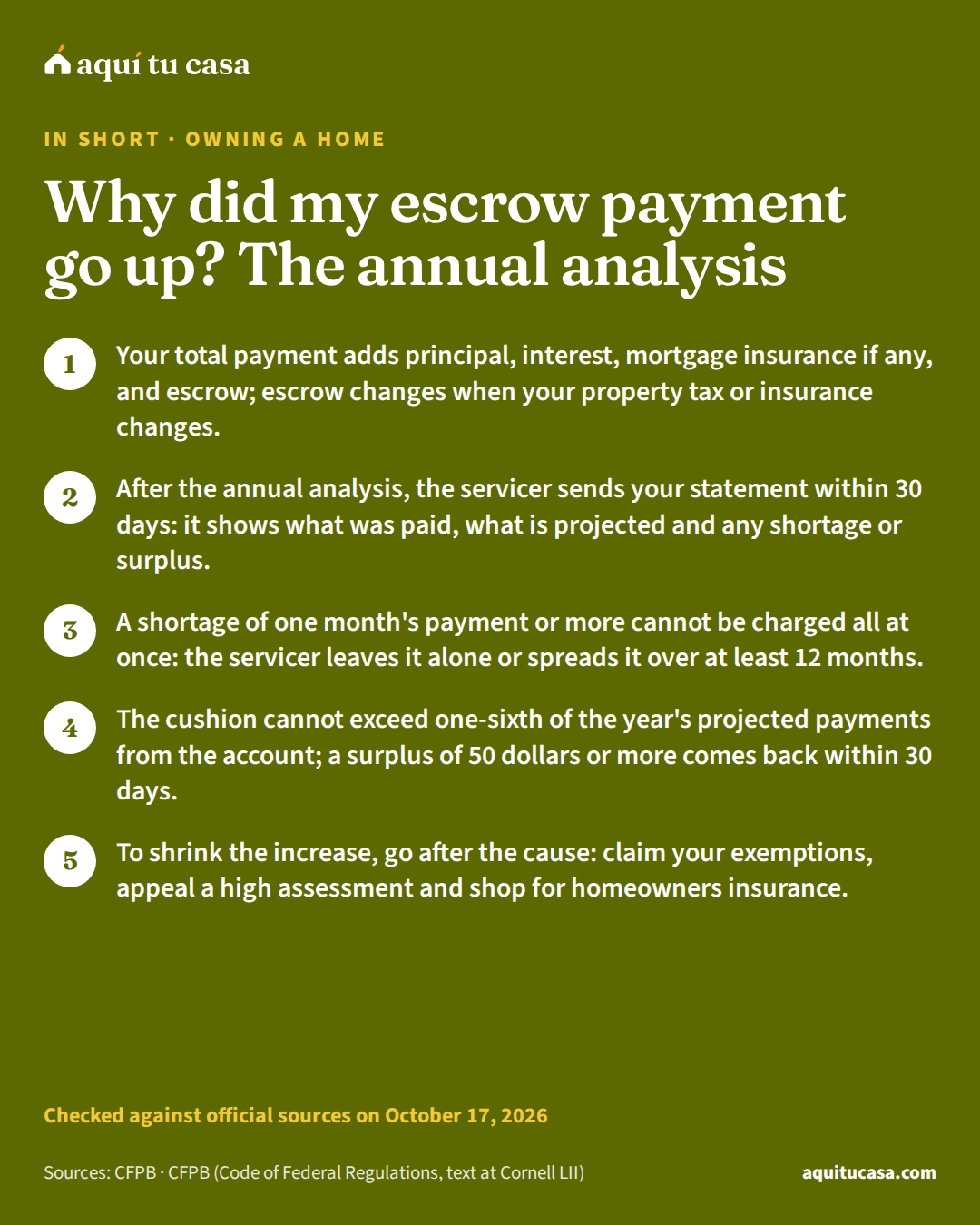
- Owning a home Why did my escrow payment go up? The annual analysis Why your payment changes with escrow even at a fixed rate: the annual analysis, shortages, deficiencies, the cushion and how to dispute an error. 12 minute read
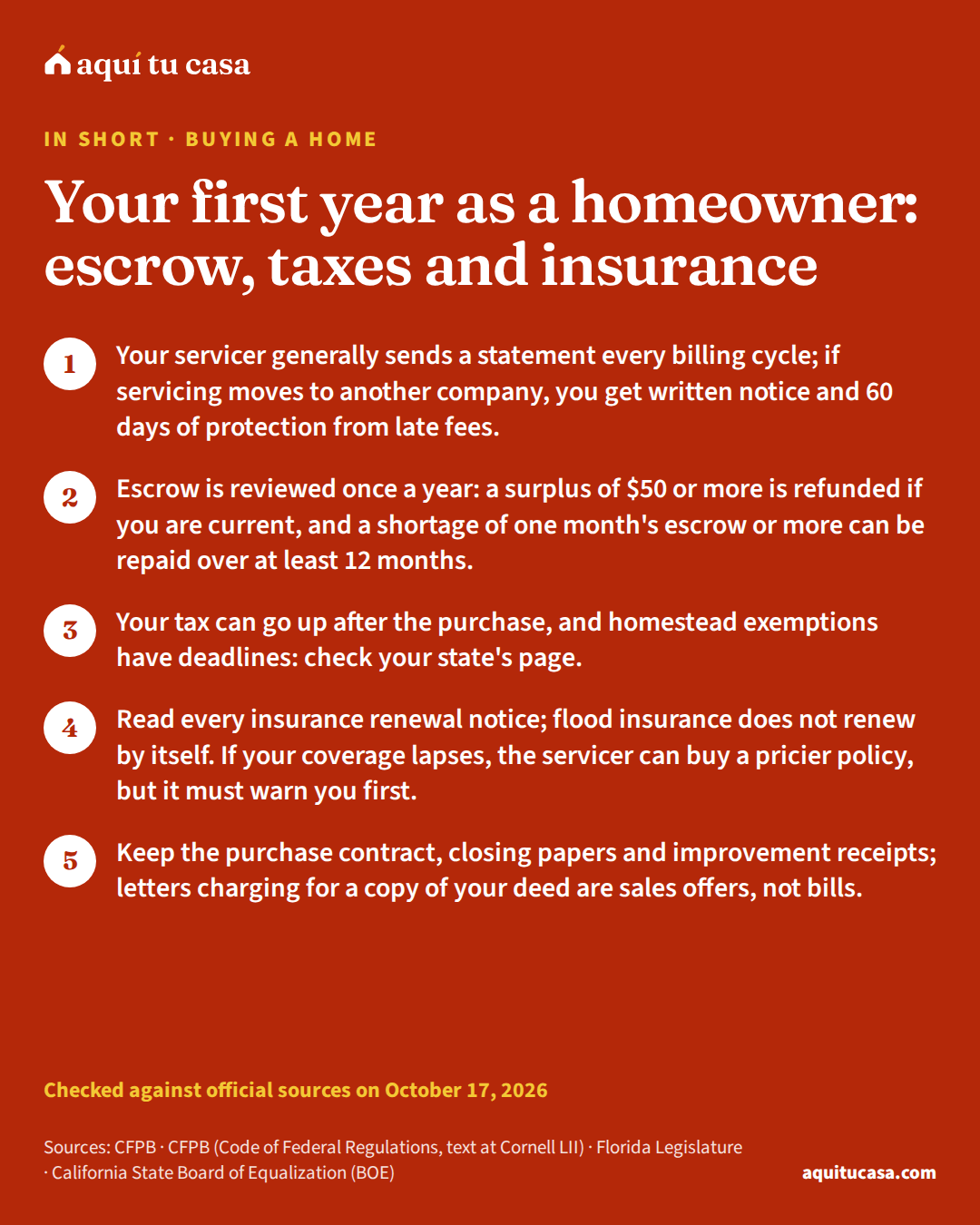
- Buying a home Your first year as a homeowner: escrow, taxes and insurance Who collects your mortgage and what happens if that changes, the yearly escrow review, taxes, exemptions, insurance, records and scams aimed at new owners. 13 minute read
Tools for this topic
Was this guide useful?
Thank you. Your answer stays in your browser; nothing is sent.