Why did my escrow payment go up? The annual analysis
Why your payment changes with escrow even at a fixed rate: the annual analysis, shortages, deficiencies, the cushion and how to dispute an error.
Verified against official sources on October 17, 2026 10 official sources

Show contents
In short
What you need to know
Quick answer
With a fixed rate, principal and interest do not change, but the escrow part does: every year the servicer reviews the account, re-estimates your property tax and insurance, and adjusts your payment. If those bills went up, your payment rises for two reasons: the new monthly amount is higher and, if last year's deposits fell short, the servicer may add the shortage, which if it is one month's payment or more can only be spread over at least 12 months. The annual statement, due within 30 days, explains every number; if you see an error, you can dispute it in writing.
What matters most
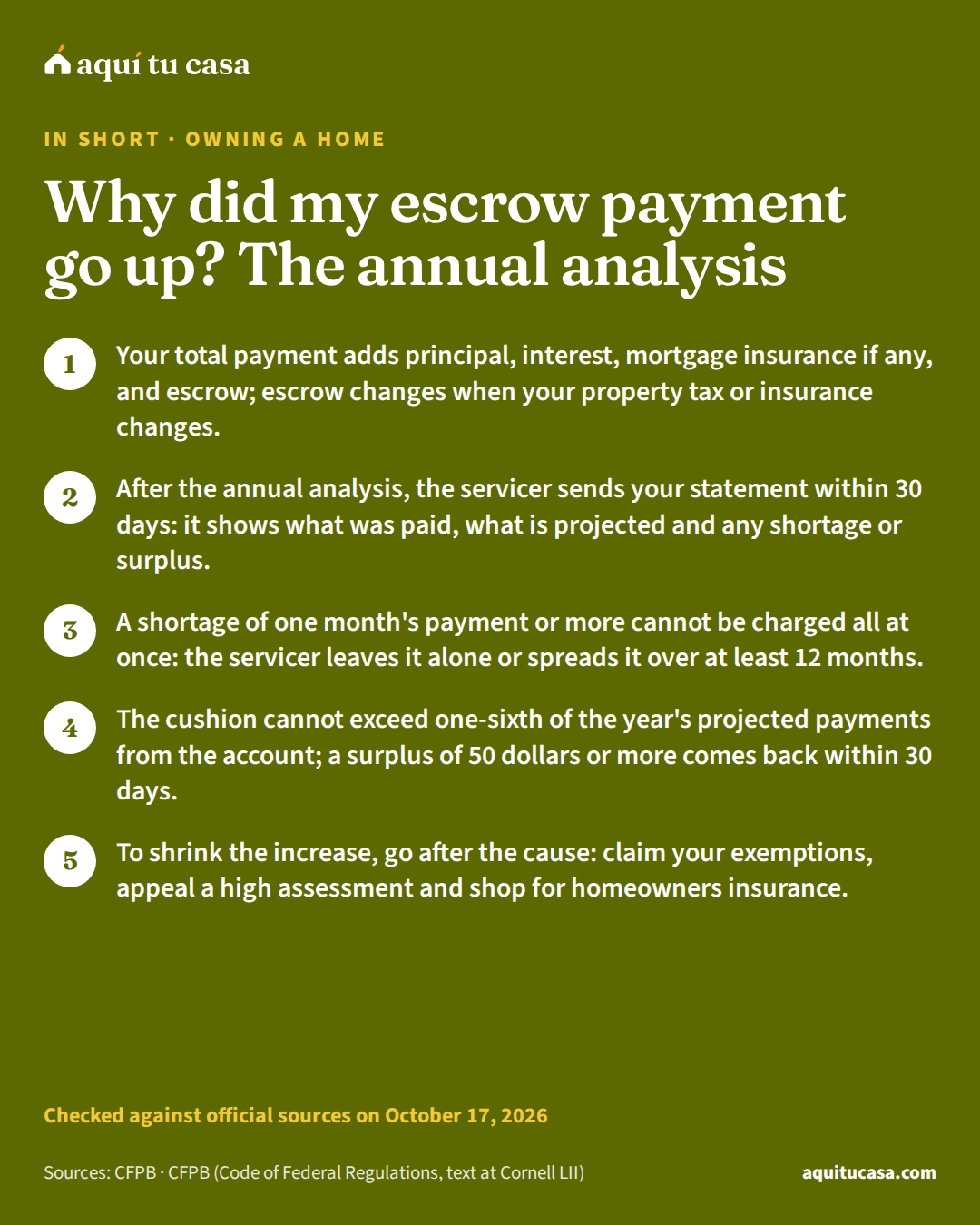
- Your total payment adds principal, interest, mortgage insurance if any, and escrow; escrow changes when your property tax or insurance changes.
- After the annual analysis, the servicer sends your statement within 30 days: it shows what was paid, what is projected and any shortage or surplus.
- A shortage of one month's payment or more cannot be charged all at once: the servicer leaves it alone or spreads it over at least 12 months.
- The cushion cannot exceed one-sixth of the year's projected payments from the account; a surplus of 50 dollars or more comes back within 30 days.
Is this for you?
This guide is for you if…
- Your mortgage servicer sent a letter saying your monthly payment is going up, even though your rate is fixed.
- Your annual escrow statement says you have a shortage or a deficiency and you do not know what that means.
- You think your servicer miscalculated your payment or did not pay your property tax or insurance on time.
Get direct help first if…
- Your mortgage has no escrow account: you pay taxes and insurance yourself, and the property tax guide will help you more.
- You can no longer pay your mortgage and are behind: start with the If you can't pay your mortgage guide and talk to a HUD-approved housing counselor today.
You paid the same amount all year and suddenly a letter arrives: your monthly payment is going up. If your mortgage has an escrowescrow accountAn escrow account is an account set up by your mortgage lender to pay certain property-related expenses on your behalf, mainly property taxes and homeowners insurance. The money comes from a portion of your monthly mortgage payment: each month you contribute a share and the loan servicer pays the bills when they come due. That is why your payment is higher than principal and interest alone, and why it can change when taxes or the insurance premium go up. In some states the word also names the period between the offer and the closing.See the full definition account, most likely your loan did not change; what is paid from that account did. This guide is for homeowners with escrow: it explains what your payment is made of, how the account works during the year, how to read the annual analysis, what shortages, deficiencies, surpluses and the cushion are, what you can be charged and how to dispute an error.
- To receive your annual statement after the account year closes
- 30 days4
- The largest the cushion can be, of the year's projected payments from the account
- 1/64
- To spread a shortage of one month's payment or more, if the servicer collects it
- 12 months or more4
- From this amount up, a surplus comes back to you within 30 days
- $504
What your payment is made of
According to the CFPB, your total monthly payment usually has four parts: principalprincipalThe principal is the amount of money you borrowed and have to pay back, not counting the interest. In Spanish it is also called "capital". When you start, the principal is the loan amount; with every payment a part goes toward reducing it, and what remains is called the balance. Interest is computed on that balance, so the less principal you owe, the less interest you pay. On your monthly payment you will see P&I: principal and interest, the part of the payment that goes to the loan, separate from taxes and insurance.See the full definition, interest, mortgage insurance if your loan requires it, and escrow for homeowners insurance and property tax. Principal and interest generally stay the same as long as you pay on time, but escrow can change: for example, if your home goes up in value, your property tax typically goes up too.1
Example with real numbers
The parts of the payment on a typical home
With the typical US home value, an FHA loan with the minimum down payment and this week's rate.
- Principal and interest (fixed with a fixed rate)
- $2,213
- FHA mortgage insurance
- $147
- Property tax (goes into escrow)
- $261
- Homeowners insurance, example estimate (goes into escrow)
- $139
- Total monthly payment
- $2,759
This is an example with national numbers. Tax and insurance are the parts that change from year to year.1 Put your own numbers in the calculator.
Run it with your numbersMortgage calculator
The CFPB lists other common reasons a payment changes: a temporary buydown ended, your adjustable rateadjustable-rate mortgage (ARM)An adjustable-rate mortgage (ARM) is a loan whose interest rate can change, usually in step with a market index. It often starts with a fixed rate for an initial period (for example, the first few years) and then adjusts at set intervals, so your payment can go up or down. The contract sets caps on how much the rate can rise at each adjustment and in total. Before accepting one, check on the Loan Estimate how high your payment could reach and whether you could afford it.See the full definition changed, you started paying principal on an interest-only loan, your private mortgage insurance changed or ended, you were charged new fees, or your servicer made a mistake.2 Your monthly statement breaks out each part: look at it before you call.
How the escrow account works during the year
Your lender sets up the account to pay certain property expenses from part of your monthly payment. Many lenders require taxes and insurance to be paid this way, and sometimes the law requires it. Your loan servicerloan servicerThe loan servicer is the company that sends you your mortgage statements and handles the day-to-day tasks of the loan: it processes your payments, answers your questions, keeps track of principal and interest paid and manages your escrow account, if you have one. It can also offer options if you fall behind and, in certain cases, start a foreclosure. It may be the same company that lent you the money or a different one, and it is common for another company to take over the loan after closing.See the full definition manages the account and pays those bills for you.3 Regulation X, the federal rule for these accounts, includes property taxes, insurance premiums (flood insurance too) and other charges in escrow, and gives the account its own 12-month year that starts with your first payment.4
Your escrow account's year
1. You receive the initial statement
At closing or within 45 days
It shows your payment, the escrow portion, what is expected to be paid during the year with dates, and the cushion selected.4
2. You deposit every month
Every month
One-twelfth of what is expected to be paid in the year, plus what is needed for the cushion.4
3. The servicer pays the bills
Before each bill's deadline
It must pay them on time, even if it has to advance money, as long as you are not more than 30 days late.4
4. Account analysis
At the end of the account year
It compares what came in and went out, estimates next year and checks for a shortage, deficiency or surplus.4
5. Annual statement
Within 30 days
It explains your new payment and how any shortage or surplus is handled.4
6. Your new payment starts
The following year
If a shortage is one month's payment or more, it can only be spread over at least 12 months.4
To set your monthly deposit, the servicer may charge one-twelfth of what it reasonably expects to pay in the year, plus what is needed to maintain a cushion. To estimate, it uses next year’s bill if it already knows it; if not, last year’s, adjusted by no more than the latest change in the Consumer Price Index.4 That is why, when your tax or insurance goes up partway through the year, the account falls short: your deposits were based on the old number.
The servicer must pay your bills on time, before the date penalties would apply, as long as your payment is not more than 30 days overdue. If the account does not have enough, it must advance the money, and it can then ask you to pay it back.4
How to read the annual statement
At the end of each account year, the servicer must run the analysis and send you the annual statement within 30 days, along with the previous year’s projection. It must also tell you at least once a year if there is a shortage or deficiency.4
| What to look for on the statement | What it tells you |
|---|---|
| Current and last year’s monthly payment, with the escrow portion | How much your payment rises and whether the increase comes from escrow |
| Total paid into the account during the year | What you deposited with your payments |
| Total paid out, for tax, insurance and other charges | Which bill went up and by how much |
| Balance at the end of the period | Whether the account came up short or has extra |
| How a surplus is handled or how you pay a shortage or deficiency | Whether you get money back or a charge is spread out |
| Why the estimated low balance was not reached, if applicable | The difference between what was projected and what happened |
Regulation X requires those lines.4 Compare the total paid for tax and insurance with your county bill and your policy: if they match, the increase is real; if not, there may be an error.

Shortage, deficiency and surplus
Three possible results of the analysis
Short of the target balance
Shortage
Negative balance
Deficiency
The surplus and deficiency rules apply if you are current: payments received within 30 days of their due date.4
Here is the reason behind many big increases. When your tax or insurance went up, your new payment rises from two sides at once. First, the one-twelfth is calculated with the new, higher bills.4 Second, if the account came up short last year, the servicer may add the shortage; if it is one month’s payment or more, it can only spread it into equal monthly payments over at least 12 months.4 Once the shortage is paid off, that part of the increase goes away, although the new one-twelfth stays as long as the bills stay high.
The cushion is the third piece. It is money the servicer may require to cover unexpected payments or payments due before your deposits are in the account.4 It cannot exceed one-sixth of the year’s projected payments from the account, and if your loan documents set a lower cushion, those documents apply.4
The surplus and deficiency rules apply if you are current at the time of the analysis, meaning the servicer received your payments within 30 days of their due date. If not, the servicer may keep a surplus in the account or collect a deficiency under your loan documents.4 4
If you think there is an error
The CFPB recommends starting with your monthly statement and calling the servicer: explain the situation, ask for a corrected statement and note a reference number, the name of the person you spoke with and the date. If it is not fixed over the phone, send a written notice of error.2

For your letter to count, the CFPB suggests including your name, address and account number, saying exactly what error you believe happened, not writing on your payment coupon and sending it to the special address your servicer uses for errors; that address may differ from the payment address. Keep paying while you wait.7 Under Regulation X, failing to pay your tax or insurance from escrow on time, or failing to refund the balance when required, is an error you can raise this way. The servicer must acknowledge your notice in writing within five business days and, in most cases, respond no later than 30 business days after.6
How to lower or control the increase
Your servicer does not set your tax or your premium: it only collects and pays them. For escrow to go down, what it pays has to go down.
- Property tax. Check that you have every exemption you qualify for; the homestead exemption guide explains how to claim the main-home one. If the value the county put on your home is high, the guide on how to appeal your property assessment explains the deadlines. The property tax guide explains how the tax is calculated.
- Homeowners insurance. The CFPB says it is usually a good idea to research the cost yourself, and that you can shop and choose the provider and plan that is right for you.8 If you switch policies, tell your servicer so it pays the right one.
- Private mortgage insurance. If your loan has it, the CFPB notes that your payment may change once you are able to cancel it and choose to.2
If this is you
You just bought
Your first escrow document is the initial statement, due at closing or within 45 days.4 Keep it to compare with your first annual analysis.
The company that collects your mortgage changed
The old servicer must send a short year statement within 60 days of the transfer, and the new one an initial statement if it changes your payment.4
You are selling or refinancing
When you pay off the loan in full, whatever is left in escrow must come back to you within 20 business days.5
You cannot afford the new payment
Call the HOPE Hotline as soon as possible, 24 hours a day, at (888) 995-4673, or find a HUD-approved housing counselor.7

Common mistakes
Mistake: Throwing away your annual escrow statement unread.
Instead: It explains what the servicer paid, your new payment and how a shortage is collected.4
Mistake: Thinking you must pay the shortage all at once.
Instead: If it is one month's payment or more, it can only be spread over at least 12 months.4
Mistake: Writing your complaint on the payment coupon.
Instead: Send a separate letter to the special address for errors.7
Mistake: Stopping payments while you dispute.
Instead: The CFPB recommends continuing your payments while you wait for an answer.7
Mistake: Letting your homeowners insurance lapse.
Instead: Force-placed insurance usually costs more and may protect only the lender.9
Mistake: Blaming the servicer for a higher tax.
Instead: Escrow changes when the tax or insurance changes; check your exemptions and your assessment.3
What to do this week
- Find your latest annual escrow statement and compare your new payment with last year’s.4
- Compare the total paid for tax and insurance with your county bill and your policy.
- If there is a shortage, check how it is being collected: if it is one month’s payment or more, it can only be spread over at least 12 months.4
- If something does not add up, call your servicer and, if it is not fixed, send a notice of error to the right address.2
- Review your exemptions, your home’s assessed value and your insurance price to bring down next year’s escrow.8
- If you cannot afford the new payment, a HUD-approved housing counselorHUD-approved housing counselorA HUD-approved housing counselor works at an agency HUD has approved to provide housing counseling: independent, expert advice customized to your situation about buying a home, renting, a missed mortgage payment, a foreclosure or credit problems. The agencies usually charge little or nothing; many serve in Spanish and offer the homebuyer education course several assistance programs require. They are not lenders or real estate agents and sell you nothing. Your county page lists the official agencies with phone numbers.See the full definition gives independent advice, often free or at low cost.10 If you are already behind, the guide If you can’t pay your mortgage explains your options.
Your numbers
Starts at the typical home value in the United States. Change it to the price you have in mind.
That is $11,645 (3.5% of the price). The usual minimum for this loan is 3.5%.
This week's average ± a quarter or half point.
National average as of November 5, 2026 (Freddie Mac); your rate may be different.
Adjust advanced details
Let's do the math
Estimated monthly payment
National figure$2,759
at 7.18% · 30 years
- Loan amount
- $326,673
- Total interest
- $470,006
- Paid off in
- November 2056
Includes $5,618 FHA upfront mortgage insurance premium.
Does it fit the income?
Comfortable
up to $1,884 a month
Tight
$1,884 to $2,422 a month
Hard
more than $2,422 a month
Your payment · 41%
Compared with the typical household income in the United States ($80,734 a year). Reference: HUD calls paying more than 30% of income for housing a cost burden.
| Principal & interest | $2,213 |
|---|---|
| Property tax | $261 |
| Home insurance | $139 |
| FHA mortgage insurance (MIP) | $147 |
How does it compare with incomes?
For this payment to be 28% of your income, you'd need to earn about $118,260 a year. With your other debts, to stay under 36%: about $91,980 a year.
You need at least $11,645 for the down payment, plus closing costs.
This is an estimate to give you an idea, not a loan offer. Your real payment depends on your rate, your credit, and the insurance and taxes on the home you buy.
Total monthly payment $2,759; principal and interest $2,213.
Ready to see the numbers? Find your county here
See how this applies in your county: its loan limits, prices and rents, from the official data.
Printable checklist
Frequently asked questions
Why did my payment go up if my rate is fixed?
Because your total payment includes escrow, which pays your property tax and insurance. According to the CFPB, principal and interest generally stay the same, but escrow changes when those bills go up. Your annual escrow statement explains what increased.
What is an escrow shortage?
It is the amount your account is short of the balance it needs at the time of the annual analysis. It happens, for example, when your tax or insurance cost more than the servicer estimated the year before.
What is the difference between a shortage and a deficiency?
A shortage means the account has less than it needs but is not negative. A deficiency is a negative balance: the servicer had to advance money to pay a bill. The rules for collecting each one are different.
Do I have to pay the shortage all at once?
If the shortage is one month's escrow payment or more, the servicer can only leave it alone or spread it into equal monthly payments over at least 12 months. If it is smaller, it can also ask you to pay it within 30 days.
What is the escrow cushion and how big can it be?
It is extra money the servicer may keep in the account to cover unexpected bills. Regulation X does not allow it to exceed one-sixth of the year's projected payments from the account, and if your loan documents set a lower cushion, those documents apply.
Do I get money back if there is extra in escrow?
If the analysis shows a surplus of 50 dollars or more and you are current, the servicer must refund it within 30 days. If it is less, it may refund it or credit it against next year's payments.
What do I do if I think my servicer made a mistake?
Call, ask for a corrected statement and note a reference number. If it is not fixed, send a written notice of error to the special address the servicer uses for errors, not on your payment coupon, and keep paying while you wait. The servicer must acknowledge it within five business days and generally respond within 30 business days.
What happens to my escrow if I sell or refinance?
When you pay off the loan in full, the servicer must return whatever is left in escrow within 20 business days, unless you agree to have it moved to the escrow account of a new loan in certain cases.
Sources
Every figure in this guide comes from one of these official sources. The number next to a sentence leads to the source behind it.
Each source on one line: who publishes it, its title, its address and the date we read it.
- 1. CFPB · On a mortgage, what’s the difference between my principal and interest payment and my total monthly payment? · consumerfinance.gov · Accessed October 17, 2026
- 2. CFPB · Why did my monthly mortgage payment go up or change? · consumerfinance.gov · Accessed October 17, 2026
- 3. CFPB · What is an escrow or impound account? · consumerfinance.gov · Accessed October 17, 2026
- 4. CFPB (Code of Federal Regulations, text at Cornell LII) · Regulation X, 12 CFR §1024.17, Escrow accounts · law.cornell.edu · Accessed October 17, 2026
- 5. CFPB (Code of Federal Regulations, text at Cornell LII) · Regulation X, 12 CFR §1024.34, Timely escrow payments and treatment of escrow account balances · law.cornell.edu · Accessed October 17, 2026
- 6. CFPB (Code of Federal Regulations, text at Cornell LII) · Regulation X, 12 CFR §1024.35, Error resolution procedures · law.cornell.edu · Accessed October 17, 2026
- 7. CFPB · How do I dispute an error or request information about my mortgage? · consumerfinance.gov · Accessed October 17, 2026
- 8. CFPB · What is homeowner's insurance? Why is homeowner's insurance required? · consumerfinance.gov · Accessed October 17, 2026
See the other 2 sources
- 9. CFPB · What can I do if my mortgage lender or servicer is charging me for force-placed homeowner's insurance? · consumerfinance.gov · Accessed October 17, 2026
- 10. CFPB · Find a Housing Counselor · consumerfinance.gov · Accessed October 17, 2026
Keep reading
Related guides
If this guide helped, these follow the same path.

Owning a home 13 minute read
Property tax explained: how it is calculated and paid
Who charges property tax, how it is calculated, how it is paid through escrow, which exemptions and appeals exist and what part is deductible.
- It is a local tax: assessed value of the home × the rates of the county, city and school district, minus exemptions. Your county sets the bill.
- With a mortgage you pay it through escrow: the servicer collects it in your monthly payment, pays it for you and reviews the account every year; a shortage is repaid over at least 12 months.
- Exemptions (such as the primary residence one) and the appeal of the assessed value have deadlines; they are on your state's page with their source.
- Owning a home Homestead exemption: what it is, what it saves, how to apply What the homestead exemption is, who qualifies, how much it lowers your home's value in Texas, Florida and California, how to apply and which dates matter. 13 minute read
- Owning a home How to appeal your property tax assessment, step by step How to read your notice of value, what evidence works, how the informal review and hearing work, and protest deadlines in Texas, Florida and California. 13 minute read
- Owning a home Home insurance explained: what it covers, how much to buy What home insurance covers, why the lender requires it, how to choose the amount and the deductible, why flood is separate and what happens if it lapses. 13 minute read
Tools for this topic
Was this guide useful?
Thank you. Your answer stays in your browser; nothing is sent.