How to appeal your property tax assessment, step by step
How to read your notice of value, what evidence works, how the informal review and hearing work, and protest deadlines in Texas, Florida and California.
Verified against official sources on October 17, 2026 10 official sources

Show contents
In short
What you need to know
Quick answer
Appealing your assessment means asking the county to correct the value it put on your home for property tax; you do not challenge the tax rate. In Texas, Florida and California you can start with an informal review with the appraisal office and continue with a hearing before a board, where you bring evidence such as sales of similar homes, photos and repair estimates. Deadlines are short and set by each state: in Texas, May 15 or 30 days after the notice is mailed; in Florida, 25 days after the TRIM notice; in California, from July 2 to September 15 or November 30.
What matters most
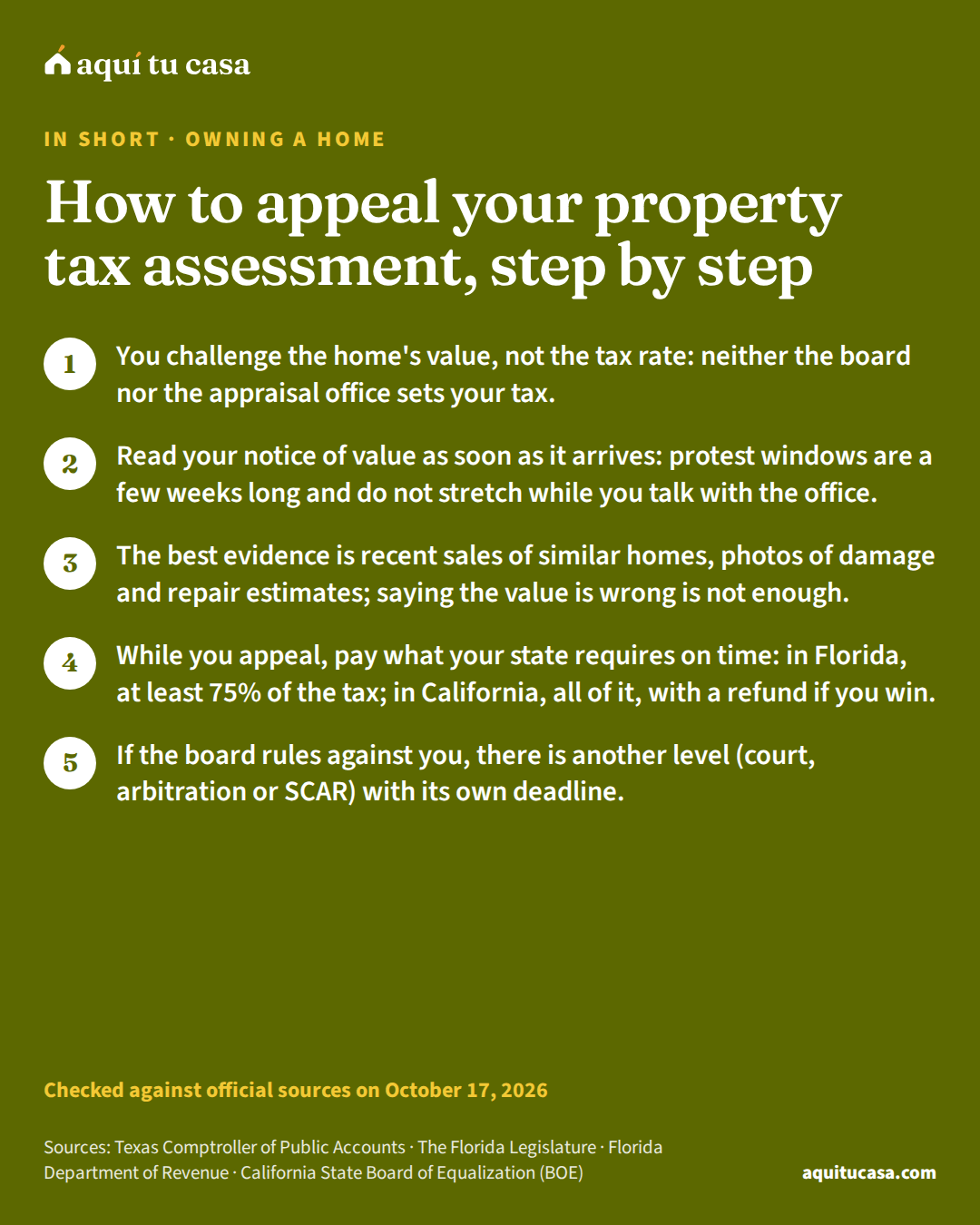
- You challenge the home's value, not the tax rate: neither the board nor the appraisal office sets your tax.
- Read your notice of value as soon as it arrives: protest windows are a few weeks long and do not stretch while you talk with the office.
- The best evidence is recent sales of similar homes, photos of damage and repair estimates; saying the value is wrong is not enough.
- While you appeal, pay what your state requires on time: in Florida, at least 75% of the tax; in California, all of it, with a refund if you win.
Is this for you?
This guide is for you if…
- You got the notice with the value the county put on your home and it looks too high.
- Your property tax went up and you want to know whether the problem is the home's value or the tax rates.
- You were denied an exemption, such as the homestead exemption, and want to push back.
Get direct help first if…
- The deadline to protest this year has passed and your state has no late window: save your evidence for the next notice.
- You have a notice of a tax sale for unpaid taxes: contact free legal aid today; this guide does not cover that process.
Every year, your county’s appraisal office puts a value on your home, and that value drives your property taxproperty taxProperty tax is the tax the county, city, school district and other local bodies charge real property owners every year to pay for schools, police, fire and other public services. It is computed on the value the assessor's office assigns to your home, at each body's rate, minus the exemptions you qualify for, such as the primary-residence exemption in many states. If you have a mortgage you normally pay it month by month inside your payment, through the escrow account. It is generally deductible on your federal return if you itemize.See the full definition. If the value is higher than what your home is worth, you have the right to challenge it: in Texas it is called a protest; in other states, an appeal or grievance. This guide is for owners who received a notice of value that seems too high: it explains how to read the notice, what evidence works, how the informal review and the hearing go, which deadlines Texas, Florida and California set, and what to pay while you wait.
What you can and cannot challenge
What you challenge is the assessed valueassessed valueAssessed value, or assessment, is the value the local government's assessor gives your property to calculate property tax. It is only for taxes: it is not the appraisal a lender orders for your mortgage. The assessor first estimates market value, usually by comparing your home with similar homes that sold recently. In some places the assessment equals full market value, and in others it is a fraction of it. The assessor does not decide how much you pay: that depends on the rates set by the county, the city and the school district.See the full definition: the value the appraisal office puts on your home. You do not challenge the rate or the bill’s total. The Texas Comptroller says it plainly: neither the appraisal review board nor the appraisal district sets your property taxes, and the board cannot take your personal economic situation into account.1 New York’s Department of Taxation and Finance says the same: assessors do not determine your taxes; if your value is fair but the tax seems high, that is a matter for the taxing jurisdictions, such as the school district or the county.7
In Texas you can protest the value or any action the district took on your property, such as an error in the records or a denied exemption.1 So if you were denied the homestead exemptionhomestead exemptionA homestead exemption is a legal protection for the home where you and your family live. It can keep certain creditors from collecting your debts out of your main home, and it can also lower the property tax on that home. In Texas, for example, the residence homestead exemption removes part of your home's value from the tax calculation; to get it you must own the home, live there as your principal residence and apply. State laws vary widely: some cap the amount protected and others depend on the size of the property or the owner's age.See the full definition, the route to push back is the same; the homestead exemption guide explains how to apply for it.
One warning before you start. In California, the State Board of Equalization says the appeals board must determine the value after hearing the evidence, and it can leave the value the same, lower it or raise it.6 Appealing is not asking for a discount: it is showing what your home is worth.

Read your notice of value as soon as it arrives
It all starts with a notice. In Texas, if the district values your home higher than the year before, it must send a notice of appraised value by April 1 if it is your residence homestead (May 1 for other property), or as soon as practical. The notice explains how to protest and that you can request an informal conference.1 In Florida, the Notice of Proposed Property Taxes, called the TRIM notice, is usually mailed in mid-August.5
Check three things:
- The mailing date. In Texas and Florida the deadline runs from when the office mails the notice, not from when you receive it.1 2
- Your home’s details. Size, bedrooms, bathrooms, year built. In Texas you can also protest errors in your property’s records.1
- The estimated market value. In New York, if your municipality does not assess at 100% of market value, you calculate the assessor’s estimate of market value by dividing your assessment by the municipality’s level of assessment.7
Then compare that value with what you think you could sell your home for. If they are close, New York’s Department of Taxation and Finance considers your assessment fair.7 If the value is clearly above what similar homes sold for, continue with the steps below.

The evidence that works
The Texas Comptroller is direct: it is up to you to bring what you need to prove your case, and you cannot go to the hearing and just say the district is wrong.1 The evidence the Texas and California agencies mention includes:
| Evidence | What it shows |
|---|---|
| Recent sales of similar homes | For a home, the best evidence according to California; sales closest in time carry the most weight |
| Photos of your home and the comparables | Differences in size, condition or location |
| Repair receipts or estimates | Problems with the home that affect its value |
| Your purchase documents | Listing, closing documents and price, if you bought recently |
| Surveys or drawings | Corrections to the size or measurements on record |
California’s Board of Equalization adds useful details. Comparable sales closest in time are best, and the board may not consider sales more than 90 days after the date your value was set. The county assessor’s website may offer sales from the last two years. Only evidence presented at the hearing counts, even if you already gave it to the assessor. And in appeals of a single-family home the owner lives in, the burden is on the assessor to prove its value is correct.6 In Texas, the district must tell you that you can request copies of the information it will use at your hearing.1
Effective property tax rate and typical home value by state
| State | Property tax (effective rate) | Typical home value |
|---|---|---|
| Alabama | 0.38% | $209,900 |
| Alaska | 1.11% | $352,900 |
| Arizona | 0.48% | $394,500 |
| Arkansas | 0.55% | $188,000 |
| California | 0.7% | $734,700 |
| Colorado | 0.48% | $539,400 |
| Connecticut | 1.81% | $366,900 |
| Delaware | 0.5% | $352,000 |
| District of Columbia | 0.58% | $737,100 |
| Florida | 0.76% | $359,000 |
| Georgia | 0.77% | $303,300 |
| Hawaii | 0.27% | $839,100 |
| Idaho | 0.49% | $418,600 |
| Illinois | 2.01% | $263,300 |
| Indiana | 0.74% | $218,200 |
| Iowa | 1.39% | $208,000 |
| Kansas | 1.29% | $217,200 |
| Kentucky | 0.75% | $205,600 |
| Louisiana | 0.55% | $216,500 |
| Maine | 1.02% | $296,600 |
| Maryland | 0.97% | $419,900 |
| Massachusetts | 1.07% | $562,100 |
| Michigan | 1.25% | $231,600 |
| Minnesota | 1.02% | $329,300 |
| Mississippi | 0.72% | $169,800 |
| Missouri | 0.85% | $230,300 |
| Montana | 0.72% | $375,800 |
| Nebraska | 1.49% | $238,600 |
| Nevada | 0.47% | $435,400 |
| New Hampshire | 1.66% | $402,500 |
| New Jersey | 2.11% | $454,400 |
| New Mexico | 0.7% | $248,100 |
| New York | 1.55% | $423,800 |
| North Carolina | 0.66% | $288,900 |
| North Dakota | 0.99% | $249,900 |
| Ohio | 1.31% | $214,800 |
| Oklahoma | 0.8% | $199,800 |
| Oregon | 0.81% | $477,600 |
| Pennsylvania | 1.3% | $254,500 |
| Puerto Rico | 0.49% | $131,500 |
| Rhode Island | 1.21% | $404,200 |
| South Carolina | 0.48% | $259,000 |
| South Dakota | 1.06% | $257,400 |
| Tennessee | 0.5% | $286,700 |
| Texas | 1.49% | $283,800 |
| Utah | 0.52% | $489,400 |
| Vermont | 1.59% | $316,600 |
| Virginia | 0.73% | $383,700 |
| Washington | 0.81% | $564,600 |
| West Virginia | 0.53% | $162,600 |
| Wisconsin | 1.42% | $266,500 |
| Wyoming | 0.57% | $309,700 |
The effective rate divides the median amount owners pay by the median home value. These averages are not evidence for an appeal: sales of homes like yours, near your home, are. Source: Census Bureau (ACS)
The table gives you a sense of how much value matters in your state: where the effective rate is higher, each dollar of value you correct lowers your bill more. Tap your state’s name to see its appeal deadlines with their official source.
The process, step by step
From the informal conference to the decision
The informal review is not required, but it often solves the problem. In Florida, the law says that at that conference you present the facts supporting a change and the appraiser presents theirs, and that the conference is not a prerequisite for formal review.2 The Florida Department of Revenue adds that you can request the conference, file the appeal or do both at the same time, and that deadlines do not change while you talk with the appraiser.5 In California, many assessors ask for a short informal review form; if a difference remains, you appeal to the county board.6 In New York, an informal discussion with the assessor can also help.7
At a Texas hearing, you and the district both present evidence, and you choose whether to go first or second.1 The board’s decisions are binding only for that tax year: if the value goes up again the next year, you can protest again.1
Deadlines and rules in five states
Protesting value in Texas, Florida and California
Appraisal review board (ARB)
Texas
Value adjustment board (VAB)
Florida
Deadlines are short and do not stretch: write them down the day the notice arrives.
Outside these three states the names change but the idea is the same. In New York, administrative review is called a “grievance” and happens at the municipal level; Grievance Day is typically the fourth Tuesday in May, but confirm it with your assessor, and you must go through that review before going to court.7 In Arizona, if you disagree with the valuation or classification on the Notice of Value, you appeal to the county assessor with Form 82130 within 60 days; if it is not resolved, you can go on to the Board of Equalization or the Tax Court. Correcting a factual error is a separate process.8
Each state has its own dates, and some counties add theirs. We gather each state’s appeal deadlines with their source under the property tax tab of your state’s page: for example, Texas, Florida and California.

What to pay while you wait
Protesting does not stop the bill. The rules vary by state:
- California: you must pay your tax on time even with an appeal pending; otherwise you face penalties and interest regardless of the outcome. If your value is reduced, you receive a refund with interest.6
- Florida: for the board to review value, you pay all non-ad valorem assessments and at least 75% of the tax before it becomes delinquent; otherwise the board must deny your petition by April 20. If you are challenging a denied exemption, you pay what you admit in good faith to owe.4
- Texas: if you win before the board and already paid, the taxing units send you a refund.1 To go to district court, the Tax Code requires paying the undisputed taxes before the delinquency date, unless the court excuses you because you cannot pay.1
If you have a mortgage with escrowescrow accountAn escrow account is an account set up by your mortgage lender to pay certain property-related expenses on your behalf, mainly property taxes and homeowners insurance. The money comes from a portion of your monthly mortgage payment: each month you contribute a share and the loan servicer pays the bills when they come due. That is why your payment is higher than principal and interest alone, and why it can change when taxes or the insurance premium go up. In some states the word also names the period between the offer and the closing.See the full definition, the servicer pays the tax from that account, and when the tax changes, your escrow payment and monthly payment change with it.9 The guide on why your escrow payment went up explains how to spot that change on the annual statement. If the tax is making it hard to pay your mortgage, the guide If you can’t pay your mortgage explains your options.
If this is you
You bought your home recently
In California, a value set after a change of ownership is appealed within 60 days of the supplemental assessment notice.6 Your closing documents count as evidence in Texas.1
You receive temporary assistance in Florida
The value adjustment board must waive the petition fee if you show it with documentation from the Department of Children and Families.3
You prefer to read in Spanish
The Texas Comptroller publishes a Spanish version of its taxpayer remedies guide among the resources on its protests page.1
Common mistakes
Mistake: Waiting for the tax bill to complain.
Instead: The clock starts with the notice of value: in Florida, 25 days after the TRIM notice is mailed.2
Mistake: Assuming that talking with the office stops the clock.
Instead: In Florida deadlines do not change while you talk with the appraiser; you can do both at once.5
Mistake: Going to the hearing only to say the tax is too high.
Instead: Bring sales of similar homes, photos and estimates; the board does not set the tax or consider your finances.1
Mistake: Stopping payments while you appeal.
Instead: In California, pay on time and get a refund with interest if you win.6 In Florida, at least 75% before delinquency.4
Mistake: Using sales from years ago or from another area.
Instead: Sales closest in time are the best evidence.6
Mistake: Skipping the hearing because you already sent your evidence.
Instead: In California, only evidence presented at the hearing counts.6

What to do this week
- Find your notice of value and write down the date it was mailed and your state’s deadline; in Texas, May 15 or 30 days after mailing.1
- Check your home’s record on the appraisal office website and note any wrong details.
- Gather three to five recent sales of similar homes, photos of damage and repair estimates.6
- Ask for the informal review and, at the same time, file your protest in writing if the deadline is close.5
- Note your tax due date and pay what your state requires while you wait.6
- If your protest reaches a court and you want guidance, a free legal aidlegal aidLegal aid is the free civil legal help that nonprofit organizations and their lawyers provide to low-income people in civil, not criminal, matters. In housing, that includes representing families facing eviction or foreclosure, alongside matters such as custody, child support, protection from domestic violence and access to benefits. In the United States, the Legal Services Corporation, created by Congress, funds a nationwide network of these organizations; its finder points you to the one in your area. Each sets its own income limits.See the full definition office can help; the free legal aid guide explains how to find one. For your budget or your mortgage, a HUD-approved housing counselor gives independent advice, often free or at low cost.10
Your numbers
Starts at the typical home value in the United States. Change it to the price you have in mind.
That is $11,645 (3.5% of the price). The usual minimum for this loan is 3.5%.
This week's average ± a quarter or half point.
National average as of November 5, 2026 (Freddie Mac); your rate may be different.
Adjust advanced details
Let's do the math
Estimated monthly payment
National figure$2,759
at 7.18% · 30 years
- Loan amount
- $326,673
- Total interest
- $470,006
- Paid off in
- November 2056
Includes $5,618 FHA upfront mortgage insurance premium.
Does it fit the income?
Comfortable
up to $1,884 a month
Tight
$1,884 to $2,422 a month
Hard
more than $2,422 a month
Your payment · 41%
Compared with the typical household income in the United States ($80,734 a year). Reference: HUD calls paying more than 30% of income for housing a cost burden.
| Principal & interest | $2,213 |
|---|---|
| Property tax | $261 |
| Home insurance | $139 |
| FHA mortgage insurance (MIP) | $147 |
How does it compare with incomes?
For this payment to be 28% of your income, you'd need to earn about $118,260 a year. With your other debts, to stay under 36%: about $91,980 a year.
You need at least $11,645 for the down payment, plus closing costs.
This is an estimate to give you an idea, not a loan offer. Your real payment depends on your rate, your credit, and the insurance and taxes on the home you buy.
Total monthly payment $2,759; principal and interest $2,213.
Ready to see the numbers? Find your county here
See how this applies in your county: its loan limits, prices and rents, from the official data.
Printable checklist
Frequently asked questions
Can appealing my assessment raise my taxes?
It can happen. In California, the State Board of Equalization says the appeals board can leave the value the same, lower it or raise it, because it is not bound by the value you or the assessor present. That is why it pays to bring solid evidence about similar homes.
What is the deadline to protest?
Each state sets it. In Texas it is May 15 or 30 days after the district mails the notice, whichever is later. In Florida, 25 days after the TRIM notice is mailed, usually in mid-August. In California, July 2 to September 15 or November 30, depending on the county. In Arizona, 60 days from the Notice of Value.
What evidence helps lower an assessment?
For a home, the best evidence is recent sales of comparable homes, according to California's Board of Equalization. The Texas Comptroller adds photos of your home and the comparables, receipts or estimates for repairs and your purchase documents. Saying the value is wrong is not enough.
Do I need a lawyer or an agent to protest?
It is not required. In California and Florida you may represent yourself, and in Florida a family member or friend can also help. In Texas you can appoint someone with Form 50-162 if you want. If your case goes to court, free legal aid can guide you.
Do I have to pay the tax while I protest?
It depends on the state. In California you must pay on time even while you appeal, and if you win you get the overpayment back with interest. In Florida, for the board to review value, you pay at least 75% of the tax before it becomes delinquent. In Texas, to go to district court you pay the undisputed taxes before the delinquency date.
How much does it cost to protest?
It depends on the state and the county. In Florida, the value adjustment board may charge up to $50 per parcel, but not for an appeal of a denied homestead exemption, and it must waive the fee for people receiving temporary assistance. In California, some counties charge a fee. Ask your appraisal office before you file.
I missed the deadline. Can I still protest?
In Texas, the board can grant a late hearing if you show good cause, and if your homestead was appraised at least one-fourth above its correct value you can ask for a correction before the delinquency date. In other states, ask the appraisal office; if there is no late window, get ready for the next notice.
What do I do if the board rules against me?
In Texas you can go to district court within 60 days of receiving the order, or request binding arbitration, available for any residence homestead. In Florida you can file a lawsuit in circuit court. In California, a challenge goes to superior court within six months. In New York, SCAR is a low-cost option for most homeowners.
Sources
Every figure in this guide comes from one of these official sources. The number next to a sentence leads to the source behind it.
Each source on one line: who publishes it, its title, its address and the date we read it.
- 1. Texas Comptroller of Public Accounts · Property Tax Protests · comptroller.texas.gov · Accessed October 17, 2026
- 2. The Florida Legislature · Florida Statutes §194.011, Assessment notice; objections to assessments · leg.state.fl.us · Accessed October 17, 2026
- 3. The Florida Legislature · Florida Statutes §194.013, Filing fees for petitions; disposition; waiver · leg.state.fl.us · Accessed October 17, 2026
- 4. The Florida Legislature · Florida Statutes §194.014, Partial payment of ad valorem taxes; proceedings before value adjustment board · leg.state.fl.us · Accessed October 17, 2026
- 5. Florida Department of Revenue · PT-101, Petitions to the Value Adjustment Board · floridarevenue.com · Accessed October 17, 2026
- 6. California State Board of Equalization (BOE) · Assessment Appeals (Frequently Asked Questions) · boe.ca.gov · Accessed October 17, 2026
- 7. New York State Department of Taxation and Finance · Contesting your assessment in New York State · tax.ny.gov · Accessed October 17, 2026
- 8. Arizona Department of Revenue (ADOR) · Property Tax FAQs · azdor.gov · Accessed October 17, 2026
See the other 2 sources
- 9. CFPB · What is an escrow or impound account? · consumerfinance.gov · Accessed October 17, 2026
- 10. CFPB · Find a Housing Counselor · consumerfinance.gov · Accessed October 17, 2026
Keep reading
Related guides
If this guide helped, these follow the same path.

Owning a home 13 minute read
Property tax explained: how it is calculated and paid
Who charges property tax, how it is calculated, how it is paid through escrow, which exemptions and appeals exist and what part is deductible.
- It is a local tax: assessed value of the home × the rates of the county, city and school district, minus exemptions. Your county sets the bill.
- With a mortgage you pay it through escrow: the servicer collects it in your monthly payment, pays it for you and reviews the account every year; a shortage is repaid over at least 12 months.
- Exemptions (such as the primary residence one) and the appeal of the assessed value have deadlines; they are on your state's page with their source.
- Owning a home Homestead exemption: what it is, what it saves, how to apply What the homestead exemption is, who qualifies, how much it lowers your home's value in Texas, Florida and California, how to apply and which dates matter. 13 minute read
- Owning a home Why did my escrow payment go up? The annual analysis Why your payment changes with escrow even at a fixed rate: the annual analysis, shortages, deficiencies, the cushion and how to dispute an error. 12 minute read
- Buying a home Your first year as a homeowner: escrow, taxes and insurance Who collects your mortgage and what happens if that changes, the yearly escrow review, taxes, exemptions, insurance, records and scams aimed at new owners. 13 minute read

Tools for this topic
Was this guide useful?
Thank you. Your answer stays in your browser; nothing is sent.