Your first year as a homeowner: escrow, taxes and insurance
Who collects your mortgage and what happens if that changes, the yearly escrow review, taxes, exemptions, insurance, records and scams aimed at new owners.
Verified against official sources on October 17, 2026 20 official sources

Show contents
In short
What you need to know
Quick answer
In your first year as an owner, your payment is collected by a loan servicer that can change: if it does, you get written notice and, for 60 days, an on-time payment sent to the old company cannot be treated as late. If you have escrow, the servicer pays your property tax and insurance, reviews the account once a year and adjusts your payment; a shortage of one month's escrow or more can be spread over at least 12 months. Check whether your state has a homestead exemption and its deadline, keep your insurance current (flood insurance does not renew by itself) and keep your closing papers and improvement receipts. Be wary of letters that charge for a copy of your deed and of anyone who charges up front to "save" your home.
What matters most
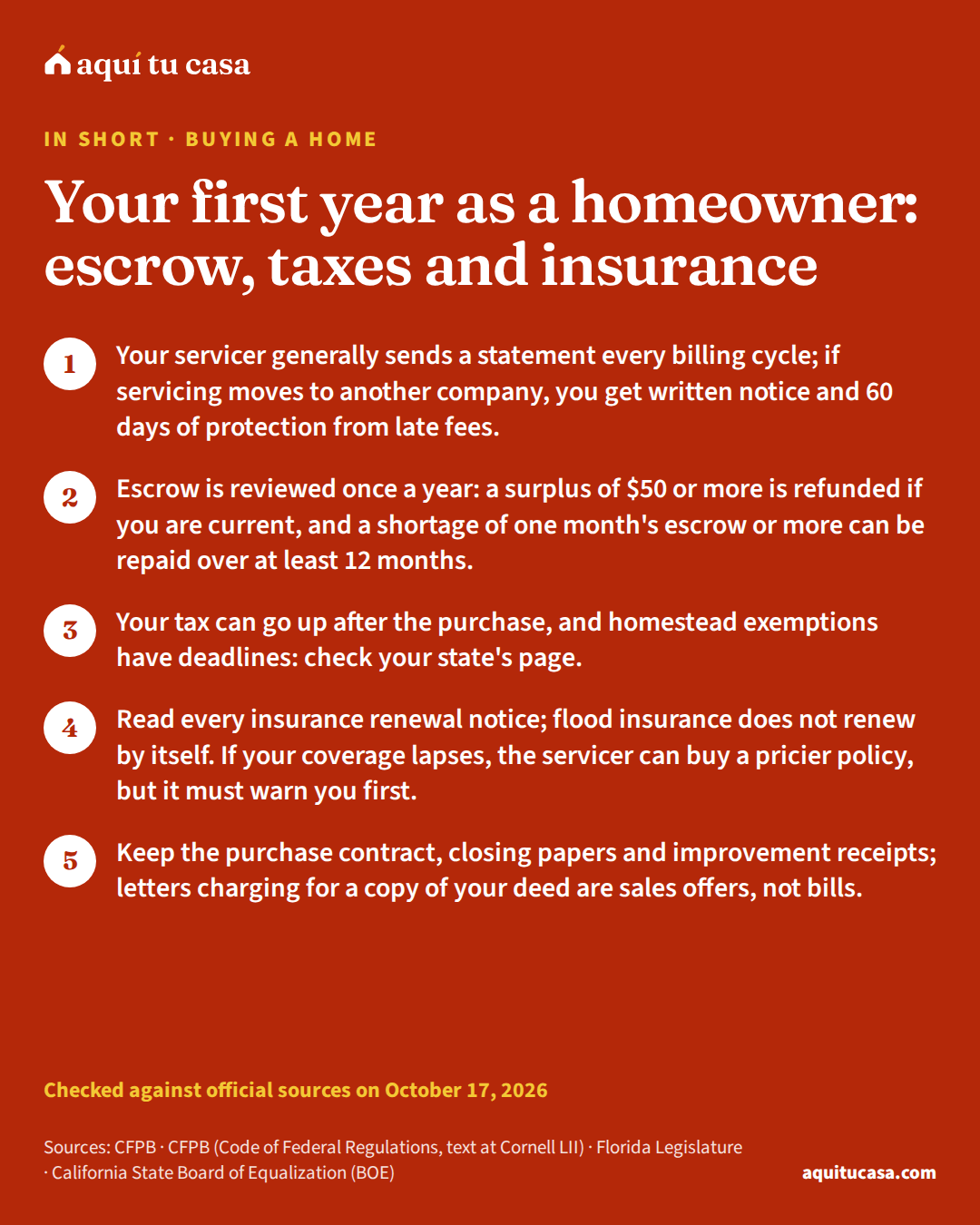
- Your servicer generally sends a statement every billing cycle; if servicing moves to another company, you get written notice and 60 days of protection from late fees.
- Escrow is reviewed once a year: a surplus of $50 or more is refunded if you are current, and a shortage of one month's escrow or more can be repaid over at least 12 months.
- Your tax can go up after the purchase, and homestead exemptions have deadlines: check your state's page.
- Read every insurance renewal notice; flood insurance does not renew by itself. If your coverage lapses, the servicer can buy a pricier policy, but it must warn you first.
Is this for you?
This guide is for you if…
- You just bought with a mortgage and are getting letters from your loan servicer, the county or your insurer that you do not understand.
- Your monthly payment changed even though your rate is fixed, or you were told another company will collect your mortgage.
- You want to know which papers to keep, which dates to write down and which offers are scams.
Get direct help first if…
- You are already behind on payments or received a foreclosure notice: talk to your servicer and a HUD-approved housing counselor today, and look for free legal aid if there are court papers.
- An insurance claim was denied: call the consumer line of your state's insurance department.
You signed, you got the keys, and now the letters start: statements, notices from a company you have never heard of, a county tax bill, an insurance renewal and offers that look official. This guide is for anyone who just bought a home with a mortgage and wants to understand what happens in that first year and what to do with each letter.
- Of protection from late fees when the company that collects your mortgage changes
- 60 days4
- Your escrow account is reviewed, and the annual statement arrives within 30 days
- Once a year3
- Escrow surplus at which it must be refunded to you, if you are current
- $503
- Of notice, at least, before you can be charged for force-placed insurance
- 45 days11
Your first year, month by month
The exact order depends on the month you closed. These are the dates set by federal rules and some state laws:
The dates of your first year
1. You get the initial escrow statement
At closing or within the next 45 days
It shows how much of your payment goes into escrow and which taxes and insurance will be paid, and when.3
2. Your statement arrives
Every billing cycle
It shows the due date, the late fee, how much goes to principal, interest and escrow, and a toll-free number.2
3. Letters arrive charging for your deed
Shortly after closing
They are offers from private companies, not government notices.16
4. If the company that collects your mortgage changes
Written notice before or after the transfer
For 60 days, an on-time payment to the old company cannot be treated as late.4
5. Your Form 1098 arrives
By January 31
It shows the interest you paid during the year and, in the year you buy, the deductible points.14
7. You renew your insurance
Before each policy expires
Flood insurance does not renew by itself: if it lapses, a new policy takes 30 days to take effect.12

Who collects your payment and what arrives each month
According to the CFPB, your lender is who loaned you the money, and your loan servicerloan servicerThe loan servicer is the company that sends you your mortgage statements and handles the day-to-day tasks of the loan: it processes your payments, answers your questions, keeps track of principal and interest paid and manages your escrow account, if you have one. It can also offer options if you fall behind and, in certain cases, start a foreclosure. It may be the same company that lent you the money or a different one, and it is common for another company to take over the loan after closing.See the full definition is the company that sends your statements, processes your payments, tracks the principalprincipalThe principal is the amount of money you borrowed and have to pay back, not counting the interest. In Spanish it is also called "capital". When you start, the principal is the loan amount; with every payment a part goes toward reducing it, and what remains is called the balance. Interest is computed on that balance, so the less principal you owe, the less interest you pay. On your monthly payment you will see P&I: principal and interest, the part of the payment that goes to the loan, separate from taxes and insurance.See the full definition and interest paid and manages your escrow if you have one. It is common for a different company to take over that role after closing. Its name is on your statement or coupon book; if you have neither, the CFPB points to the MERS servicer lookup, run by a private company, at (888) 679-6377.1
You generally get a statement every billing cycle with the due date, the late fee, how much goes to principal, interest and escrow, and a toll-free number (with exceptions, such as certain coupon books and small servicers).2 If you have escrow, you also get, at closing or within 45 days after, an initial escrow statement listing the taxes and insurance to be paid and when.3
If the company you pay changes
Under Regulation X, the old servicer generally notifies you in writing at least 15 days before the transfer and the new one no more than 15 days after (or both in a single notice). The notice gives the date, each company’s details and a toll-free or collect-call number, the day you start paying the new one, and states that your loan terms do not change except those tied to servicing. For 60 days after the transfer, if the old servicer receives your payment on time (including any grace period), it cannot be treated as late.4
The CFPB suggests telling your bank if your payment is automatic, allowing extra time if you pay by mail and checking your next statement. If you never got a notice or your payments are not being applied correctly, write to both companies.5
Your escrow account and its yearly review
According to the CFPB, your lender sets up the escrowescrow accountAn escrow account is an account set up by your mortgage lender to pay certain property-related expenses on your behalf, mainly property taxes and homeowners insurance. The money comes from a portion of your monthly mortgage payment: each month you contribute a share and the loan servicer pays the bills when they come due. That is why your payment is higher than principal and interest alone, and why it can change when taxes or the insurance premium go up. In some states the word also names the period between the offer and the closing.See the full definition account to pay, from part of your monthly payment, bills such as your property taxproperty taxProperty tax is the tax the county, city, school district and other local bodies charge real property owners every year to pay for schools, police, fire and other public services. It is computed on the value the assessor's office assigns to your home, at each body's rate, minus the exemptions you qualify for, such as the primary-residence exemption in many states. If you have a mortgage you normally pay it month by month inside your payment, through the escrow account. It is generally deductible on your federal return if you itemize.See the full definition and insurance. Because those costs can change from year to year, so can your payment.6

Under Regulation X, the servicer analyzes the account at the end of each year and sends you the annual statement within 30 days: what went in, what it paid, your new payment and what happens to any surplus or shortage. The cushion cannot exceed one-sixth of the payments it expects to make in the year, and when it does not know a bill yet, it may estimate from last year’s.3 That is why the first analysis after buying can bring surprises: if your tax goes up after the sale, the original estimate falls short.
Depending on the result, the regulation says:3
| Result of the analysis | What the servicer may do |
|---|---|
| Surplus of $50 or more | Refund it within 30 days, if you are current |
| Surplus under $50 | Refund it or credit it to next year’s escrow |
| Shortage under one month’s escrow | Leave it, or ask you to repay it within 30 days or in equal payments over at least 12 months |
| Shortage of one month’s escrow or more | Leave it, or ask you to repay it in equal payments over at least 12 months |
As long as you are not more than 30 days behind, the servicer must pay your tax and insurance on time, even if it has to advance the money; it can then ask you to repay it.3 The mortgage calculator shows how your payment moves if the tax or insurance goes up.

Property tax: the bill and exemptions
How the tax is calculated, appealed and deducted is in the property tax explained guide. In the first year, check two things:
- The value can change after the sale. In Florida, a homestead property is assessed at just value as of January 1 of the year after a change of ownership,7 so the seller’s bill does not tell you what you will pay.
- The homestead exemptionhomestead exemptionA homestead exemption is a legal protection for the home where you and your family live. It can keep certain creditors from collecting your debts out of your main home, and it can also lower the property tax on that home. In Texas, for example, the residence homestead exemption removes part of your home's value from the tax calculation; to get it you must own the home, live there as your principal residence and apply. State laws vary widely: some cap the amount protected and others depend on the size of the property or the owner's age.See the full definition. Where it exists, it has its own rules and dates. In California it takes $7,000 off the taxable value and is claimed once with the county assessor, no later than February 15 to get the full exemption that year.8 In Florida, whoever holds title on January 1 applies to the county property appraiser by March 1; otherwise that year’s exemption is generally lost.9
For your state, check its page under Places or ask your county assessor’s office.
Renewing homeowners and flood insurance
According to the CFPB, lenders generally require proof of homeowners insurancehomeowners insuranceHomeowners insurance pays for losses and damage to your property if something unexpected happens, like a fire or a burglary, and usually includes liability coverage if someone is hurt at your home. Lenders require it as long as you have a mortgage, because the home is their collateral, and almost always collect it inside your monthly payment through the escrow account. The price depends on the location, the rebuilding cost, the deductible and your history. A standard policy does not cover floods or, in many states, earthquakes: those risks are insured separately.See the full definition; many owners pay it through escrow, but you choose the company. Standard policies do not cover earthquakes or floods.10 Read the renewal notice: if the premium goes up, your escrow payment goes up.6 If you switch companies, send proof of the new policy to your servicer. If your coverage lapses, the servicer can buy force-placed insurance, which usually costs more and generally protects only the lender, but it must warn you at least 45 days before charging you.11
Flood insuranceflood insuranceFlood insurance is a separate policy that can cover a building, its contents, or both, when flood water causes damage. Most homeowners insurance policies do not cover that damage. Most of these policies are backed by FEMA's National Flood Insurance Program (NFIP) and bought through insurers and agents. If your home is in a high-risk flood area and your mortgage is backed by the federal government, the lender is required to demand it; outside those areas it is optional, but floods happen there too.See the full definition is separate and, according to FEMA, does not renew by itself: you renew it every year. If it lapses, a new policy takes 30 days to take effect and you may lose discounts.12 In a special flood hazard area, federal law requires that coverage on loans from regulated lenders, for the life of the loan; if it is missing, the servicer notifies you and, if you do not buy it within 45 days, buys it and charges you.13
More in the home insurance explained guide; if your policy is not renewed, ask your state’s insurance department.
Your tax return: Form 1098
Early in the year another letter arrives: Form 1098, the Mortgage Interest Statement. According to IRS Publication 530, if you paid $600 or more of mortgage interest during the year, the lender should send you that form or a similar statement with the total interest you paid. In the year you buy your main home, it also shows the points you can deduct, and it should include the interest you paid at closing. It should reach you by January 31 of the following year.14
To deduct home expenses such as mortgage interest or property tax, you have to itemize your deductions on Schedule A of Form 1040, and if you itemize you cannot take the standard deduction.14 Which option fits you depends on your numbers, and the rules can change from year to year: check the latest edition of Publication 530 when you prepare your tax returntax returnA tax return is the yearly form you use to report your income to the IRS and figure the tax you owe, so you can pay what is due or get a refund. The federal return for individuals is Form 1040. In general you must file if your gross income is above the minimum the IRS sets for your filing status, or if you had a certain amount of net earnings from self-employment; even when you do not have to, filing can pay off. You need your SSN or ITIN, and those of everyone else on the return, plus documents such as your W-2s and 1099s.See the full definition.
If you want free help, the IRS VITAVITA (free tax preparation)VITA (Volunteer Income Tax Assistance) and TCE (Tax Counseling for the Elderly) are IRS programs that offer free basic tax return preparation by IRS-certified volunteers. They are meant for people with moderate income, people with disabilities and limited-English speakers; TCE focuses on people sixty and older. The IRS sets no program-wide income limit, but individual sites may set their own. Many sites serve in Spanish and help with ITIN applications and renewals. Filing taxes every year builds the record lenders ask for.See the full definition and TCE programs prepare basic returns at no cost for people who qualify. Many sites help people with incomes below a certain level, people with disabilities and people who speak limited English, and each site may set its own income limit.15
Records, disputes and repairs
The IRS calls for full records: the purchase contract, the closing papers and the receipts for each improvement. They establish your home’s basis (what it cost, plus adjustments) and are kept while you own the home and for a time after you sell. An improvement adds value or extends the home’s life (a new roof, a fence) and is added to the basis; a repair only maintains it (painting, fixing a leak). Neither is deductible.14
If the servicer makes a mistake (does not apply a payment, charges an improper fee or fails to pay your tax or insurance on time), the CFPB says to send a written notice of error, to the special address on your statement if there is one, and it cannot charge you to respond. It generally has 5 business days to acknowledge it and 30 business days to fix it or explain why there was no error, and for 60 days it cannot report the disputed payment to the credit bureaus.11
For repairs, how much to set aside depends on your home: its age, the climate, the roof and the appliances. Your inspection report shows what is oldest; put something aside each month in a separate account.
If this is you
You got an escrow shortage
If it is one month's escrow or more, the servicer may ask you to repay it in equal payments over at least 12 months, not all at once.3
You have already missed a payment
HUD-approved housing counselors help at no cost if you are having trouble paying.18 The guide if you can't pay your mortgage explains your options.
Scams aimed at new owners
Shortly after closing, letters like a “deed processing notice” arrive charging for a copy of your deed. The Rhode Island Attorney General’s office explained that they use real details about your property to look official but come from private companies; a copy costs a few dollars at the local office.16 Virginia’s added that most owners receive their deed at purchase, no one has to pay these companies and their deadlines are artificial.17
The other scam poses as help (“loss mitigation”, “rescue”). According to the CFPB, the signs are: they tell you to stop paying your mortgage, charge up front, ask you to pay someone else, want you to sign over title or pressure you. These companies cannot charge up front, and HUD-approved housing counselors help at no cost if you are having trouble paying.18 You can report them to the CFPB online or at (855) 411-2372, and to your state attorney general.19

Common first-year mistakes
Mistake: Paying the old company after a transfer notice.
Instead: Note the date you start paying the new one, and tell your bank if you pay automatically.5
Mistake: Paying for a copy of your deed because the letter looks official.
Instead: It is an offer from a private company; a copy is usually much cheaper at the local office.17
Mistake: Letting your flood insurance lapse.
Instead: It does not renew by itself: if it lapses, a new policy takes 30 days to take effect.12
Mistake: Missing the homestead exemption deadline.
Instead: In Florida it is due March 1; if you miss it, you generally lose that year's exemption.9
Mistake: Switching insurers without telling your servicer.
Instead: Send proof of the new policy: without it, the servicer can buy more expensive insurance, though it must warn you first.11
Mistake: Paying up front someone who promises to “save” your home.
Instead: These companies cannot charge up front; a HUD-approved counselor helps at no cost.18
What to do this week
- Write down your servicer’s name and phone number from your statement.2
- Compare the payment, escrow amount and rate with your Closing DisclosureClosing DisclosureThe Closing Disclosure is a required five-page form with the final details of the mortgage you selected: the loan terms, your monthly payment, every closing cost and how much cash you must bring on signing day. The lender must give it to you at least three business days before closing, so you can compare it with your Loan Estimate and ask about any change. If an important number changes, the three-day period starts again. Keep it: you will need it for your taxes.See the full definition and the initial escrow statement; if something does not match, call before the next payment.3
- Keep the contract, closing papers, policies and improvement receipts in one place.14
- Check your state’s page for a homestead exemption and its deadline.9
- Write down when your homeowners policy and, if you have one, your flood policy expire.12
- If your escrow or payments do not add up, a HUD-approved housing counselor can help, often free or at low cost.20
Your numbers
Starts at the typical home value in the United States. Change it to the price you have in mind.
That is $11,645 (3.5% of the price). The usual minimum for this loan is 3.5%.
This week's average ± a quarter or half point.
National average as of November 5, 2026 (Freddie Mac); your rate may be different.
Adjust advanced details
Let's do the math
Estimated monthly payment
National figure$2,759
at 7.18% · 30 years
- Loan amount
- $326,673
- Total interest
- $470,006
- Paid off in
- November 2056
Includes $5,618 FHA upfront mortgage insurance premium.
Does it fit the income?
Comfortable
up to $1,884 a month
Tight
$1,884 to $2,422 a month
Hard
more than $2,422 a month
Your payment · 41%
Compared with the typical household income in the United States ($80,734 a year). Reference: HUD calls paying more than 30% of income for housing a cost burden.
| Principal & interest | $2,213 |
|---|---|
| Property tax | $261 |
| Home insurance | $139 |
| FHA mortgage insurance (MIP) | $147 |
How does it compare with incomes?
For this payment to be 28% of your income, you'd need to earn about $118,260 a year. With your other debts, to stay under 36%: about $91,980 a year.
You need at least $11,645 for the down payment, plus closing costs.
This is an estimate to give you an idea, not a loan offer. Your real payment depends on your rate, your credit, and the insurance and taxes on the home you buy.
Total monthly payment $2,759; principal and interest $2,213.
Ready to see the numbers? Find your county here
See how this applies in your county: its loan limits, prices and rents, from the official data.
Printable checklist
Frequently asked questions
Why did my payment go up if my rate is fixed?
If you have escrow, your payment changes when property taxes or insurance go up: the yearly analysis resets your payment and may spread out a shortage. The annual escrow statement shows what changed; if it does not add up, you can send your servicer a written notice of error.
I got a letter saying another company will collect my mortgage. Is it real?
Servicing transfers are common, and the rules require both companies to notify you, with their phone numbers and the date you start paying the new one. Confirm by calling the number on your last statement, not the one in the letter, and tell your bank if you pay automatically.
Do I need to buy a certified copy of my deed?
Most owners receive a copy of their deed at purchase, and if you need another, your county or town records office provides it for far less than the companies sending those letters. The Rhode Island and Virginia attorneys general warn that these letters are sales offers, not government notices.
What if I cannot afford to pay an escrow shortage?
If the shortage is one month's escrow or more, the servicer may ask you to repay it in equal monthly payments over at least 12 months, not all at once. If that still does not fit your budget, a HUD-approved housing counselor can help you review options, often free or at low cost.
When does Form 1098 arrive?
According to the IRS, if you paid $600 or more of mortgage interest during the year, the lender should send you a Form 1098 or similar statement by January 31 of the following year. It shows the interest you paid and, in the year you buy, the deductible points. If you want free help with your return, look for an IRS VITA site.
What do I do if my servicer made a mistake with my payment?
Send a written notice of error, to the special address on your statement if there is one. It cannot charge you to respond; it generally has 5 business days to acknowledge it and 30 business days to fix it or explain why there was no error.
Does flood insurance renew automatically?
No. According to FEMA, you have to renew it every year. If it lapses, a new policy takes 30 days to take effect and you may lose discounts.
Which home papers should I keep?
The IRS calls for full records: the purchase contract, the closing papers and the receipts for improvements. They establish your home's basis, and you keep them while you own the home and, after you sell, for the period of limitations that applies to you.
Sources
Every figure in this guide comes from one of these official sources. The number next to a sentence leads to the source behind it.
Each source on one line: who publishes it, its title, its address and the date we read it.
- 1. CFPB · What's the difference between a mortgage lender and a mortgage servicer? · consumerfinance.gov · Accessed October 17, 2026
- 2. CFPB (Code of Federal Regulations, text at Cornell LII) · Regulation Z, 12 CFR §1026.41, Periodic statements for residential mortgage loans · law.cornell.edu · Accessed October 17, 2026
- 3. CFPB (Code of Federal Regulations, text at Cornell LII) · Regulation X, 12 CFR §1024.17, Escrow accounts · law.cornell.edu · Accessed October 17, 2026
- 4. CFPB (Code of Federal Regulations, text at Cornell LII) · Regulation X, 12 CFR §1024.33, Mortgage servicing transfers · law.cornell.edu · Accessed October 17, 2026
- 5. CFPB · What happens if the company that I send my mortgage payments to changes? · consumerfinance.gov · Accessed October 17, 2026
- 6. CFPB · What is an escrow or impound account? · consumerfinance.gov · Accessed October 17, 2026
- 7. Florida Legislature · Florida Statutes §193.155, Homestead assessments · leg.state.fl.us · Accessed October 17, 2026
- 8. California State Board of Equalization (BOE) · Homeowners' Exemption · boe.ca.gov · Accessed October 17, 2026
See the other 12 sources
- 9. Florida Legislature · Florida Statutes §196.011, Annual application required for exemption · leg.state.fl.us · Accessed October 17, 2026
- 10. CFPB · What is homeowner's insurance? Why is homeowner's insurance required? · consumerfinance.gov · Accessed October 17, 2026
- 11. CFPB · Your mortgage servicer must comply with federal rules · consumerfinance.gov · Accessed October 17, 2026
- 12. FEMA, National Flood Insurance Program (FloodSmart) · How to renew your flood insurance policy · floodsmart.gov · Accessed October 17, 2026
- 13. U.S. Congress (text at Cornell LII) · 42 U.S.C. §4012a, Flood insurance purchase and compliance requirements · law.cornell.edu · Accessed October 17, 2026
- 14. IRS · Publication 530 (2025), Tax Information for Homeowners · irs.gov · Accessed October 17, 2026
- 15. IRS · Free tax return preparation for qualifying taxpayers · irs.gov · Accessed October 17, 2026
- 16. Rhode Island Office of the Attorney General (RI.gov) · AG Kilmartin Warns Homeowners of Deceptive Solicitation for "Deed and Property Profile" · ri.gov · Accessed October 17, 2026
- 17. Office of the Attorney General of Virginia · Attorney General Herring warns homeowners to be cautious of letters that urge them to buy copies of their home deed · oag.state.va.us · Accessed October 17, 2026
- 18. CFPB · How to spot and avoid foreclosure relief scams · consumerfinance.gov · Accessed October 17, 2026
- 19. CFPB · What are mortgage loan modification scams? · consumerfinance.gov · Accessed October 17, 2026
- 20. CFPB · Find a Housing Counselor · consumerfinance.gov · Accessed October 17, 2026
Keep reading
Related guides
If this guide helped, these follow the same path.

Owning a home 13 minute read
Property tax explained: how it is calculated and paid
Who charges property tax, how it is calculated, how it is paid through escrow, which exemptions and appeals exist and what part is deductible.
- It is a local tax: assessed value of the home × the rates of the county, city and school district, minus exemptions. Your county sets the bill.
- With a mortgage you pay it through escrow: the servicer collects it in your monthly payment, pays it for you and reviews the account every year; a shortage is repaid over at least 12 months.
- Exemptions (such as the primary residence one) and the appeal of the assessed value have deadlines; they are on your state's page with their source.
- Owning a home Home insurance explained: what it covers, how much to buy What home insurance covers, why the lender requires it, how to choose the amount and the deductible, why flood is separate and what happens if it lapses. 13 minute read
- Money problems Can't pay your mortgage? What to do in the first week Can't pay your mortgage? Call your servicer, learn the options that exist, the federal rules that protect you and the rescue scams to avoid. 14 minute read
- Protect yourself from scams Housing scams: the complete guide to spotting them The rental, mortgage, title, contractor, credit and moving scams families run into most: how to spot them, what to do and where to report them. 17 minute read
Tools for this topic
Was this guide useful?
Thank you. Your answer stays in your browser; nothing is sent.