Identity theft: how to freeze your credit and recover
What to do if your identity is stolen: close accounts, place a fraud alert, freeze your credit for free and report it at IdentityTheft.gov.
Verified against official sources on October 31, 2026 6 official sources

Show contents
In short
What you need to know
Quick answer
If your identity is stolen, act in this order: call the companies where the fraud happened and ask them to close or freeze the accounts; place a free fraud alert with one of the three bureaus (it notifies the other two); freeze your credit at Equifax, Experian and TransUnion, which is free and does not lower your score; and report the theft at IdentityTheft.gov (RobodeIdentidad.gov in Spanish) to get your report and a recovery plan. With that report, the bureau must block information that is not yours within 4 business days. If you have an ITIN or SSN, also get an IRS IP PIN.
What matters most
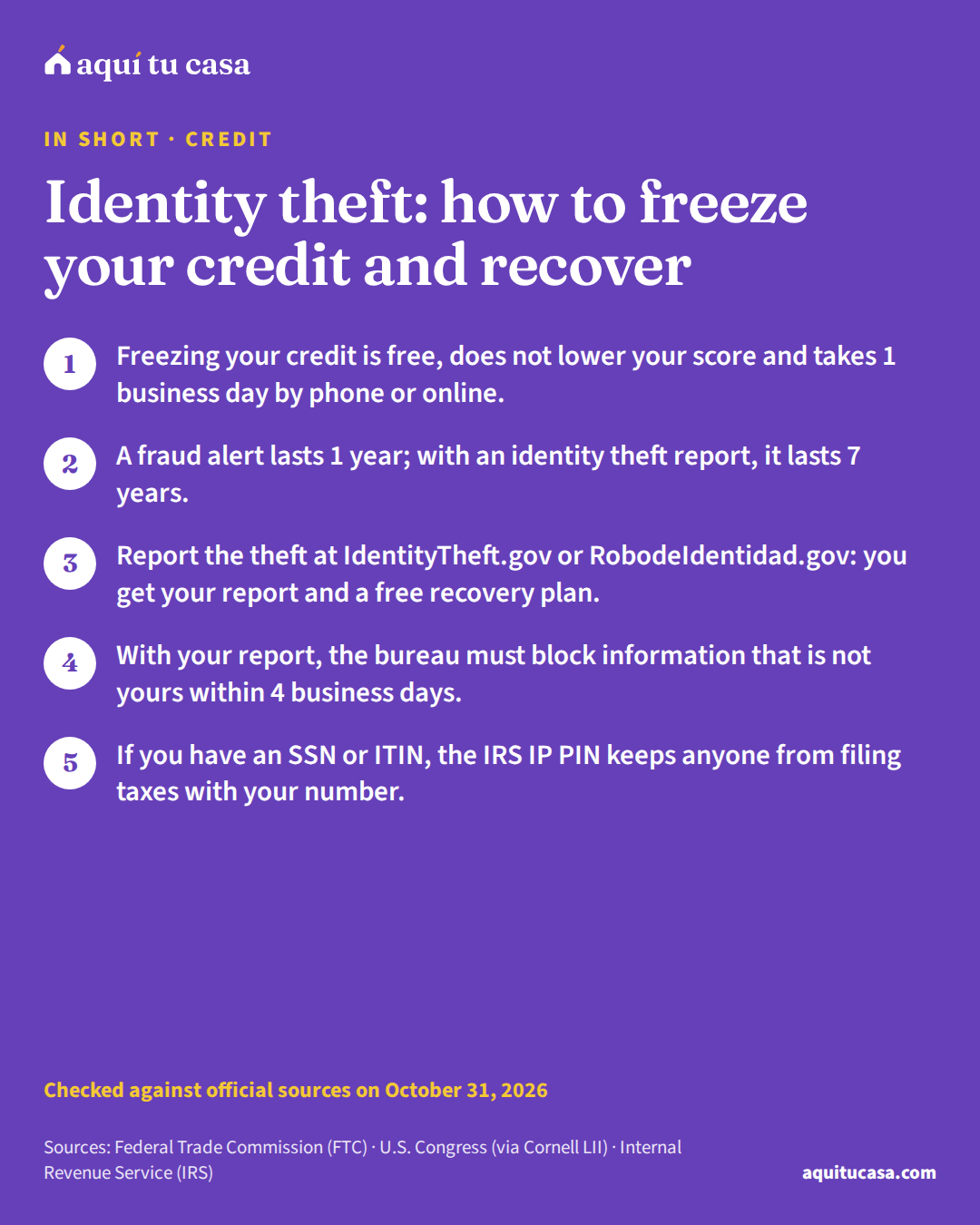
- Freezing your credit is free, does not lower your score and takes 1 business day by phone or online.
- A fraud alert lasts 1 year; with an identity theft report, it lasts 7 years.
- Report the theft at IdentityTheft.gov or RobodeIdentidad.gov: you get your report and a free recovery plan.
- With your report, the bureau must block information that is not yours within 4 business days.
Is this for you?
This guide is for you if…
- You see accounts, charges or debts on your credit report that are not yours.
- You lost your wallet, had documents stolen or were told about a data breach.
- You want to protect your credit before buying a home or renting, even if nothing has happened.
Get direct help first if…
- You recently sent money to a scammer: call your bank today and read «I was scammed, what now?» first.
- You only want to fix an error on your report that is not from identity theft: read the guide on disputing errors.
Identity theft happens when someone uses your information, such as your Social Security number, your ITIN or your accounts, to open credit, buy things or collect money in your name. It can wreck your credit right when you want to rent or buy a home. The good news is that the law gives you free tools to stop the damage and clean up your report. This guide explains how to spot the theft, what to do first, how to freeze your credit and how to recover, according to the FTC, federal law and the IRS.
The signs of identity theft
The FTC lists these signs:1
- You stop getting a bill. Someone may have changed your address.
- Charges for things you did not buy.
- Bank withdrawals you did not make.
- Accounts in your name you do not recognize on your credit reportcredit reportA credit report is a statement that has information about your credit activity and current credit situation: your loans and cards, the balances, whether you have paid on time, accounts in collection and who has checked your credit. Credit reporting companies, also called credit bureaus, compile it from what banks and creditors report; your credit score is computed from it. When you apply for a mortgage, the lender pulls your report from the three bureaus. You have the right to see it for free and to dispute anything that is wrong.See the full definition.
If you also get calls about a debt you do not recognize, or are turned down for a loan or an apartment over something you do not understand, check your report. You can get it at AnnualCreditReport.com or 877-322-8228, and the three bureaus let you check it for free once a week.2 Our guide AnnualCreditReport step by step explains how, and How to read your credit report helps you find what is not yours.
What to do first
Order matters. The FTC recommends three steps:2
First steps if your identity was stolen
1. Call the companies where the fraud happened
Today
Ask for the fraud department, explain that your identity was stolen and ask them to close or freeze the accounts.2
2. Change your passwords and PINs
Today
Change access to your bank, email and other accounts; turn on two-factor authentication.1
3. Place a fraud alert
Today
Call one of the three bureaus; it is free for a year and that bureau must notify the other two.2
4. Freeze your credit at all three bureaus
Today or tomorrow
It is free and, by phone or online, it is placed within 1 business day.4
5. Report the theft at IdentityTheft.gov
This week
You get your identity theft report and a free recovery plan.2
6. Ask them to block what is not yours
With your report
The bureau must block that information no later than 4 business days after.5
The three credit bureaus and their contact information, according to the FTC:2
| Bureau | Website | Phone |
|---|---|---|
| Equifax | Equifax.com/personal/credit-report-services | 800-685-1111 |
| Experian | Experian.com/help | 888-397-3742 |
| TransUnion | TransUnion.com/credit-help | 888-909-8872 |
Before you call, set up a sheet for each company. Write down the date, the time, the name of the person who helped you and what you were told. Ask for a confirmation or case number for each call. If you are asked to send something in writing, do it promptly and keep a copy. That sheet will help you weeks later, when you have to show what you asked for and when. Also keep each freeze confirmation: some bureaus give you a number or ask you to create an account so you can lift it later.
Fraud alert or credit freeze
These are two different tools, and you can use both.
Fraud alert or credit freeze
They verify it is you
Fraud alert
- A business must verify your identity before opening a new account
- The initial alert lasts at least 1 year and is free
- You place it with one bureau, which notifies the other two
- With an identity theft report, you can get the 7-year extended alert
Nobody opens new accounts
Credit freeze
- Nobody can open new credit in your name, not even you
- It is free to place and lift, and it does not lower your score
- You request it from each of the three bureaus
- It stays until you ask to lift it
If your identity was already stolen, the FTC recommends the alert and a freeze.
The fraud alertfraud alertA fraud alert is a note in your credit file that requires creditors who check your report to verify your identity before opening a new account, issuing an additional card or raising your credit limit. You only need to ask one of the nationwide credit reporting companies, which must notify the others. An initial alert is for anyone who suspects they are, or are about to become, a victim of fraud or identity theft, and it lasts one year unless you ask to remove it sooner. An extended alert requires an identity theft report and lasts seven years. When you place one, you are entitled to free copies of your report.See the full definition. If you suspect in good faith that you are or will be a fraud victim, the bureau must place an initial alert for at least 1 year and notify the other bureaus. If you submit an identity theft report, you can request a 7-year extended alert; the bureau also removes you for 5 years from lists of credit offers you did not ask for and gives you 2 free copies of your report in the next 12 months. If you are on active military duty, you can request an active duty alert for at least 12 months.4
The credit freezesecurity freezeA security freeze, also called a credit freeze, keeps new creditors from seeing your credit file, which helps stop an identity thief from opening new accounts in your name. By law it is free to place and to lift, and you must ask each of the three nationwide credit reporting companies separately. While it is on, only a few can see your file, such as creditors on accounts you already have, and you can still review your reports. It does not affect your score. Because creditors rarely lend without checking your file, it stops you too; you can lift it for free for a period of time when you need to.See the full definition. With a freeze, nobody can open a new credit account in your name, not even you. It costs nothing and does not affect your score.3 By law, the bureau must place it free no later than 1 business day after you ask by phone or online, or 3 business days if you ask by mail. It stays until you ask to remove it. The freeze does not apply to companies you already have an account with when they review or collect on that account.4

If you are applying for credit: how to lift a freeze
If you are applying for a mortgage, a card or an apartment, the lender or landlord will want to see your report. Lift the freeze temporarily before they check it. By law, the bureau must lift it free no later than 1 hour after you ask by phone or online, or 3 business days by mail.4 Ask the lender which bureau it will use, and when the process is over, freeze it again.
Report the theft and recover your credit
Reporting the theft to the FTC gives you two things: your identity theft report and a free recovery plan with next steps. You can do it in English at IdentityTheft.gov, in Spanish at RobodeIdentidad.gov, or in another language by calling 877-438-4338 and pressing 3, with interpreters from 9:00 a.m. to 5:00 p.m. Eastern Time.2
That report unlocks strong rights. With it, the bureau must block from your report the information that resulted from the theft, no later than 4 business days after receiving:5
- Proof of your identity.
- A copy of your identity theft report.
- A list of the information that is not yours.
- Your statement that the information does not relate to any transaction of yours.
The bureau must also notify the company that reported that information.5 If you later see other errors, you can file a credit disputecredit report disputeA credit report dispute is the complaint you make when your credit report has wrong or incomplete information. You have the right to dispute it, and the investigation is free. It is usually done in two places: with the credit reporting company and with the company that supplied the information, called a furnisher, such as your bank, your landlord or your credit card company. You explain in writing what is wrong and why, with copies of your documents. The credit reporting company must investigate, generally within thirty days, and delete or correct anything found to be inaccurate, incomplete or unverifiable.See the full definition: our guide How to dispute credit report errors explains how to do it in writing. And if a collection agency calls about a debt that is not yours, Debt collection: your rights explains how to respond.
Tax-related identity theft
One form of identity theft is someone filing a tax return with your number to collect a refund. The IRS IP PIN stops it. It is a six-digit number that only you and the IRS know, and anyone with an SSN or ITIN who can verify their identity can request it, including for dependents. The fastest way is your IRS online account; if you cannot open one, there are other options, including an in-person appointment at a Taxpayer Assistance Center. A new IP PIN is generated every year.6
Our guide Tax refund timing and scams explains other tax-season traps. If you have a problem with the IRS because of identity theft, look for a Low Income Taxpayer ClinicLow Income Taxpayer Clinic (LITC)A Low Income Taxpayer Clinic (LITC) is an organization that helps low-income people who have a dispute with the IRS, such as an audit, an appeal or a tax collection matter, for free or for a small fee. It can represent you before the IRS or in court. It also teaches taxpayer rights and responsibilities to people who speak English as a second language. To qualify, your income generally must be below a certain level. The clinics get part of their funding from the IRS but are independent of it.See the full definition near you.
How to protect yourself starting today
The FTC recommends:1
- Take your mail out of the mailbox as soon as possible if you get statements with personal information.
- Ask questions before giving out your Social Security number. Organizations that ask for it will not call, email or text you to ask; if you are not satisfied with their answers, do not give it.
- Use strong passwords and two-factor authentication on your accounts.
- Do not give your information to someone who calls, emails or texts you out of the blue.
Also review your bank and card statements every month, not only when something seems off. A small charge you do not recognize can be a thief’s test before a big one. And keep important documents, such as your Social Security card, your ITIN letter and your tax returns, somewhere safe at home, not in your wallet.
Our guide What documents to share with lenders and landlords explains what they can really ask for, and Impostor calls and messages how to spot someone pretending to be your bank or the government.
Example with real numbers
A family about to buy a home finds an account that is not theirs
An example in words, not a real case, of how to use these tools.
- They check their report before applying for a loan
- A credit card they never opened shows up
- That same day
- They call the card company, place a fraud alert and freeze their credit
- That week
- They report the theft at IdentityTheft.gov and ask the bureau to block the account
- Before the preapproval
- They lift the freeze temporarily; online, the bureau lifts it within 1 hour
- What they achieve
- A clean report to apply for their loan, and the freeze back on afterward
The rules come from the FTC and the Fair Credit Reporting Act.254 Use the credit plan to see what else to check before you apply.
Run it with your numbersCredit planIf this is you
You are applying for a mortgage
Check your report early and lift the freeze before the lender pulls it.4
You use an ITIN
Get an IRS IP PIN so nobody can file taxes with your number.6
You have children under 16
You can freeze their credit for free until you ask to lift it.3
You are on active duty
Request an active duty alert, which lasts at least 12 months.4
You prefer to do it in Spanish
Report the theft at RobodeIdentidad.gov; for other languages, call 877-438-4338 and press 3.2
Your wallet was stolen today
Call your bank, place a fraud alert and freeze your credit today.2

Mistakes that cost you
Mistake: Paying a service to freeze your credit.
Instead: Placing and lifting a freeze is free by law; ask each bureau directly.4
Mistake: Freezing your credit at only one bureau.
Instead: You have to ask all three: Equifax, Experian and TransUnion.3
Mistake: Thinking a freeze lowers your score.
Instead: It does not affect it; it only keeps new accounts from being opened.3
Mistake: Forgetting to lift the freeze before applying for a loan.
Instead: Lift it temporarily; by phone or online, within 1 hour.4
Mistake: Not reporting the theft out of fear or embarrassment.
Instead: With your IdentityTheft.gov report, the bureau must block what is not yours.5
Mistake: Giving your Social Security number to someone who calls you.
Instead: Organizations that ask for it will not call or email to ask.1
What to do this week
- Get your reports at AnnualCreditReport.com and look for accounts you do not recognize.2
- Freeze your credit at Equifax, Experian and TransUnion, even if nothing has happened.3
- If you found something that is not yours, call that company and place a fraud alert.2
- Report the theft at IdentityTheft.gov and save your report and plan.2
- Send your report to the bureaus so they block what is not yours.5
- Request your IP PIN in your IRS online account.6
Your situation
If you have never had a card or a loan in the U.S., choose "None".
Your credit plan
12 steps
You have done 0 of 12.
This week
Get your three credit reports for free
At AnnualCreditReport.com you can get the Equifax, Experian and TransUnion reports for free once a week. Checking your own report does not lower your score. If it comes up empty, that is not an error: you simply have no history yet.
Source: CFPB: How do I get a free copy of my credit reports? ↗ · CFPB: Does requesting my credit report hurt my credit score? ↗
Dispute any error in writing
Write to the credit bureau and to the company that reported the item, with copies of your proof, by certified mail. By law, the bureau must investigate again for free and resolve it within 30 days of receiving your notice.
Source: CFPB: How do I dispute an error on my credit report? ↗ · Congreso de EE. UU. (texto en Cornell LII): Fair Credit Reporting Act, 15 U.S.C. §1681i, Procedure in case of disputed accuracy ↗
Talk to a HUD-approved housing counselor
They give independent advice on buying, renting, defaults and credit, often free or at low cost. You can go over your report and your plan with them.
Source: CFPB: Find a Housing Counselor ↗
This month
Open a secured card
You deposit an amount (for example, $500) and can spend up to that amount. With on-time payments, the limit can go up, and the deposit comes back. Before signing, ask whether they report to all three bureaus and compare the annual fee and the rate: they can be high.
Source: CFPB: What are some ways to start or rebuild a good credit history? ↗ · CFPB: How to rebuild your credit ↗
Or a credit builder loan
The bank or credit union holds the money as savings while you make small payments, usually for six to 24 months; when you finish, you get it. You build history and savings at the same time.
Source: CFPB: What are some ways to start or rebuild a good credit history? ↗
Ask for your rent to be reported
On-time rent payments can help build your credit. Ask your landlord whether they take part in a rent reporting program (often through a payment app) and check its fees.
Set up automatic payments
An automatic payment or a reminder before the statement date prevents the costliest kind of slip: payment history is the main factor in most models.
What does not build credit
Paying with a debit card or cash, prepaid cards and payday loans do not build history, according to the CFPB. They are ways to pay, not accounts that get reported.
From here on
Do not close your first account
A long history of on-time payments helps your score. When a better card comes along, keep the first one open and current.
Only apply for the credit you need
Opening several accounts in a short time is a risk signal for lenders, and each application leaves a hard inquiry that does affect your score.
Source: CFPB: How do I get and keep a good credit score? ↗ · CFPB: What is a credit inquiry? ↗
Watch your debt-to-income ratio
Lenders divide your monthly debt payments by your gross monthly income to see whether you can handle a new loan. While you prepare, avoid new payments, such as a car.
Watch out for "credit repair"
It is a scam if they charge before doing anything, promise to remove accurate negative information, tell you not to contact the bureaus or to dispute everything. Disputing errors is free by law, and if you already signed up for something like this, you can cancel within three business days.
Source: CFPB: How can I tell a credit repair scam from a reputable credit counselor? ↗
An educational plan built on what the CFPB, the NCUA and the federal credit reporting law publish; not individual advice. We recommend no brands and are paid for no product.
Ready to see the numbers? Find your county here
See how this applies in your county: its loan limits, prices and rents, from the official data.
Printable checklist
Frequently asked questions
Does freezing my credit lower my score?
No. The FTC says freezing your credit does not affect your score. It only keeps new credit accounts from being opened in your name, even by you, until you lift it.
How much does a credit freeze cost?
Nothing. By law, placing and lifting it is free. You have to request it from each of the three bureaus: Equifax, Experian and TransUnion.
What is the difference between a fraud alert and a freeze?
With an alert, a business must verify your identity before opening a new account; it lasts 1 year, or 7 with an identity theft report, and you place it with just one bureau. With a freeze, nobody can open a new account in your name; you request it from all three bureaus.
I am about to apply for a mortgage. What do I do with my freeze?
Lift it temporarily before the lender checks your credit. If you ask by phone or online, the bureau must lift it within 1 hour; by mail, within 3 business days. You can freeze it again afterward.
Can I report identity theft in Spanish?
Yes. The FTC has RobodeIdentidad.gov in Spanish. For another language, call 877-438-4338 and press 3; interpreters are available from 9:00 a.m. to 5:00 p.m. Eastern Time.
Can I freeze my child's credit?
Yes. If your child is under 16, you can request a free freeze, which lasts until you ask to remove it. Each bureau has its own instructions for minors.
I have an ITIN. Can I get an IP PIN?
Yes. The IRS says anyone with an SSN or ITIN who can verify their identity can request an IP PIN, which keeps someone else from filing taxes with your number. You get a new one every year.
Sources
Every figure in this guide comes from one of these official sources. The number next to a sentence leads to the source behind it.
Each source on one line: who publishes it, its title, its address and the date we read it.
- 1. Federal Trade Commission (FTC) · What To Know About Identity Theft · consumer.ftc.gov · Accessed October 31, 2026
- 2. Federal Trade Commission (FTC) · How to recover from identity theft · consumer.ftc.gov · Accessed October 31, 2026
- 3. Federal Trade Commission (FTC) · What To Know About Credit Freezes and Fraud Alerts · consumer.ftc.gov · Accessed October 31, 2026
- 4. U.S. Congress (via Cornell LII) · 15 U.S.C. §1681c-1, Identity theft prevention; fraud alerts and active duty alerts (security freeze) · law.cornell.edu · Accessed October 31, 2026
- 5. U.S. Congress (via Cornell LII) · 15 U.S.C. §1681c-2, Block of information resulting from identity theft · law.cornell.edu · Accessed October 31, 2026
- 6. Internal Revenue Service (IRS) · Get an identity protection PIN (IP PIN) · irs.gov · Accessed October 31, 2026
Keep reading
Related guides
If this guide helped, these follow the same path.

Credit 13 minute read
How to read your credit report, line by line
Where to get your free credit reports, what each part says, how long negative items can stay and how to spot errors or identity theft.
- AnnualCreditReport.com is the only site the federal government authorizes for free reports; right now you can view them every week.
- The report is not the score: the report is your history; the score is a prediction calculated from it, and in most cases it is not included.
- Check five parts: personal information, accounts, collections, public records and inquiries. Requesting your own report does not lower your score.
- Credit How to dispute errors on your credit report How to fix credit report errors for free: what to send each bureau and the company that reported it, legal deadlines, and credit repair scams. 14 minute read
- Money problems I was scammed: what to do in the first hours If you sent money or personal information to a scammer: who to call first, how to dispute a charge, where to report it and how to stop identity theft. 13 minute read
Tools for this topic
Was this guide useful?
Thank you. Your answer stays in your browser; nothing is sent.