What documents to share with lenders and landlords, and when
What you give a lender before and after the Loan Estimate, what a landlord may ask for, who may see your credit report and how to spot a scam.
Verified against official sources on October 29, 2026 22 official sources

Show contents
In short
What you need to know
Quick answer
To receive a Loan Estimate, a lender may only ask you for six pieces of information: name, income, Social Security number, property address, estimated value and loan amount. It cannot require pay stubs, W-2s or a purchase contract before giving it to you. The full documents come later, when you tell the lender you want to proceed. A landlord may check your credit, rental history and income, but only for an application you started, and if it turns you down because of a report it must tell you. Never follow wiring instructions or send documents through an email you have not verified.
What matters most
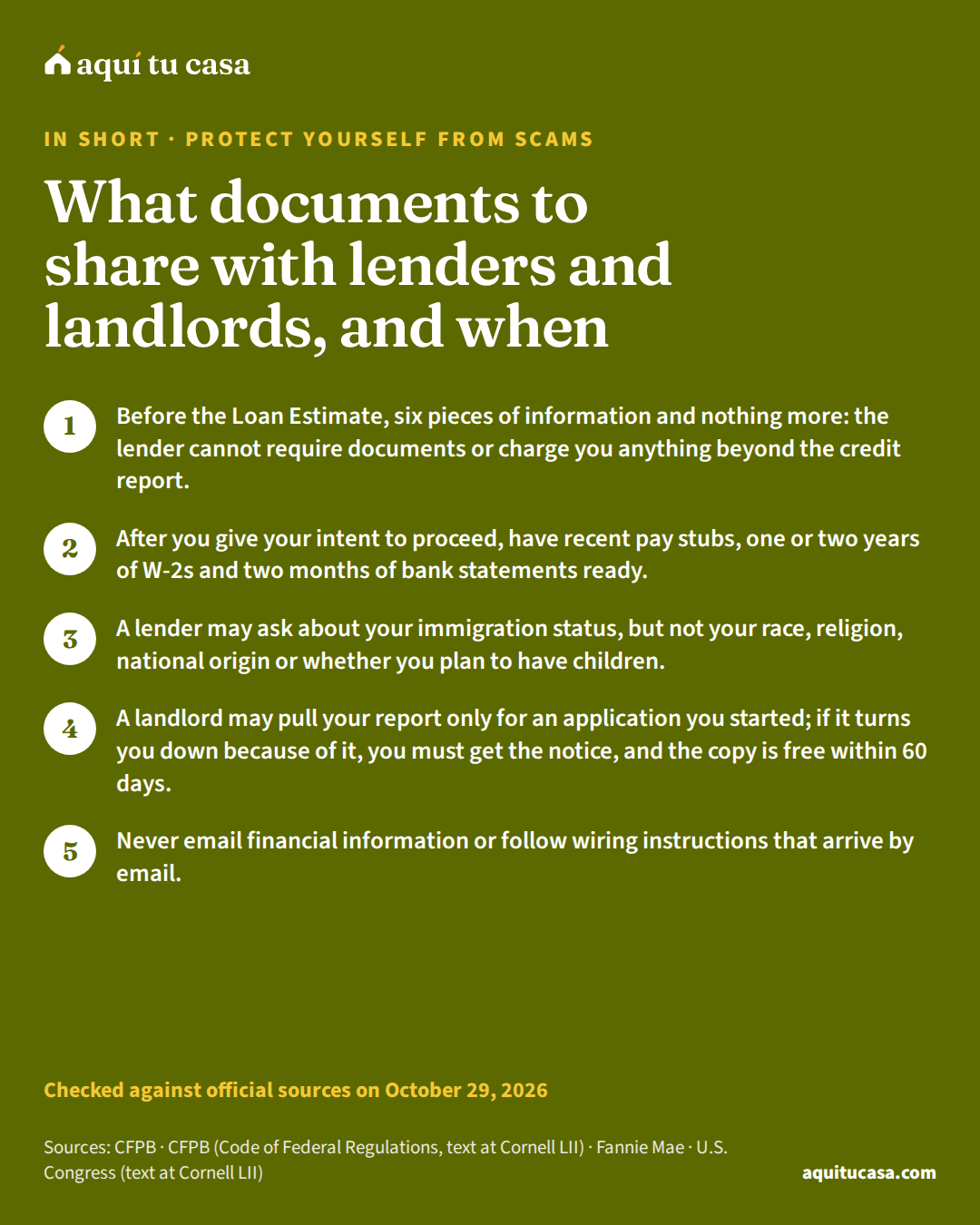
- Before the Loan Estimate, six pieces of information and nothing more: the lender cannot require documents or charge you anything beyond the credit report.
- After you give your intent to proceed, have recent pay stubs, one or two years of W-2s and two months of bank statements ready.
- A lender may ask about your immigration status, but not your race, religion, national origin or whether you plan to have children.
- A landlord may pull your report only for an application you started; if it turns you down because of it, you must get the notice, and the copy is free within 60 days.
Is this for you?
This guide is for you if…
- You are about to apply for a mortgage and a lender asks for paperwork before giving you a Loan Estimate.
- You are about to rent and the application asks for your Social Security number, your passport or your bank statements.
- You want to know who may see your credit report and which questions you cannot be asked.
Get direct help first if…
- Your identity was already stolen or you were already scammed: start with the guide on what to do if you were scammed and the one on impostor calls.
- You feel you were treated differently because of your origin or your family: the lending discrimination guide explains how to complain.
- You have a question about your immigration case: this guide does not answer it; an accredited representative or a legal aid office can guide you.
Applying for a mortgage or renting a home means handing over paperwork: your Social Security number or ITIN, your pay stubs, your bank statements, your passport. Sharing them with the right person, at the right time, is normal. Sharing them too early, or with someone who should not have them, opens the door to identity theft. This guide explains, with the federal rules and what the agencies publish, what a lender and a landlord may ask you for, when, what they cannot ask, and how to recognize when something is wrong.
- All a lender may require of you to give you a Loan Estimate
- 6 items2
- For the lender to deliver the Loan Estimate after your application
- 3 business days1
- How long the lender is required to honor the Loan Estimate's terms
- 10 business days5
- To get a free copy of the report a landlord used to turn you down
- 60 days12
The Loan Estimate: six pieces of information and nothing more
The Loan EstimateLoan EstimateThe Loan Estimate is a three-page form you receive from the lender within days of applying for a mortgage. In the same format at every bank, it sums up the terms of the loan being offered: amount, interest rate, whether the payment can change, the estimated monthly payment with taxes and insurance, the itemized closing costs and how much cash you need at closing. Because every lender uses the same form, it lets you compare offers side by side. It commits you to nothing: requesting one is not accepting the loan.See the full definition is the three-page form you receive after applying for a mortgage. All lenders must use the same form, and that is what lets you compare offers. The lender must deliver it within three business days of receiving your application. When you receive it, nothing has been approved or denied yet.1
And what is “your application”? Under Regulation Z, for these loans an application is six pieces of information: your name, your income, your Social Security number to obtain your credit report, the property address, an estimate of its value and the loan amount you are seeking.7 The CFPB puts it in plain words: with those six items, the lender is required to give you the Loan Estimate, and it cannot require more. You do not have to hand over a purchase agreement or documents verifying your income.2 You do not need a signed purchase contract to apply either.4
This matters because many families hear “bring me your W-2s, your pay stubs and your bank statements first, and then we’ll see.” According to the CFPB, a lender or mortgage broker cannot require any documents as a condition for giving you the Loan Estimate.3 Regulation Z says the same: they may not require verification documents before providing it.8 You can share them if you want, and the CFPB says it is often a good idea because they make the Loan Estimate more accurate,2 but the decision is yours, and the best time to make it is once you have chosen whom to go with.
The money. Before you receive the Loan Estimate, neither the lender nor anyone else may charge you a fee in connection with your application, with one exception: a bona fide and reasonable fee for obtaining your credit report.8 And if someone gives you a written “estimate” before the official Loan Estimate, the rule requires it to say at the top, in at least 12-point type, that your actual rate, payment and costs could be higher and that you should get an official Loan Estimate before choosing a loan.8 A paper with that notice is not the official Loan Estimate.
Before and after your intent to proceed
Only the six items
Before the Loan Estimate
Share the minimum to compare and the full set only with the lender you chose.3
Your intent to proceed
After comparing, you tell the lender you chose that you want to go ahead. That is called expressing your intent to proceed, and it is a step you take: the lender cannot assume silence means yes. You have some room: the lender is only required to honor the terms of the Loan Estimate for 10 business days. If you take longer, it may give you a revised Loan Estimate with different costs.5
From there, what you are asked for changes. According to the CFPB, once you notify the lender, you typically pay an application or appraisal fee and provide full documentation of your income, assets and other financial information. If you delay providing it, the lender may need to delay your closing, and your rate lockrate lockA rate lock (or lock-in) means your interest rate will not change between the offer and closing, as long as you close within the agreed time frame and your application does not change. Rates can change daily; if yours is not locked, it can change at any time. Even when locked, it can change if your loan amount, credit score, verified income or appraisal changes. Extending a lock can cost money, and if rates fall you may be stuck with the higher rate. The first page of the Loan Estimate says whether your rate is locked and until when.See the full definition could expire.5 And you can continue to comparison shop with other lenders throughout the process.3
From first contact to closing, what you share at each step
1. Request Loan Estimates from several lenders
At the start
With the same six items for each one. Request three or more and compare them.5
2. Receive each Loan Estimate
Within 3 business days of each application
If a lender does not send it, call and ask why.2
3. Compare and choose
Within 10 business days
After that, the lender may change the terms.5
Try it with your numbersCompare loans4. Give your intent to proceed
Once you have chosen
Say it clearly to the lender you chose; silence does not count.5
5. Hand over the full documentation
As soon as possible after notifying the lender
Pay stubs, W-2s, bank statements and whatever is needed to verify what you already gave.9
Try it with your numbersDocument checklist6. Review any revised Loan Estimate
If something changed
Ask what changed and why. Intentionally underestimating charges is illegal.6
What you will be asked for after you proceed
The CFPB explains that, after your intent to proceed, the lender may require documents to verify what you already told it, and that if those documents show something different you may receive a revised Loan Estimate.3 Exactly which documents depends on the loan type and on each lender. Fannie Mae’s rules, which many conventional loans follow, give a clear picture of what is typical.
For employment income, Fannie Mae requires the most recent pay stubpay stubA pay stub is the statement that comes with your pay and shows how much you earned before deductions (gross pay), what was taken out and what you keep (net pay). Deductions include taxes, such as federal income tax, Social Security and Medicare, and sometimes health insurance or retirement savings. It also shows year-to-date totals. The federal wage law (FLSA) does not require employers to give you pay stubs, but it does require them to keep records of your hours and wages. For a mortgage, the lender may ask for your most recent one.See the full definition to be dated no more than 30 days before the application and to include your year-to-date earnings, and W-2 formsForm W-2Form W-2 (Wage and Tax Statement) is the document your employer must prepare for each employee. It shows the wages you were paid and the taxes withheld from your pay, such as income tax and Social Security and Medicare taxes. The employer files it with the government and sends you a copy, on paper or electronically, in January or February so you can file your tax return. If it does not arrive or has errors, you first ask your employer to fix it; if you still do not get it, the IRS can help you obtain it.See the full definition to cover the last year or the last two, depending on your income type, with your name as the employee. If you are missing one, it accepts alternatives such as an IRS wage transcriptIRS tax transcriptAn IRS tax transcript is a free official summary of the information on your tax returns and tax account. It is not a photocopy of your return. There are several types: the tax return transcript shows most line items from your Form 1040 as filed and usually meets the needs of mortgage lenders; the tax account transcript shows changes made after you filed; the wage and income transcript shows what your W-2s and 1099s reported. You can get one through your IRS online account, by mail, by phone or with Form 4506-T.See the full definition, a written verification of employment or the final pay stub of the year.9
For the down payment and closing money, the lender may request a verification directly from your bank or copies of your bank statementsbank statementA bank statement is the summary your bank or credit union gives you of the activity in your account over a period: deposits, withdrawals, payments and the ending balance. Most send one every month, on paper or online; the law only requires a monthly statement when there was at least one electronic transfer that month, and otherwise it may come quarterly. When you apply for a mortgage, the lender can use your statements to verify you have money for the down payment, closing and reserves. Under Fannie Mae's rules, they must show the bank's name, your name, part of the account number, the period, all transactions and the ending balance.See the full definition. Those statements must show the bank’s name, your name as account holder, at least the last four digits of the account, the period, all deposits and withdrawals and the ending balance. On a purchase they cover the most recent two full months; on a refinance, the most recent month. If the latest statement is more than 45 days old, you will be asked for a newer one.10 Because statements show every deposit, cash deposits can raise questions: the guide to cash savings and your mortgage explains how to prepare them.
Example with real numbers
The typical purchase file, piece by piece
What Fannie Mae's rules require for a conventional loan; other loans and lenders may ask for more or something different.
- Most recent pay stub
- No more than 30 days old, with year-to-date earnings.9
- W-2 forms
- For the last year or the last two, with your name.9
- Bank statements
- The most recent two full months, with the last four digits of the account.10
- If the statement is more than 45 days old
- A newer bank-generated form.10
- When to hand it over
- After your intent to proceed, not before.3
The document checklist builds your version according to your income type and your identification number.
Run it with your numbersDocument checklistA revised Loan Estimate is not always a bad sign. The CFPB explains that the lender may raise charges if certain circumstances change, for example if it could not verify your overtime or bonuses, or if your score changed; what is illegal is intentionally underestimating charges to surprise you later.6 How to read the two versions is explained in the guide to how to compare Loan Estimates.

What a lender cannot ask you
Handing over documents is not the same as answering any question. Regulation B, which implements the equal credit law, lets the lender request the information it needs, with clear limits. It may not ask your race, color, religion, national originnational originNational origin is one of the characteristics the Fair Housing Act protects. According to the Department of Justice, national origin discrimination can be based on the country where you were born or where your ancestors came from. The law prohibits refusing to sell or rent you a home, setting different terms or publishing ads that state a preference based on your national origin. According to the CFPB, the Equal Credit Opportunity Act also prohibits lenders from discriminating against you because of your national origin when you apply for credit, such as a mortgage.See the full definition or sex, except for exceptions such as the data the government uses to monitor that no one discriminates. It may not ask about birth control or whether you plan to have or raise children, though it may ask how many dependents you have and their ages. And it may not ask whether your income comes from alimony or child support without telling you that you do not have to reveal it if you do not want it counted.15
Immigration status is different. Regulation B allows the lender to ask about your permanent residency and immigration status,15 and to consider them in its decision.16 That permission has limits: the guide to lending discrimination explains where it ends, what the sources say about national origin and how to complain. If you have an ITINITIN (Individual Taxpayer Identification Number)An ITIN is a nine-digit number the IRS, the federal tax agency, issues to people who need a U.S. taxpayer identification number to file taxes and are not eligible for a Social Security number. It is for tax purposes only: it does not authorize you to work in the United States, does not qualify you for Social Security benefits or the Earned Income Tax Credit, and says nothing about your immigration status. You apply with Form W-7, and it expires if it goes unused for several years. Some lenders accept an ITIN for a mortgage.See the full definition instead of a Social Security number, remember what the IRS says: it is a 9-digit number for federal tax purposes only, it does not provide or change immigration status and it does not serve as identification outside the tax system.21 Ask the lender from the start what it accepts.

What a landlord may ask for and check
For renting, the process is shorter, but you still hand over personal data. According to the CFPB, many landlords use a tenant screeningtenant screening reportA tenant screening report is a report many landlords use to decide whether to rent to you and how much to charge for the security deposit. Specialty companies prepare it, and it can include your credit report, your rental history including eviction cases and lawsuits, employment verification, criminal history and a score or recommendation. It is not the same as a credit report. If a landlord denies you, or asks for a larger deposit or higher rent, because of the report, federal law requires the landlord to tell you, name the company and explain your right to a free copy and to dispute errors.See the full definition report to decide whether to rent to you and how much to charge for the deposit. That report may include your credit reportcredit reportA credit report is a statement that has information about your credit activity and current credit situation: your loans and cards, the balances, whether you have paid on time, accounts in collection and who has checked your credit. Credit reporting companies, also called credit bureaus, compile it from what banks and creditors report; your credit score is computed from it. When you apply for a mortgage, the lender pulls your report from the three bureaus. You have the right to see it for free and to dispute anything that is wrong.See the full definition, your rental history with evictions and lawsuits, your employment verification and your criminal history.12 The companies that produce them also verify your identity and your income, and most have nothing on you until you apply for a home or authorize the landlord to request the report.13
One detail that costs money: according to the CFPB, landlords may request your credit report as a hard inquiryhard inquiryA hard inquiry happens when a lender checks your credit report because you applied for a loan or a card, to decide whether to approve you. It can affect your score, because most scoring models look at how often and how recently you apply for credit, and other businesses that buy your report can see it. A single inquiry has little impact. Scoring models also allow for comparison shopping: several inquiries for the same type of loan, such as a mortgage, within a short period usually count as one.See the full definition, which could lower your score, something that adds up if you send several applications at once.13 Ask how they check credit before you apply. What you can offer if you have no Social Security number or credit history is explained in the guide to how to rent without a Social Security number or credit.
Questions have limits here too. The Fair Housing ActFair Housing ActThe Fair Housing Act is the federal law that makes it illegal to refuse to sell or rent a dwelling, or to discriminate in its terms, because of race, color, religion, sex, familial status (having children), national origin or disability. It applies to landlords, real estate agents and managers, and also to banks and lenders when their practices make housing or credit unavailable for those reasons. National origin covers your language and the country you come from, regardless of immigration status. If you believe you were discriminated against, you can file a complaint with HUD at no cost; many states add protections.See the full definition makes it unlawful to refuse to rent or sell, or to make a dwelling “unavailable,” because of race, color, religion, sex, familial status or national origin, and also because of disability; it bans advertisements that show a preference on those grounds; and it bans telling you a dwelling is not available when it is.17 If a landlord asks you for documents it does not ask others for, or says “it’s already rented” after seeing your last name, keep the messages: the guide to housing discrimination explains how to report it. On immigration status, the rule depends on your state; the guide to your immigration status and your landlord explains what the sources say.
Some states require the landlord to tell you before screening you. In Washington, for example, the law says that before obtaining any information about you the landlord must notify you in writing, or by posting, what types of information it will access and, if it uses a consumer report, the name and address of the agency and your right to a free copy and to dispute it; it may charge you for the report only if it gave that notice; if it turns you down it must give you the reasons in writing; and if it does not comply it may be liable to you for up to one hundred dollars.18 In other states the rules differ or do not exist; a free legal aidlegal aidLegal aid is the free civil legal help that nonprofit organizations and their lawyers provide to low-income people in civil, not criminal, matters. In housing, that includes representing families facing eviction or foreclosure, alongside matters such as custody, child support, protection from domestic violence and access to benefits. In the United States, the Legal Services Corporation, created by Congress, funds a nationwide network of these organizations; its finder points you to the one in your area. Each sets its own income limits.See the full definition office knows the ones in your area.
Who may see your report: the FCRA
Your credit report is not open to anyone. The Fair Credit Reporting Act (FCRA) says a consumer reporting agency may furnish it only for a permissible purpose: for example, in accordance with your written instructions; to someone it has reason to believe will use it in a credit transaction with you, such as a lender; or to someone with a legitimate business need in connection with a transaction you initiated, such as the landlord you sent an application to. And no one may use or obtain your report for any other purpose.11
In practice, that means two things. A lender you gave your six items to has a permissible purpose; a landlord you asked to rent from does too. But an “owner” who asks for your Social Security number by text before showing you the home, or a “company” that promises approval if you send your documents first, has not shown you who they are or why they want your information. If you want to know who has looked at your report, the guide to how to read your credit report explains where inquiries appear.
If you are turned down because of a report
If a landlord denies you housing, requires a co-signerco-signerA co-signer is a person who signs another person's loan or credit account to back it up, and by doing so becomes responsible for the debt. If the borrower does not pay, the creditor can collect up to the full debt from the co-signer, plus late fees or collection costs, without first trying to collect from the borrower, and the default may become part of the co-signer's credit record. A federal FTC rule calls for the co-signer to get a written notice explaining these risks before signing. On a mortgage, according to Fannie Mae, a co-signer signs the note and shares liability for the debt with the borrower but has no ownership interest in the home on the title.See the full definition, or asks you for a larger deposit or higher rent than others because of what a report says, that is adverse action. According to the CFPB, the adverse action noticeadverse action noticeAn adverse action notice is the notice you get when a company denies you credit or takes another action against you on your application or account. Under federal law, the lender must give you the main reasons or tell you how to ask for them. If the decision was based on a credit report or another consumer report, the company must also give you the score that was used, the name and contact information of the company that supplied the report, and explain your right to a free copy of that report and to dispute errors. The reporting company did not make the decision and cannot tell you why it was made.See the full definition may be given in writing, orally or electronically; it must include the name, address and phone number of the company that provided the report; and it must explain your right to a free copy if you request it within 60 days and to dispute anything wrong. The company generally has 30 days to investigate your dispute, in some cases 45.14 You can also ask the landlord what information was the problem, in case you can explain it, and if you believe the rules were not followed, submit a complaint to the CFPB online or at (855) 411-CFPB (2372).14 How to write the dispute is explained in the guide to how to dispute credit report errors.
Signs that something is wrong
The papers you hand over for a mortgage or a rental are exactly what an identity thief wants. The CFPB warns that scammers pretend to be the FTC, the CFPB, other agencies and your bank, and asks that you contact banks and agencies only through official websites and phone numbers. The FTC never threatens you or tells you to transfer your money to “protect it.”19 Impostor calls and messages have their own guide.
At the closing of a purchase, the biggest risk is wire fraudwire fraud at closingThis is a scam aimed at people about to close on a home. Days before closing, the scammer sends an email that looks like it comes from your real estate agent or settlement agent with "new" instructions to wire or electronically transfer your down payment or closing costs to a different account. If it works, getting the money back can be very hard. The CFPB recommends writing down two trusted contacts ahead of time, confirming any instructions with them using only those numbers, and not using phone numbers or links in the email. If it happens to you, call your bank right away to stop or reverse the transfer.See the full definition. The CFPB has warned that scammers send spoofed emails imitating the real estate agent, the settlement agent or a legal representative, with false instructions for wiring the closing funds. Its rule is simple: never follow wiring instructions that arrive by email; verify the account name and number in person or by the phone number you agreed on beforehand; do not email financial information; and if you already wired money, call your bank immediately and ask for a wire recall.20
If you already gave your information to someone you should not have, the CFPB says to close the affected accounts, report it at IdentityTheft.gov and place a fraud alertfraud alertA fraud alert is a note in your credit file that requires creditors who check your report to verify your identity before opening a new account, issuing an additional card or raising your credit limit. You only need to ask one of the nationwide credit reporting companies, which must notify the others. An initial alert is for anyone who suspects they are, or are about to become, a victim of fraud or identity theft, and it lasts one year unless you ask to remove it sooner. An extended alert requires an identity theft report and lasts seven years. When you place one, you are entitled to free copies of your report.See the full definition or a credit freezesecurity freezeA security freeze, also called a credit freeze, keeps new creditors from seeing your credit file, which helps stop an identity thief from opening new accounts in your name. By law it is free to place and to lift, and you must ask each of the three nationwide credit reporting companies separately. While it is on, only a few can see your file, such as creditors on accounts you already have, and you can still review your reports. It does not affect your score. Because creditors rarely lend without checking your file, it stops you too; you can lift it for free for a period of time when you need to.See the full definition. The alert requires creditors to make sure it is you before opening a new account. The freeze is free at the three nationwide companies and stops new creditors from accessing your file; however, it does not apply to someone requesting your report for employment, tenant screening or insurance, so a landlord could still see it.19
If this is you
If this is you
You have an ITIN, not a Social Security number
The ITIN is a number for federal tax purposes only and does not serve as identification.21 Ask the lender or landlord what it accepts before handing anything over; the guide to ITIN mortgages explains who lends with it.
You have never had credit here
Most screening companies have nothing on you until you apply.13 Bring ID, proof of income and references, and ask whether they will make a hard inquiry.
You are renting and they ask for a lot of paperwork
The landlord may check credit, rental history, employment and income for an application you started.12 Hand them over only after seeing the home and verifying the company.
You prefer to understand everything in Spanish
A HUD-approved housing counselor can go over with you what is being requested and why, often at little or no cost.22

Mistakes that cost you
Mistake: Handing pay stubs, W-2s and bank statements to five lenders to "see who offers more."
Instead: Give each one the six items, compare the Loan Estimates and hand over the full documents only to the one you chose.3
Mistake: Paying an application or appraisal fee before receiving the Loan Estimate.
Instead: Before the Loan Estimate you may only be charged for the credit report.8
Mistake: Letting weeks pass without saying which lender you are going with.
Instead: The Loan Estimate's terms are only honored for 10 business days, and your silence does not count as intent.5
Mistake: Sending a copy of your passport or Social Security card to an "owner" who has not shown you the home.
Instead: A landlord checks your report for an application you started; make the formal application with a company you can verify.11
Mistake: Following wiring instructions from an email "from the settlement agent."
Instead: Confirm the account name and number by the phone number you agreed on beforehand; never follow instructions that arrive by email.20
Mistake: Accepting a denial or a higher deposit without asking.
Instead: Request the adverse action notice and your free copy of the report within 60 days.14
What to do this week
- Write your six items for the Loan Estimate on a piece of paper and request it from three or more lenders with those items, no documents.25
- Write down the verified phone number of each lender, your agent and your settlement agent before any email arrives.20
- Build your document folder with the list below, so it is ready the day you give your intent to proceed.910
- If you are renting, ask each landlord what it checks and whether it will make a hard inquiry before sending the application.13
- If you are turned down because of a report, request the notice and your free copy within 60 days.14
- If you want someone to go over what you are being asked for, talk with a HUD-approved housing counselorHUD-approved housing counselorA HUD-approved housing counselor works at an agency HUD has approved to provide housing counseling: independent, expert advice customized to your situation about buying a home, renting, a missed mortgage payment, a foreclosure or credit problems. The agencies usually charge little or nothing; many serve in Spanish and offer the homebuyer education course several assistance programs require. They are not lenders or real estate agents and sell you nothing. Your county page lists the official agencies with phone numbers.See the full definition or a free legal aid office.22
Your numbers
We start with the typical home value in the United States. Enter the price you are looking at.
Adjust advanced details
FHA
Estimated monthly payment
$2,759
Principal and interest, tax, homeowners insurance and mortgage insurance.
- Down payment
- $11,645 (3.5%)
- Mortgage insurance
- $147 a monthFHA annual premium · whole term
- Upfront premium or fee
- $5,618FHA upfront mortgage insurance · added to the loan
- Paid in 5 years
- $141,609
- Balance after 5 years
- $308,088
- County limit
- Find your county to see the limit
Rules and notes
- Minimum down payment of 3.5% with a score of 580 or more; between 500 and 580 at least 10% is required.In effect since September 14, 2016 · Source ↗
- Mortgage insurance: 1.75% upfront plus an annual premium; with less than 10% down it lasts the whole term.In effect since March 20, 2023 · Source ↗
- Only citizens, lawful permanent residents and citizens of the Freely Associated States; non-permanent residents are no longer eligible.In effect since May 25, 2025 · Source ↗
Conventional, 3% down
Estimated monthly payment
$2,747
Principal and interest, tax, homeowners insurance and mortgage insurance.
- Down payment
- $9,981 (3%)
- Mortgage insurance
- $161 a monthPMI (example) · ends around year 13
- Upfront premium or fee
- None
- Paid in 5 years
- $140,854
- Balance after 5 years
- $304,358
- County limit
- Find your county to see the limit
Rules and notes
- Fannie Mae requires a minimum score of 620 on manually underwritten fixed-rate loans; its automated system (DU) sets no fixed minimum.In effect since April 22, 2026 · Source ↗
- Private mortgage insurance (PMI) with less than 20% down; it cancels on its own at 78% of the original value.In effect since January 1, 2024 · Source ↗
- Fannie Mae buys loans to lawful permanent and non-permanent residents on the same terms as citizens; the lender verifies the status.In effect since July 28, 2015 · Source ↗
Conventional, 5% down
Estimated monthly payment
$2,698
Principal and interest, tax, homeowners insurance and mortgage insurance.
- Down payment
- $16,635 (5%)
- Mortgage insurance
- $158 a monthPMI (example) · ends around year 12
- Upfront premium or fee
- None
- Paid in 5 years
- $137,950
- Balance after 5 years
- $298,082
- County limit
- Find your county to see the limit
Rules and notes
- Fannie Mae requires a minimum score of 620 on manually underwritten fixed-rate loans; its automated system (DU) sets no fixed minimum.In effect since April 22, 2026 · Source ↗
- Private mortgage insurance (PMI) with less than 20% down; it cancels on its own at 78% of the original value.In effect since January 1, 2024 · Source ↗
- Fannie Mae buys loans to lawful permanent and non-permanent residents on the same terms as citizens; the lender verifies the status.In effect since July 28, 2015 · Source ↗
Conventional, 20% down
Lowest paymentEstimated monthly payment
$2,202
Principal and interest, tax, homeowners insurance and mortgage insurance.
- Down payment
- $66,540 (20%)
- Mortgage insurance
- None
- Upfront premium or fee
- None
- Paid in 5 years
- $108,184
- Balance after 5 years
- $251,017
- County limit
- Find your county to see the limit
Rules and notes
- Fannie Mae requires a minimum score of 620 on manually underwritten fixed-rate loans; its automated system (DU) sets no fixed minimum.In effect since April 22, 2026 · Source ↗
- Private mortgage insurance (PMI) with less than 20% down; it cancels on its own at 78% of the original value.In effect since January 1, 2024 · Source ↗
- Fannie Mae buys loans to lawful permanent and non-permanent residents on the same terms as citizens; the lender verifies the status.In effect since July 28, 2015 · Source ↗
VA
Estimated monthly payment
$2,702
Principal and interest, tax, homeowners insurance and mortgage insurance.
- Down payment
- $0 (0%)
- Mortgage insurance
- None
- Upfront premium or fee
- $7,153VA funding fee · added to the loan
- Paid in 5 years
- $138,137
- Balance after 5 years
- $320,517
- County limit
- Find your county to see the limit
Rules and notes
- Military service requirements by period of service; you must meet VA's and your lender's credit standards.In effect since September 22, 2026 · Source ↗
- No down payment as long as the price is not above the appraisal; funding fee of 2.15% on first use with no down payment (exempt: zero). No monthly mortgage insurance.In effect since April 7, 2023 · Source ↗
- Up to the conforming limit with no down payment in most areas; more with a down payment.In effect since January 7, 2026 · Source ↗
USDA
Estimated monthly payment
$2,773
Principal and interest, tax, homeowners insurance and mortgage insurance.
- Down payment
- $0 (0%)
- Mortgage insurance
- $97 a monthUSDA annual fee · whole term
- Upfront premium or fee
- $3,327USDA upfront fee · added to the loan
- Paid in 5 years
- $142,404
- Balance after 5 years
- $316,909
- County limit
- No county limit
Rules and notes
- Home in an eligible rural area and income within the area limit; finances the full price for those who qualify.In effect since December 9, 2013 · Source ↗
- Upfront fee of 1% and annual fee of 0.35% of the balance.In effect since October 1, 2026 · Source ↗
- Each lender sets the score.
- Applicants must show they are U.S. citizens, U.S. non-citizen nationals or qualified aliens, as the federal rule defines them.In effect since November 29, 2022 · Source ↗
ITIN loan (example)
ExampleEstimated monthly payment
$2,315
Principal and interest, tax, homeowners insurance and mortgage insurance.
- Down payment
- $49,905 (15%)
- Mortgage insurance
- None
- Upfront premium or fee
- None
- Paid in 5 years
- $114,945
- Balance after 5 years
- $266,705
- County limit
- No county limit
Rules and notes
- Not a federal program: each lender sets the down payment, rate and documents. The 15% is only an example; rates are usually higher.
- They usually ask for ITIN tax returns for the last two years and more reserves; compare several lenders.
An educational estimate, not a loan offer. The same rate for every program (the real one differs); homeowners insurance is an example (0.5% of the value a year) and so is PMI (0.6% a year). The rules quoted are dated; check with your lender.
Ready to see the numbers? Find your county here
See how this applies in your county: its loan limits, prices and rents, from the official data.
Printable checklist
Frequently asked questions
Can I request a Loan Estimate without giving my Social Security number?
The Social Security number is one of the six pieces of information that make up the application, because the lender uses it to pull your credit report. If you have an ITIN instead of a Social Security number, ask the lender what it accepts: the IRS says the ITIN is for federal tax purposes only and not identification. The guide to ITIN mortgages explains which lenders work with that number.
The lender wants my W-2s and pay stubs before giving me the Loan Estimate. Is that legal?
According to the CFPB, a lender or broker cannot require any documents as a condition for giving you the Loan Estimate, and Regulation Z bars requiring verification documents before providing it. You can share them if you want, because they make the Loan Estimate more accurate, but they cannot be demanded at that point.
What can I be charged before the Loan Estimate?
Under Regulation Z, before you receive the Loan Estimate no one may charge you a fee in connection with your application, except a bona fide and reasonable fee for obtaining your credit report. Application or appraisal fees come later, when you tell the lender you want to proceed.
How many days do I have to decide which lender to go with?
The CFPB explains that the lender is only required to honor the terms of the Loan Estimate for 10 business days, and that it cannot assume silence means you want to proceed. After that, it may give you a revised Loan Estimate with different costs.
Can a landlord ask for my credit report and bank statements?
Yes. The federal credit reporting law allows your report to be furnished to someone with a legitimate business need in a transaction you initiated, such as your rental application. According to the CFPB, tenant screening companies verify credit, rental history, identity, income and employment. What each landlord asks for varies; in some states, such as Washington, it must tell you beforehand what it will check.
Can I be asked about my immigration status?
A lender can: Regulation B lets it ask about your permanent residency and immigration status and consider them. What it cannot do is ask your race, color, religion, national origin or sex, except to monitor compliance with the law. For landlords, the rule depends on your state; the guide on your immigration status and your landlord explains what the sources say.
A landlord turned me down and I do not know why. What do I do?
If it used a report, federal law requires it to tell you and to give you the company's name, address and phone number. Request your free copy within 60 days, review it and dispute anything wrong; the company generally has 30 days to investigate. You can also ask the landlord what information was the problem.
I got an email from the settlement agent with new wiring instructions for my money. What do I do?
Do not follow it. The CFPB has warned that scammers imitate emails from the real estate agent or settlement agent with false instructions. Call the phone number you agreed on beforehand and confirm the account name and number in person or on that call. If you already wired the money, contact your bank immediately and ask for a wire recall.
Sources
Every figure in this guide comes from one of these official sources. The number next to a sentence leads to the source behind it.
Each source on one line: who publishes it, its title, its address and the date we read it.
- 1. CFPB · What is a Loan Estimate? · consumerfinance.gov · Accessed October 29, 2026
- 2. CFPB · What information do I have to provide a lender in order to receive a Loan Estimate? · consumerfinance.gov · Accessed October 29, 2026
- 3. CFPB · Can a lender make me provide documents like my W-2 or pay stub in order to give me a Loan Estimate? · consumerfinance.gov · Accessed October 29, 2026
- 4. CFPB · My loan officer says that I can't apply for a mortgage loan and receive a Loan Estimate until I can provide a copy of a signed purchase contract, is that correct? · consumerfinance.gov · Accessed October 29, 2026
- 5. CFPB · My loan officer said that I need to express my 'Intent to Proceed' in order for my mortgage loan application to move forward. What does that mean? · consumerfinance.gov · Accessed October 29, 2026
- 6. CFPB · I received a revised Loan Estimate from my lender showing a higher interest rate and increased closing costs. What does this mean? · consumerfinance.gov · Accessed October 29, 2026
- 7. CFPB (Code of Federal Regulations, text at Cornell LII) · Regulation Z, 12 CFR §1026.2, Definitions and rules of construction · law.cornell.edu · Accessed October 29, 2026
- 8. CFPB (Code of Federal Regulations, text at Cornell LII) · Regulation Z, 12 CFR §1026.19, Certain mortgage and variable-rate transactions · law.cornell.edu · Accessed October 29, 2026
See the other 14 sources
- 9. Fannie Mae · Selling Guide B3-3.1-02, Standards for Employment Documentation · selling-guide.fanniemae.com · Accessed October 29, 2026
- 10. Fannie Mae · Selling Guide B3-4.2-01, Verification of Deposits and Assets · selling-guide.fanniemae.com · Accessed October 29, 2026
- 11. U.S. Congress (text at Cornell LII) · Fair Credit Reporting Act, 15 U.S.C. §1681b, Permissible purposes of consumer reports · law.cornell.edu · Accessed October 29, 2026
- 12. CFPB · What is a tenant screening report? · consumerfinance.gov · Accessed October 29, 2026
- 13. CFPB · List of consumer reporting companies · consumerfinance.gov · Accessed October 29, 2026
- 14. CFPB · What should I do if my rental application is denied because of a tenant screening report? · consumerfinance.gov · Accessed October 29, 2026
- 15. CFPB (Code of Federal Regulations, text at Cornell LII) · Regulation B, 12 CFR §1002.5, Rules concerning requests for information · law.cornell.edu · Accessed October 29, 2026
- 16. CFPB (Code of Federal Regulations, text at Cornell LII) · Regulation B, 12 CFR §1002.6, Rules concerning evaluation of applications · law.cornell.edu · Accessed October 29, 2026
- 17. U.S. Congress (text at Cornell LII) · Fair Housing Act, 42 U.S.C. §3604, Discrimination in the sale or rental of housing · law.cornell.edu · Accessed October 29, 2026
- 18. Washington State Legislature · RCW 59.18.257, Screening of prospective tenants · app.leg.wa.gov · Accessed October 29, 2026
- 19. CFPB · What do I do if I am a victim of identity theft? · consumerfinance.gov · Accessed October 29, 2026
- 20. CFPB · Mortgage Closing Scams: How to protect yourself and your closing funds · consumerfinance.gov · Accessed October 29, 2026
- 21. IRS · Individual Taxpayer Identification Number (ITIN) · irs.gov · Accessed October 29, 2026
- 22. CFPB · Find a Housing Counselor · consumerfinance.gov · Accessed October 29, 2026
Keep reading
Related guides
If this guide helped, these follow the same path.

Buying a home 16 minute read
How to compare Loan Estimates, page by page
How to read and compare two or three Loan Estimates side by side: what to check on each page, what can change and how to negotiate with lenders.
- The Loan Estimate is the same three-page form at every lender: that is what makes it useful for comparing.
- Get at least three, for the same kind of loan and on nearby days; before you receive them, the only fee allowed is for your credit report.
- Compare what the lender controls: Sections A, B and J on page 2, and the five-year cost, APR and TIP on page 3.
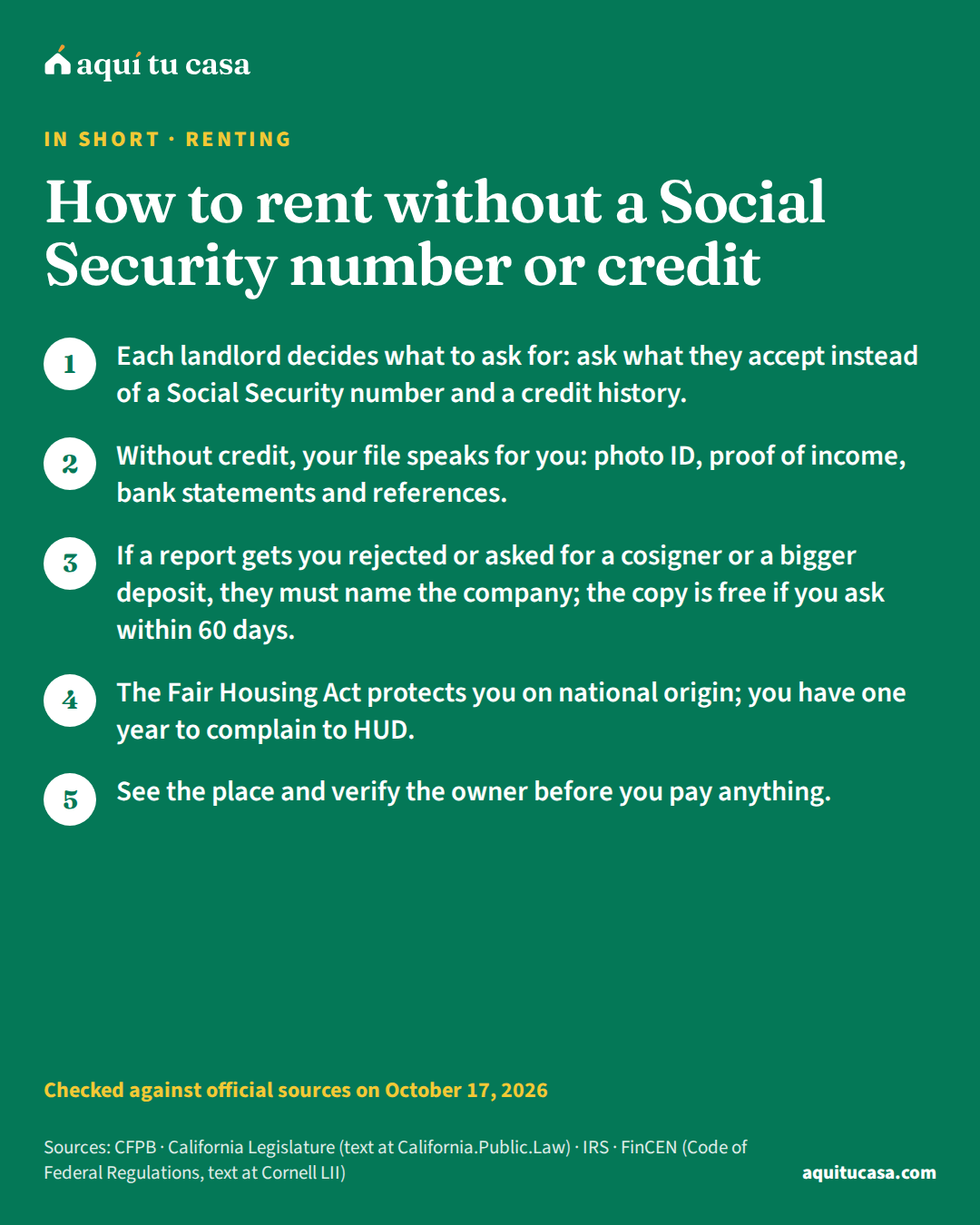
- Renting How to rent without a Social Security number or credit What a landlord can ask for, what to offer instead of an SSN and credit, how much rent fits your income and your rights if you are turned down. 11 minute read
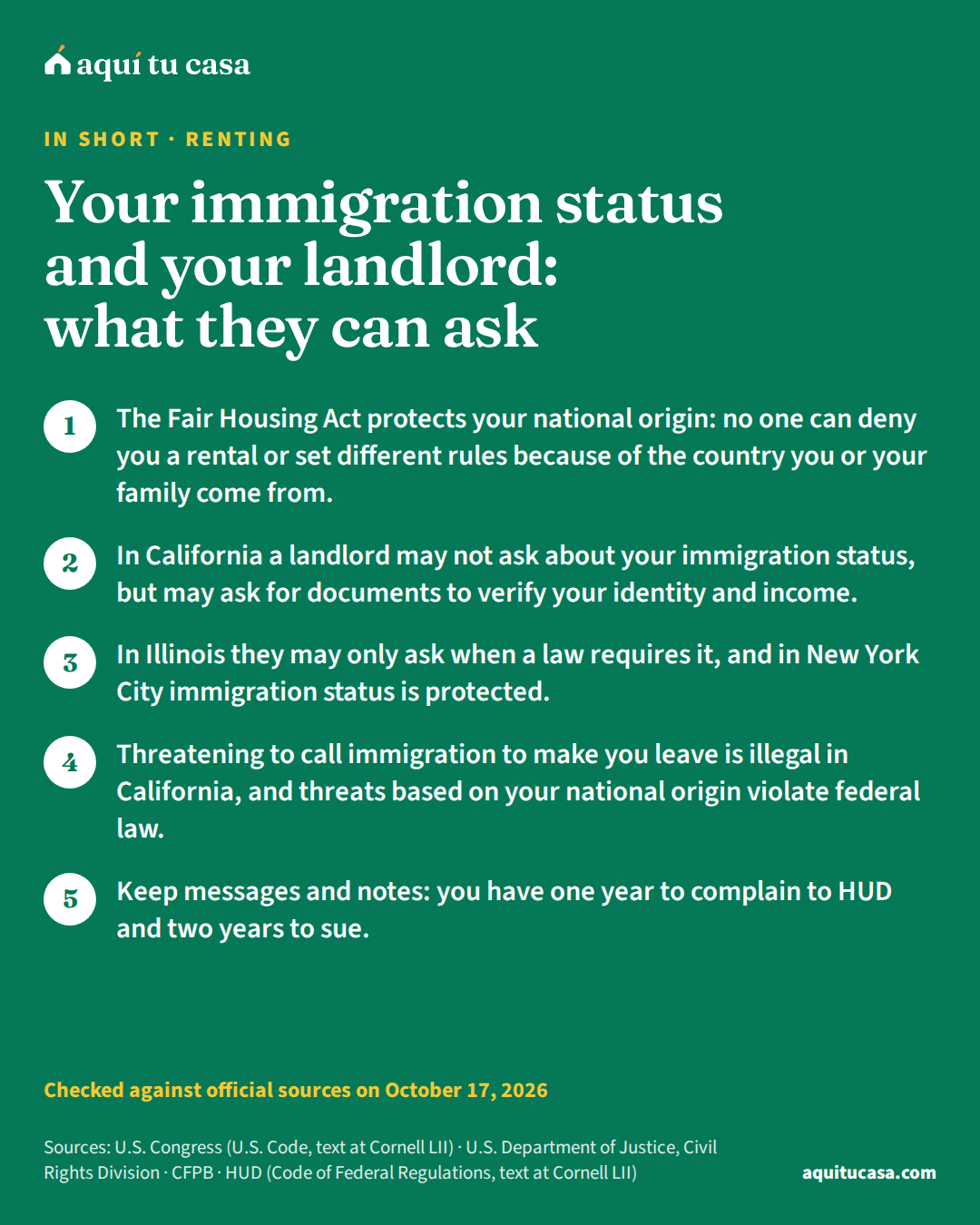
- Renting Your immigration status and your landlord: what they can ask What a landlord may ask about your immigration status, what protects you, which states ban those questions and what to do if you are threatened. 10 minute read
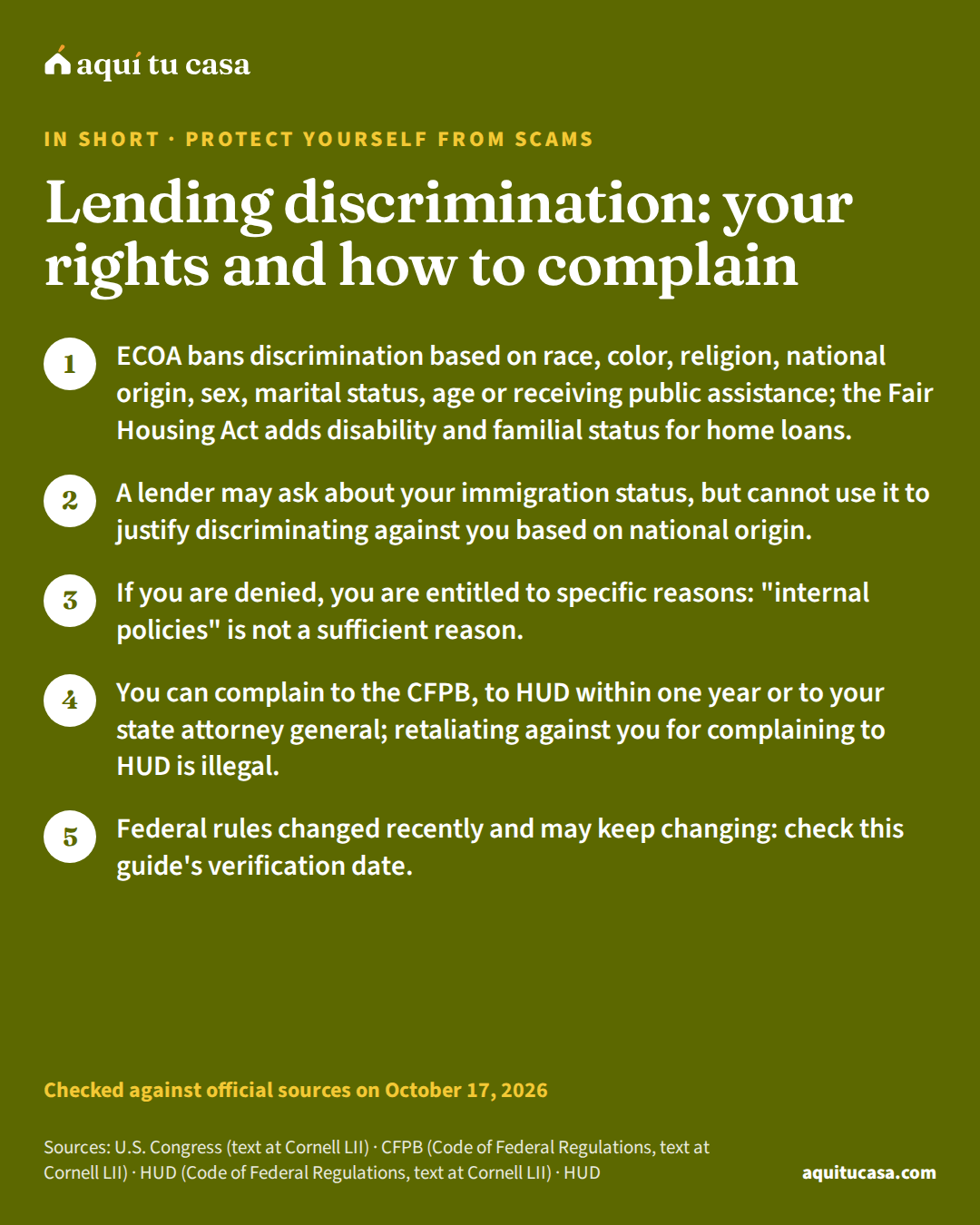
- Protect yourself from scams Lending discrimination: your rights and how to complain What the law bans when you apply for a loan or mortgage, what lenders may ask, including immigration status, and how to complain to the CFPB or HUD. 12 minute read
Tools for this topic
Was this guide useful?
Thank you. Your answer stays in your browser; nothing is sent.