How to compare Loan Estimates, page by page
How to read and compare two or three Loan Estimates side by side: what to check on each page, what can change and how to negotiate with lenders.
Verified against official sources on October 17, 2026 17 official sources

Show contents
In short
What you need to know
Quick answer
To compare Loan Estimates, get at least three for the same kind of loan, on nearby days, and put them side by side page by page. On page 1, check the loan amount, the rate, whether it is locked and whether there are risky features; on page 2, the costs that depend on the lender (Sections A, B and J); and on page 3, the five-year cost, the APR and the TIP. Taxes and insurance do not depend on the lender: if they differ between offers, ask why, but do not choose a lender because of them.
What matters most
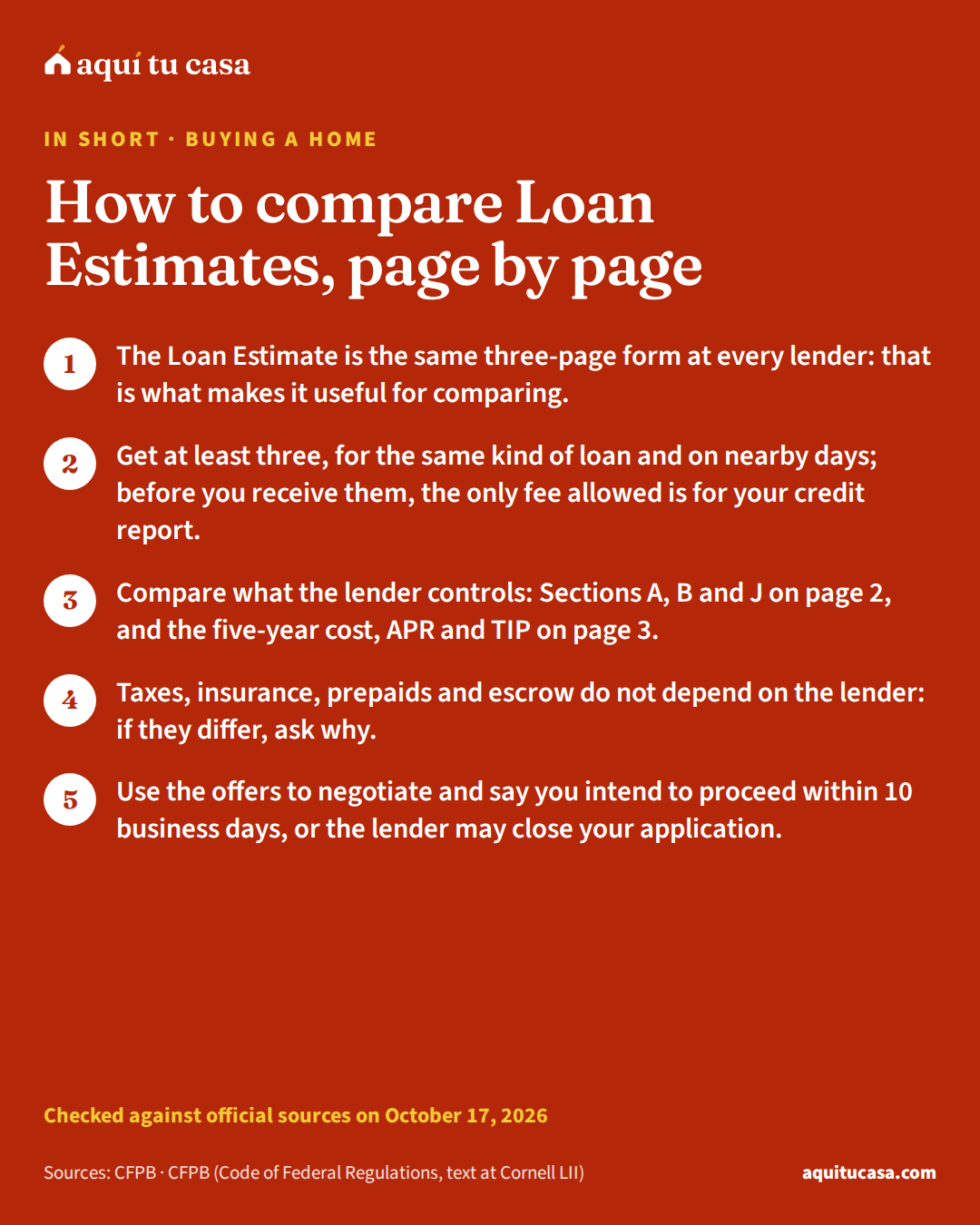
- The Loan Estimate is the same three-page form at every lender: that is what makes it useful for comparing.
- Get at least three, for the same kind of loan and on nearby days; before you receive them, the only fee allowed is for your credit report.
- Compare what the lender controls: Sections A, B and J on page 2, and the five-year cost, APR and TIP on page 3.
- Taxes, insurance, prepaids and escrow do not depend on the lender: if they differ, ask why.
Is this for you?
This guide is for you if…
- You applied for a mortgage and have two or three Loan Estimates to compare.
- You are about to request Loan Estimates and want to know what information you need and what you can be charged.
- You do not understand the rate, the APR, the TIP or the five-year line on page 3.
Get direct help first if…
- You already have the Closing Disclosure and sign in a few days: start with the Closing Disclosure guide.
- You want every closing cost explained line by line: the closing costs guide covers them in depth.
- You are getting a reverse mortgage, a home equity line of credit (HELOC) or a mobile home loan not secured by real estate: you do not get this form.
When you apply for a mortgage, each lender sends you a Loan Estimate: three pages, in the same format across the country. This guide is for anyone holding two or three of them, or about to request them. It explains what to look at on each page, which numbers depend on the lender and which do not, what can change before closing and how to use the offers to negotiate.
- For the lender to send you the Loan Estimate after you apply
- 3 business days4
- Are enough to request one; no purchase contract needed
- 6 pieces of information2
- Window in which several mortgage credit checks count as one
- 45 days6
- To say you intend to proceed before the lender can close your application
- 10 business days8
What the Loan Estimate is and how to request one
According to the CFPB, the Loan EstimateLoan EstimateThe Loan Estimate is a three-page form you receive from the lender within days of applying for a mortgage. In the same format at every bank, it sums up the terms of the loan being offered: amount, interest rate, whether the payment can change, the estimated monthly payment with taxes and insurance, the itemized closing costs and how much cash you need at closing. Because every lender uses the same form, it lets you compare offers side by side. It commits you to nothing: requesting one is not accepting the loan.See the full definition is a three-page form you receive after applying for a mortgage. Every lender must use the same standard form, which is why it works for comparing. When you receive it, the lender has not yet approved or denied your loan: it only shows what the lender expects to offer you.1
Requesting one is easier than it sounds. Regulation Z says that, for these mortgages, an application is six pieces of information: your name, your income, your Social Security number to pull your credit report, the property address, an estimate of its value and the loan amount you are seeking.3 The CFPB adds that the lender cannot require more to give you a Loan Estimate. You do not need a purchase contract or income documents. Still, the more the lender knows about your situation, the more accurate the estimate will be.2
Once it has those details, the lender must deliver or mail the Loan Estimate no later than the third business day.4 If it does not arrive, the CFPB suggests calling to ask why. Speak up early if anything is unusual: if you are self-employed, if your income is irregular or if you are buying an unusual type of property.6
It is also cheap. Before you receive the Loan Estimate and say you want to proceed, no one can charge you for your application except a bona fide and reasonable fee for your credit report.4 The CFPB says asking you to pay anything else to get a Loan Estimate is against the law.6
Before you compare: ask everyone for the same thing
The CFPB estimates that homebuyers can potentially save $600 to $1,200 per year by getting offers from multiple lenders.6 Its “Your home loan toolkit” recommends getting at least three offers in writing.15 For the comparison to mean anything, ask each lender for the same kind of loan with the same features.6
From the first call to the offer you choose
1. You decide which loan to ask for
Before you call
Ask each lender for the same kind of loan, with the same features.6
2. You request Loan Estimates from several lenders
On nearby days
Before you receive one, the only fee allowed is for your credit report.4
3. You receive each Loan Estimate
No later than 3 business days after
If one does not arrive in time, call and ask why.4
4. You check it and fix errors
When it arrives
An error that seems minor, like the address, can affect your rate and costs.6
5. You compare and negotiate
With all of them in hand
Line up Sections A, B and J and the five-year cost of each offer.7
Try it with your numbersCompare loans6. You say you intend to proceed
Within 10 business days
If you do not, the lender can close your application as incomplete.8
7. You lock the rate, if it was not locked
After you choose
You get a revised Loan Estimate no later than 3 business days after the lock.4
8. You receive the Closing Disclosure
No later than 3 business days before signing
Compare it with your last Loan Estimate.4
Two details prevent misleading comparisons. First, rates change daily. If two Loan Estimates were issued on different days, part of the difference may be the market rather than the lender.7 That is why it helps to request them on nearby days. Second, share with every lender what you know about property taxes and association dues, so each one estimates your payment with the same information.6
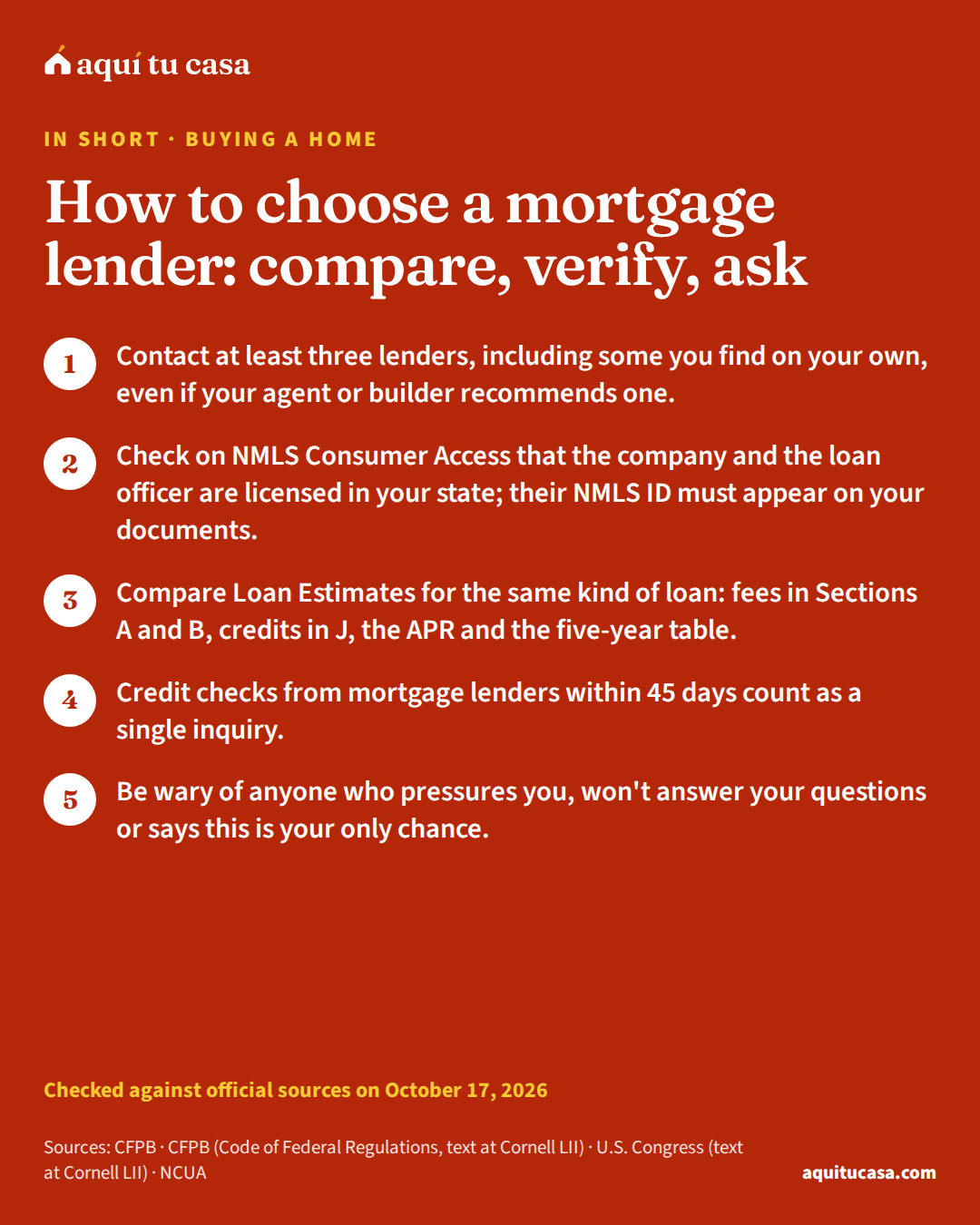
What about your credit? Within a 45-day window, multiple credit checks from mortgage lenders are recorded on your credit report as a single inquiry.6 The guide on how to choose a mortgage lender explains how to build your list and check licenses.
Page 1: the loan, the payment and the cash to close
At the top, the page says “Save this Loan Estimate to compare with your Closing Disclosure.” Then come the general details, including the product (fixed, adjustable or step rate) and the loan type (conventional, FHA, VA or other).5 Check that they match what you asked for and that your name is spelled correctly: the CFPB warns that even minor misspellings can cause big problems later.10 It also says whether your rate is locked (“Rate Lock”) and the date and time the estimated costs expire.5
| What it says | What it is | What to check when comparing |
|---|---|---|
| Loan Amount | The amount you borrow | That the loan plus your down payment equals the sale price |
| Interest Rate | The interest rate at closing | That the offers are from nearby days |
| Monthly Principal & Interest | Your principal and interest payment | Whether it can go up after closing |
| Prepayment Penalty / Balloon Payment | A penalty for paying early, and a balloon payment | If either says “YES”, ask for an offer without it |
| Projected Payments | Payments by period, with insurance and escrow | The estimated total monthly payment |
| Costs at Closing | Closing costs and cash to close | That the cash to close is what you expected |
In the “Loan Terms” table, the loan amount, rate and payment each come with the question “Can this amount increase after closing?” Further down, “Does the loan have these features?” tells you whether there is a prepayment penaltyprepayment penaltyA prepayment penalty is a fee some lenders charge if you pay off all or part of your mortgage early. Not every mortgage has one; if yours does, you agreed to it at closing. According to the CFPB, it usually applies if you pay off the whole balance within a certain number of years, for example when you sell or refinance, and sometimes if you pay a large amount at once; it does not normally apply to small extra principal payments. Many states limit these penalties. The Loan Estimate says whether the loan has one, and the details may be in the note or an addendum.See the full definition or a balloon paymentballoon paymentA balloon payment is a large, one-time payment at the end of the loan term, higher than the payments before it and sometimes much higher. On the Loan Estimate, "Balloon Payment" means any payment that is more than two times a regular payment. Loans with a balloon payment usually have shorter terms and lower monthly payments that do not pay off the whole debt. If you cannot make the final payment, you may have to refinance or sell the home, or face foreclosure. With limited exceptions, a Qualified Mortgage (QM) cannot have a balloon payment.See the full definition, meaning a payment more than twice a regular payment.5 The CFPB calls both of those features risky.10 If they appear, ask why and request another Loan Estimate without them to see the difference.6
If the loan has an adjustable rateadjustable-rate mortgage (ARM)An adjustable-rate mortgage (ARM) is a loan whose interest rate can change, usually in step with a market index. It often starts with a fixed rate for an initial period (for example, the first few years) and then adjusts at set intervals, so your payment can go up or down. The contract sets caps on how much the rate can rise at each adjustment and in total. Before accepting one, check on the Loan Estimate how high your payment could reach and whether you could afford it.See the full definition, the right-hand column says “YES” next to the rate: it can change after closing. That Loan Estimate carries more detail in the projected payments and two extra tables at the bottom of page 2.10 The CFPB recommends looking at the worst-case scenario if rates rise.7 The interest rates guide explains how they work.
The “Projected Payments” table shows each payment or range of payments with an estimate of taxes, insurance and assessments, and what is paid from your escrowescrow accountAn escrow account is an account set up by your mortgage lender to pay certain property-related expenses on your behalf, mainly property taxes and homeowners insurance. The money comes from a portion of your monthly mortgage payment: each month you contribute a share and the loan servicer pays the bills when they come due. That is why your payment is higher than principal and interest alone, and why it can change when taxes or the insurance premium go up. In some states the word also names the period between the offer and the closing.See the full definition account. “Costs at Closing” sums up closing costs and the “Cash to Close.”5

Page 2: the closing costs that depend on the lender
Page 2 itemizes closing costsclosing costsClosing costs are all of the costs you pay on closing day on top of the down payment: lender fees, the appraisal, the credit report, title insurance, the closing agent's fees, any transfer taxes your state or county charges and the first deposits into the escrow account. The lender must itemize them on the Loan Estimate within days of your application and confirm them on the Closing Disclosure before you sign. Some can be paid by the seller, and several state programs help cover them.See the full definition in lettered blocks: A (origination charges), B (services you cannot shop for), C (services you can shop for), D (total loan costs), E (taxes and other government fees), F (prepaids), G (initial escrow payment), H (other), I (total other costs) and J (total closing costs).9 The closing costs guide explains every line and which ones can go up.
To compare lenders, the CFPB recommends focusing on what varies from one to another: the Section A total, the Section B services and the Section J credits.7 You can shop for the Section C services yourself, with any lender.15 In Section A, some lenders itemize more than others. The total is what matters.10
When comparing, separate what the lender controls
Compare here
Depends on the lender
A Loan Estimate with lower taxes and insurance is not a better deal because of that: the lender does not control them.7
Discount pointsdiscount pointsDiscount points are a payment you make to the lender at closing in exchange for a lower interest rate over the life of the loan. Each point costs a percentage of the loan amount. The opposite is lender credits: the bank lowers your closing costs today in exchange for a higher rate. Buying points only pays off if you keep the loan long enough for the monthly savings to exceed what you paid. Points appear on the Loan Estimate, in section A of the closing costs.See the full definition go in Section A: you pay more at closing in exchange for a lower rate, and one point is 1% of the loan amount. Lender credits go in Section J: they lower your closing costs in exchange for a higher rate. That is why the CFPB recommends asking each lender for the same amount of points or credits.16 If you did not discuss this with the lender, ask: a similar loan may be available without points.10
Page 3: the measures for comparing
Page 3 starts with contact details: the name and NMLS number of the lender, the broker if there is one, and the loan officer.5 If the loan officer you are working with is not listed, ask. You can look them up by name or number in the NMLSNMLS IDThe NMLS (Nationwide Multistate Licensing System) is the official system state regulators use to license and register financial-services companies and individuals, such as mortgage loan originators. Loan originators get a unique number, the NMLS ID, that identifies them and lets the public see their employment history and any disciplinary actions against them. The loan originator must put its name and NMLS ID on the application, the Loan Estimate, the Closing Disclosure, the promissory note and the security instrument. With NMLS Consumer Access you can check for free whether they are authorized in your state.See the full definition database.10
Next comes the “Comparisons” table, which says “Use these measures to compare this loan with other loans.”5 It has three numbers:
- In 5 Years. The first number is what you will have paid over five years in principal, interest, mortgage insurance and loan costs. The second is the principal you will have paid off.5 The CFPB explains that, on average, people keep a mortgage about five years. Subtract the second number from the first and you have your five-year cost in interest and fees. On an adjustable-rate loan, that figure assumes the rate does not change.7
- APR. The APRannual percentage rate (APR)The annual percentage rate (APR) is a broader measure of the cost of borrowing money than the interest rate. Besides the interest, it includes certain loan charges, such as discount points and some lender fees, spread over the life of the loan and expressed as a yearly percentage. That is why the APR is almost always a little higher than the interest rate. It is useful for comparing offers: if two loans have the same interest rate but a different APR, the one with the higher APR charges more in fees.See the full definition (annual percentage rate) includes the interest rate, points, broker fees and other charges to get the loan, which is why it is usually higher than the rate. On an adjustable-rate loan it does not reflect the maximum rate, and it is not wise to decide on the APR alone.12
- TIP. The Total Interest Percentagetotal interest percentage (TIP)The total interest percentage (TIP) is a figure on the Loan Estimate and the Closing Disclosure that tells you how much interest you will pay over the life of the mortgage, as a percentage of the amount you borrowed. It is calculated by adding up all the scheduled interest payments and dividing by the loan amount, assuming you pay on time and keep the loan for its full term. It is not your interest rate or the APR, and it does not include upfront fees other than prepaid interest. It is most useful for comparing offers.See the full definition tells you how much interest you would pay over the full term, as a percentage of the loan. It assumes you make every payment on time and keep the loan to the end. It does not include upfront fees other than prepaid interest; the APR does include them.11
Example with real numbers
What the TIP measures on a typical loan
With the typical US home value, an FHA loan with the minimum down payment (3.5%) and the average 30-year rate as of November 5, 2026.
- FHA loan, with the upfront premium financed
- $326,674
- Average 30-year rate
- 7.18%
- Principal and interest per month
- $2,213
- Interest over 30 years, if you make every payment in the term
- $470,007
This is an example with national numbers. The TIP on page 3 expresses that total interest as a percentage of the loan and assumes you keep it for the full term.11 Put your own offers side by side in the tool.
Run it with your numbersCompare loansAt the end come the “Other Considerations.” They say the lender will promptly give you a copy of any appraisalhome appraisalAn appraisal is a written document that gives a professional appraiser's opinion of how much a property is worth. The lender orders it before approving the mortgage, because the home is the loan's collateral and the lender does not want to lend more than it is worth. If the appraisal comes in below the price you agreed, the bank bases the loan on the lower value and you will have to cover the difference, renegotiate the price or walk away if your contract allows it. An appraisal is not an inspection: it measures value, not the home's condition.See the full definition, even if you do not close; whether a future buyer could assume your loan; the late payment feelate feeA late fee is what you are charged when your payment arrives after the due date or after the grace period your contract allows. Your contract says how much it is and when it applies. On a mortgage, the Loan Estimate and the Closing Disclosure show the fee and how many days late a payment must be to trigger it, and your monthly statement shows the amount and the date it will be charged if you do not pay. For rent, some states set rules: in New York, for example, the law says when a payment counts as late and caps the fee.See the full definition and how many days late triggers it; that you may not be able to refinance; and whether the lender will service your loan or transfer it to another servicerloan servicerThe loan servicer is the company that sends you your mortgage statements and handles the day-to-day tasks of the loan: it processes your payments, answers your questions, keeps track of principal and interest paid and manages your escrow account, if you have one. It can also offer options if you fall behind and, in certain cases, start a foreclosure. It may be the same company that lent you the money or a different one, and it is common for another company to take over the loan after closing.See the full definition.5 Most loans do not allow another buyer to assume them.10 If there is a signature line, signing only confirms you received the form: it does not commit you to the loan.5

What can and cannot change before closing
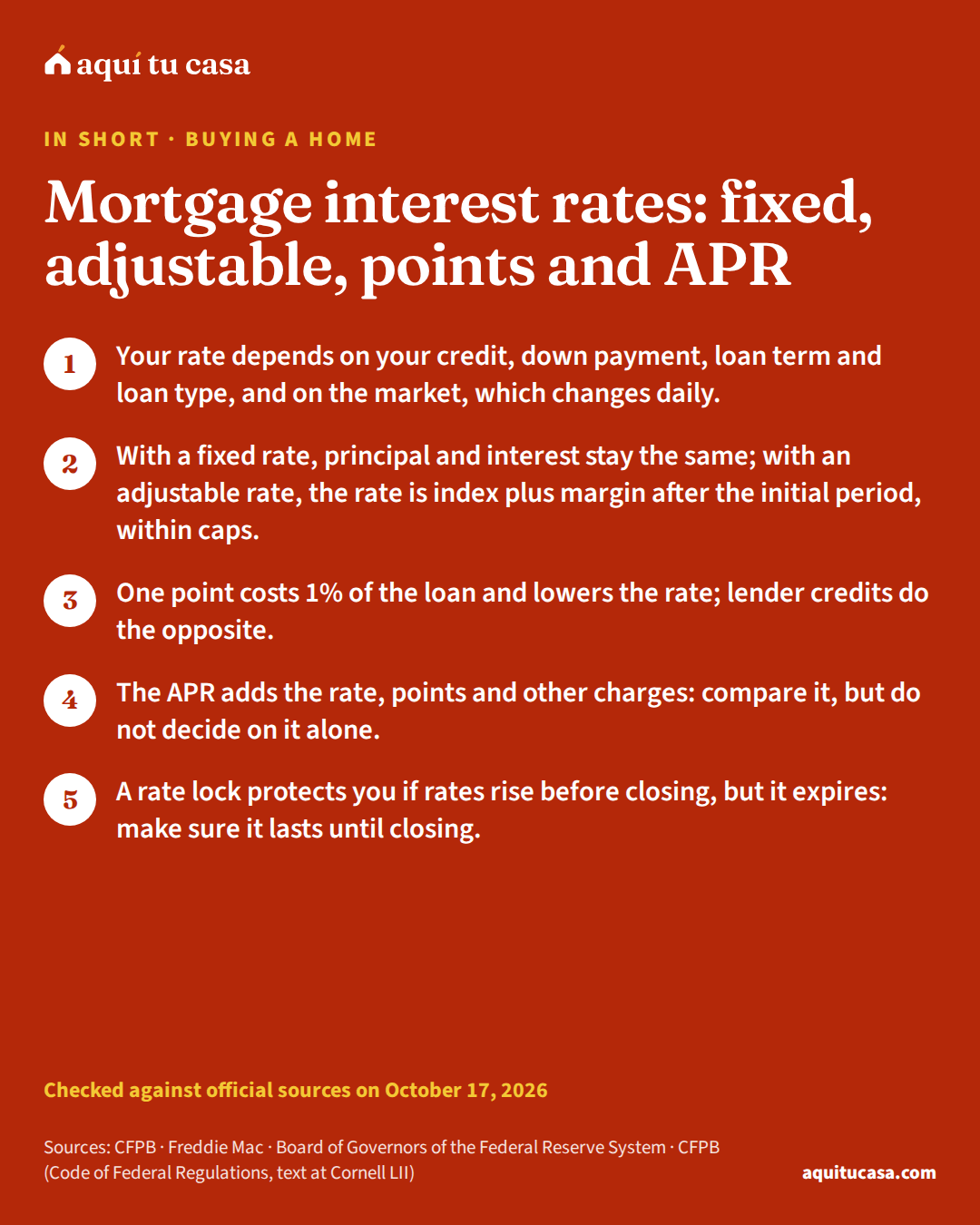
A Loan Estimate is not a contract, but the lender cannot change it at will either. If your rate is not locked, the rate, points and credits can change.5 With a rate lockrate lockA rate lock (or lock-in) means your interest rate will not change between the offer and closing, as long as you close within the agreed time frame and your application does not change. Rates can change daily; if yours is not locked, it can change at any time. Even when locked, it can change if your loan amount, credit score, verified income or appraisal changes. Extending a lock can cost money, and if rates fall you may be stuck with the higher rate. The first page of the Loan Estimate says whether your rate is locked and until when.See the full definition, your rate does not change between the offer and closing as long as you close within the time frame and nothing changes in your application. Locks are typically for 30, 45 or 60 days. Extending one can be expensive, and the Loan Estimate does not say how much it costs.13 If you lock the rate after receiving the Loan Estimate, the lender must send you a revised one no later than three business days after.4
Closing costs also have limits. The CFPB sums them up in three groups: some cannot go up, some can go up by up to 10% as a group and some by any amount. It is illegal for a lender to deliberately underestimate them.14 Those limits do not apply after a “change in circumstances,” for example if the appraisal comes in higher or lower than expected. You may then receive a revised Loan Estimate,14 which must reach you no later than four business days before signing.4
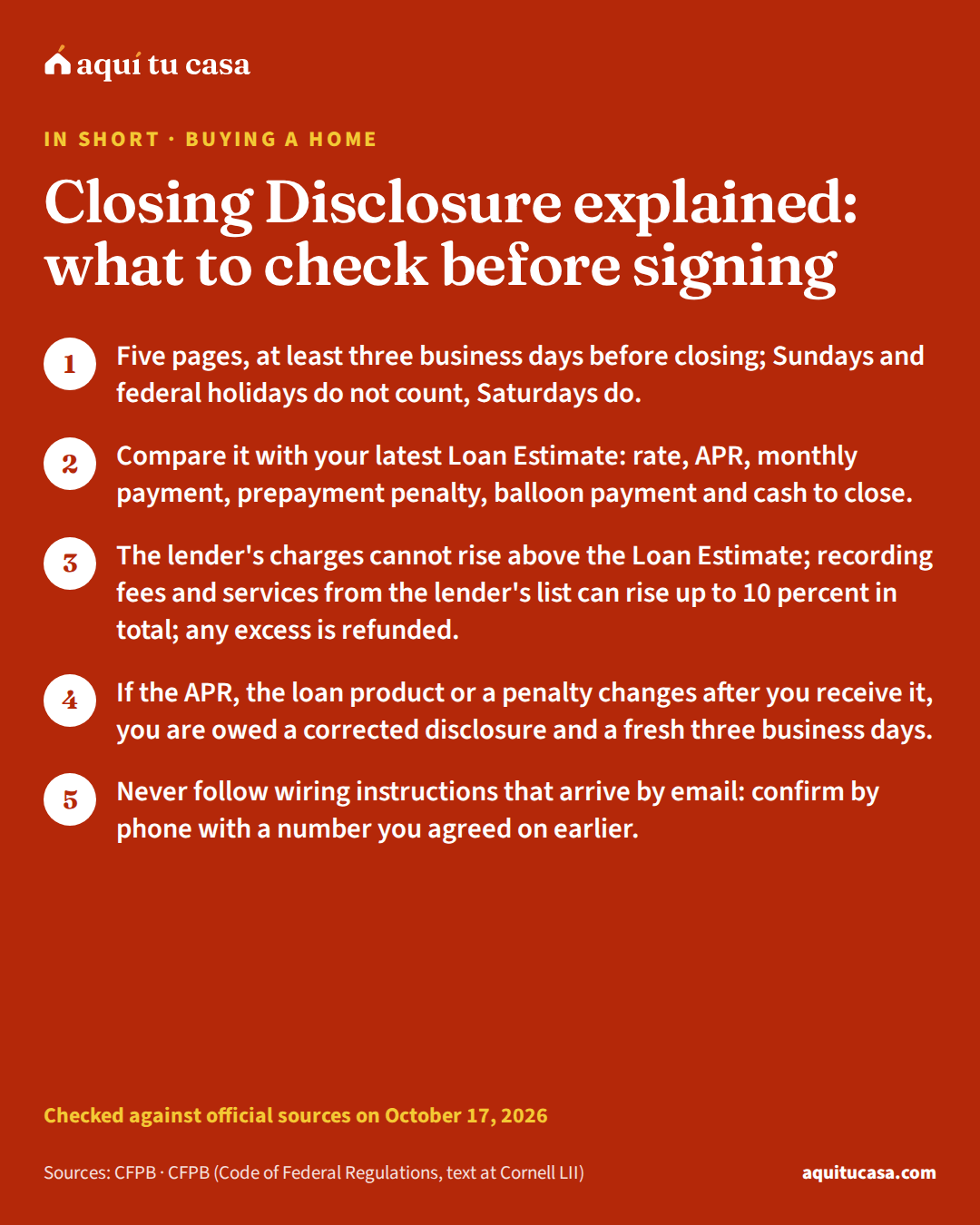
Finally, you must receive the Closing DisclosureClosing DisclosureThe Closing Disclosure is a required five-page form with the final details of the mortgage you selected: the loan terms, your monthly payment, every closing cost and how much cash you must bring on signing day. The lender must give it to you at least three business days before closing, so you can compare it with your Loan Estimate and ask about any change. If an important number changes, the three-day period starts again. Keep it: you will need it for your taxes.See the full definition no later than three business days before signing.4 Compare it with your last Loan Estimate using the Closing Disclosure guide. If a cost rose more than allowed without a change in circumstances, you are entitled to a refund of the amount above the limit.14
How to negotiate and choose
The CFPB says negotiating can save you money and that your best bargaining chip is usually having Loan Estimates from other lenders in hand. If the lender you feel most comfortable with charges more, ask them to match what you found. Negotiating works best over a short timeframe, after you have a signed purchase contract.7

Be wary of anything that does not add up. If the loan officer suggests a different type of loan, ask for Loan Estimates for the one you requested and the one being suggested, so you can see the differences. Never sign a blank form or one with blank spaces.6 A “no closing cost” loan is not free either: the catch is a higher monthly payment.7
When you choose, tell the lender you want to proceed (“intent to proceed”). If you do not do so within 10 business days of the lender sending the Loan Estimate, it can close your application as incomplete. Application and appraisal fees are often charged at that point, and they might or might not be refundable. You are not committed until you sign the final documents, but switching lenders later means starting over and could delay your closing.8 Saying you will proceed does not mean you accept the loan, either.6
If this is you
You are buying for the first time
A housing counselor can review your Loan Estimates with you; the CFPB gives 1-800-569-4287 to find a HUD-certified one.6
You are self-employed
Say so from the start: the CFPB asks you to tell lenders if you are self-employed or your income is irregular.6 The guide for self-employed buyers explains which papers to gather.
You are buying with an ITIN
The CFPB's list for requesting a Loan Estimate mentions a Social Security number, used to pull your credit report.2 The ITIN mortgage guide explains how those loans work.
You are buying a duplex, a condo or a manufactured home
Lenders can charge slightly more for those loans.6 Compare the same way: same kind of loan, nearby days.
If you believe you faced illegal credit discrimination, the CFPB says you can call your local fair housing agency, file a complaint with HUD at (800) 669-9777 or with the CFPB at (855) 411-2372.6

Costly mistakes
Mistake: Comparing rates on Loan Estimates issued on different days.
Instead: Request them on nearby days: rates change daily.7
Mistake: Choosing on the rate alone or the APR alone.
Instead: Also look at Sections A, B and J and the five-year cost; the APR alone is not enough.12
Mistake: Assuming the Loan Estimate with lower taxes is the better offer.
Instead: The lender does not control your taxes or insurance; ask why they differ.7
Mistake: Paying an application fee to get a Loan Estimate.
Instead: Before you receive it, the only fee allowed is for your credit report.4
Mistake: Letting days go by without answering the offer you wanted.
Instead: Say you intend to proceed within 10 business days.8
Mistake: Signing a form with blank spaces.
Instead: Do not sign it: what you sign on an application says it is true.6
What to do this week
- Request a Loan Estimate from at least three lenders, for the same kind of loan and on nearby days.15
- Check page 1 of each one: your name, the loan amount, the loan type, whether the rate is locked and whether there are risky features.6
- Compare Sections A, B and J on page 2, and ask why E, F and G differ if they are not similar.7
- On page 3, work out your five-year cost and look at the APR and TIP.7
- Negotiate with the offers in hand and say you intend to proceed within 10 business days.8
- If you want help reviewing them, a HUD-approved housing counselorHUD-approved housing counselorA HUD-approved housing counselor works at an agency HUD has approved to provide housing counseling: independent, expert advice customized to your situation about buying a home, renting, a missed mortgage payment, a foreclosure or credit problems. The agencies usually charge little or nothing; many serve in Spanish and offer the homebuyer education course several assistance programs require. They are not lenders or real estate agents and sell you nothing. Your county page lists the official agencies with phone numbers.See the full definition gives independent advice, often free or at low cost.17 The CFPB gives 1-800-569-4287 to find one.6
Your numbers
We start with the typical home value in the United States. Enter the price you are looking at.
Adjust advanced details
FHA
Estimated monthly payment
$2,759
Principal and interest, tax, homeowners insurance and mortgage insurance.
- Down payment
- $11,645 (3.5%)
- Mortgage insurance
- $147 a monthFHA annual premium · whole term
- Upfront premium or fee
- $5,618FHA upfront mortgage insurance · added to the loan
- Paid in 5 years
- $141,609
- Balance after 5 years
- $308,088
- County limit
- Find your county to see the limit
Rules and notes
- Minimum down payment of 3.5% with a score of 580 or more; between 500 and 580 at least 10% is required.In effect since September 14, 2016 · Source ↗
- Mortgage insurance: 1.75% upfront plus an annual premium; with less than 10% down it lasts the whole term.In effect since March 20, 2023 · Source ↗
- Only citizens, lawful permanent residents and citizens of the Freely Associated States; non-permanent residents are no longer eligible.In effect since May 25, 2025 · Source ↗
Conventional, 3% down
Estimated monthly payment
$2,747
Principal and interest, tax, homeowners insurance and mortgage insurance.
- Down payment
- $9,981 (3%)
- Mortgage insurance
- $161 a monthPMI (example) · ends around year 13
- Upfront premium or fee
- None
- Paid in 5 years
- $140,854
- Balance after 5 years
- $304,358
- County limit
- Find your county to see the limit
Rules and notes
- Fannie Mae requires a minimum score of 620 on manually underwritten fixed-rate loans; its automated system (DU) sets no fixed minimum.In effect since April 22, 2026 · Source ↗
- Private mortgage insurance (PMI) with less than 20% down; it cancels on its own at 78% of the original value.In effect since January 1, 2024 · Source ↗
- Fannie Mae buys loans to lawful permanent and non-permanent residents on the same terms as citizens; the lender verifies the status.In effect since July 28, 2015 · Source ↗
Conventional, 5% down
Estimated monthly payment
$2,698
Principal and interest, tax, homeowners insurance and mortgage insurance.
- Down payment
- $16,635 (5%)
- Mortgage insurance
- $158 a monthPMI (example) · ends around year 12
- Upfront premium or fee
- None
- Paid in 5 years
- $137,950
- Balance after 5 years
- $298,082
- County limit
- Find your county to see the limit
Rules and notes
- Fannie Mae requires a minimum score of 620 on manually underwritten fixed-rate loans; its automated system (DU) sets no fixed minimum.In effect since April 22, 2026 · Source ↗
- Private mortgage insurance (PMI) with less than 20% down; it cancels on its own at 78% of the original value.In effect since January 1, 2024 · Source ↗
- Fannie Mae buys loans to lawful permanent and non-permanent residents on the same terms as citizens; the lender verifies the status.In effect since July 28, 2015 · Source ↗
Conventional, 20% down
Lowest paymentEstimated monthly payment
$2,202
Principal and interest, tax, homeowners insurance and mortgage insurance.
- Down payment
- $66,540 (20%)
- Mortgage insurance
- None
- Upfront premium or fee
- None
- Paid in 5 years
- $108,184
- Balance after 5 years
- $251,017
- County limit
- Find your county to see the limit
Rules and notes
- Fannie Mae requires a minimum score of 620 on manually underwritten fixed-rate loans; its automated system (DU) sets no fixed minimum.In effect since April 22, 2026 · Source ↗
- Private mortgage insurance (PMI) with less than 20% down; it cancels on its own at 78% of the original value.In effect since January 1, 2024 · Source ↗
- Fannie Mae buys loans to lawful permanent and non-permanent residents on the same terms as citizens; the lender verifies the status.In effect since July 28, 2015 · Source ↗
VA
Estimated monthly payment
$2,702
Principal and interest, tax, homeowners insurance and mortgage insurance.
- Down payment
- $0 (0%)
- Mortgage insurance
- None
- Upfront premium or fee
- $7,153VA funding fee · added to the loan
- Paid in 5 years
- $138,137
- Balance after 5 years
- $320,517
- County limit
- Find your county to see the limit
Rules and notes
- Military service requirements by period of service; you must meet VA's and your lender's credit standards.In effect since September 22, 2026 · Source ↗
- No down payment as long as the price is not above the appraisal; funding fee of 2.15% on first use with no down payment (exempt: zero). No monthly mortgage insurance.In effect since April 7, 2023 · Source ↗
- Up to the conforming limit with no down payment in most areas; more with a down payment.In effect since January 7, 2026 · Source ↗
USDA
Estimated monthly payment
$2,773
Principal and interest, tax, homeowners insurance and mortgage insurance.
- Down payment
- $0 (0%)
- Mortgage insurance
- $97 a monthUSDA annual fee · whole term
- Upfront premium or fee
- $3,327USDA upfront fee · added to the loan
- Paid in 5 years
- $142,404
- Balance after 5 years
- $316,909
- County limit
- No county limit
Rules and notes
- Home in an eligible rural area and income within the area limit; finances the full price for those who qualify.In effect since December 9, 2013 · Source ↗
- Upfront fee of 1% and annual fee of 0.35% of the balance.In effect since October 1, 2026 · Source ↗
- Each lender sets the score.
- Applicants must show they are U.S. citizens, U.S. non-citizen nationals or qualified aliens, as the federal rule defines them.In effect since November 29, 2022 · Source ↗
ITIN loan (example)
ExampleEstimated monthly payment
$2,315
Principal and interest, tax, homeowners insurance and mortgage insurance.
- Down payment
- $49,905 (15%)
- Mortgage insurance
- None
- Upfront premium or fee
- None
- Paid in 5 years
- $114,945
- Balance after 5 years
- $266,705
- County limit
- No county limit
Rules and notes
- Not a federal program: each lender sets the down payment, rate and documents. The 15% is only an example; rates are usually higher.
- They usually ask for ITIN tax returns for the last two years and more reserves; compare several lenders.
An educational estimate, not a loan offer. The same rate for every program (the real one differs); homeowners insurance is an example (0.5% of the value a year) and so is PMI (0.6% a year). The rules quoted are dated; check with your lender.
Ready to see the numbers? Find your county here
See how this applies in your county: its loan limits, prices and rents, from the official data.
Printable checklist
Frequently asked questions
How many Loan Estimates should I get?
The CFPB recommends getting at least three offers in writing, all for the same kind of loan. Requesting them on nearby days helps, because rates change daily and a difference may come from the market rather than the lender.
Will getting several Loan Estimates lower my credit score?
According to the CFPB, within a 45-day window, multiple credit checks from mortgage lenders are recorded on your credit report as a single inquiry. The impact is the same no matter how many lenders you consult in that time.
Can a lender charge me for a Loan Estimate?
Before you receive it and say you want to proceed, the only fee allowed is a bona fide and reasonable fee for your credit report. The CFPB says asking you to pay anything else to get a Loan Estimate is against the law.
Do I need a purchase contract to request a Loan Estimate?
No. According to the CFPB, six pieces of information are enough: your name, income, Social Security number, the property address, an estimate of its value and the loan amount. The lender cannot require more to give you a Loan Estimate, although sharing more makes it more accurate.
Does a Loan Estimate mean I am approved?
No. When you receive it, the lender has not yet approved or denied your loan, even if your rate is locked. It does not commit you either: you are not committed to a lender until you sign the final closing documents.
What is the difference between the interest rate and the APR?
The rate is what you pay each year to borrow the money. The APR adds the rate, points, broker fees and other charges to get the loan, which is why it is usually higher. The rate is on page 1 of the Loan Estimate and the APR on page 3.
What is the TIP on page 3?
It is the Total Interest Percentage: how much interest you would pay over the full term, as a percentage of what you borrowed. It is useful for comparing Loan Estimates, but it assumes you keep the loan for the full term and it does not include upfront fees other than prepaid interest.
How long is a Loan Estimate good for?
Page 1 says whether your rate is locked and until when, and the date and time the estimated costs expire. Also, according to the CFPB, if you do not say you intend to proceed within 10 business days of the lender sending it, the lender can close your application as incomplete.
Sources
Every figure in this guide comes from one of these official sources. The number next to a sentence leads to the source behind it.
Each source on one line: who publishes it, its title, its address and the date we read it.
- 1. CFPB · What is a Loan Estimate? · consumerfinance.gov · Accessed October 17, 2026
- 2. CFPB · What information do I have to provide a lender in order to receive a Loan Estimate? · consumerfinance.gov · Accessed October 17, 2026
- 3. CFPB (Code of Federal Regulations, text at Cornell LII) · Regulation Z, 12 CFR §1026.2, Definitions and rules of construction · law.cornell.edu · Accessed October 17, 2026
- 4. CFPB (Code of Federal Regulations, text at Cornell LII) · Regulation Z, 12 CFR §1026.19, Certain mortgage and variable-rate transactions · law.cornell.edu · Accessed October 17, 2026
- 5. CFPB (Code of Federal Regulations, text at Cornell LII) · Regulation Z, 12 CFR §1026.37, Content of disclosures for certain mortgage transactions (Loan Estimate) · law.cornell.edu · Accessed October 17, 2026
- 6. CFPB · Request and review multiple Loan Estimates · consumerfinance.gov · Accessed October 17, 2026
- 7. CFPB · Compare and negotiate your loan offers · consumerfinance.gov · Accessed October 17, 2026
- 8. CFPB · Choose a loan offer · consumerfinance.gov · Accessed October 17, 2026
See the other 9 sources
- 9. CFPB · Sample Loan Estimate (adjustable-rate loan) · files.consumerfinance.gov · Accessed October 17, 2026
- 10. CFPB · Loan Estimate Explainer · consumerfinance.gov · Accessed October 17, 2026
- 11. CFPB · What is the Total Interest Percentage (TIP) on a mortgage? · consumerfinance.gov · Accessed October 17, 2026
- 12. CFPB · What is the difference between a mortgage interest rate and an APR? · consumerfinance.gov · Accessed October 17, 2026
- 13. CFPB · What's a lock-in or a rate lock on a mortgage? · consumerfinance.gov · Accessed October 17, 2026
- 14. CFPB · Can my final mortgage costs increase from what was on my Loan Estimate? · consumerfinance.gov · Accessed October 17, 2026
- 15. CFPB · Your home loan toolkit: A step-by-step guide · files.consumerfinance.gov · Accessed October 17, 2026
- 16. CFPB · How should I use lender credits and points (also called discount points)? · consumerfinance.gov · Accessed October 17, 2026
- 17. CFPB · Find a Housing Counselor · consumerfinance.gov · Accessed October 17, 2026
Keep reading
Related guides
If this guide helped, these follow the same path.

Buying a home 14 minute read
Closing costs explained: what you pay and what can change
What closing costs are, how to read them on your Loan Estimate, which charges cannot go up before closing and how to compare offers to pay less.
- Closing costs are what you pay to get the loan and transfer the home to you; together with the down payment they make up your cash to close.
- The Loan Estimate sorts them by letter: A, B and C are loan costs; E, F, G and H are taxes, prepaids, escrow and other; J is the total.
- Lender charges and transfer taxes cannot go up; recording fees and services picked from the lender's list can rise up to 10% as a group, unless there is a change in circumstances.
- Buying a home Closing Disclosure explained: what to check before signing What the Closing Disclosure is, when it must reach you, what to check on each of its five pages and which closing costs are not allowed to go up. 18 minute read
- Buying a home How to choose a mortgage lender: compare, verify, ask How to find and compare mortgage lenders, check their license on NMLS, what to ask the loan officer and which warning signs to watch for. 13 minute read
- Buying a home Mortgage interest rates: fixed, adjustable, points and APR What your mortgage rate is and what moves it, how fixed and adjustable rates differ, and how points, the APR and rate locks work. 13 minute read
Tools for this topic
Was this guide useful?
Thank you. Your answer stays in your browser; nothing is sent.